
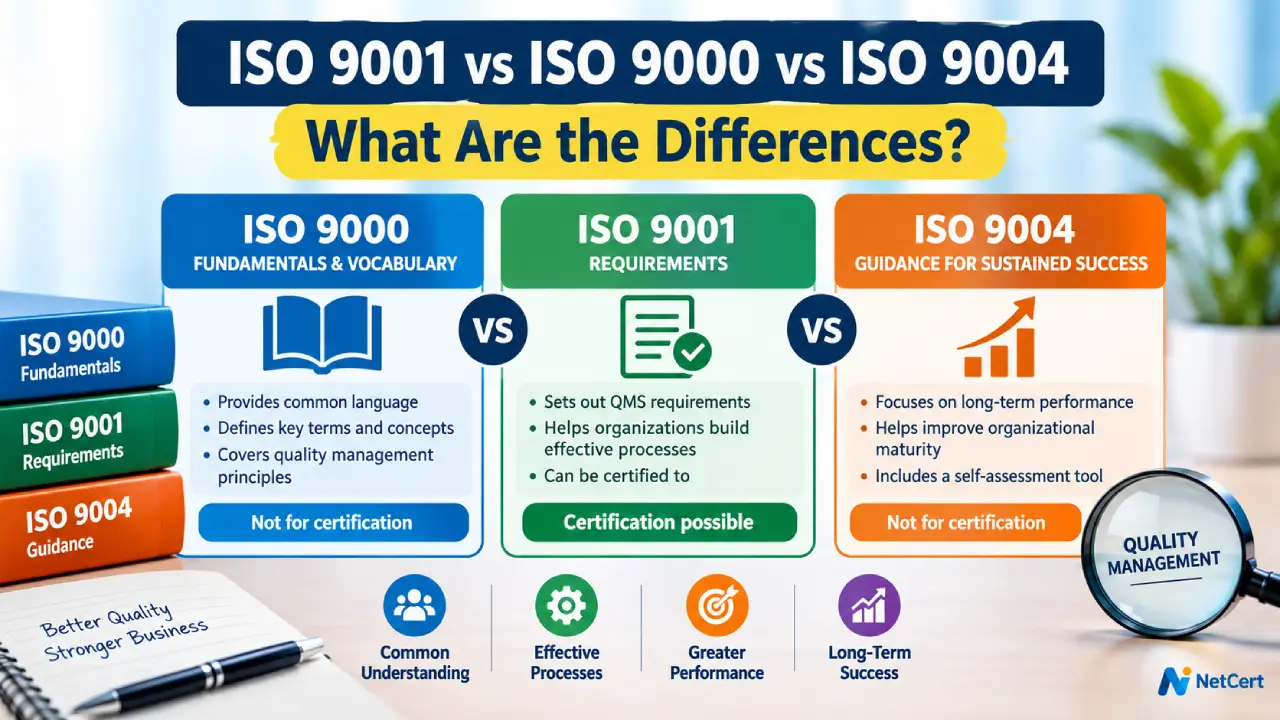
Understanding the ISO 9001 vs ISO 9000 vs ISO 9004 differences is important because these three standards are closely connected, but they do very different jobs.
ISO 9000 establishes the fundamentals and vocabulary of quality management, ISO 9001 sets requirements for a quality management system (QMS), and ISO 9004 provides guidance for improving an organization’s ability to achieve sustained success.
In simple terms, ISO 9000 explains the language and basic concepts, ISO 9001 tells an organization what its QMS needs to meet, and ISO 9004 helps an organization go beyond basic conformity and improve its overall performance.
Contents
- 1. Introduction: Why Are ISO 9000, ISO 9001 and ISO 9004 Confused?
- 2. The ISO 9000 Family at a Glance
- 3. What Is ISO 9000:2026?
- 4. What Is ISO 9001:2026?
- 5. Why ISO 9001 Is So Important
- 6. ISO 9001 Certification vs Guidance: The Key Difference
- 7. What Is ISO 9004:2018?
- 8. The Simplest Way to Remember the Three Standards
- 9. Where ISO/TC 176 Fits Into the Picture
- 10. The Big Picture: How the Three Standards Work Together
- 11. ISO 9001 vs ISO 9000 vs ISO 9004: Comparing Their Purpose and Use
- 12. ISO 9000 vs ISO 9001: What Is the Difference?
- 13. ISO 9001 vs ISO 9004: What Is the Difference?
- 14. Understanding the Seven Quality Management Principles
- 15. How the Seven Principles Connect the Three Standards
- 16. ISO 9001:2026 — What Has Changed in the New Edition?
- 17. ISO 9001 Scope Differences: What Organizations Should Understand
- 18. Can a Small Business Use ISO 9001?
- 19. Does ISO 9001 Certification Mean a Company Has High Quality?
- 20. ISO 9000, ISO 9001 and ISO 9004 in an Audit Environment
- 21. A Practical Example: Applying All Three Standards
- 22. Which Standard Should Your Organization Use?
- 23. Common Mistakes Organizations Make
- 24. What Quality Professionals Should Remember
- 25. ISO 9001 Certification, Implementation and Improvement: A Practical Comparison
- 26. How to Implement the Standards in a Real Organization
- 27. A Step-by-Step ISO 9001 Implementation Roadmap
- 28. How Certification Actually Works
- 29. What an Auditor Looks For
- 30. ISO 9001 Internal Audit vs Certification Audit
- 31. How ISO 9004 Can Improve an Already Certified QMS
- 32. ISO 9001 vs ISO 9004: Certification Is Not the Same as Excellence
- 33. What Should a Quality Manager Do in 2026?
- 34. What Has Not Changed About the Basic Quality Approach?
- 35. ISO 9000:2026 vs ISO 9001:2026: Why the New Editions Matter Together
- 36. Is ISO 9004 Necessary for ISO 9001 Certification?
- 37. Benefits of Using All Three Standards Together
- 38. Common Questions About ISO 9000, ISO 9001 and ISO 9004
- 39. ISO 9000 vs ISO 9001 vs ISO 9004: Final Comparison
- 40. Actionable ISO Quality Management Checklist
- 41. Conclusion: Which One Is Right for You?
Introduction: Why Are ISO 9000, ISO 9001 and ISO 9004 Confused?
If you work in quality, manufacturing, engineering, construction, healthcare, aerospace, automotive, software, logistics, or professional services, you have probably heard people say, “Our company is ISO 9000 certified.”
That statement sounds reasonable, but it is usually not technically correct.
ISO 9000 is not the certification standard. ISO 9001 is the standard against which a quality management system can be certified.
This distinction becomes even more important in 2026 because the ISO 9000 family standards have entered a new edition cycle. ISO 9000:2026 is now published, and ISO 9001:2026 is the current edition of the requirements standard. ISO 9004:2018, meanwhile, remains the current edition and was confirmed in 2023. (ISO)
The confusion is understandable because all three standards carry the familiar 9000-series numbering and are designed around quality management.
But they are not interchangeable.
Think about them this way:
- ISO 9000 = fundamentals and vocabulary
- ISO 9001 = requirements
- ISO 9004 = guidance for sustained success
- ISO 9001 certification = independent certification against requirements
- ISO 9004 = improvement and self-assessment guidance, not a certification standard
This article explains how the three standards fit together, where they differ, when to use each one, and how a quality professional can use them in a practical QMS.
The ISO 9000 Family at a Glance
The first concept to understand is that ISO 9000 is both the name of a specific standard and part of a broader family of quality management standards.
The ISO 9000 family contains standards and guidance documents covering different aspects of quality management.
The three standards discussed in this article have particularly important roles:
Standard | Main purpose | Certification? | Primary use |
ISO 9000:2026 | Fundamentals and vocabulary | No | Understanding quality management concepts and terminology |
ISO 9001:2026 | QMS requirements | Yes | Implementing and certifying a QMS |
ISO 9004:2018 | Guidance for sustained success | No | Improving organizational performance and maturity |
ISO describes ISO 9000:2026 as the standard providing the fundamentals and vocabulary for quality management systems. ISO 9001:2026 establishes requirements for establishing, implementing, maintaining and continually improving a QMS. ISO 9004:2018 provides guidance for enhancing an organization’s ability to achieve sustained success. (ISO)
That basic distinction answers a large part of the question.
But there is more to it.
Why the ISO 9000 family matters
Quality management is not simply about inspecting products at the end of a production line.
A modern QMS connects:
- customer requirements
- organizational processes
- leadership
- people
- resources
- risks and opportunities
- suppliers
- performance measurement
- internal audits
- corrective action
- continual improvement
The purpose is to create a system that can consistently produce the intended results.
For example, imagine a U.S. manufacturer producing precision components for medical-device customers.
A final inspection might identify a dimensional defect.
A mature quality management approach asks a deeper question:
Why was the defect possible in the first place?
The investigation may identify unclear drawings, weak supplier controls, inadequate training, poor process parameters, outdated work instructions, or ineffective measurement equipment.
That is the difference between simply finding defects and managing quality systematically.
What Is ISO 9000:2026?
ISO 9000:2026 is the foundation standard for understanding quality management.
Its title is Quality management — Fundamentals and vocabulary.
ISO published the fifth edition in May 2026. The previous ISO 9000:2015 edition has been withdrawn and replaced by ISO 9000:2026. (ISO)
The purpose of ISO 9000 is not to give an organization a certification checklist.
Instead, it establishes a common understanding of quality management concepts, principles and terminology.
ISO 9000 fundamentals and vocabulary
This is where the ISO 9000 fundamentals vocabulary concept becomes important.
Quality professionals use terms such as:
- quality
- requirement
- customer
- process
- organization
- objective
- risk
- opportunity
- conformity
- nonconformity
- effectiveness
- efficiency
- audit
- improvement
If different people understand these words differently, the QMS can quickly become confusing.
For example, suppose a production manager says:
“The process is effective.”
An auditor may ask:
Effective in achieving what result?
That question is important because quality terminology is not meant to be used casually. The organization needs a shared understanding of what its processes are supposed to achieve and how results will be evaluated.
ISO 9000:2026 includes sections covering terms and definitions as well as quality management principles and fundamental concepts.
Is ISO 9000 a certification standard?
No.
This is one of the most important points in the entire article.
An organization does not normally obtain an “ISO 9000 certificate” by being audited against ISO 9000.
ISO itself also does not perform certification. Certification is carried out by independent certification bodies. (ISO)
For organizations seeking third-party certification of their QMS, the relevant standard is ISO 9001.
You can read the official standard information for ISO 9000:2026 and ISO 9001:2026.
What Is ISO 9001:2026?
ISO 9001 is the requirements standard.
This is the standard that organizations implement when they want to establish a formal quality management system and, when desired, seek third-party certification.
The latest edition is ISO 9001:2026, published on 16 September 2026. It is the sixth edition of ISO 9001 and replaces ISO 9001:2015. (ISO)
ISO states that ISO 9001:2026 is intended for organizations of all sizes and sectors.
That means the same basic standard can be applied to:
- manufacturing companies
- construction organizations
- engineering firms
- software companies
- hospitals and healthcare organizations
- logistics companies
- educational organizations
- government-related organizations
- professional service companies
- small businesses
- large multinational corporations
The way the QMS is implemented will differ considerably, but the underlying requirements framework is intended to be broadly applicable.
What do the ISO 9001 requirements do?
The ISO 9001 requirements establish the framework an organization uses to manage its quality system.
In practical terms, an organization needs to understand its business environment, establish appropriate processes, provide resources, manage operations, monitor performance, address problems and continually improve.
A certification auditor does not simply ask:
“Do you have a quality manual?”
Instead, the auditor is interested in whether the organization’s QMS actually works.
For example, suppose a company has a documented procedure for handling customer complaints.
The auditor may examine:
- How complaints are received.
- Who evaluates them.
- How they are recorded.
- How responsibility is assigned.
- How root causes are investigated.
- What corrective action is taken.
- Whether effectiveness is checked.
- Whether recurring complaints are analyzed.
- Whether management receives relevant performance information.
This is why ISO 9001 is a management system standard, not simply a documentation exercise.
Why ISO 9001 Is So Important
ISO 9001 has become the best-known quality management system standard in the world.
ISO currently reports more than one million ISO 9001 certificates issued across organizations in 189 countries. (ISO)
That scale matters because ISO 9001 is widely recognized across international supply chains.
For a U.S. company supplying components to an overseas customer, ISO 9001 certification may help demonstrate that the company has a structured management system for controlling quality.
However, certification should not be misunderstood.
Certification does not mean every product is perfect.
It means an independent certification body has assessed the organization’s QMS against the applicable requirements and determined conformity within the scope of certification.
ISO itself does not issue the certificate. (ISO)
ISO 9001 Certification vs Guidance: The Key Difference
The difference between ISO 9001 certification vs guidance is one of the easiest ways to remember the roles of these standards.
ISO 9001 contains requirements that can be assessed for conformity.
ISO 9004 contains guidance that organizations can use to improve their overall performance.
Consider this example.
A company wants to become ISO 9001 certified.
Its quality team would build and operate a QMS based on the applicable ISO 9001 requirements. The organization could then engage an independent certification body for an external audit.
Now imagine that the same company has already achieved certification but wants to become more mature.
Management may ask:
- Are our processes delivering strong results?
- Are we learning effectively from failures?
- Are employees actively involved in improvement?
- Are our strategic objectives linked to quality objectives?
- Are suppliers contributing to long-term performance?
- Are we prepared for changing markets?
- Are we balancing customer needs with broader organizational performance?
This is where ISO 9004 becomes especially useful.
What Is ISO 9004:2018?
ISO 9004:2018 is focused on sustained success.
Its official title is Quality management — Quality of an organization — Guidance to achieve sustained success.
Unlike ISO 9001, ISO 9004 is not designed as a certification standard.
ISO says ISO 9004:2018 provides guidance for enhancing an organization’s ability to achieve sustained success and includes a self-assessment tool for reviewing how extensively the organization has adopted the concepts in the document. The standard applies to organizations regardless of size, type or activity. (ISO)
Importantly, ISO 9004:2018 remains the current edition. ISO last reviewed and confirmed it in 2023. (ISO)
What does ISO 9004 help an organization do?
Think of ISO 9001 as establishing a strong QMS foundation.
ISO 9004 can then help the organization ask:
“How good can our organization become?”
This moves the conversation beyond basic conformity.
For example, a manufacturer might meet ISO 9001 requirements but still experience:
- high scrap rates
- frequent customer complaints
- weak employee engagement
- excessive process variation
- poor supplier performance
- slow response to market changes
- repeated corrective actions
- inefficient processes
Certification alone does not automatically solve these business problems.
ISO 9004 can be used as a broader improvement reference.
The Simplest Way to Remember the Three Standards
If you only remember one section from this article, remember this:
ISO 9000 explains.
ISO 9001 requires.
ISO 9004 guides.
Or use this practical analogy:
Standard | Think of it as |
ISO 9000 | The dictionary and foundation |
ISO 9001 | The requirements framework |
ISO 9004 | The improvement guide |
This is the heart of the QMS standards comparison.
An organization can use ISO 9000 to understand the concepts and terminology, ISO 9001 to establish a certifiable QMS, and ISO 9004 to explore broader organizational improvement and sustained success.
The three standards therefore complement one another rather than compete with one another.
Where ISO/TC 176 Fits Into the Picture
Another term quality professionals often encounter is ISO TC176.
ISO/TC 176 is the technical committee responsible for quality management and quality assurance standards.
Within it, different subcommittees handle different areas.
For example, ISO/TC 176/SC 1 is responsible for concepts and terminology, while ISO/TC 176/SC 2 is responsible for quality management systems. ISO’s current catalogue identifies ISO 9000:2026 under ISO/TC 176/SC 1 and ISO 9001:2026 under ISO/TC 176/SC 2. (ISO)
This structure helps explain why these standards are related.
They are part of a broader international effort to create consistent approaches to quality management.
For quality professionals, understanding this relationship is useful when following revisions, interpretations and supporting standards.
The Big Picture: How the Three Standards Work Together
Imagine a mid-sized U.S. engineering company that designs and manufactures industrial equipment.
The company could use the standards in this sequence:
Step 1 — Understand quality management
The organization uses ISO 9000 to understand fundamental concepts, principles and terminology.
Step 2 — Build the QMS
The company uses ISO 9001 to establish processes and controls that meet applicable requirements.
Step 3 — Seek certification
The organization can have its QMS assessed by an independent certification body.
Step 4 — Improve beyond basic conformity
After establishing a functioning QMS, the company can use ISO 9004 to assess and improve broader organizational performance.
That is the practical relationship.
It is not:
ISO 9000 → ISO 9001 → mandatory ISO 9004 certification.
Instead, it is better understood as:
ISO 9000 → understand the foundation
ISO 9001 → implement requirements
ISO 9004 → pursue sustained success
And that distinction will become even more useful when we compare the standards clause by clause, examine certification, scope, quality management principles, implementation, auditing and real-world examples.
ISO 9001 vs ISO 9000 vs ISO 9004: Comparing Their Purpose and Use
The easiest way to understand these three standards is to stop thinking of them as competing standards.
They are designed to serve different purposes within quality management.
ISO 9000 provides the foundation of concepts, principles and terminology. ISO 9001 converts the quality management approach into requirements that an organization can implement and, if it chooses, have independently certified. ISO 9004 takes a broader view and provides guidance for improving the organization’s ability to achieve sustained success. ISO confirms that ISO 9001:2026 is the only standard in the ISO 9000 family that can be certified to, although certification itself is not mandatory. (ISO)
Side-by-Side Comparison
Area | ISO 9000:2026 | ISO 9001:2026 | ISO 9004:2018 |
Main purpose | Fundamentals and vocabulary | QMS requirements | Guidance for sustained success |
Main question | What does quality management mean? | What must our QMS achieve? | How can our organization improve further? |
Certification | No | Yes | No |
Requirements | No certifiable requirements | Yes | Guidance |
Primary audience | Anyone needing a common quality language | Organizations implementing a QMS | Organizations seeking broader improvement |
Main focus | Concepts and terminology | Conformity and QMS effectiveness | Organizational performance and sustained success |
Self-assessment | Not its primary purpose | Audits and evaluation support conformity | Includes a self-assessment tool |
Relationship | Foundation | Requirements | Improvement guidance |
This table captures the central quality system standards comparison.
However, organizations should not treat the standards as isolated documents. ISO describes the ISO 9000 family as a group of related quality management standards, with ISO 9001 at its center and supporting standards providing additional concepts and guidance. (ISO)
ISO 9000 vs ISO 9001: What Is the Difference?
The difference between ISO 9000 and ISO 9001 can be explained with a simple example.
Imagine that a company wants to establish a reliable system for managing customer orders.
ISO 9000 helps the company understand important concepts such as process, quality, requirement, conformity, customer focus and improvement.
ISO 9001 then provides the requirements that the organization needs to address within its QMS.
So, ISO 9000 helps establish the common language and foundation, while ISO 9001 provides the requirements framework.
Example: A manufacturing company
Suppose a U.S. manufacturer receives 500 customer orders each month.
The organization experiences:
- incorrect quantities shipped
- late deliveries
- unclear customer specifications
- repeated production errors
- complaints about documentation
Management decides to introduce a structured QMS.
ISO 9000 can help the organization understand the concepts behind process management and quality.
ISO 9001 can then be used to establish appropriate controls for:
- customer requirements
- production planning
- operational control
- competence
- documented information
- monitoring and measurement
- nonconformity
- corrective action
- performance evaluation
- improvement
The distinction is therefore practical, not merely theoretical.
ISO 9001 vs ISO 9004: What Is the Difference?
The difference becomes clearer when we compare conformity with improvement.
ISO 9001 is concerned with whether the organization’s QMS meets specified requirements and is capable of achieving intended results.
ISO 9004 goes further.
It asks the organization to consider its broader ability to achieve sustained success.
ISO describes ISO 9004:2018 as guidance for enhancing an organization’s ability to achieve sustained success, and the standard includes a self-assessment tool. ISO also confirms that the 2018 edition remains current following its 2023 review. (ISO)
Consider two companies
Company A has a certified QMS.
Its processes are documented, internal audits are performed, corrective actions are managed, and the organization meets applicable ISO 9001 requirements.
Company B does all of that, but also systematically evaluates:
- long-term organizational performance
- strategic direction
- innovation
- organizational learning
- stakeholder relationships
- resource effectiveness
- process maturity
- future business risks
- opportunities for improvement
Company B is using the broader thinking encouraged by ISO 9004.
This does not mean Company A is poorly managed.
It simply means that ISO 9001 certification and organizational excellence are not the same thing.
Understanding the Seven Quality Management Principles
The seven quality management principles ISO uses as a foundation are extremely important when comparing these standards.
ISO identifies seven principles:
- Customer focus
- Leadership
- Engagement of people
- Process approach
- Improvement
- Evidence-based decision making
- Relationship management
ISO states that these principles form the basis for ISO 9000, ISO 9001 and related quality management standards. (ISO)
They are not seven separate certification requirements.
Instead, they provide the thinking behind an effective quality management system.
1. Customer focus
A QMS should begin with understanding customer needs.
For example, a manufacturer may believe that its product is excellent because it meets internal specifications.
But if the product does not meet the customer’s actual requirements, the organization still has a quality problem.
Customer focus means understanding present and future customer needs and using that information to guide decisions.
2. Leadership
Quality cannot be delegated entirely to the quality department.
Top management needs to provide direction, resources and support.
If senior management says quality is important but rewards employees only for production volume, the organization is sending two different messages.
Leadership behavior has a direct effect on quality culture.
3. Engagement of people
People who perform the work often understand process problems better than anyone else.
A production operator may know that a particular inspection step causes delays.
A service employee may know that customers repeatedly misunderstand a particular form.
A strong QMS creates ways for these employees to contribute.
4. Process approach
Instead of treating every department as a separate island, the organization considers how processes interact.
For example:
Sales → Contract Review → Design → Purchasing → Production → Inspection → Delivery → Customer Feedback
A problem in one process can affect the next process.
This is why process thinking is so important.
5. Improvement
No QMS should remain unchanged forever.
Customer expectations change.
Technology changes.
Suppliers change.
Regulations change.
Markets change.
Employees change.
An organization that never improves can eventually become ineffective even if its original processes were once successful.
6. Evidence-based decision making
Quality decisions should be supported by reliable information.
Consider two statements:
“I think supplier performance has improved.”
and:
“Supplier on-time delivery improved from 87% to 96% over the last two quarters.”
The second statement provides evidence that management can analyze.
Data does not eliminate judgment, but it makes decisions more reliable.
7. Relationship management
Organizations depend on many external and internal relationships.
These may include:
- suppliers
- contractors
- customers
- regulators
- employees
- technology providers
- logistics partners
- business partners
A quality problem can originate outside the organization’s physical facility.
For example, poor supplier controls can create production problems even when the organization’s internal manufacturing process is well controlled.
How the Seven Principles Connect the Three Standards
The seven principles help explain why ISO 9000, ISO 9001 and ISO 9004 work together.
ISO 9000 explains the principles.
ISO 9001 applies them through QMS requirements.
ISO 9004 uses the broader quality management approach to support organizational improvement and sustained success.
ISO’s 2026 publication on quality management principles specifically states that these principles underpin ISO 9000, ISO 9001 and related quality management standards. (ISO)
For example, consider customer focus.
ISO 9000 helps an organization understand the principle.
ISO 9001 requires the organization to address relevant customer requirements and monitor customer-related information within its QMS.
ISO 9004 encourages the organization to consider how customer and stakeholder relationships contribute to longer-term organizational success.
The same principle therefore appears at different levels.
ISO 9001:2026 — What Has Changed in the New Edition?
This is particularly important for organizations preparing content, procedures or transition plans in 2026.
ISO 9001:2026 was published on 16 September 2026, replacing ISO 9001:2015. ISO says the new edition maintains the established framework while improving clarity and addressing how organizations operate in a changing business environment. (ISO)
ISO highlights several areas in the new edition, including:
- greater clarity of requirements
- stronger emphasis on quality culture
- stronger emphasis on leadership
- clearer treatment of risks and opportunities
- improved alignment with other management system standards
- relevance to organizations operating in an increasingly digital and interconnected environment
This matters because articles written entirely around the old 2015 edition can now become outdated.
For organizations transitioning from ISO 9001:2015, the correct approach is not simply to replace every occurrence of “2015” with “2026.”
The organization needs to review the new edition carefully and determine what changes are relevant to its QMS. (ISO)
ISO 9001 Scope Differences: What Organizations Should Understand
One of the most common misunderstandings concerns ISO 9001 scope differences.
ISO 9001 can be applied to organizations of different sizes, structures and industries.
But the scope of an organization’s QMS is organization-specific.
For example:
“Manufacturing of precision-machined components for industrial equipment.”
is different from:
“Design, manufacture and servicing of industrial automation systems.”
The second scope may include design, manufacturing and service activities.
The first may focus primarily on manufacturing.
The QMS scope needs to accurately represent the activities and boundaries to which the management system applies.
Why scope matters
Suppose a company has three business units:
- industrial equipment
- consumer products
- technical consulting
The organization may not necessarily apply its QMS identically to every activity.
However, it cannot simply exclude activities because they are inconvenient if those activities are relevant to the organization’s ability to provide conforming products and services.
The scope therefore needs careful consideration.
A poorly written scope can create confusion during certification audits, customer audits and internal audits.
Can a Small Business Use ISO 9001?
Yes.
ISO 9001 is not limited to large manufacturers.
ISO specifically states that the standard is applicable to organizations of all sizes and sectors, including manufacturing, services, healthcare, education, government and non-profit organizations. (ISO)
Consider a 20-person engineering consultancy.
It may have no production line.
Yet it still has processes such as:
Customer inquiry → quotation → contract review → engineering work → technical review → customer approval → final deliverable → feedback
Quality problems can occur at every stage.
A small company can therefore benefit from process control, competence management, customer feedback, documented information and improvement without copying the paperwork of a 10,000-person manufacturer.
The QMS should be appropriate to the organization.
That is one of the most important practical lessons for implementation.
Does ISO 9001 Certification Mean a Company Has High Quality?
Not necessarily.
This deserves a direct answer because it is a common search question.
ISO 9001 certification demonstrates conformity of the certified QMS to the applicable requirements at the time and within the certified scope. It does not guarantee that every product or service will always be defect-free.
A company can have a certified QMS and still experience:
- product defects
- customer complaints
- delivery delays
- supplier problems
- process failures
- employee mistakes
The important question is how effectively the QMS identifies, controls and improves these issues.
For example, suppose a company ships 10,000 products and discovers 20 defective units.
The existence of 20 defects does not automatically mean the QMS is ineffective.
The organization should investigate:
- What happened?
- Why did it happen?
- Was the issue detected internally or by the customer?
- Was the cause understood?
- Was corrective action implemented?
- Was effectiveness verified?
- Could the same issue occur elsewhere?
That is where a functioning QMS becomes much more valuable than a certificate displayed on a wall.
ISO 9000, ISO 9001 and ISO 9004 in an Audit Environment
These standards also have different roles during audits.
ISO 9000
An auditor may use ISO 9000 concepts and terminology to support a common understanding of quality management.
However, an external certification audit is not performed against ISO 9000 as the certification criteria.
ISO 9001
This is the primary standard used for determining conformity when an organization seeks ISO 9001 certification.
Auditors examine evidence.
That evidence may include:
- records
- interviews
- process observations
- performance data
- documented information
- customer-related information
- audit results
- corrective action records
ISO 9004
ISO 9004 is not used as the certification requirement.
Instead, organizations can use its guidance and self-assessment approach to identify opportunities for broader improvement.
This distinction is essential for both quality managers and internal auditors.
A Practical Example: Applying All Three Standards
Consider ABC Precision Manufacturing, a fictional U.S. company producing machined components for industrial customers.
The company has 85 employees.
It wants to improve quality and win contracts where customers expect ISO 9001 certification.
Stage 1: Building understanding
The quality team studies ISO 9000.
They learn the common concepts and terminology needed to understand quality management.
The team also reviews the seven principles.
Stage 2: Establishing the QMS
The company implements ISO 9001.
Its QMS includes processes for:
- customer requirements
- purchasing
- production
- inspection
- equipment
- competence
- internal auditing
- nonconformity
- corrective action
- performance evaluation
- improvement
Stage 3: Certification
An independent certification body audits the QMS.
The organization demonstrates conformity with applicable ISO 9001 requirements.
If the certification process is successfully completed, the organization receives certification for its defined scope.
Stage 4: Moving beyond conformity
Two years later, management wants to improve business performance.
The company begins using ISO 9004 concepts to examine:
- process maturity
- organizational learning
- employee involvement
- strategic alignment
- supplier relationships
- innovation
- long-term performance
The organization is no longer asking only:
“Are we meeting the requirements?”
It is also asking:
“Are our management practices helping us remain successful?”
That is the real difference between basic conformity and broader organizational maturity.
Which Standard Should Your Organization Use?
The answer depends on the objective.
Use ISO 9000 when:
- You need to understand quality management terminology.
- Your team is new to QMS concepts.
- You want a common quality language.
- You are studying the ISO 9000 family.
- You are training quality professionals.
Use ISO 9001 when:
- You want a structured QMS.
- Customers require ISO 9001 certification.
- You want third-party certification.
- You need systematic process controls.
- You want a recognized international QMS framework.
Use ISO 9004 when:
- Your QMS is already established.
- You want broader organizational improvement.
- You want to assess organizational maturity.
- You are focused on sustained success.
- You want to identify improvement opportunities beyond basic conformity.
In many mature organizations, the most useful answer is not “ISO 9000 or ISO 9001 or ISO 9004.”
It is:
ISO 9000 + ISO 9001 + ISO 9004, each used for its intended purpose.
Common Mistakes Organizations Make
Understanding the standards is only half the job.
Organizations also need to avoid common misunderstandings.
Mistake 1: Saying “ISO 9000 certified”
The correct reference for a QMS certification is generally ISO 9001 certification, not ISO 9000 certification.
Mistake 2: Treating ISO 9001 as a paperwork exercise
A large collection of procedures does not automatically create an effective QMS.
The system needs to work in practice.
Mistake 3: Believing certification guarantees perfect products
Certification relates to the QMS and its conformity with applicable requirements.
It is not a lifetime guarantee of zero defects.
Mistake 4: Using ISO 9004 as a certification checklist
ISO 9004 is guidance for sustained success, not the certification criteria.
Mistake 5: Copying another company’s QMS
A QMS should reflect the organization’s:
- size
- processes
- risks
- products
- services
- customers
- legal and regulatory environment
- organizational structure
Copying another company’s documents can produce a QMS that looks impressive but does not actually control the organization’s processes.
Mistake 6: Ignoring the 2026 editions
Organizations using older materials should verify which edition applies to their transition or implementation plans.
ISO 9001:2026 has now replaced ISO 9001:2015, while ISO 9000:2026 has replaced ISO 9000:2015. ISO 9004:2018 remains current. (ISO)
Quick Decision Guide
Use this simple decision tree:
Do you need to understand quality management concepts?
→ Start with ISO 9000:2026.
Do you need requirements for establishing a QMS?
→ Use ISO 9001:2026.
Do you want third-party certification?
→ Certification is against ISO 9001:2026.
Do you want guidance for improving organizational performance and sustained success?
→ Use ISO 9004:2018.
Do you want the strongest overall understanding?
→ Study and use all three according to their intended roles.
Authoritative References for Further Reading
For organizations and quality professionals, the best starting point is the official ISO material rather than relying only on secondary summaries.
- ISO 9000:2026 — Fundamentals and vocabulary
- ISO 9001:2026 — Quality management systems — Requirements
- ISO 9004:2018 — Guidance to achieve sustained success
- ISO Quality Management Principles
- ISO 9000 Family
These sources are particularly useful when preparing controlled QMS documents because standards editions and transition information can change.
What Quality Professionals Should Remember
The most important lesson is that the numbers 9000, 9001 and 9004 do not mean three versions of the same standard.
They represent different roles within a connected quality management framework.
ISO 9000 gives you the foundation.
ISO 9001 gives you requirements.
ISO 9004 gives you guidance for sustained success.
An organization that understands this distinction is less likely to waste time creating unnecessary documentation, chasing the wrong type of certification, or treating quality management as an isolated quality-department activity.
The next step is to look more closely at the actual requirements, certification process, implementation approach, audit expectations, benefits, limitations and practical differences between the three standards. That is where organizations can turn the comparison from theory into an effective QMS strategy.
ISO 9001 Certification, Implementation and Improvement: A Practical Comparison
By now, the basic distinction should be clear: ISO 9000 provides the foundation, ISO 9001 provides requirements, and ISO 9004 provides guidance for sustained success.
The practical question is what an organization should actually do with that information.
A company preparing for certification should not start by collecting procedures and forms. It should first understand its business, customers, processes, risks, resources and expected results. It can then use ISO 9001:2026 to establish an appropriate QMS, use ISO 9000:2026 to clarify concepts and terminology, and use ISO 9004:2018 when it wants to examine organizational maturity and longer-term performance. ISO confirms that ISO 9001:2026 is the only standard in the ISO 9000 family that can be certified to, although certification itself remains voluntary. (ISO)
How to Implement the Standards in a Real Organization
A useful way to apply the three standards is to treat them as three layers.
Layer 1: Build understanding with ISO 9000
Start by creating a common understanding of quality management.
This is especially useful when people across departments use quality terms differently.
For example, engineering may use the word “requirement” to mean a technical specification, while sales may use it to mean a customer request.
A common quality vocabulary reduces this confusion.
ISO 9000:2026 specifically covers terms related to organizations, management, processes, systems, requirements, actions, results, data, information, customers, characteristics, determination and auditing. Its contents also cover quality management principles and fundamental quality management concepts.
Layer 2: Build the QMS with ISO 9001
Next, determine how the organization’s processes will meet the applicable ISO 9001 requirements.
The QMS should be built around the organization’s actual operations.
For a manufacturing company, this might include:
Sales → Contract Review → Design → Purchasing → Production → Inspection → Release → Delivery → Customer Feedback
For a software company, the process map could look very different:
Customer Need → Requirements → Development → Testing → Release → Support → Feedback → Improvement
The standard does not require every company to use identical processes.
That is important.
ISO 9001 provides a framework, not a ready-made business model.
Layer 3: Improve organizational performance with ISO 9004
Once the QMS is functioning, ISO 9004 can provide another perspective.
Instead of asking only:
“Are we meeting the requirements?”
management can ask:
“Are our processes and management practices helping the organization achieve sustained success?”
ISO 9004:2018 includes a self-assessment tool specifically intended to help organizations review how extensively they have adopted the concepts in the standard. (ISO)
A Step-by-Step ISO 9001 Implementation Roadmap
If the primary objective is certification, the organization should focus on ISO 9001 rather than attempting to “implement ISO 9000 certification.”
A practical implementation sequence can look like this.
Step 1: Understand the organization
Identify:
- internal issues
- external issues
- interested parties
- customer expectations
- applicable requirements
- key products and services
- important processes
- major risks and opportunities
Do not rush this step.
A weak understanding of the organization can create problems throughout the QMS.
Step 2: Define the QMS scope
Clearly determine which activities, locations, products and services are covered.
For example:
“Design and manufacture of industrial control panels and associated technical support services.”
The scope should accurately represent what the QMS covers.
Step 3: Identify processes
Map the organization’s key processes and their interactions.
A process map might include:
Customer requirements → Planning → Procurement → Production → Inspection → Delivery → Customer feedback
Then identify supporting processes such as:
- human resources
- maintenance
- calibration
- IT
- document control
- supplier management
- internal audit
Step 4: Establish responsibilities
People should know:
- who owns each process
- who performs activities
- who approves decisions
- who monitors performance
- who responds when something goes wrong
A QMS becomes weak when responsibility is assigned only to the quality department.
Step 5: Establish necessary controls
Determine what controls are needed to produce consistent results.
These might include:
- specifications
- drawings
- work instructions
- inspection plans
- acceptance criteria
- supplier controls
- competence requirements
- equipment controls
- monitoring methods
The goal is not to create paperwork for its own sake.
Create information because it helps control the process.
Step 6: Train and involve employees
Employees need to understand how their work affects quality.
For example, a warehouse employee may not consider their job part of “quality.”
But incorrect material identification can cause a production error.
Quality therefore belongs to the entire organization.
Step 7: Measure performance
Useful indicators may include:
- customer complaints
- on-time delivery
- first-pass yield
- scrap
- rework
- supplier performance
- process capability
- corrective action closure
- customer satisfaction
Do not create dozens of KPIs simply because a dashboard looks impressive.
A smaller number of meaningful measures is usually more useful.
Step 8: Conduct internal audits
Internal audits provide an independent check on whether the QMS is implemented and effective.
A good audit does more than ask whether a procedure exists.
It follows evidence through the process.
For example:
Customer order → production planning → material issue → production record → inspection result → final release → delivery record
This approach helps auditors understand whether the process actually works.
Step 9: Review performance
Management should review relevant QMS performance and determine whether action is needed.
This is where quality information becomes management information.
If customer complaints increase, management needs to understand why.
If supplier defects increase, purchasing and supplier management may need attention.
If delivery performance falls, production planning or capacity may need review.
Step 10: Correct problems and improve
When a nonconformity occurs, determine its significance and cause.
Do not automatically treat every problem as an isolated employee mistake.
Ask:
Why was the system unable to prevent or detect this problem?
That question often reveals stronger corrective actions.
How Certification Actually Works
Many organizations assume that ISO itself sends an auditor to issue the certificate.
That is not how the system works.
ISO develops the standard.
An independent certification body performs the conformity assessment.
Accreditation bodies assess the competence and credibility of certification bodies.
This creates a broader conformity-assessment structure.
Typical certification journey
A simplified journey looks like:
Implement QMS
↓
Conduct internal audit
↓
Management review
↓
Correct identified problems
↓
Select certification body
↓
Certification audit
↓
Address any nonconformities
↓
Certification decision
↓
Surveillance and recertification activities
The exact certification process can vary according to the certification scheme and certification body.
ISO explains that certification can provide additional confidence to customers and other stakeholders when a certificate is issued by an accredited conformity assessment body. (ISO)
What an Auditor Looks For
An auditor is interested in objective evidence.
Suppose the organization says:
“All employees are trained.”
The auditor may ask:
- What training is required?
- How are competence needs identified?
- What evidence demonstrates competence?
- What happens when an employee is not competent?
- How is training effectiveness evaluated where appropriate?
Likewise, if the organization says:
“We control suppliers.”
The auditor may examine:
- supplier selection
- supplier evaluation
- purchasing requirements
- incoming inspection
- supplier performance
- re-evaluation
- corrective action
This is why a QMS should be built around real processes rather than around documents prepared specifically for an audit.
ISO 9001 Internal Audit vs Certification Audit
These two audits are not the same.
An internal audit is performed by or for the organization to evaluate its own QMS.
A certification audit is performed by an independent certification body to determine conformity against the certification criteria.
Internal audits should therefore be used as a management tool.
They should help the organization discover weaknesses before customers, regulators or certification auditors discover them.
A mature internal audit program does not try to make every department look perfect.
It tries to identify where the QMS can become stronger.
How ISO 9004 Can Improve an Already Certified QMS
This is where many organizations stop too early.
They achieve ISO 9001 certification and then treat the certificate as the destination.
A better approach is to use certification as a foundation.
ISO 9004 provides guidance for enhancing an organization’s ability to achieve sustained success and is applicable regardless of organizational size, type or activity. (ISO)
For example, a certified company might discover that its QMS is effective but its overall business performance is still inconsistent.
Management could examine:
Strategy
Are quality objectives connected to business objectives?
Leadership
Do leaders actively promote quality culture?
People
Are employees involved in improvement?
Knowledge
Does the organization retain lessons learned?
Suppliers
Are suppliers treated only as vendors, or are strategic relationships developed where appropriate?
Innovation
Does the organization use customer and process information to develop better products and services?
Performance
Are measures helping management make better decisions?
These questions move the organization beyond basic conformity.
ISO 9001 vs ISO 9004: Certification Is Not the Same as Excellence
This distinction is worth repeating.
A company can be ISO 9001 certified and still have significant opportunities for improvement.
That is not a contradiction.
ISO 9001 certification demonstrates conformity of the QMS against applicable requirements within its defined scope.
ISO 9004 looks more broadly at organizational quality and sustained success.
ISO itself has described the relationship by explaining that ISO 9001 focuses on confidence in an organization’s ability to consistently provide conforming products and services, while ISO 9004 focuses on the organization and its longer-term sustained success. (ISO)
Consider two organizations.
Organization A
- ISO 9001 certified
- good documentation
- regular audits
- corrective actions completed
- acceptable customer satisfaction
Organization B
- ISO 9001 certified
- strong quality culture
- high employee participation
- mature supplier relationships
- strong process performance
- effective organizational learning
- strategic use of quality data
- systematic innovation
Both can be certified.
But Organization B may have a more mature overall management system.
That is one reason ISO 9004 can be useful after certification.
What Should a Quality Manager Do in 2026?
The release of ISO 9001:2026 creates an important transition period.
ISO states that ISO 9001:2015 has been withdrawn and replaced by ISO 9001:2026. (ISO)
ISO/TC 176’s published transition guidance states that:
- accreditation bodies should be ready to assess ISO 9001:2026 by 31 March 2027
- accredited certification bodies have transition-related milestones during 2027
- from 31 March 2028, new and initial accredited certifications may only be issued to ISO 9001:2026
- organizations already certified to ISO 9001:2015 have until 30 September 2029 to complete their transition. (ISO)
Therefore, a company certified to ISO 9001:2015 should not simply wait until the last possible date.
A practical transition plan
2026
Review ISO 9001:2026 and identify changes affecting the QMS.
2027
Complete a detailed gap assessment and update relevant processes, documented information, training and internal audit arrangements.
2028
Ensure the organization is prepared for its certification body’s transition requirements.
2029
Complete the transition within the applicable deadline.
The exact transition plan should be agreed with the organization’s certification body.
What Has Not Changed About the Basic Quality Approach?
Despite the new edition, the fundamental purpose of quality management remains familiar.
Organizations still need to:
- understand customers
- manage processes
- provide competent people
- control operations
- evaluate performance
- address nonconformities
- improve
ISO’s explanation of ISO 9001:2026 emphasizes that customer focus, the process approach, risk-based thinking and continual improvement remain central to the standard. (ISO)
That continuity is important.
An organization with a mature QMS should not assume that everything needs to be rebuilt from zero.
Instead, it should conduct a structured impact assessment.
ISO 9000:2026 vs ISO 9001:2026: Why the New Editions Matter Together
The release of ISO 9000:2026 alongside ISO 9001:2026 is particularly useful because the two standards are intended to work together.
ISO 9000:2026 updates the vocabulary, fundamentals and concepts used across the family.
ISO explains that the new edition was developed to ensure terminology and principles remain aligned with modern quality management approaches and the revised ISO 9001. (ISO)
This matters to auditors and quality professionals because definitions influence interpretation.
If a team uses terminology inconsistently, it can create unnecessary arguments during audits.
A shared understanding helps quality teams, process owners, auditors and management discuss the QMS using the same basic language.
Is ISO 9004 Necessary for ISO 9001 Certification?
No.
An organization does not need ISO 9004 certification to become ISO 9001 certified.
In fact, ISO 9004 itself is not intended for certification.
It is guidance.
The relationship can be represented simply:
ISO 9000 → Understand
ISO 9001 → Implement and demonstrate conformity
ISO 9004 → Evaluate and improve
This makes the standards easier to understand.
Benefits of Using All Three Standards Together
An organization that uses the standards appropriately can gain several practical benefits.
Better quality understanding
ISO 9000 creates a common language.
More structured processes
ISO 9001 encourages systematic management of processes.
Better customer focus
The QMS connects requirements and performance.
Stronger problem solving
Nonconformities and corrective actions can be managed systematically.
Better decision making
Performance data can support management decisions.
Greater organizational maturity
ISO 9004 provides a broader improvement perspective.
Better long-term thinking
The organization can consider sustained success rather than focusing only on the next audit.
These benefits are consistent with ISO’s description of quality management principles, which connects effective quality management with customer satisfaction, organizational performance, employee engagement, relationship management and informed decision-making. (ISO)
Common Questions About ISO 9000, ISO 9001 and ISO 9004
Is ISO 9000 certification possible?
No. ISO 9000 is not the certification standard. ISO 9001 is the standard in the family that organizations can be certified to. (ISO)
Is ISO 9004 mandatory?
No. ISO 9004 is guidance for sustained success and organizational improvement.
Do I need ISO 9000 before ISO 9001?
No. An organization does not have to obtain or “certify against” ISO 9000 before implementing ISO 9001.
However, understanding ISO 9000 can make it easier to understand quality management concepts and terminology.
Can a small company implement ISO 9001?
Yes. ISO 9001 is designed to be applicable to organizations of different sizes and sectors.
The QMS should be appropriate to the organization’s actual activities rather than copied from a large corporation.
Does ISO 9001 guarantee zero defects?
No.
It provides a framework for managing quality and improving processes.
No management system can reasonably promise that every human, machine, supplier or operational event will be defect-free forever.
Is ISO 9004 a replacement for ISO 9001?
No.
The standards have different purposes.
ISO 9004 provides guidance and is not a substitute for ISO 9001’s requirements when an organization needs certification against a QMS standard.
Which standard should I study first?
For someone new to quality management, a sensible learning sequence is:
ISO 9000 → ISO 9001 → ISO 9004
First understand the concepts.
Then understand the requirements.
Then study broader organizational improvement.
ISO 9000 vs ISO 9001 vs ISO 9004: Final Comparison
Question | ISO 9000:2026 | ISO 9001:2026 | ISO 9004:2018 |
What is it? | Fundamentals and vocabulary | QMS requirements | Guidance for sustained success |
Certification? | No | Yes | No |
Mandatory? | No | No, unless required by contract, regulation or business need | No |
Main purpose | Establish common understanding | Establish and demonstrate a QMS | Improve organizational performance |
Main users | Quality professionals, auditors, organizations, learners | Organizations and QMS professionals | Management and organizations pursuing maturity |
Focus | Concepts and terminology | QMS conformity and effectiveness | Sustained success |
Self-assessment | Not its main purpose | QMS audits and evaluation | Yes |
Best starting point | Understanding quality | Building a certifiable QMS | Improving an established system |
Actionable ISO Quality Management Checklist
Use this checklist if you are responsible for implementing or improving a QMS.
Foundation
- Understand ISO 9000:2026 terminology.
- Review the seven quality management principles.
- Identify key organizational processes.
- Understand customer and stakeholder expectations.
ISO 9001 implementation
- Define the QMS scope.
- Identify relevant processes and interactions.
- Assign process responsibilities.
- Identify risks and opportunities.
- Establish appropriate operational controls.
- Define competence requirements.
- Control necessary documented information.
- Monitor meaningful performance indicators.
- Conduct internal audits.
- Conduct management reviews.
- Address nonconformities.
- Implement effective corrective action.
- Continually improve the QMS.
ISO 9004 improvement
- Review organizational maturity.
- Evaluate leadership and quality culture.
- Review strategic alignment.
- Evaluate employee engagement.
- Assess supplier relationships.
- Review organizational learning.
- Examine process performance.
- Identify long-term improvement opportunities.
The Most Important Takeaways
If you remember only a few points from this entire article, remember these:
- ISO 9000 is not the certification standard.
- ISO 9001 is the requirements standard.
- ISO 9004 is guidance for sustained success.
- ISO 9000:2026 is the current fundamentals and vocabulary edition.
- ISO 9001:2026 is the current QMS requirements edition.
- ISO 9004:2018 remains the current ISO 9004 edition. (ISO)
- ISO 9001 certification is voluntary unless a customer, contract, regulation or other business requirement makes it necessary.
- Certification does not guarantee zero defects.
- A QMS should fit the organization’s real processes.
- ISO 9004 can help organizations move beyond basic conformity toward broader organizational improvement.
Conclusion: Which One Is Right for You?
The answer depends on what you are trying to accomplish.
If you are trying to understand what quality management means, start with ISO 9000:2026.
If you are trying to establish a formal quality management system, ISO 9001:2026 is the key standard.
If you want to pursue sustained organizational success and greater maturity, ISO 9004:2018 provides useful guidance.
The three standards therefore should not be viewed as alternatives.
They are better understood as parts of a larger quality management framework:
ISO 9000 → Learn the fundamentals.
ISO 9001 → Build and operate the QMS.
ISO 9004 → Improve the organization and pursue sustained success.
For U.S. organizations currently certified to ISO 9001:2015, the 2026 edition makes this topic especially timely. ISO 9001:2026 is now the current edition, and organizations certified to the previous edition should work with their certification bodies to plan the transition. ISO/TC 176’s published transition information gives certified organizations until 30 September 2029 to complete the transition, while new and initial accredited certifications will move to ISO 9001:2026 from 31 March 2028. (ISO)
The bigger lesson, however, goes beyond certification.
Quality should not be treated as a certificate, a department, or a stack of procedures.
A strong quality management system connects leadership, people, processes, customers, suppliers, data and improvement into one working system.
That is where ISO 9000, ISO 9001 and ISO 9004 become most useful: not as three documents to memorize, but as three different tools for building a stronger approach to quality.
Official References
- ISO 9000:2026 — Fundamentals and vocabulary
- ISO 9001:2026 — Quality management systems — Requirements
- ISO 9004:2018 — Guidance to achieve sustained success
- ISO Quality Management Principles
- ISO 9001:2026 — What businesses need to know

“Hey, I am Sachin Ramdurg, the founder of VDiversify.com.
I am QA/QC Manager, Certified Lead Auditor and Quality Champion. I am an Engineer and Passionate Blogger with a mindset of Entrepreneurship. I have been experienced in Blogging for more than 15+ years and following as a youtuber along with blogging, online business ideas, affiliate marketing, and make money online ideas since 2012.