
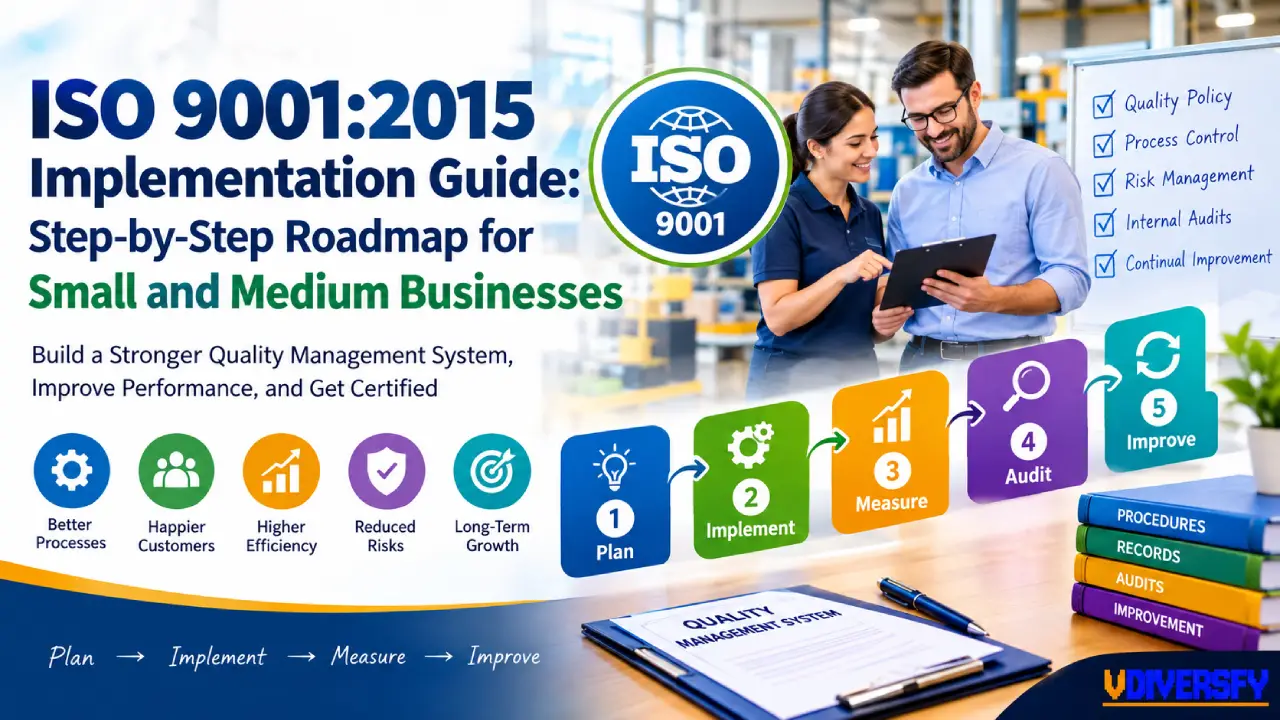
For a small or medium-sized company, implementing a quality management system can feel like a major project involving procedures, records, audits, training, and certification.
In reality, a practical ISO 9001 2015 implementation guide small medium businesses should start with the way the company already works and then improve those processes against the standard.
This guide explains how to build a useful QMS without creating unnecessary paperwork, how to understand the ISO 9001 requirements, how to prepare for certification, and how to turn quality management into a normal part of daily business.
Current update: ISO 9001:2015 has now been withdrawn and replaced by ISO 9001:2026. However, the 2015 framework remains highly relevant for organizations that are currently certified to the 2015 edition and are preparing for transition. Organizations certified to ISO 9001:2015 have until September 30, 2029, to complete the transition to ISO 9001:2026. Organizations starting a new certification project should discuss the applicable edition and transition arrangements with an accredited certification body before beginning the project.
Contents
- 1. Why ISO 9001 Matters for Small and Medium Businesses
- 2. What Is an ISO 9001 Quality Management System?
- 3. The Seven Quality Management Principles
- 4. ISO 9001 Implementation: Start With the Business, Not the Documents
- 5. Step 1: Obtain Top Management Commitment
- 6. Step 2: Understand the ISO 9001 Requirements
- 7. Step 3: Determine the Context of the Organization
- 8. Step 4: Identify Interested Parties
- 9. Step 5: Define the QMS Scope
- 10. Step 6: Map the Organization’s Core Processes
- 11. Step 7: Conduct an ISO 9001 Gap Analysis
- 12. A Practical Gap Analysis Rating System
- 13. Step 8: Build an Implementation Plan
- 14. Do Small Businesses Need a Huge Quality Manual?
- 15. What Comes Next?
- 16. Step 9: Establish the Quality Policy
- 17. Step 10: Define Roles, Responsibilities, and Authority
- 18. Step 11: Establish Quality Objectives
- 19. Step 12: Apply Risk-Based Thinking
- 20. Step 13: Identify Opportunities for Improvement
- 21. Step 14: Establish Competence Requirements
- 22. Step 15: Create a Practical Training System
- 23. Step 16: Control Organizational Knowledge
- 24. Step 17: Establish Communication Controls
- 25. Step 18: Build the Documented Information System
- 26. Step 19: Control Changes to Documents
- 27. Step 20: Understand Operational Planning and Control
- 28. Step 21: Review Customer Requirements Before Accepting Work
- 29. Step 22: Control Design and Development Where Applicable
- 30. Step 23: Strengthen Supplier and External Provider Controls
- 31. Step 24: Control Purchased Information
- 32. Step 25: Control Production and Service Provision
- 33. Step 26: Identify and Control Traceability Requirements
- 34. Step 27: Protect Customer and External Property
- 35. Step 28: Control Product Preservation
- 36. Step 29: Establish Release and Acceptance Controls
- 37. Step 30: Establish a Nonconforming Output Process
- 38. Step 31: Use Corrective Action to Fix the Cause
- 39. Step 32: Measure QMS Performance
- 40. Step 33: Monitor Customer Satisfaction
- 41. Step 34: Plan the Internal Audit Program
- 42. Step 35: Build an Internal Audit Schedule Based on Risk
- 43. Step 36: Prepare for Management Review
- 44. The SME ISO 9001 Implementation Cycle
- 45. Common Implementation Mistakes to Avoid
- 46. A Practical QMS Documentation Structure for an SME
- 47. How to Know Whether the QMS Is Working
- 48. What Happens Before Certification?
- 49. The Most Important Principle for SMEs
- 50. Moving Toward Certification
- 51. Step 37: Perform a Final Certification Readiness Review
- 52. Step 38: Allow the QMS to Generate Real Evidence
- 53. Step 39: Understand the ISO 9001 Certification Process
- 54. Step 40: Select the Right Certification Body
- 55. Step 41: Understand the Role of a Consultant
- 56. Step 42: Prepare for Stage 1 Audit
- 57. Step 43: Prepare for Stage 2 Audit
- 58. Step 44: Train Employees for Auditor Interviews
- 59. Step 45: Understand Audit Findings
- 60. Step 46: Corrective Action After the Audit
- 61. Step 47: Know the Difference Between Certification and Accreditation
- 62. Step 48: Understand What Happens After Certification
- 63. Step 49: Create a 12-Month Continuous Improvement Cycle
- 64. Step 50: Build a Simple ISO 9001 Implementation Timeline
- 65. Step 51: Estimate ISO 9001 Implementation Cost
- 66. Step 52: Avoid Buying Unnecessary ISO Software
- 67. Step 53: Use Technology to Make Quality Easier
- 68. Step 54: Use Data to Find the Real Quality Problems
- 69. Step 55: Use Pareto Thinking for Recurring Problems
- 70. Step 56: Build a Quality Culture, Not Just a Compliance Culture
- 71. Step 57: Make Management Review a Business Meeting
- 72. Step 58: The Final ISO 9001 Implementation Checklist
- 73. Step 59: ISO 9001 Certification Readiness Checklist for Employees
- 74. Step 60: ISO 9001 Implementation for Different Types of SMEs
- 75. Step 61: ISO 9001 FAQs for Small and Medium Businesses
- 76. Step 62: What Changes With ISO 9001:2026?
- 77. Step 63: How SMEs Should Approach the 2015-to-2026 Transition
- 78. Step 64: The Best Way to Keep ISO 9001 Simple
- 79. Step 65: The Complete SME ISO 9001 Roadmap
- 80. Actionable Takeaways: ISO 9001 Implementation Checklist
- 81. Conclusion: ISO 9001 Should Improve the Business, Not Just Produce a Certificate
Why ISO 9001 Matters for Small and Medium Businesses
ISO 9001 is not simply a certificate to display on a website or reception wall. It provides a structured way to control how an organization understands customer requirements, plans work, manages resources, delivers products or services, measures performance, handles problems, and improves.
This is especially important for smaller organizations because a quality problem can have a much larger effect when there are fewer people, fewer customers, and fewer resources available to absorb mistakes.
Imagine a 40-person engineering company that repeatedly receives incomplete customer specifications. Engineers begin work using different assumptions, revisions are missed, and inspection discovers problems near delivery. The company may think it has an engineering problem.
The real problem may be process control.
A well-designed QMS asks practical questions:
- How are customer requirements received?
- Who reviews them?
- How are changes controlled?
- Who approves the final output?
- What happens when a requirement is unclear?
- How is customer feedback recorded?
- How are repeated problems analyzed?
- How does management know whether the process is working?
That shift—from reacting to defects to controlling the process—is one of the most valuable parts of ISO 9001.
ISO describes ISO 9001 as a standard that can be applied by organizations of different sizes and sectors. It focuses on customer satisfaction, process management, performance evaluation, documented information, improvement, and risk-based thinking.
What Is an ISO 9001 Quality Management System?
A Quality Management System, or QMS, is the organized system an organization uses to consistently achieve intended results and meet applicable requirements.
It includes more than documents.
A working QMS normally includes:
- Processes
- People
- Responsibilities
- Resources
- Controls
- Performance measures
- Records
- Customer feedback
- Risk controls
- Internal audits
- Corrective actions
- Continual improvement
For example, a manufacturing company may have purchasing, production, inspection, maintenance, sales, shipping, and customer service processes.
ISO 9001 does not tell the company exactly how many forms it must create or exactly how every process must operate. Instead, it provides requirements that the organization must apply according to its own business, customers, products, services, risks, and operating conditions.
That flexibility is particularly useful for SMEs.
A 25-person company should not copy the QMS of a 10,000-person multinational simply because both organizations have ISO 9001 certification.
The Seven Quality Management Principles
The ISO 9000 family is built around seven quality management principles:
- Customer focus
- Leadership
- Engagement of people
- Process approach
- Improvement
- Evidence-based decision making
- Relationship management
These principles help explain why ISO 9001 is more than a compliance checklist. ISO states that these principles can be adapted to organizations of different sizes, sectors, cultures, and operating environments.
For an SME, the practical meaning is straightforward.
Customer focus means understanding what the customer actually needs instead of assuming it.
Leadership means management provides direction, resources, and accountability instead of leaving quality entirely to the quality department.
Engagement of people means employees understand their responsibilities and are able to identify problems.
Process approach means understanding how activities interact rather than managing every department as an isolated unit.
Improvement means using problems, data, feedback, and lessons learned to make the business better.
Evidence-based decision making means decisions should be supported by reliable information.
Relationship management means suppliers, contractors, customers, and other relevant parties are managed as part of the wider business system.
ISO 9001 Implementation: Start With the Business, Not the Documents
One of the most common mistakes is starting an ISO project by downloading procedures from the internet.
That approach often produces a large collection of documents that employees do not understand and auditors struggle to connect with actual operations.
A better QMS implementation roadmap starts with the business.
Before writing procedures, management should understand:
- What does the organization sell?
- Who are its customers?
- What are the major products or services?
- What processes are needed to deliver them?
- What can go wrong?
- What legal or regulatory requirements apply?
- Which suppliers are important?
- Where do customer complaints originate?
- Which processes affect quality the most?
The aim is to create a QMS that describes and improves the company’s real way of working.
Step 1: Obtain Top Management Commitment
ISO 9001 implementation should not be treated as a project owned only by the Quality Manager.
Top management needs to establish direction and make quality part of normal business management.
Leadership commitment should be visible through actions such as:
- Setting quality objectives
- Providing necessary resources
- Assigning responsibilities
- Reviewing QMS performance
- Supporting employee training
- Addressing recurring problems
- Participating in improvement activities
- Ensuring customer requirements are understood
For example, if management says that customer complaints are important but refuses to provide resources to investigate recurring defects, the QMS will quickly become a paperwork exercise.
A small company may not need a large quality department.
In some organizations, the Operations Manager may coordinate the QMS, while department managers remain responsible for their processes. The important issue is clear accountability, not job title.
Step 2: Understand the ISO 9001 Requirements
Before implementation begins, the project team should understand the structure of the standard.
For ISO 9001:2015, the main requirement clauses are:
Clause | Main subject |
4 | Context of the organization |
5 | Leadership |
6 | Planning |
7 | Support |
8 | Operation |
9 | Performance evaluation |
10 | Improvement |
Clauses 1–3 provide introductory material, while clauses 4–10 contain the core management system requirements.
This structure is important because implementation should not become a collection of disconnected activities.
For example:
Context → Leadership → Planning → Support → Operations → Measurement → Improvement
That is essentially the management cycle.
A company identifies its business environment, establishes direction, plans what needs to happen, provides resources, controls operations, evaluates results, and improves.
Step 3: Determine the Context of the Organization
The phrase context of organization ISO 9001 refers to understanding the internal and external issues that can affect the organization’s ability to achieve the intended results of its QMS.
This does not mean creating a complicated 50-page strategic report.
A small business may identify issues such as:
External issues
- Customer expectations
- Market competition
- Supply chain problems
- New technology
- Regulatory requirements
- Economic conditions
- Climate-related factors
- Availability of skilled workers
Internal issues
- Employee competence
- Production capacity
- Equipment condition
- Company culture
- Existing processes
- Information systems
- Financial resources
- Organizational structure
For example, suppose a small medical-device supplier depends heavily on one specialist supplier. Supplier capacity becomes an important external issue because a disruption could affect delivery performance.
The QMS should recognize that issue and determine an appropriate response.
ISO’s current guidance continues to emphasize understanding the organization, its environment, interested parties, processes, and factors that can affect its ability to achieve intended results. The newer 2026 edition also puts greater emphasis on leadership, quality culture, risks, and opportunities.
Step 4: Identify Interested Parties
Customers are obviously important, but they are not the only parties that can affect the QMS.
Depending on the business, relevant interested parties may include:
- Customers
- Employees
- Owners
- Suppliers
- Contractors
- Regulators
- Certification bodies
- Business partners
- Distributors
- Investors
- Local authorities
The organization should determine which interested parties are relevant and which of their requirements need to be addressed through the QMS.
For example, a construction supplier may need to consider customer specifications, applicable regulations, employee competence, supplier reliability, inspection requirements, and contractual conditions.
The goal is not to create paperwork for every possible stakeholder.
The goal is to identify requirements that can actually affect the organization’s ability to provide conforming products and services.
Step 5: Define the QMS Scope
The ISO 9001 scope statement explains the boundaries and applicability of the quality management system.
A good scope should make it clear:
- What the organization does
- Which products or services are covered
- Which locations are included
- Which relevant activities are included
- Whether any ISO 9001 requirements are not applicable
For example:
“Provision of mechanical design, fabrication, inspection, and installation services for industrial equipment at the company’s Houston, Texas facility.”
The scope should reflect reality.
An organization should not create an artificially broad scope simply to make its certificate look impressive.
Likewise, it should not exclude an important activity merely because that activity is difficult to control.
The scope should help customers, employees, auditors, and management understand what the QMS actually covers.
Step 6: Map the Organization’s Core Processes
Before conducting a formal ISO 9001 gap analysis, map the organization’s processes.
A simple process map might look like:
Customer inquiry → Contract review → Design → Purchasing → Production → Inspection → Delivery → Customer feedback → Improvement
Support processes might include:
Human resources → Training → Maintenance → IT → Document control → Calibration → Supplier management
The exact process structure depends on the organization.
A service company might have:
Lead → Proposal → Contract → Service delivery → Review → Invoice → Customer feedback
The process approach is a central part of ISO 9001. ISO explains that understanding interrelated processes as a system helps organizations improve effectiveness and efficiency rather than treating activities as isolated functions.
Step 7: Conduct an ISO 9001 Gap Analysis
The ISO 9001 gap analysis is one of the most useful early implementation activities.
It compares the organization’s current practices against the applicable requirements.
A simple gap analysis table can contain:
Requirement | Current practice | Gap | Action | Owner |
Customer requirements | Informal review | No consistent evidence | Create contract review method | Sales Manager |
Supplier control | Approved supplier list | Evaluation criteria unclear | Define supplier evaluation | Purchasing |
Training | Training occurs | Records inconsistent | Establish competence records | HR |
Internal audit | Not established | Major gap | Develop audit program | Quality |
Corrective action | Problems corrected individually | Root cause not consistent | Implement CAPA process | Operations |
The objective is not to mark every missing document as a failure.
The important question is:
Does the organization have an effective process that meets the requirement, and can it demonstrate that the process works?
For example, a company may already perform customer reviews perfectly well but have no formal procedure called “Contract Review Procedure.”
That does not automatically mean the company has no system.
The gap analysis should identify what is genuinely missing, what is already effective, and what needs improvement.
A Practical Gap Analysis Rating System
SMEs can simplify their assessment by using four ratings:
- Green: Requirement effectively implemented
- Yellow: Partially implemented
- Orange: Weak or inconsistent
- Red: Not implemented
This gives management a quick picture of implementation maturity.
The organization can then prioritize gaps based on:
Customer impact + business risk + compliance importance + audit significance
This is much more useful than trying to fix every issue simultaneously.
Step 8: Build an Implementation Plan
After the gap analysis, convert findings into an implementation plan.
A practical plan should identify:
- Requirement
- Required action
- Responsible person
- Target date
- Required resources
- Evidence required
- Status
- Verification method
For a small company, implementation may be organized over several months rather than attempting everything in a few weeks.
A simple sequence is:
Month 1: Leadership, context, scope, process mapping and gap analysis.
Month 2: Quality policy, objectives, risks, responsibilities and process controls.
Month 3: Documentation, competence, supplier controls, operational controls and records.
Month 4: Performance monitoring, internal audit and corrective actions.
Month 5: Management review and final preparation.
Month 6: Certification audit preparation.
The actual schedule should depend on company size, complexity, existing controls, customer requirements, regulatory requirements, and available resources.
Do Small Businesses Need a Huge Quality Manual?
No.
One of the biggest misunderstandings about ISO 9001 implementation is that certification requires a massive quality manual ISO 9001 containing every detail of the company’s operations.
ISO 9001:2015 moved toward the concept of documented information, giving organizations flexibility in deciding what documented information is needed to support effective operation and provide evidence of results.
A small business can have a relatively simple QMS if its processes are simple and well controlled.
For example, a 15-person consulting company may need:
- Quality policy
- Quality objectives
- Process information
- Project records
- Customer feedback
- Competence records
- Supplier records where relevant
- Internal audit records
- Management review records
- Corrective action records
It does not need dozens of unnecessary procedures simply because another company has them.
The basic rule is simple:
Document what people need to perform the process consistently and what the organization needs to demonstrate that the process is controlled.
That principle can prevent the QMS from becoming an administrative burden.
What Comes Next?
Once the organization has established its foundation, the next stage is to build the actual operating controls.
This includes the practical implementation of leadership responsibilities, quality policy, quality objectives, risk-based planning, competence, awareness, communication, documented information, supplier management, production and service controls, customer requirements, monitoring, internal audits, management review, nonconformity, corrective action, and continual improvement.
The strongest SME QMS is not the one with the most documents.
It is the one where employees understand what must be done, why it matters, how it is controlled, and what happens when something goes wrong.
ISO itself emphasizes that effective quality assurance depends on leadership, clear objectives, process planning, competent people, performance monitoring, and continual improvement.
Once an organization has established its context, defined the QMS scope, mapped its processes, and completed the initial gap assessment, the next task is to turn those findings into a working quality management system. This is where ISO 9001 implementation becomes practical.
The organization needs to decide who is responsible for quality, establish measurable objectives, control risks, provide competent people and resources, manage operations, control suppliers, maintain appropriate documented information, and collect evidence that processes are actually working.
For small and medium businesses, the most effective approach is to build controls around existing business activities rather than create a separate system that employees have to maintain alongside their normal work.
Step 9: Establish the Quality Policy
The quality policy provides the overall direction for the organization’s QMS.
A good quality policy should be relevant to the organization’s purpose and operating environment. It should also provide a framework for setting quality objectives and include a commitment to meeting applicable requirements and improving the QMS.
The policy does not need to be complicated.
For example, a small engineering company could establish a policy based on:
- Meeting customer requirements
- Delivering work on time
- Providing technically competent services
- Controlling risks
- Developing employee competence
- Improving processes
- Meeting applicable legal and contractual requirements
The important question is not whether the policy sounds impressive.
The important question is:
Do employees understand what the policy means in their daily work?
If an employee cannot explain how their work contributes to the quality policy, management should consider whether the policy is actually being communicated effectively.
Example of a Practical Quality Policy
A U.S.-based fabrication company could use a policy along these lines:
“We are committed to providing products that meet customer, statutory, regulatory, and applicable contractual requirements. We maintain effective processes, develop employee competence, work with reliable suppliers, monitor performance, address problems at their root cause, and continually improve our quality management system.”
The final wording should always reflect the organization’s actual business and commitments.
A policy should never promise something the company cannot realistically control.
Step 10: Define Roles, Responsibilities, and Authority
ISO 9001 implementation becomes difficult when everyone assumes that someone else is responsible for quality.
Management should establish clear responsibilities for QMS-related activities.
For example:
Activity | Primary responsibility |
Customer requirements | Sales / Project Manager |
Contract review | Sales / Operations |
Purchasing | Purchasing Manager |
Supplier evaluation | Purchasing / Quality |
Production control | Operations |
Inspection | Quality / Inspection |
Training | Department Manager / HR |
Internal audit | Qualified Internal Auditor |
Corrective action | Process Owner |
Management review | Top Management |
The person responsible for a process does not necessarily have to be the person who performs every task within that process.
For example, the Operations Manager may own the production process while supervisors and operators perform individual activities.
This distinction is important because process ownership creates accountability.
Step 11: Establish Quality Objectives
Quality objectives convert the organization’s quality policy into measurable results.
Weak objectives include:
- Improve quality
- Reduce complaints
- Increase customer satisfaction
These are good intentions, but they are difficult to manage because they do not clearly define success.
A stronger objective might be:
“Reduce customer complaints related to shipment errors from the current baseline by 30% within the next 12 months.”
Another example:
“Maintain on-time delivery performance at or above 95% each month.”
Another:
“Reduce repeat corrective actions by 20% during the next financial year.”
Good objectives should have:
- A measurable target where practical
- A responsible owner
- A defined measurement method
- A review frequency
- Appropriate resources
- A connection to relevant business and customer needs
Example Quality KPI Dashboard
A small manufacturing company might monitor:
KPI | Target | Frequency | Owner |
On-time delivery | ≥95% | Monthly | Operations |
Customer complaints | <5/month | Monthly | Customer Service |
First-pass yield | ≥98% | Weekly | Production |
Supplier on-time delivery | ≥95% | Monthly | Purchasing |
Corrective actions closed on time | ≥90% | Monthly | Quality |
Employee training completion | 100% | Monthly | Department Managers |
The exact targets should be based on business conditions and meaningful historical data.
Do not select impressive-looking targets simply because another company uses them.
Step 12: Apply Risk-Based Thinking
Risk-based thinking is one of the most important concepts for practical implementation.
A business does not need to eliminate every possible risk.
Instead, it should understand risks that could affect its ability to achieve intended results and determine appropriate actions.
Consider a company that manufactures custom electrical control panels.
Potential risks include:
- Incorrect customer specifications
- Wrong components purchased
- Supplier delays
- Design errors
- Incorrect wiring
- Failed inspection
- Equipment breakdown
- Inadequate employee competence
- Shipping damage
The organization can assess these risks and decide where stronger controls are needed.
A simple risk table could be:
Risk | Possible effect | Existing control | Further action |
Incorrect drawing revision | Wrong product | Drawing approval | Revision control |
Supplier delay | Late delivery | Approved suppliers | Supplier performance monitoring |
Incorrect wiring | Product failure | Inspection | Independent verification |
Operator lacks competence | Defects | Training | Competency assessment |
Risk assessment should not become a mathematical exercise unless the organization’s business requires it.
For many SMEs, a simple risk-and-opportunity register is enough to start meaningful discussions.
Step 13: Identify Opportunities for Improvement
Risk is only one side of planning.
Organizations should also consider opportunities.
For example:
A company notices that employees spend significant time manually entering the same customer information into three systems.
The risk is data entry error.
The opportunity is to automate or simplify the process.
Another company discovers that most customer complaints involve unclear installation instructions.
The risk is customer dissatisfaction.
The opportunity is to improve instructions and reduce support calls.
This is where a QMS becomes more than a compliance system.
Quality management should help the business work better.
Step 14: Establish Competence Requirements
People performing work that affects product or service conformity need appropriate competence.
Competence can come from:
- Education
- Training
- Experience
- Technical knowledge
- Demonstrated skills
- On-the-job development
A common mistake is to treat training attendance as proof of competence.
It is not always enough.
For example, suppose an employee attends an eight-hour inspection training course.
The attendance record proves participation.
It does not necessarily prove that the employee can correctly perform inspections.
The organization may need additional evidence such as:
- Practical demonstration
- Supervisor evaluation
- Test results
- Observation
- Inspection accuracy
- Qualification records
This distinction becomes particularly important in technical industries.
Step 15: Create a Practical Training System
A simple training matrix can help an SME understand who is qualified to perform important tasks.
Employee / Role | Process | Required competence | Status |
Operator A | CNC setup | Qualified | Current |
Operator B | Final inspection | Training required | Open |
Technician C | Calibration | Qualified | Current |
Engineer D | Design review | Qualified | Current |
The organization should determine whether specific roles require:
- Initial training
- Refresher training
- Qualification
- Certification
- Authorization
- Competency evaluation
Training records should be controlled according to the organization’s documented-information process.
Step 16: Control Organizational Knowledge
Organizations also need to protect important knowledge.
Consider a small machine shop where one experienced employee knows how to set up a critical machine.
If that employee leaves without transferring the knowledge, production may suffer.
Organizational knowledge can be preserved through:
- Work instructions
- Engineering drawings
- Lessons learned
- Training material
- Troubleshooting guides
- Standard settings
- Process parameters
- Maintenance information
- Job records
This is especially important for SMEs because a few experienced employees may hold a large percentage of the organization’s practical knowledge.
Step 17: Establish Communication Controls
Quality-related information needs to reach the right people at the right time.
Communication may include:
- Customer requirements
- Engineering changes
- Inspection results
- Supplier issues
- Production changes
- Complaints
- Corrective actions
- Safety or regulatory information
- Quality objectives
A simple rule is useful:
Important information should have a defined route.
For example:
Customer change → Project Manager → Engineering → Production → Inspection → Shipping
If an engineering change reaches only the engineer but not production, the organization has a communication control problem.
Step 18: Build the Documented Information System
One of the most misunderstood areas of ISO 9001 implementation is documentation.
The objective is not to create a mountain of paperwork.
The organization needs enough documented information to support effective process operation and provide evidence that requirements have been met.
Documentation may include:
- Policies
- Procedures
- Process maps
- Work instructions
- Forms
- Checklists
- Specifications
- Drawings
- Inspection records
- Training records
- Audit records
- Management review records
- Corrective action records
The key distinction is between information that tells people what to do and records that demonstrate what happened.
For example:
Work instruction: How to perform a final inspection.
Inspection record: Evidence that the final inspection was completed.
Both can be important, but they serve different purposes.
Step 19: Control Changes to Documents
A document control system should prevent employees from accidentally using outdated information.
Imagine that a production drawing is revised from Revision B to Revision C.
If an operator continues using Revision B, the company could manufacture a nonconforming product even though the operator followed the document available at the workstation.
Controls may include:
- Revision numbers
- Approval before release
- Controlled access
- Removal or identification of obsolete versions
- Electronic permissions
- Change history
Modern electronic systems can make this easier, but a small company can also manage document control using a simple structured folder system if it is properly controlled.
The method matters less than the result.
Step 20: Understand Operational Planning and Control
Clause 8 is where the QMS connects directly to product and service delivery.
The organization should plan and control the processes required to meet product and service requirements.
This can include:
- Reviewing customer requirements
- Establishing acceptance criteria
- Defining process controls
- Providing resources
- Establishing inspection methods
- Managing changes
- Controlling external providers
- Maintaining appropriate records
For a service business, operational controls may look very different.
A consulting company might control:
Proposal → Contract → Project plan → Resource assignment → Deliverable review → Customer approval → Project closeout
The principles remain the same even though the physical work is different.
Step 21: Review Customer Requirements Before Accepting Work
A company should understand what the customer is asking for before committing to deliver.
This includes checking:
- Specifications
- Drawings
- Delivery dates
- Quantities
- Applicable standards
- Acceptance criteria
- Special requirements
- Regulatory requirements
- Customer-provided property
- Required documentation
Suppose a customer asks for delivery within 10 business days.
Before accepting the order, the organization should determine whether it actually has the capacity and resources to meet that requirement.
If the company accepts an impossible commitment, the resulting late delivery is not simply a customer service issue.
It is a planning failure.
Step 22: Control Design and Development Where Applicable
Not every organization performs design and development.
If design is part of the organization’s scope, the process should be controlled.
Design controls may address:
- Inputs
- Outputs
- Reviews
- Verification
- Validation
- Changes
- Responsibilities
- Records
Consider an engineering company designing a pressure vessel.
Design inputs may include:
- Customer specifications
- Applicable codes
- Operating pressure
- Temperature
- Material requirements
- Environmental conditions
Design outputs may include:
- Drawings
- Specifications
- Bills of materials
- Calculations
- Inspection requirements
Design reviews and verification activities help identify problems before production or delivery.
Step 23: Strengthen Supplier and External Provider Controls
Small companies often underestimate supplier risk.
A business may have excellent internal processes but still experience customer complaints because an external provider supplied defective material.
Supplier controls should be appropriate to the risk.
Possible controls include:
- Supplier approval
- Supplier evaluation
- Supplier selection criteria
- Purchase specifications
- Supplier performance monitoring
- Incoming inspection
- Corrective action requests
- Periodic supplier review
Not every supplier needs the same level of control.
A company supplying office stationery does not normally require the same evaluation process as a supplier providing a critical component used in a safety-related product.
Example Supplier Evaluation
A manufacturing company could evaluate suppliers using:
- Quality performance
- Delivery performance
- Responsiveness
- Technical capability
- Price competitiveness
- Certification status where relevant
Supplier performance should be based on actual business needs and evidence.
Step 24: Control Purchased Information
Purchase orders and specifications should clearly communicate applicable requirements.
For example, instead of writing:
“Supply stainless steel.”
A technically appropriate purchase requirement might identify:
- Material grade
- Applicable specification
- Dimensions
- Quantity
- Required certificates
- Inspection requirements
- Delivery requirements
The level of detail should match the risk.
The supplier cannot reliably meet a requirement that the organization has not clearly communicated.
Step 25: Control Production and Service Provision
Operational controls should help employees perform work consistently.
Depending on the business, controls may include:
- Approved drawings
- Work instructions
- Equipment settings
- Inspection criteria
- Qualified personnel
- Process parameters
- Acceptance criteria
- Monitoring
- Release controls
A useful question for each major process is:
What could cause this process to produce the wrong result, and what control prevents or detects it?
This simple question can reveal many practical quality improvements.
Step 26: Identify and Control Traceability Requirements
Traceability is not equally important for every organization.
For some products, traceability may involve:
- Serial numbers
- Lot numbers
- Batch numbers
- Material certificates
- Production dates
- Operator identification
- Inspection records
For a low-risk service organization, detailed traceability may be unnecessary.
The organization should determine what traceability is required by customers, regulations, contracts, standards, or internal risk controls.
Step 27: Protect Customer and External Property
Organizations may receive property belonging to customers or other external parties.
Examples include:
- Customer-owned equipment
- Drawings
- Tools
- Materials
- Confidential information
- Software
- Data
Suppose a customer sends a specialized measuring device for use during production.
The organization should protect it from loss, damage, misuse, or unauthorized use.
If the property is damaged or lost, the organization should appropriately notify the owner and maintain relevant information.
Step 28: Control Product Preservation
Product preservation covers activities needed to maintain conformity during processing and delivery.
Depending on the product, this can include:
- Handling
- Packaging
- Storage
- Protection
- Transportation
- Contamination control
- Environmental conditions
For example, an electronics manufacturer may need controls for moisture and electrostatic discharge.
A food-related business may need temperature and contamination controls.
A steel supplier may need protection against corrosion.
The control should match the product’s characteristics and risks.
Step 29: Establish Release and Acceptance Controls
Products and services should not be released until planned requirements have been completed, unless an authorized person approves otherwise.
Evidence of release may include:
- Inspection records
- Test reports
- Approval signatures
- Electronic release status
- Certificates
- Customer acceptance
For example, a manufactured component should not automatically move to shipping merely because production has finished.
If final inspection is required, the inspection result should provide evidence that the product meets defined acceptance criteria.
Step 30: Establish a Nonconforming Output Process
No organization achieves zero defects forever.
A mature QMS does not pretend that problems never occur.
Instead, it ensures that nonconforming outputs are identified and controlled.
Possible actions include:
- Correction
- Segregation
- Rework
- Repair
- Reclassification
- Return to supplier
- Customer concession where appropriate
- Scrap
The organization should prevent unintended use or delivery of nonconforming output.
Example
An order requires 100 components with a specified dimension.
Inspection finds that 8 components are outside tolerance.
The organization should not simply tell the operator to “fix them” without determining what happened.
The immediate action may be to segregate the 8 components.
The next question is:
Why did the process produce them?
That leads into corrective action and root-cause analysis.
Step 31: Use Corrective Action to Fix the Cause
Correction and corrective action are not the same.
Correction deals with the immediate problem.
Corrective action addresses the cause so that the problem does not recur.
Example:
A customer receives the wrong product.
Correction: Send the correct product.
Corrective action: Determine why the wrong product was shipped and change the process to prevent recurrence.
Possible root causes might include:
- Similar product codes
- Poor labeling
- Inadequate order verification
- Manual data entry
- Weak final shipping checks
A useful corrective action process should include:
- Identify the nonconformity.
- Take immediate action.
- Determine whether similar problems exist.
- Investigate the cause.
- Decide whether action is needed.
- Implement the action.
- Verify effectiveness.
- Update risks or processes when necessary.
The organization should avoid automatically blaming an employee.
If five employees make the same mistake, the process may be the real problem.
Step 32: Measure QMS Performance
A QMS should generate useful information for management.
Measurements can include:
- Customer complaints
- On-time delivery
- Defect rates
- Rework
- Scrap
- Supplier performance
- Process performance
- Customer satisfaction
- Audit findings
- Corrective action performance
The organization should not measure everything.
It should measure what helps answer important business questions.
For example:
Are customers receiving what we promised?
Are our processes producing conforming results?
Are suppliers performing reliably?
Are problems being corrected effectively?
Are our quality objectives being achieved?
Step 33: Monitor Customer Satisfaction
Customer satisfaction is broader than simply counting complaints.
Organizations can use:
- Surveys
- Complaints
- Repeat business
- Returns
- Warranty claims
- Customer meetings
- Delivery performance
- Customer ratings
- Direct feedback
A company with zero complaints should not automatically assume that customers are satisfied.
Customers may simply stop doing business with the company.
That is why multiple sources of customer feedback can provide a more useful picture.
Step 34: Plan the Internal Audit Program
Internal audits are one of the most powerful tools available to an SME when they are performed correctly.
An internal audit should not be a document hunt.
The auditor should determine whether the QMS process:
- Meets applicable requirements
- Is implemented
- Is effective
- Produces intended results
A good auditor asks employees practical questions.
For a purchasing process:
How do you select this supplier?
What requirements do you communicate?
How do you know the supplier is performing?
What happens when incoming material fails inspection?
For production:
What information do you use to perform this job?
How do you know you are using the current revision?
What happens when you find a defect?
These questions reveal much more than simply asking, “Do you have a procedure?”
Step 35: Build an Internal Audit Schedule Based on Risk
Not every process needs identical audit frequency.
High-risk or poorly performing processes may need more attention.
For example:
Process | Risk | Audit frequency |
Production | High | Quarterly |
Supplier control | High | Twice yearly |
Document control | Medium | Annually |
HR training | Medium | Annually |
Office administration | Low | As needed |
The audit program should also consider:
- Previous audit results
- Customer complaints
- Process changes
- Nonconformities
- New equipment
- New employees
- Supplier problems
This makes internal auditing more useful than simply auditing every department once a year.
Step 36: Prepare for Management Review
Top management should periodically review the QMS to determine whether it remains suitable, adequate, effective, and aligned with organizational direction.
Inputs can include:
- Audit results
- Customer feedback
- Process performance
- Quality objectives
- Nonconformities
- Corrective actions
- Supplier performance
- Resource needs
- Risks and opportunities
- Improvement opportunities
- Changes affecting the QMS
Management review does not need to be a long formal meeting.
For a small business, it can be integrated into an existing management meeting if the required topics are properly addressed and evidence is maintained.
The important issue is that management actually reviews performance and makes decisions.
The SME ISO 9001 Implementation Cycle
At this stage, the organization has a complete management cycle:
Plan → Implement → Measure → Audit → Review → Correct → Improve
This cycle should repeat continuously.
It is not something the organization performs once before certification.
A company that stops improving after receiving its certificate has technically completed an audit project but has missed much of the value of a QMS.
Common Implementation Mistakes to Avoid
Small and medium businesses frequently make several avoidable mistakes.
Mistake 1: Creating Too Many Procedures
More documents do not automatically mean better quality.
Better approach: Document only what is necessary to control important processes and demonstrate conformity.
Mistake 2: Making Quality the Quality Manager’s Responsibility
Quality is not owned exclusively by one department.
Better approach: Make process owners responsible for process performance.
Mistake 3: Copying Another Company’s QMS
A copied system may contain irrelevant processes and controls.
Better approach: Build the QMS around the organization’s own processes, risks, customers, and business model.
Mistake 4: Treating Training Attendance as Competence
A certificate or attendance sheet does not always demonstrate capability.
Better approach: Evaluate whether the person can actually perform the required task.
Mistake 5: Closing Corrective Actions Too Quickly
Writing “employee retrained” is often not enough.
Better approach: Determine why the system allowed the problem to happen and verify whether the corrective action worked.
Mistake 6: Waiting Until the Certification Audit to Perform an Internal Audit
This leaves little time to identify and correct weaknesses.
Better approach: Conduct internal audits before certification and allow enough time for corrective action.
Mistake 7: Treating the Certificate as the Goal
Certification is an external confirmation of the management system.
It should not be the final objective.
The real objective is a business that can consistently deliver conforming products and services while improving performance.
A Practical QMS Documentation Structure for an SME
A small organization can organize documented information into a simple structure:
Level 1 — Direction
- Quality policy
- QMS scope
- Quality objectives
Level 2 — Process controls
- Process maps
- Procedures where needed
- Work instructions
- Operational controls
Level 3 — Supporting information
- Forms
- Checklists
- Specifications
- Templates
Level 4 — Records
- Inspection records
- Training records
- Audit reports
- Management review records
- Supplier evaluations
- Corrective action records
This structure is only an example.
ISO 9001 does not require every organization to use these four document levels.
The system should be designed according to actual needs.
How to Know Whether the QMS Is Working
A QMS is probably becoming effective when employees stop asking:
“What document do I need for ISO?”
and start asking:
“What is the correct way to control this process?”
That is an important cultural shift.
Other signs include:
- Fewer repeat problems
- Better process visibility
- Clearer responsibilities
- Faster corrective action
- Better supplier performance
- Improved customer communication
- More reliable records
- Better management decisions
- Greater consistency between employees
- More useful performance data
The best QMS is often almost invisible because it becomes part of the way the company normally operates.
What Happens Before Certification?
Once the organization has implemented the system, it should allow enough time for the processes to operate and generate evidence.
This is important.
An organization cannot demonstrate an effective management system merely by producing procedures on the day of the audit.
Auditors will generally want to see evidence that processes have actually been implemented.
Before entering the ISO 9001 certification process, an organization should therefore consider completing:
- QMS implementation
- Employee awareness
- Internal audits
- Corrective actions
- Management review
- KPI monitoring
- Supplier evaluation
- Customer feedback analysis
- Operational records
- Document control checks
The organization should also confirm that the selected certification body is appropriately accredited for the relevant certification activity.
The certification process itself will be addressed in detail in Part 3.
The Most Important Principle for SMEs
ISO 9001 should make the organization more controlled, more consistent, and more capable, not simply more bureaucratic.
If a new procedure adds five pages of paperwork but does not reduce risk, improve consistency, satisfy a requirement, or provide useful evidence, management should ask whether the procedure is really necessary.
On the other hand, if a simple checklist prevents repeated customer errors, that checklist can provide significant value.
The question should always be:
What level of control does this process actually need?
That is how an SME can build a QMS that is practical rather than excessive.
Moving Toward Certification
At this point, the organization has moved beyond planning and into implementation.
The next stage is to test the system under realistic conditions.
That means asking:
- Are employees actually following the defined processes?
- Are records being completed correctly?
- Are customer requirements controlled?
- Are suppliers being evaluated?
- Are quality objectives being monitored?
- Are internal audits finding meaningful issues?
- Are corrective actions addressing root causes?
- Is management reviewing performance?
- Is the QMS producing evidence of effective operation?
If the answer to these questions is consistently yes, the organization is approaching certification readiness.
The final stage is not simply “passing the audit.”
It is demonstrating that the QMS is implemented, maintained, monitored, and capable of achieving its intended results.
The implementation work is now largely complete. The organization has established its QMS foundation, defined processes, assigned responsibilities, developed controls, trained employees, monitored performance, conducted internal audits, and performed management review.
The next step is to determine whether the system is ready for independent certification and, more importantly, whether it is mature enough to continue delivering consistent results after the auditor leaves.
There is one important current update for organizations reading this guide in 2026: ISO 9001:2015 is no longer the current edition. ISO 9001:2026 was published on September 16, 2026, and ISO 9001:2015 has been withdrawn. Organizations already certified to the 2015 edition have until September 30, 2029, to transition.
New initial accredited certifications are scheduled to move to the 2026 edition from March 31, 2028. Therefore, organizations starting a new certification project today should discuss the applicable edition with their certification body before committing to a 2015-based certification program.
Step 37: Perform a Final Certification Readiness Review
Before inviting an external auditor, conduct one final internal assessment.
Think of this as a pre-certification health check.
The purpose is not to create another layer of paperwork. It is to determine whether the QMS is actually operating.
Review each major requirement and ask:
- Is the requirement applicable?
- Has it been implemented?
- Do employees understand it?
- Is there evidence that it is being followed?
- Has performance been measured?
- Have problems been identified?
- Were corrective actions completed?
- Has management reviewed the results?
A useful readiness review can be divided into three categories:
Status | Meaning | Recommended action |
Green | Implemented and effective | Maintain |
Yellow | Implemented but inconsistent | Improve |
Red | Not implemented or ineffective | Correct before certification |
Do not try to hide weaknesses.
A good internal audit should find problems before the certification auditor does.
Step 38: Allow the QMS to Generate Real Evidence
One of the most common mistakes is rushing toward certification immediately after documents are approved.
A QMS needs operating evidence.
For example, if you have established a supplier evaluation process, you should have actual supplier evaluations.
If you have established an internal audit process, you should have completed audits.
If you have established quality objectives, you should have performance information.
If you have established corrective action controls, you should have evidence showing how problems were investigated and addressed.
This is why implementation should be treated as a business project rather than a document-generation project.
An auditor is interested in whether the management system works in practice.
Step 39: Understand the ISO 9001 Certification Process
The ISO 9001 certification process is performed by an independent certification body, not by ISO itself.
ISO develops and publishes the standard but does not issue ISO 9001 certificates. ISO recommends evaluating certification bodies and considering accreditation when selecting one. Certification and accreditation are different activities: a certification body audits and certifies organizations, while an accreditation body evaluates the competence of certification bodies.
A typical certification journey can be represented as:
QMS implementation → Certification-body selection → Application → Stage 1 audit → Stage 2 audit → Corrective actions, if required → Certification decision → Surveillance audits → Recertification
The exact arrangements can vary by certification body and organizational circumstances.
Step 40: Select the Right Certification Body
Choosing a certification body is an important business decision.
Do not select one only because it offers the lowest price.
Consider:
- Accreditation status
- Industry experience
- Auditor competence
- Geographic coverage
- Certification scope
- Audit methodology
- Customer service
- Scheduling flexibility
- Recognition by your customers
- Experience with organizations of similar size
ISO specifically advises organizations to evaluate several certification bodies and check relevant accreditation arrangements. Accredited certification provides independent confirmation of competence.
For organizations serving major U.S. customers, it is particularly useful to ask whether the certification body is accepted by key customers, industry programs, or procurement systems.
Do Not Confuse ISO With Certification Companies
A company may advertise:
“Get ISO certified through us.”
That does not mean the company is ISO.
ISO does not issue ISO 9001 certificates.
An independent certification body performs the conformity assessment.
This distinction is important when evaluating consultants, training organizations, and certification companies.
Step 41: Understand the Role of a Consultant
An ISO consultant can help an SME understand requirements, design processes, train employees, conduct gap assessments, and prepare for certification.
However, hiring a consultant is not mandatory.
A small organization may implement its QMS internally if it has sufficient knowledge and resources.
If a consultant is used, avoid becoming completely dependent on that person.
The organization’s employees should understand:
- Why each process exists
- Who owns the process
- What controls are required
- What records are maintained
- How performance is measured
- What happens when something goes wrong
A consultant should strengthen organizational capability rather than become the only person who understands the QMS.
Step 42: Prepare for Stage 1 Audit
A typical accredited certification program includes a Stage 1 audit followed by Stage 2, although the exact audit arrangement depends on the certification program and certification body.
Stage 1 generally focuses on readiness and understanding the organization’s management system.
The auditor may examine areas such as:
- QMS scope
- Organizational context
- Process structure
- Applicable requirements
- Management commitment
- Objectives
- Internal audit arrangements
- Management review
- Readiness for Stage 2
- Relevant documented information
The auditor is effectively asking:
Is this organization ready for a full certification assessment?
Stage 1 should not be treated as a rehearsal where the organization tries to impress the auditor.
It is an opportunity to identify issues before the more detailed assessment.
Step 43: Prepare for Stage 2 Audit
Stage 2 is the detailed assessment of the organization’s QMS against the applicable requirements.
The auditor will generally look beyond documents and examine implementation.
This can involve:
- Interviews
- Process observation
- Records
- Customer requirements
- Operational controls
- Supplier controls
- Inspection activities
- KPI results
- Internal audit results
- Management review
- Corrective action
- Evidence of process effectiveness
Employees may be asked questions directly.
This is normal.
Employees do not need to memorize the ISO standard.
They should understand their own work.
For example, an auditor may ask an operator:
“How do you know which drawing revision to use?”
A good answer could be:
“The current approved drawing is available in our controlled production system. I check the revision before starting the job.”
The employee does not need to respond:
“According to Clause 7.5.3.2…”
Practical understanding is more important than memorized clause numbers.
Step 44: Train Employees for Auditor Interviews
Do not coach employees to give artificial answers.
Instead, explain what auditors are likely to ask and encourage employees to answer honestly.
Employees should know:
- What their responsibilities are
- Where they find current information
- What quality requirements apply to their work
- What records they complete
- What they do when they identify a problem
- Who they contact when requirements are unclear
A simple employee awareness exercise can be very effective.
Ask each employee:
“Tell me what you do, what quality requirements apply to your work, and what you do if something goes wrong.”
If employees can answer naturally, the system is probably becoming part of the organization’s culture.
Step 45: Understand Audit Findings
An external auditor may identify nonconformities.
Do not panic.
Finding a nonconformity does not automatically mean the entire certification project has failed.
The important issue is how the organization responds.
A finding should be understood clearly.
Ask:
- What requirement is involved?
- What evidence supports the finding?
- What exactly failed?
- Is the issue isolated or systemic?
- What immediate correction is needed?
- What is the root cause?
- What corrective action is required?
- How will effectiveness be verified?
The organization should avoid arguing about a finding simply because it is uncomfortable.
At the same time, management should ensure that the finding is properly understood and supported by objective evidence.
Step 46: Corrective Action After the Audit
Suppose the auditor identifies inconsistent training records.
A weak response might be:
“All employees were reminded to complete the form.”
That may correct one immediate issue but may not address the underlying system weakness.
A stronger investigation might discover:
Problem: Training records incomplete.
Cause: Different department managers use different methods for recording training.
Corrective action: Establish one controlled training-record process and assign responsibility.
Effectiveness check: Review records after three months and confirm that required training is consistently recorded.
This approach addresses the system rather than merely treating the symptom.
Step 47: Know the Difference Between Certification and Accreditation
These terms are often confused.
Certification is the process through which an independent certification body provides assurance that a management system meets specified requirements.
Accreditation is the independent recognition of the competence of organizations that perform conformity assessment activities.
For an organization buying certification, the practical question is whether the certification body has appropriate accreditation and recognition for the relevant certification activity.
ISO explains that accreditation provides independent confirmation of certification-body competence, while ISO itself does not perform certification.
Step 48: Understand What Happens After Certification
Certification is not the end of the QMS.
Certified organizations generally undergo periodic surveillance assessments and later recertification according to the applicable certification scheme.
This means the organization must continue to:
- Maintain its QMS
- Monitor performance
- Conduct internal audits
- Perform management reviews
- Address nonconformities
- Maintain competence
- Control changes
- Review risks and opportunities
- Improve processes
This is why it is dangerous to create a “special ISO system” immediately before the audit.
If employees return to their old habits after certification, the organization will struggle during future surveillance audits.
Step 49: Create a 12-Month Continuous Improvement Cycle
A practical SME can organize its QMS around an annual cycle.
Quarter 1
Focus on:
- Quality objectives
- Risk review
- Customer feedback
- Supplier performance
- Process KPIs
Quarter 2
Focus on:
- Internal audits
- Training
- Corrective actions
- Process improvement
Quarter 3
Focus on:
- Supplier review
- Customer satisfaction
- Operational performance
- Document and process changes
Quarter 4
Focus on:
- Full QMS performance review
- Internal audit
- Management review
- Objectives for the next year
- Strategic improvement priorities
The exact frequency should reflect business risk and certification requirements.
The point is to make QMS activities part of the management calendar.
Step 50: Build a Simple ISO 9001 Implementation Timeline
A small or medium business with an existing basic management structure could use a roadmap like this:
Phase | Main activities | Typical duration |
Phase 1 | Leadership and planning | 2–4 weeks |
Phase 2 | Context, scope and process mapping | 2–4 weeks |
Phase 3 | Gap analysis | 2–3 weeks |
Phase 4 | QMS development | 4–8 weeks |
Phase 5 | Implementation and training | 4–8 weeks |
Phase 6 | Monitoring and internal audit | 3–6 weeks |
Phase 7 | Corrective actions and management review | 2–4 weeks |
Phase 8 | Certification preparation | 2–4 weeks |
These are planning estimates, not certification rules.
A simple organization with mature processes may move faster.
A highly regulated manufacturer with multiple locations, complex suppliers, design activities, and significant customer requirements may need much longer.
Step 51: Estimate ISO 9001 Implementation Cost
There is no single ISO 9001 implementation price for every SME.
Costs can include:
- Standard purchase
- Training
- Consultant support
- Employee time
- Process development
- Software
- Internal auditor training
- Certification-body fees
- Travel
- Corrective actions
- Equipment or infrastructure improvements
The hidden cost is often employee time.
For example, a company may pay a consultant $10,000 but spend considerably more internal time mapping processes, developing controls, training employees, preparing records, and participating in audits.
Management should therefore budget for total implementation effort, not just consulting fees.
Step 52: Avoid Buying Unnecessary ISO Software
There are many QMS software products available.
They can be useful for:
- Document control
- Training
- Audits
- Corrective actions
- Supplier management
- Risk registers
- KPI dashboards
But software does not create an effective QMS by itself.
A poorly designed process placed into expensive software remains a poorly designed process.
A small organization may initially manage many QMS activities using existing business systems if they provide adequate control.
Consider software when the organization has a genuine information-management problem.
Step 53: Use Technology to Make Quality Easier
Digital tools can significantly reduce administrative work.
Examples include:
- Electronic forms
- Automated approval workflows
- Controlled document repositories
- Mobile inspection records
- Automated KPI dashboards
- Supplier performance dashboards
- Digital training matrices
- Corrective-action tracking
However, digitalization should simplify the process rather than create another complicated system.
For example, if an inspector currently completes a paper checklist and someone later enters the same information into Excel, an electronic inspection form may eliminate duplicate work.
That is a quality improvement with a clear business benefit.
Step 54: Use Data to Find the Real Quality Problems
Once the QMS has been operating for several months, management should look for patterns.
Suppose customer complaints show:
- 40% shipment errors
- 25% documentation errors
- 20% product defects
- 15% other issues
Management should not automatically spend equal effort on all four categories.
The data suggests that shipment accuracy deserves significant attention.
Further analysis might show that most shipment errors occur on orders with multiple product variants.
That could lead to a specific process improvement such as barcode scanning or a second-person verification step.
This is where evidence-based decision making becomes practical.
Step 55: Use Pareto Thinking for Recurring Problems
A simple Pareto analysis can help identify which problems deserve priority.
For example:
Problem | Number of incidents |
Wrong shipment | 38 |
Documentation error | 24 |
Packaging damage | 15 |
Product defect | 9 |
Other | 6 |
Instead of opening five major improvement projects, management may begin with wrong shipments because they represent the largest source of customer issues.
The exact analytical method does not matter as much as the principle:
Use evidence to focus improvement effort where it matters most.
Step 56: Build a Quality Culture, Not Just a Compliance Culture
A compliance culture asks:
“What do we need to show the auditor?”
A quality culture asks:
“How can we consistently deliver the result our customer needs?”
That difference is significant.
Employees should feel comfortable reporting problems.
If employees believe that reporting a defect will automatically result in punishment, problems may be hidden.
If management treats problems as opportunities to improve the process, the organization can learn from them.
This does not mean ignoring accountability.
It means separating honest reporting and process improvement from careless or deliberate behavior.
Step 57: Make Management Review a Business Meeting
Management review should not be treated as an annual meeting created solely to satisfy an audit requirement.
It can become a powerful management tool.
A practical management review agenda could include:
- Customer performance
- Quality objectives
- KPI trends
- Complaints
- Supplier performance
- Internal audit results
- Corrective actions
- Process performance
- Risks and opportunities
- Resource requirements
- Improvement opportunities
The meeting should result in decisions.
For example:
“Supplier delivery performance has remained below target for three consecutive months. Purchasing will qualify a second source by June 30.”
That is much more useful than recording:
“Supplier performance reviewed.”
Step 58: The Final ISO 9001 Implementation Checklist
Before certification or transition, management can use this practical checklist.
Leadership
- Management has demonstrated commitment.
- Quality responsibilities are defined.
- Quality policy is established.
- Employees understand the policy.
Context and Planning
- Internal and external issues have been considered.
- Relevant interested parties have been identified.
- QMS scope is defined.
- Processes are identified and controlled.
- Risks and opportunities are addressed.
- Quality objectives are measurable where appropriate.
Support
- Resources are available.
- Competence requirements are defined.
- Training needs are identified.
- Training effectiveness is evaluated where appropriate.
- Organizational knowledge is controlled.
- Communication arrangements are defined.
- Documented information is controlled.
Operations
- Customer requirements are reviewed.
- Design controls are implemented where applicable.
- Purchasing is controlled.
- Suppliers are evaluated.
- Production/service processes are controlled.
- Identification and traceability are addressed where necessary.
- Customer property is protected where applicable.
- Product preservation is controlled.
- Release requirements are defined.
- Nonconforming outputs are controlled.
Performance Evaluation
- KPIs are monitored.
- Customer satisfaction is evaluated.
- Internal audits are completed.
- Audit findings are addressed.
- Management review has been completed.
Improvement
- Nonconformities are controlled.
- Corrective actions address causes.
- Effectiveness is verified.
- Improvement opportunities are identified.
- QMS changes are controlled.
Step 59: ISO 9001 Certification Readiness Checklist for Employees
A useful employee-level test is even simpler.
Ask:
- What do you do?
The employee should understand their role.
- What quality requirements apply to your work?
The employee should know the important requirements.
- What information do you use?
The employee should know where to find current instructions, specifications, drawings, or other relevant information.
- What records do you complete?
The employee should understand what evidence is required.
- What happens if you find a problem?
The employee should know how to identify, contain, report, and escalate problems.
If employees can answer these questions naturally, the QMS is more likely to be embedded into actual operations.
Step 60: ISO 9001 Implementation for Different Types of SMEs
ISO 9001 can be adapted to different business models.
Manufacturing Company
Main focus may include:
- Production controls
- Inspection
- Calibration
- Supplier management
- Traceability
- Nonconforming product
- Equipment
- Process capability
Engineering Company
Important areas may include:
- Customer requirements
- Design inputs
- Design reviews
- Verification
- Validation
- Engineering changes
- Document control
- Technical competence
Construction Company
Important areas may include:
- Contract requirements
- Project planning
- Subcontractors
- Materials
- Inspection
- Site controls
- Customer communication
- Project records
IT or Software Company
Depending on scope and business model, focus may include:
- Customer requirements
- Project planning
- Software development controls
- Testing
- Change management
- Configuration management
- Incident handling
- Customer support
Consulting Company
Important areas may include:
- Proposal review
- Contract requirements
- Consultant competence
- Project planning
- Deliverable review
- Customer feedback
- Document control
- Corrective action
The standard is the same, but implementation should follow the organization’s actual risks and processes.
Step 61: ISO 9001 FAQs for Small and Medium Businesses
Is ISO 9001 only for large companies?
No.
ISO 9001 is designed to be applicable across organizations of different sizes and sectors. ISO states that more than one million organizations worldwide have used ISO 9001, reflecting its broad application.
A small company can build a simple QMS if its processes and risks are relatively simple.
Does a company need a Quality Manager?
No.
ISO 9001 does not require an organization to employ a person with the job title “Quality Manager.”
Responsibilities can be distributed among management and process owners.
However, someone should have clear responsibility and authority for coordinating the QMS.
Does ISO 9001 require a quality manual?
The 2015 edition did not require a formal quality manual as a mandatory document.
An organization can use a quality manual if it finds one useful, but the focus should be on effective documented information and process control.
How long does ISO 9001 implementation take?
There is no universal timeframe.
An SME with mature processes may implement the system relatively quickly, while a complex organization may require many months.
The correct timeline depends on organizational complexity, existing controls, resources, regulatory requirements, customer expectations, and the size of the gaps identified.
Can one person manage ISO 9001?
In a very small company, one person may coordinate much of the implementation.
However, quality should not become the responsibility of that person alone.
Process owners and top management must remain involved.
Is ISO 9001 a legal requirement?
ISO 9001 itself is generally a voluntary management-system standard.
However, customers, contracts, government procurement requirements, industry expectations, or other business conditions may require certification.
Organizations should identify the legal and contractual requirements applicable to their specific industry and location.
Can a company be ISO 9001 certified without using a consultant?
Yes.
Consulting support can be useful, especially when internal expertise is limited, but a consultant is not inherently required.
How often should internal audits be conducted?
ISO 9001 does not mean every process must automatically be audited on the same fixed schedule.
The audit program should consider process importance, changes, risks, previous audit results, and performance.
What happens if an auditor finds a nonconformity?
The organization normally needs to understand the finding, correct the immediate issue where appropriate, investigate its cause, implement corrective action where required, and provide evidence according to the certification body’s process.
The presence of a finding is not automatically a reason to abandon certification.
Step 62: What Changes With ISO 9001:2026?
This is particularly important for readers using this guide today.
ISO 9001:2026 now replaces ISO 9001:2015. ISO describes the new edition as building on the established framework while strengthening areas such as leadership, organizational culture, strategic alignment, and the treatment of risks and opportunities. Customer focus, the process approach, risk-based thinking, and continual improvement remain central.
The transition timetable matters for SMEs.
According to ISO/TC 176’s published transition guidance:
- September 16, 2026: ISO 9001:2026 published.
- March 31, 2027: Accreditation bodies are expected to be ready to assess certification bodies for the new edition.
- June 30, 2027: Certification bodies are expected to submit transition declarations and supporting information.
- September 30, 2027: Accreditation-body transition decisions are expected to be completed.
- March 31, 2028: New and initial accredited certifications may only be issued to ISO 9001:2026.
- September 30, 2029: Existing ISO 9001:2015-certified organizations must complete transition.
This creates an important practical decision for businesses.
If your organization is already certified to ISO 9001:2015, it should work with its certification body to plan the transition.
If your organization is starting certification from scratch after the 2026 edition has been published, it should not automatically build a new QMS solely around the withdrawn 2015 edition.
The implementation principles in this three-part guide remain highly useful because the new edition builds on the established ISO 9001 framework. But the organization should use the current applicable standard and certification-body requirements for its actual certification project.
Step 63: How SMEs Should Approach the 2015-to-2026 Transition
Existing 2015-certified organizations should avoid assuming that transition means rebuilding the entire QMS.
A sensible approach is:
Step 1 — Obtain the current standard.
Do not rely on unofficial summaries alone.
Step 2 — Review the changes.
Identify new, revised, clarified, or relocated requirements.
Step 3 — Perform a focused gap assessment.
Compare the current QMS with the 2026 requirements.
Step 4 — Update relevant processes.
Focus on actual changes rather than rewriting documents unnecessarily.
Step 5 — Train relevant employees.
Training should focus on what has changed and what employees need to do differently.
Step 6 — Update internal audit criteria.
Internal auditors need to assess the current edition.
Step 7 — Review management-system evidence.
Make sure records demonstrate that revised requirements are implemented.
Step 8 — Coordinate with the certification body.
Determine whether transition will occur during surveillance, recertification, or a separate transition assessment.
ISO/TC 176 confirms that organizations certified to ISO 9001:2015 have until September 30, 2029, and that transition may occur during a scheduled surveillance or recertification audit or through a separate transition audit.
Step 64: The Best Way to Keep ISO 9001 Simple
There is a simple test that can be applied to almost every QMS activity:
Does this help us control quality, meet a requirement, provide useful evidence, reduce risk, or improve performance?
If yes, it may be valuable.
If not, management should question whether the activity is necessary.
This mindset prevents the QMS from becoming overloaded with unnecessary forms.
For an SME, simplicity is not the enemy of compliance.
Poorly designed complexity is.
A simple process that employees understand and consistently follow is usually more valuable than a sophisticated procedure that nobody uses.
Step 65: The Complete SME ISO 9001 Roadmap
The entire implementation journey can now be summarized as follows:
- Obtain management commitment
↓
- Understand ISO 9001
↓
- Identify organizational context
↓
- Identify interested parties
↓
- Define QMS scope
↓
- Map processes
↓
- Conduct gap analysis
↓
- Establish quality policy
↓
- Define responsibilities
↓
- Establish quality objectives
↓
- Address risks and opportunities
↓
- Define competence and resources
↓
- Establish documented information
↓
- Control customer requirements
↓
- Control operations
↓
- Control suppliers
↓
- Control nonconforming outputs
↓
- Measure performance
↓
- Conduct internal audits
↓
- Conduct management review
↓
- Implement corrective actions
↓
- Perform certification readiness review
↓
- Complete certification assessment
↓
- Maintain and improve the QMS
That is the practical ISO 9001 implementation roadmap for an SME.
Actionable Takeaways: ISO 9001 Implementation Checklist
Before starting, remember these principles:
- Start with the business, not templates.
- Define the QMS scope clearly.
- Map real business processes.
- Conduct a practical gap analysis.
- Assign process ownership.
- Establish measurable quality objectives.
- Address important risks and opportunities.
- Train people based on actual competence needs.
- Keep documented information controlled but simple.
- Control customer requirements before accepting work.
- Evaluate suppliers according to risk.
- Control nonconforming outputs.
- Investigate recurring problems at their root cause.
- Measure process and customer performance.
- Conduct meaningful internal audits.
- Make management review a real decision-making activity.
- Use corrective action to prevent recurrence.
- Keep employees involved.
- Select an appropriate certification body.
- Verify certification and accreditation arrangements.
- Treat certification as the start of continual improvement, not the finish line.
- If certified to 2015, plan the 2026 transition before the September 30, 2029 deadline.
Conclusion: ISO 9001 Should Improve the Business, Not Just Produce a Certificate
Implementing ISO 9001 in a small or medium business does not require creating a huge bureaucracy.
It requires understanding how the business actually works, identifying where failures can occur, establishing sensible controls, giving people the resources and competence they need, measuring performance, and continually improving the system.
The strongest QMS is one that employees can use without constantly thinking about ISO.
A salesperson knows how customer requirements are reviewed. An engineer knows how design changes are controlled. A purchaser knows how suppliers are evaluated. An operator knows which instructions are current. An inspector knows the acceptance criteria. A manager knows which KPIs need attention. And when something goes wrong, the organization knows how to contain it, investigate it, correct it, and prevent recurrence.
That is the real purpose of quality management.
Certification can provide external confidence and may be required by customers or contracts. ISO notes that certification can add credibility and that certification is performed by independent certification bodies rather than by ISO itself.
But the certificate should be viewed as evidence of a working management system, not as the objective itself.
For organizations already certified to ISO 9001:2015, the next priority is to plan the transition to ISO 9001:2026 in a controlled way. For organizations starting a new QMS today, the better strategy is to use the proven principles explained in this guide while building against the current 2026 edition and confirming certification requirements with an appropriate certification body.
Ultimately, quality is not created by a certificate.
Quality is created by controlled processes, capable people, clear requirements, good decisions, reliable evidence, and a management culture that keeps improving.

“Hey, I am Sachin Ramdurg, the founder of VDiversify.com.
I am QA/QC Manager, Certified Lead Auditor and Quality Champion. I am an Engineer and Passionate Blogger with a mindset of Entrepreneurship. I have been experienced in Blogging for more than 15+ years and following as a youtuber along with blogging, online business ideas, affiliate marketing, and make money online ideas since 2012.