
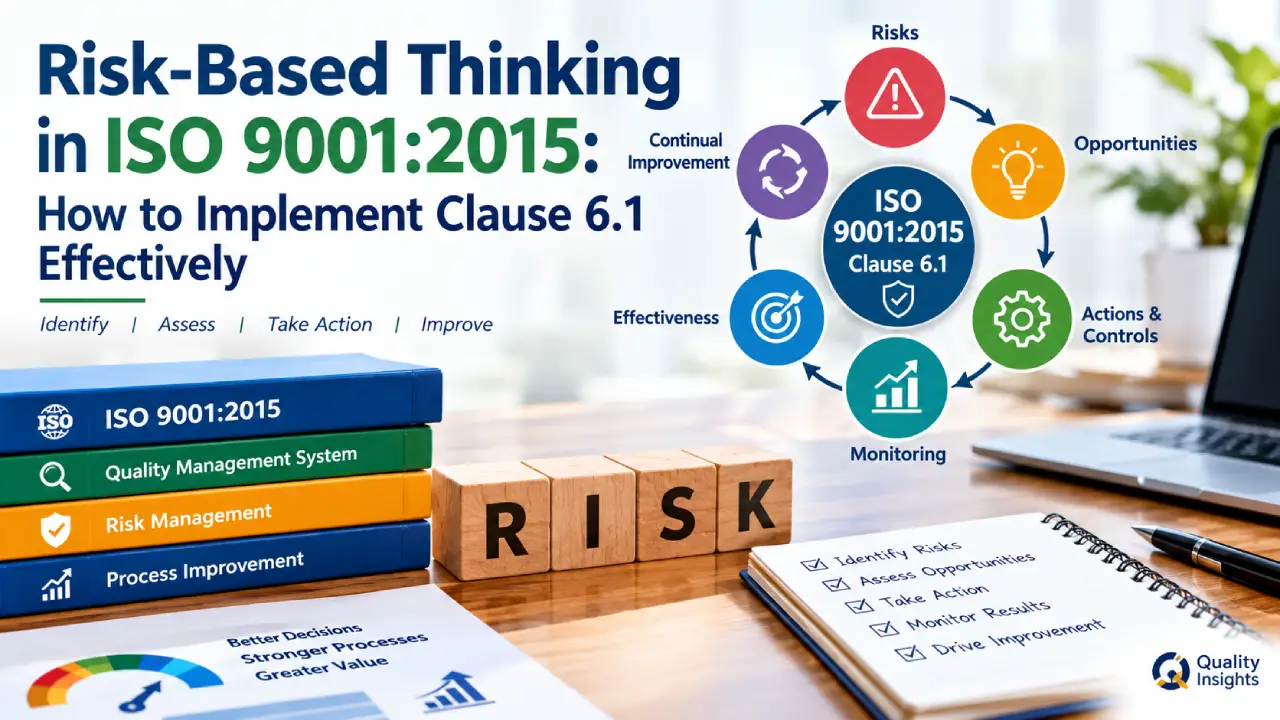
A strong quality management system does more than find problems after they happen. It helps an organization understand what could go wrong, what could affect customer satisfaction, and what opportunities could improve business performance before taking action.
This is the basic idea behind risk based thinking ISO 9001 2015 clause 6.1, which requires organizations to consider risks and opportunities when planning their Quality Management System (QMS).
For many organizations, however, risk-based thinking becomes nothing more than a spreadsheet created before an ISO audit. A few risks are listed, numbers are assigned, actions are added, and the document is filed away. That approach may produce paperwork, but it does not create an effective QMS.
The real purpose is different.
Risk-based thinking should influence everyday decisions. It should help a company decide where controls are needed, where resources should be used, which suppliers require closer monitoring, where processes are likely to fail, and where an opportunity can improve results.
ISO 9001:2015 made this approach much more visible than previous editions. ISO’s own Auditing Practices Group explains that risk had already been present in earlier versions of ISO 9001, but the 2015 edition made risk-based thinking a clear part of planning and QMS effectiveness. It also explains that risk-based thinking considers both risks and opportunities.
Risk-based thinking in ISO 9001 means identifying issues that could affect intended QMS results, deciding what needs to be done, integrating those actions into processes, and checking whether the actions work.
This guide explains how to make that approach practical rather than turning Clause 6.1 into a paperwork exercise.
Contents
- 1. What Is Risk-Based Thinking in ISO 9001:2015?
- 2. Why Does ISO 9001 Require Risk-Based Thinking?
- 3. Understanding ISO 9001 Clause 6.1
- 4. Clause 6.1 in Simple Terms
- 5. Risk and Opportunity: What Is the Difference?
- 6. Risk-Based Thinking Is Not the Same as Risk Management
- 7. How Clause 6.1 Connects With the Process Approach
- 8. Risk-Based Thinking and the PDCA Cycle
- 9. How to Start a Risk Assessment for Your QMS
- 10. Where SWOT Analysis Can Help
- 11. What Should a Risk Register Contain?
- 12. The Biggest Mistake: Creating a Risk Register and Stopping There
- 13. A Practical Rule for Small and Medium Businesses
- 14. Current ISO 9001 Status: An Important 2026 Note
- 15. Key Takeaways So Far
- 16. How to Implement Clause 6.1 Step by Step
- 17. Step 1: Map the Processes Before Assessing Risk
- 18. Step 2: Identify Risk Sources
- 19. Step 3: Identify Opportunities as Well as Risks
- 20. Step 4: Establish Risk Evaluation Criteria
- 21. Why Risk Scores Should Not Be Blindly Trusted
- 22. Step 5: Evaluate Existing Controls
- 23. Step 6: Decide the Right Response
- 24. Step 7: Define Clause 6.1 Actions
- 25. Example: Supplier Risk Action
- 26. Step 8: Integrate Actions Into QMS Processes
- 27. Step 9: Assign Ownership
- 28. Step 10: Set Review Dates
- 29. How to Build a Practical Risk Register
- 30. Using FMEA for Detailed Risk Assessment
- 31. Risk Assessment in Manufacturing
- 32. Risk Assessment in Construction
- 33. Risk Assessment in Engineering Services
- 34. Risk-Based Thinking and Corrective Action
- 35. Linking Risks to Quality Objectives
- 36. Risk-Based Thinking and Change Management
- 37. How to Know Whether a Risk Action Worked
- 38. Common Risk-Based Thinking Mistakes
- 39. A Simple Risk Assessment Example
- 40. A Practical Decision Tree
- 41. Practical Risk-Based Thinking Checklist
- 42. What an Auditor Is Likely to Look For
- 43. The Goal Is Not Zero Risk
- 44. Key Takeaways So Far
- 45. Auditing Risk-Based Thinking Under Clause 6.1
- 46. What Evidence Can Demonstrate Effective Implementation?
- 47. Questions an Internal Auditor Can Ask
- 48. Common Clause 6.1 Nonconformities
- 49. How Internal Audit Can Test Risk-Based Thinking
- 50. Linking Risk to Management Review
- 51. Connecting Risk With Quality Objectives
- 52. Risk-Based Thinking and Customer Satisfaction
- 53. Risk-Based Thinking in Supplier Management
- 54. Risk-Based Thinking and Competence
- 55. Risk-Based Thinking and Documented Information
- 56. How Technology Can Improve Risk Management
- 57. Using Data to Monitor Risk
- 58. Using Pareto Analysis to Prioritize Quality Risks
- 59. Risk-Based Thinking and Continual Improvement
- 60. A Complete Clause 6.1 Implementation Example
- 61. How to Improve an Existing Weak Risk Register
- 62. Risk-Based Thinking: A Management Checklist
- 63. Practical Clause 6.1 Audit Checklist
- 64. 15 Questions Employees Should Be Able to Answer
- 65. What Good Risk-Based Thinking Looks Like
- 66. Frequently Asked Questions
- 67. Actionable Takeaways
- 68. Final Conclusion
- 69. References and Further Reading
- 70. Quick Reference: Clause 6.1 at a Glance
What Is Risk-Based Thinking in ISO 9001:2015?
Risk-based thinking is the practice of considering what could happen, how it could affect the QMS, and what the organization should do about it.
It is not limited to negative events.
There are two sides:
- Risk: something that could cause an unwanted result.
- Opportunity: something that could help achieve a better result.
For example, a manufacturer may identify the risk of a critical machine breaking down. The possible result could be production delay, late delivery, additional repair costs and customer dissatisfaction.
The organization could respond by:
- introducing preventive maintenance;
- keeping critical spare parts;
- training more than one technician;
- monitoring machine condition;
- reviewing maintenance performance.
Now consider the opportunity side.
The same company may identify an opportunity to use automated machine monitoring. This could provide earlier warning of equipment problems and reduce unplanned downtime.
Both situations involve planning based on what may happen.
That is the heart of the approach.
Why Does ISO 9001 Require Risk-Based Thinking?
A QMS operates in a changing environment.
Customers change their requirements. Suppliers experience delays. Employees leave. Technology changes. Regulations change. New competitors enter the market. Equipment becomes obsolete. Raw material prices fluctuate. Cybersecurity threats increase. Climate-related events can affect supply and operations.
A quality system that only reacts after something happens is weak.
Risk-based thinking encourages the organization to look ahead.
ISO 9001:2015 connects this thinking with several parts of the QMS, including organizational context, planning, operational controls, performance evaluation and improvement. ISO’s TC 176 guidance states that risk-based thinking is essential to achieving an effective QMS and encourages organizations to address both risks and opportunities.
This means Clause 6.1 should not be treated as an isolated quality department activity.
It should connect with actual business processes.
Example: Supplier Risk
Imagine a U.S. manufacturer depends on one supplier for a critical electronic component.
The supplier has a good quality history, so the company may initially consider the supplier low risk.
But a review shows that:
- there is no approved alternative supplier;
- the component has a 12-week lead time;
- the supplier operates from a single production location;
- demand is increasing;
- the component is required for every finished product.
The quality risk is not simply “supplier may provide defective material.”
The bigger risk may be loss of supply.
The organization could respond by qualifying a second supplier, increasing safety stock, improving supplier communication or reviewing forecast information.
This is risk-based thinking because the company is considering the possible effect before a failure occurs.
Understanding ISO 9001 Clause 6.1
Clause 6.1 of ISO 9001:2015 is titled Actions to Address Risks and Opportunities.
The clause requires the organization to consider the issues identified in Clause 4.1 and the requirements of relevant interested parties identified in Clause 4.2.
The organization then determines the risks and opportunities that need to be addressed so that it can:
- give assurance that the QMS can achieve its intended result;
- enhance desirable effects;
- prevent or reduce undesirable effects;
- achieve improvement.
The important point is that the standard does not prescribe one mandatory risk-management method.
There is no universal ISO 9001 requirement saying every company must use:
- a 5 × 5 risk matrix;
- FMEA;
- SWOT analysis;
- a specific risk score;
- a particular risk register format.
The organization needs to choose an approach that is suitable for its size, complexity, products, services and level of risk.
That flexibility is important.
A small engineering consultancy may not need the same risk process as a large aerospace manufacturer.
Clause 6.1 in Simple Terms
Clause 6.1 can be understood through five practical questions:
Question | What the organization should consider |
1. What can affect our QMS? | Internal and external issues |
2. Who can affect or be affected by us? | Interested parties and their requirements |
3. What risks and opportunities matter? | Issues that could affect intended results |
4. What will we do? | Actions and controls |
5. Does it work? | Monitor and evaluate effectiveness |
This is a useful way to explain the clause to employees who are not familiar with ISO terminology.
The objective is not to create a complicated risk document.
The objective is to make better quality decisions.
Risk and Opportunity: What Is the Difference?
The phrase risk and opportunity ISO 9001 is important because organizations sometimes focus only on threats.
That creates an incomplete system.
Risk
A risk is associated with uncertainty that may affect an intended result.
For a manufacturer, examples could include:
- incorrect raw material;
- equipment failure;
- inadequate employee competence;
- incorrect drawing revision;
- late supplier delivery;
- inaccurate inspection equipment;
- poor production planning;
- ineffective communication;
- software failure;
- customer requirement being misunderstood.
Opportunity
An opportunity may create a beneficial result.
Examples include:
- automating inspection;
- qualifying a second supplier;
- improving employee training;
- simplifying an approval process;
- using digital inspection records;
- redesigning packaging;
- improving production flow;
- introducing statistical process monitoring.
An opportunity does not always mean a guaranteed benefit.
It means there is a reasonable possibility of achieving a better result if the organization chooses to pursue it.
Risk-Based Thinking Is Not the Same as Risk Management
This distinction is often misunderstood.
ISO 9001 risk management does not necessarily mean creating a separate corporate risk-management department or applying a complex enterprise risk framework.
Risk-based thinking is broader.
It should become part of normal management decisions.
For example:
A purchasing manager asks, “What could affect this supplier’s ability to meet our requirements?”
A production manager asks, “Where could this process produce nonconforming output?”
A project manager asks, “What could cause this project to miss customer requirements?”
A quality engineer asks, “What could cause the measurement system to give unreliable results?”
A top manager asks, “What changes could affect the organization’s ability to consistently meet customer requirements?”
All of these are examples of risk-based thinking.
How Clause 6.1 Connects With the Process Approach
ISO 9001:2015 uses the process approach.
An organization identifies processes, understands their inputs and outputs, establishes controls, monitors performance and improves the processes.
Risk-based thinking strengthens this approach.
Instead of asking only:
“What is this process supposed to do?”
the organization also asks:
“What could prevent this process from achieving its intended result?”
Consider an incoming inspection process.
Its intended result may be to ensure purchased material meets specified requirements before release to production.
Potential risks include:
- incorrect specification used;
- wrong material identification;
- inadequate sampling;
- damaged material not detected;
- inspection equipment out of calibration;
- inspector lacks competence.
Once these risks are understood, appropriate controls can be selected.
This makes the risk process directly useful to operations.
Risk-Based Thinking and the PDCA Cycle
Risk-based thinking also fits naturally into the Plan-Do-Check-Act (PDCA) approach.
Plan
Identify relevant risks and opportunities and determine actions.
Do
Implement the selected controls and actions.
Check
Monitor results and determine whether the controls are effective.
Act
Improve the process when results are not satisfactory or when better opportunities are identified.
This prevents risk assessment from becoming a once-a-year exercise.
For example, a company identifies a risk of incorrect product labeling.
It introduces barcode verification.
After implementation, it monitors labeling errors for three months.
If errors fall significantly, the control appears effective. If errors continue, the organization needs to investigate why the control is not working.
The action is not the end of the risk process.
Effectiveness matters.
How to Start a Risk Assessment for Your QMS
A practical risk assessment QMS process can begin with the organization’s existing processes.
Do not start by filling in a risk template.
Start by understanding the business.
Step 1: Review Organizational Context
Look at the internal and external issues that can affect the QMS.
Examples include:
- market conditions;
- customer expectations;
- technology;
- workforce capability;
- infrastructure;
- supplier availability;
- legal and regulatory requirements;
- financial conditions;
- business growth;
- changes in products or services.
The 2024 climate-action amendment to ISO 9001:2015 also added climate-change considerations to Clauses 4.1 and 4.2. Organizations using the 2015 edition with the amendment therefore need to determine whether climate change is a relevant issue and recognize that interested parties can have climate-related requirements.
This is especially relevant where climate conditions can affect transportation, facilities, energy availability, raw materials, water supply or supply-chain reliability.
Step 2: Identify Interested Parties
Ask who has requirements or expectations that can affect the QMS.
Examples include:
- customers;
- regulators;
- employees;
- suppliers;
- owners;
- distributors;
- certification bodies;
- local authorities.
For a U.S. company, applicable federal, state and local requirements may form part of the organization’s external compliance environment depending on the industry and location.
Step 3: Identify Risks and Opportunities
Now look at each important process.
Ask:
What could prevent this process from achieving its intended result?
Then ask:
What could improve this process or create a better result?
This simple pair of questions can generate useful information without making the process unnecessarily complicated.
Where SWOT Analysis Can Help
A SWOT analysis ISO 9001 can be useful during strategic planning and context analysis.
SWOT stands for:
- Strengths
- Weaknesses
- Opportunities
- Threats
For example, an engineering company may identify:
SWOT Area | Example |
Strength | Highly experienced engineering team |
Weakness | Dependence on two senior engineers |
Opportunity | Growing demand for digital engineering services |
Threat | Increasing competition and price pressure |
SWOT is useful for understanding the bigger picture.
However, it should not be treated as the complete Clause 6.1 process.
A SWOT table may identify a broad issue such as “dependence on key personnel,” but the organization still needs to determine what action is appropriate.
For example:
- cross-training;
- succession planning;
- documented technical knowledge;
- recruitment;
- competency development.
The action is what turns risk thinking into QMS control.
What Should a Risk Register Contain?
A risk register quality document can be very simple.
A practical register might contain:
Field | Example |
Process | Supplier management |
Risk | Critical supplier delay |
Cause | Single-source dependency |
Potential effect | Production interruption |
Existing control | Monthly supplier review |
Risk rating | High |
Action | Qualify alternate supplier |
Owner | Purchasing Manager |
Due date | 30 June |
Status | In progress |
Effectiveness | Monitor delivery performance |
The exact format is not prescribed by ISO 9001:2015.
The important thing is whether the organization can show that relevant risks and opportunities have been considered and that appropriate actions are integrated into the QMS.
The Biggest Mistake: Creating a Risk Register and Stopping There
A risk register is only a tool.
It is not the objective.
A company can have 100 risks listed in a spreadsheet and still have a weak QMS if nobody acts on them.
A useful risk process should answer:
- Why was the risk identified?
- What could happen?
- How serious could the result be?
- What controls already exist?
- Is additional action necessary?
- Who owns the action?
- When will it be completed?
- How will effectiveness be checked?
- What happens if the risk changes?
That is much more valuable than simply assigning a number such as “12” or “16.”
A Practical Rule for Small and Medium Businesses
Small businesses often believe risk-based thinking requires a large system.
It does not.
A small machine shop could use one simple worksheet covering:
- key business processes;
- major risks;
- opportunities;
- existing controls;
- additional actions;
- responsible person;
- review status.
A 20-person company does not need to copy the risk process of a multinational manufacturer.
The level of control should make sense for the organization’s risks.
That is one of the strengths of the ISO 9001 framework.
Current ISO 9001 Status: An Important 2026 Note
There is an important update for anyone reading older ISO 9001:2015 guidance.
ISO published ISO 9001:2026 on September 16, 2026, and it is the new edition replacing ISO 9001:2015. ISO states that the 2026 edition builds on the existing framework and places greater emphasis on areas including quality culture, leadership, and proactive treatment of risks and opportunities. Organizations certified to the 2015 edition should therefore check the transition arrangements issued by their certification body.
This article focuses specifically on the ISO 9001:2015 Clause 6.1 approach requested here, including the 2024 climate-action amendment. The concepts remain highly useful for understanding the development of risk-based planning and for organizations working through transition to the new edition.
Key Takeaways So Far
Before moving into the practical implementation methods, remember these points:
- Risk-based thinking is not just a quality department activity.
- It considers both risks and opportunities.
- Clause 6.1 is connected to organizational context and interested parties.
- ISO 9001:2015 does not require one specific risk-assessment method.
- A risk register is a tool, not the purpose of the process.
- Risks should be connected to actual processes and controls.
- Actions should have owners and defined follow-up.
- Effectiveness should be checked.
- SWOT can support context analysis, but it does not replace risk assessment.
- Risk thinking should operate as part of normal business decisions.
- The 2024 amendment introduced climate-change considerations into the context and interested-party requirements.
- As of September 2026, ISO 9001:2026 is the current edition, so organizations using 2015 should consider transition requirements.
How to Implement Clause 6.1 Step by Step
The best way to implement Clause 6.1 is to connect risk thinking directly to the organization’s processes. Instead of creating a separate quality exercise, review what the company actually does, identify what could affect results, decide what controls are needed, assign responsibility, and then check whether those controls work.
A practical implementation can follow this sequence:
- Understand the process.
- Identify possible risks.
- Identify opportunities.
- Evaluate significance.
- Review existing controls.
- Decide additional actions.
- Assign responsibility.
- Implement the actions.
- Monitor effectiveness.
- Update the assessment when conditions change.
This approach keeps the system simple while creating clear evidence that planning has been carried out.
Step 1: Map the Processes Before Assessing Risk
Risk assessment becomes much more useful when it is connected to processes.
Start by listing the organization’s major QMS processes.
For a manufacturing company, these could include:
- sales and contract review;
- purchasing;
- supplier control;
- incoming inspection;
- production;
- equipment maintenance;
- inspection and testing;
- calibration;
- warehousing;
- delivery;
- customer service;
- corrective action;
- internal audit.
For an engineering consultancy, the list could be different:
- customer inquiry;
- proposal preparation;
- contract review;
- engineering design;
- design verification;
- document control;
- client approval;
- project delivery;
- technical review;
- customer feedback.
There is no benefit in forcing every organization into the same process map.
Risk should follow the business.
Example: Production Process
Consider a production process with the following basic flow:
Customer order → Production planning → Material issue → Manufacturing → Inspection → Packing → Delivery
Each stage has potential failure points.
For example:
Process Stage | Possible Risk | Possible Effect |
Order review | Requirement misunderstood | Incorrect product |
Planning | Incorrect capacity estimate | Late delivery |
Material issue | Wrong material selected | Nonconforming product |
Manufacturing | Machine setting incorrect | Defective output |
Inspection | Incorrect measurement | Defect escapes |
Packing | Wrong label | Customer receives wrong product |
This process-level view is much more useful than writing a generic statement such as “production risk.”
Step 2: Identify Risk Sources
Once the process is understood, identify what could cause failure.
A useful question is:
What could prevent this process from achieving its intended result?
Consider different sources of risk.
People
Potential issues include:
- insufficient competence;
- inadequate training;
- high employee turnover;
- dependence on one specialist;
- unclear responsibilities;
- fatigue or workload.
Equipment
Potential issues include:
- machine failure;
- inadequate maintenance;
- obsolete equipment;
- incorrect settings;
- unreliable measuring equipment.
Materials
Potential issues include:
- incorrect specification;
- supplier variation;
- shortage;
- counterfeit or substituted material;
- poor storage conditions.
Methods
Potential issues include:
- unclear work instructions;
- outdated procedures;
- inconsistent inspection methods;
- inadequate process controls.
Measurement
Potential issues include:
- equipment out of calibration;
- incorrect measurement method;
- poor sampling;
- data-entry errors;
- unreliable inspection results.
Environment
Potential issues include:
- temperature;
- humidity;
- contamination;
- power interruption;
- workplace conditions;
- extreme weather events.
External Factors
Potential issues include:
- regulatory changes;
- supplier disruption;
- transportation problems;
- market changes;
- cybersecurity incidents;
- geopolitical events;
- climate-related disruption.
This broad view prevents the assessment from becoming too focused on obvious production defects.
Step 3: Identify Opportunities as Well as Risks
Many organizations understand risk identification but forget the opportunity side.
The standard expects organizations to determine risks and opportunities that need to be addressed.
Opportunity identification ISO activities can be built into normal management meetings.
Ask:
What could make this process better than it is today?
Examples include:
- automation;
- employee cross-training;
- digital records;
- supplier development;
- process simplification;
- improved inspection technology;
- better production planning;
- customer communication improvements;
- data analysis;
- new service capabilities.
Example: Inspection Opportunity
Suppose a company currently performs manual inspection of every component.
The process works, but it takes significant labor time.
The organization identifies an opportunity to introduce automated vision inspection.
The opportunity could potentially:
- reduce inspection time;
- improve consistency;
- provide electronic inspection records;
- detect certain defects earlier;
- free employees for higher-value activities.
The company would then evaluate whether the investment is suitable.
An opportunity is not automatically an action.
It should be evaluated just as a significant risk would be.
Step 4: Establish Risk Evaluation Criteria
Once risks have been identified, the organization needs a consistent way to determine which ones deserve attention.
One common approach is a simple risk score.
For example:
Risk Score = Severity × Likelihood
A company could use a 1–5 scale.
Severity
Score | Meaning |
1 | Very low impact |
2 | Low impact |
3 | Moderate impact |
4 | High impact |
5 | Very high impact |
Likelihood
Score | Meaning |
1 | Rare |
2 | Unlikely |
3 | Possible |
4 | Likely |
5 | Almost certain |
A risk with severity 5 and likelihood 4 would receive a score of:
5 × 4 = 20
The organization could define its own categories, such as:
- 1–4: Low;
- 5–9: Moderate;
- 10–16: High;
- 17–25: Critical.
These numbers are only an example.
ISO 9001:2015 does not require this particular scoring system.
The important requirement is that the organization has a sensible method for deciding what needs attention.
Why Risk Scores Should Not Be Blindly Trusted
A numerical score can create a false sense of accuracy.
Consider two risks:
Risk A: A cosmetic defect occurs frequently but rarely affects product function.
Risk B: A safety-critical component fails very rarely but could have severe consequences.
A basic multiplication score may make the two risks appear similar.
Management therefore needs to consider the nature of the risk, not simply the number.
For higher-risk industries, organizations may use more detailed techniques such as:
- FMEA;
- fault-tree analysis;
- hazard analysis;
- process capability analysis;
- reliability analysis;
- statistical methods.
For a small service company, a simple qualitative assessment may be sufficient.
Use a method that matches the organization’s actual risk.
Step 5: Evaluate Existing Controls
A common mistake is to identify a risk and immediately create another procedure.
Before doing that, ask:
What controls already exist?
For example, the risk is:
Wrong drawing revision used during production.
Existing controls may include:
- controlled electronic drawings;
- document revision status;
- production traveler;
- supervisor verification;
- removal of obsolete drawings.
If these controls are already effective, another procedure may add unnecessary complexity.
The assessment should therefore distinguish between:
- inherent risk — risk before controls;
- existing controls — what is already being done;
- residual risk — remaining risk after controls.
This creates a more realistic picture.
Step 6: Decide the Right Response
After evaluating a risk, the organization can decide what to do.
Possible responses include:
Avoid
Stop or change the activity that creates unacceptable risk.
Reduce
Introduce controls that reduce likelihood or impact.
Share
Use contracts, insurance, partnerships or other arrangements where appropriate.
Accept
Accept the risk when it is understood and within the organization’s defined tolerance.
Pursue
For an opportunity, deliberately invest resources to achieve a desirable result.
The correct response depends on the situation.
Not every risk needs an expensive control.
Step 7: Define Clause 6.1 Actions
This is where many risk registers become weak.
A statement such as:
“Monitor supplier performance.”
is often too vague.
A better action might be:
“Establish monthly supplier delivery and quality performance review for critical suppliers and initiate corrective action when defined performance limits are missed.”
The second statement gives the organization something that can actually be implemented and checked.
Good clause 6.1 actions should ideally identify:
- what will be done;
- why it is needed;
- who is responsible;
- when it will be completed;
- what evidence will demonstrate completion;
- how effectiveness will be evaluated.
Example: Supplier Risk Action
Risk
Critical supplier repeatedly delivers components late.
Possible effect
Production schedule disruption and customer delivery delays.
Existing control
Supplier performance reviewed quarterly.
Additional action
Increase review frequency to monthly for the supplier and develop an alternate source.
Owner
Purchasing Manager.
Target
Complete alternate supplier qualification within six months.
Effectiveness measure
Supplier on-time delivery reaches the organization’s defined target for three consecutive months.
That is much stronger than writing “supplier risk — medium — monitor.”
Step 8: Integrate Actions Into QMS Processes
Clause 6.1 does not simply ask organizations to identify risks.
The actions need to be integrated into the QMS processes.
For example, if supplier risk is high, the response may become part of:
- purchasing controls;
- supplier evaluation;
- incoming inspection;
- supplier audits;
- inventory planning.
If employee competence is a significant risk, the response may become part of:
- competency requirements;
- training plans;
- qualification records;
- job descriptions;
- succession planning.
If equipment failure is a major risk, the response may become part of:
- preventive maintenance;
- spare-parts management;
- equipment monitoring;
- maintenance records.
Risk management becomes powerful when it changes the way work is performed.
Step 9: Assign Ownership
A risk without an owner often remains a risk indefinitely.
The owner should have enough authority and resources to implement the action.
For example:
Risk | Action | Owner |
Critical supplier failure | Qualify alternate supplier | Purchasing Manager |
Measurement error | Review calibration controls | Quality Manager |
Skill shortage | Cross-train operators | Production Manager |
Design error | Add independent design review | Engineering Manager |
Cybersecurity disruption | Strengthen system backup controls | IT Manager |
The Quality Manager may coordinate the overall process, but operational risks should normally have operational owners.
This creates accountability.
Step 10: Set Review Dates
Risk is not static.
A risk assessment should be reviewed when relevant conditions change.
Examples include:
- new product;
- new customer;
- new supplier;
- major equipment change;
- organizational restructuring;
- process change;
- new regulatory requirement;
- significant nonconformity;
- customer complaint trend;
- serious supplier problem;
- major market change.
The organization can also establish periodic reviews.
The frequency should depend on risk and business conditions.
A highly dynamic manufacturing operation may review important risks monthly, while a stable low-risk process may require less frequent formal review.
How to Build a Practical Risk Register
A good risk register should be easy for employees to understand.
Here is an example.
Process | Risk | Effect | Existing Control | Rating | Action | Owner | Status |
Purchasing | Supplier delay | Production interruption | Supplier monitoring | High | Qualify second source | Purchasing | Open |
Production | Incorrect machine setup | Defective product | Setup checklist | Medium | Add first-piece verification | Production | Open |
Inspection | Measurement error | Defect escape | Calibration | High | Review measurement method | Quality | In progress |
HR/Competence | Skill shortage | Production delay | Training matrix | Medium | Cross-train operators | HR/Production | Open |
Document Control | Obsolete drawing used | Nonconforming output | Revision control | High | Add point-of-use verification | Quality | Closed |
The register can be maintained in Excel, a QMS platform, an ERP system or another suitable tool.
The software is not what makes the process effective.
Good decisions and follow-through do.
Using FMEA for Detailed Risk Assessment
Failure Mode and Effects Analysis, commonly called FMEA, can be useful when a process requires deeper analysis.
FMEA generally considers:
- failure mode;
- effect;
- cause;
- existing controls;
- severity;
- occurrence;
- detection;
- recommended action.
For example:
Failure Mode | Effect | Cause | Control |
Incorrect torque | Joint failure | Tool setting incorrect | Torque verification |
Wrong component | Product malfunction | Similar parts stored together | Barcode verification |
Missing inspection | Defect escape | Inspection step skipped | Electronic inspection hold |
FMEA is particularly useful for complex or higher-risk processes.
However, organizations should avoid using FMEA simply because it sounds sophisticated.
If a simple risk assessment adequately controls a low-risk process, an elaborate FMEA may waste time.
Risk Assessment in Manufacturing
Manufacturing provides many clear examples of risk-based thinking.
Imagine a U.S. manufacturer producing precision-machined components.
A process review identifies the following:
Risk 1: Tool Wear
Tool wear could increase dimensional variation.
Potential controls:
- tool-life monitoring;
- first-piece inspection;
- periodic dimensional checks;
- defined replacement limits.
Risk 2: Measuring Equipment
An out-of-calibration instrument could cause incorrect acceptance decisions.
Potential controls:
- calibration program;
- identification of calibration status;
- equipment verification;
- controls for equipment found out of calibration.
Risk 3: Material Identification
Incorrect material could enter production.
Potential controls:
- supplier certificates;
- material identification;
- segregation;
- barcode scanning;
- traceability records.
Each risk leads to a process control.
That is what makes the assessment useful.
Risk Assessment in Construction
Construction organizations face a different risk profile.
Examples may include:
- drawing revision errors;
- incorrect material specification;
- subcontractor performance;
- inspection hold-point failures;
- inadequate competency;
- incomplete records;
- weather disruption;
- supply-chain delays.
Suppose a project team identifies the risk that a subcontractor will install an outdated design revision.
The response could include:
- controlled drawing distribution;
- revision verification before work;
- inspection hold points;
- subcontractor briefing;
- documented approval.
The risk assessment should therefore connect directly to project controls.
Risk Assessment in Engineering Services
An engineering consultancy may face risks such as:
- incomplete customer requirements;
- incorrect design assumptions;
- inadequate technical review;
- unauthorized design changes;
- loss of project knowledge;
- missed contractual requirements.
A practical control could be an independent technical review before issuing critical deliverables.
The organization could then measure:
- design review findings;
- customer corrections;
- rework;
- project delays;
- complaints.
This gives management information about whether the control is actually working.
Risk-Based Thinking and Corrective Action
Risk-based thinking should not replace corrective action.
The two activities serve different purposes.
Corrective action responds to an identified nonconformity and seeks to address its cause so that the problem does not recur.
Risk-based thinking is more proactive.
It asks:
“What could go wrong even though we have not experienced the problem yet?”
Consider a company that has never experienced a critical supplier failure.
That does not mean supplier failure is impossible.
Risk-based thinking allows the company to identify the exposure before an actual failure occurs.
This is one reason the 2015 edition moved away from treating preventive action as a separate formal clause and embedded preventive thinking throughout the QMS.
In practice, this means ISO 9001 preventive action is better understood as part of proactive planning, process control and risk-based thinking rather than as a separate mandatory “preventive action procedure.”
Linking Risks to Quality Objectives
Risk-based thinking becomes stronger when it is connected to quality objectives.
Suppose an organization has a quality objective:
Reduce customer complaints by 20%.
The organization can examine what risks could prevent achievement.
Potential risks include:
- recurring production defects;
- inadequate customer requirement review;
- weak complaint analysis;
- supplier defects;
- inadequate final inspection.
Actions can then support the objective.
For example:
- supplier improvement;
- process capability monitoring;
- complaint trend analysis;
- additional inspection;
- employee training.
This creates a direct connection:
Risk → Action → Objective → Measurement → Improvement
That is far more useful than keeping the risk register separate from the rest of the QMS.
Risk-Based Thinking and Change Management
Changes create new risks.
Whenever an organization changes:
- equipment;
- software;
- suppliers;
- processes;
- facilities;
- personnel;
- product specifications;
- organizational structure;
it should consider possible effects on the QMS.
Example
A manufacturer replaces a manual inspection process with automated inspection.
The change may create an opportunity to improve consistency.
But it also introduces risks:
- software configuration errors;
- incorrect inspection parameters;
- employee training gaps;
- equipment integration problems;
- inaccurate acceptance criteria.
A risk-based approach considers both sides before implementation.
The organization can then test the system, train employees, validate the inspection method where appropriate and monitor early results.
How to Know Whether a Risk Action Worked
This is one of the most important parts of the process.
Completing an action does not automatically mean the risk has been controlled.
For example:
Action: Employee training completed.
That proves training occurred.
It does not prove competence improved.
A better effectiveness check could include:
- observation of actual work;
- examination results;
- first-pass yield;
- error rate;
- supervisor evaluation;
- process performance.
Likewise:
Action: Supplier audit completed.
That proves the audit occurred.
It does not prove supplier performance improved.
Better evidence might include:
- on-time delivery;
- defect rate;
- complaint rate;
- corrective action performance.
Effectiveness should be based on results, not paperwork alone.
Common Risk-Based Thinking Mistakes
Mistake 1: Copying Risks From the Internet
Generic risk lists are often disconnected from the organization’s actual processes.
Use them only as prompts.
Your organization’s risks should come from its own activities, customers, suppliers, data and experience.
Mistake 2: Treating Every Risk as High
If everything is high risk, the ranking system provides no useful priority.
Use meaningful criteria.
Mistake 3: Ignoring Opportunities
A risk register containing only threats provides an incomplete view.
Look for ways to improve processes.
Mistake 4: No Action Owner
A risk without responsibility can remain open indefinitely.
Assign an owner.
Mistake 5: No Effectiveness Review
Closing an action because someone completed a task is not enough.
Check the result.
Mistake 6: Making the System Too Complicated
A 20-person company does not necessarily need a 200-page risk-management procedure.
Keep the process proportional.
Mistake 7: Reviewing Risks Only Before Certification Audits
Risk-based thinking should support everyday decisions.
It should not appear only when an external auditor arrives.
A Simple Risk Assessment Example
Consider a company that supplies industrial control panels.
One process is final inspection.
Identified Risk
Incorrect wiring connection passes final inspection.
Cause
Inspection checklist does not identify several critical connection points.
Potential Effect
Panel fails during customer installation.
Existing Control
Final visual inspection.
Risk Evaluation
Severity: 5
Likelihood: 3
The organization decides the risk requires additional action.
Clause 6.1 Action
Revise the inspection checklist to identify all critical connection points and introduce independent verification for high-risk connections.
Owner
Quality Manager.
Effectiveness
Monitor customer installation failures and final inspection defects for three months.
Result
If the defect rate decreases and no related customer issue occurs, the control provides evidence of effectiveness.
This is the type of chain an auditor can understand easily:
Risk → Cause → Effect → Control → Action → Owner → Evidence → Effectiveness
A Practical Decision Tree
When evaluating any risk, use these questions:
- Is the issue relevant to the QMS?
If no, it may not belong in the QMS risk assessment.
- Could it affect intended results?
If yes, continue.
- Are existing controls sufficient?
If yes, document the rationale and monitor.
- Is additional action needed?
If yes, define the action.
- Who owns it?
Assign responsibility.
- How will we know it worked?
Define an effectiveness measure.
- When should the risk be reviewed again?
Set an appropriate review point.
This simple decision path can make Clause 6.1 much easier to manage.
Practical Risk-Based Thinking Checklist
Use the following checklist when implementing or reviewing your system:
- QMS processes have been identified.
- Relevant internal issues have been considered.
- Relevant external issues have been considered.
- Interested-party requirements have been considered.
- Relevant risks have been identified.
- Relevant opportunities have been identified.
- Risk evaluation criteria are defined where appropriate.
- Existing controls are identified.
- Significant risks have appropriate actions.
- Opportunities have been evaluated.
- Actions have responsible owners.
- Target dates are defined where appropriate.
- Actions are integrated into relevant processes.
- Risk controls are monitored.
- Effectiveness is evaluated.
- Risks are reviewed when changes occur.
- Significant results are considered during management review.
- Records provide suitable evidence of implementation.
What an Auditor Is Likely to Look For
An auditor does not normally need to see a perfect-looking risk spreadsheet.
The more important question is whether the organization’s approach is effective and connected to the QMS.
An auditor may ask:
“How did you determine this risk?”
“Why did you decide this risk was significant?”
“What action did you take?”
“Who is responsible?”
“Where is this action implemented?”
“How do you know it was effective?”
“What happens when the process changes?”
“Can you show me an example where risk-based thinking changed a decision?”
That final question can be especially revealing.
A mature organization should be able to show real examples.
For instance:
“We identified a single-source supplier as a significant supply risk, so we qualified an alternative supplier and increased monitoring until the second source was approved.”
That demonstrates that risk thinking affected an actual business decision.
The Goal Is Not Zero Risk
One final point is worth emphasizing.
ISO 9001 does not mean an organization must eliminate every risk.
Risk exists in every business.
The goal is to understand relevant risks, decide how they should be addressed, apply appropriate controls and improve the organization’s ability to achieve intended results.
A company that spends $100,000 eliminating a minor risk while ignoring a major supplier dependency has not demonstrated mature risk-based thinking.
The better approach is to focus resources where they can provide the greatest value.
That is why risk-based approach quality should be based on the organization’s actual circumstances rather than on a generic checklist.
Key Takeaways So Far
Effective Clause 6.1 implementation is practical when the organization:
- starts with its actual processes;
- identifies both risks and opportunities;
- considers causes and potential effects;
- evaluates significance using suitable criteria;
- reviews existing controls before creating new ones;
- assigns clear actions and owners;
- integrates controls into normal processes;
- links significant risks to quality objectives where relevant;
- considers risk when making changes;
- monitors whether controls are effective;
- updates the assessment when conditions change;
- keeps the level of documentation proportional to the organization’s needs.
The strongest risk assessment is not necessarily the longest one.
It is the one that changes decisions, improves controls and reduces unwanted surprises.
Auditing Risk-Based Thinking Under Clause 6.1
A well-designed risk process should produce evidence that can be followed from risk identification to action and results. During an ISO 9001 audit, the auditor is interested not only in whether a risk register exists, but whether the organization has actually considered relevant risks and opportunities and integrated appropriate actions into its QMS.
The strongest evidence usually tells a clear story:
Issue → Risk or opportunity → Evaluation → Action → Implementation → Monitoring → Effectiveness → Improvement
For example, suppose a company identifies late supplier deliveries as a significant risk. The auditor may follow that risk into supplier evaluation records, purchase controls, delivery-performance data, management review and improvement actions.
This is much stronger evidence than showing a spreadsheet with several risk scores but no connection to actual operations.
What Evidence Can Demonstrate Effective Implementation?
Evidence will vary by organization and industry, but useful examples include:
- risk and opportunity assessments;
- process risk reviews;
- SWOT or context-analysis records;
- supplier evaluations;
- FMEA studies;
- maintenance plans;
- competency assessments;
- inspection plans;
- process-control plans;
- quality objectives;
- project risk reviews;
- change-management records;
- management-review outputs;
- internal-audit results;
- customer complaint trends;
- corrective-action records;
- performance indicators.
Not every organization needs all of these.
The key is objective evidence that the organization’s chosen approach is being used and is effective.
Example of an Audit Trail
Imagine an auditor identifies a recurring supplier-quality problem.
The organization can demonstrate:
- Supplier risk was identified.
- The supplier was classified as significant.
- Additional incoming inspection was introduced.
- The supplier received a corrective-action request.
- Supplier performance was monitored.
- Defect rates declined.
- The supplier was re-evaluated.
That is a strong example of risk-based thinking becoming part of the QMS.
Questions an Internal Auditor Can Ask
Internal auditors can use simple questions to determine whether Clause 6.1 is working.
Questions for Process Owners
- What are the main risks in this process?
- How were they identified?
- What could happen if the risk occurs?
- What controls are currently in place?
- Which risks require additional action?
- Who owns those actions?
- How do you know the controls are working?
- What opportunities have you identified?
- What happens when the process changes?
Questions for Employees
Employee interviews can reveal whether risk-based thinking has reached the working level.
For example:
“What could cause you to produce an incorrect product?”
An operator might answer:
“The drawing revision could be wrong, or the machine setup could be incorrect. We check the revision before starting and complete the setup verification.”
That answer provides useful evidence that the risk has been translated into actual work controls.
Common Clause 6.1 Nonconformities
Risk-based thinking can fail in several predictable ways.
Risk Register Exists but Is Not Used
The organization has a risk register, but employees do not know about it and operational controls do not reflect its contents.
This suggests that risk assessment has become a documentation exercise.
Generic Risks
Statements such as:
- “economic conditions”;
- “supplier risk”;
- “employee risk”;
- “quality problems”
are too broad to be useful without further analysis.
A useful risk description explains what could happen and how it could affect the process or QMS.
No Evidence of Action
A high-risk item remains open for months without an owner, action or follow-up.
This raises questions about whether the organization is actually addressing the issue.
Actions Without Effectiveness Evaluation
An organization closes every action as soon as the task is completed.
For example:
“Training completed — closed.”
But there is no evidence that competence improved or the original problem was reduced.
Risks Not Updated After Change
A company introduces a new machine, supplier or software system but never reassesses relevant risks.
This can create gaps because the original assessment may no longer reflect actual operating conditions.
Opportunities Ignored
The organization has a long list of threats but has never considered opportunities to improve QMS performance.
This can indicate an overly defensive approach to Clause 6.1.
How Internal Audit Can Test Risk-Based Thinking
Internal audit should not simply verify that the risk register has been updated.
Instead, select a few significant risks and trace them through the system.
For example:
Risk: Critical supplier may fail to deliver.
Follow it to:
- supplier evaluation;
- purchasing controls;
- approved supplier list;
- stock strategy;
- alternate supplier qualification;
- supplier performance data;
- management review.
Then ask whether the controls are producing the intended results.
This process-based audit approach provides much stronger assurance.
Linking Risk to Management Review
Management review is an important place to evaluate whether significant risks and opportunities remain relevant.
Management should have information that helps answer questions such as:
- Have significant risks changed?
- Are risk controls effective?
- Have new risks emerged?
- Have opportunities been pursued?
- Are quality objectives being achieved?
- Are customer complaints increasing?
- Are suppliers creating new problems?
- Are changes affecting QMS performance?
- Are additional resources required?
For example, if supplier delays are increasing despite existing controls, management may need to approve:
- additional supplier qualification;
- higher inventory levels;
- supplier development;
- contractual changes;
- alternate sourcing.
This demonstrates that risk-based thinking is influencing management decisions.
Connecting Risk With Quality Objectives
Risk and objectives should support each other.
Suppose the organization’s objective is:
Achieve at least 98% on-time delivery.
Management can identify risks that could prevent this target.
Potential risks include:
- supplier delays;
- equipment breakdown;
- inaccurate production planning;
- labor shortages;
- excessive rework;
- transportation disruption.
The organization can then develop actions and monitor relevant indicators.
For example:
Objective | Risk | Action | Indicator |
98% on-time delivery | Supplier delay | Develop alternate source | Supplier OTD |
98% on-time delivery | Machine failure | Improve preventive maintenance | Downtime |
98% on-time delivery | Rework | Analyze recurring defects | First-pass yield |
98% on-time delivery | Planning error | Improve capacity review | Schedule adherence |
This creates a clear relationship between strategic goals and operational risk.
Risk-Based Thinking and Customer Satisfaction
Customer satisfaction is one of the central outcomes of a quality management system.
Risk-based thinking should therefore consider risks that could affect the customer’s experience.
Examples include:
- late delivery;
- incorrect product;
- poor communication;
- product reliability;
- incomplete documentation;
- inconsistent service;
- billing errors;
- slow complaint response.
Consider a service company that receives a large increase in customer inquiries.
The opportunity is business growth.
But there is also a risk.
If staffing does not increase, response times may increase and customer satisfaction may decline.
The organization could therefore:
- forecast workload;
- adjust staffing;
- automate routine inquiries;
- establish response targets;
- monitor response time;
- review customer feedback.
One business change can therefore create both an opportunity and a risk.
Risk-Based Thinking in Supplier Management
Supplier control is one of the areas where risk-based thinking can provide immediate value.
Not every supplier deserves identical controls.
A company may classify suppliers based on factors such as:
- effect on product conformity;
- criticality;
- complexity;
- supplier performance;
- availability of alternatives;
- regulatory impact;
- lead time;
- historical problems.
A critical supplier may require:
- closer performance monitoring;
- supplier audits;
- incoming inspection;
- contingency planning;
- alternate-source development.
A low-risk supplier may require a much simpler approach.
This is an example of applying resources based on risk rather than treating every supplier identically.
Risk-Based Thinking and Competence
People-related risks are often underestimated.
A process can have excellent procedures and equipment but still fail because employees do not have the required competence.
Consider a new CNC machine introduced into a production area.
Potential risks include:
- operators do not understand setup requirements;
- incorrect program selection;
- inadequate troubleshooting skills;
- maintenance personnel lack equipment-specific knowledge.
Possible actions include:
- operator qualification;
- supervised training;
- competency verification;
- refresher training;
- documented troubleshooting instructions.
The effectiveness measure could be a reduction in setup errors, scrap or machine-related downtime.
This provides a much stronger connection between competence and risk.
Risk-Based Thinking and Documented Information
ISO 9001:2015 does not require organizations to create a massive collection of documents for every risk.
The organization should determine what documented information is needed to support effective operation and provide evidence of results.
For risk-based thinking, useful records may include:
- risk assessment;
- action tracking;
- monitoring results;
- review records;
- management decisions;
- effectiveness results.
The amount of documentation should be proportional to:
- organization size;
- process complexity;
- risk level;
- employee competence;
- regulatory environment;
- customer requirements.
A simple process can have simple documentation.
How Technology Can Improve Risk Management
Digital tools can make risk monitoring easier, especially as organizations grow.
A QMS or business system can potentially provide:
- automated action reminders;
- risk dashboards;
- overdue-action alerts;
- supplier performance monitoring;
- trend analysis;
- links between risks and processes;
- audit findings;
- corrective actions;
- management-review information.
But technology should not be used to hide a weak process.
A sophisticated dashboard containing poor-quality data is still a poor risk-management system.
Process first. Technology second.
Using Data to Monitor Risk
Risk-based thinking becomes more powerful when supported by actual performance data.
Useful indicators may include:
- defect rate;
- first-pass yield;
- customer complaints;
- returns;
- rework;
- scrap;
- supplier defects;
- on-time delivery;
- downtime;
- calibration failures;
- audit findings;
- training effectiveness;
- corrective-action recurrence.
For example, if supplier defects increase from 1.2% to 4.8%, the trend may indicate that the current supplier controls are no longer sufficient.
The risk assessment should then be reviewed.
This is an important principle:
Risk assessment should respond to evidence.
Using Pareto Analysis to Prioritize Quality Risks
A Pareto analysis can help an organization identify which problems contribute most to poor quality.
Suppose customer complaints are categorized as:
Complaint Type | Number |
Late delivery | 45 |
Incorrect specification | 20 |
Packaging damage | 12 |
Documentation error | 8 |
Other | 5 |
Instead of spreading resources equally across every complaint type, management can first focus on the largest contributors.
The same idea can be applied to risk-based thinking.
Data can help identify where controls need more attention.
Risk-Based Thinking and Continual Improvement
Risk-based thinking should ultimately support improvement.
A mature QMS does not remain static.
The organization learns from:
- complaints;
- nonconformities;
- audit findings;
- process data;
- supplier performance;
- employee feedback;
- customer feedback;
- changes;
- business results.
These inputs can reveal new risks and opportunities.
For example, recurring rework may identify a process risk.
The organization investigates the cause, changes the process, monitors the results and updates its risk assessment.
That creates a continual improvement loop:
Data → Risk → Action → Result → Learning → Improvement
A Complete Clause 6.1 Implementation Example
Consider a U.S.-based manufacturer producing industrial components.
Context
The company has grown rapidly and now depends heavily on a small number of skilled technicians.
Risk Identified
Loss of key technical personnel could affect production capacity and product quality.
Potential Effects
- production delays;
- setup errors;
- increased rework;
- slower troubleshooting;
- customer delivery problems.
Existing Controls
- job descriptions;
- work instructions;
- training records.
Evaluation
Management determines that the risk requires additional action.
Actions
The organization:
- identifies critical skills;
- creates a competency matrix;
- cross-trains selected employees;
- documents critical technical knowledge;
- introduces qualification assessments;
- reviews competency coverage monthly.
Effectiveness Measures
Management monitors:
- percentage of critical skills with more than one qualified employee;
- setup-related defects;
- production downtime;
- training effectiveness.
Result
After implementation, the company has better coverage of critical skills and fewer production disruptions when experienced employees are absent.
This is a complete example of risk-based thinking because the organization did not simply document the risk.
It changed the way the business manages competence.
How to Improve an Existing Weak Risk Register
If your organization already has a risk register but auditors or employees find it ineffective, do not immediately replace the entire system.
First, review each entry.
Ask:
Is the risk specific?
Replace:
“Supplier risk”
with something more useful:
“Critical supplier may fail to deliver required components within agreed lead time, potentially interrupting production.”
Is the effect clear?
Explain what could happen to:
- product conformity;
- delivery;
- customer satisfaction;
- process performance;
- QMS objectives.
Are existing controls identified?
Document what is already being done.
Is additional action really required?
Avoid creating actions simply to make the register look active.
Is there an owner?
Assign responsibility.
Is there evidence of effectiveness?
Define what result would show improvement.
This process can dramatically improve a weak risk register without making the QMS more complicated.
Risk-Based Thinking: A Management Checklist
Before considering Clause 6.1 implementation mature, management can ask:
Context
- Have significant internal and external issues been considered?
- Have relevant interested-party requirements been considered?
- Has climate change been considered where relevant under the 2024 amendment?
Risk
- Are important QMS risks identified?
- Are risks connected to actual processes?
- Are significant risks prioritized?
- Are existing controls considered?
Opportunity
- Have improvement opportunities been identified?
- Are opportunities evaluated realistically?
- Are worthwhile opportunities incorporated into planning?
Action
- Are significant risks and opportunities addressed?
- Are actions integrated into QMS processes?
- Are responsibilities clear?
- Are actions monitored?
Effectiveness
- Is there evidence that actions work?
- Are performance trends reviewed?
- Are risks updated after changes?
- Are lessons from failures and complaints used?
Management
- Are important risk trends discussed by management?
- Are resources provided where needed?
- Are risk-related results considered during management review?
If the answer to these questions is consistently yes, the organization is likely using risk-based thinking as a management practice rather than merely maintaining an ISO document.
Practical Clause 6.1 Audit Checklist
The following checklist can be used during an internal audit.
No. | Audit Question | Evidence to Sample |
1 | Have relevant risks been identified? | Risk assessment |
2 | Have opportunities been considered? | Risk/opportunity records |
3 | Are risks linked to QMS processes? | Process documents |
4 | Are significant risks prioritized? | Evaluation criteria |
5 | Are existing controls identified? | Procedures/records |
6 | Are actions defined where needed? | Action plans |
7 | Are responsible owners assigned? | Action register |
8 | Are actions implemented? | Objective evidence |
9 | Is effectiveness evaluated? | KPIs/trends |
10 | Are risks reviewed after changes? | Change records |
11 | Are risk results considered in management review? | Management-review records |
12 | Are opportunities used for improvement? | Improvement projects |
An auditor should sample actual processes rather than relying exclusively on documents.
15 Questions Employees Should Be Able to Answer
A practical risk-based culture does not require employees to memorize ISO clauses.
Employees should understand their work and the controls that protect quality.
Useful questions include:
- What can go wrong in your work?
- What happens if it goes wrong?
- What controls prevent the problem?
- What should you do if the control fails?
- What requirements are critical?
- How do you know the equipment is suitable?
- How do you know you are using the correct document?
- What happens when a requirement changes?
- Who should you contact when there is a problem?
- What records do you complete?
- What customer requirements affect your work?
- What supplier issues affect your process?
- What training do you need?
- What improvement would make your process better?
- Have you seen a risk that management should know about?
These questions help move risk-based thinking from management documents to the workplace.
What Good Risk-Based Thinking Looks Like
A mature organization usually shows several characteristics.
First, risks are connected to real work.
Employees understand why controls exist.
Second, management focuses on significant issues.
The company does not waste resources treating every minor issue as critical.
Third, opportunities are considered.
The organization looks for ways to improve, not just ways to prevent failure.
Fourth, actions have owners and evidence.
Problems do not remain indefinitely in a spreadsheet.
Fifth, the system learns.
New information changes the organization’s understanding of risk.
This is the difference between a risk register system and a genuine risk-based management culture.
Frequently Asked Questions
What is risk-based thinking in ISO 9001?
Risk-based thinking is the practice of considering risks and opportunities that could affect the QMS and deciding what actions are needed to achieve intended results, prevent undesirable effects and improve performance.
Is a risk register mandatory under ISO 9001:2015?
No. ISO 9001:2015 does not prescribe a specific risk-register format. An organization must determine and address relevant risks and opportunities, but it can choose documentation and assessment methods appropriate to its circumstances.
Does ISO 9001 require a risk matrix?
No. A 5 × 5 risk matrix is a common tool, but it is not specifically required by ISO 9001:2015.
Does ISO 9001 require FMEA?
No. FMEA can be an excellent risk-analysis method for suitable processes, but ISO 9001 does not require every organization to use it.
What is the difference between risk and opportunity?
A risk is associated with the possibility of an undesirable effect or uncertainty affecting an intended result. An opportunity is a situation that could help achieve a desirable result or improve performance.
Is SWOT analysis enough for Clause 6.1?
No. SWOT can help analyze organizational context, but the organization still needs to determine relevant risks and opportunities and decide appropriate actions.
How often should risks be reviewed?
There is no single universal review frequency suitable for every organization. Risks should be reviewed at appropriate intervals and when significant changes, failures, trends or new information could affect their relevance.
Can a small business use a simple risk assessment?
Yes. The approach should be proportional to the organization’s size, complexity and risk. A small company may use a straightforward process and spreadsheet rather than an elaborate enterprise risk-management system.
How do auditors verify risk-based thinking?
Auditors can review documented information, interview employees, observe processes and trace significant risks through controls, actions and performance results. The focus is on whether the organization’s approach is implemented and effective.
Is risk-based thinking the same as preventive action?
They are closely related but not identical. Risk-based thinking is a proactive way of considering uncertainty, risks and opportunities throughout the QMS. Preventive thinking is embedded in this approach rather than being maintained as a separate mandatory preventive-action procedure under ISO 9001:2015.
Does risk-based thinking eliminate risk?
No. The objective is not necessarily zero risk. The objective is to understand relevant risks, address them appropriately and improve the organization’s ability to achieve intended results.
Actionable Takeaways
If you are implementing Clause 6.1 today, start with these practical actions:
- Map your major QMS processes.
- Ask what could prevent each process from achieving its intended result.
- Identify both risks and opportunities.
- Consider internal and external issues.
- Consider relevant interested-party requirements.
- Review climate-change relevance where applicable.
- Identify existing controls before adding new controls.
- Use a simple scoring method if it helps prioritize risks.
- Do not let numerical scores replace professional judgment.
- Give significant actions clear owners.
- Set realistic completion dates.
- Integrate actions into normal processes.
- Measure whether controls actually work.
- Review risks when significant changes occur.
- Use complaints, audit findings and process data as risk inputs.
- Discuss important risk trends during management review.
- Keep documentation proportional to the organization’s needs.
- Train employees to recognize and report process risks.
- Treat opportunities as seriously as threats.
- Use risk-based thinking to support continual improvement.
Final Conclusion
Risk-based thinking is one of the most practical ideas within ISO 9001:2015 when it is applied correctly.
It does not require every company to create a complex risk-management department. It does not require every process to have a 5 × 5 matrix. It does not mean creating hundreds of risk statements simply to satisfy an auditor.
The real objective is much simpler.
Understand what could affect quality, decide what matters, take appropriate action, and learn from the results.
Clause 6.1 becomes effective when risk assessment changes the way people make decisions.
A purchasing team qualifies a second supplier because supply interruption is a significant risk.
A production team introduces additional verification because a process has a high potential for defect escape.
An engineering team adds an independent review because a design error could have a major customer impact.
A manager invests in cross-training because the organization depends too heavily on one specialist.
A company adopts new inspection technology because it sees an opportunity to improve consistency.
These are examples of risk-based thinking in action.
The strongest QMS is therefore not the one with the biggest risk register.
It is the one where people naturally ask:
“What could affect our ability to deliver the right result, and what should we do about it?”
That question turns Clause 6.1 from an ISO requirement into a practical management habit.
Final Implementation Formula
A simple way to remember the complete approach is:
Understand → Identify → Evaluate → Act → Monitor → Improve
Use that cycle across your processes, and risk-based thinking becomes part of the way the organization operates rather than another document maintained only for certification.
Important 2026 Transition Note
Because this article specifically discusses ISO 9001:2015 Clause 6.1, organizations should also consider the current edition when planning their QMS.
ISO published ISO 9001:2026 on September 16, 2026, replacing ISO 9001:2015. Organizations currently certified to ISO 9001:2015 should obtain the transition information applicable to them from their certification body and plan their transition accordingly. The 2015 framework and its risk-based approach remain valuable for understanding the evolution of the standard, but organizations should not assume that 2015 requirements will remain the current certification requirements indefinitely.
References and Further Reading
For authoritative technical information, readers should prioritize ISO and ISO/IAF sources over generic ISO blogs.
- ISO 9001 — Quality management systems — Requirements: Official information about the ISO 9001 standard and its editions.
- ISO/TC 176 guidance: Resources explaining ISO 9001 implementation, auditing and risk-based thinking.
- ISO/IAF Auditing Practices Group: Guidance explaining how auditors can approach risk-based thinking.
- ISO 9001:2015/Amd 1:2024: Official information concerning climate-action changes to ISO 9001.
- ISO 9001:2026: Current edition and transition information from ISO.
- Ahrefs: Useful SEO research and content-structure guidance for creating reader-focused search content.
For SEO and content research, resources such as Google Search Central, Ahrefs, Semrush, Search Engine Journal and Search Engine Land can help with search-intent analysis and content optimization. However, technical ISO requirements should always be verified against authoritative ISO sources, not SEO articles.
Quick Reference: Clause 6.1 at a Glance
Element | Practical Question |
Context | What issues affect our organization? |
Interested parties | What requirements matter to our QMS? |
Risk | What could prevent intended results? |
Opportunity | What could improve results? |
Evaluation | Which issues require attention? |
Action | What will we do? |
Ownership | Who is responsible? |
Integration | Where will the action be implemented? |
Monitoring | What evidence will we collect? |
Effectiveness | Did the action work? |
Review | Has anything changed? |
Improvement | What did we learn? |
The goal is not to predict every possible problem. The goal is to build a QMS that is prepared to recognize uncertainty, respond intelligently and improve continuously.

“Hey, I am Sachin Ramdurg, the founder of VDiversify.com.
I am QA/QC Manager, Certified Lead Auditor and Quality Champion. I am an Engineer and Passionate Blogger with a mindset of Entrepreneurship. I have been experienced in Blogging for more than 15+ years and following as a youtuber along with blogging, online business ideas, affiliate marketing, and make money online ideas since 2012.