
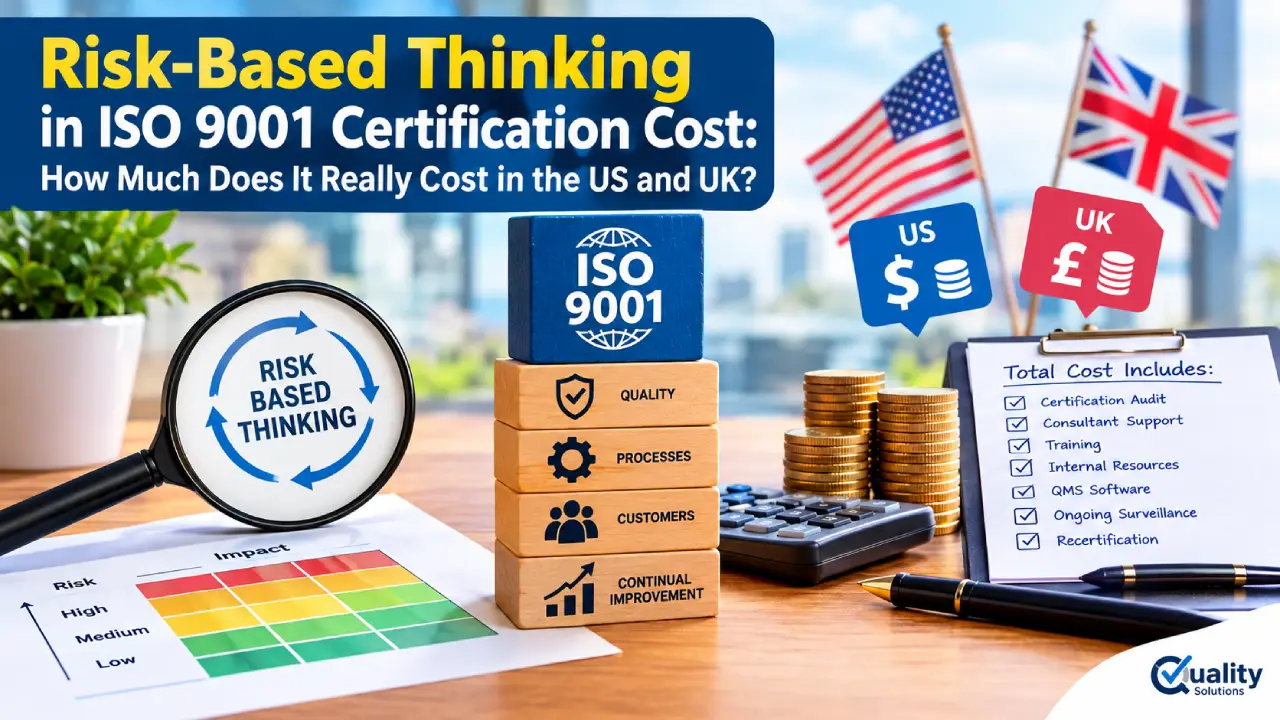
For a business planning an ISO 9001 project, ISO 9001 certification cost US UK is not one fixed number. The amount you actually spend depends on your company size, number of locations, business complexity, existing quality system, certification body, consultant support, employee time, and the level of preparation already completed.
For a small US company, a realistic first-year budget can often fall somewhere around $5,000 to $17,000, while more complex organizations can spend considerably more. In the UK, smaller businesses may commonly budget around £3,000 to £10,000 or more when preparation and certification are considered together.
The important point is that the certification fee itself is only one part of the investment.
A company can receive a low certification quote and still spend much more than expected because the quotation does not include consulting, employee time, training, internal audits, travel, corrective actions, or later surveillance audits.
This guide explains what you should actually budget, what drives the price, how US and UK costs compare, and how to avoid paying for services you do not really need.
Contents
- 1. How Much Does ISO 9001 Certification Cost?
- 2. Why There Is No Fixed ISO 9001 Certification Price
- 3. What Are You Actually Paying For?
- 4. ISO 9001 Certification Cost in the US
- 5. ISO 9001 Certification Cost in the UK
- 6. US vs UK: Which Country Is More Expensive?
- 7. The New ISO 9001:2026 Edition Matters to Your Budget
- 8. What Drives the Final Cost?
- 9. The Cheapest Quote Is Not Always the Cheapest Option
- 10. What Should a Small US Business Budget?
- 11. The Real Question: What Will You Get Back?
- 12. Breaking Down the ISO 9001 Certification Cost
- 13. What Are Certification Body Fees?
- 14. Why Audit Time Affects the ISO 9001 Audit Cost
- 15. Stage 1 Audit Cost
- 16. Stage 2 Audit Cost
- 17. What Happens If You Receive a Nonconformity?
- 18. ISO 9001 Consultant Cost
- 19. Can You Get ISO 9001 Without a Consultant?
- 20. Training Costs
- 21. Internal Audit Costs
- 22. Management Review Costs
- 23. Documentation and QMS Software Costs
- 24. What Is the Certification Timeline?
- 25. A Realistic US Small-Business Example
- 26. A Leaner US Example
- 27. What About Surveillance Audit Cost?
- 28. ISO 9001 Recertification Cost
- 29. Three-Year Certification Budget
- 30. Does ISO 9001:2026 Increase Certification Cost?
- 31. Hidden Costs Businesses Often Forget
- 32. How to Compare Two Certification Quotes
- 33. Accredited Certification vs Low-Cost Certification
- 34. Should You Pay for a Cheap ISO Certificate?
- 35. What Is a Reasonable Quality Certification Investment?
- 36. Where the Money Should Go First
- 37. The Most Important Cost-Control Principle
- 38. What Should Be Included in Your ISO 9001 Budget?
- 39. A Practical US Cost Formula
- 40. What Should a UK Business Budget?
- 41. A Simple Rule for Management
- 42. Why the First Year Usually Costs More
- 43. Certification Should Become Part of Normal Business
- 44. What Happens Next?
- 45. How to Calculate ISO 9001 ROI
- 46. Where ISO 9001 Can Create Financial Benefits
- 47. ISO 9001 ROI Is Not Always Immediate
- 48. How to Reduce ISO 9001 Certification Cost
- 49. How to Choose an ISO 9001 Certification Body
- 50. What Does Accreditation Mean?
- 51. Do Customers Always Require Accredited Certification?
- 52. Questions to Ask Your Customers Before Certification
- 53. How Long Should You Keep Your Certificate?
- 54. Example: Three-Year US Budget
- 55. Example: Three-Year UK Budget
- 56. Should You Use an ISO 9001 Consultant?
- 57. Beware of “Guaranteed Certification”
- 58. Avoid the “Paper QMS” Trap
- 59. How to Prepare for Certification Without Overspending
- 60. A Certification Readiness Checklist
- 61. Common ISO 9001 Cost Mistakes
- 62. How to Make ISO 9001 Pay for Itself
- 63. Metrics Worth Tracking After Certification
- 64. ISO 9001 Cost vs Cost of Poor Quality
- 65. When ISO 9001 May Not Be Worth the Cost
- 66. When ISO 9001 Can Be a Strong Investment
- 67. The US Business Case in One Example
- 68. What About Small Businesses?
- 69. What About Startups?
- 70. What About Existing ISO 9001:2015 Certification?
- 71. A Practical 2026–2029 Transition Budget
- 72. How Much Should You Really Expect to Spend?
- 73. The Most Important Cost Question
- 74. ISO 9001 Certification Cost: Quick Comparison
- 75. Final ISO 9001 Cost Checklist
- 76. 10 Ways to Reduce Your Certification Budget
- 77. Frequently Asked Questions About ISO 9001 Certification Cost
- 78. Final Takeaways
How Much Does ISO 9001 Certification Cost?
For a small, single-site organization in the United States, a practical planning range for the first year is approximately $5,000 to $17,000 when certification-body auditing and preparation support are considered together.
Some organizations may spend less by managing most of the implementation internally. Others can easily exceed $20,000 or $30,000 when they have several locations, complex manufacturing processes, extensive customer requirements, or significant consultant involvement.
Current US market estimates show certification-body audit fees alone can often be in the region of $3,000 to $7,000 for smaller organizations, although actual quotations vary substantially by scope and audit time.
Consulting and implementation support can add another $3,000 to $15,000 or more, depending on how much work is outsourced.
In the UK, smaller organizations can often expect roughly £3,000 to £10,000+ for the first year when certification and preparation are considered together. Published 2026 market estimates show smaller companies sometimes receiving certification-body quotations around £1,000 to £3,000, while consultancy and implementation can add several thousand pounds.
These are planning ranges, not official ISO prices. ISO does not set a universal certification fee. Independent certification bodies quote their services based on the organization being audited.
Why There Is No Fixed ISO 9001 Certification Price
One of the most common mistakes businesses make is searching for a single price for certification.
ISO 9001 does not work like buying a standard-priced product.
A certification body needs to determine how much audit time is appropriate for your organization. The audit effort can increase when there are more employees, more sites, more processes, greater operational complexity, or other factors that require additional audit work.
For example, consider two companies:
- Company A has 12 employees, one office, one site and simple service processes.
- Company B has 12 employees, but operates a laboratory, warehouse and manufacturing area with several outsourced processes.
Both companies have the same number of employees.
Their audit requirements may still be very different.
This is why a quotation based only on headcount should be examined carefully.
What Are You Actually Paying For?
Your total quality certification investment normally contains several different cost categories.
1. Certification body fees
This is the money paid to the independent organization that audits your QMS and, when the requirements are met, issues the certificate.
The fee normally covers activities such as:
- Application and certification administration
- Stage 1 audit
- Stage 2 certification audit
- Audit reporting
- Certification decision
- Certificate issuance
- Ongoing certification administration
The exact structure varies between certification bodies.
2. ISO 9001 consultant cost
A consultant can help with:
- Gap assessment
- Process mapping
- QMS documentation
- Implementation
- Employee awareness
- Internal audit preparation
- Management review preparation
- Corrective action
- Certification audit preparation
For a small organization, consultant costs can range from several thousand dollars to well above $10,000, depending on the level of involvement.
A company with an experienced quality manager may need only limited external support.
A company starting from almost nothing may need considerably more.
3. Internal employee time
This is one of the most overlooked costs.
Suppose five employees each spend 40 hours supporting the ISO project. That is 200 hours of internal labor.
Even if nobody receives an additional invoice, those hours have an economic value.
The work may include:
- Creating process maps
- Reviewing customer requirements
- Updating procedures
- Collecting records
- Performing internal audits
- Attending training
- Preparing management review inputs
- Closing corrective actions
A realistic budget should therefore include both cash costs and internal labor costs.
4. Training and QMS resources
Training expenses may include:
- ISO 9001 awareness training
- Internal auditor training
- Lead auditor training
- Process-specific training
- Quality tools training
Some organizations also purchase QMS software, document-control systems, audit-management tools or electronic forms.
These expenses are not always necessary.
A small business can often manage a straightforward QMS using existing business software if its controls are properly designed.
ISO 9001 Certification Cost in the US
For US organizations, the following is a useful planning model for a small single-site company.
Cost area | Typical planning range |
Certification body audit | 3,000–7,000+ |
Consultant/implementation | 3,000–15,000+ |
Training | 500–3,000+ |
Internal labor | Depends on employee time |
QMS software | 0–5,000+ |
First-year planning range | 5,000–17,000+ |
The ranges overlap because companies use very different implementation approaches.
A business with an established QMS may spend closer to the lower end.
A company building its system from scratch may spend much more.
For larger manufacturers, regulated businesses, engineering companies or multi-site organizations, a budget of $20,000 to $40,000+ is not unusual when implementation support and extensive audit requirements are included.
One US market example published in 2026 places small-business certification and implementation around the $6,500 to $15,000 range for certain single-site packages, while another US consulting source gives a small-business combined estimate of approximately $9,500 when consulting and certification audit fees are included.
These figures demonstrate an important point: there is no universal market price.
You should compare quotations based on scope and deliverables rather than simply choosing the lowest number.
ISO 9001 Certification Cost in the UK
UK organizations face the same basic cost structure.
The certification body charges for auditing and certification, while any consultant or implementation provider charges separately for preparation work.
For a smaller UK business, a practical first-year planning range is approximately:
Cost area | Typical planning range |
Initial certification audit | £1,000–£3,000+ |
Consultancy/implementation | £2,000–£7,000+ |
Training and other resources | £500–£2,000+ |
First-year planning range | £3,000–£10,000+ |
Some 2026 UK estimates are lower, particularly for very small businesses with a narrow scope and limited consultancy requirements.
At the other end, organizations with 50+ employees, several sites, manufacturing activities or complex processes can move into the £10,000–£20,000+ range.
The UK market also has significant differences between certification bodies.
For example, a business may compare quotations from organizations such as BSI, NQA, LRQA, SGS and other UKAS-accredited certification bodies. The fact that one company quotes more does not automatically mean its audit is better, and a lower price does not automatically mean poor service.
The key question is whether the certification body is appropriate for your required scope and whether its accreditation is acceptable to your customers and procurement requirements.
US vs UK: Which Country Is More Expensive?
There is no reliable rule that says ISO 9001 certification is always cheaper in one country.
The cost depends much more on the organization than the country.
For a small, single-site organization, a simplified comparison might look like this:
Business type | US planning range | UK planning range |
Very small/simple business | 5,000–10,000 | £3,000–£6,000 |
Small business with consultant | 8,000–17,000+ | £5,000–£10,000+ |
Medium/complex organization | 15,000–30,000+ | £9,000–£20,000+ |
Multi-site/complex operation | $25,000+ | £15,000+ |
These figures are budgeting guides rather than fixed market tariffs.
Exchange rates should also not be used to compare the two countries too literally because auditor day rates, travel, labor costs, market structure and certification-body pricing differ.
The New ISO 9001:2026 Edition Matters to Your Budget
There is an important update for anyone planning certification in late 2026.
ISO 9001:2026 is now the current edition.
ISO published the sixth edition on September 16, 2026, replacing ISO 9001:2015. The new edition maintains the familiar quality management structure but introduces updates around areas such as leadership, quality culture, risk and opportunity, organizational context and modern business conditions.
Organizations already certified to ISO 9001:2015 are being given a three-year transition period to move to the new edition.
This matters financially.
If you are starting a new certification project now, you should ask your certification body which edition will be used for your certification and how the transition will affect your audit schedule.
If you already have a certified QMS, do not automatically assume you need to rebuild everything.
The better approach is to review your existing system, identify the changes required by the 2026 edition, and incorporate those changes into your normal improvement cycle.
The cost of transition will depend on how mature your existing QMS is.
A well-maintained system may require targeted changes.
A weak system that exists mainly to maintain a certificate may require considerably more work.
What Drives the Final Cost?
The biggest cost drivers are usually:
- Number of employees
- Number of locations
- Scope of certification
- Business complexity
- Industry and operational risk
- Existing QMS maturity
- Number of processes
- Number of shifts
- Outsourced processes
- Travel requirements
- Certification body selected
- Consultant involvement
- Employee availability
- Time available before the audit
This explains why two businesses asking for ISO 9001 certification on the same day can receive very different quotations.
The organization that already has controlled processes, documented responsibilities, internal audit records and management-review evidence may require far less preparation than a company starting from scratch.
The Cheapest Quote Is Not Always the Cheapest Option
Suppose one certification provider quotes $3,500 and another quotes $5,500.
At first glance, the first provider looks better.
But imagine the $3,500 quotation excludes:
- Travel
- Certificate administration
- Additional audit time
- Follow-up activities
- Certain certification expenses
The $5,500 quotation may actually provide better value.
The same principle applies to consultants.
A consultant offering a very low initial fee may charge separately for documentation changes, internal audits, training and audit support.
A slightly higher fixed-price project may provide a clearer total budget.
Always ask for a written scope of work before comparing prices.
What Should a Small US Business Budget?
For planning purposes, a small US company should not simply put the certification body’s quotation into its budget.
A more realistic model is:
Certification audit + implementation + internal labor + training + ongoing maintenance = true ISO 9001 cost
For example, a 20-person company could potentially budget:
- Certification-body audit: $4,000
- Consultant support: $5,000
- Training: $1,000
- QMS tools/document control: $500
- Internal employee time: $3,000 equivalent
- Contingency: $1,500
That produces an estimated first-year investment of approximately $15,000.
Another company with a strong existing QMS might spend only half that amount.
The difference is not necessarily the certification itself. It is the amount of work required to become ready for certification.
The Real Question: What Will You Get Back?
ISO 9001 should not be treated only as a certificate purchase.
A properly implemented QMS can help an organization improve process consistency, customer satisfaction, corrective action, supplier control, documentation, employee awareness and continual improvement.
ANAB notes potential benefits including reduced scrap and rework, fewer warranty claims, better communication, customer satisfaction, competitive advantage and reduced customer audits.
That is why the more useful financial question is not simply:
“How much does certification cost?”
It is:
“What business problem will the QMS help us solve?”
If certification helps a manufacturer reduce rework by $20,000 per year, win a customer requiring certification, reduce customer complaints, or improve process control, the financial picture can change significantly.
That is where the concept of ISO 9001 ROI becomes important.
The cost should be evaluated against measurable business results rather than the certificate alone.
Breaking Down the ISO 9001 Certification Cost
The easiest way to understand the real cost of certification is to separate the project into individual cost components.
A certification quote might look simple on paper, but the complete project usually involves audit fees, preparation, employee time, training, internal audits, corrective actions, travel, certification administration and ongoing surveillance.
For budgeting purposes, think about ISO 9001 as a three-stage financial commitment:
- Getting the QMS ready
- Getting certified
- Keeping the certification active
The first stage is often where businesses underestimate their spending.
What Are Certification Body Fees?
Certification body fees are the charges from the independent organization that audits your quality management system.
The certification body is not the same thing as ISO.
ISO develops and publishes the standard. It does not normally visit your company and issue your ISO 9001 certificate. Certification is performed by independent conformity-assessment organizations, and accreditation provides an additional level of confidence in the competence and impartiality of the certification body.
This distinction is important when comparing quotations.
A certification body’s price can include several different activities:
- Application review
- Audit planning
- Stage 1 audit
- Stage 2 audit
- Certification decision
- Certificate issuance
- Audit reporting
- Certification administration
- Surveillance audits
- Recertification
Some providers show these as one package.
Others show them as separate line items.
What Should You Ask the Certification Body?
Before accepting a quote, ask:
- What is the total initial certification fee?
- How many audit days are included?
- Is Stage 1 included?
- Is Stage 2 included?
- Are travel expenses included?
- Are certification fees included?
- Is the certification decision included?
- What will the surveillance audits cost?
- What will the three-year recertification cost?
- What happens if additional audit time is required?
- Is the quotation based on ISO 9001:2026?
- What accreditation applies to the certificate?
These questions can prevent a low initial quotation from turning into a much higher final invoice.
Why Audit Time Affects the ISO 9001 Audit Cost
The ISO 9001 audit cost is strongly influenced by the amount of audit time required.
Certification bodies do not simply decide that every company needs the same number of auditor days.
International accreditation requirements provide a framework for determining audit time based on factors such as the size and complexity of the organization.
IAF MD 5, for example, provides mandatory requirements for the consistent determination of audit time for quality management system certification.
That means your employee count matters, but it is not the only consideration.
Your certification scope, processes, locations and operational complexity can all affect the audit effort.
Example: Two 25-Employee Companies
Imagine these two organizations:
Company A
- 25 employees
- One office
- Software support services
- Low operational complexity
- Limited outsourced processes
Company B
- 25 employees
- One manufacturing facility
- Incoming inspection
- Production
- Calibration
- Warehouse
- Multiple suppliers
- Product testing
Both have 25 employees.
However, Company B’s QMS may require considerably more audit attention.
This is why you should never assume that another company’s audit quotation will apply to your business.
Stage 1 Audit Cost
Stage 1 is generally the initial assessment of the organization’s readiness for the main certification audit.
The auditor may review areas such as:
- QMS scope
- Documented information
- Understanding of organizational context
- Process structure
- Applicable requirements
- Audit readiness
- Location and operational information
- Planning for Stage 2
The exact activities depend on the certification arrangement and applicable requirements.
Stage 1 should not be treated as a meaningless paperwork exercise.
A good Stage 1 can identify weaknesses before the organization reaches the more demanding certification assessment.
For a small business, Stage 1 might represent a relatively modest part of the overall audit bill.
However, if the organization has several locations or complex operations, the effort can increase.
Stage 2 Audit Cost
Stage 2 is the main certification audit.
This is where auditors evaluate whether the QMS has been implemented and is effective enough to meet the applicable requirements.
The auditor is not simply looking for a folder containing procedures.
They will typically seek objective evidence that processes are actually being followed.
Examples can include:
- Customer requirements
- Quotations and contracts
- Production records
- Inspection results
- Training records
- Supplier evaluations
- Customer complaints
- Corrective actions
- Internal audit results
- Management review outputs
- Performance information
This is why a company can have excellent-looking documentation and still perform poorly during certification.
The system must work in practice.
What Happens If You Receive a Nonconformity?
Receiving a nonconformity does not automatically mean certification has failed permanently.
The organization normally needs to investigate the issue, identify the cause, take appropriate correction and corrective action, and provide evidence according to the certification body’s process.
However, additional work can create costs.
For example, a significant issue may require:
- Additional employee time
- Corrective-action investigation
- Process changes
- Additional records
- Auditor review
- Follow-up assessment
This is another reason preparation matters.
The objective should not be to create a QMS that looks good for two audit days.
The objective should be to create a system that employees can actually use.
ISO 9001 Consultant Cost
Consulting is one of the largest variable costs in many certification projects.
A consultant may charge:
- By the day
- By the hour
- By project
- By milestone
- Through a fixed certification package
For US organizations, a rough planning range for external consulting may be:
Consulting approach | Approximate planning range |
Limited gap assessment | 1,000–3,000 |
Targeted implementation support | 3,000–7,500 |
Full implementation support | 7,500–15,000+ |
Complex/multi-site project | 15,000–30,000+ |
These are market planning figures, not regulated fees.
A small organization may not need a $15,000 consulting package.
If the quality manager can create process maps, manage documented information, perform internal audits and coordinate corrective actions, external assistance can be limited to specific areas.
When Does Hiring a Consultant Make Sense?
Consultant support can be valuable when:
- Nobody internally understands ISO 9001
- The organization has never implemented a management system
- Certification is needed within a short period
- Customers are demanding certification
- The company has experienced repeated audit failures
- Internal staff lack audit skills
- Management wants an independent implementation adviser
The consultant should help build capability inside the organization.
A poor approach is to let the consultant create a QMS that employees do not understand.
A better approach is to have employees participate in the process from the beginning.
Can You Get ISO 9001 Without a Consultant?
Yes.
ISO 9001 does not require you to hire a consultant.
A capable internal team can develop and implement the QMS.
This can substantially reduce the direct ISO 9001 consultant cost.
However, “no consultant” does not mean “no cost.”
Internal employees will spend time:
- Learning the standard
- Reviewing processes
- Creating controls
- Conducting audits
- Training employees
- Collecting evidence
- Preparing for certification
For a small company, this may be the best approach if someone internally already understands quality management.
Training Costs
Training is another area where companies sometimes spend too much.
You do not necessarily need to send every employee through an expensive multi-day auditor course.
Training should be based on responsibilities.
For example:
Senior management
- Quality objectives
- Customer focus
- QMS performance
- Risks and opportunities
- Continual improvement
Process owners
- Process controls
- Performance indicators
- Risks
- Records
- Corrective action
Internal auditors
- Audit principles
- Audit planning
- Evidence gathering
- Interview techniques
- Reporting findings
General employees
- Quality awareness
- Their process responsibilities
- Customer requirements
- Reporting problems
- Following controlled processes
This role-based approach can reduce unnecessary training expenditure.
Internal Audit Costs
An organization preparing for certification should budget time for internal auditing.
The internal audit is an important part of the QMS because it provides an opportunity to identify weaknesses before the certification body does.
For a small organization, the direct cash cost can be close to zero if trained employees perform the audits.
But there is still an internal labor cost.
Suppose two employees spend 16 hours each conducting and documenting internal audits.
That is 32 employee-hours.
If the internal labor value is $40 per hour, the economic cost is approximately $1,280.
The exercise may still be worthwhile because finding a problem internally is generally preferable to discovering it during certification.
Management Review Costs
Management review is another area where employee time should be considered.
Senior managers may need to review:
- Audit results
- Customer feedback
- Process performance
- Quality objectives
- Nonconformities
- Corrective actions
- Supplier performance
- Resource requirements
- Risks and opportunities
- Improvement opportunities
The cost is mainly management time.
For example, if six managers spend two hours reviewing QMS performance, the meeting itself consumes 12 management-hours.
But the value comes from using the information to make better decisions.
Documentation and QMS Software Costs
You may also encounter costs for:
- Document-control software
- Electronic forms
- Audit-management software
- Training-management software
- Supplier-management software
- Corrective-action systems
- Quality dashboards
These tools can range from free or low-cost solutions to thousands of dollars annually.
Do not buy software simply because it is marketed as an “ISO 9001 solution.”
First understand your processes.
A 10-person consulting company may not need an expensive enterprise QMS platform.
A 500-person manufacturer operating across multiple locations may benefit significantly from specialized software.
The tool should support the QMS, not become the QMS.
What Is the Certification Timeline?
The certification timeline can influence the total cost because a rushed implementation usually requires more external support and overtime.
A small organization with an established management system may be able to prepare relatively quickly.
A company starting from zero should allow substantially more time.
A practical planning model might look like:
Activity | Example timeframe |
Initial planning | 1–2 weeks |
Gap assessment | 1–2 weeks |
QMS development | 4–8 weeks |
Implementation | 4–12+ weeks |
Internal audit | 1–2 weeks |
Management review | 1–2 weeks |
Certification audit | Scheduled with certification body |
Corrective action | Depends on findings |
These timeframes are examples rather than mandatory ISO deadlines.
The important point is that the QMS needs enough time to produce meaningful evidence.
Trying to implement everything in two weeks because a customer has demanded a certificate next month can create serious quality problems.
A Realistic US Small-Business Example
Consider a fictional 18-person engineering services company in Texas.
The company has:
- One location
- 18 employees
- Existing procedures
- Basic customer complaint records
- No formal internal audit program
- No structured management review
- No formal corrective-action process
Management decides to pursue certification.
Its estimated budget could look like this:
Expense | Estimated amount |
Gap assessment | $1,500 |
Consultant support | $5,000 |
Employee training | $1,000 |
Certification audits | $4,500 |
QMS tools | $500 |
Internal employee time | $3,000 |
Contingency | $1,500 |
Estimated first-year investment | $17,000 |
The company may ultimately spend less or more.
The important lesson is that the $4,500 audit quote is not the total certification cost.
The certification audit is only one part of the project.
A Leaner US Example
Now consider a 10-person software services company.
It already has:
- Documented processes
- Customer feedback records
- A basic corrective-action process
- Regular management meetings
- Internal staff with quality experience
The organization may choose to do most implementation internally.
Its budget might look like:
Expense | Estimated amount |
Limited consulting | $1,500 |
Training | $750 |
Certification audit | $3,500 |
Software/document control | $250 |
Internal labor | $2,000 |
Contingency | $750 |
Estimated first-year investment | $8,750 |
This demonstrates why company maturity has such a large effect on price.
The two companies are both seeking ISO 9001 certification.
Their budgets are very different because their starting points are different.
What About Surveillance Audit Cost?
Certification is not normally a one-time purchase.
Once certified, organizations must maintain their certification through the certification body’s ongoing audit program.
The surveillance audit cost is therefore an important part of your long-term budget.
IAF MD 5 states that, during the initial three-year certification cycle, the total annual surveillance audit time should generally be about one-third of the audit time used for the initial certification audit, subject to the applicable rules and adjustments. It also notes that a surveillance audit is unlikely to be less than one audit day.
This does not mean your annual invoice will always be exactly one-third of the original invoice.
Travel, certification administration, changes to the organization and other commercial factors can affect the final price.
The certification body also reviews relevant organizational changes and may adjust audit time.
ISO 9001 Recertification Cost
At the end of the three-year certification cycle, the organization normally undergoes a recertification audit if it wants to continue certification.
IAF MD 5 states that the recertification audit is normally approximately two-thirds of the audit time that would be required for an initial certification audit at that point, rather than simply two-thirds of the original audit duration.
This distinction is important.
Your business may have changed considerably over three years.
You might have:
- Added employees
- Added products
- Added sites
- Changed processes
- Added shifts
- Outsourced activities
- Entered new markets
Therefore, the ISO 9001 recertification cost should be reviewed based on your situation at the time of recertification.
Three-Year Certification Budget
A useful way to plan is to consider the complete three-year cycle.
For example, suppose a small US business spends:
Year 1
- Initial certification: $5,000
- Consulting/training/internal preparation: $8,000
Year 2
- Surveillance: 2,000–3,000
Year 3
- Surveillance: 2,000–3,000
Year 4
- Recertification: potentially a larger audit cost again
The business should therefore avoid thinking:
“ISO certification costs $5,000.”
A more accurate statement is:
“Our initial certification may cost around $5,000, but maintaining certification requires a multi-year budget.”
This is a much better approach for management planning.
Does ISO 9001:2026 Increase Certification Cost?
Not necessarily by a fixed amount.
The new edition was published on September 16, 2026, and organizations certified to the 2015 edition have until September 30, 2029 to complete the transition under the published transition guidance. New initial accredited certifications are scheduled to move exclusively to ISO 9001:2026 from March 31, 2028.
The financial effect will depend on the organization’s current QMS.
ISO itself states that organizations do not need to completely rebuild their systems. Instead, existing systems should be reviewed and targeted changes made where needed.
That means a mature organization may face a relatively manageable transition effort.
A poorly maintained QMS may require considerably more work.
Example of Transition Planning
Imagine a US manufacturer already certified to ISO 9001:2015.
Its QMS includes:
- Established process owners
- Internal audits
- Management reviews
- Corrective actions
- Quality objectives
- Customer feedback
- Supplier controls
Rather than hiring a consultant to rewrite every document, the company can perform a structured gap assessment against ISO 9001:2026.
It may then identify a limited number of areas requiring updates.
This approach can reduce the transition cost substantially.
Hidden Costs Businesses Often Forget
The most common budgeting mistake is focusing only on the certification-body invoice.
Other costs can include:
- Employee overtime
- Travel
- Auditor accommodation
- Translation
- Additional audit days
- Corrective-action work
- Training
- Calibration or measurement resources
- Supplier reassessment
- Process redesign
- Customer-specific requirements
- Internal audit time
- Management review time
- Document-control software
- Certificate administration
- Transition work
Not every organization will incur all of these costs.
But your budget should at least consider whether any apply.
How to Compare Two Certification Quotes
Suppose you receive three quotations:
Provider | Initial quote | Audit days | Travel | Surveillance | Recertification |
Provider A | $4,200 | 3 | Extra | $2,200 | Separate |
Provider B | $5,100 | 3 | Included | $2,400 | Included |
Provider C | $3,700 | 2 | Extra | $2,800 | Separate |
Do not automatically select Provider C.
Ask whether the audit-day calculation is appropriate for your organization and whether all necessary certification activities are included.
The lowest first-year number may produce the highest three-year cost.
A better comparison is:
Total initial cost + surveillance costs + expected additional charges + recertification cost
This gives management a more realistic financial picture.
Accredited Certification vs Low-Cost Certification
Another important issue is accreditation.
ISO recommends evaluating several certification bodies, checking that the relevant conformity-assessment requirements are used, and checking whether the certification body is accredited.
This matters particularly when your customer, regulator, government contract or supply-chain partner expects certification from an accredited body.
A certificate that is inexpensive but not accepted by your customer may provide little commercial value.
Before signing a contract, ask:
“Will our major customers accept this certification body and certificate?”
That question can save far more money than negotiating a few hundred dollars off the audit fee.
Should You Pay for a Cheap ISO Certificate?
Be careful with providers promising an unusually fast or unusually cheap certificate.
A credible certification process requires an independent assessment of the QMS.
If someone promises a certificate without meaningful auditing, that should raise concerns.
Certification is intended to provide confidence to external parties that the organization has demonstrated conformity through an independent assessment.
The objective is therefore not:
“Get the certificate as cheaply as possible.”
The better objective is:
“Build a useful QMS and obtain credible certification at a reasonable cost.”
What Is a Reasonable Quality Certification Investment?
A reasonable quality certification investment depends on what you expect ISO 9001 to achieve.
If the objective is simply to satisfy a customer checkbox, the organization may try to minimize every expense.
But if the QMS is expected to improve:
- Process performance
- Customer satisfaction
- Supplier quality
- Corrective action
- Employee awareness
- Risk management
- Operational consistency
- Continual improvement
then some investment in implementation is justified.
The strongest ISO 9001 projects connect the QMS to business performance.
For example, instead of creating a quality objective merely because the standard requires one, a manufacturer could establish:
“Reduce customer-related defects from 3.2% to 2.0% within 12 months.”
That turns the QMS into a business improvement system.
Where the Money Should Go First
If the budget is limited, prioritize spending on the areas that create the greatest value.
A sensible order is:
- Understand the requirements
- Perform a realistic gap assessment
- Fix weak business processes
- Train process owners
- Establish internal auditing
- Run management review
- Collect objective evidence
- Use limited external consulting where necessary
- Select an appropriate certification body
- Maintain the system after certification
Do not spend thousands of dollars making documents visually impressive while basic operational problems remain unresolved.
An auditor is interested in whether the QMS is effective, not whether your procedures have expensive graphic design.
The Most Important Cost-Control Principle
The best way to reduce ISO 9001 costs is not necessarily to negotiate the certification fee.
It is to reduce the amount of rework required to become ready.
A company that understands its processes and maintains good records from the beginning will generally have a much easier certification project than a company that waits until one month before the audit.
Good preparation reduces:
- Consultant hours
- Employee overtime
- Corrective-action work
- Audit surprises
- Repeat work
- Delays
- Additional audit activity
That is why quality maturity can have a direct financial impact.
What Should Be Included in Your ISO 9001 Budget?
Before management approves the project, create a simple budget containing:
Certification
- Certification application
- Stage 1
- Stage 2
- Certification decision
- Certificate
Implementation
- Gap assessment
- Process development
- Documentation
- Training
- Internal audits
- Management review
People
- Quality manager time
- Process owner time
- Employee training
- Management time
Ongoing certification
- Surveillance audit
- Recertification
- Certificate administration
- Transition activities
Contingency
Keep some budget available for unexpected work.
A 10% to 20% contingency can be useful for a small project, particularly when the organization has never implemented ISO 9001 before.
A Practical US Cost Formula
For a small US organization, a useful planning formula is:
Total first-year ISO 9001 cost = certification-body fees + consulting + training + internal labor + QMS tools + corrective-action costs + contingency
For long-term planning:
Three-year certification cost = initial certification + surveillance audits + QMS maintenance + training + internal audits + transition/changes + recertification preparation
This approach is much more reliable than searching for a single “ISO certificate price.”
What Should a UK Business Budget?
The same principle applies in the UK.
A small UK organization might build its initial budget around:
- Certification audit
- Consultant support
- Employee training
- Internal audit
- Management review
- Documentation
- QMS tools
- Travel
- Corrective action
- Ongoing surveillance
For a straightforward organization, a £3,000–£10,000+ first-year planning range can be a useful starting point.
More complex organizations should budget higher.
The exact figure should come from quotations based on the organization’s actual scope.
NQA, for example, advises organizations to request a quotation because certification costs depend on the organization and its certification requirements rather than being a universal fixed fee.
A Simple Rule for Management
If management asks:
“How much should we approve for ISO 9001?”
Do not answer with only the certification body’s audit fee.
Instead, prepare three numbers:
Minimum: What it costs if we do most work internally.
Expected: What it realistically costs with moderate external support.
Maximum: What we may spend if significant corrective work or additional support is required.
For example:
- Minimum: $7,000
- Expected: $12,000
- Maximum planning budget: $18,000
This gives management a much more useful decision-making framework.
Why the First Year Usually Costs More
The first year is normally the most expensive because the organization has to establish the system.
Later years are mainly about maintaining and improving it.
Once employees understand:
- Their responsibilities
- Process controls
- Documented information
- Internal auditing
- Corrective action
- Management review
the organization should not need to rebuild the system every year.
That is an important financial benefit of building a practical QMS rather than an audit-only QMS.
Certification Should Become Part of Normal Business
The strongest organizations eventually stop thinking of ISO 9001 as a separate project.
Quality becomes part of:
- Sales
- Purchasing
- Production
- Engineering
- Customer service
- Human resources
- Management
- Supplier management
- Continuous improvement
When this happens, the ongoing cost of maintaining the system can become much lower than the original implementation cost.
More importantly, the organization can begin using its QMS to make better decisions.
What Happens Next?
The next stage is to examine whether the money spent on ISO 9001 produces enough business value to justify the investment.
That is where ISO 9001 ROI becomes particularly important.
A $10,000 certification project may look expensive if viewed only as a compliance expense.
But if the organization uses the QMS to prevent $25,000 of annual rework, improve customer retention, qualify for a major contract or reduce recurring complaints, the same $10,000 can become a strategic investment.
How to Calculate ISO 9001 ROI
The cost of certification is only half of the financial discussion.
The other half is what the organization gets back.
ISO 9001 ROI can come from many sources, and not all of them appear as a direct reduction in expenses. Some benefits show up as fewer defects, fewer complaints, better supplier performance, reduced rework, improved productivity, better customer retention, or access to customers that require a certified quality management system.
A simple calculation is:
ISO 9001 ROI = (Financial benefits − ISO 9001 investment) ÷ ISO 9001 investment × 100
For example, suppose a US manufacturer invests $15,000 in its first year.
After implementing the QMS, it identifies:
- $8,000 reduction in rework
- $5,000 reduction in customer-related costs
- $6,000 improvement from better supplier control
- $4,000 in additional contribution from a new customer requiring certification
The total measurable benefit is $23,000.
Using the simple formula:
($23,000 − $15,000) ÷ $15,000 × 100 = 53.3%
This does not mean every organization will achieve a 53% return.
It demonstrates how management can evaluate certification as a business investment rather than treating it only as a compliance expense.
Where ISO 9001 Can Create Financial Benefits
A mature QMS can influence several areas of business performance.
Reduced Rework
Rework can be expensive because the company pays for labor, materials, machine time and supervision more than once.
Suppose a manufacturer spends $50,000 per year correcting preventable production problems.
A 20% reduction would represent approximately $10,000 in annual savings.
Even a modest improvement can therefore have a meaningful effect on the business case.
Fewer Customer Complaints
Customer complaints consume time.
Employees may need to:
- Investigate the problem
- Communicate with the customer
- Replace products
- Issue credits
- Perform corrective action
- Prepare reports
- Manage escalations
Reducing recurring complaints can therefore create both direct and indirect savings.
Better Supplier Performance
Supplier problems can affect:
- Production schedules
- Incoming inspection
- Material availability
- Product quality
- Customer deliveries
A stronger supplier evaluation and monitoring process can help identify poor-performing suppliers earlier.
Improved Process Consistency
A QMS establishes clearer expectations around how important processes are performed.
This can reduce variation between employees and shifts.
For example, if five employees perform the same customer-order process in five different ways, errors are more likely.
A controlled process makes the expected method clearer.
ISO 9001 ROI Is Not Always Immediate
One mistake is expecting certification to pay for itself within a few weeks.
Some benefits may take months to appear.
For example:
- Supplier improvement may take several review cycles.
- Customer satisfaction may improve gradually.
- Employees may need time to adopt new processes.
- Internal audits may reveal problems that require investment before improvements become visible.
- Process metrics may need several months of data before a trend becomes meaningful.
The objective should therefore be sustained improvement, not a short-term financial spike.
How to Reduce ISO 9001 Certification Cost
You do not need to spend the maximum possible amount to build a good QMS.
Several practical steps can reduce unnecessary spending.
Build on What You Already Have
Many organizations already have parts of a quality system.
You may already have:
- Purchasing controls
- Customer complaint processes
- Employee training records
- Inspection records
- Supplier evaluations
- Maintenance schedules
- Management meetings
- Performance metrics
- Corrective actions
Do not automatically replace these systems.
First determine what already works.
Then identify the gaps.
This can dramatically reduce implementation time.
Keep Documentation Proportional
A common mistake is creating too many procedures.
The goal is not to produce a giant quality manual.
The goal is to provide the level of documented information needed to support effective processes and demonstrate conformity.
A five-person service company does not necessarily need the same documentation structure as a 500-person manufacturer.
Over-documentation can increase:
- Review time
- Training requirements
- Document-control work
- Revision workload
- Employee frustration
Keep the QMS usable.
Use Internal Expertise
If you already employ:
- A quality manager
- Process engineers
- Experienced supervisors
- Internal auditors
- Compliance professionals
use their knowledge.
External consultants can provide valuable expertise, but the organization should not outsource every responsibility.
A strong internal team can reduce the ISO 9001 consultant cost significantly.
Train the Right People
Do not automatically purchase expensive training for every employee.
Instead, match training to responsibility.
A production employee may need quality awareness.
An internal auditor needs deeper audit training.
A process owner needs to understand process controls and performance.
Management needs to understand QMS performance and decision-making responsibilities.
This approach is both cheaper and more effective.
How to Choose an ISO 9001 Certification Body
Choosing a certification body is one of the most important purchasing decisions in the project.
Do not select a provider solely because its quotation is the cheapest.
Start by checking whether the certification body is appropriately accredited for the certification service you require.
In the United States, organizations may verify accreditation through bodies such as ANAB. In the UK, UKAS is the national accreditation body for the United Kingdom.
The exact accreditation requirements depend on your market, certification scope and customer expectations.
Questions to Ask Certification Bodies
Before signing a contract, ask:
- Are you accredited for ISO 9001 certification?
- Who is your accreditation body?
- Does the accreditation cover our required scope?
- How many audit days are proposed?
- What assumptions were used to calculate audit time?
- What is included in the quotation?
- What expenses are excluded?
- How much will surveillance cost?
- How is recertification priced?
- What happens if the organization changes scope or adds a site?
- What is the expected certification timeline?
- How will the ISO 9001:2026 transition be handled?
Get the answers in writing.
What Does Accreditation Mean?
Accreditation and certification are not the same thing.
A certification body audits your organization and can issue a certificate when the applicable requirements are met.
An accreditation body assesses the competence and conformity of certification bodies.
This creates an additional layer of confidence.
ISO explains that organizations should consider the competence and credibility of certification bodies and, where appropriate, look for accredited certification. (iso.org)
For businesses selling to large corporations or participating in regulated supply chains, this distinction can be particularly important.
Do Customers Always Require Accredited Certification?
Not necessarily.
Customer requirements vary.
One customer may simply ask for:
“ISO 9001 certified.”
Another may specify:
“ISO 9001 certification from an accredited certification body.”
A government contract may contain still different requirements.
Therefore, check your customer and tender requirements before selecting a certification provider.
Spending less on a certificate that your target customer will not accept is not a saving.
Questions to Ask Your Customers Before Certification
If certification is being pursued primarily for commercial reasons, ask key customers or prospective customers:
- Is ISO 9001 mandatory?
- Is accreditation mandatory?
- Which certification bodies are accepted?
- Is a particular scope required?
- Does the certificate need to cover a particular location?
- Is ISO 9001:2026 required?
- Is there a deadline?
- Will certification replace customer audits or reduce them?
This can help you avoid building a QMS that does not meet the customer’s actual requirement.
How Long Should You Keep Your Certificate?
ISO 9001 certification operates through an ongoing certification cycle rather than being a permanent one-time approval.
The typical certification cycle is three years, with surveillance activity during the cycle and recertification at the end.
That means management should think in terms of three-year total cost of ownership.
A useful planning model is:
Three-year ISO 9001 cost = initial certification + surveillance + maintenance + training + internal audits + transition work + recertification preparation
The exact certification-body invoices will vary.
But the principle remains the same.
Example: Three-Year US Budget
Consider a small manufacturing company.
Assume:
Year 1
- Certification audits: $5,000
- Consultant: $6,000
- Training: $1,000
- Internal labor: $3,000
- QMS tools: $500
- Contingency: $1,500
Year 1 total: $17,000
Then assume:
Year 2
- Surveillance: $2,500
- Training and internal audit resources: $1,500
Year 2 total: $4,000
Year 3
- Surveillance: $2,500
- Training and internal audit resources: $1,500
Year 3 total: $4,000
The organization therefore spends approximately $25,000 during the first three years, excluding unusual corrective-action or expansion costs.
The fourth-year recertification cycle would then require another budget.
This is much more useful for management than saying “our ISO certificate costs $5,000.”
Example: Three-Year UK Budget
A small UK business could use a similar model.
Suppose:
Year 1
- Certification: £2,500
- Consultancy: £4,000
- Training: £750
- Internal labor: £1,500
- QMS tools: £250
Year 1 total: £9,000
Year 2
- Surveillance: £1,500
- Internal maintenance: £750
Year 2 total: £2,250
Year 3
- Surveillance: £1,500
- Internal maintenance: £750
Year 3 total: £2,250
That produces an illustrative three-year expenditure of approximately £13,500.
Again, this is a planning example rather than a market quotation.
Should You Use an ISO 9001 Consultant?
There is no universal answer.
Consultancy can be valuable when the organization lacks internal expertise.
However, consultancy becomes less attractive when the organization is paying someone to do routine work that employees could reasonably perform themselves.
A Consultant Is Often Useful For
- Initial gap assessment
- QMS implementation strategy
- Difficult compliance questions
- Internal auditor training
- Certification preparation
- Corrective-action support
- Complex transition projects
Internal Teams Can Often Handle
- Process ownership
- Routine document updates
- Record management
- Performance monitoring
- Employee awareness
- Internal improvement
- Routine internal audits after suitable training
The best approach is often a hybrid model.
Use external expertise where it adds value and build internal capability everywhere else.
Beware of “Guaranteed Certification”
Be cautious about providers promising:
“100% guaranteed ISO certificate.”
A legitimate certification process involves independent assessment.
A consultant can help you prepare, but should not control the certification decision.
This is especially important because consulting and certification are separate roles.
The certification body should independently evaluate the QMS.
Avoid the “Paper QMS” Trap
A paper QMS is a system designed primarily to pass an audit.
It may contain:
- Beautiful procedures
- Long manuals
- Generic forms
- Templates copied from another business
- Policies employees have never read
But when an auditor interviews employees, the real process does not match the documents.
That creates risk.
A good QMS should describe how the organization actually works, while also establishing appropriate controls where improvement is needed.
If your procedure says one thing and employees consistently do something else, the solution is not automatically to blame the employees.
Ask whether the documented process is practical.
How to Prepare for Certification Without Overspending
A lean preparation sequence is:
Step 1: Define the Scope
Clearly identify:
- Locations
- Products
- Services
- Processes
- Organizational boundaries
An unclear scope can create unnecessary work.
Step 2: Perform a Gap Assessment
Compare the existing system with ISO 9001 requirements.
Separate findings into:
- Already compliant
- Partially implemented
- Missing
- Needs improvement
Step 3: Fix Business Processes
Do not start with documentation.
Start with how work is actually performed.
Step 4: Establish Evidence
Make sure the organization has appropriate records showing that important processes are being performed.
Step 5: Conduct Internal Audit
Test the system before the certification body does.
Step 6: Complete Management Review
Management should evaluate QMS performance and make decisions based on evidence.
Step 7: Correct Problems
Do not simply close audit findings with superficial explanations.
Address the cause.
Step 8: Select the Certification Body
Compare quotations based on total value, not only price.
A Certification Readiness Checklist
Before scheduling the certification audit, ask whether you can answer “yes” to these questions:
- Is the certification scope clearly defined?
- Are key processes identified?
- Are process responsibilities clear?
- Are customer requirements controlled?
- Are relevant risks and opportunities addressed?
- Are quality objectives established where appropriate?
- Are employees aware of their responsibilities?
- Is documented information controlled?
- Are suppliers evaluated appropriately?
- Are nonconformities controlled?
- Are corrective actions effective?
- Has an internal audit been completed?
- Has management review been completed?
- Is objective evidence available?
- Have major gaps been corrected?
- Has the certification body confirmed the audit plan?
- Have ISO 9001:2026 transition requirements been considered?
If several answers are “no,” delaying the certification audit may be cheaper than rushing into it.
Common ISO 9001 Cost Mistakes
Mistake 1: Budgeting Only for the Certificate
A $4,000 audit does not necessarily mean a $4,000 certification project.
Remember the preparation costs.
Mistake 2: Hiring a Consultant Too Early
Do not automatically outsource the entire project before understanding what you already have.
Perform a gap assessment first.
Mistake 3: Choosing the Lowest Bid
Compare the complete three-year cost.
Mistake 4: Ignoring Employee Time
Internal labor is a real business cost even if nobody sends you an invoice.
Mistake 5: Overbuying Software
Software cannot compensate for poor processes.
Mistake 6: Over-documenting
More procedures do not automatically mean a better QMS.
Mistake 7: Treating Certification as the Finish Line
The certificate is not the end.
Continual improvement is part of the quality-management approach.
Mistake 8: Ignoring the 2026 Transition
Organizations planning certification or maintaining a 2015 certificate should understand the current transition requirements and timetable.
How to Make ISO 9001 Pay for Itself
The most effective strategy is to connect quality objectives to business objectives.
For example:
Instead of:
“Complete internal audits.”
Use:
“Reduce repeat customer complaints by 25% over the next 12 months.”
Instead of:
“Monitor suppliers.”
Use:
“Reduce supplier-related production disruptions by 20%.”
Instead of:
“Improve quality.”
Use:
“Reduce internal rework from 4% to 2.5%.”
These objectives create measurable financial and operational outcomes.
The QMS then becomes a management tool instead of an audit project.
Metrics Worth Tracking After Certification
To evaluate whether the investment is working, consider monitoring:
- Customer complaints
- On-time delivery
- Defect rate
- Scrap
- Rework
- Warranty claims
- Supplier defects
- Corrective-action closure time
- Internal audit findings
- Repeat nonconformities
- Customer satisfaction
- Process performance
- Employee training effectiveness
Not every organization needs every metric.
Choose measurements that matter to the business.
ISO 9001 Cost vs Cost of Poor Quality
One of the strongest arguments for certification is the cost of poor quality.
Poor quality can include:
- Scrap
- Rework
- Returns
- Warranty claims
- Complaints
- Expedited shipping
- Lost production
- Lost customers
- Corrective-action labor
- Reputation damage
Suppose a company spends $100,000 annually dealing with quality-related failures.
A $15,000 improvement project may seem expensive until management compares it with the cost of doing nothing.
If the QMS contributes to a 15% reduction in those costs, the company could potentially avoid $15,000 in annual losses.
This is why the business case should include both:
Cost of implementing quality controls
and
Cost of not having effective quality controls.
When ISO 9001 May Not Be Worth the Cost
ISO 9001 is not automatically the right investment for every business.
Certification may have limited value when:
- No customer cares about certification
- The organization has no plan to use the QMS
- Management will not support implementation
- Employees are unwilling to follow processes
- The business is too unstable to maintain the system
- Certification is being purchased only as a marketing label
In these situations, management may first benefit from improving basic process control before pursuing certification.
When ISO 9001 Can Be a Strong Investment
Certification can be particularly valuable when:
- Customers require it
- Large contracts require it
- The organization wants stronger process control
- Customer complaints are increasing
- Rework is expensive
- Supplier quality is inconsistent
- Multiple locations need standardized processes
- Management wants measurable continual improvement
- The company wants to enter new supply chains
In these circumstances, certification can support both commercial and operational goals.
The US Business Case in One Example
Imagine a 40-person US manufacturer.
Before ISO 9001:
- Rework: $45,000/year
- Customer complaints: $20,000/year in related costs
- Supplier issues: $25,000/year
- Expedited shipments: $15,000/year
Potential quality-related loss:
$105,000 per year
The company invests $22,000 in its first year to improve its QMS and achieve certification.
Suppose the following year it reduces those costs by 15%.
Potential avoided cost:
$15,750
The company has not yet recovered the entire investment in one year.
But if the improvements continue and certification helps it win a customer worth another $50,000 in annual gross contribution, the financial case becomes much stronger.
This is why ROI should include both operational savings and commercial benefits.
What About Small Businesses?
Small businesses sometimes worry that ISO 9001 is designed for large corporations.
It is not.
The management system should be appropriate to the organization’s size and complexity.
A small business may have:
- Fewer employees
- Fewer processes
- One location
- Less documentation
- Simpler reporting structures
This can make implementation easier.
The important point is proportionality.
A small organization should not copy a 1,000-person multinational’s QMS.
What About Startups?
Startups should be careful about timing.
If the organization is still changing its basic business model every few months, a large formal QMS implementation may create unnecessary work.
However, a startup entering aerospace, medical-device supply chains, automotive supply chains, engineering procurement, government contracting or major corporate procurement may have strong commercial reasons to establish a quality system early.
The right timing depends on the market.
What About Existing ISO 9001:2015 Certification?
Organizations already certified to ISO 9001:2015 should not assume that the transition requires a complete restart.
The current transition guidance provides a three-year transition period ending September 30, 2029.
Existing certified organizations should work with their certification body to determine the transition audit arrangements and specific timing.
The earlier the organization performs a gap review, the easier it can spread the work across normal QMS activities.
Waiting until 2029 may create an unnecessary rush.
A Practical 2026–2029 Transition Budget
A certified organization can approach the transition in stages:
2026
- Understand ISO 9001:2026
- Perform initial gap review
- Identify affected processes
2027
- Update relevant processes
- Train employees
- Integrate changes into internal audits
2028
- Verify implementation
- Address remaining gaps
- Confirm transition arrangements with certification body
By September 30, 2029
- Complete the required transition process
This staged approach can spread internal workload instead of creating a large last-minute project.
How Much Should You Really Expect to Spend?
For a small US organization, a useful planning range remains approximately:
5,000–17,000+ for the first year
For a medium or more complex US organization:
15,000–30,000+
For a multi-site or highly complex organization:
$25,000+, potentially substantially higher.
For a small UK organization:
£3,000–£10,000+
For larger or more complex UK organizations:
£10,000–£20,000+ or more
These numbers should be treated as budgeting ranges, not official ISO prices.
The actual quotation should come from certification bodies after they understand your organization, scope, locations, employee numbers and complexity.
The Most Important Cost Question
If you remember only one thing from this article, remember this:
ISO 9001 does not have one universal price.
The certification fee is only one component.
Your true investment depends on:
Organization complexity + QMS maturity + audit time + external support + internal labor + ongoing maintenance
This is why two companies can receive completely different quotations and both quotations can be reasonable.
ISO 9001 Certification Cost: Quick Comparison
Cost factor | Small US company | Small UK company |
Initial certification | 3,000–7,000+ | £1,000–£3,000+ |
Consultant support | 3,000–15,000+ | £2,000–£7,000+ |
Training | 500–3,000+ | £500–£2,000+ |
Internal labor | Variable | Variable |
QMS software | 0–5,000+ | £0–£3,000+ |
First-year planning range | 5,000–17,000+ | £3,000–£10,000+ |
Complex organizations | 15,000–30,000+ | £10,000–£20,000+ |
Ongoing surveillance | Additional | Additional |
Recertification | Additional | Additional |
Again, these are planning ranges, not official certification tariffs.
Final ISO 9001 Cost Checklist
Before approving your certification project, use this checklist.
Financial planning
- Certification-body quotation received
- Stage 1 included
- Stage 2 included
- Travel expenses checked
- Certification administration checked
- Surveillance costs estimated
- Recertification cost estimated
- Consultant budget established
- Training budget established
- Internal labor estimated
- Software costs considered
- Contingency included
Technical preparation
- Certification scope defined
- Existing processes mapped
- Gap assessment completed
- QMS requirements assigned
- Process owners identified
- Quality objectives established
- Risks and opportunities addressed
- Documented information controlled
- Internal audit completed
- Management review completed
- Corrective actions completed
- Objective evidence available
Commercial preparation
- Customer requirements reviewed
- Accreditation requirements confirmed
- Accepted certification bodies identified
- Certificate scope confirmed
- Certification deadline confirmed
- ISO 9001:2026 requirements considered
10 Ways to Reduce Your Certification Budget
- Use existing processes wherever they work.
- Perform a gap assessment before hiring extensive consultancy.
- Train employees according to their roles.
- Avoid unnecessary QMS software.
- Use internal employees for suitable audit and improvement activities.
- Compare certification bodies using total cost, not headline price.
- Ask for all additional fees in writing.
- Prepare evidence before the certification audit.
- Fix recurring process problems rather than repeatedly correcting symptoms.
- Treat the QMS as a business improvement system after certification.
Frequently Asked Questions About ISO 9001 Certification Cost
How much does ISO 9001 certification cost in the US?
For a small single-site organization, a practical first-year planning range is often around $5,000 to $17,000+, including certification and preparation. More complex organizations can spend $20,000, $30,000 or considerably more.
The exact price depends on audit time, company size, complexity, locations, QMS maturity and consulting requirements.
How much does ISO 9001 certification cost in the UK?
A small UK organization may commonly budget around £3,000 to £10,000+ for its first year when certification and preparation are considered together.
Larger or more complex organizations can spend substantially more.
Does ISO set the certification price?
No.
ISO develops the standard but does not establish one universal certification price.
Independent certification bodies provide quotations based on the organization and certification requirements.
Is consultant support mandatory?
No.
An organization can implement ISO 9001 using internal resources.
Consultants can be useful when internal expertise or available time is limited.
How much does an ISO 9001 audit cost?
There is no universal audit price.
For a small US organization, an initial certification audit may commonly fall within several thousand dollars, while larger or more complex organizations require more audit time.
The certification body’s quotation should be based on the organization’s actual circumstances.
What is the difference between certification cost and ISO 9001 implementation cost?
Certification cost is mainly what you pay the certification body for assessment and certification.
Implementation cost includes the wider work required to establish the QMS.
Implementation may include:
- Consulting
- Training
- Employee time
- Process development
- Internal audits
- Documentation
- Software
- Corrective actions
Therefore, implementation can cost more than the certification audit itself.
Is ISO 9001 worth the money?
It can be, particularly when customers require certification or the organization has significant quality problems to address.
The strongest business case comes when the QMS improves measurable business performance.
Can a small business get ISO 9001 certification?
Yes.
ISO 9001 can be applied to organizations of different sizes and sectors.
The QMS should be appropriate to the organization’s size, complexity and activities.
How long does ISO 9001 certification take?
The timeline depends on the starting point.
An organization with mature processes may prepare relatively quickly.
A company starting without a structured QMS may need several months.
The certification audit itself is only one part of the timeline.
Do ISO 9001 certificates expire?
Certification operates through a certification cycle, normally involving surveillance activity and a recertification assessment.
Therefore, organizations need an ongoing maintenance budget.
What is the ISO 9001 recertification cost?
Recertification cost depends on audit time and the certification body’s quotation.
IAF audit-time guidance indicates that recertification audit time is normally a proportion of the audit time applicable to an initial certification audit at that point in the cycle. The actual commercial price can vary.
What is the surveillance audit cost?
Surveillance audit cost depends on the audit time and certification-body pricing.
It should be included in the organization’s multi-year budget rather than treated as an unexpected expense.
Does ISO 9001:2026 mean companies need to start over?
No.
ISO’s transition guidance indicates that existing organizations do not need to rebuild their entire QMS from scratch.
They should review the new requirements and make the necessary changes.
What is the deadline for ISO 9001:2015 transition?
The current transition period runs until September 30, 2029 for organizations certified to ISO 9001:2015, subject to the applicable transition arrangements.
Organizations should confirm their specific transition audit arrangements with their certification body.
Final Takeaways
If you are planning ISO 9001 certification in the United States, start with a realistic first-year budget rather than looking for a single certificate price.
For many small organizations, 5,000–17,000+ is a reasonable planning range, but complexity can push the cost much higher.
For UK organizations, £3,000–£10,000+ can be a useful starting range for smaller businesses.
But these numbers are only the beginning.
The real cost is determined by the amount of work needed to establish, implement and maintain an effective QMS.
The largest cost drivers are usually:
- Audit time
- Organization size
- Business complexity
- Number of locations
- Consultant involvement
- Internal employee time
- Training
- QMS tools
- Corrective actions
- Ongoing surveillance
- Recertification
The smartest organizations do not simply ask:
“Who can give us the cheapest ISO certificate?”
They ask:
“How can we build a practical quality management system that improves our business and gives us credible certification at a reasonable total cost?”
That change in thinking matters.
A low-cost certificate that does not improve the business may be an expense.
A well-designed QMS that reduces rework, improves customer satisfaction, strengthens supplier performance, supports new contracts and gives management better control can become a genuine quality certification investment.
And because ISO 9001:2026 is now the current edition, organizations starting a new project in 2026 should plan around the new standard and confirm the applicable certification and transition arrangements with their chosen certification body.
The best time to understand the cost is before signing the certification contract.
The best time to control the cost is before the audit.
And the best way to make the investment worthwhile is to ensure that the QMS continues creating measurable business value long after the certificate has been issued.

“Hey, I am Sachin Ramdurg, the founder of VDiversify.com.
I am QA/QC Manager, Certified Lead Auditor and Quality Champion. I am an Engineer and Passionate Blogger with a mindset of Entrepreneurship. I have been experienced in Blogging for more than 15+ years and following as a youtuber along with blogging, online business ideas, affiliate marketing, and make money online ideas since 2012.