
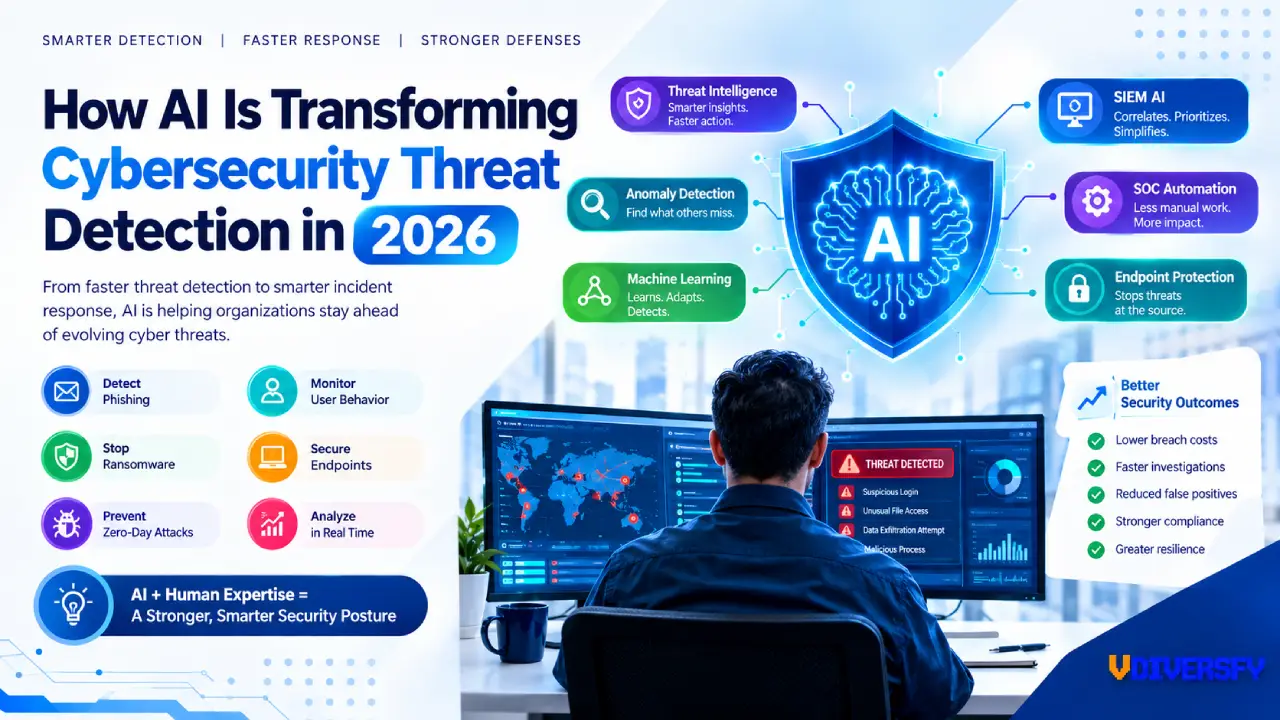
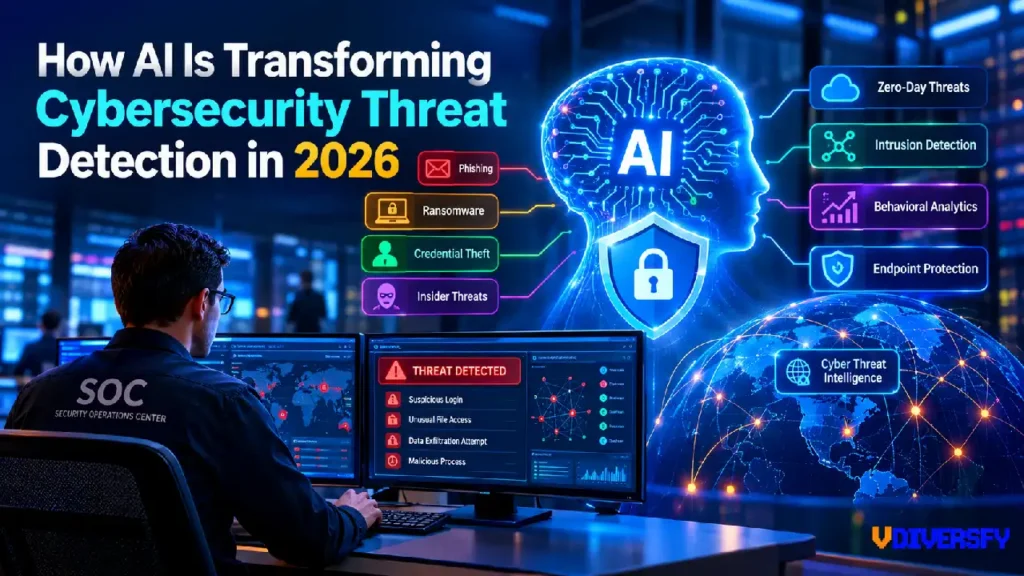
AI cybersecurity threat detection 2026 is changing how organizations identify, investigate, and respond to cyberattacks.
As businesses move more of their operations to cloud platforms, remote work environments, and connected applications, security teams face more alerts, more complex attack methods, and less time to investigate suspicious activity.
Artificial intelligence (AI) helps security teams analyze large volumes of data, recognize unusual behavior, and identify potential attacks before they cause serious damage.
However, AI is not a replacement for skilled cybersecurity professionals. Its real value comes from combining intelligent detection, reliable security data, automated investigation, and human decision-making to build stronger defenses.
Contents
- 1. Why AI Is Changing Cybersecurity Threat Detection
- 2. What Is AI-Powered Cybersecurity Threat Detection?
- 3. Why Traditional Cybersecurity Tools Are No Longer Enough on Their Own
- 4. How AI Works in Cybersecurity Threat Detection
- 5. The Role of AI in Modern Security Tools
- 6. How AI Detects Real-World Cyberattacks
- 7. How AI Improves the Security Operations Center
- 8. Real-World Evidence: What Current Research Tells Us
- 9. How Organizations Can Implement AI-Based Threat Detection
- 10. AI Cybersecurity Risks: What Organizations Need to Understand
- 11. AI Cybersecurity, Governance, and Compliance in the United States
- 12. How AI Is Changing Cybersecurity Careers in 2026
- 13. The Future of AI Threat Detection Beyond 2026
- 14. Actionable Checklist: How to Prepare Your Organization
- 15. Conclusion: Building Smarter Cybersecurity Defenses With AI
- 16. FAQs
Why AI Is Changing Cybersecurity Threat Detection
Cybersecurity has become a business priority for organizations of every size. A successful attack can expose customer information, interrupt business operations, damage a company’s reputation, and create major financial losses.
For US businesses, the risks affect sectors ranging from banking and healthcare to retail, manufacturing, education, and government.
Traditional security tools remain important, but they often depend on known attack patterns, predefined rules, and signatures. These methods work well when a threat matches something the security system already recognizes.
The problem arises when attackers change their techniques, use stolen employee credentials, exploit unknown vulnerabilities, or spread malicious activity across several systems.
This is where AI threat detection becomes valuable.
AI-based security systems can examine activity across networks, endpoints, cloud services, user accounts, and applications to find patterns that might indicate an attack. Instead of relying entirely on a list of known threats, these systems can also identify behavior that differs from what is expected.
The change is already measurable. IBM’s 2026 Cost of a Data Breach Report, released in July 2026, found that one in four malicious breaches covered by its global research was AI-enabled. Those breaches cost an average of $6 million, compared with the overall average breach cost of $4.99 million.
IBM also reported that organizations using AI and automation in security operations reduced breach costs by almost $2 million on average. These figures come from IBM’s research involving 602 organizations that experienced breaches between March 2025 and February 2026, so they should be understood within that study’s scope rather than as a prediction for every company. Read IBM’s 2026 findings.
This article explains how AI works in modern security systems, the technologies behind it, where organizations can apply it, and what businesses should consider before relying on automated detection.
What Is AI-Powered Cybersecurity Threat Detection?
AI-powered cybersecurity threat detection is the use of artificial intelligence and related techniques to analyze security information, recognize suspicious activity, and help security teams investigate possible attacks.
These systems can process information from many sources, including:
- Network traffic and connection logs.
- Employee login records and authentication events.
- Endpoint activity from laptops, desktops, and servers.
- Cloud infrastructure and application logs.
- Email messages, attachments, and links.
- Threat intelligence feeds and known malicious indicators.
- Identity systems, access permissions, and privileged accounts.
The system uses this information to identify patterns, compare activity with expected behavior, and assign risk scores to suspicious events. Depending on the product and its configuration, it may also recommend containment steps or start an approved response workflow.
For example, an employee usually logs in from Chicago during normal US business hours. One evening, the same account attempts to sign in from an unfamiliar location, downloads a large number of sensitive files, and tries to access systems the employee has never used before.
A conventional rule might flag the unusual login. An AI-assisted system could connect the login, file downloads, and access attempts into a single investigation. That broader view may help the security team recognize a compromised account rather than treating each event as an unrelated alert.
The main advantage is context. An individual event may look harmless, but several related events can reveal a much more serious threat.
Traditional Threat Detection vs. AI-Based Detection
Traditional security controls and AI-powered detection are not competing choices in every situation. Most effective security programs use them together.
Area | Traditional detection | AI-assisted detection |
Known malware | Matches signatures and indicators | Can combine signatures with behavioral evidence |
Unknown threats | May miss unfamiliar patterns | Can identify suspicious behavior without a known signature |
User activity | Applies predefined rules | Can compare activity with normal behavior |
Alert investigation | Analysts connect events manually or through rules | Analytics can correlate events and prioritize related alerts |
Response | Uses configured rules and playbooks | Can recommend or trigger approved actions |
Reliability | Depends on rule quality and updated signatures | Depends on data quality, model performance, and validation |
Traditional methods remain effective against many known threats. AI adds another layer by finding relationships and unusual activity that may not fit a predefined rule.
Neither approach guarantees detection. A well-designed security program combines prevention, detection, response, regular testing, and human oversight.
Why Traditional Cybersecurity Tools Are No Longer Enough on Their Own
Modern attacks rarely follow one simple path. An attacker might begin with a phishing email, steal a password, bypass weak authentication, access a cloud account, and quietly collect data over several days.
Each individual step may look ordinary. Together, however, they can indicate an active intrusion.
The Growing Volume of Security Alerts
Large organizations collect millions of security events from endpoints, firewalls, identity platforms, cloud services, and business applications. Security teams must determine which events are harmless, which require further investigation, and which indicate an active attack.
This creates a serious workload problem. If analysts spend most of their time reviewing low-risk alerts, they have less time to investigate complex incidents.
AI can help by grouping related alerts, ranking events according to risk, enriching investigations with additional information, and identifying activity that deserves immediate attention.
Consider a hospital in the United States. Its security team may receive alerts about failed logins, unusual access to patient records, suspicious email attachments, and devices communicating with unfamiliar servers. AI-assisted correlation can help connect those events and determine whether they may be part of one attack.
The objective is not simply to produce more alerts. It is to help analysts focus on the alerts that matter most.
Attackers Are Changing Their Methods
Cybercriminals can use AI tools to improve phishing messages, create convincing impersonations, automate parts of their operations, and adjust malicious content more quickly. Attackers may also use stolen credentials and legitimate administrative tools to avoid triggering traditional malware detection.
The Verizon 2025 Data Breach Investigations Report identified credential abuse and vulnerability exploitation as important initial access methods across the breaches it studied. The report also found that ransomware appeared in 44% of the breaches in its dataset, illustrating the continuing importance of attacks that disrupt operations or threaten data. These findings describe the report’s specific sample, not every incident worldwide. Read the Verizon DBIR.
For defenders, the lesson is clear: security tools need to examine more than malicious files. They must also look at identity misuse, unusual behavior, suspicious connections, and changes in normal system activity.
The Need for Faster Detection and Response
An attack can become more damaging when it remains undetected. An intruder who gains access to one employee account might use that access to discover other systems, steal additional credentials, or locate sensitive information.
AI-assisted systems can shorten parts of the detection and investigation process by collecting relevant evidence automatically. They can also help analysts identify related activity across several systems.
However, detection speed is only one measure of success. Organizations must also evaluate whether alerts are accurate, whether incidents are contained safely, and whether automated actions create unnecessary disruption.
How AI Works in Cybersecurity Threat Detection
AI is not one single technology. Security products may combine machine learning, statistical analysis, behavioral analytics, threat intelligence, and automated workflows. Understanding these methods helps organizations choose suitable tools and evaluate their results.
1. Machine Learning Security
Machine learning security uses algorithms that learn patterns from data and apply those patterns to new events. Depending on the method, a model may learn from labeled examples of malicious and legitimate activity, identify clusters in data, or estimate whether an event differs from expected behavior.
In cybersecurity, machine learning can support tasks such as:
- Detecting suspicious email messages.
- Classifying files based on potentially malicious characteristics.
- Identifying unusual network connections.
- Scoring risky login attempts.
- Recognizing patterns associated with malware.
- Prioritizing alerts for investigation.
For example, a model may examine a file’s behavior, code features, and relationship to other suspicious files. It might identify warning signs even when the file has never appeared in a threat intelligence database.
That does not mean the model can always identify new malware correctly. Its results depend on the quality of the data, the attack techniques represented during training, and the conditions in which the model operates.
Security teams should therefore test models against realistic threats and monitor performance as attackers change their methods.
2. Behavioral Analytics
Behavioral analytics examines how users, devices, applications, and accounts normally behave. The system builds a baseline from relevant activity and looks for meaningful departures from that baseline.
For example, an employee might normally access a few business applications and download a limited number of documents each day. If that account suddenly accesses hundreds of files, creates unusual forwarding rules, and attempts to export sensitive data, the combined activity may deserve investigation.
Behavioral analytics can support the detection of:
- Compromised employee accounts.
- Insider threats and unauthorized data access.
- Unusual use of privileged accounts.
- Suspicious access to cloud resources.
- Unexpected communication between systems.
The system must consider context. An IT administrator may legitimately access many servers during a maintenance window. A sudden increase in activity is not automatically evidence of an attack.
Effective detection combines behavioral changes with identity, device, business, and threat information to avoid treating every unusual event as malicious.
3. Anomaly Detection
Anomaly detection identifies events that differ from an established pattern or statistical baseline. It is especially useful when the exact attack method is unknown or when a system needs to identify unusual activity that has not previously been labeled as malicious.
Suppose a company’s finance server normally sends data to a small group of approved internal systems. It suddenly begins transferring large amounts of information to an unfamiliar external address.
An anomaly detection system could flag the transfer because it differs from the server’s usual communication pattern. Analysts could then examine the destination, user activity, process history, and data involved.
An anomaly is a warning, not proof of an attack. Legitimate software updates, new business processes, seasonal workloads, and system migrations can all create unusual activity.
Security teams need to tune detection thresholds, investigate important findings, and feed verified results back into their monitoring processes.
4. AI-Assisted Correlation and Risk Scoring
An attack often generates evidence across multiple security products. One tool may detect a suspicious login, another may record an unusual process, and a third may flag a data transfer.
AI-assisted correlation helps connect these signals. Risk scoring then helps determine which events require the fastest response.
For instance, a failed login from an unfamiliar location may be low risk by itself. The same login followed by successful authentication, privilege escalation, and an unusual download of sensitive files should receive much greater attention.
This approach helps the security team move from reviewing isolated alerts to investigating a possible attack sequence.
Risk scores should remain explainable enough for analysts to understand why an event was prioritized. Security teams also need a clear way to challenge incorrect scores and review missed detections.
The Role of AI in Modern Security Tools
AI detection becomes more useful when it is connected to the security systems an organization already uses. The following technologies play an important role.
SIEM AI: Making Security Logs More Useful
A security information and event management platform, commonly called a SIEM, collects and analyzes logs from across an organization. It helps security teams search events, investigate incidents, and monitor suspicious activity.
SIEM AI adds AI-assisted analytics to this process. Depending on the platform, these capabilities may include event correlation, alert prioritization, natural-language searches, investigation summaries, and recommendations for next steps.
Imagine that a SOC analyst needs to investigate a possible compromised account. Instead of manually searching multiple log sources, the analyst may use AI-assisted tools to summarize the account’s recent activity and identify related events across identity, endpoint, and cloud systems.
The analyst must still validate the evidence before declaring an incident or taking disruptive action.
Examples of SIEM platforms with AI-related security capabilities include:
- Microsoft Sentinel — cloud-based security monitoring and investigation.
- Google Security Operations — security analytics, investigation, and threat operations.
- Splunk Enterprise Security — security monitoring, investigation, and analytics.
Capabilities, licensing, and integration requirements vary by product and change over time. Organizations should evaluate each platform against their own technical and business needs rather than selecting a tool simply because it advertises AI.
Endpoint Protection: Detecting Threats on Devices
Endpoint protection focuses on laptops, desktops, servers, and other devices that connect to an organization’s systems. Modern endpoint detection and response products monitor process activity, file behavior, system changes, and network connections.
AI can help identify activity that appears suspicious even when a known malware signature is unavailable.
For example, an endpoint agent might observe a document application launching a command interpreter, followed by unusual file changes and attempts to contact an unfamiliar server. These events could indicate a malicious script or an attempted ransomware infection.
AI-enhanced endpoint protection can help security teams:
- Identify suspicious process behavior.
- Detect possible malware execution.
- Investigate unusual changes to files.
- Link device activity to wider incidents.
- Support containment, such as isolating a compromised device.
Products in this area include Microsoft Defender for Endpoint, CrowdStrike Falcon and SentinelOne Singularity.
These platforms offer different capabilities and deployment options. Their effectiveness depends on correct configuration, adequate endpoint coverage, current policies, and a response process that has been tested.
Intrusion Detection: Finding Suspicious Network Activity
Intrusion detection systems monitor network traffic or host activity for signs of unauthorized access and malicious behavior. Traditional systems may rely on signatures and predefined rules, while AI-assisted approaches can analyze patterns, communication relationships, and deviations from normal network activity.
For example, a server that normally communicates with a few internal services may begin making repeated connections to unfamiliar destinations. An AI-assisted network monitoring tool could flag this behavior for investigation.
This can be helpful when attackers use legitimate credentials or built-in system tools instead of deploying easily recognized malware.
AI does not replace network segmentation, secure configurations, access controls, or timely patching. Instead, it adds another layer of visibility that helps defenders recognize activity worth investigating.
Why Combining Security Tools Matters
A single security product rarely has a complete view of an attack. Endpoint tools understand device behavior, identity platforms track authentication, SIEM platforms correlate logs, and network monitoring systems observe communications.
When these tools share useful evidence, security teams can develop a clearer picture of an incident.
For example, an unusual login becomes more concerning when it is followed by suspicious endpoint activity and unexpected access to sensitive cloud data. The combined evidence can help analysts prioritize the investigation and choose an appropriate response.
The strongest results come from connected security tools, reliable data, and trained analysts, not from adding AI to a single product and assuming the problem is solved.
How AI Detects Real-World Cyberattacks
AI becomes most valuable when it helps security teams recognize the warning signs of an attack before the damage spreads. Different attacks create different patterns, so an effective detection system needs to examine more than one type of evidence.
In 2026, organizations are using AI-assisted security tools to investigate suspicious emails, detect ransomware-like behavior, identify compromised accounts, monitor cloud environments, and prioritize vulnerabilities. The exact capabilities vary by product, available data, and configuration.
The following examples explain how these techniques work in practical security environments.
1. Detecting Phishing and Business Email Compromise
Phishing remains a major security concern because attackers can use deceptive emails to steal passwords, deliver malware, or persuade employees to transfer money. Business email compromise (BEC) is especially dangerous because the attacker may impersonate an executive, supplier, or trusted business partner without using a malicious attachment.
AI-assisted email security examines several signals together, including sender reputation, message content, links, attachment behavior, authentication results, and communication patterns.
For example, an employee in a US company’s finance department receives an email that appears to come from the chief financial officer. The message requests an urgent payment to a new bank account and uses language similar to previous business conversations.
A traditional filter might allow the email through if it comes from a compromised, legitimate account. An AI-assisted system may flag the unusual payment request, the new recipient, and the difference from normal communication patterns.
What AI can help identify:
- Messages that imitate trusted senders.
- Suspicious links and attachments.
- Unusual requests for payments or sensitive information.
- Account activity associated with email compromise.
- Similar phishing campaigns across multiple employees.
However, AI-generated phishing messages may contain correct grammar, relevant business details, and convincing personal references. Security awareness training, email authentication, payment verification procedures, and phishing-resistant multifactor authentication remain essential.
Microsoft’s 2025 Digital Defense Report discusses the growing use of AI in phishing and social engineering, while emphasizing the continued importance of basic security controls. Its findings also identify password-spray attacks as a major component of identity attacks observed in its telemetry. Read Microsoft’s Digital Defense Report.
2. Identifying Ransomware Before It Spreads
Ransomware can encrypt files, disrupt business operations, and threaten to publish stolen information. In many incidents, attackers also spend time inside a network before launching the final attack.
AI-assisted endpoint protection can monitor behavior that may indicate preparation for ransomware or an active infection. Examples include unusual file modifications, suspicious process activity, attempts to disable security controls, and unexpected access to shared drives.
Imagine a manufacturing company whose file server suddenly begins modifying thousands of documents. At the same time, an unfamiliar process attempts to delete backups and connects to a server outside the company’s normal network.
A detection system could combine these events and assign a high risk score. Depending on the product and the organization’s response policies, it might alert the SOC, isolate the affected endpoint, or block a suspicious process.
The earlier the warning arrives, the more opportunity the company has to limit the damage.
Verizon’s 2025 Data Breach Investigations Report found ransomware in 44% of the breaches it examined, up from 32% in the previous report. The report also highlighted a particularly serious effect on smaller organizations. These results show why ransomware detection should remain a priority even when a business has invested in modern security technology. Source: Verizon 2025 DBIR.
AI detection should be supported by offline or otherwise protected backups, tested recovery procedures, restricted administrative access, network segmentation, and a rehearsed incident response plan. If the system incorrectly isolates a business-critical server, the response itself could interrupt operations, so automated containment needs appropriate safeguards.
3. Detecting Stolen Credentials and Account Takeover
Attackers do not always need malware to gain access to an organization. A stolen password, an exposed session token, or a compromised employee account may give them an entry point into business systems.
AI-assisted identity monitoring examines login times, device details, authentication outcomes, access patterns, and changes in account behavior. It can help identify activity that looks inconsistent with the account’s usual use.
For example, an employee normally signs in from a managed laptop and accesses a small number of applications. The account suddenly attempts to access sensitive cloud storage, creates unfamiliar access tokens, and downloads large volumes of information.
Any one event might have a legitimate explanation. The combination is more concerning.
AI can help prioritize the investigation and connect the events to other evidence, such as suspicious email rules or unusual endpoint activity.
Useful detection signals include:
- Repeated password failures followed by a successful login.
- Sign-ins from unfamiliar devices or locations.
- Unexpected use of administrator privileges.
- Unusual access to sensitive applications.
- New authentication methods or suspicious session activity.
Organizations should not treat geographic differences as conclusive evidence of compromise. VPN use, travel, mobile networks, and shared cloud infrastructure can produce misleading location signals.
The strongest defense combines risk-based detection with phishing-resistant MFA, least-privilege access, secure session management, and rapid revocation of compromised credentials.
4. Detecting Insider Threats and Data Theft
Insider threats can involve employees, contractors, or other authorized users who misuse their access. Some incidents are deliberate, while others result from mistakes, compromised accounts, or poor handling of sensitive information.
These events can be difficult to detect because the user may have legitimate access to the systems involved.
Behavioral analytics can establish patterns for normal access and identify activity that deserves closer review. For example, a departing employee might begin downloading unusual volumes of customer records, accessing confidential folders outside their normal responsibilities, and transferring files to an unapproved cloud account.
An AI-assisted system can correlate these events and alert the security team.
However, unusual activity does not establish malicious intent. A legitimate project, a change in job duties, or an approved data migration may produce similar signals.
Organizations should therefore investigate with care, restrict access according to job responsibilities, and follow appropriate privacy and employment policies. Monitoring should be proportionate, documented, and consistent with applicable laws and company policies.
5. Detecting Zero-Day Threats
A zero-day threat involves the exploitation of a vulnerability for which an effective patch or other complete fix may not yet be available. These attacks can be difficult to identify because defenders may not have a known signature or a full understanding of the exploit.
AI cannot guarantee the detection of every zero-day attack. Its value lies in identifying suspicious activity surrounding the exploitation, even when the exact vulnerability is unknown.
For example, an internet-facing application begins launching processes that are not part of its normal operation. Soon afterward, the server makes unusual outbound connections and attempts to access credentials stored elsewhere on the network.
A traditional signature-based system may not recognize the exploit itself. Behavioral detection could still flag the unusual process chain and network activity.
AI-assisted analysis can support zero-day defense by:
- Identifying abnormal application behavior.
- Detecting unexpected process execution.
- Recognizing suspicious network connections.
- Prioritizing vulnerable internet-facing systems.
- Helping analysts connect related events across multiple tools.
The detection system still needs reliable telemetry and good coverage. An attack that produces little observable evidence, or activity that closely resembles normal operations, may escape detection.
Patching, secure development, application isolation, web application firewalls, least-privilege access, and exposure management remain necessary. AI should complement these controls, not replace them.
How AI Improves the Security Operations Center
A security operations center (SOC) monitors an organization’s systems, investigates alerts, and coordinates incident response. SOC teams often work under time pressure, especially when they have limited staff and a large number of security events to review.
AI can improve several parts of the workflow, from alert triage to investigation and reporting. The greatest benefit often comes from reducing repetitive work while helping analysts understand the evidence behind a potential attack.
Alert Triage and Prioritization
Alert triage is the process of reviewing security alerts and deciding which ones need further investigation. Traditional approaches often use fixed severity levels and predefined rules.
AI-assisted triage can consider more context, including asset importance, identity risk, threat intelligence, and related events.
For example, an alert involving a routine scan of a test server may be less urgent than a similar alert involving a domain controller or a system that stores sensitive customer information.
A useful triage process should help analysts answer three questions:
- What happened?
- How likely is it to represent a real threat?
- What should be investigated next?
AI can help answer these questions, but analysts need access to the underlying evidence rather than only a generated summary or unexplained risk score.
SOC Automation and Incident Response
SOC automation uses workflows and security integrations to carry out repetitive tasks. When combined with AI, it can help summarize events, gather evidence, enrich alerts, and suggest response actions.
For example, when a potentially compromised endpoint generates an alert, a workflow might automatically:
- Retrieve the device’s recent security events.
- Check the affected account’s authentication history.
- Search for related indicators across other systems.
- Collect relevant threat intelligence.
- Create an investigation record.
- Recommend next steps to the analyst.
Some actions can be automated safely after testing. Others require human approval, particularly when they may disrupt essential systems, delete data, disable accounts, or affect business operations.
Organizations should begin with low-risk, reversible tasks and expand automation only after measuring its reliability.
Generative AI as an Analyst Assistant
Generative AI can make security tools easier to use by translating technical information into clear language, summarizing long investigations, and helping analysts query security data.
A junior analyst, for example, may receive an alert containing process names, network indicators, and authentication events. An AI assistant can organize the evidence into a readable timeline and explain which details deserve further review.
This can support training and improve consistency, but the assistant may misinterpret logs, omit relevant details, or produce incorrect conclusions.
Analysts should verify important claims against the original telemetry, particularly before declaring an incident resolved or taking a high-impact response action.
Measuring Whether AI Actually Helps
Organizations should not measure success only by the number of automated tasks or the speed of generated summaries.
More useful measures include:
Metric | What it tells the SOC |
Mean time to detect (MTTD) | How long it takes to identify a security incident |
Mean time to respond (MTTR) | How long it takes to respond to an incident, using a clearly defined measurement |
False-positive rate | How often alerts incorrectly identify benign activity as suspicious |
Detection coverage | Which important attack techniques and assets are monitored |
Analyst workload | How much time staff spend on triage and investigation |
Missed detections | Whether meaningful threats are escaping the detection process |
Response accuracy | Whether automated actions are appropriate and safe |
Measurements should be compared against a baseline collected before deployment. Results should also be reviewed over time because attack methods, systems, and workloads change.
A successful AI implementation is one that improves security outcomes without creating excessive noise, unnecessary disruption, or new blind spots.
Real-World Evidence: What Current Research Tells Us
AI’s role in cybersecurity is not limited to product marketing. Government agencies and security researchers are documenting how both defenders and attackers use these capabilities.
Microsoft’s 2025 Digital Defense Report describes AI as a tool that can support cyber defense while also helping attackers scale phishing, analyze information, and develop convincing fraudulent content. It also highlights the importance of securing identities, protecting cloud environments, and fixing known weaknesses.
The report offers an important lesson for US organizations: advanced detection cannot compensate for weak basic security. If a company leaves internet-facing systems unpatched, permits excessive privileges, or relies on easily stolen passwords, AI may help detect an attack but cannot ensure that the attack will be prevented.
The Verizon DBIR provides a complementary view. Its 2025 findings showed that vulnerability exploitation accounted for 20% of the initial access vectors in its relevant breach sample, while credential abuse accounted for 22%. This reinforces the need to combine behavioral analytics with vulnerability management and strong identity controls.
These reports measure different populations and use different methods, so their percentages should not be combined as though they describe one shared dataset.
For practical purposes, organizations should use published research to identify priorities, then validate those priorities against their own incident records, threat model, industry, and exposure.
How Organizations Can Implement AI-Based Threat Detection
Introducing AI into cybersecurity requires more than purchasing a new platform. Organizations need reliable data, clearly defined security goals, trained staff, and a plan for measuring results.
For US businesses, the best approach is to start with a specific security problem, test a solution against real operational needs, and expand only after the results have been validated.
Step 1: Identify the Most Important Security Risks
Before selecting an AI security product, identify the threats that pose the greatest risk to the organization.
A healthcare provider may prioritize ransomware, unauthorized access to patient records, and service disruption. A financial services company may focus on account takeover, payment fraud, and data theft. A small business may need better phishing detection, endpoint monitoring, and protection for cloud accounts.
Start by asking:
- Which systems contain the most sensitive information?
- Where are the organization’s largest security gaps?
- Which attacks have occurred previously?
- Which alerts take the longest to investigate?
- Which systems lack sufficient logging or monitoring?
- What level of disruption could an automated response cause?
These questions help determine whether the organization needs better endpoint detection, identity monitoring, AI-assisted SIEM analytics, or a combination of tools.
Practical recommendation: Choose one measurable problem, such as reducing the time needed to investigate suspicious login activity, before attempting a broad AI deployment.
Step 2: Improve Data Quality and Visibility
AI detection depends on the information it receives. If important systems are not monitored, logs are incomplete, or timestamps are inconsistent, the system may fail to connect events that belong to the same attack.
Organizations should establish reliable logging across relevant sources, including:
- Endpoints and servers.
- Identity and authentication platforms.
- Cloud infrastructure and applications.
- Firewalls and network monitoring systems.
- Email security tools.
- Critical business applications.
Logs should have consistent timestamps, appropriate retention periods, and access controls. Sensitive information should be collected only when necessary and handled according to the organization’s privacy and security requirements.
Data quality also affects behavioral analytics. If an organization introduces a new application or changes normal employee workflows, detection baselines may need to be updated.
Step 3: Choose the Right AI Security Tools
The right product depends on the organization’s size, existing technology, regulatory obligations, budget, and security maturity.
Security need | Capabilities to evaluate | Example products |
Security event monitoring | Log correlation, alert prioritization, investigation support | Microsoft Sentinel, Google Security Operations, Splunk Enterprise Security |
Endpoint protection | Behavioral detection, investigation, device containment | Microsoft Defender for Endpoint, CrowdStrike Falcon, SentinelOne |
Identity protection | Risky sign-ins, account compromise signals, access monitoring | Microsoft Entra, Okta |
Cloud security | Workload monitoring, cloud posture, identity and data risk | Microsoft Defender for Cloud, Google Security Command Center |
Threat intelligence | Indicator enrichment, threat context, campaign tracking | Recorded Future, Mandiant threat intelligence |
Security workflow automation | Case management, enrichment, response playbooks | Microsoft Sentinel automation, Splunk SOAR |
These are examples of products and platforms, not a ranking or an endorsement. Features and licensing vary, and not every product uses AI in the same way.
Official product information is available from the relevant vendors:
When evaluating vendors, ask for evidence of detection performance, integration requirements, data handling practices, model limitations, and response controls. Request a demonstration using realistic scenarios rather than relying solely on advertised capabilities.
Step 4: Run a Controlled Pilot
A pilot helps an organization understand how a system behaves before it becomes part of critical security operations.
For example, a company could deploy AI-assisted alert prioritization for a subset of endpoint and identity alerts. During the pilot, analysts would compare the system’s recommendations with actual investigation results.
Record the baseline before deployment, then evaluate:
- Time required to investigate each alert.
- Number of false positives.
- Quality of incident summaries.
- Important threats missed by the system.
- Analyst confidence in its recommendations.
- Operational costs and licensing requirements.
Include difficult cases, not just examples the vendor’s product is expected to handle well. Test legitimate unusual activity, simulated attacks, and situations in which evidence is incomplete.
Do not allow a pilot to make high-impact changes to production systems without explicit authorization and tested safeguards.
Step 5: Integrate AI With Existing Security Workflows
AI should work with established security controls rather than operate as an isolated tool.
A well-integrated workflow may connect the SIEM, endpoint detection platform, identity provider, threat intelligence sources, and incident response system. This allows analysts to investigate a suspicious event without manually collecting every piece of evidence.
Organizations should define which actions AI can recommend, which actions it can perform automatically, and which require human approval.
A practical model is to automate repetitive, low-risk tasks first. More disruptive actions, such as disabling a privileged account or isolating a critical server, should have stronger approval and recovery controls.
Step 6: Train Analysts and Review Performance
Security teams need to understand how the system works, where it may fail, and how to verify its results.
Training should cover alert interpretation, investigation techniques, data privacy, model limitations, incident response, and the safe use of generative AI. Analysts should also learn how to recognize unsupported AI-generated conclusions.
Review performance regularly. Detection quality can decline as systems, user behavior, and attack methods change. New applications may create unexpected activity, while attackers may adapt their techniques to avoid detection.
An effective program treats AI as a security capability that needs ongoing testing, monitoring, and improvement.
AI Cybersecurity Risks: What Organizations Need to Understand
AI can strengthen detection, but it also introduces risks that security teams must manage. A system that produces convincing but incorrect conclusions, exposes sensitive data, or takes unsafe automated actions can create additional problems.
Adversarial AI and Evasion Techniques
Adversarial AI describes attacks and manipulation techniques that target AI systems or exploit their weaknesses. In cybersecurity, this can include attempts to confuse detection models, poison training data, manipulate an AI assistant, or evade AI-supported security controls.
For example, an attacker might change the timing or structure of malicious activity to make it resemble legitimate business operations. Another attack might introduce misleading data into a process used to train or update a detection model.
These techniques do not make AI security useless, but they demonstrate why detection systems need layered defenses.
Organizations should consider:
- Testing models against changing attack techniques.
- Protecting training and reference data from unauthorized changes.
- Monitoring changes in model performance.
- Maintaining traditional detection rules alongside AI.
- Limiting access to model configuration and sensitive prompts.
- Reviewing high-risk recommendations before execution.
Security teams should also understand whether their vendors provide information about model updates, known limitations, and testing methods.
False Positives and Missed Threats
A false positive occurs when a system flags legitimate activity as suspicious. A false negative occurs when a genuine threat goes undetected.
Both can be costly. Too many false positives can overwhelm analysts, while missed threats can allow an attacker to remain inside a network.
For example, a new cloud application may generate a large volume of activity that differs from historical patterns. An anomaly detection model might flag the behavior repeatedly even though it is legitimate.
Conversely, a patient attacker who gradually accesses data using valid credentials may avoid triggering a threshold designed to detect sudden spikes.
Organizations should measure both types of error, review detection thresholds, and test the system with realistic scenarios. They should also ensure that analysts can examine the evidence behind an alert and report incorrect results.
Data Privacy and Confidentiality
AI security systems may process employee information, customer records, source code, authentication logs, and other sensitive material. Sending this data to an external service without appropriate controls can create privacy and confidentiality risks.
Before deploying a solution, organizations should determine:
- What data the system collects.
- Where the data is processed and stored.
- Whether the provider uses customer data to train models.
- How long information is retained.
- Who can access prompts, logs, and investigation records.
- How the provider handles deletion, incidents, and legal requests.
Contracts, technical safeguards, data minimization, access controls, and vendor reviews should support these decisions. US businesses must also consider applicable federal and state requirements, which vary by industry and data type.
Overreliance on Automated Decisions
An AI-generated explanation may sound confident even when the evidence is incomplete. If an analyst accepts the conclusion without verification, the organization may close a genuine incident or take an unnecessary action.
The risk increases when AI can disable accounts, quarantine endpoints, or change security policies.
Human oversight should be proportionate to the impact of the decision. Low-risk tasks may be automated after testing, while high-impact actions should require stronger validation, approval, or an established emergency procedure.
The goal is not to require manual approval for every small task. It is to make sure that important decisions remain accountable and recoverable.
AI Cybersecurity, Governance, and Compliance in the United States
AI-based threat detection should be part of a broader cybersecurity risk management program. Organizations need to understand not only whether a tool detects threats, but also how it handles data, makes recommendations, and affects business operations.
For US organizations, established frameworks provide a useful starting point for managing these responsibilities.
The NIST Cybersecurity Framework 2.0
The National Institute of Standards and Technology (NIST) published Cybersecurity Framework 2.0 in February 2024. It provides guidance for managing cybersecurity risks across organizations of different sizes and industries.
The framework organizes cybersecurity outcomes into six functions:
- Govern: Establish cybersecurity responsibilities, policies, and oversight.
- Identify: Understand assets, systems, and risks.
- Protect: Apply safeguards to reduce the likelihood and impact of attacks.
- Detect: Identify and analyze possible cybersecurity incidents.
- Respond: Contain incidents and coordinate appropriate action.
- Recover: Restore affected systems and improve resilience.
AI-based detection can support the Detect function by identifying suspicious activity and helping analysts investigate potential incidents. However, effective use of AI also depends on governance, asset management, prevention, response, and recovery.
For example, a company could use AI to identify a compromised account, but it still needs policies defining who can disable that account, how business access will be restored, and how the incident will be documented.
Organizations can use the official NIST Cybersecurity Framework 2.0 as a starting point for connecting AI detection with wider risk management.
Managing AI Risks With the NIST AI Risk Management Framework
The NIST AI Risk Management Framework (AI RMF) helps organizations identify and manage risks associated with AI systems. Its four core functions are Govern, Map, Measure, and Manage.
These functions are relevant when a business uses AI to analyze security events, recommend actions, or automate incident response.
For example, before deploying an AI assistant in a SOC, an organization should identify the data it can access, measure its accuracy, define acceptable uses, and establish controls for incorrect recommendations.
The framework can help teams build a structured approach to AI risk rather than relying entirely on vendor assurances.
Reference: NIST AI Risk Management Framework.
Compliance, Accountability, and Auditability
Organizations in regulated industries may need to demonstrate how they manage access, protect sensitive information, monitor security events, and respond to incidents.
AI can support these activities by helping analysts summarize evidence, organize investigation records, and identify potentially relevant events. It does not automatically make an organization compliant with a law, regulation, or security standard.
Security leaders should ensure that AI-assisted decisions can be reviewed and that important actions are recorded. They should also document the system’s intended purpose, limitations, approval requirements, and performance.
For organizations subject to frameworks such as HIPAA, PCI DSS, or financial-sector requirements, the compliance team should assess the specific rules that apply rather than assuming that a general AI security capability meets every obligation.
How AI Is Changing Cybersecurity Careers in 2026
AI is changing security work, but it does not eliminate the need for people who understand networks, operating systems, identity systems, incident response, and risk management.
Instead, many roles are placing greater emphasis on investigation, judgment, automation, and the ability to validate machine-generated findings.
Skills SOC Analysts Should Develop
SOC analysts can benefit from learning how AI-assisted detection fits into the wider incident response process.
Important skills include:
- Reading authentication, endpoint, and network logs.
- Investigating alerts across multiple security tools.
- Understanding machine learning limitations.
- Using SIEM queries and detection rules.
- Validating AI-generated summaries against original evidence.
- Building and reviewing safe response playbooks.
- Communicating findings clearly to technical and nontechnical teams.
Hands-on practice remains essential. Analysts should learn how attacks work and how security tools record them before relying on AI to interpret those records.
Skills for Cybersecurity Engineers and Threat Hunters
Security engineers and threat hunters need to understand how detection systems can be tested, tuned, and improved.
Useful areas of study include Python, query languages such as Kusto Query Language (KQL) and SPL, endpoint telemetry, cloud security, identity monitoring, and threat hunting.
Threat hunters should also learn to investigate activity that automated systems have not flagged. This helps identify gaps in existing detection coverage.
Engineers can use AI to support query development and investigation planning, but they should validate generated code and queries before using them in production environments.
Skills for GRC Analysts and Security Leaders
Governance, risk, and compliance professionals need to understand the risks associated with AI adoption, including privacy, third-party dependencies, access controls, accountability, and audit evidence.
They should be able to ask practical questions:
- What decisions can the AI system make?
- What information does it process?
- How is its performance tested?
- Who reviews incorrect or high-impact decisions?
- How are changes to the system approved?
- What happens if the vendor becomes unavailable?
Security leaders should also understand how to measure the value of AI investments. Faster investigations are useful, but they should not come at the expense of missed incidents, poor decisions, or excessive operational risk.
Cybersecurity Certifications Worth Considering
Certifications can provide a structured way to build relevant knowledge, although no single certification guarantees expertise in AI security.
Certification or learning path | Primary focus | Who may benefit |
CompTIA Security+ | Security fundamentals, threats, controls, and risk | Beginners and early-career professionals |
ISC2 Certified in Cybersecurity (CC) | Foundational security concepts and practices | People entering cybersecurity |
Google Cybersecurity Certificate | Practical introductory security skills | Career changers and beginners |
CompTIA CySA+ | Security analytics, monitoring, and incident response | Analysts developing defensive skills |
ISC2 Systems Security Certified Practitioner (SSCP) | Practical security administration and operations | Security practitioners |
Certified Ethical Hacker (CEH) | Ethical hacking concepts and offensive security methods | Professionals exploring penetration testing |
CCST Cybersecurity | Entry-level networking and cybersecurity concepts | Beginners building technical foundations |
Certification names, exam objectives, and eligibility requirements can change. Candidates should check the issuing organization’s current official materials before enrolling.
AI-related security work also benefits from hands-on labs, realistic incident simulations, and familiarity with the MITRE ATT&CK knowledge base. These activities help connect theoretical knowledge with actual attacker behavior.
The Future of AI Threat Detection Beyond 2026
AI-based threat detection is likely to become more closely integrated with identity security, endpoint protection, cloud monitoring, and incident response. Security teams will increasingly evaluate systems based on how well they connect evidence and support reliable decisions, rather than on whether they simply include an AI assistant.
Several developments deserve attention.
More Context-Aware Detection
Future systems will continue to combine information from identities, devices, applications, and network activity. This can help distinguish routine behavior from suspicious activity with greater context.
However, better context depends on data quality, integration, and accurate interpretation. Organizations should not assume that a more advanced model will automatically outperform a well-configured traditional detection system.
Greater Use of Automated Investigation
AI assistants may take on more routine investigation tasks, including gathering evidence, summarizing events, and preparing recommended response actions.
This could allow analysts to spend more time on complex incidents and proactive threat hunting. The key challenge will be making sure that the automated process is accurate, secure, and easy to review.
Increased Focus on AI System Security
As organizations rely more heavily on AI tools, protecting the AI systems themselves will become an important part of cybersecurity.
Security teams will need to consider unauthorized access, data leakage, prompt injection, manipulation of connected tools, and weaknesses in automated workflows. These risks are especially important when an AI assistant can access sensitive information or execute actions.
Organizations should apply least-privilege access, restrict tool permissions, monitor activity, test failure scenarios, and require appropriate approval for sensitive actions.
A Continued Need for Human Judgment
Even highly capable detection systems cannot remove uncertainty from cybersecurity. Legitimate business activity can resemble an attack, while malicious activity can appear normal.
Human expertise remains important for evaluating evidence, understanding business context, making high-impact decisions, and learning from incidents.
The likely direction is not a choice between AI and people. It is a security model in which automated analysis supports human judgment and well-defined processes control the response.
Actionable Checklist: How to Prepare Your Organization
Organizations can use the following checklist to build a stronger foundation for AI-assisted detection.
- Identify critical assets, sensitive data, and the most likely threats.
- Review existing security tools and identify gaps in detection coverage.
- Confirm that important systems generate reliable, useful logs.
- Strengthen identity security with phishing-resistant MFA where appropriate.
- Deploy and properly configure endpoint protection.
- Review SIEM rules, alert quality, and investigation procedures.
- Evaluate AI tools using realistic scenarios and measurable objectives.
- Test false positives, missed detections, and response accuracy.
- Start with low-risk automation and define approval requirements.
- Protect sensitive data used by AI systems.
- Establish policies for model access, monitoring, and change management.
- Train analysts to validate AI-generated conclusions.
- Test incident response and backup recovery procedures.
- Review performance regularly and adjust detection coverage.
- Document findings and use them to improve the security program.
Smaller organizations do not need to implement every capability at once. Improving basic security controls, monitoring important systems, and testing one focused use case can be a practical starting point.
Conclusion: Building Smarter Cybersecurity Defenses With AI
AI is changing how organizations detect and investigate cyberattacks by helping security teams analyze large volumes of information, recognize unusual behavior, and connect events that might otherwise appear unrelated. Its value is particularly clear in phishing detection, identity monitoring, endpoint protection, SIEM analytics, and the investigation of complex incidents.
However, AI is not a complete security solution. Models can make mistakes, attackers can adapt, and poorly controlled automation can introduce new risks. Strong security still depends on reliable data, effective access controls, timely patching, tested incident response, and people who understand how to interpret evidence.
For organizations in the United States, a sensible path forward is to combine AI-assisted detection with established security practices, use recognized risk management frameworks, and measure performance against real security outcomes.
For cybersecurity professionals, the opportunity is to build strong technical foundations while learning how to validate AI-assisted findings, investigate threats, and manage automated workflows.
The most effective cybersecurity strategy is not to trust AI blindly, but to use it intelligently. Organizations that combine automation with reliable controls, clear accountability, and skilled security teams will be better positioned to identify threats and respond before incidents become major business problems.
References and Further Reading
The following authoritative resources provide additional guidance on threat detection, AI risk management, security operations, and current cybersecurity research.
- National Institute of Standards and Technology (NIST) — Cybersecurity Framework 2.0. Guidance for managing cybersecurity risks.
- NIST — AI Risk Management Framework. Guidance for identifying and managing AI-related risks.
- Verizon — Data Breach Investigations Report. Research on observed breaches and attack patterns.
- Microsoft — Microsoft Digital Defense Report. Research on current cyber threats and defensive practices.
- IBM — Cost of a Data Breach Report. Research on breach costs and security practices.
- MITRE — MITRE ATT&CK. A knowledge base of observed adversary tactics and techniques.
- Cybersecurity and Infrastructure Security Agency (CISA) — Secure Our World. Practical guidance on reducing common cybersecurity risks.
- Google Cloud — Security Operations. Product information for security analytics and investigation.
- Microsoft Security — Security Products and Solutions. Information on Microsoft’s security tools and capabilities.
FAQs
What is AI-based cybersecurity threat detection?
AI-based cybersecurity threat detection uses artificial intelligence, machine learning, and related analytical methods to identify suspicious activity across systems, networks, identities, and applications.
It can help security teams recognize unusual behavior, correlate related events, prioritize alerts, and investigate possible attacks. Its effectiveness depends on data quality, model performance, and the security controls surrounding it. AI supports detection but does not guarantee that every attack will be identified.
How does AI detect cyberattacks?
AI systems analyze security information such as login records, network traffic, endpoint events, application logs, and threat intelligence. They use learned patterns, statistical methods, behavioral analytics, or other analytical techniques to identify activity that may indicate an attack.
Some systems can correlate several events into a single investigation and recommend response actions. Security analysts should verify important findings before making high-impact decisions.
Can AI detect zero-day attacks?
AI can help detect suspicious behavior associated with a zero-day attack, even when a known malware signature or vulnerability indicator is unavailable.
For example, it may identify unusual process execution, unexpected network connections, or abnormal access to sensitive systems. However, it cannot reliably detect every zero-day exploit. Patching, secure configurations, network segmentation, and layered monitoring remain necessary.
What is the difference between AI and traditional threat detection?
Traditional detection commonly relies on signatures, predefined rules, and known indicators of compromise. AI-assisted detection can add behavioral analysis, anomaly detection, and the correlation of events that may not match existing rules.
Traditional methods are still valuable for known threats, while AI can provide additional context for unfamiliar activity. Most effective security programs combine both approaches.
How does AI help a security operations center?
AI can help a SOC prioritize alerts, summarize investigations, gather evidence, correlate events, and recommend next steps. These capabilities can reduce repetitive work and help analysts focus on higher-risk incidents.
Automated actions may also speed up containment when they have been properly tested and authorized. Organizations should measure detection accuracy and response quality rather than judging success by automation volume alone.
What are the main risks of AI in cybersecurity?
The main risks include false positives, missed threats, adversarial manipulation, data privacy problems, incorrect AI-generated conclusions, and unsafe automation. AI systems may also perform poorly when data is incomplete or attack behavior changes.
Organizations can reduce these risks through testing, access controls, monitoring, human oversight, and layered security. No AI tool should be treated as a substitute for a complete security program.
Which AI cybersecurity tools should businesses consider?
Businesses may evaluate AI-assisted SIEM platforms, endpoint detection and response tools, identity security systems, cloud security platforms, and security automation products.
Examples include Microsoft Sentinel, Google Security Operations, Splunk Enterprise Security, Microsoft Defender for Endpoint, CrowdStrike Falcon, and SentinelOne.
The right choice depends on the organization’s requirements, existing infrastructure, budget, and risk profile. Businesses should verify current capabilities and licensing directly with vendors.
Will AI replace SOC analysts and cybersecurity professionals?
AI can automate parts of alert triage, evidence gathering, and investigation reporting, but cybersecurity work also requires judgment, technical understanding, communication, and accountability.
Analysts need to determine whether evidence supports a finding, understand business impact, and coordinate responses.
AI may change daily responsibilities and increase the value of automation and analytical skills. Professionals who understand both security fundamentals and AI limitations will be better prepared for changing roles.
How can a small business start using AI for cybersecurity?
A small business should begin by identifying its most important risks, securing employee accounts, deploying endpoint protection, maintaining backups, and enabling useful security logging.
It can then evaluate AI-assisted detection or managed security services for a specific need, such as suspicious login monitoring or phishing investigation.
The business should test the solution, establish an incident response plan, and confirm how sensitive information is handled. Starting with a focused, measurable use case is usually more practical than attempting a complete transformation immediately.
