
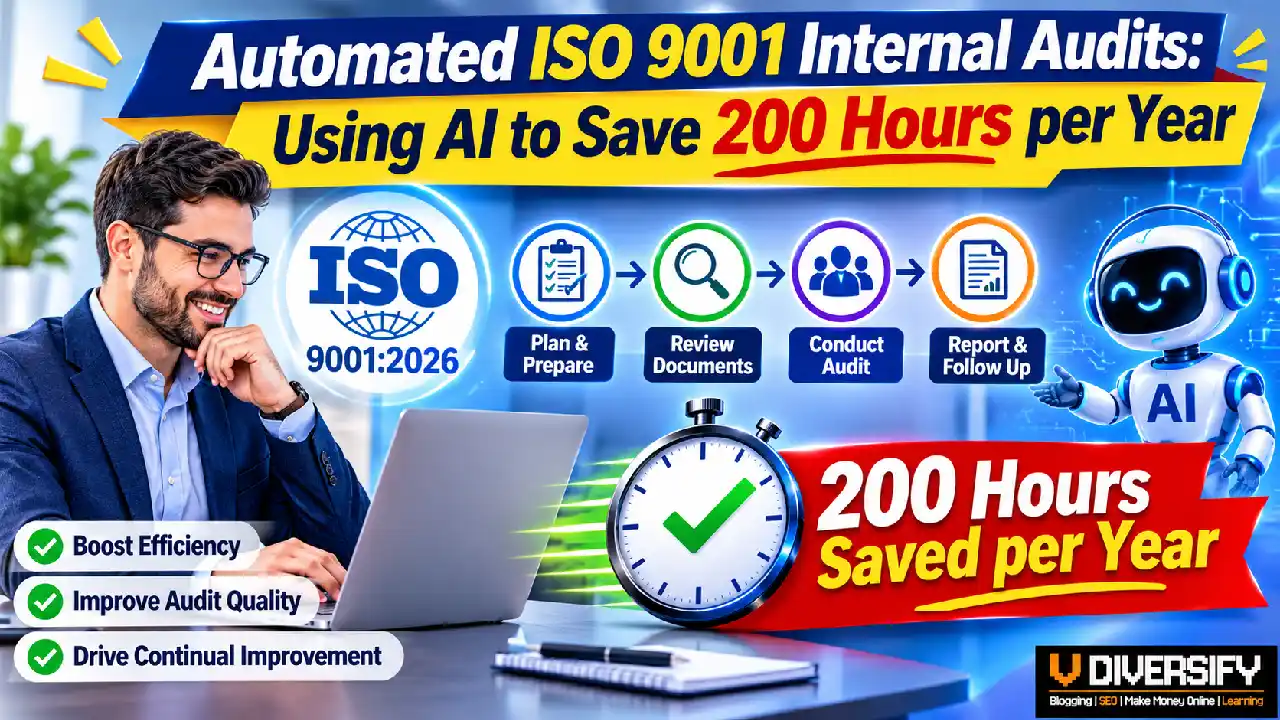
Internal auditing is one of the most important activities in maintaining an effective Quality Management System (QMS), but it is also one of the most time-consuming responsibilities for quality managers and internal auditors.
From preparing audit schedules and developing checklists to reviewing procedures, collecting evidence, preparing reports, and following up on corrective actions, the workload can quickly become difficult to manage.
This is where automated ISO 9001 internal audits AI save time becomes an important opportunity for organizations looking to improve audit efficiency without compromising quality, accuracy, or compliance.
Instead of spending several hours on repetitive administrative activities, quality professionals can use Artificial Intelligence (AI) to simplify routine tasks, organize information, and prepare audit documents more efficiently.
Consider a manufacturing company that conducts internal audits across production, purchasing, warehousing, maintenance, human resources, and quality departments. Its quality manager may spend several days preparing audit checklists, coordinating with department heads, reviewing documented information, and compiling audit reports.
When these activities are repeated throughout the year, hundreds of working hours can be consumed by administrative tasks rather than actual process evaluation and improvement.
AI is changing how organizations approach these activities. Tools such as ChatGPT, Microsoft Copilot, and workflow automation platforms can assist with audit planning, document analysis, checklist preparation, evidence organization, report drafting, and corrective action tracking.
However, there is an important distinction: AI does not replace the internal auditor. It supports the auditor by reducing repetitive work, improving access to information, and making audit preparation more efficient. The auditor must still verify evidence, conduct interviews, evaluate processes, identify genuine nonconformities, and make independent decisions.
In this article, we will explore how organizations can introduce AI into their internal audit processes, understand the relevant ISO 9001 requirements, automate repetitive activities, and build a practical approach to reducing annual audit administration time by approximately 200 hours.
Contents
- 1. What Are Automated ISO 9001 Internal Audits?
- 2. AI-assisted internal audit workflow
- 3. Why Traditional ISO 9001 Internal Audits Consume So Much Time
- 4. Understanding ISO 9001 Internal Audit Requirements
- 5. How AI Is Changing ISO 9001 Internal Auditing
- 6. 10 Ways to Use AI to Automate ISO 9001 Internal Audits
- 7. How to Automate an ISO 9001 Internal Audit Step by Step Using AI
- 8. How AI Can Save 200 Hours per Year in ISO 9001 Internal Audits
- 9. Illustrative annual productivity improvement
- 10. Best AI Tools and Software for ISO 9001 Internal Audits
- 11. Real-World Examples of AI-Powered Internal Auditing
- 12. Risks and Limitations of Using AI in ISO 9001 Internal Audits
- 13. 11. Human Auditors vs. AI: Who Should Do What?
- 14. How to Implement AI Internal Audit Automation in Your Organization
- 15. 90-day AI internal audit implementation roadmap
- 16. Measuring the Performance of Automated ISO 9001 Internal Audits
- 17. Internal audit performance dashboard
- 18. Common Mistakes to Avoid When Automating Internal Audits
- 19. Actionable Checklist for Implementing AI-Powered Internal Audits
- 20. Conclusion
- 21. FAQs
What Are Automated ISO 9001 Internal Audits?
Automated ISO 9001 internal audits are audits in which digital tools, artificial intelligence, and workflow automation are used to support or simplify activities throughout the internal auditing process. These activities may include preparing audit programmes, generating checklists, reviewing QMS documents, organizing audit evidence, drafting reports, and monitoring corrective actions.
In a traditional audit system, most of these activities are performed manually. An auditor may search through multiple folders to locate procedures, compare different document versions, prepare questions in spreadsheets, and manually transfer observations into an audit report.
With an AI-assisted approach, some of these repetitive activities can be completed faster using existing organizational information and carefully designed workflows.
For example, an AI tool can review an approved purchasing procedure and generate a draft checklist covering supplier evaluation, purchasing controls, supplier performance monitoring, and incoming material verification. The auditor can then review the questions, remove irrelevant items, and use the approved checklist during the actual audit.
The purpose of audit automation is not to automate compliance decisions. It is to automate repetitive administrative work so that auditors can spend more time evaluating process effectiveness.
Traditional internal audits vs. AI-assisted internal audits
The following comparison explains how the two approaches differ.
Audit activity | Traditional approach | AI-assisted approach |
Audit planning | Manual preparation of schedules | AI-assisted programme drafting |
Checklist preparation | Questions developed manually | Draft questions generated from process documents |
Document review | Manual searching and comparison | AI-supported document analysis |
Audit scheduling | Emails and spreadsheets | Automated notifications and workflows |
Evidence organization | Manual file collection | Structured evidence classification |
Report preparation | Manual report drafting | AI-assisted report preparation |
Corrective action tracking | Spreadsheet follow-ups | Automated reminders and dashboards |
Management reporting | Manual data compilation | AI-assisted summaries and analysis |
It is important to understand that the AI-assisted column does not mean every task can be completed without human involvement. For example, an AI system can suggest that a procedure does not address supplier re-evaluation, but a qualified auditor must check the applicable requirements, review the actual process, and determine whether a nonconformity exists.
How does an automated internal audit work?
A typical AI-assisted internal audit follows this sequence:
AI-assisted internal audit workflow
- Audit programme preparation
Prepare the annual audit schedule and identify processes.
- Checklist generation
Generate draft questions based on audit criteria and process documents.
- Audit execution
Auditors conduct interviews, observe activities, and collect evidence.
- Evidence analysis and reporting
AI assists with organizing verified notes and drafting reports.
- Corrective action monitoring
Track assigned actions, deadlines, and follow-up activities.
- Human verification and closure
The responsible auditor verifies results and approves audit conclusions.
This approach allows organizations to maintain control over their audit process while reducing unnecessary administrative effort.
Why Traditional ISO 9001 Internal Audits Consume So Much Time
Internal auditing is not limited to visiting departments and asking questions. A complete audit involves planning, preparation, execution, documentation, reporting, and follow-up.
Many organizations underestimate the time spent on activities before and after the actual audit. In some cases, auditors spend more time preparing documents and compiling reports than evaluating the processes themselves.
Let’s examine the major reasons.
2.1 Manual audit programme preparation
An internal audit programme must consider the importance of processes, organizational changes, previous audit results, and other relevant factors.
Quality managers often use Excel spreadsheets to prepare annual audit schedules. They manually identify departments, assign auditors, select audit dates, and coordinate with process owners.
This becomes challenging when an organization operates across multiple locations or has several departments.
How AI helps: AI can assist in preparing draft audit schedules, organizing process information, and highlighting areas that may need additional attention based on previous audit results. The quality manager must review the programme and ensure that it meets the organization’s requirements.
2.2 Preparing audit checklists manually
Checklist preparation is another time-consuming activity.
An auditor must understand the process, identify applicable ISO requirements, review organizational procedures, and develop relevant audit questions.
For example, an auditor conducting a purchasing audit may need questions covering:
- Supplier selection and approval.
- Supplier evaluation and monitoring.
- Purchasing specifications.
- Purchase order verification.
- Incoming material inspection.
- Supplier performance.
- Control of externally provided processes.
Preparing these questions manually for several departments can take considerable time.
AI can generate an initial checklist based on the applicable requirements and the organization’s approved procedures. This gives the auditor a starting point rather than requiring every question to be developed from scratch.
2.3 Reviewing procedures and documented information
A typical QMS may contain hundreds of documents, including:
- Quality policies.
- Quality manuals, where maintained.
- Standard operating procedures.
- Work instructions.
- Inspection plans.
- Process flowcharts.
- Forms and templates.
- Quality records.
- Risk assessments.
Reviewing all these documents manually can be difficult, particularly when documents are stored in different locations.
AI-supported document analysis can help summarize documents, compare revisions, identify missing information, and locate relevant sections.
For instance, an auditor can use an approved document repository and an authorized AI tool to identify whether a production inspection procedure addresses inspection frequency, acceptance criteria, responsibilities, and record retention.
The auditor must still verify the original documents and applicable requirements before making conclusions.
2.4 Coordinating with different departments
Internal audits require coordination between auditors and process owners.
Audit notifications, meeting invitations, document requests, reminders, and rescheduling can consume valuable working hours.
When several departments are involved, managing these communications manually can become difficult.
Workflow automation tools can help by:
- Sending audit notifications.
- Scheduling reminders.
- Requesting documents before audits.
- Notifying department heads about upcoming audits.
- Tracking audit completion.
- Reminding responsible persons about pending actions.
2.5 Preparing audit reports and following up
After completing an audit, auditors must organize their observations, review evidence, classify findings, and prepare the audit report.
The process does not end when the report is issued. Corrective actions must be assigned, investigated, implemented, and reviewed for effectiveness.
AI can help organize verified audit notes into a structured report and prepare summaries of overdue corrective actions.
For example, instead of manually preparing a weekly spreadsheet showing 15 open corrective actions, a connected workflow can generate an updated report showing action owners, target dates, and current status.
The biggest opportunity is reducing repetitive work across the complete audit lifecycle, not simply making checklist preparation faster.
Understanding ISO 9001 Internal Audit Requirements
Before automating internal audits, quality professionals must understand what ISO 9001 expects from an organization. Automation should make the existing audit system more efficient, not change the purpose of auditing or weaken the organization’s compliance obligations.
ISO 9001 requires organizations to conduct internal audits at planned intervals to determine whether their QMS conforms to the organization’s own requirements and the requirements of the applicable standard. Internal audits must also establish whether the QMS is effectively implemented and maintained.
As of November 2026, organizations should refer to the published ISO 9001:2026 edition when establishing or updating their QMS. The latest edition was published on September 16, 2026.
3.1 Understanding Clause 9.2 – Internal Audit
Clause 9.2 is the main requirement governing internal audits in ISO 9001.
It requires organizations to establish, implement, and maintain an internal audit programme. The programme must consider the importance of the processes concerned, changes affecting the organization, and the results of previous audits.
The organization must also:
- Define the audit criteria and scope for each audit.
- Select auditors and conduct audits to ensure objectivity and impartiality.
- Ensure audit results are reported to relevant management.
- Take appropriate correction and corrective action without undue delay.
- Retain documented information as evidence of audit programme implementation and audit results.
These requirements are important because an audit is not simply a checklist exercise. It must evaluate whether processes are operating as intended and whether the QMS is achieving its planned results.
How AI supports Clause 9.2:
AI can assist with several activities associated with the internal audit programme.
ISO 9001 audit requirement | Possible AI application |
Audit programme | Prepare draft annual audit schedules |
Audit criteria | Organize applicable requirements |
Audit scope | Draft process-specific audit scopes |
Auditor selection | Support competency and availability planning |
Audit execution | Generate relevant audit questions |
Audit reporting | Prepare draft audit reports |
Corrective action | Track action status and due dates |
Documented information | Organize audit records and reports |
AI must not independently decide whether the audit programme satisfies ISO 9001. The organization’s responsible personnel must approve the programme and ensure that the audit process is suitable for its QMS.
3.2 Understanding ISO 19011 and Its Importance
While ISO 9001 establishes the requirements for internal auditing, ISO 19011 provides guidelines for auditing management systems.
The latest edition, ISO 19011:2026, was published in May 2026. It provides guidance on auditing principles, managing audit programmes, conducting management system audits, and evaluating auditor competence.
Guidelines for auditing management systems+1
This standard is particularly relevant when organizations introduce AI into their auditing activities.
For example, an organization can use AI to prepare an audit checklist, but the checklist should still be reviewed to ensure that it is relevant to the audit scope and criteria. Similarly, AI can summarize audit notes, but the auditor must evaluate the underlying evidence before accepting any conclusion.
Some important auditing principles to maintain include:
- Integrity: Auditors must act honestly and responsibly.
- Fair presentation: Audit findings and conclusions must accurately reflect the evidence.
- Due professional care: Auditors must apply appropriate judgment and diligence.
- Confidentiality: Audit information must be protected.
- Independence: Auditors must maintain objectivity.
- Evidence-based approach: Conclusions must be based on verifiable evidence.
- Risk-based approach: Audit planning should consider significant risks and opportunities.
AI should support these principles rather than weaken them.
3.3 Can AI Conduct an ISO 9001 Internal Audit Independently?
AI can support many auditing activities, but an organization should not treat an AI-generated audit as automatically valid or complete.
For example, an AI tool may review a calibration procedure and identify that the document does not clearly explain how overdue measuring equipment is controlled. However, this observation alone does not establish a nonconformity.
The auditor must investigate:
- What does the applicable requirement expect?
- What does the organization’s approved procedure require?
- How is the process actually implemented?
- What objective evidence is available?
- Is there a genuine gap between the requirement and actual practice?
Only after evaluating these points can the auditor determine whether a finding is justified.
Remember: AI can assist with audit preparation and evidence analysis, but audit conclusions must remain under the control of competent, authorized personnel.
How AI Is Changing ISO 9001 Internal Auditing
Artificial Intelligence is changing how quality professionals prepare documents, analyze information, and manage repetitive activities.
Earlier, an internal auditor might spend several hours searching through procedures, preparing questions, and organizing information before conducting an audit. Today, AI tools can help perform parts of this work in a fraction of the time, provided the information is available in a suitable format and the tool is properly configured.
There are several AI technologies relevant to internal auditing.
4.1 Generative AI for Audit Preparation and Documentation
Generative AI can produce draft content based on instructions and information supplied by the user.
For example, a quality manager can provide an approved procedure and ask an AI tool to prepare:
- Audit questions.
- Process-specific checklists.
- Document review summaries.
- Audit notification emails.
- Audit report templates.
- Corrective action summaries.
- Management review inputs.
This is where ChatGPT ISO 9001 applications become useful.
A quality professional can use ChatGPT to prepare a first draft of an internal audit checklist, identify areas requiring further review, and organize audit documentation.
Similarly, generative AI quality documents can be developed more efficiently when the AI system has access to approved organizational references and clear instructions.
However, AI-generated documents should always undergo technical review and approval before being released for use within the QMS.
4.2 Large Language Models for SOP and Work Instruction Analysis
Large Language Models (LLMs) are AI systems designed to understand and generate human language.
They can help quality teams review large volumes of documented information, compare text, extract important requirements, and summarize procedures.
For example, consider a company with separate SOPs for:
- Incoming material inspection.
- Production planning.
- Equipment maintenance.
- Product identification.
- Final inspection.
- Nonconforming product control.
An auditor can use an approved LLM-based application to search these documents and generate a summary of responsibilities, process controls, and required records.
This makes it easier to prepare for an audit without manually reading every document from beginning to end.
Applications such as LLM SOP ISO 9001 analysis can also support procedure comparisons and help identify inconsistencies between different documents.
For example, the purchasing procedure may specify that suppliers are evaluated annually, while the supplier evaluation form may contain a six-month review frequency. An AI-assisted document comparison can flag this difference for investigation.
The AI has identified a possible inconsistency, not automatically established that either document is incorrect. The document owner must verify the intended requirement.
4.3 AI-Powered Document Search and Retrieval
Many organizations store their QMS documents in Microsoft SharePoint, OneDrive, document management systems, or centralized network folders.
Finding the correct approved document can be difficult when document libraries contain hundreds or thousands of files.
AI-powered document search can help auditors locate information using natural-language questions.
For example:
Which approved procedure explains how production equipment is maintained, and what records must be retained?
Instead of searching through several folders manually, an AI application connected to an authorized document repository can retrieve relevant information and point the auditor toward the applicable source documents.
This is especially useful for organizations with multiple locations, departments, and document owners.
However, the system must be configured to respect document permissions and distinguish current approved documents from obsolete or draft versions.
4.4 Workflow Automation for Audit Administration
Not every automation task requires generative AI.
Traditional workflow automation tools can perform repetitive activities based on predefined conditions.
For example, Microsoft Power Automate can be configured to:
- Send audit notifications when an audit date approaches.
- Request documents from department heads.
- Notify auditors when audit records are uploaded.
- Send reminders for overdue corrective actions.
- Update audit status in a tracking system.
- Notify quality managers when actions require escalation.
This type of automation can reduce the amount of time spent sending emails and updating spreadsheets.
The best approach is to combine AI with workflow automation. AI helps interpret and organize information, while workflow automation moves tasks between people and systems according to approved rules.
4.5 AI for Audit Data Analysis and Trend Identification
AI can also support the analysis of historical audit results.
For example, a company may have completed 40 internal audits over the previous 12 months. The audit records may contain recurring observations related to calibration, document control, supplier evaluation, training, and nonconforming outputs.
An AI-assisted analysis can help organize these findings into categories and highlight repeated issues.
A quality manager can then investigate whether certain processes require additional audit attention.
Consider this example:
Process | Previous audit observations | Possible area for further investigation |
Production | 12 | Process control and inspection |
Purchasing | 8 | Supplier monitoring |
Maintenance | 7 | Preventive maintenance |
Document control | 6 | Revision management |
Warehouse | 4 | Identification and traceability |
HR and training | 3 | Competence records |
These numbers are illustrative, not published industry statistics.
The table can help prioritize further investigation, but the number of findings alone should not determine whether a process is ineffective. Audit scope, process risk, severity, recurrence, and other relevant evidence must also be considered.
10 Ways to Use AI to Automate ISO 9001 Internal Audits
AI becomes most useful when it is applied to specific activities rather than introduced as a general-purpose tool without a clear objective.
The following ten applications can help organizations reduce administrative effort while maintaining effective internal auditing.
5.1 Automatically Prepare the Annual Internal Audit Programme
Preparing an annual audit programme requires the quality manager to consider the organization’s processes, previous audit results, process importance, and relevant changes.
AI can assist by organizing this information and preparing a draft audit programme.
For example, a manufacturing organization may have the following processes:
- Sales and customer service.
- Purchasing.
- Incoming inspection.
- Production.
- Quality control.
- Maintenance.
- Warehousing.
- Human resources.
- Management review.
The quality manager can provide the process list, previous audit findings, and planned organizational changes to an authorized AI tool.
The AI can prepare a proposed audit schedule showing:
- Process to be audited.
- Proposed audit month.
- Suggested audit duration.
- Proposed audit team.
- Relevant audit criteria.
- Previous findings requiring follow-up.
The quality manager must review and approve the schedule, including auditor competence and independence.
5.2 Generate Process-Specific Internal Audit Checklists
Checklist generation is one of the easiest ways to introduce AI into internal auditing.
Instead of preparing every question manually, an auditor can provide the applicable standard requirements, process details, and approved organizational procedures.
The AI can then prepare a draft checklist containing relevant questions.
Example: Production department audit checklist
Audit area | Example audit question |
Production planning | How are production requirements communicated to operators? |
Work instructions | Are current approved work instructions available? |
Equipment | Are production machines maintained as planned? |
Process monitoring | How are process parameters monitored? |
Inspection | Are inspection activities performed according to defined criteria? |
Identification | How is product identification maintained? |
Nonconforming output | How are rejected products identified and controlled? |
Records | Are required production records maintained? |
An AI-generated checklist should not be treated as a complete representation of every applicable requirement.
The auditor must check that the questions cover the audit scope and are suitable for the actual process.
5.3 Review QMS Procedures and Identify Documentation Gaps
Quality professionals often spend significant time reviewing procedures before an internal audit.
An AI tool can help compare approved procedures against a defined set of requirements and identify areas that may need further investigation.
For example, an organization can provide its document control procedure and ask the AI to check whether it clearly addresses:
- Document approval.
- Document revision.
- Access to current versions.
- Prevention of unintended use of obsolete documents.
- External documents.
- Document retention and disposal.
This is also useful when organizations want to use AI write quality procedures as part of their document development process.
An AI procedure generator can prepare an initial procedure structure, but the process owner must confirm that it reflects actual organizational practices.
AI should never invent process responsibilities, approval authorities, or controls that the organization has not implemented.
5.4 Analyze SOPs and Work Instructions
Standard operating procedures and work instructions explain how employees perform their activities.
When these documents are lengthy, auditors may find it difficult to identify the important controls quickly.
AI can help summarize an SOP and extract:
- Process responsibilities.
- Required inputs and outputs.
- Control points.
- Inspection requirements.
- Records to be maintained.
- Escalation procedures.
- Related documents.
For example, an auditor can ask an LLM to summarize the inspection requirements contained in a final inspection work instruction and prepare questions to verify whether employees follow the approved process.
ChatGPT work instructions applications can also help identify unclear steps, missing responsibilities, and differences between related documents.
However, the original approved work instruction remains the controlling document. AI-generated summaries must not replace it.
5.5 Prepare Audit Notifications and Scheduling Emails
Internal audit coordination can consume considerable administrative time.
AI can help prepare professional audit notifications containing:
- Audit date and time.
- Department or process.
- Audit scope.
- Audit criteria.
- Assigned auditor.
- Documents required before the audit.
- Department representative requirements.
A workflow automation platform can then send the notification to the appropriate personnel.
For example, when an audit is scheduled for the purchasing department, the system can automatically send a notification to the purchasing manager and auditor.
A reminder can also be triggered three working days before the planned audit.
This reduces repetitive communication and makes the audit schedule easier to manage.
5.6 Organize and Classify Audit Evidence
During an internal audit, auditors may collect different types of evidence, including:
- Inspection records.
- Training records.
- Calibration certificates.
- Purchase orders.
- Supplier evaluation records.
- Production reports.
- Maintenance records.
- Customer complaint records.
AI-assisted tools can help classify these records according to the relevant audit area.
For example, an auditor reviewing calibration records can use an approved document analysis system to extract equipment identification, calibration dates, certificate references, and stated calibration results.
The auditor must verify the extracted information against the original records.
AI must not be allowed to change evidence, create missing records, or treat an unverified document summary as proof of compliance.
5.7 Draft Internal Audit Reports
Preparing audit reports is another activity that can benefit from AI.
After completing an audit, the auditor may have interview notes, observations, document references, and verified evidence that need to be organized into a formal report.
An AI tool can help structure this information into:
- Audit details.
- Audit scope and criteria.
- Processes audited.
- Positive observations.
- Nonconformities.
- Opportunities for improvement.
- Supporting evidence references.
- Audit conclusion.
For example, the auditor can provide a verified observation and ask AI to rewrite it in clear, professional language without changing its meaning.
This is where AI quality writing can improve report readability and consistency.
However, AI must not invent findings, assign unsupported severity levels, or convert a general observation into a nonconformity without sufficient evidence.
5.8 Track Corrective Actions and Overdue Findings
Corrective action monitoring often requires repeated communication between the quality department and process owners.
AI and workflow automation can help organize corrective action information, prepare reminders, and identify overdue actions.
A tracking system may contain:
Finding reference | Responsible department | Target date | Status |
IA-001 | Production | November 20 | In progress |
IA-002 | Purchasing | November 15 | Overdue |
IA-003 | Maintenance | November 25 | Open |
IA-004 | Warehouse | November 18 | Completed |
The system can automatically notify the responsible department when an action is approaching its deadline.
It can also alert the quality manager when an action becomes overdue.
The auditor or designated reviewer must still verify whether the correction, root cause analysis, corrective action, and effectiveness review are adequate.
5.9 Summarize Internal Audit Results for Management Review
Management needs useful information about the performance of the QMS.
Rather than manually reviewing multiple audit reports, quality managers can use AI to prepare summaries of verified audit information.
These summaries may include:
- Total audits planned.
- Total audits completed.
- Open audit findings.
- Repeated nonconformities.
- Overdue corrective actions.
- Common process weaknesses.
- Areas requiring management attention.
For example, an AI-assisted system may identify that supplier monitoring appears frequently in recent audit findings.
The quality manager can investigate the underlying records and decide whether supplier evaluation methods, resources, or process controls need improvement.
5.10 Generate Audit Questions Based on Previous Findings
Previous audit results can provide useful information when preparing future audits.
AI can analyze historical findings and suggest follow-up questions based on recurring problems.
For example, if a previous audit identified missing maintenance records, the next audit may include questions about:
- Maintenance planning.
- Completion of maintenance activities.
- Equipment downtime.
- Overdue maintenance.
- Maintenance record availability.
- Review of maintenance effectiveness.
This makes audit preparation more focused.
However, the auditor should avoid assuming that a previous problem still exists. The purpose of the next audit is to verify the current condition using fresh evidence.
The most effective AI-assisted audit programmes combine these ten applications into a controlled workflow, with human review at every important decision point.
How to Automate an ISO 9001 Internal Audit Step by Step Using AI
Introducing AI into internal auditing does not require an organization to replace its existing QMS software or completely redesign its audit programme.
A better approach is to start with the activities that consume the most administrative time and gradually introduce automation. Organizations can begin with checklist preparation and document review before moving toward automated scheduling, evidence organization, reporting, and corrective action monitoring.
The following steps provide a practical implementation method.
Step 1: Identify the Activities That Consume the Most Time
Before selecting an AI tool, the quality manager should understand where auditors spend their working hours.
Review the previous year’s internal audit activities and identify the major time-consuming tasks.
For example:
Activity | Current time per audit |
Audit preparation | 3 hours |
Checklist development | 2 hours |
Document review | 2 hours |
Audit coordination | 1 hour |
Audit execution | 4 hours |
Report preparation | 2 hours |
Follow-up administration | 1 hour |
Total | 15 hours |
These are illustrative figures. Each organization should establish its own baseline using actual time records.
The purpose is to identify which activities can be improved through AI and which require direct auditor involvement.
Step 2: Collect Approved QMS Documents
AI tools become more useful when they have access to relevant and accurate organizational information.
Collect the approved documents required for audit preparation, such as:
- Quality policy.
- Applicable quality management standard.
- Approved QMS procedures.
- Work instructions.
- Process flowcharts.
- Previous audit reports.
- Corrective action records.
- Risk assessments.
- Relevant forms and templates.
Organizations can use controlled document repositories to make approved information accessible to authorized AI applications.
For example, a company using Microsoft SharePoint can organize its approved QMS documents into department-specific libraries and configure an AI application to retrieve information from authorized sources.
This can support AI ISO 9001 documentation activities while reducing the risk of using outdated documents.
Step 3: Select an Appropriate AI Tool
The next step is to identify an AI application that supports the organization’s requirements.
For a small organization, a general-purpose AI tool may be sufficient for preparing draft checklists and summarizing documents.
Larger organizations may need enterprise AI applications connected to their document management systems, access controls, and existing business workflows.
Consider the following factors:
- Data confidentiality.
- Document access permissions.
- Accuracy of document retrieval.
- Integration with existing systems.
- User access controls.
- Audit trail availability.
- Cost and licensing.
- Human approval requirements.
Do not upload confidential customer information, employee records, proprietary procedures, or sensitive business information into an AI service without confirming that its security and data handling arrangements are approved by the organization.
Step 4: Create Standardized AI Prompts for Auditors
One common mistake is allowing every auditor to use AI without standardized instructions.
This can produce inconsistent checklists, reports, and audit questions.
Instead, quality managers should develop approved prompt templates for common audit activities.
Example: ChatGPT prompt for preparing an ISO 9001 internal audit checklist
Internal audit checklist prompt (Example prompt for a purchasing process audit)
You are assisting an internal auditor in preparing an ISO 9001 internal audit checklist.
Prepare a detailed checklist for the purchasing department of a manufacturing organization.
Consider the following information:
- Supplier selection and approval.
- Supplier evaluation and monitoring.
- Purchasing specifications.
- Purchase order verification.
- Incoming material inspection.
- Supplier performance monitoring.
- Control of externally provided processes.
For each audit question, provide:
- Audit question.
- Relevant ISO 9001 requirement.
- Suggested objective evidence.
- Possible records to review.
- Suggested verification method.
Use simple, professional language.
Do not invent ISO requirements or assume that a process is nonconforming. Clearly distinguish draft audit questions from actual audit findings. Identify areas that require verification against the applicable standard and approved organizational procedures.
Auditors can use similar prompts for production, maintenance, warehousing, human resources, engineering, and other processes.
Standardized prompts also support consistent ISO 9001 AI writing across the quality department.
Step 5: Generate and Validate Audit Checklists
Once the prompt is prepared, the AI can generate a draft checklist.
The auditor should compare the generated questions with the applicable ISO 9001 requirements and approved QMS documentation.
For example, if the AI generates a question about supplier evaluation, the auditor should confirm that it relates to the organization’s actual purchasing process and relevant requirements.
The checklist should be reviewed and approved before being used during the audit.
Step 6: Introduce Automated Scheduling and Notifications
After checklist preparation has been improved, the organization can automate administrative activities.
A workflow can be configured to:
- Read the approved audit schedule.
- Identify upcoming audits.
- Send notifications to the relevant department.
- Request required documents.
- Send reminders before the audit.
- Update the audit status.
- Notify the quality manager about delays.
This can be achieved using workflow automation platforms and existing organizational applications.
Step 7: Use AI to Assist with Reporting and Follow-Up
After completing an audit, the auditor can use AI to organize verified observations and prepare a draft report.
For example, an auditor may provide the following verified observation:
Three sampled measuring instruments had calibration due dates that had passed, and no evidence of completed recalibration was available at the time of the audit.
AI can help structure the observation into a professional report format.
However, the auditor must confirm the applicable requirement, verify the sample records, investigate the actual condition, and determine whether a nonconformity exists.
The AI must not independently create a finding or claim that corrective action has been completed.
Step 8: Monitor the Results and Improve the System
Once automation is introduced, the quality manager should measure its performance.
Useful indicators include:
- Time spent preparing audit checklists.
- Time spent reviewing documents.
- Audit report preparation time.
- Percentage of audits completed as planned.
- Number of overdue corrective actions.
- Time required to close audit reports.
- Accuracy of AI-generated document summaries.
- Auditor satisfaction with the system.
The results should be reviewed periodically to identify areas where further automation may be useful.
A practical example: Using AI to support QMS documentation
Suppose an organization wants to review its quality procedures before the annual internal audit.
The quality manager can use an authorized AI application to summarize existing procedures, compare document revisions, and identify areas that may need clarification.
This approach can support the preparation of a GenAI quality manual, an AI ISO 9001 manual, and other supporting documents. Similarly, LLM quality procedures and LLM quality documentation workflows can help organize existing content and prepare initial drafts of revised procedures.
However, the AI-generated material must reflect the organization’s actual processes. It should be checked by process owners, reviewed by authorized personnel, and approved through the organization’s document control process.
Automated quality documentation should improve the accuracy and accessibility of QMS information, not create additional uncontrolled documents.
The same principle applies to ChatGPT QMS applications: AI can help prepare and organize quality information, but the organization remains responsible for document accuracy, approval, implementation, and control.
How AI Can Save 200 Hours per Year in ISO 9001 Internal Audits
One of the biggest reasons organizations are interested in AI-powered internal audits is the opportunity to reduce the time spent on repetitive audit activities.
However, saving 200 hours annually should not be treated as a marketing promise. It should be treated as a measurable improvement target that an organization can achieve by identifying administrative activities that can be simplified, automated, or supported by AI.
To understand how this works, consider a manufacturing company with approximately 150 employees, eight major business processes, and an established ISO 9001 Quality Management System.
The company conducts regular internal audits throughout the year. Its quality manager and internal auditors spend considerable time preparing checklists, reviewing procedures, coordinating with departments, preparing reports, and following up on corrective actions.
By introducing AI and workflow automation, the company can reduce the time spent on several of these activities.
7.1 Annual time-saving calculation
The following example compares the estimated annual workload before and after introducing AI-assisted auditing.
Internal audit activity | Manual process (hours/year) | AI-assisted process (hours/year) | Hours saved |
Audit programme preparation | 35 | 12 | 23 |
Checklist preparation | 50 | 15 | 35 |
QMS document review | 45 | 15 | 30 |
Audit scheduling and coordination | 30 | 10 | 20 |
Evidence organization | 55 | 25 | 30 |
Audit report preparation | 60 | 20 | 40 |
Corrective action tracking | 35 | 13 | 22 |
Management reporting | 20 | 10 | 10 |
Total | 330 | 120 | 210 |
Illustrative annual productivity improvement
Manual workload: 330 hrs
AI-assisted workload: 120 hrs
Potential annual administrative time saved: 210 hours
Approximately 64% less administrative time: 63.6%
Illustrative model, not a measured industry benchmark. Actual results depend on the audit programme, number of processes, existing systems, and automation maturity.
The example shows that an organization could save approximately 210 hours annually, exceeding the 200-hour improvement target.
These savings are primarily associated with administrative activities. The calculation does not assume that AI replaces audit interviews, process observations, evidence verification, or auditor decision-making.
7.2 How can an organization achieve these savings?
The improvement comes from reducing repetitive tasks across several stages of the audit lifecycle.
For example:
Checklist preparation: Instead of preparing every question manually, auditors can use AI to generate an initial checklist based on approved procedures and applicable requirements.
Document review: AI can summarize lengthy procedures, locate relevant information, and highlight possible inconsistencies for further investigation.
Audit coordination: Automated notifications can reduce the time spent sending emails, requesting records, and following up on audit schedules.
Report preparation: AI can organize verified observations into a consistent report structure, reducing repetitive formatting and writing.
Corrective action tracking: Automated workflows can send reminders and prepare status reports without requiring the quality manager to update multiple spreadsheets manually.
The important point is that these improvements accumulate. Saving 15 minutes on one task may appear insignificant, but repeating that saving across multiple audits and departments can produce a meaningful annual improvement.
7.3 Calculate the financial value of saved hours
Time savings can also be translated into an estimated financial benefit.
Suppose the organization saves 200 working hours annually and the average fully loaded labor cost of the employees involved is $45 per hour.
The estimated value of the recovered working time would be:
200 ✖ $45 = $9,000
Illustrative annual labor capacity recovered: $9,000
(200 hours × $45 per hour)
This does not automatically mean that the organization reduces its payroll expenses by $9,000. The benefit represents the estimated value of employee time that can be redirected toward other productive activities.
For example, auditors can use the recovered time to:
- Conduct deeper process audits.
- Investigate recurring nonconformities.
- Review supplier performance.
- Improve process controls.
- Support risk-based thinking.
- Monitor corrective action effectiveness.
- Identify opportunities for continual improvement.
7.4 How to measure actual time savings
Organizations should not rely on estimates indefinitely.
A practical method is to record the time spent on each audit activity before introducing AI and compare it with the time required after implementation.
Use the following formula:
Time Saved = Baseline Hours – Actual Hours
For percentage improvement:
Time Reduction (%) = (Hours Saved ÷ Basline Hours) ✖ 100
For example, if checklist preparation previously required 50 hours annually and now requires 15 hours, the saving is 35 hours, or 70%.
The quality manager should also monitor whether audit quality remains satisfactory. Faster reporting is not an improvement if findings become less accurate or important process risks are overlooked.
Best AI Tools and Software for ISO 9001 Internal Audits
Selecting the right AI tools is an important part of successful audit automation.
Not every organization needs an expensive enterprise platform. A small business may achieve meaningful improvements using an AI assistant, spreadsheets, and basic workflow automation. Larger organizations may benefit from integrated systems that connect AI with document management, audit records, and corrective action tracking.
The following tools offer different capabilities.
8.1 ChatGPT – For Audit Checklists, Procedures, and Reports
Best suited for: Audit preparation, document drafting, checklist generation, and report writing.
Official website: ChatGPT
ChatGPT can help quality professionals prepare draft audit checklists, summarize procedures, develop audit questions, and organize verified audit observations.
For example, a quality manager can provide a purchasing procedure and request a checklist covering supplier evaluation, purchasing controls, and incoming inspection.
It can also help prepare an AI ISO 9001 manual or draft supporting SOPs and work instructions.
Advantages:
- Helps prepare audit documentation.
- Generates process-specific questions.
- Summarizes lengthy documents.
- Assists with professional report writing.
- Supports brainstorming and analysis.
Limitations: It does not automatically know whether a company follows its procedures. Its outputs must be checked against the applicable standard and actual organizational evidence.
8.2 Microsoft 365 Copilot – For QMS Document and Audit Workflow Support
Best suited for: Organizations using Microsoft 365, SharePoint, Word, Excel, Outlook, and Teams.
Official website: Microsoft 365 Copilot
Microsoft 365 Copilot can help users work with organizational information within supported Microsoft applications.
For example, quality managers can use it to prepare audit communications, summarize information, analyze spreadsheet data, and work with documents.
When combined with properly configured document repositories and permissions, it can support easier access to approved QMS information.
8.3 Microsoft Power Automate – For Audit Notifications and Corrective Action Tracking
Best suited for: Repetitive audit administration and workflow automation.
Official website: Power Automate
Power Automate can connect supported applications and trigger actions based on predefined conditions.
For example, when a corrective action is approaching its due date, the system can send a reminder to the responsible department.
It can also automate audit notifications, document requests, approval routing, and status updates.
8.4 Microsoft Copilot Studio – For Building an Internal Audit Assistant
Best suited for: Building customized AI assistants connected to approved organizational information.
Official website: Copilot Studio
Organizations can develop AI agents that help auditors retrieve approved audit procedures, locate templates, and understand internal audit methodologies.
A particularly useful published example is Grupo Bimbo, which developed two AI agents using Microsoft Copilot Studio.
Its Audit Assist and Comatrix solutions support audit guidance and planning using approved content stored in SharePoint. Microsoft reports that planning-phase audit completion time decreased by approximately 20%, while preparing risk and control matrices was reduced from around two days to less than half a day. Auditors still review and refine the AI-generated outputs.
This demonstrates how an organization can use AI to improve audit preparation without removing the auditor’s responsibility.
8.5 Power BI – For Internal Audit Dashboards
Best suited for: Audit performance monitoring and management reporting.
Official website: Power BI
Power BI can help organizations visualize audit data from supported sources.
A quality manager can develop dashboards showing:
- Planned versus completed audits.
- Audit findings by department.
- Open and overdue corrective actions.
- Repeated nonconformities.
- Audit completion time.
- Corrective action closure trends.
Power BI is primarily an analytics platform rather than an autonomous audit tool. It becomes more useful when connected to reliable and controlled audit records.
8.6 Dedicated QMS and Audit Management Software
Organizations with complex audit programmes may consider specialized audit management and QMS platforms.
Examples include:
- Ideagen – Official website.
- MasterControl – Official website.
- QT9 QMS – Official website.
- Qualio – Official website.
These products offer different combinations of document control, audit management, training, corrective action, and quality record management.
Before purchasing any system, organizations should evaluate its actual features, integration capabilities, data security, access controls, and suitability for their QMS.
8.7 Which AI tool should an organization choose?
Organization type | Suggested starting approach |
Small business | ChatGPT and controlled spreadsheets |
Small manufacturing company | ChatGPT and workflow automation |
Medium-sized organization | Microsoft 365 Copilot and Power Automate |
Multi-location organization | Copilot Studio and centralized document management |
Large enterprise | Integrated QMS and audit management platform |
The best solution is not necessarily the one with the most AI features. It is the one that fits the organization’s processes, security requirements, resources, and audit needs.
Real-World Examples of AI-Powered Internal Auditing
AI-powered auditing is not limited to theoretical applications. Organizations are already using AI agents and digital platforms to improve how auditors prepare, retrieve information, and complete audit-related activities.
The following examples demonstrate how similar approaches can be applied in different industries.
9.1 Manufacturing Industry – Automating Production Audits
Consider an automotive component manufacturing company with several production lines, inspection stations, and maintenance departments.
The quality manager conducts internal audits to verify production controls, inspection activities, equipment maintenance, product identification, and nonconforming output management.
Previously, auditors manually reviewed production procedures, inspection reports, maintenance records, and other documents before conducting each audit.
The company introduces an AI-assisted audit system connected to its approved QMS documents.
The system can help:
- Retrieve current production procedures.
- Prepare production audit checklists.
- Summarize inspection requirements.
- Organize production records.
- Prepare draft audit reports.
- Track corrective action deadlines.
For example, when auditing a final inspection, the AI can help the auditor locate the approved inspection procedure and prepare questions about inspection frequency, acceptance criteria, inspection records, and product release authorization.
The auditor then visits the production area, interviews employees, observes inspection activities, and verifies actual records.
Expected benefit: Less preparation and documentation time, more consistent audit questions, and greater focus on actual production controls.
9.2 Service Industry – Automating Process Audits
AI automation is equally useful for service-based organizations.
Consider an IT services company that maintains an ISO 9001-certified QMS.
Its internal audit programme covers:
- Customer requirement reviews.
- Service delivery.
- Complaint management.
- Project management.
- Employee competence.
- Supplier management.
- Customer satisfaction.
AI can help prepare checklists based on service delivery procedures and summarize previous audit findings.
For example, an auditor preparing to audit customer complaint management can ask an AI application to identify the approved complaint-handling procedure, extract the defined responsibilities, and prepare relevant audit questions.
During the audit, the auditor verifies actual complaint records, response times, customer communication, and the organization’s handling of recurring problems.
This approach reduces preparation work while allowing auditors to concentrate on service quality and customer requirements.
9.3 Purchasing Department – Supplier Audit Preparation
Supplier management is an important area for many manufacturing and service organizations.
An AI-assisted audit system can help organize supplier evaluation records, approved supplier lists, purchasing procedures, and supplier performance reports.
For example, the system can help identify suppliers with repeated delivery delays or recurring quality problems from historical records.
The auditor can use this information to prepare focused questions about supplier evaluation, performance monitoring, and purchasing controls.
However, AI should not independently approve or disqualify suppliers. Those decisions must follow the organization’s approved supplier management process.
9.4 Warehouse and Inventory – Record Analysis
Warehouses generate large volumes of records associated with product identification, storage, preservation, inventory movement, and traceability.
AI can help auditors search and organize relevant information before the audit.
For example, an auditor can ask an approved AI application to identify records associated with a particular product batch and summarize the available receiving, inspection, and dispatch information.
The auditor must verify the original records and physically inspect the relevant materials where necessary.
9.5 Real Published Example – Grupo Bimbo
One useful published example comes from Grupo Bimbo, a multinational food manufacturing company.
According to Microsoft’s June 2026 customer story, the company developed Audit Assist and Comatrix using Microsoft Copilot Studio.
These AI agents connect with approved audit information stored in SharePoint and help auditors retrieve guidance, prepare audit planning documents, and work with standardized audit methodologies.
Microsoft reports the following results:
- Approximately 20% reduction in planning-phase audit completion time.
- Risk and control matrix preparation reduced from around two days to less than half a day.
- Improved access to approved audit guidance.
- Reduced dependency on quality assurance personnel for routine questions.
The important lesson is that AI provides auditors with a better starting point, while human auditors continue reviewing and refining the outputs.
This example demonstrates the practical value of connecting AI applications with approved organizational information rather than relying entirely on general-purpose AI responses.
Risks and Limitations of Using AI in ISO 9001 Internal Audits
Although AI can improve audit efficiency, organizations must understand its limitations before introducing it into their QMS.
An AI application can generate incorrect information, misunderstand technical requirements, summarize documents inaccurately, or produce findings that are not supported by objective evidence.
For this reason, AI should be introduced with appropriate controls.
10.1 Incorrect AI-Generated Information
One of the most important risks is inaccurate or fabricated information.
For example, an AI tool may generate an audit question referring to a requirement that does not exist in the applicable standard.
If the auditor uses this question without checking its validity, the audit may become misleading.
Control measures:
- Verify standard references against an authorized copy of the applicable standard.
- Review all AI-generated checklists.
- Use approved organizational documents as source information.
- Do not accept AI-generated nonconformities without objective evidence.
- Require human approval before releasing audit reports.
10.2 Confidentiality and Data Security
Internal audits may involve confidential information, including:
- Customer information.
- Supplier contracts.
- Employee training records.
- Production performance data.
- Proprietary manufacturing procedures.
- Internal nonconformity reports.
- Business-sensitive information.
Uploading such information into an unapproved AI service may create confidentiality and security risks.
Organizations should evaluate the provider’s data handling terms, retention settings, access controls, encryption, administrative controls, and applicable contractual requirements.
For example, Microsoft states that prompts and responses in Microsoft 365 Copilot with enterprise data protection are not used to train foundation models. However, organizations must still evaluate logging, permissions, retention, and their own configuration.
Similarly, the organization should review the applicable business data protection terms before using ChatGPT or another AI platform for confidential QMS information.
10.3 AI Bias and Incomplete Analysis
AI may give more attention to information that is clearly documented while overlooking important operational problems that are not captured in the available records.
For example, a production department may maintain complete inspection records, but employees may not consistently follow the approved inspection procedure.
A document-based AI review may not identify this problem.
The auditor must still conduct interviews, observe activities, and verify actual implementation.
10.4 Overdependence on AI
Another risk is allowing auditors to depend too heavily on AI-generated checklists and reports.
If auditors simply accept generated questions without understanding the process, they may miss important risks and operational weaknesses.
AI should support professional judgment, not replace it.
10.5 Loss of Audit Objectivity
Internal auditors must maintain objectivity and impartiality.
If AI is used to evaluate audit evidence, its recommendations must not influence the auditor to accept unsupported conclusions.
For example, an AI application may suggest that a department is compliant because all required documents are available. However, document availability alone does not prove that employees follow the procedures.
The organization must ensure that AI-supported auditing remains evidence-based, independent, and professionally controlled.
11. Human Auditors vs. AI: Who Should Do What?
A common question among quality professionals is whether AI will eventually replace internal auditors.
The practical answer is that AI can automate or assist with many administrative tasks, but effective internal auditing requires human involvement.
Auditors must understand organizational processes, communicate with employees, evaluate evidence, identify process weaknesses, and exercise professional judgment.
The following comparison explains the responsibilities.
Internal audit activity | AI responsibility | Human auditor responsibility |
Audit programme | Prepare draft schedules | Review and approve programme |
Checklist | Generate draft questions | Validate audit criteria and questions |
Document review | Summarize and compare documents | Verify original documents |
Interviews | Help prepare questions | Conduct interviews |
Process observation | Organize observation notes | Observe actual operations |
Evidence analysis | Extract and classify information | Evaluate evidence |
Nonconformity | Assist with report wording | Determine and approve findings |
Audit reporting | Prepare draft reports | Verify and approve reports |
Corrective action | Send reminders and summarize status | Evaluate adequacy and effectiveness |
11.1 Why human judgment remains essential
Consider an internal audit of a calibration process.
An AI tool may identify that a measuring instrument has an expired calibration date.
However, the auditor must investigate:
- Whether the equipment was actually used after the due date.
- Whether the equipment affected product acceptance.
- Whether the organization has an approved control process.
- Whether previous measurement results require evaluation.
- Whether any potentially affected product requires further action.
These decisions require an understanding of the organization’s operations and the applicable requirements.
AI can help organize the information, but it cannot independently establish the full context.
11.2 Building AI competency among internal auditors
Organizations should train auditors to use AI responsibly.
Training should cover:
- Basic understanding of generative AI and LLMs.
- Writing clear and effective prompts.
- Reviewing AI-generated information.
- Identifying inaccurate AI responses.
- Protecting confidential information.
- Verifying ISO requirements.
- Maintaining audit objectivity.
- Documenting AI-assisted activities where necessary.
Auditors should also understand that AI-generated text is not automatically reliable simply because it is written in professional language.
How to Implement AI Internal Audit Automation in Your Organization
A structured implementation approach helps organizations introduce AI without disrupting existing audit activities.
A practical 30-60-90-day roadmap can be used to start the process.
90-day AI internal audit implementation roadmap
- Days 1–30: Assessment and preparation
- Review existing audit procedures.
- Identify repetitive administrative tasks.
- Measure current audit preparation time.
- Select suitable AI tools.
- Review confidentiality and data security.
- Develop standardized AI prompts.
- Days 31–60: Pilot implementation
- Select one or two departments.
- Test AI-generated checklists.
- Introduce document analysis.
- Automate audit notifications.
- Test AI-assisted reporting.
- Train internal auditors.
- Review accuracy and usability.
- Days 61–90: Expansion and improvement
- Review pilot performance.
- Correct identified problems.
- Expand automation to other departments.
- Introduce corrective action reminders.
- Develop audit dashboards.
- Measure time savings.
- Establish ongoing monitoring and controls.
12.1 Start with a small pilot project
Organizations should avoid automating the entire audit programme immediately.
A better approach is to select a department with a manageable audit scope, such as purchasing or maintenance.
Test the AI application using approved procedures and compare the results with the organization’s existing audit preparation method.
If the system produces accurate and useful outputs, expand it gradually.
12.2 Establish an AI usage procedure
Organizations should consider documenting how AI can be used within their QMS.
The procedure or guidance document may define:
- Approved AI applications.
- Authorized users.
- Permitted and prohibited information.
- Document review requirements.
- Human approval responsibilities.
- Record retention.
- Output verification.
- Handling of AI-generated errors.
- Monitoring and improvement.
This creates a controlled approach and reduces the risk of employees using unapproved applications for sensitive audit information.
12.3 Integrate AI with existing QMS software
Where practical, AI should connect with existing organizational systems rather than create separate, uncontrolled document repositories.
For example, an organization may connect its AI application with an approved SharePoint document library and use Power Automate to manage notifications.
This can create a more connected audit process while maintaining existing document control and access permissions.
Measuring the Performance of Automated ISO 9001 Internal Audits
Introducing AI is not enough. Organizations must determine whether it actually improves audit performance.
Quality managers should establish measurable indicators before implementing automation and compare results periodically.
The following KPIs can help.
KPI | What it measures | Why it matters |
Audit preparation time | Hours spent preparing audits | Measures administrative efficiency |
Checklist preparation time | Time required to develop checklists | Measures AI assistance |
Audit completion rate | Completed audits against planned audits | Measures programme execution |
Report preparation time | Time taken to issue reports | Measures documentation efficiency |
Corrective action closure time | Time required to close actions | Measures follow-up performance |
Overdue actions | Number of actions past due date | Highlights follow-up problems |
Repeat findings | Recurrence of similar findings | Indicates possible process weaknesses |
Audit coverage | Processes audited against the programme | Measures audit programme coverage |
13.1 Example of an internal audit performance dashboard
The following example illustrates how a quality manager could present audit performance to management.
Internal audit performance dashboard
Illustrative sample data for a quarterly review
Audits planned: 20
Audits completed: 18
Open findings: 12
Overdue actions: 3
Audit programme completion: 18 of 20 audits (90%)
13.2 Review audit quality alongside time savings
A reduction in audit preparation time does not necessarily mean that the audit programme has improved.
Quality managers should also examine:
- Whether important processes are receiving sufficient audit coverage.
- Whether audit findings are supported by objective evidence.
- Whether auditors maintain independence.
- Whether corrective actions address root causes.
- Whether recurring problems are decreasing.
- Whether audit reports are issued accurately and on time.
The ultimate objective is to improve the effectiveness of the QMS, not simply to produce more audit reports in less time.
Common Mistakes to Avoid When Automating Internal Audits
Organizations should be aware of several mistakes that can reduce the value of AI-powered auditing.
- Using AI-generated checklists without verification
AI-generated questions may be irrelevant, incomplete, or based on incorrect interpretations. Always validate them against the applicable requirements and organizational procedures.
- Uploading confidential information into unapproved AI applications
Establish data security rules before allowing employees to use AI for audit-related information.
- Treating AI suggestions as actual nonconformities
A possible gap identified by AI must be investigated and supported by objective evidence before being reported as a nonconformity.
- Automating processes that are already poorly controlled
Automating an ineffective audit process can make existing problems happen faster. Improve the underlying workflow before introducing automation.
- Ignoring auditor competency
Auditors must understand how to evaluate AI outputs and recognize incorrect information.
- Focusing only on cost savings
The goal should be better audit effectiveness, improved process understanding, and reduced administrative effort.
- Failing to maintain document control
AI-generated procedures, checklists, and reports must follow the organization’s approval and document control arrangements.
- Allowing AI to make independent audit decisions
Audit conclusions, finding classification, and approval must remain under appropriate human control.
Actionable Checklist for Implementing AI-Powered Internal Audits
The following checklist can help quality managers assess their organization’s readiness.
AI audit implementation checklist:
- Review the current internal audit procedure and programme.
- Identify repetitive activities that consume the most working hours.
- Establish a baseline for audit preparation and reporting time.
- Confirm the applicable ISO 9001 edition and audit criteria.
- Identify approved QMS documents for AI-assisted analysis.
- Select an AI application approved by the organization.
- Evaluate data security, confidentiality, and user permissions.
- Develop standardized prompts for audit preparation.
- Test AI-generated checklists against actual requirements.
- Introduce automated audit notifications and reminders.
- Establish human verification and approval controls.
- Train internal auditors in responsible AI usage.
- Pilot the system in one or two departments.
- Measure actual time savings and audit quality.
- Expand automation based on pilot results.
- Review the system periodically and improve it.
This checklist can be used during an initial AI readiness assessment or as part of a quality department improvement project.
Conclusion
Internal auditing is essential for maintaining an effective Quality Management System, but it should not require quality professionals to spend unnecessary hours performing repetitive administrative activities.
AI offers organizations an opportunity to improve the way they prepare audit programmes, develop checklists, review QMS documentation, organize evidence, prepare reports, and monitor corrective actions.
By combining generative AI, Large Language Models, and workflow automation, organizations can simplify many activities that traditionally consume significant working time.
As demonstrated in the illustrative time-saving calculation, an organization could potentially save more than 200 hours annually by improving its internal audit workflow. The actual results will depend on the organization’s size, audit frequency, existing processes, and the level of automation introduced.
However, the most important benefit is not simply the number of hours saved.
It is the opportunity to allow internal auditors to spend more time on activities that genuinely improve organizational performance, including:
- Identifying process weaknesses.
- Evaluating operational risks.
- Investigating recurring nonconformities.
- Improving supplier performance.
- Strengthening process controls.
- Evaluating corrective action effectiveness.
- Supporting continual improvement.
Organizations should also remember that AI cannot replace auditor competence, independence, professional judgment, or objective evidence.
The most successful approach is to use AI as an intelligent assistant while keeping audit decisions, verification, and approval under appropriate human control.
The future of internal auditing is not about replacing auditors with AI. It is about helping auditors work smarter, complete administrative activities faster, and focus more attention on improving quality.
For quality managers and organizations looking to modernize their QMS, starting with a small AI-assisted audit project can be an effective first step toward a more efficient and well-controlled internal audit programme.
References and Further Reading
The following resources provide additional information about ISO standards, AI applications, audit automation, and responsible use of technology.
- International Organization for Standardization (ISO): ISO 9001:2026 – Quality Management Systems Requirements.
- International Organization for Standardization (ISO): ISO 19011:2026 – Guidelines for Auditing Management Systems.
- Microsoft Customer Stories: Grupo Bimbo Cuts Audit Times by 20% with Microsoft Copilot Studio.
- OpenAI: OpenAI Business Solutions.
- Microsoft: Enterprise Data Protection in Microsoft Copilot.
- Microsoft: Microsoft Power Automate.
FAQs
Can AI perform ISO 9001 internal audits?
AI can assist with audit planning, checklist preparation, document analysis, evidence organization, report drafting, and corrective action tracking. However, it should not independently replace competent auditors or make unsupported audit conclusions.
Human auditors must verify evidence, conduct interviews, evaluate actual processes, and approve findings. Organizations remain responsible for meeting applicable ISO 9001 internal audit requirements.
Can ChatGPT generate ISO 9001 internal audit checklists?
Yes. ChatGPT can generate draft internal audit checklists based on supplied process information, applicable requirements, and approved QMS procedures. It can also suggest audit questions, evidence to examine, and records to review.
However, auditors must verify the questions against the correct edition of ISO 9001 and their organization’s actual processes. AI-generated checklists should be reviewed before being used in an official audit.
How much time can AI save in internal auditing?
The time saved depends on the organization’s size, audit frequency, process complexity, and existing documentation system. An illustrative organization may save approximately 200 hours annually by automating checklist preparation, document review, audit coordination, report drafting, and corrective action administration.
Actual savings should be established by comparing recorded working hours before and after implementation. AI should reduce administrative effort without reducing necessary audit activities.
Is AI-generated documentation acceptable for ISO 9001?
AI-generated documentation can be used as draft material for QMS procedures, work instructions, checklists, and audit reports. However, the organization must verify the technical accuracy of the content and ensure that it reflects actual business processes.
Documents must follow the organization’s established review, approval, and control arrangements. AI-generated documents are not automatically compliant simply because they refer to ISO 9001.
Which AI tools are best for ISO 9001 internal audits?
ChatGPT and Microsoft 365 Copilot can assist with document preparation, checklist generation, and information analysis. Microsoft Power Automate can support scheduling, notifications, and corrective action reminders.
Copilot Studio can be used to develop customized audit assistants connected to approved organizational information. Larger organizations may also benefit from specialized QMS and audit management software.
Can AI identify ISO 9001 nonconformities?
AI can help identify possible gaps in procedures, records, and process documentation. It can also compare information against specified requirements and highlight inconsistencies for investigation.
However, an AI-generated observation is not automatically a valid nonconformity. The auditor must establish the applicable requirement, verify objective evidence, and evaluate the actual condition before reporting a finding.
Is AI mandatory under ISO 9001?
No. ISO 9001 does not require organizations to use artificial intelligence for internal auditing. Organizations can continue using manual audit programmes, spreadsheets, and conventional audit management systems.
AI is an optional technology that can improve efficiency when appropriately selected and controlled. The organization must still meet the applicable QMS requirements regardless of the technology it uses.
How can small businesses automate ISO 9001 internal audits?
Small businesses can start with affordable AI tools to prepare checklists, summarize approved procedures, and draft reports. They can use spreadsheets to maintain audit schedules and corrective action records, together with basic workflow automation for reminders.
It is not necessary to invest in a complex enterprise platform immediately. A small pilot project can help identify the most useful applications before expanding automation.

“Hey, I am Sachin Ramdurg, the founder of VDiversify.com.
I am QA/QC Manager, Certified Lead Auditor and Quality Champion. I am an Engineer and Passionate Blogger with a mindset of Entrepreneurship. I have been experienced in Blogging for more than 15+ years and following as a youtuber along with blogging, online business ideas, affiliate marketing, and make money online ideas since 2012.