
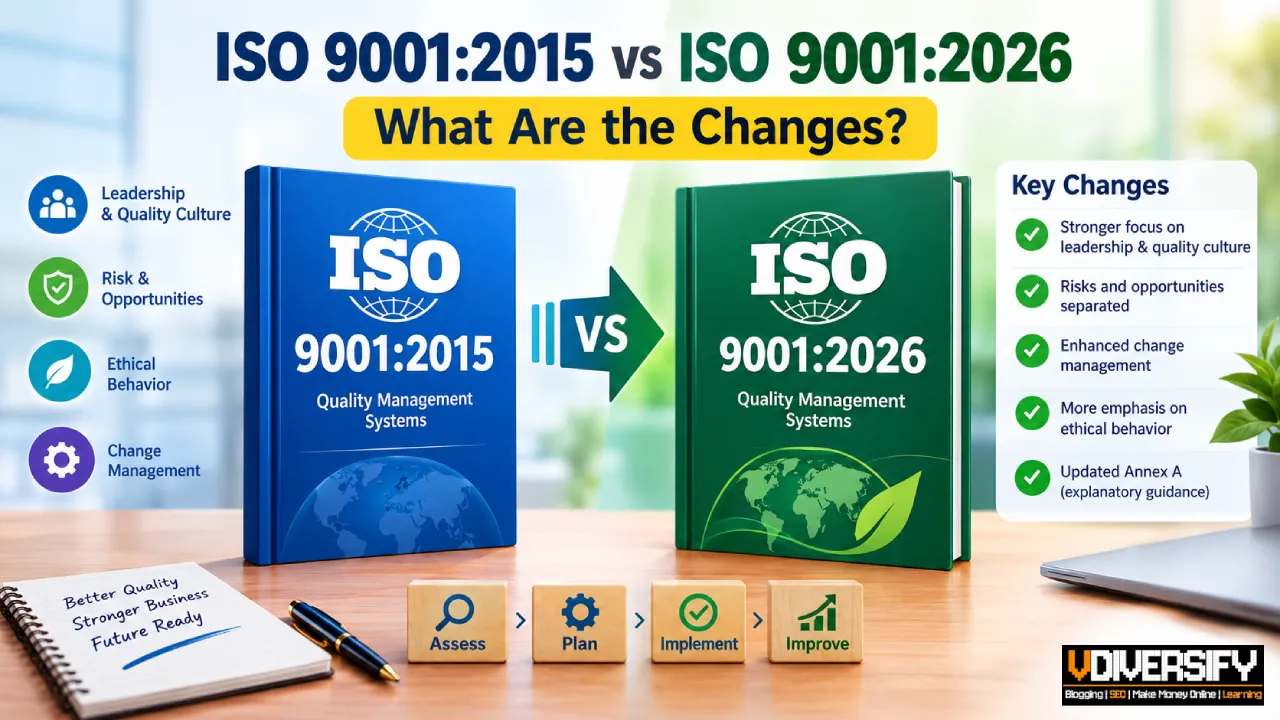
The ISO 9001:2015 vs ISO 9001:2026 changes are important for organizations that want to maintain certification, improve product and service quality, and meet customer expectations.
Published on September 16, 2026, ISO 9001:2026 is the latest edition of the international quality management system standard, replacing the 2015 edition. The revision builds on the existing framework rather than requiring companies to create a completely new quality management system.
However, organizations need to understand the updated requirements, review their current processes, and plan their transition within the applicable deadline.
This article explains the major differences, the reasons behind the revision, the practical effects on businesses, and the steps quality professionals should take to prepare.
Contents
- 1. Why the ISO 9001 Revision Matters
- 2. What Is ISO 9001:2015?
- 3. What Is ISO 9001:2026?
- 4. ISO 9001:2015 vs ISO 9001:2026 – Main Differences
- 5. Why ISO 9001:2026 Is Important for US Businesses
- 6. ISO 9001:2026 Transition Timeline and Certification Deadlines
- 7. Clause 3: Terms and Definitions – What Has Changed?
- 8. Clause 4: Context of the Organization
- 9. Clause 5: Leadership – Quality Culture and Ethical Behavior
- 10. Clause 6: Planning – Separate Risks and Opportunities
- 11. Clause 7: Support – Competence, Awareness, and Quality Culture
- 12. Clause 8: Operation – Planning and Controlling Work
- 13. Clause 9: Performance Evaluation – Audits, Measurement, and Management Review
- 14. Clause 10: Improvement – Corrective Action and Continual Improvement
- 15. New Annex A: Why the Additional Guidance Matters
- 16. ISO 9001:2015 vs ISO 9001:2026 – Transition Planning, Implementation, and Certification
- 17. How to Conduct an ISO 9001:2026 Gap Analysis
- 18. ISO 9001:2026 Implementation Roadmap for US Organizations
- 19. Management of Change: A Key Area to Review
- 20. ISO 9001:2026 Transition Costs: What Should Businesses Budget For?
- 21. ISO 9001:2026 Training and Internal Auditor Preparation
- 22. Common Mistakes to Avoid During the Transition
- 23. Practical ISO 9001:2026 Transition Checklist
- 24. Conclusion: Prepare for ISO 9001:2026 with a Practical Plan
- 25. FAQs
Why the ISO 9001 Revision Matters
ISO 9001 is one of the world’s most widely used standards for quality management. It helps organizations establish consistent processes, meet customer requirements, control risks, monitor performance, and improve the quality of their products and services.
For US businesses, ISO 9001 certification can be especially important when working with manufacturers, automotive suppliers, engineering firms, government contractors, medical equipment suppliers, and customers that require evidence of a controlled quality management system.
The standard is not limited to manufacturing. Consulting companies, software service providers, construction firms, logistics businesses, laboratories, and other service organizations can also use it.
According to the International Organization for Standardization (ISO), the standard has a global reach of more than one million certificates across 189 countries. This scale shows why even targeted changes to ISO 9001 can affect a large number of organizations and their supply chains.
The publication of the 2026 edition creates a practical question for quality professionals: what needs to change, and what can remain the same?
Companies that already follow ISO 9001:2015 should not assume that every existing procedure is outdated. The better approach is to compare the new requirements against the current quality management system, identify genuine gaps, and update only what is necessary.
What Is ISO 9001:2015?
ISO 9001:2015 is the fifth edition of the ISO 9001 quality management system standard. Published in 2015, it introduced a stronger focus on organizational context, leadership responsibility, risk-based thinking, process performance, and continual improvement.
The standard uses a process-based approach. Instead of treating quality as the responsibility of the inspection department alone, it requires organizations to manage the processes that influence their ability to deliver conforming products and services.
For example, a US manufacturer of industrial components cannot achieve consistent quality through final inspection alone. Its quality results also depend on supplier selection, purchasing controls, machine maintenance, employee competence, production planning, measurement equipment, and customer communication.
ISO 9001 provides a framework for controlling these connected activities.
The main objectives of ISO 9001:2015
The 2015 edition aims to help organizations:
- Consistently provide products and services that meet customer and applicable legal requirements.
- Improve customer satisfaction.
- Identify and address risks that may affect quality.
- Establish clear responsibilities and process controls.
- Use performance data to make better decisions.
- Correct problems and prevent their recurrence.
- Improve the effectiveness of the quality management system.
A key feature of the 2015 edition is that it does not prescribe one universal set of procedures for every organization. Companies have flexibility to determine the documented information, controls, and resources appropriate to their operations.
A small engineering consultancy, for example, may need controlled project records, competence assessments, contract reviews, and customer feedback processes. A large automotive component manufacturer may need additional controls for production, traceability, equipment, supplier performance, and product release.
Both organizations can apply the same standard, but the implementation will reflect their size, complexity, risks, and customer requirements.
What Is ISO 9001:2026?
ISO 9001:2026 is the sixth edition of the international standard for quality management systems. ISO published it on September 16, 2026, following the international revision process.
The revised edition retains the established structure and core principles of quality management while improving the clarity and usability of requirements. It places greater emphasis on quality culture, leadership accountability, and the separate consideration of risks and opportunities. It also introduces a new Annex A that helps users understand the structure, terminology, and intent of the requirements.
These updates are intended to help organizations apply the standard more effectively in changing business environments.
Official source: ISO 9001:2026 – Quality management systems: Requirements.
Why was the standard revised?
Business conditions have changed considerably since the 2015 edition was developed. Organizations now face more complex supply chains, faster technological changes, changing customer expectations, increased reliance on digital systems, and greater pressure to demonstrate responsible business practices.
A quality management system must remain useful under these conditions. A company may have documented procedures and valid certificates but still experience recurring defects, poor communication, supplier failures, or weak leadership involvement.
The revision seeks to make the standard clearer and support more effective implementation, without abandoning the established quality management framework.
Consider a US electronics manufacturer that depends on suppliers in several countries. A disruption at one supplier can delay production, affect delivery commitments, and create customer complaints. The company needs to identify these risks, evaluate alternative suppliers, communicate with customers, and monitor the effectiveness of its response.
The revised standard reinforces the importance of applying quality management in a way that supports the organization’s real operating conditions rather than treating certification as a paperwork exercise.
What organizations should understand immediately
The 2026 edition is now the current edition of ISO 9001. Organizations certified to the 2015 edition have a transition period to update their systems and complete the required certification transition.
The change does not mean that all existing quality procedures must be discarded. Many established controls, such as internal audits, management reviews, corrective actions, supplier evaluations, process monitoring, and customer feedback, remain relevant.
The priority is to understand the published requirements, compare them with current practices, and determine where changes are necessary.
ISO 9001:2015 vs ISO 9001:2026 – Main Differences
The most useful way to understand the revision is to compare the existing framework with the main areas of change in the new edition.
Area | ISO 9001:2015 | ISO 9001:2026 |
Overall framework | Established quality management system requirements | Retains the established framework with targeted updates |
Clause structure | Harmonized structure with Clauses 4–10 | Retains the harmonized structure |
Leadership | Leadership commitment and accountability are required | Greater emphasis on leadership’s role in quality culture and ethical behavior |
Risk and opportunity | Addressed through risk-based thinking and planning | Clearer distinction between risks and opportunities |
Organizational context | Organizations determine relevant internal and external issues | Climate-related considerations remain part of context assessment, with improved clarity |
Support and awareness | Competence, awareness, communication, and resources | Greater emphasis on awareness of quality culture and ethical behavior |
Operations | Established operational planning and control requirements | Core operational framework retained, with targeted clarifications |
Performance evaluation | Monitoring, measurement, analysis, internal audits, and management review | Core approach retained |
Improvement | Nonconformity control, corrective action, and continual improvement | Continued improvement with stronger attention to leadership involvement |
Explanatory guidance | Previous supporting structure and guidance | New Annex A provides clarification of terminology, structure, and requirements |
This comparison summarizes the broad direction of the revision. For compliance decisions, organizations should consult the published ISO 9001:2026 text rather than rely solely on a summary table.
Does the new edition introduce a completely different quality management system?
No. ISO 9001:2026 builds on the established approach. Organizations that already have an effective quality management system should be able to retain much of their existing framework while making targeted updates.
For example, a manufacturer that already controls production processes, evaluates suppliers, performs internal audits, investigates nonconformities, and reviews customer satisfaction does not need to replace those activities simply because a new edition has been published.
However, the company should check whether its existing practices adequately address the revised requirements, particularly those relating to leadership, quality culture, ethical behavior, risk and opportunity planning, and awareness.
The distinction is important: the objective is effective conformity, not unnecessary documentation.
Why ISO 9001:2026 Is Important for US Businesses
For US organizations, the transition is not only a certification matter. It is also an opportunity to examine whether the quality management system supports reliable operations, customer retention, supplier control, and business growth.
Many businesses use ISO 9001 certification to demonstrate their ability to manage quality consistently. Customers may require certification as part of supplier approval, purchasing agreements, or contract conditions. Others use the standard internally to improve process control and reduce waste.
Impact on manufacturers
Manufacturers may need to review how leadership supports quality objectives, how employees understand their responsibilities, and how risks and opportunities are identified and addressed.
For example, a metal fabrication company might have a procedure requiring operators to inspect dimensions at specified production stages. The procedure may be technically sound, but recurring defects could continue if production targets encourage employees to bypass inspections or if managers ignore repeated nonconformities.
A stronger quality culture requires management to support correct inspection practices, provide adequate resources, and respond appropriately when problems are reported.
Impact on service companies
Service organizations also need to consider how the revised requirements apply to their activities.
A software development company, for example, may focus on customer requirements, project planning, software testing, change control, service delivery, and customer complaints. It may not need manufacturing inspection procedures, but it still needs effective controls over the processes that determine service quality.
The transition should reflect these operational differences. A company should not copy a manufacturer’s documentation system if a simpler approach can meet the requirements and control its actual risks.
Impact on suppliers and contractors
Suppliers may face questions from customers about their transition plans, especially when ISO 9001 certification is a contractual requirement.
A supplier should review customer-specific requirements, determine when its certification body can conduct the transition assessment, and communicate realistic plans to relevant customers.
This is particularly important when customers require an accredited certificate to the current edition rather than accepting an older certificate during the transition period.
ISO 9001:2026 Transition Timeline and Certification Deadlines
Organizations currently certified to ISO 9001:2015 should understand the transition timeline before deciding when to update their quality management systems.
The published transition arrangements provide a three-year period for organizations to move to the new edition. The transition process involves certification bodies and accreditation bodies as well as the organizations holding certificates.
The following dates are important for planning.
Milestone | Date | What it means |
ISO 9001:2026 publication | September 16, 2026 | The sixth edition becomes available |
Accreditation bodies ready to assess the new edition | By March 31, 2027 | Accreditation bodies must be ready to assess certification bodies against the revised standard |
Certification body transition declarations | By June 30, 2027 | Applicable accredited certification bodies submit the required transition information |
Accreditation transition decisions | By September 30, 2027 | Accreditation bodies complete the relevant transition decisions |
New initial accredited certifications | From March 31, 2028 | New and initial accredited certifications must use ISO 9001:2026 |
Final transition deadline | September 30, 2029 | Existing certified organizations must complete the transition |
These dates are based on the published transition arrangements. Organizations should confirm the applicable requirements and audit arrangements with their certification body.
Official transition information is available through the ISO/TC 176 quality management committee and the Global Accreditation Cooperation transition requirements.
Will ISO 9001:2015 certificates become invalid immediately?
No. Publication of the new edition does not mean that every existing certificate becomes invalid immediately.
Organizations certified to ISO 9001:2015 can use the transition period to review their systems, implement required changes, and complete the necessary assessment through their certification body.
However, companies should not wait until the final deadline to begin preparing. Audit availability, customer requirements, internal resources, and the time needed to correct identified gaps can affect the transition plan.
For example, a manufacturer with several production facilities may need to coordinate training, document updates, internal audits, and management reviews across multiple locations. Starting early gives the company more time to address problems before the certification transition audit.
Should an organization purchase the new standard?
Yes, obtaining access to the official published edition is a sensible first step for organizations that need to implement or assess against it.
Use the official ISO 9001 standard page to review publication information and purchasing options. Organizations should work from the published requirements rather than rely only on blogs, presentations, training slides, or draft documents.
The official standard is the primary reference for determining conformity. Guidance from certification bodies and professional quality organizations can help explain the requirements, but it does not replace the standard itself.
What should organizations do before the transition audit?
Before arranging a transition assessment, organizations should:
- Obtain and review the published ISO 9001:2026 standard.
- Compare its requirements with the current quality management system.
- Identify gaps and assign responsibility for addressing them.
- Update relevant procedures, records, and awareness activities.
- Train employees and managers on changes affecting their work.
- Conduct an internal audit against the new edition.
- Review unresolved nonconformities and corrective actions.
- Discuss audit timing and evidence requirements with the certification body.
A transition plan should have clear responsibilities, realistic deadlines, and evidence that the updated system is working. Updating a document without implementing the required process is not enough.
Clause 3: Terms and Definitions – What Has Changed?
One of the changes in the 2026 edition is the inclusion of selected quality management system terms and definitions directly in Clause 3. In the 2015 edition, users relied more heavily on ISO 9000 for quality management fundamentals and vocabulary.
ISO 9000 remains the normative reference for quality management terms and definitions. The updated Clause 3 helps users understand terminology within the context of ISO 9001 itself.
Reference: ISO 9001:2026 and ASQ’s published revision summary.
What does this mean for organizations?
Companies should review their quality management system manuals, training materials, audit checklists, and internal procedures to ensure that employees use the correct terminology.
For example, a company might use different internal meanings for a correction, corrective action, and improvement action. This can lead to confusion when employees investigate defects or report audit findings.
Clear terminology helps employees understand what action is required, who is responsible, and what evidence must be retained.
Practical actions:
- Review internal quality terminology and definitions.
- Update training materials where the meaning or use of terms has changed.
- Check internal audit checklists against the published edition.
- Ensure employees understand the distinction between correcting an immediate problem and addressing its cause.
Organizations do not need to rewrite every procedure merely because terminology has been updated. Changes should be based on actual differences and the need for clarity.
Clause 4: Context of the Organization
Clause 4 requires organizations to understand their internal and external circumstances, identify relevant interested parties, define the scope of their quality management system, and establish the processes needed to operate it.
These requirements remain central to ISO 9001:2026. The revision should be viewed as an opportunity to verify whether the organization’s existing context analysis reflects its current business conditions.
Understanding organizational context
A company’s context may include:
- Customer expectations and contractual requirements.
- Supplier reliability and supply chain dependencies.
- Applicable laws and regulatory obligations.
- Technology and changes in production methods.
- Employee skills and resource availability.
- Market conditions and competition.
- Climate-related issues when relevant to the quality management system.
The 2024 climate action amendment had already introduced climate-related considerations into Clauses 4.1 and 4.2 of ISO 9001:2015. Therefore, organizations should not incorrectly assume that climate change first became relevant with the 2026 edition.
The organization must determine whether climate change is a relevant issue and recognize that interested parties may have climate-related requirements. These considerations should be proportionate to the organization’s circumstances and the potential effect on its ability to deliver conforming products and services.
Example: A US food packaging manufacturer
Imagine a company that manufactures packaging for food products. Its context assessment identifies several business issues:
- Customers require packaging to meet specified performance requirements.
- Some raw materials depend on suppliers located in regions affected by extreme weather.
- Production equipment is sensitive to high temperatures.
- Customers increasingly ask suppliers about material consistency and supply continuity.
The organization should evaluate which of these issues affect its quality management system and decide whether action is necessary.
It might qualify alternative suppliers, improve temperature monitoring, or establish contingency plans for critical materials.
The purpose is not to create a climate policy simply to satisfy an auditor. It is to understand the conditions that could affect product quality, customer commitments, and process performance.
Audit evidence to prepare
An auditor may examine:
- The documented scope of the quality management system.
- Records identifying internal and external issues.
- Interested-party requirements and their relevance.
- Evidence that relevant issues are reviewed when circumstances change.
- Links between context, risks, objectives, and operational controls.
Key takeaway: Context analysis should reflect the real business, not a generic list copied from a template.
Clause 5: Leadership – Quality Culture and Ethical Behavior
Clause 5 addresses leadership and commitment, the quality policy, and organizational responsibilities. One of the most significant themes in the 2026 edition is the more explicit treatment of quality culture and ethical behavior.
The standard places greater emphasis on the way leaders influence quality throughout the organization. Quality should not be viewed only as the responsibility of the quality department. Senior management must support the conditions that allow employees to follow processes, raise concerns, and make decisions that protect conformity.
What is a quality culture?
A quality culture exists when people across an organization understand the importance of quality and make decisions that support it.
It can be seen in everyday behavior:
- Employees report defects rather than hide them.
- Managers respond to problems instead of blaming employees automatically.
- Production targets do not encourage bypassing required inspections.
- Employees understand when to stop work or escalate a concern.
- Leaders provide the resources needed to perform work correctly.
- Corrective actions are completed and checked for effectiveness.
A quality culture cannot be established simply by issuing a policy. It develops through leadership behavior, communication, training, and consistent decisions.
What is ethical behavior in quality management?
Ethical behavior means acting honestly and responsibly when making decisions that affect product conformity, customers, employees, and other relevant parties.
For a manufacturing organization, this may involve accurate inspection records, honest reporting of nonconforming products, responsible handling of customer complaints, and transparent communication about delivery or quality problems.
For a service provider, it may involve reporting errors in project deliverables, protecting the accuracy of performance data, and avoiding misleading statements about service capability.
Example: Production pressure and inspection results
A manufacturing company has a target of producing 10,000 components per week. Near the end of the month, production falls behind schedule because several components fail dimensional inspection.
A supervisor asks an inspector to release the parts without completing the required review so that the shipment can leave on time.
In an organization with a weak quality culture, the inspector may feel pressured to comply. The records might show that the shipment met the target, but the company has accepted an uncontrolled quality risk.
In an organization with stronger leadership support, the inspector can report the problem, the affected parts are controlled, and management helps resolve the production issue without compromising conformity.
This example shows why leadership behavior matters as much as written procedures.
What should organizations update?
Companies should examine whether their leadership practices provide evidence of:
- Clear responsibility for quality.
- Communication of the quality policy and objectives.
- Support for reporting defects and concerns.
- Appropriate resources for quality-related work.
- Consistent responses to nonconformities.
- Awareness of ethical behavior and quality culture.
An organization does not necessarily need a separate quality culture procedure. It should determine how the requirements are addressed through its existing leadership, training, communication, and performance management processes.
Clause 6: Planning – Separate Risks and Opportunities
Risk-based thinking was already a key feature of ISO 9001:2015. Organizations were expected to consider risks and opportunities when planning the quality management system and deciding what action was needed.
The 2026 edition makes the distinction between risks and opportunities clearer and calls for separate consideration of actions to address them. This helps organizations avoid treating opportunities as simply the positive side of a risk register.
Risk and opportunity are not the same
A risk is an uncertain situation that could affect the intended results of the quality management system. Depending on the circumstances, its effects may be negative or otherwise create uncertainty about achieving objectives.
An opportunity is a favorable possibility that the organization may choose to pursue to improve results.
For example, a supplier’s unstable delivery performance is a risk to production continuity. Qualifying a second supplier may be an opportunity to improve resilience and reduce dependence on one source.
The organization should evaluate both issues and plan appropriate actions.
Example: A medical device component supplier
A US company manufactures precision components for medical device manufacturers.
Its quality team identifies the following:
Issue | Type | Possible action |
A critical supplier has repeated delivery delays | Risk | Establish an alternative source and monitor supplier performance |
A machine has a rising failure rate | Risk | Review maintenance and equipment condition |
Automated inspection may reduce manual measurement errors | Opportunity | Run a controlled trial and validate the inspection method |
Customer demand is increasing for a new product | Opportunity | Assess process capacity and production readiness |
The company should not simply list these items and consider the planning activity complete. It needs to determine which actions are appropriate, assign responsibility, and evaluate whether the actions are effective.
How should the risk register change?
A company that already has a risk register should review its format and content rather than automatically replace it.
A useful register may include:
- The issue or opportunity.
- The affected process or objective.
- The possible effect on quality.
- The action selected.
- The responsible person.
- The planned completion date.
- The method for evaluating effectiveness.
A combined register can still be useful if it clearly distinguishes risks from opportunities and records the relevant actions separately. The format itself is not the objective; effective planning is.
Should every risk receive the same treatment?
No. Actions should be appropriate to the potential effect and the organization’s circumstances.
For example, a supplier delivering low-cost office stationery does not normally present the same quality risk as a supplier providing a critical component used in a safety-related product.
A practical risk assessment helps organizations focus resources where they matter most.
Practical recommendation: Review the current risk and opportunity process, confirm that the two are clearly distinguished, and ensure that selected actions are integrated into relevant business processes.
Clause 7: Support – Competence, Awareness, and Quality Culture
Clause 7 covers the resources and support required to operate an effective quality management system. Its established areas include people, infrastructure, the environment for operating processes, monitoring and measuring resources, organizational knowledge, competence, awareness, communication, and documented information.
The 2026 edition strengthens the emphasis on awareness of quality culture and ethical behavior. This means organizations should consider whether employees understand not only their tasks but also the quality-related behavior expected of them.
What is the difference between competence and awareness?
Competence concerns a person’s ability to perform assigned work effectively. Awareness concerns understanding relevant requirements, policies, objectives, and the effect of one’s activities.
A person can be technically competent but still make poor quality decisions if they do not understand the importance of a required control.
For example, an experienced machine operator may know how to set up a machine correctly but may not understand that bypassing a documented first-piece inspection can allow a batch of nonconforming parts to proceed.
Both competence and awareness matter.
Example: Training a new quality inspector
A company hires an inspector to measure machined components.
The training program should cover the measurement method, equipment handling, acceptance criteria, recording of results, and action to take when a component fails inspection.
The inspector should also understand why accurate records matter, why results must not be changed to meet production targets, and whom to notify when a serious problem is identified.
The company can demonstrate effective training through relevant competence records, practical assessments, observation of work, and evidence that the employee follows the required process.
What should be reviewed?
Organizations should check whether existing arrangements adequately cover:
- Competence requirements for relevant roles.
- Training and evaluation of training effectiveness.
- Awareness of the quality policy and relevant objectives.
- Awareness of the effect of individual work on product and service quality.
- Expected quality culture and ethical behavior.
- Internal communication and escalation of problems.
- Control of documents and records.
There is no need to send every employee to an external ISO training course. Training should match the person’s responsibilities and the requirements that affect their work.
A production operator may need practical process and defect-reporting training, while a department manager may need training on leadership responsibilities, risk decisions, and performance evaluation.
Clause 8: Operation – Planning and Controlling Work
Clause 8 contains the operational requirements of the quality management system. It addresses customer requirements, design and development where applicable, external providers, production and service provision, release of products and services, and control of nonconforming outputs.
The operational framework remains largely intact in the 2026 edition. The revision is primarily focused on clarifications and consistency rather than requiring organizations to redesign all their operational controls.
What should manufacturers review?
Manufacturing organizations should confirm that the existing processes adequately control:
- Review of customer and product requirements.
- Design and development, where applicable.
- Purchasing and supplier performance.
- Production planning and process control.
- Equipment and monitoring resources.
- Identification and traceability, where required.
- Product inspection and release.
- Control of nonconforming outputs.
For example, a company producing industrial pumps may already have inspection plans, supplier approval records, production travelers, test results, and final release records.
These controls should remain in place where they are effective. The company should assess whether any revised requirements affect how these processes are defined, documented, or implemented.
What about service organizations?
Service providers should apply Clause 8 to their actual service delivery processes.
A consulting firm, for example, may control customer requirements through contract reviews, project planning, technical review, approval of deliverables, and customer feedback. A software provider may rely on requirements management, version control, testing, release approvals, and incident handling.
The principle is the same: establish controls that help ensure the service meets requirements.
Example: Supplier-related nonconformity
A US equipment manufacturer receives a batch of components that do not meet the agreed dimensions.
A suitable response includes identifying and controlling the affected material, evaluating the impact on production, contacting the supplier, and deciding whether replacement or another approved disposition is appropriate.
The company should also consider whether the event indicates a wider problem with supplier selection, specification clarity, incoming verification, or supplier monitoring.
A one-time correction may be sufficient for an isolated event. Repeated failures may indicate the need for broader corrective action.
Do companies need to change every operational procedure?
No. Organizations should avoid unnecessary revisions that do not improve conformity or satisfy a revised requirement.
A gap analysis should identify specific changes needed to meet the new edition. Where an existing procedure already satisfies the applicable requirements, it can normally be retained.
This approach reduces disruption and helps employees focus on meaningful improvements rather than repeated document changes.
Clause 9: Performance Evaluation – Audits, Measurement, and Management Review
Clause 9 addresses the evaluation of quality management system performance. It covers monitoring and measurement, analysis and evaluation, internal audits, and management review.
The central approach remains the same in ISO 9001:2026. Organizations must monitor relevant performance, evaluate whether the system is effective, and use the results to make informed decisions.
What should organizations measure?
Relevant performance indicators depend on the organization’s products, services, risks, and objectives.
Common examples include:
- Customer complaint rates.
- On-time delivery performance.
- First-pass yield.
- Scrap and rework rates.
- Supplier defect rates.
- Corrective action completion and effectiveness.
- Internal audit findings.
- Customer satisfaction results.
A company should select indicators that help it evaluate performance. It does not need to measure every possible activity.
Example: Using data to identify a recurring problem
A manufacturer records its monthly defect rate and finds that defects have increased from 1.8% to 3.6% over three months.
The data indicates a trend that deserves investigation. The quality manager may examine the affected product families, machines, shifts, operators, raw materials, and recent process changes.
The organization should not automatically assume that the operators are responsible. It should use evidence to identify the cause and determine what action is appropriate.
This is how performance evaluation supports actual process improvement.
Internal audits under the new edition
Internal audits remain a key method for determining whether the quality management system conforms to applicable requirements and is effectively implemented.
Organizations should update their audit criteria and checklists to include relevant changes in ISO 9001:2026. Auditors should be trained to distinguish revised requirements from practices that were already required under the 2015 edition.
An internal audit can examine whether leadership supports quality culture, employees understand ethical expectations, and risk and opportunity planning leads to appropriate action.
Auditors should evaluate evidence rather than rely only on interviews or the existence of documents.
Management review
Management review remains an important opportunity for top management to assess quality performance and determine whether the system remains suitable, adequate, and effective.
Organizations should ensure that management review considers the required inputs, evaluates relevant performance information, and produces decisions and actions consistent with the applicable requirements.
For example, if customer complaints rise while delivery performance improves, management should examine whether production pressure is affecting product conformity. The aim is to make balanced decisions based on the complete picture of quality performance.
Clause 10: Improvement – Corrective Action and Continual Improvement
Clause 10 covers improvement, nonconformity, corrective action, and continual improvement. These activities remain fundamental to ISO 9001:2026.
The revision gives clearer emphasis to the role of leadership in supporting continual improvement. Organizations should therefore examine whether improvement activities are supported by management decisions, resources, and follow-up rather than being left entirely to the quality department.
Correction versus corrective action
A correction addresses a detected problem. Corrective action addresses its cause to prevent recurrence or occurrence elsewhere, as appropriate.
For example, if an inspector finds a batch of incorrectly machined parts, sorting the batch and replacing defective components may correct the immediate issue.
If the investigation finds that the machine’s fixture has gradually worn beyond acceptable limits, the organization may need to repair the fixture, review maintenance controls, and assess whether other batches or machines are affected.
The corrective action should be appropriate to the problem and supported by evidence that the action was effective.
Example: Repeated customer complaints
A US service company receives repeated complaints about incorrect invoices.
The company initially corrects each invoice manually. However, the same error keeps returning because employees use an outdated pricing spreadsheet.
A stronger improvement process investigates the underlying cause, controls the outdated file, establishes an approved source of pricing data, trains relevant employees, and checks later invoices to confirm that the problem has been reduced.
This approach addresses the cause rather than repeatedly correcting individual outputs.
How can leadership support continual improvement?
Leadership can support improvement by:
- Reviewing recurring nonconformities and customer complaints.
- Assigning resources to address significant problems.
- Removing barriers that prevent employees from following processes.
- Reviewing the effectiveness of corrective actions.
- Encouraging employees to report problems and suggest improvements.
- Evaluating whether improvements have produced the intended results.
Improvement does not always require a large project. Small changes to process layout, inspection methods, training, or information flow can produce useful results when they address a genuine problem.
New Annex A: Why the Additional Guidance Matters
ISO 9001:2026 introduces a new Annex A containing explanatory information intended to clarify the structure, terminology, and intent of the requirements.
Annex A is informative rather than a separate set of mandatory requirements. It helps users understand the standard but does not replace the normative clauses or create additional requirements by itself. The 2026 edition also removes the previous Annex B, which provided information about other standards in the ISO/TC 176 family.
How can Annex A help quality professionals?
The guidance can help quality managers, auditors, consultants, and process owners interpret the standard more consistently.
For example, when a company is unsure how a requirement should be understood, it can consult the relevant clause and use Annex A for clarification. This can help prevent both under-implementation and unnecessary documentation.
However, Annex A should not be treated as a substitute for professional judgment. The organization must still determine how the normative requirements apply to its activities and demonstrate conformity.
Practical recommendation: Use the published standard and Annex A together during the gap analysis. Record the relevant clause, the existing control, the identified gap, and the action required. This creates a clear link between the requirement and the change made to the quality management system.
References to read more
- ISO — ISO 9001:2026 and information for businesses
- ASQ — Quality standards frequently asked questions
- BSI — ISO 9001:2026 key changes and guidance
- ISO — Official ISO 9001:2026 standard page
ISO 9001:2015 vs ISO 9001:2026 – Transition Planning, Implementation, and Certification
Understanding the changes is only the first step. The next challenge is to turn those requirements into practical actions that employees can follow and auditors can verify.
For US organizations, a successful transition should protect existing quality controls, address genuine gaps, maintain customer confidence, and avoid unnecessary documentation or disruption to production and service delivery.
The most effective approach is to treat the transition as a controlled quality improvement project. Top management should provide direction, the quality manager should coordinate the work, process owners should implement changes, and internal auditors should verify that the revised system is working as intended.
How to Conduct an ISO 9001:2026 Gap Analysis
A gap analysis is a systematic comparison between the requirements of the new edition and the organization’s existing quality management system. It helps determine which requirements are already satisfied, which need additional evidence, and which require changes to processes or controls.
A gap analysis should be based on the published standard, not solely on a blog article or a generic checklist. The organization should also consider applicable customer-specific requirements and any additional obligations relevant to its industry.
Step 1: Obtain the published standard
Obtain the official ISO 9001:2026 edition and identify the requirements that apply to the organization’s quality management system.
Do not rely on draft documents or preliminary comparison tables when making compliance decisions. Drafts are useful for understanding how a revision developed, but the published edition is the appropriate reference for implementation.
Step 2: Review the existing quality management system
Gather relevant documents and records, including:
- Quality policy and quality objectives.
- Scope of the quality management system.
- Context and interested-party assessments.
- Risk and opportunity records.
- Competence and training records.
- Supplier approval and performance records.
- Operational procedures and inspection records.
- Internal audit reports.
- Management review minutes.
- Nonconformity and corrective action records.
The aim is to understand how the current system operates in practice, not simply to collect documents.
Step 3: Compare each applicable requirement
For each requirement, record the existing process, available evidence, any identified gap, the action required, the responsible person, and the target date.
The following example illustrates a practical gap analysis format.
Area to assess | Example of existing evidence | Potential action |
Leadership and quality culture | Quality policy, management review minutes, employee interviews | Strengthen evidence of leadership support and expected quality behavior where needed |
Risks and opportunities | Risk register and action plans | Check that risks and opportunities are clearly distinguished and appropriately addressed |
Employee awareness | Training records and induction materials | Update awareness activities to address relevant new requirements |
Internal audits | Audit program and checklists | Revise audit criteria to cover the published 2026 requirements |
Management review | Agenda, minutes, action records | Confirm that the required inputs and outputs are addressed |
Corrective action | Nonconformity reports and effectiveness checks | Strengthen investigation and follow-up where recurring problems remain |
These are illustrative assessment areas, not a substitute for a complete clause-by-clause review of the published standard.
Step 4: Prioritize the gaps
Not all gaps have the same level of importance. Prioritize them according to the applicable requirement, potential effect on product or service conformity, customer risk, implementation effort, and any contractual deadline.
For example, a missing control over a critical production process deserves more urgent attention than a minor formatting inconsistency in a document.
Step 5: Verify that changes work
After implementing the required actions, conduct an internal audit or another suitable evaluation to verify that the revised arrangements are implemented and effective.
A document revision alone does not demonstrate conformity. The organization needs evidence that employees understand the changes, processes are controlled, and the intended results are being achieved.
ISO 9001:2026 Implementation Roadmap for US Organizations
A structured implementation plan helps organizations complete the transition without interrupting normal operations. The exact time required depends on the organization’s size, the complexity of its processes, the condition of its existing quality management system, and the number of gaps identified.
A small service company with a mature quality system may need only targeted updates. A manufacturer with multiple facilities, complex supplier networks, and customer-specific requirements may need a longer project.
The following roadmap provides a practical starting point.
Phase 1: Understand the new standard
Suggested timing: Weeks 1–2
- Obtain the published standard.
- Brief top management on the changes.
- Assign a transition coordinator.
- Identify the certification body’s transition arrangements.
Phase 2: Perform the gap analysis
Suggested timing: Weeks 2–4
- Compare the existing QMS with the new requirements.
- Interview process owners.
- Review documents, records, and actual practices.
- Rank gaps according to importance and urgency.
Phase 3: Implement required changes
Suggested timing: Weeks 4–8
- Update applicable processes and documents.
- Strengthen risk and opportunity planning.
- Address relevant leadership and awareness requirements.
- Communicate responsibilities to affected employees.
Phase 4: Train and verify
Suggested timing: Weeks 8–10
- Train employees on relevant changes.
- Collect implementation evidence.
- Conduct an internal audit against the 2026 edition.
- Correct identified nonconformities.
Phase 5: Complete the transition assessment
Timing: According to the certification plan
- Complete necessary corrective actions.
- Ensure management review and audit evidence are available.
- Agree on the assessment date with the certification body.
- Close any findings within the applicable certification process.
The phase durations are illustrative planning estimates, not ISO-mandated deadlines. Organizations should adapt the roadmap to their actual gaps and audit schedule.
How should the transition project be managed?
The quality manager should coordinate the transition, but responsibility should not rest with one person alone.
A practical responsibility structure is:
Role | Main responsibility |
Top management | Approve priorities, provide resources, and support the transition |
Quality manager | Coordinate the gap analysis, action plan, and audit readiness |
Department managers | Update relevant processes and ensure implementation |
HR or training coordinator | Arrange role-specific training and awareness activities |
Internal auditors | Verify conformity and effectiveness independently of the work being audited |
Certification body | Explain its transition assessment process and certification arrangements |
This structure makes responsibilities clear and reduces the chance that the transition becomes a paperwork exercise owned only by the quality department.
Management of Change: A Key Area to Review
One important change in ISO 9001:2026 is the strengthened treatment of changes to the quality management system. Organizations should consider how changes are planned and controlled so that the intended results of the system are maintained.
Change management is relevant far beyond the transition between standard editions. It applies when organizations introduce new equipment, change suppliers, modify products, reorganize departments, introduce software, or change how services are delivered.
What should a change review consider?
Before making a significant change, the organization should consider the purpose of the change, its possible consequences, the resources required, responsibilities, and any effects on the integrity of the quality management system.
For example, a manufacturer may replace a manual inspection process with automated vision inspection. The new system could improve speed and consistency, but the organization should determine whether the inspection method is suitable, whether it has been validated, whether employees need training, and how inspection records will be maintained.
A rushed implementation could create a new source of defects even if the equipment itself performs as intended.
Example: Changing a critical supplier
A company decides to replace a supplier because the current supplier has repeated delivery problems.
Before switching, the company evaluates the new supplier, confirms that the supplied material meets specifications, checks any qualification requirements, updates purchasing information, and communicates relevant changes to affected personnel.
It also considers whether customer approval is required and whether existing inventory needs to be controlled.
This is an example of change management supporting both quality and business continuity.
A practical change-control checklist
Before implementing a significant change, ask:
- What is the reason for the change?
- Which products, services, processes, and customers may be affected?
- What quality risks could arise?
- Are new resources, skills, or training required?
- Do documents, specifications, or inspection methods need updating?
- Are customer approvals or notifications necessary?
- Who will authorize the change?
- How will the organization verify that the change achieved the intended result?
The level of control should be proportionate to the change and its possible effects. A minor administrative update does not require the same assessment as changing a critical production process.
ISO 9001:2026 Transition Costs: What Should Businesses Budget For?
The cost of transitioning to ISO 9001:2026 varies by organization. There is no single mandatory transition fee that applies to every business.
For many organizations with a mature quality management system, the main costs will be staff time, targeted training, internal auditing, and any additional certification assessment required by the certification body.
Organizations with significant system weaknesses, multiple facilities, or complex operational requirements may need more extensive work.
Common cost categories
Cost category | What may be included |
Standard purchase | Official copy of ISO 9001:2026 and relevant supporting standards |
Training | Employee awareness sessions, management briefings, auditor training |
Internal resources | Time spent on gap analysis, process changes, documentation, and evidence collection |
External support | Consultant assistance, if required |
Internal auditing | Auditor time, audit planning, and follow-up of findings |
Certification assessment | Transition audit fees or additional assessment time, as agreed with the certification body |
Process improvements | Equipment, software, supplier qualification, or other changes identified during implementation |
How can an organization control costs?
Start with a gap analysis before purchasing extensive consulting or training services. This helps distinguish changes required by the revised standard from broader improvements the company may wish to make.
Other useful cost-control measures include:
- Reusing effective existing procedures.
- Combining transition training with scheduled quality training.
- Integrating the gap analysis with the internal audit program.
- Assigning actions to existing process owners.
- Scheduling the transition assessment alongside an appropriate planned audit where the certification body permits it.
For example, a company that already has a reliable supplier evaluation process should not purchase a new supplier management system solely because the standard has been revised. It should first verify whether the current process meets the requirements.
Important: Ask the certification body for a written quotation that explains the assessment scope, audit time, travel costs if applicable, and any additional fees. Avoid relying on generic online cost estimates as though they were fixed prices.
ISO 9001:2026 Training and Internal Auditor Preparation
Training is an important part of the transition because employees and auditors need to understand the changes that affect their responsibilities.
However, training should be practical and role-based. Sending every employee to a lengthy external course may not be necessary. The organization should identify what each group needs to understand and provide suitable training.
Who needs training?
Employee group | Recommended training focus |
Top management | Leadership responsibilities, quality culture, strategic alignment, and resource decisions |
Quality managers | Revised requirements, gap analysis, implementation planning, and certification transition |
Internal auditors | Updated audit criteria, evidence collection, and evaluation of conformity |
Process owners | Changes affecting operational controls, risks, opportunities, and process performance |
Production and service employees | Relevant work instructions, awareness, reporting, and ethical behavior |
Purchasing teams | Supplier controls, supplier-related risks, and change management |
How should internal auditors prepare?
Internal auditors should understand the revised requirements before conducting audits against ISO 9001:2026.
They should review the updated standard, revise audit checklists, and understand how the changes apply to the organization’s processes.
For example, an auditor reviewing the risk management process should check whether risks and opportunities are clearly distinguished and whether appropriate actions are planned. An auditor reviewing leadership should look for evidence of the required commitment and support rather than accepting the existence of a quality policy as sufficient proof.
Auditors should also avoid raising findings simply because an organization has not adopted a preferred template. A nonconformity should be based on an unmet requirement supported by objective evidence.
Should organizations hire external trainers?
External training can be useful when the internal quality team lacks experience with standards revisions or needs a structured explanation of the changes.
When selecting a course, check that it covers the published ISO 9001:2026 edition, includes practical implementation or auditing examples, and clearly explains the difference between mandatory requirements and recommended practices.
Useful starting points include the American Society for Quality and the ISO official standard page.
Common Mistakes to Avoid During the Transition
Organizations can make the transition more difficult than necessary by treating it as a document-update exercise instead of a review of the quality management system.
The following mistakes are worth avoiding.
Mistake 1: Waiting until 2029
The final transition deadline is September 30, 2029, but waiting until the last few months can create scheduling problems and leave little time to address audit findings.
Better approach: Establish a transition plan early and coordinate with the certification body.
Mistake 2: Updating documents without changing behavior
A company may revise its quality policy or training presentation without changing how managers respond to defects or how employees report quality problems.
Better approach: Verify implementation through interviews, records, observations, and process results.
Mistake 3: Treating risks and opportunities as interchangeable
A single register can still be practical, but the organization should clearly distinguish risks from opportunities and consider the actions appropriate to each.
Better approach: Review the risk management process and confirm that both are addressed in a way consistent with the revised requirements.
Mistake 4: Assuming climate change is a completely new requirement
Climate-related considerations were already addressed by the 2024 amendment to ISO 9001:2015.
Better approach: Review whether the organization has appropriately considered relevant climate-related issues and interested-party requirements.
Mistake 5: Rewriting every procedure
Not every existing process needs to change. Replacing effective procedures without a clear reason wastes time and may introduce unnecessary confusion.
Better approach: Make changes only where required or where a justified improvement will strengthen the system.
Mistake 6: Ignoring the certification body
Organizations may misunderstand the assessment process if they rely only on general online guidance.
Better approach: Confirm the transition audit scope, timing, evidence requirements, and applicable fees directly with the certification body.
Mistake 7: Failing to check corrective action effectiveness
Closing an action because a document has been revised does not necessarily demonstrate that the original problem has been resolved.
Better approach: Define how effectiveness will be checked and retain appropriate evidence.
Practical ISO 9001:2026 Transition Checklist
Use this checklist to track your organization’s preparation. It is an implementation aid, not an official ISO checklist or a replacement for the published standard.
- Obtain the official ISO 9001:2026 standard.
- Appoint a transition coordinator and assign process owners.
- Confirm transition arrangements with the certification body.
- Complete a clause-by-clause gap analysis.
- Review organizational context and interested-party requirements.
- Review leadership responsibilities, quality culture, and ethical behavior.
- Update risk and opportunity planning where necessary.
- Review change management and operational controls.
- Update relevant documents, records, and audit checklists.
- Provide role-specific training and awareness activities.
- Conduct an internal audit against the new edition.
- Address nonconformities and verify corrective action effectiveness.
- Complete the required management review activities.
- Agree on the transition assessment date and evidence requirements.
- Complete the certification transition before the applicable deadline.
Organizations should assign a responsible person and target date to each applicable action. Keeping the checklist with the transition action plan makes it easier to track progress and demonstrate management oversight.
Authoritative References and Further Reading
For organizations planning their transition, the following resources provide useful technical information and implementation guidance.
- International Organization for Standardization (ISO): ISO 9001:2026 — Official standard. Use this source for the published edition, official requirements, and purchasing information.
- ISO/TC 176: ISO 9001:2026 — What businesses need to know. This resource explains the revision’s key changes, what remains the same, and the general transition approach.
- Global Accreditation Cooperation Incorporated: ISO 9001:2026 transition requirements. This source explains the transition timeline for accreditation and certification bodies.
- American Society for Quality (ASQ): Quality standards FAQs. This provides additional information about the changes and the role of quality management standards.
- British Standards Institution (BSI): ISO 9001:2026 key changes and guidance. This is a useful starting point for additional transition guidance.
- American National Standards Institute (ANSI): ISO 9001:2026 revision updates. This resource discusses selected changes and their implications for quality management systems.
These references should be used alongside the official published standard. Certification and accreditation arrangements may depend on the relevant accreditation framework, so organizations should confirm the applicable requirements with their certification body.
Conclusion: Prepare for ISO 9001:2026 with a Practical Plan
ISO 9001:2026 represents an update to an established quality management framework, not a requirement to rebuild every quality management system from the beginning. Its key changes reinforce leadership responsibility, quality culture, ethical behavior, and the need to consider risks and opportunities clearly.
The revised edition also strengthens change management and provides additional explanatory guidance to help organizations understand the requirements.
For US companies, the most practical response is to obtain the published standard, complete a gap analysis, assign responsibilities, update the processes that need attention, and verify implementation through internal audits and other suitable checks.
Organizations should coordinate their transition plans with their certification bodies and work toward completing the transition before September 30, 2029.
The transition is also an opportunity to examine whether the quality management system helps the business make better decisions, reduce recurring problems, meet customer requirements, and improve process performance.
The real objective is not simply to obtain a new certificate. It is to build a quality management system that works consistently, supports employees, and gives customers confidence in the organization’s products and services.
If your organization is certified to ISO 9001:2015, begin with a structured gap analysis and a realistic action plan. Keeping what already works while addressing genuine gaps is the most effective way to prepare for ISO 9001:2026.
FAQs
1. What is the main difference between ISO 9001:2015 and ISO 9001:2026?
The 2026 edition retains the established quality management system framework while clarifying requirements and strengthening the focus on leadership, quality culture, ethical behavior, and the separate consideration of risks and opportunities.
It also strengthens the treatment of changes to the quality management system and introduces a revised explanatory Annex A.
2. Has ISO 9001:2026 been officially published?
Yes. The International Organization for Standardization published ISO 9001:2026 on September 16, 2026. It is the sixth edition and replaces ISO 9001:2015. See the official ISO publication page.
3. When must organizations transition to ISO 9001:2026?
Under the published transition arrangements, organizations certified to ISO 9001:2015 must complete the transition by September 30, 2029. The applicable assessment arrangements should be confirmed with the organization’s certification body.
4. Can an organization continue using ISO 9001:2015 during the transition period?
Existing certified organizations can transition within the established transition period. However, the certificate’s status, customer-specific requirements, and audit arrangements should be confirmed with the certification body. From March 31, 2028, new and initial accredited certifications may only be issued to ISO 9001:2026 under the published transition requirements.
5. Does ISO 9001:2026 require organizations to rewrite their quality manual?
Not automatically. Organizations should update documented information where necessary to meet applicable requirements and support effective process control. Existing documents can remain in use when they are suitable and compliant.
6. Is climate change a new requirement in ISO 9001:2026?
No. Climate-related considerations were introduced into the context requirements through the 2024 amendment to ISO 9001:2015. Organizations should continue to determine whether climate change is a relevant issue for their quality management system and whether interested parties have relevant requirements.
7. What is the difference between a risk and an opportunity?
A risk involves uncertainty that could affect intended results, while an opportunity represents a favorable possibility the organization may choose to pursue. The 2026 edition distinguishes these concepts more clearly and emphasizes separate consideration of actions to address them.
8. Is certification to ISO 9001:2026 mandatory for every US company?
No. ISO 9001 certification is generally voluntary. However, customers, contracts, supply chain agreements, or other applicable requirements may make certification necessary for a particular business relationship. Organizations should check the requirements that apply to their activities.
9. Will ISO 9001:2026 increase certification costs?
Costs depend on the organization, the condition of its existing quality management system, the certification body’s assessment arrangements, and any improvements required. Some organizations may need only limited changes, while others may require more training, process improvements, or additional audit time.
10. Can a small business implement ISO 9001:2026 without a consultant?
Yes. A small business can implement the standard using its own staff if it has access to the requirements and the necessary knowledge and resources. External support may be useful when internal expertise is limited, but it is not universally required.
11. What should internal auditors focus on under the new edition?
Internal auditors should evaluate conformity with the published requirements, including relevant changes involving leadership, quality culture, ethical behavior, risks and opportunities, change management, and awareness. They should also assess whether the organization’s existing controls remain effective.
12. What is the first step toward ISO 9001:2026 compliance?
Obtain the published standard and perform a gap analysis. This identifies what the organization already does well, what needs to change, and which actions should receive priority.

“Hey, I am Sachin Ramdurg, the founder of VDiversify.com.
I am QA/QC Manager, Certified Lead Auditor and Quality Champion. I am an Engineer and Passionate Blogger with a mindset of Entrepreneurship. I have been experienced in Blogging for more than 15+ years and following as a youtuber along with blogging, online business ideas, affiliate marketing, and make money online ideas since 2012.