
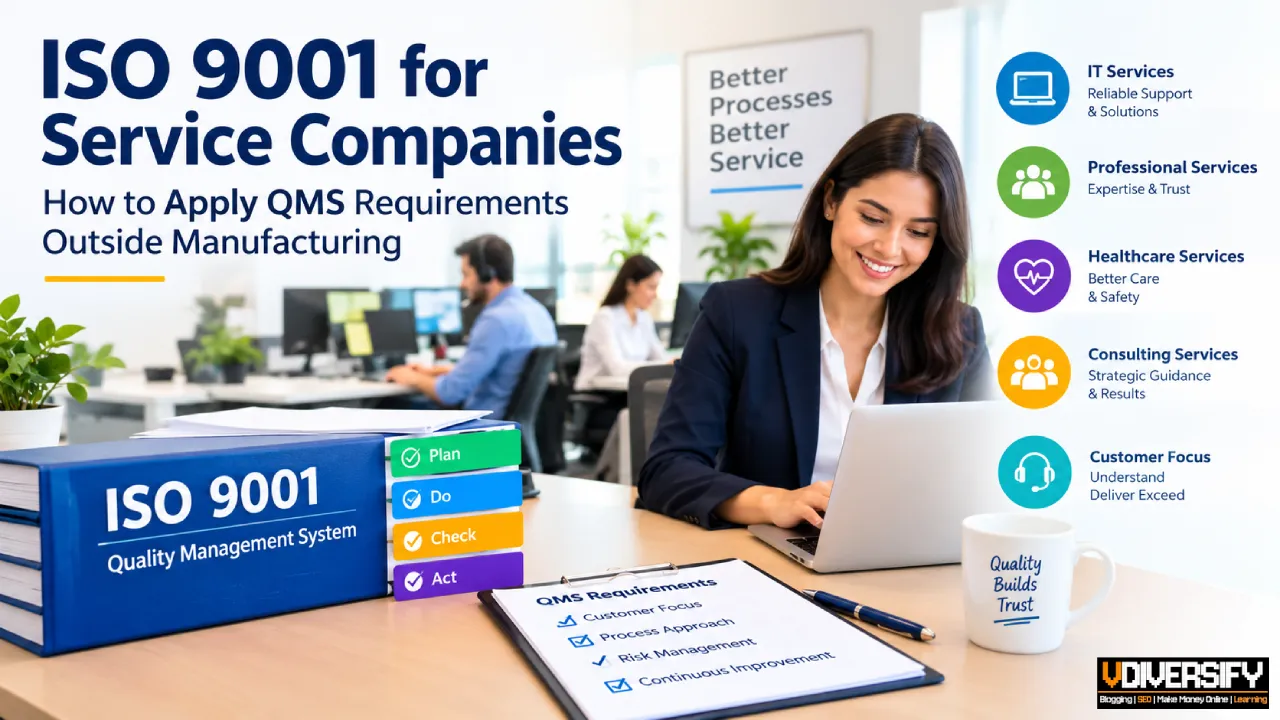
ISO 9001 service companies QMS requirements outside manufacturing explain how organizations that provide services can establish consistent work processes, meet customer expectations, manage risks, and improve the quality of their services without operating a factory or producing physical goods.
From IT support providers and consulting firms to healthcare organizations, logistics companies, and engineering service businesses, ISO 9001 offers a practical framework for delivering reliable results.
The key is to apply quality management requirements to the way services are planned, delivered, checked, and improved.
Contents
- 1. Why ISO 9001 Matters for Service Companies?
- 2. What Is ISO 9001 for Service Organizations?
- 3. Can Service Companies Get ISO 9001 Certification?
- 4. Why ISO 9001 Is Important in the Service Industry
- 5. Understanding the Ten ISO 9001 Clauses in a Service Business
- 6. How to Implement ISO 9001 in a Service Company
- 7. Customer Focus: Building Quality Around Customer Expectations
- 8. Service Design and Development Under ISO 9001
- 9. ISO 9001 IT Services: Managing Support, Software, and Technical Operations
- 10. Professional Services ISO 9001: Consulting, Engineering, and Advisory Firms
- 11. Healthcare ISO 9001: Improving Service Processes in Healthcare Settings
- 12. Service Process Documentation: What Should Be Documented?
- 13. Risk-Based Thinking in Service Operations
- 14. Controlling External Providers and Outsourced Services
- 15. Measuring Service Delivery Quality
- 16. Step-by-Step ISO 9001 Certification Roadmap for Service Companies
- 17. ISO 9001 Readiness Checklist and Practical Case Study
- 18. ISO 9001 Certification Costs and Timelines in the United States
- 19. Common ISO 9001 Implementation Mistakes and Frequently Asked Questions
- 20. Actionable Takeaways and Conclusion
Why ISO 9001 Matters for Service Companies?
When people hear about ISO 9001, they often picture a manufacturing facility, inspection equipment, production lines, and product testing. This view is incomplete. ISO 9001 applies to service organizations too, regardless of their size, industry, or location.
A service business can face quality problems just as easily as a manufacturer. An IT company might miss a support deadline, a consulting firm might submit an inaccurate report, and a logistics provider might deliver a shipment to the wrong location.
In each case, the customer expects a reliable outcome, and the organization needs a system that helps prevent mistakes and correct them when they occur.
ISO 9001 provides that system through a quality management system (QMS). It helps a business define responsibilities, control its processes, understand customer requirements, evaluate performance, and improve its results over time.
For US businesses, a well-implemented QMS can also help demonstrate that the organization has a structured approach to quality when responding to customer questionnaires, bidding for contracts, or working with larger companies that require documented quality controls.
The important point is that quality management is about reliable outcomes, not factory production. Service companies can apply the same underlying principles while adapting their procedures and records to their actual work.
This guide explains how to interpret the requirements, build a practical system, choose useful performance measures, prepare for certification, and avoid common implementation mistakes.
What Is ISO 9001 for Service Organizations?
ISO 9001 is an international standard that specifies requirements for establishing, implementing, maintaining, and continually improving a quality management system. Its purpose is to help organizations consistently provide products and services that meet customer expectations and applicable legal and regulatory requirements.
The current edition is ISO 9001:2026, published by the International Organization for Standardization on September 16, 2026. It builds on the established QMS framework, with updates intended to improve clarity, leadership accountability, quality culture, and the treatment of risks and opportunities.
Organizations should consult the official ISO 9001 standard page for the current requirements and contact their certification body for applicable transition arrangements.
ISO 9001 is not a product-quality specification or a detailed instruction manual for one industry. Instead, it establishes requirements for how an organization manages the processes that affect quality. Each business determines how to meet those requirements in a way that suits its activities.
For example, a software support company might control ticket handling, response times, escalation rules, and customer feedback. A business consultancy might control project proposals, data analysis, report reviews, client approvals, and final deliverables.
Both organizations can use ISO 9001, even though their services and day-to-day activities are very different.
What Does a Service Quality Management System Include?
A service quality management system is the connected set of processes, responsibilities, resources, records, and controls an organization uses to deliver its services consistently.
It may include:
- A quality policy and measurable quality objectives.
- Defined service processes and employee responsibilities.
- Procedures for reviewing customer requirements.
- Staff competence and training records.
- Controls for suppliers and outsourced services.
- Methods for handling complaints and service failures.
- Performance monitoring and internal audits.
- Corrective actions and continual improvement.
These elements should work together rather than exist as separate documents created only for an audit.
Consider an IT support company with 25 employees. If every technician handles support requests differently, customers may receive different answers, response times may vary, and important issues may remain unresolved.
A QMS can define how requests are logged, prioritized, assigned, resolved, reviewed, and closed.
The purpose is not to remove professional judgment. It is to establish a reliable process that allows employees to use their judgment within clear responsibilities and controls.
Can Service Companies Get ISO 9001 Certification?
Yes. Service companies can obtain ISO 9001 certification if their quality management systems meet the applicable requirements and the certification process confirms conformity.
ISO 9001 is designed for organizations across different sectors. Manufacturing is not a condition for certification, and a business does not need a physical production line to demonstrate that it controls service quality.
Examples of organizations that can implement the standard include:
Service sector | How ISO 9001 can be applied |
IT and software services | Control support tickets, software releases, testing, changes, and service-level commitments. |
Consulting and professional services | Review proposals, manage project risks, verify reports, and control client deliverables. |
Healthcare-related services | Improve administrative workflows, appointment handling, records management, and service consistency within applicable regulations. |
Logistics and transportation | Monitor delivery performance, shipment handling, customer complaints, and subcontractors. |
Construction and engineering services | Control project documentation, design reviews, inspections, schedules, and client approvals. |
Education and training | Manage course design, trainer competence, learner feedback, and training records. |
Cleaning and facilities management | Define service schedules, inspection criteria, staff training, and corrective actions. |
Financial and administrative services | Control transaction processing, document accuracy, customer requests, and error resolution. |
The exact QMS scope depends on what the organization does and which activities it intends to include. A company should define its scope clearly instead of claiming that every activity is covered when some are outside the system.
Certification is generally voluntary unless a contract, procurement condition, regulation, or other applicable obligation makes it necessary. Even when certification is not mandatory, customers may value the structured controls that support consistent service delivery.
It is also important to distinguish ISO 9001 certification from other forms of approval. For example, an ISO 9001 certificate does not automatically demonstrate compliance with every healthcare, privacy, cybersecurity, financial, or professional licensing requirement that may apply to a US business.
Why ISO 9001 Is Important in the Service Industry
In the ISO 9001 service industry, quality is often judged through timeliness, accuracy, communication, reliability, and the customer’s experience throughout the service process.
Unlike many manufactured products, services may be delivered and consumed at the same time. Customers may also participate directly in the process by providing information, approving work, explaining their needs, or making decisions. This makes clear communication and controlled workflows especially important.
A consulting company, for example, might produce technically accurate recommendations but still disappoint its client if it misses the agreed deadline or fails to explain the findings. Quality therefore involves more than technical accuracy; it also includes whether the agreed service requirements have been met.
A well-designed QMS can help organizations achieve the following benefits.
1. More Consistent Service Delivery
Clear processes help employees understand what must be done, who is responsible, and how completion is verified. This reduces the risk of important steps being missed when workloads increase or employees change.
Example: A facilities management company introduces a standard inspection checklist for its cleaning teams. Supervisors can verify the same service criteria across different customer sites rather than relying on informal verbal instructions.
2. Better Customer Satisfaction
ISO 9001 requires organizations to focus on customer requirements and monitor customer perceptions. Businesses can use complaints, surveys, repeat business, feedback, and service performance data to understand where they need to improve.
Example: An IT provider notices repeated complaints about slow responses to high-priority incidents. It reviews its ticket-prioritization rules and staffing arrangements, then measures whether response performance improves.
3. Fewer Errors and Less Rework
Unclear instructions, incomplete information, poor handovers, and inadequate reviews can lead to repeated work. A QMS helps identify these causes and establish controls to prevent recurrence.
Example: A consulting firm introduces a technical review before sending reports to clients. The additional review catches missing data and calculation errors before delivery, reducing the need for revised reports.
4. Clearer Responsibilities and Accountability
Service quality often depends on several departments working together. Defined responsibilities help prevent tasks from being overlooked between sales, operations, customer support, and management.
5. Stronger Customer and Supplier Confidence
Some US customers include quality requirements in supplier evaluations and requests for proposals. A relevant ISO 9001 certificate can help demonstrate that an organization operates a structured quality management system, although it does not guarantee that a company will win a contract.
6. Decisions Based on Evidence
Rather than relying only on assumptions, management can review performance indicators, complaints, audit findings, and process results to decide where action is needed.
ISO reports that more than one million certificates have been issued to organizations in 189 countries, illustrating the widespread use of the standard. This figure relates to the broader ISO 9001 certification landscape, not specifically to service companies or to measured improvements in their performance.
See the official ISO overview.
Understanding the Ten ISO 9001 Clauses in a Service Business
ISO 9001 follows a structured framework covering organizational context, leadership, planning, support, operations, performance evaluation, and improvement. Understanding the purpose of each clause helps service companies build a QMS around their actual work rather than copying manufacturing procedures.
The following table summarizes the ten-clause structure and shows how it can be applied in a service setting.
Clause | Main subject | Service-business application |
1 | Scope | Understand the purpose and coverage of the standard. |
2 | Normative references | Identify referenced standards that are applicable to the requirements. |
3 | Terms and definitions | Understand the terminology used in the standard. |
4 | Context of the organization | Identify business conditions, interested parties, and QMS scope. |
5 | Leadership | Establish leadership responsibilities, a quality policy, and customer focus. |
6 | Planning | Address risks and opportunities and set quality objectives. |
7 | Support | Manage people, competence, infrastructure, communication, and documented information. |
8 | Operation | Plan, control, and deliver services that meet requirements. |
9 | Performance evaluation | Monitor results, conduct internal audits, and review QMS performance. |
10 | Improvement | Address nonconformities and improve the QMS. |
Clauses 1–3 establish the standard’s scope, references, and terminology. The main requirements for an organization’s QMS are set out in Clauses 4–10. The practical controls needed will depend on the company’s services, risks, customers, and applicable obligations.
Clause 4: Understanding the Organization and Its Context
A service company must understand the internal and external factors that can affect its ability to achieve the intended results of its QMS.
Relevant factors may include customer expectations, competition, technology changes, staffing shortages, supplier reliability, legal obligations, and the organization’s ability to handle changes in demand.
The organization also needs to identify relevant interested parties and their applicable requirements. These may include customers, employees, regulators, owners, suppliers, and business partners.
Example: A US-based cloud support provider identifies system availability, customer data protection obligations, skilled technical staff, and reliable software vendors as important business concerns. It defines a QMS scope covering its managed IT support and incident-management services.
This context helps the company focus its quality controls on the activities that matter most to its customers and business.
Clause 5: Leadership and Commitment
Top management must take responsibility for the effectiveness of the QMS. Quality cannot be treated only as the responsibility of a quality manager or an employee who maintains documents.
Leaders should establish an appropriate quality policy, support relevant objectives, assign responsibilities, and ensure that quality requirements are built into business processes.
For a service organization, leadership commitment might include reviewing customer complaints, resolving staffing constraints, approving process improvements, and ensuring that employees have the tools and training needed to do their work.
Example: The director of a consulting firm reviews project delays and client feedback during management meetings. When the data shows repeated problems with project handovers, the director assigns an owner to improve the process and checks whether the changes work.
A policy statement alone is not enough. Management decisions and actions must support the quality commitments made to customers.
Clause 6: Planning for Risks, Opportunities, and Quality Objectives
Planning helps an organization identify what could prevent it from meeting customer requirements and what changes could improve its performance.
Service-related risks may include missed deadlines, incorrect reports, staff turnover, system outages, poor communication, incomplete customer information, and failures by external providers.
Quality objectives should be measurable where practical and relevant to the organization’s goals. For example, an IT service company might aim to improve its percentage of tickets resolved within the agreed service target. A consulting firm might track on-time project completion or the rate of deliverables accepted without rework.
The company should define how it will achieve these objectives, who is responsible, what resources are needed, and how results will be evaluated.
Clause 7: Support, Competence, and Documented Information
Service quality depends heavily on people, tools, knowledge, and communication. Clause 7 addresses the resources and support needed to operate the QMS effectively.
A service business should determine the competence required for each relevant role, ensure employees are competent through suitable education, training, or experience, and retain appropriate evidence where required.
It should also control documented information so that employees can access current instructions and relevant records. This does not mean creating a separate procedure for every task. The amount of documentation should fit the complexity of the work and the risks involved.
Example: A payroll services company maintains controlled processing instructions, role-based access to relevant systems, training records, and documented checks for high-risk transactions. These controls help reduce errors and make it easier to investigate problems.
Clause 8: Operational Planning and Service Delivery
Clause 8 is central to service organizations because it deals with planning and controlling the processes needed to provide services that meet requirements.
Depending on the business, this can involve reviewing customer requests, confirming service specifications, planning resources, controlling changes, managing external providers, verifying work, and addressing service problems.
A company providing engineering design services may review project specifications, check design inputs, verify calculations, and obtain required client approvals. An IT support provider may use ticket priorities, escalation rules, change approvals, and closure checks.
Some requirements concerning design and development may not apply to a particular organization if they are genuinely outside its scope under the standard. Such applicability decisions must be justified appropriately rather than made simply to avoid inconvenient requirements.
Clause 9: Performance Evaluation
A QMS needs evidence that its processes are working. Clause 9 covers monitoring, measurement, analysis, evaluation, internal audits, and management review.
Useful service indicators include response time, on-time completion, first-time accuracy, repeat complaints, rework rates, and customer satisfaction. The measures should reflect the service requirements and the organization’s quality objectives rather than being selected only because they are easy to count.
Example: A logistics company reviews delivery performance monthly. It finds that delays are concentrated in a particular handover process and uses that evidence to investigate the cause.
Internal audits and management reviews help determine whether the system conforms to requirements, is being used effectively, and needs changes.
Clause 10: Improvement and Corrective Action
Service failures will not disappear simply because procedures have been written. Organizations need a clear way to identify nonconformities, respond to them, evaluate their causes, take appropriate corrective action, and check whether the action has been effective.
For example, if a consultancy repeatedly submits reports with missing attachments, reminding employees to be more careful may not address the real problem. The organization might discover that its project-closeout checklist is incomplete or that responsibilities for final review are unclear.
The aim is to prevent recurrence, not merely fix the immediate mistake. Corrective action should be proportionate to the problem and supported by evidence that the solution works.
How to Implement ISO 9001 in a Service Company
Understanding the clauses is only the first step. The real challenge is translating the requirements into processes that employees can follow consistently without creating unnecessary paperwork or slowing down customer service.
For a service business, implementation should begin with how work actually happens. Management needs to understand how customers request services, how requirements are confirmed, how work is assigned, how results are checked, and how problems are resolved.
A practical implementation approach follows these steps:
- Define the QMS scope: Identify the services, locations, departments, and activities covered by the system.
- Map service processes: Document the main steps from the initial customer request to final delivery and feedback.
- Identify risks: Determine where delays, errors, misunderstandings, or service failures could occur.
- Establish controls: Introduce suitable checklists, approvals, reviews, training, and performance checks.
- Set quality objectives: Select measurable indicators that reflect customer and business requirements.
- Evaluate performance: Use records, customer feedback, audits, and management reviews to identify weaknesses.
- Improve the system: Correct problems and check whether the changes produce the intended results.
The level of control should reflect the size and complexity of the business. A small consulting firm may need a straightforward project review process, while a national IT provider may need formal escalation procedures, controlled changes, and several levels of service monitoring.
ISO 9001 should support the way the business operates, not create a separate administrative system that employees use only during audits.
Customer Focus: Building Quality Around Customer Expectations
Customer focus is one of the most important parts of a successful QMS. A service may be technically correct but still fail to meet expectations if the provider misunderstands the request, misses a deadline, or communicates poorly.
A customer focus service QMS starts by identifying what customers actually require and determining how those requirements will be met.
Reviewing Customer Requirements Before Accepting Work
Before agreeing to provide a service, the organization should understand the scope, expected results, delivery schedule, responsibilities, acceptance criteria, and any relevant legal or contractual obligations.
This review is particularly important when customers provide incomplete specifications or request changes after work has started.
Example: A management consulting firm
A client asks a consulting firm to improve its operational efficiency within eight weeks. Before accepting the assignment, the firm clarifies:
- Which departments are included in the project.
- What information the client must provide.
- Which deliverables will be produced.
- Who will review and approve the findings.
- What the delivery milestones and deadlines are.
- How changes to the original scope will be handled.
This reduces the risk of disagreement at the end of the project.
Measuring Customer Satisfaction
ISO 9001 requires organizations to monitor customer perceptions of whether their needs and expectations have been met. It does not require every organization to use a particular survey or achieve a universal satisfaction score.
Suitable methods may include:
- Customer satisfaction surveys.
- Complaint and escalation records.
- Client review meetings.
- Repeat business and customer retention data.
- Service-level performance reports.
- Feedback from project completion reviews.
For example, an IT support company might track customer satisfaction after ticket closure alongside response time and repeat incidents. A consulting firm might review client feedback after each project milestone.
These measures should be interpreted together. A high satisfaction score does not necessarily prove that every contractual requirement has been met, and a low complaint count may simply mean that customers have few convenient ways to report problems.
Service Design and Development Under ISO 9001
Service design ISO 9001 requirements become particularly important when a company develops a new service, changes an existing offering, or creates a customized solution for a customer.
Although service design may not involve physical product drawings or production equipment, it can involve designing workflows, software features, consulting methods, training programs, maintenance plans, and customer support models.
Where the design and development requirements apply, the organization should plan the work, identify inputs, control reviews and verification or validation activities as appropriate, manage changes, and retain the required documented information.
A Practical Service Design Example
Consider a company introducing a new remote IT support package for small US businesses.
Before launch, the company should define:
- Customer needs: What types of incidents will be supported, and what response commitments apply?
- Service inputs: What technical information, systems access, staffing, and tools are required?
- Service workflow: How will requests be logged, prioritized, assigned, and escalated?
- Performance criteria: How will response times, resolution quality, and customer experience be evaluated?
- Testing and review: How will the company verify that the proposed process works before offering it to customers?
- Change control: How will future changes to service coverage, pricing, support hours, or technical processes be reviewed?
The organization can then test the service with a suitable group of users, assess the results, and address identified issues before wider deployment.
Not every service change requires a large formal design project. The controls should be appropriate to the nature and risk of the change.
When Design and Development May Not Apply
Some service companies deliver established services using customer-defined requirements without designing or developing the service itself. In such cases, certain design and development requirements may be determined not to apply, provided the decision is justified and does not affect the organization’s ability to meet customer and applicable statutory or regulatory requirements.
For example, a company that only provides a defined cleaning service using a customer’s established specification may have a different design responsibility from a software company creating a custom application.
The decision should be based on actual responsibilities, not simply on whether the organization describes itself as a service provider.
ISO 9001 IT Services: Managing Support, Software, and Technical Operations
IT businesses often depend on several connected processes: incident management, service requests, change management, software releases, access administration, supplier coordination, and customer communication.
ISO 9001 IT services implementation helps establish consistent processes for these activities. It does not replace specialist information security or IT service management standards, but it can complement them.
Example: An IT Support Company
Imagine a managed IT services provider supporting 120 small and medium-sized businesses across the United States. Customers report slow responses, unresolved tickets, and inconsistent communication between technicians.
The company introduces a structured process:
Process stage | Quality control | Example evidence |
Request intake | Record the issue and required information | Support ticket |
Prioritization | Apply defined severity criteria | Priority and impact fields |
Assignment | Assign an owner and target response time | Ticket assignment record |
Resolution | Follow suitable technical steps and escalation rules | Work notes and resolution details |
Verification | Confirm the outcome where appropriate | Test results or customer confirmation |
Closure | Check that required records are complete | Closure record |
Improvement | Review recurring issues and failures | Trend reports and corrective actions |
The company could monitor indicators such as:
- Percentage of tickets receiving a response within the agreed target.
- Percentage of incidents resolved within the agreed time.
- Reopened ticket rate.
- Recurring incident rate.
- Customer satisfaction after resolution.
The company should define each measure carefully. For example, the resolution rate should specify the time period, which tickets are included, and how reopened or waiting-for-customer tickets are treated.
These definitions make performance results more useful and prevent misleading comparisons.
Important distinction: ISO 9001 does not automatically establish cybersecurity compliance. IT providers should separately identify applicable security, privacy, contractual, and regulatory obligations and introduce controls that address them.
Professional Services ISO 9001: Consulting, Engineering, and Advisory Firms
Professional services rely heavily on knowledge, competence, communication, and the accuracy of work products. The main quality risks may involve incomplete analysis, incorrect calculations, missed deadlines, poorly controlled revisions, or misunderstandings about what the client expects.
Professional services ISO 9001 implementation should therefore focus on the complete service lifecycle, from the initial proposal through delivery and post-delivery feedback.
Practical Controls for Professional Service Providers
A consulting, engineering, or advisory business may establish the following controls:
- Proposal review: Confirm that the organization can meet the requested scope, deadline, and technical requirements.
- Competence checks: Assign work to personnel with appropriate qualifications, experience, and skills.
- Project planning: Define milestones, deliverables, responsibilities, and review points.
- Technical review: Check calculations, recommendations, reports, or other outputs before release.
- Revision control: Ensure employees and clients use the correct versions of documents.
- Client approval: Record required decisions, acceptance, or changes.
- Lessons learned: Review recurring errors, delays, and customer feedback after completion.
For example, an engineering consultancy may require an independent technical review of calculations before issuing a report. A marketing consultancy may check that campaign deliverables match the approved brief and that required client approvals have been obtained.
The exact controls depend on the professional activity and the consequences of an error. A high-risk engineering deliverable may require more formal review than a routine administrative service.
Healthcare ISO 9001: Improving Service Processes in Healthcare Settings
Healthcare-related organizations can use quality management principles to improve administrative and support processes, patient communication, scheduling, document control, supplier management, and other activities within their QMS scope.
However, ISO 9001 is not a substitute for healthcare-specific requirements. US healthcare organizations must also consider the laws, regulations, licensing rules, patient safety obligations, privacy requirements, and other standards that apply to their activities.
Healthcare ISO 9001 implementation should be carefully scoped so that quality controls support safe, reliable, and compliant service delivery.
Example: A Medical Appointment and Administrative Service
Consider an organization managing appointment scheduling and patient communications for several clinics. Its service quality may depend on accurate scheduling, correct patient information, clear instructions, timely communication, and effective handling of appointment changes.
Potential controls include:
- Standard procedures for receiving and confirming appointment requests.
- Defined checks for relevant information.
- Staff training and competence records.
- Controlled access to sensitive information.
- Escalation rules for urgent or unusual requests.
- Monitoring of scheduling errors and missed communications.
- Corrective action for recurring process failures.
The organization could measure appointment booking accuracy, administrative processing time, avoidable scheduling errors, and complaint trends.
These indicators should be chosen carefully and should never encourage employees to prioritize speed over patient safety or applicable requirements.
For clinical organizations, the QMS scope and controls must also account for the clinical responsibilities that apply to the services being delivered. Certification to ISO 9001 alone does not demonstrate that every clinical, privacy, or patient safety requirement has been satisfied.
Service Process Documentation: What Should Be Documented?
Service process documentation helps employees understand how important activities should be performed and provides evidence that required processes have been carried out.
ISO 9001 requires documented information in specified areas and where the organization determines it is necessary for the effectiveness of its QMS. It does not require every service company to maintain a large collection of written procedures.
A small business may manage many routine activities using a combination of a process map, checklists, software records, and clearly assigned responsibilities.
Essential Documentation for a Service-Based QMS
Document or record | Purpose | Example |
QMS scope | Define the activities covered | IT support and managed services |
Quality policy | Set the organization’s quality commitments | Commitment to meeting requirements and improving services |
Quality objectives | Establish measurable improvement goals | Reduce repeat service incidents |
Process map | Show how work moves between functions | Customer request to service closure |
Competence records | Demonstrate relevant competence where required | Training and qualification records |
Customer requirement records | Show what was agreed | Contract or approved project brief |
Operational records | Provide evidence of service activities | Tickets, inspection checklists, project reviews |
Supplier evaluation records | Support control of external providers | Supplier performance review |
Audit records | Document internal audit results | Audit plan, findings, and follow-up |
Corrective action records | Track problems and action effectiveness | Root cause, action owner, and verification |
The required records will vary according to the applicable requirements and the organization’s processes. Some activities can be controlled through existing business software rather than separate forms.
How to Avoid Excessive Documentation
A common mistake is to create documents for every possible activity without considering whether they help control quality.
Instead, ask three questions:
- Is this information required by the standard or an applicable obligation?
- Is it needed to ensure consistent service delivery or manage a significant risk?
- Is there already a reliable system that records the information?
If a service desk platform already captures ticket assignments, timestamps, resolutions, and approvals, the organization may not need to recreate the same information in a separate spreadsheet.
Good documentation makes work clearer and evidence easier to find. It should not create duplicate records that employees must maintain simply to satisfy an audit.
Risk-Based Thinking in Service Operations
Service organizations face risks even when they do not manufacture products. Common examples include staff shortages, inaccurate information, missed deadlines, supplier failures, system outages, customer misunderstandings, and inadequate control of changes.
Risk-based thinking helps an organization determine which problems could affect its ability to meet requirements and what action is appropriate.
ISO 9001 does not require every business to use one particular risk register, scoring method, or formal risk assessment template. The organization should select a method suited to its processes and risks.
Example: A Payroll Processing Provider
A payroll service provider identifies several risks:
Risk | Possible consequence | Example control |
Incomplete customer data | Incorrect payroll processing | Input validation and customer confirmation |
Missed processing deadline | Late employee payments | Deadline tracking and escalation |
Staff absence | Processing delays | Cross-training and backup assignments |
Software update failure | Incorrect calculations or interruptions | Controlled testing and release approval |
Repeated processing error | Customer complaints and rework | Root cause analysis and corrective action |
The company should determine which controls are appropriate, assign responsibilities, and review whether they work.
Risk management should also consider opportunities. For example, automating a routine data validation step may reduce errors and free employees to handle more complex customer requests.
The goal is not to eliminate every possible risk. It is to take suitable action to manage risks and opportunities that matter to the QMS.
Controlling External Providers and Outsourced Services
Many service businesses rely on external providers for cloud hosting, payroll systems, software development, subcontracted labor, transport, maintenance, or specialist expertise.
When externally provided processes, products, or services affect the organization’s ability to meet requirements, ISO 9001 requires appropriate controls. Outsourcing a process does not automatically remove the organization’s responsibility for the quality of its own service.
A company should determine suitable supplier evaluation, selection, monitoring, and reevaluation methods based on the effect the provider may have on service conformity.
For example, a consulting firm that outsources specialist data analysis might review the provider’s competence, define the expected deliverables, protect confidential information, and verify the results before including them in a customer report.
A managed IT provider may review its cloud hosting supplier’s service commitments, incident communication, and performance against agreed requirements.
Supplier controls should be proportionate. A provider supplying routine office materials may not need the same evaluation process as a subcontractor handling sensitive customer information or a critical service dependency.
Measuring Service Delivery Quality
Service delivery quality should be evaluated through measures that reflect the organization’s promises to customers and the outcomes it needs to achieve.
A company should avoid selecting indicators simply because they produce attractive reports. Measures should help management identify problems, make decisions, and evaluate improvement.
Useful Quality Indicators for Service Companies
Indicator | What it measures | Example application |
On-time delivery rate | Percentage of services completed by the agreed deadline | Consulting projects |
First-time accuracy | Percentage of outputs accepted without correction | Reports or data processing |
Response time | Time taken to respond to a request | IT support |
Resolution time | Time required to re solve an issue | Service desk operations |
Rework rate | Amount or percentage of work requiring correction | Professional services |
Complaint rate | Frequency of customer complaints using a defined basis | Customer support |
Customer satisfaction | Customer perception of service quality | Post-service surveys |
Repeat incident rate | Frequency of recurring problems | IT and maintenance |
Corrective action effectiveness | Whether actions prevent recurrence | QMS improvement |
Suppose a service company completes 180 of 200 jobs by the agreed deadline in one month. Its on-time completion rate is:
(180 ÷ 200) ✕ 100 = 90%
The result is useful only if the organization defines what counts as a completed job, which jobs are included, and how customer-approved schedule changes are treated.
If the company’s objective is to reach 95%, management can investigate the reasons for the missed deadlines, assign corrective actions where needed, and monitor performance in subsequent months.
There is no single ISO 9001 target that every service business must achieve for customer satisfaction, on-time delivery, or first-time accuracy. Objectives should be appropriate to the organization’s circumstances, risks, and customer commitments.
Measure what matters, investigate what falls short, and verify whether improvements work. This is more useful than collecting large amounts of data without taking action.
Step-by-Step ISO 9001 Certification Roadmap for Service Companies
A service company should approach certification as a business improvement project rather than a document preparation exercise. The goal is to establish a working QMS, demonstrate that it meets the applicable requirements, and ensure that employees use it consistently.
The following roadmap can help US service businesses plan the work.
Step 1: Define the Scope of Certification
Start by deciding which services, locations, teams, and activities the QMS will cover.
For example, a company providing IT consulting, software development, and technical support may choose to include all three services within its QMS. If a separate business unit performs unrelated activities, management should assess whether it belongs in the same scope.
The scope must accurately reflect the organization’s activities and applicable requirements. It should not exclude activities merely because they are difficult to control or important to service quality.
Step 2: Conduct a Gap Analysis
Compare the organization’s current practices with the requirements of the applicable edition of ISO 9001.
A gap analysis helps identify what already works, what needs improvement, and what is missing. It may reveal that the company already has effective customer feedback processes and staff training records but lacks a formal method for reviewing recurring service failures.
Record each gap, its importance, the action needed, the responsible person, and the target completion date.
Step 3: Assign Responsibilities
Management should appoint people to coordinate implementation and ensure that process owners understand their responsibilities.
A small business may assign coordination to an operations manager while department leads manage their own processes. A larger company may have a dedicated quality team.
However, QMS responsibility belongs to the organization as a whole, not just the person responsible for maintaining the quality manual or audit schedule.
Step 4: Build and Implement the Processes
Develop or improve the procedures, work instructions, forms, and system controls needed to meet requirements.
Focus on actual work processes, such as customer onboarding, service delivery, technical review, complaint handling, supplier evaluation, and change management.
Train employees on the controls that affect their roles. Allow enough time for them to use the system and generate evidence of how it operates.
Step 5: Monitor Performance and Correct Problems
Collect records that show whether the processes work as intended. Review relevant performance indicators, customer feedback, service failures, and corrective actions.
If a process repeatedly misses its targets, investigate the causes rather than simply recording the poor result.
For example, if a consulting firm regularly misses project deadlines, it might discover that customer approvals are not built into project schedules or that staff capacity is not reviewed before new work is accepted.
Step 6: Conduct an Internal Audit
Internal audits help determine whether the QMS conforms to applicable requirements and the organization’s own arrangements, and whether it is effectively implemented and maintained.
Auditors should gather objective evidence through interviews, record reviews, and observation of processes. The audit program should consider process importance, changes affecting the organization, and previous audit results.
Where practical, auditors should maintain suitable objectivity and impartiality rather than auditing their own work.
Step 7: Hold a Management Review
Top management should review the QMS at planned intervals to determine whether it remains suitable, adequate, and effective.
Relevant inputs include customer satisfaction, progress against objectives, audit results, nonconformities, corrective actions, supplier performance, risks and opportunities, and the need for resources or changes.
The review should lead to decisions and actions, not just meeting minutes.
Step 8: Select a Certification Body and Complete the Audit
Choose a certification body that is competent to certify the organization’s scope and is appropriately accredited for the intended certification. In the United States, organizations can check relevant accreditation information through the ANSI National Accreditation Board (ANAB) and its certification body resources.
The certification body will explain its audit process, scope arrangements, required information, and applicable edition and transition requirements.
A typical initial certification process includes two stages:
- Stage 1 audit: Reviews readiness, the QMS scope, documented information, and other relevant preparation.
- Stage 2 audit: Evaluates implementation and effectiveness against the applicable requirements.
If the audit identifies nonconformities, the organization must address them through the certification body’s process. Certification is issued only when the applicable requirements for certification have been satisfied.
After certification, the organization remains subject to ongoing surveillance and recertification arrangements. A certificate is not a permanent approval that removes the need for continued control and improvement.
ISO 9001 Readiness Checklist and Practical Case Study
Before scheduling an external audit, service companies should verify that the QMS is implemented and supported by evidence. The following checklist can help management assess readiness.
ISO 9001 Readiness Checklist
Use this list during an internal review:
- The QMS scope accurately describes the services and activities covered.
- Relevant internal and external issues have been considered.
- Interested parties and applicable requirements have been identified.
- A suitable quality policy is established and communicated.
- Quality objectives are defined and monitored.
- Responsibilities and authorities are clear.
- Employees have the competence required for their work.
- Customer requirements are reviewed before commitments are made.
- Service delivery processes have suitable controls.
- Risks and opportunities have been considered and addressed as appropriate.
- External providers are controlled according to their impact on quality.
- Documented information is controlled and available where needed.
- Customer feedback and complaints are monitored.
- Performance data is reviewed and used to make decisions.
- Internal audits have been conducted.
- Management review has been completed.
- Nonconformities and corrective actions are tracked.
- Action effectiveness is checked where appropriate.
- Employees can explain the processes relevant to their roles.
- The organization has checked the applicable edition and certification arrangements.
A completed checklist does not, by itself, prove conformity. Auditors need to see objective evidence that the QMS meets the applicable requirements and works in practice.
Illustrative Case Study: A US IT Support Company
Consider a fictional IT support provider with 35 employees that serves small businesses across three US states. Before implementing its QMS, each support team handled customer requests differently. Ticket records were incomplete, customer complaints were not reviewed systematically, and management could not easily identify recurring problems.
The company began by mapping its service process from request intake through resolution and closure. It introduced common ticket categories, defined escalation responsibilities, trained employees on recordkeeping, and established a process for reviewing recurring incidents.
Management also selected several performance indicators:
Measure | Illustrative baseline | Illustrative target |
Tickets responded to within the agreed target | 82% | 95% |
Tickets reopened after closure | 14% | 8% or less |
Customer satisfaction score | 3.8/5 | 4.4/5 |
Tickets with complete required records | 76% | 98% |
These figures are hypothetical and are provided to demonstrate how objectives can be defined. They are not published research findings or ISO 9001-mandated targets.
After several months of using the new processes, the company reviews the results. It finds that many reopened tickets involve incomplete diagnosis or unclear closure notes. The company improves its technical review and closure process, then checks whether the reopened-ticket rate falls.
The important outcome is not simply that the company has written procedures. It has established a way to identify weaknesses, act on them, and verify whether its changes improve service quality.
ISO 9001 Certification Costs and Timelines in the United States
The cost and duration of certification depend on the size and complexity of the organization, the number of employees, the scope of services, the number of locations, the maturity of the existing QMS, and the amount of external support required.
There is no single fixed fee for every service company. Businesses should obtain written quotations from suitable certification bodies and consultants rather than rely on a universal online price.
What Costs Should a Service Company Budget For?
Cost category | What affects the cost |
ISO 9001 standard | The price of obtaining the official standard and any necessary guidance |
Implementation support | Whether the organization uses internal staff, an external consultant, or a combination |
Staff training | Training needs for process owners, internal auditors, and employees |
Internal audit | Internal staff time or the cost of independent audit support |
Certification audit | Audit duration, number of sites, service complexity, and certification body fees |
Travel and expenses | Auditor travel or other applicable expenses |
Ongoing maintenance | Surveillance audits, training, internal audits, and process improvements |
Transition activities | Work needed to align an existing QMS with a revised standard, where applicable |
A small service business with established processes may need relatively little external consulting, while a multi-site organization with complex outsourced services may need a larger budget.
As an initial planning exercise, a small service company might compare scenarios ranging from several thousand dollars to the low tens of thousands for implementation support and initial certification-related expenses.
This is a broad budgeting illustration, not an official market average or quotation. Actual costs can fall outside that range, especially where extensive consulting, multiple locations, or complex operations are involved.
For an official starting point, see the ISO 9001 standard page. For certification expenses, request itemized proposals that distinguish implementation consulting from certification audits. Certification bodies should independently assess conformity rather than sell a guaranteed certificate.
How Long Does Implementation Take?
Implementation time varies with the organization’s starting point, resources, complexity, and readiness. The following are practical planning estimates rather than ISO-prescribed deadlines.
Organization profile | Illustrative planning period |
Small service company with mature processes | 2–4 months |
Small or medium-sized business with several process gaps | 4–8 months |
Multi-site or more complex service organization | 6–12 months or longer |
A company may need additional time to gather performance evidence, train staff, complete internal audits, resolve nonconformities, and arrange the external audit.
The timeline should allow employees to use the system under normal operating conditions. Writing procedures quickly does not establish that the QMS is effective.
Important Update: ISO 9001:2026
The current edition is ISO 9001:2026, published on September 16, 2026. The revision maintains the familiar high-level clause structure while refining requirements and emphasizing clarity, leadership, quality culture, and the consideration of risks and opportunities. The official ISO page provides the current standard information. See also ISO’s guidance on the 2026 edition.
Organizations already certified to the 2015 edition should contact their certification body to confirm the applicable transition timetable and audit arrangements. Organizations beginning certification should confirm which edition their certification body is accepting and the relevant accreditation arrangements before setting an audit date. ISO/TC 176 transition guidance provides additional information.
An organization with a functioning QMS should build on processes that already work, identify the changes required by the new edition, train relevant personnel, and verify that the updated system is implemented. It does not automatically need to rebuild its entire QMS from scratch.
Common ISO 9001 Implementation Mistakes and Frequently Asked Questions
Even well-established service businesses can struggle with ISO 9001 when they focus on paperwork instead of how work is performed. Avoiding the following mistakes can make implementation more useful and certification preparation more straightforward.
Common Mistakes to Avoid
- Copying manufacturing procedures into a service business
Service companies should not adopt production inspection forms or factory procedures that have no meaningful role in their operations. Instead, they should identify the controls needed for their actual services, such as project reviews, ticket checks, customer approvals, and service records.
- Creating too much documentation
A large quality manual does not automatically indicate a strong QMS. Documents should help employees perform work consistently, manage risks, and retain the evidence required by the standard.
- Treating quality as the quality manager’s responsibility alone
Employees across sales, operations, customer support, IT, and management influence service quality. Each function should understand its responsibilities and how its work affects the customer.
- Setting targets without a clear reason
A company should not choose performance targets simply because another organization uses them. Targets should reflect customer commitments, business risks, available resources, and opportunities for improvement.
- Ignoring customer complaints
Complaints can reveal weaknesses in service delivery, communication, competence, or process design. They should be recorded and evaluated so the organization can identify recurring problems and determine whether corrective action is necessary.
- Fixing symptoms instead of causes
If the same mistake keeps occurring, repeated reminders may not solve it. The organization should investigate the underlying causes and determine whether its processes, training, tools, or responsibilities need to change.
- Preparing for the audit only at the last minute
A QMS needs to operate in normal working conditions. Last-minute document preparation cannot replace evidence that employees follow the processes and that management evaluates performance.
- Assuming certification guarantees customer satisfaction
Certification provides evidence of conformity to the applicable QMS requirements. It does not guarantee perfect service, zero complaints, regulatory compliance in every area, or commercial success.
Actionable Takeaways and Conclusion
A Practical Action Plan for Service Companies
Organizations that want to start implementing ISO 9001 can use this action plan as a starting point.
- Define the scope: Identify the services, sites, and activities that the QMS will cover.
- Understand customer needs: Review contracts, service specifications, deadlines, and acceptance criteria.
- Map key processes: Follow work from the initial request through delivery and customer feedback.
- Identify risks: Examine where mistakes, delays, misunderstandings, or supplier failures could affect quality.
- Assign responsibilities: Make sure employees understand their roles and decision-making authority.
- Document essential controls: Create or maintain the procedures and records needed to manage service delivery.
- Set useful objectives: Select measures that reflect service quality and customer requirements.
- Train employees: Ensure people understand the processes and controls relevant to their work.
- Review results: Monitor performance, complaints, audits, and corrective actions.
- Improve continuously: Investigate recurring problems, implement appropriate changes, and verify their effectiveness.
- Prepare for certification: Confirm the applicable standard edition, select a suitable certification body, and complete the required audit process.
The organization should assign an owner and a realistic target date to each major action. Management should also review progress regularly and ensure that employees have enough time and resources to implement the system properly.
Conclusion
ISO 9001 is not limited to factories, production lines, or physical products. It provides a practical framework that service companies can use to understand customer needs, establish reliable processes, manage risks, measure results, and improve the quality of their work.
For an IT support provider, this may mean better ticket handling and fewer recurring incidents. For a consultancy, it may involve more reliable project planning and technical reviews. For a healthcare-related service provider, it may mean more consistent administrative processes and stronger control of service records.
The requirements remain grounded in the same purpose: consistently meeting applicable requirements and improving the effectiveness of the quality management system.
Successful implementation does not depend on creating the most documents or passing an audit as quickly as possible. It depends on building processes that employees can use, management can evaluate, and customers can rely on.
For organizations beginning their journey, the best next step is to review the official ISO 9001 standard, assess current processes, identify the most important gaps, and develop a realistic implementation plan.
Where certification is a business objective, work with a suitable certification body to confirm the applicable requirements and audit arrangements.
A well-run QMS should continue to provide value long after the certificate is issued.
Authoritative References and Further Reading
- ISO 9001:2026 — Quality management systems: Requirements — The official standard and publication information.
- ISO: What businesses need to know about ISO 9001:2026 — Guidance on the current edition and transition planning.
- ISO/TC 176: ISO 9001 revision and transition information — Updates from the technical committee responsible for the standard.
- American Society for Quality (ASQ) — Quality management concepts, tools, and professional resources.
- ANSI National Accreditation Board (ANAB) — Information about accreditation and certification in the United States.
For certification decisions, always refer to the applicable standard and obtain current guidance from the relevant certification body.
FAQs
Is ISO 9001 only for manufacturing companies?
No. ISO 9001 can be used by organizations of different sizes and sectors, including IT companies, consultancies, logistics providers, healthcare-related organizations, educational services, and professional firms. The requirements are applied according to the organization’s activities, context, and scope.
Does a service company need a quality manual?
The standard does not require every organization to maintain a document specifically called a quality manual. A company must maintain the documented information required by the applicable requirements and whatever additional information it determines is necessary for an effective QMS.
A process map, controlled procedures, records, and other suitable documentation may provide the information employees need without a lengthy manual.
Can a small service company implement ISO 9001 without a consultant?
Yes. An organization can implement its QMS using internal knowledge, the official standard, suitable training, and available guidance. A consultant may be helpful where the business lacks experience or needs assistance interpreting requirements, but hiring one does not guarantee certification.
Is ISO 9001 mandatory for US service companies?
ISO 9001 certification is generally voluntary. However, a customer contract, procurement requirement, industry arrangement, or other applicable obligation may require certification or specified quality controls. Businesses should confirm the requirements that apply to their own services and customers.
Does ISO 9001 certification mean a service is error-free?
No. ISO 9001 requires an effective system for managing quality, controlling processes, evaluating performance, and addressing nonconformities. It does not promise that mistakes will never happen. The organization must be able to identify problems, respond appropriately, and improve its processes.
What is the difference between ISO 9001 and ISO 20000-1?
ISO 9001 is a general quality management system standard applicable across many industries. ISO/IEC 20000-1 focuses specifically on service management systems, particularly in the context of IT and other service management activities. The standards address different needs and may complement each other where appropriate.
Can a service company exclude design and development requirements?
Potentially, if design and development are genuinely not applicable to the organization’s activities and the decision satisfies the standard’s conditions.
For example, a company delivering an established service strictly to customer-defined specifications may have different design responsibilities from a company developing a new software product or engineering solution.
The decision must be justified and cannot compromise the organization’s ability to provide conforming services.
How often must a certified company be audited?
Certification normally involves an initial certification audit followed by surveillance audits and periodic recertification. The certification body determines the applicable arrangements under the relevant certification rules. Companies should confirm their audit schedule directly with their certification body.
What is the most important part of ISO 9001 for a service company?
There is no single clause that matters equally to every organization. Customer requirements, operational controls, competence, performance evaluation, and improvement are especially important in many service environments. The organization’s risks and activities determine where particular controls deserve the most attention.

“Hey, I am Sachin Ramdurg, the founder of VDiversify.com.
I am QA/QC Manager, Certified Lead Auditor and Quality Champion. I am an Engineer and Passionate Blogger with a mindset of Entrepreneurship. I have been experienced in Blogging for more than 15+ years and following as a youtuber along with blogging, online business ideas, affiliate marketing, and make money online ideas since 2012.