
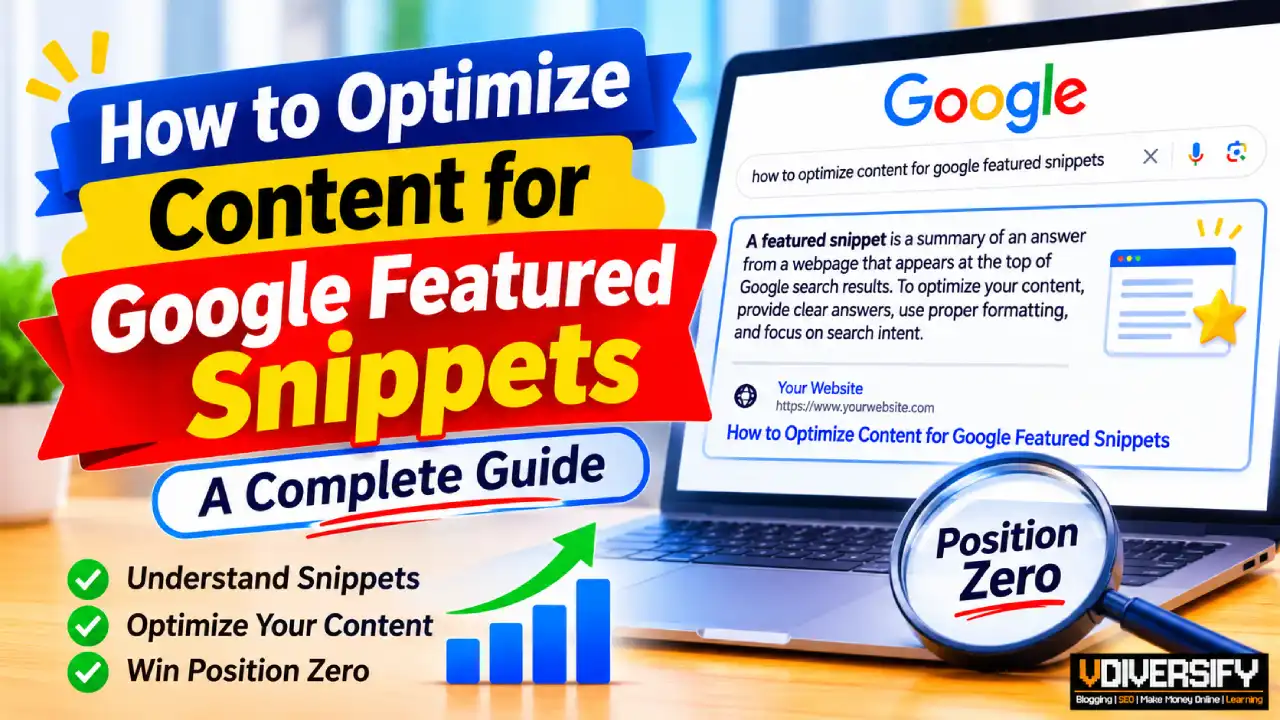
Getting your content onto the first page of Google is difficult enough, but getting your page selected as the answer shown above the traditional organic results can give your brand much more search visibility.
If you are learning how to optimize content for google featured snippets, the goal should not be to write content that simply looks good to a search engine. You need to create content that gives a clear, useful, and trustworthy answer to the exact question a searcher is asking.
This guide explains how featured snippets work, what types of snippets Google can display, how to find realistic opportunities, and how to structure your content so important answers are easy for both people and search systems to understand.
Contents
- 1. What Are Google Featured Snippets?
- 2. Why Do Featured Snippets Matter for SEO?
- 3. Featured Snippet Types You Need to Understand
- 4. Featured Snippets and Position Zero Ranking
- 5. How Google Chooses Content for Featured Snippets
- 6. Start With Search Intent
- 7. Find Featured Snippet Opportunities
- 8. Use Question Header Optimization
- 9. Write the Answer Before the Explanation
- 10. Avoid Snippet Bait Content
- 11. Build Content That Can Stand on Its Own
- 12. The First Featured Snippet Optimization Rule
- 13. Use Snippet-Friendly Formatting
- 14. Master Paragraph Snippet Optimization
- 15. Optimize Lists for Featured Snippets
- 16. Create Tables That Answer Comparison Queries
- 17. Match the Content Format to the Search Query
- 18. Build Multiple Snippet Opportunities Into One Article
- 19. Use Supporting Examples After Direct Answers
- 20. Use Internal Links to Build Topic Depth
- 21. Make the Page Easy for Google to Crawl and Understand
- 22. Improve Page Experience Without Losing the Answer
- 23. Use Structured Data Correctly
- 24. Don’t Hide the Answer Behind JavaScript or Tabs
- 25. Use Images Where They Actually Help
- 26. Don’t Ignore the Title and Introduction
- 27. Create Clear Content Hierarchy
- 28. Avoid Keyword Stuffing
- 29. Avoid Writing for an Imaginary Word Count
- 30. Common Featured Snippet Mistakes
- 31. Don’t Confuse Featured Snippet Optimization With Ranking Manipulation
- 32. Build Answers That Work Beyond Traditional Search
- 33. Featured Snippets Are Not the Whole SEO Strategy
- 34. How to Audit an Existing Page for Featured Snippet Opportunities
- 35. A Simple Before-and-After Example
- 36. The Key Principle: Optimize for Clarity First
- 37. Featured Snippets in the Age of AI Overviews
- 38. How AEO Changes Featured Snippet Optimization
- 39. Featured Snippets and Generative Engine Optimization
- 40. Optimize for LLM Understanding Without Writing for Machines
- 41. Don’t Chase AI Overviews at the Expense of Readers
- 42. Understand Zero-Click Searches
- 43. How to Measure Featured Snippet Performance
- 44. Measure Your Snippet Win Rate
- 45. Track Changes Before and After Optimization
- 46. Give Google Time to Reprocess Changes
- 47. Refresh Existing Content for New Snippet Opportunities
- 48. Refresh Statistics and References
- 49. Use Primary Sources When Making Google Claims
- 50. Don’t Treat Third-Party SEO Statistics as Google Rules
- 51. Build a Featured Snippet Optimization Workflow
- 52. Complete Featured Snippet Optimization Checklist
- 53. Actionable Takeaways
- 54. Final Thoughts
- 55. FAQs
What Are Google Featured Snippets?
A featured snippet is a search result in which Google displays a selected piece of information from a webpage prominently in the results. Instead of showing only a traditional blue link and description, Google may show a short paragraph, list, table, or other content that directly answers the searcher’s query.
For example, someone searching “what is technical SEO?” may see a short definition taken from a relevant webpage before the regular organic results.
The important point is that Google chooses the content automatically. Website owners cannot simply add a special tag that tells Google, “Make this my featured snippet.” Google’s systems determine whether a page is a suitable answer for a particular search.
That makes featured snippet optimization different from traditional on-page SEO.
You are not optimizing for a guaranteed position. You are making your content clearer, more useful, better structured, and easier to extract when Google determines that a featured answer would help the searcher.
Google also explains that there is no fixed minimum amount of text required for a page to qualify for a featured snippet. The amount Google displays can vary depending on the information, language, device, and other factors.
Why Do Featured Snippets Matter for SEO?
Featured snippets can give a page additional visibility because they can occupy a prominent part of the search results page.
However, they should not be treated as a guaranteed source of traffic.
A historical Ahrefs study of millions of search queries found that approximately 12.3% of queries had a featured snippet, while about 30.9% of featured snippets appeared in the first organic position. The study also found that featured snippets did not always receive the highest click-through rate because the answer can sometimes satisfy the searcher’s need without requiring a click.
These figures are from Ahrefs’ research rather than a current Google-wide benchmark, so they should be used as context rather than as a promise of performance.
The larger lesson is more useful:
A featured snippet can increase visibility, but the real objective is to satisfy the searcher’s intent.
Suppose you operate a website about home improvement.
Someone searches:
How often should you replace an HVAC filter?
A page that immediately answers the question and then explains filter types, household conditions, maintenance schedules, and warning signs is more useful than a page that repeats the phrase “HVAC filter replacement” throughout the article.
The first page has a better chance of being useful to both the reader and Google’s search systems.
Featured Snippet Types You Need to Understand
Before optimizing an article, identify which featured snippet types appear for your target query.
The format Google already uses for a query provides an important clue about the kind of answer searchers expect.
The main formats commonly seen include paragraphs, lists, tables, and videos.
Paragraph Featured Snippets
Paragraph snippets provide a short text answer to a question.
They are especially common for queries such as:
- What is content marketing?
- What is a meta description?
- How does compound interest work?
- What is a landing page?
- Why is website speed important?
For these searches, Google can extract a short section of explanatory text from a webpage.
This is where paragraph snippet optimization becomes important.
If your H2 says:
What Is Content Marketing?
Do not make the reader go through five paragraphs before finding the definition.
Give the direct answer immediately.
For example:
Content marketing is the process of creating and distributing useful content to attract, educate, and retain a specific audience. It can include blog posts, videos, guides, newsletters, case studies, and other formats.
Then expand on the topic.
This structure works for people because they receive the answer quickly. It also creates a clearly defined section that search systems can understand.
List Featured Snippets
List snippets display information as either numbered or bulleted items.
They are particularly useful for queries involving:
- Steps
- Methods
- Tips
- Reasons
- Examples
- Types
- Rankings
- Processes
For example:
How to improve website speed
- Compress large images.
- Reduce unnecessary scripts.
- Enable browser caching.
- Improve server response time.
- Remove unused code.
This is an example of list snippet optimization because the information is presented in a format that naturally matches the searcher’s question.
You should not create a list simply because you want a snippet.
Create one when a list is genuinely the clearest way to explain the information.
Table Featured Snippets
Table snippets are useful when people need to compare structured information.
Examples include:
SEO Element | Main Purpose |
Title tag | Describes the page in search results |
Meta description | Provides a search-result description |
Internal link | Connects related pages |
Canonical tag | Helps indicate the preferred URL |
This is where table snippet formatting can make an important difference.
Keep tables simple, readable, and directly connected to the question.
Do not put an entire article inside a table. Tables work best when readers need to compare attributes, values, features, prices, dates, or categories.
Video Featured Snippets
Some searches can surface video content prominently, especially when the query involves a visual process.
Examples include:
- How to change a tire
- How to tie a tie
- How to install a ceiling fan
- How to use a particular software feature
If the search intent is strongly visual, a text-only article may not be the ideal format for the entire query.
This is why SEO should begin with understanding the search results, not blindly following a content template.
Featured Snippets and Position Zero Ranking
You may have heard featured snippets called position zero ranking because they can appear above the traditional organic listings.
The term is useful for describing their historical position in the SERP, but it can also create the wrong impression.
There is no separate “position zero” button that you can target.
Google’s own documentation states that publishers cannot mark a page as a featured snippet. Google’s systems decide whether a page would make a useful featured answer for a particular search.
That means you should not build your entire SEO strategy around winning snippets.
Instead, think of a featured snippet as a possible search visibility outcome that can result from strong content and clear information architecture.
This distinction is important in 2026 because Google Search has continued to expand beyond traditional ten-blue-link results.
AI Overviews and AI Mode can provide synthesized answers and link to supporting webpages. Google’s guidance for AI features says the same basic SEO foundations remain relevant, including making content accessible to Google, following Search Essentials, and creating useful, unique content.
Therefore, optimizing for featured snippets should be part of a wider search strategy rather than an isolated tactic.
How Google Chooses Content for Featured Snippets
There is no public formula that says:
“Write exactly 47 words and you will win.”
That is a common misunderstanding.
Google does not publish a fixed word count for featured snippets. In fact, Google specifically says the minimum length can vary based on several factors.
This means that writing an artificially short answer is not enough.
A better approach is to make the answer:
- Direct
- Accurate
- Complete enough for the question
- Easy to understand
- Clearly connected to the heading
- Supported by useful context
- Written for the reader first
Consider two answers to the question:
What is A/B testing?
Weak answer:
A/B testing is a marketing method used for testing things.
Better answer:
A/B testing is a controlled experiment that compares two versions of a webpage, email, advertisement, or other asset to determine which version performs better against a specific goal.
The second answer defines the subject clearly.
It does not need excessive explanation before reaching the point.
This is the foundation of concise answer writing.
Start With Search Intent
One of the biggest mistakes in featured snippet optimization is focusing on keywords without understanding what the searcher wants.
Take the query:
best running shoes for beginners
The searcher may expect product recommendations, comparisons, features, prices, or buying advice.
Now compare it with:
what are running shoes
That query is primarily informational.
The expected answer is a definition.
These two searches may contain related words, but their intents are different.
Google’s systems attempt to understand the meaning behind queries, so your content should match the task the searcher is trying to complete.
Before creating a snippet-focused section, ask:
What would a person expect to see immediately after searching this question?
If they want a definition, provide a definition.
If they want steps, provide steps.
If they want a comparison, provide a comparison.
If they want a list of reasons, provide a useful list.
This simple process prevents one of the most common SEO problems: creating content around a keyword while ignoring the actual question behind it.
Find Featured Snippet Opportunities
You do not need to create a new article every time you want to target a featured snippet.
In many cases, your existing pages may already have opportunities.
Start with Google Search Console.
Look for pages that:
- Already receive impressions
- Rank for question-based searches
- Appear around the first page of results
- Have strong relevance to the query
- Receive impressions but relatively few clicks
- Cover questions that Google could answer directly
Then manually inspect the search results.
Search the exact query and related questions.
Look at:
- Whether a featured snippet appears.
- What format Google uses.
- Which page currently provides it.
- What information appears in the snippet.
- Whether your page gives a better or clearer answer.
- Whether your page is missing a direct response.
- Whether the search results show a different intent from what you expected.
Tools such as Ahrefs and Semrush can also help identify keywords that trigger featured snippets and pages that are already ranking for them.
A particularly useful opportunity is a page that already ranks reasonably well but does not clearly answer a question that appears within its topic.
For example, imagine your article ranks on page one for “email marketing.”
Inside that article, you have a section about email subject lines, but the section begins with a long introduction.
A related search might be:
What makes a good email subject line?
If your competitors are providing direct answers and your page is already relevant, improving that section may create a realistic optimization opportunity.
Use Question Header Optimization
Headings are not just visual separators.
They help readers understand the structure of your article and make it easier to identify individual questions and answers.
For question-based searches, consider using a clear question as an H2 or H3 when it naturally fits the article.
For example:
What Is Internal Linking?
Then answer the question immediately.
This is question header optimization.
You do not need to turn every heading into an awkward exact-match keyword.
Natural headings are better:
What Is Technical SEO?
How Does Internal Linking Help SEO?
How Do You Compress Images Without Losing Quality?
How Often Should You Update Old Blog Posts?
These headings closely reflect the questions readers may ask.
After the heading, give the direct answer.
Then provide supporting details, examples, exceptions, and practical advice.
This creates a simple information pattern:
Question → direct answer → explanation → example → additional details
That structure is particularly useful for AEO because an answer engine needs clear units of information that can be understood independently.
Write the Answer Before the Explanation
One of the simplest improvements you can make is to reverse the order in which information is presented.
Many writers begin with background.
For example:
In today’s rapidly changing digital environment, businesses are increasingly looking for ways to improve their online presence. There are many factors that can influence search performance, and one of the most important areas is website speed…
Only later do they answer:
Website speed is…
That structure makes the reader work too hard.
Instead, lead with the answer:
Website speed is the time it takes for a webpage and its important content to become available to a visitor. Faster pages can provide a better user experience and can support a site’s overall search performance.
Then explain the details.
This approach combines concise answer writing with useful depth.
The goal is not to make every paragraph short.
The goal is to make every important answer easy to find.
Avoid Snippet Bait Content
There is a major difference between creating content that is easy to extract and creating snippet bait content.
Snippet bait is content written mainly to manipulate search appearance.
For example, a website might add dozens of extremely short definitions to a page simply because the writer believes Google will extract them.
That can produce a page that feels unnatural and provides little value.
A better strategy is to make the entire page useful.
Give each question enough context to be genuinely helpful.
If a definition needs two sentences, use two sentences.
If a process requires eight steps, explain all eight.
If the reader needs a warning or exception, include it.
Google’s current people-first guidance emphasizes original, useful, trustworthy content rather than content created mainly to manipulate rankings.
So the principle is simple:
Optimize the presentation of useful information, not the information solely for a snippet.
The difference may seem small, but it changes how you build the entire article.
Build Content That Can Stand on Its Own
A featured snippet may give someone only part of your answer.
Your page still needs to satisfy the person who clicks through.
For example, suppose Google displays:
A canonical URL is the preferred version of a set of duplicate or very similar webpages.
That answer may satisfy a quick definition search.
But someone who clicks your page may also want to know:
- When should a canonical URL be used?
- How do you implement one?
- What mistakes should you avoid?
- Can canonical tags point to another domain?
- How do canonical URLs differ from redirects?
- How can you check whether Google selected your canonical?
A strong article answers those follow-up questions.
This is where featured snippet optimization connects with Answer Engine Optimization, Generative Engine Optimization, and broader search optimization.
Instead of writing one isolated answer, build a useful information resource where individual sections can answer specific questions while the complete article provides deeper understanding.
That approach also gives readers a reason to visit your website instead of taking only the information shown in the search results.
The First Featured Snippet Optimization Rule
If there is one principle to remember from this section, it is this:
Answer the question clearly before trying to impress the reader.
Use the format that matches the intent.
Use a paragraph for a definition.
Use a numbered list for a process.
Use bullets for a collection of items.
Use a table for structured comparisons.
Use video when the query genuinely requires visual demonstration.
Then add the depth that makes your page more useful than a one-line answer.
Featured snippets are not won by stuffing keywords into awkward sentences. They are earned when your page provides information in a form that is useful, clear, accessible, and relevant to the searcher’s needs.
Use Snippet-Friendly Formatting
Once you understand search intent and the type of answer Google displays for a query, the next step is to make your page easy to scan and understand.
This is where snippet-friendly formatting becomes useful.
Snippet-friendly formatting does not mean designing a page specifically for Google’s extraction systems. It means organizing information so that both readers and search engines can quickly identify the important parts of an answer.
A well-structured section might look like this:
What Is a Meta Description?
A meta description is a short summary that can appear below a page title in search results. It helps searchers understand what a webpage is about before they visit it.
A good meta description should accurately describe the page and encourage a relevant click without making promises the page cannot deliver.
You can then expand the section with examples, recommendations, and related information.
The answer is immediately visible, while the rest of the section provides depth.
Useful formatting elements include:
- Descriptive H2 and H3 headings
- Short introductory answers
- Numbered steps
- Bulleted lists
- Simple comparison tables
- Clear examples
- Relevant images
- Descriptive captions where useful
- Internal links to supporting pages
- Adequate spacing between sections
Good formatting also improves usability on mobile devices, where long blocks of text can be difficult to read.
Master Paragraph Snippet Optimization
Paragraph snippets are among the simplest formats to optimize for because the basic structure is straightforward.
Start with the question.
Then answer it directly in the first one or two sentences.
After that, explain the subject in more detail.
For example:
What Is a 301 Redirect?
A 301 redirect is a permanent redirect that sends users and search engines from one URL to another. It is commonly used when a webpage has permanently moved to a different URL.
That answer is immediately useful.
You can then explain when to use a 301 redirect, how it differs from a temporary redirect, and what to check after implementation.
This is much better than writing four paragraphs of background before answering the question.
How Long Should a Featured Snippet Answer Be?
There is no official Google word count that guarantees a featured snippet.
Third-party SEO studies have found that many paragraph snippets are relatively short, but those studies should not be treated as Google’s official requirement.
Instead of targeting an exact number of words, focus on complete but concise answers.
If a question can be answered accurately in 35 words, do not force the answer to 70 words.
If explaining the concept requires 80 words, do not remove important information simply to hit an arbitrary limit.
For example:
What is bounce rate?
Bounce rate is a website engagement metric that describes visits in which a user leaves without taking another measured action on the site. Its interpretation depends on the page type, analytics setup, and user intent.
That is concise without being incomplete.
Optimize Lists for Featured Snippets
Lists work particularly well when the query itself suggests a sequence or collection.
Consider the question:
How do you create a content brief?
A useful answer could begin:
- Define the target audience.
- Identify the primary search intent.
- Review competing pages.
- List important questions to answer.
- Plan the article structure.
- Add relevant internal links.
- Define the content goal.
- Set standards for accuracy and originality.
This is effective list snippet optimization because the structure matches the task.
The key is not simply putting information into bullets.
The order should make sense.
If the query asks how to perform something, use a numbered sequence when the steps need to happen in a particular order.
If the query asks for examples or ideas, ordinary bullet points may be more appropriate.
For example:
Common types of content marketing:
- Blog posts
- Videos
- Case studies
- Newsletters
- Podcasts
- White papers
- Webinars
There is no reason to number these because they are not sequential steps.
Keep List Items Consistent
A common formatting mistake is mixing different types of information in the same list.
Poor structure:
- Write useful content.
- Google is a search engine.
- Use internal links because they connect pages.
- Keyword research.
The items are not parallel.
A stronger list would be:
- Identify the searcher’s main question.
- Review the current search results.
- Create a direct answer.
- Add supporting examples.
- Link to related pages.
- Review the content for accuracy.
Consistency makes the information easier to understand.
Create Tables That Answer Comparison Queries
Tables can communicate structured information much faster than several paragraphs.
Suppose someone searches:
SEO vs PPC: what’s the difference?
A useful table might look like this:
Factor | SEO | PPC |
Main approach | Organic search visibility | Paid search advertising |
Cost model | Investment in content, links, technical work, and resources | Payment for advertising clicks or impressions |
Traffic start | Usually takes time to build | Can begin soon after campaigns launch |
Long-term value | Can continue producing traffic after content ranks | Traffic generally depends on active campaigns |
Main challenge | Competition and time required | Budget and campaign efficiency |
This is useful table snippet formatting because each row answers a clear comparison point.
Do not overload tables with unnecessary sentences.
If the information cannot be understood quickly, the table has lost much of its purpose.
For mobile readers, especially, very wide tables can also create usability problems. Consider whether a list or short comparison section would be easier to read.
Match the Content Format to the Search Query
One of the strongest ways to improve your chances of appearing in a featured snippet is to study what Google is already showing.
Suppose you search:
how to write a blog post
Google displays a numbered list.
That suggests the query has a process-based intent.
Now search:
what is a blog post
If Google displays a paragraph definition, the intent is different.
Do not use the same content structure for both queries simply because they contain related keywords.
Instead:
Search intent | Useful answer format |
What is X? | Definition paragraph |
How do I do X? | Numbered steps |
Types of X | Bulleted list |
X vs Y | Comparison table |
Best X for Y | Comparison, recommendations, or buying criteria |
Why does X matter? | Direct explanation plus reasons |
Examples of X | List with short explanations |
This is not a guarantee of a featured snippet.
It is a way of aligning your content with the format that already appears useful for that search.
Build Multiple Snippet Opportunities Into One Article
A long-form article does not need to target only one question.
A comprehensive page can answer a main topic and several related questions.
For example, an article about technical SEO could include:
What Is Technical SEO?
A direct definition.
Why Is Technical SEO Important?
A concise explanation.
What Are the Main Technical SEO Elements?
A bullet list.
How Do You Perform a Technical SEO Audit?
A numbered process.
Technical SEO vs On-Page SEO
A comparison table.
This creates multiple opportunities for Google to understand individual sections.
However, do not add unrelated questions just to create more snippet targets.
Every section should support the main topic.
A useful test is:
Would this section still make sense if Google never displayed a featured snippet from it?
If the answer is yes, the section probably serves a real user need.
Use Supporting Examples After Direct Answers
Examples are especially useful because they turn abstract information into something readers can understand.
Consider:
What Is Search Intent?
Search intent is the reason behind a user’s search query—the information, action, or result the person is trying to find.
That is the direct answer.
Now add an example:
Suppose someone searches “best project management software for small businesses.” They are probably evaluating options rather than looking for a dictionary definition of project management software.
By contrast, someone searching “what is project management software?” is more likely looking for a basic explanation.
The two queries concern the same broad subject but require different answers.
This combination of direct answer + example + deeper explanation is useful for readers and can also make your content easier to understand semantically.
Use Internal Links to Build Topic Depth
Featured snippet optimization should not happen in isolation.
Internal links can help users discover related information and help search engines understand how pages on your website relate to one another.
Imagine you have a comprehensive article about SEO.
Within it, you could naturally link to pages covering:
- Keyword research
- Technical SEO
- Internal linking
- On-page SEO
- Content optimization
- Link building
- Search intent
- Google Search Console
The links should be placed where they genuinely help.
For example:
Before optimizing individual sections, review your search intent research to understand what users expect from the query.
That link is useful because the reader may need more information about search intent.
Avoid adding dozens of internal links to every paragraph.
The goal is not to maximize the number of links.
The goal is to make the site’s information easier to navigate.
Make the Page Easy for Google to Crawl and Understand
A perfect answer cannot help much if Google cannot properly access the page.
Technical SEO therefore remains important.
Check that:
- The page can be crawled.
- Important content is available in the HTML.
- The page is not accidentally blocked by robots.txt.
- The intended URL is indexable.
- Internal links can be followed.
- The page does not have an accidental noindex directive.
- Canonical signals are configured appropriately.
- Mobile users can access the content.
- The page loads reliably.
- Important content is not hidden behind unnecessary interactions.
Google’s Search Essentials remain the foundation.
There is no separate technical checklist that guarantees a featured snippet.
Instead, technical SEO removes barriers that could prevent search engines from discovering, rendering, understanding, or indexing your content.
Improve Page Experience Without Losing the Answer
Page speed matters for users, but optimizing performance should not mean stripping useful information from a page.
A common mistake is becoming so focused on performance that important content is removed.
Instead, improve the technical delivery of the page.
Review:
- Image sizes
- Image formats
- Unused JavaScript
- Unnecessary third-party scripts
- CSS delivery
- Server response time
- Caching
- Font loading
- Mobile performance
Google’s Core Web Vitals include metrics such as Largest Contentful Paint (LCP), Interaction to Next Paint (INP), and Cumulative Layout Shift (CLS).
These metrics measure aspects of loading performance, responsiveness, and visual stability.
They do not provide a direct “featured snippet score.”
Think of them as part of the overall page experience rather than a shortcut to position zero.
Use Structured Data Correctly
Structured data helps search engines understand certain types of content.
However, structured data should not be confused with featured snippet optimization.
There is no general “featured snippet schema.”
You should use structured data only when it accurately describes eligible content on the page and follows Google’s documentation.
For example, websites may use appropriate structured data for supported content types such as:
- Products
- Events
- Articles
- Organization information
- Breadcrumbs
- Local businesses
The availability of rich-result features changes over time, so always check current Google Search Central documentation before implementing schema based on an old SEO article.
This matters because many older optimization guides continue recommending structured-data features that Google no longer displays in the same way.
For example, Google’s documentation has changed over time regarding FAQ rich results. A website should not add FAQ structured data simply because someone says it is a guaranteed way to obtain a Google FAQ result.
The principle is straightforward:
Use structured data for accurate machine-readable information, not as a featured-snippet hack.
Don’t Hide the Answer Behind JavaScript or Tabs
If an important answer is buried in a complicated interactive interface, users may have difficulty finding it.
Search engines have become much better at processing modern webpages, but straightforward content presentation is still useful.
If the answer is important, make it visible.
For example, instead of creating a page where someone has to click through four tabs to find the definition of a term, consider presenting the definition directly on the page.
Interactive elements can still be useful when they genuinely improve the experience.
The problem occurs when interaction becomes a barrier to accessing important information.
Use Images Where They Actually Help
Images can improve understanding, particularly when explaining visual processes.
For example, an article explaining Google Search Console could use screenshots to show where a report appears.
An article about website speed could use a simple visual explaining how page resources load.
An article about changing a physical component could use step-by-step photographs.
Images should support the written answer rather than replace essential text.
Use descriptive image filenames and appropriate alt text when the image conveys meaningful information.
For decorative images, avoid stuffing keywords into alt attributes.
A useful alt text describes the image for people who cannot see it.
For example:
Screenshot of the Google Search Console Performance report
is more useful than:
best SEO Google Search Console featured snippets SEO tool
The second example is written for keywords rather than people.
Don’t Ignore the Title and Introduction
The featured snippet usually comes from a specific section of a page, but the overall page still matters.
Your title should accurately describe what the article covers.
The introduction should quickly establish:
- What the reader will learn
- What problem the article solves
- Who the article is for
- What makes the information useful
Avoid opening with several paragraphs of generic statements.
For example:
SEO is more important than ever in today’s digital world…
does not tell the reader much.
A stronger introduction gets specific:
Google featured snippets can place a concise answer from your webpage prominently in search results. This guide explains how to identify snippet opportunities, structure answers, optimize paragraphs and lists, and measure whether those changes improve search visibility.
The second introduction establishes the topic immediately.
Create Clear Content Hierarchy
Your page should have a logical hierarchy.
A simple structure could be:
H1: How to Optimize Content for Google Featured Snippets
H2: What Are Featured Snippets?
H2: Why Featured Snippets Matter
H2: Featured Snippet Types
H3: Paragraph Snippets
H3: List Snippets
H3: Table Snippets
H2: How to Find Featured Snippet Opportunities
H2: How to Optimize Your Content
This structure makes the article easier to navigate.
Do not use heading levels simply because the text looks larger or smaller.
Headings should describe the content that follows them.
A clear hierarchy also helps readers jump directly to the section they need.
Avoid Keyword Stuffing
One of the easiest ways to make a good article sound unnatural is to repeat the target keyword in every section.
You do not need to write:
Featured snippet optimization helps with featured snippets because featured snippet optimization improves featured snippets…
That does not help the reader.
Instead, naturally discuss related concepts:
- Search intent
- Direct answers
- Question-based queries
- Search visibility
- Organic rankings
- Content structure
- Paragraph answers
- Lists
- Tables
- User experience
- Helpful content
- AEO
Search engines understand relationships between concepts much better than they once did.
Your writing should therefore focus on covering the topic properly rather than repeatedly inserting one phrase.
Avoid Writing for an Imaginary Word Count
Word count is often misunderstood in SEO.
A 5,000-word article is not automatically better than a 1,500-word article.
If a searcher’s question requires 500 words, writing 2,000 words of repetition makes the page worse.
Likewise, if a topic genuinely requires a detailed guide, cutting it down simply to reach a particular word count can leave important questions unanswered.
The correct length is the length required to satisfy the search intent.
For a comprehensive guide, depth should come from:
- Useful examples
- Original explanations
- Relevant data
- Practical instructions
- Comparisons
- Expert insights
- Supporting evidence
- Important limitations
- Related questions
Not from repeating the same point in different words.
Common Featured Snippet Mistakes
Many websites make the same mistakes when attempting to optimize for snippets.
Mistake 1: Starting With a Long Introduction
The reader asks a question, but the page makes them wait several paragraphs for the answer.
Fix: Put the direct answer near the beginning of the relevant section.
Mistake 2: Forcing Every Section Into a List
Not every question is a list.
Fix: Choose the format that best matches the information.
Mistake 3: Copying the Existing Snippet
Simply rewriting another website’s answer does not create a strong content strategy.
Fix: Add original explanations, examples, data, experience, or useful context.
Mistake 4: Using Exact-Match Keywords Everywhere
Repeated keywords make writing unnatural.
Fix: Use natural language and related terminology.
Mistake 5: Treating Featured Snippets as Guaranteed
No optimization technique guarantees that Google will select your page.
Fix: Focus on relevance, usefulness, clarity, and overall search performance.
Mistake 6: Ignoring the Rest of the SERP
The featured snippet is only one part of the search results.
Fix: Study the complete SERP, including organic results, related searches, images, videos, discussions, shopping results, and AI-generated features where applicable.
Don’t Confuse Featured Snippet Optimization With Ranking Manipulation
There is an important distinction between making content easier to understand and trying to manipulate search systems.
Good optimization improves the presentation of information.
Manipulative optimization tries to create artificial signals.
For example, writing:
What is SEO? SEO is…
is sensible if the section genuinely answers that question.
Adding 100 nearly identical definitions at the bottom of an article simply to create more extraction opportunities is not a useful content strategy.
Your optimization should improve the page even if Google never displays a featured snippet.
That is the strongest test you can apply.
Build Answers That Work Beyond Traditional Search
Search is no longer limited to a simple list of blue links.
Google now provides several ways for users to interact with information, including AI Overviews and AI Mode.
Google’s current documentation explains that AI features can use a wider range of supporting links and queries, while continuing to rely on core search systems and SEO fundamentals.
This creates an important opportunity for publishers.
Instead of asking only:
“How do I get the featured snippet?”
Ask:
“How can I make every important answer on this page easy to understand, verify, and use?”
That change in thinking supports traditional SEO as well as AEO, GEO, and LLM-focused content optimization.
A well-structured article can contain:
- Clear definitions
- Direct answers
- Supporting evidence
- Original examples
- Structured comparisons
- Step-by-step instructions
- Relevant internal links
- Trustworthy external references
- Clear authorship
- Updated information
These elements give both people and search systems more useful information to work with.
Featured Snippets Are Not the Whole SEO Strategy
It is tempting to make a featured snippet the primary goal of an article.
But a website needs more than snippets to build sustainable search visibility.
A successful content strategy also considers:
- Topic coverage
- Search intent
- Organic rankings
- Internal linking
- Technical SEO
- Content quality
- Brand trust
- External references
- User experience
- Conversion intent
- Content freshness
- Original value
Imagine that your page wins a featured snippet but provides no reason for someone to continue reading.
You may receive visibility without building a relationship with the visitor.
Now imagine the snippet gives a useful answer, and the page continues with a detailed explanation, examples, tools, comparisons, and practical next steps.
That page has a much stronger chance of turning search visibility into meaningful website engagement.
How to Audit an Existing Page for Featured Snippet Opportunities
You can apply these principles to content that is already published.
Start by selecting a page that has relevant search impressions.
Then work through this audit:
Step 1: Identify question-based queries.
Use Google Search Console or an SEO platform to find queries that bring impressions to the page.
Step 2: Search the queries manually.
Look at what Google displays.
Step 3: Identify the current format.
Is it a paragraph, list, table, video, or another format?
Step 4: Compare your answer.
Does your page answer the question directly?
Step 5: Improve the relevant section.
Use a clear heading and place the answer near the beginning.
Step 6: Add useful depth.
Provide examples, explanations, evidence, or supporting details.
Step 7: Review the entire page.
Remove repetition and fix sections that do not satisfy the reader’s intent.
Step 8: Monitor performance.
Give Google time to recrawl and reassess the page before judging the result.
Do not change ten different SEO variables at once if you want to understand what caused a performance change.
A Simple Before-and-After Example
Imagine an article targeting:
How does email marketing work?
The original section says:
Email marketing has become an important part of digital marketing. Businesses have been using email for many years to communicate with customers. There are different ways businesses can use email, and these can vary depending on their goals and audiences…
The answer is delayed.
A stronger version begins:
Email marketing works by sending targeted messages to people who have opted to receive communications from a business or organization. These messages can promote products, share educational content, deliver updates, or encourage specific actions.
Then the article can explain:
- How people join an email list.
- How subscribers are segmented.
- How campaigns are created.
- How messages are delivered.
- How results are measured.
- How future campaigns are improved.
The second version is easier to scan and gives the reader the answer immediately.
It also creates a clean section that can potentially satisfy a definition-style search.
The Key Principle: Optimize for Clarity First
The most reliable approach to featured snippet optimization is surprisingly simple.
Make the answer obvious.
Do not make readers search through your article to discover the information they came for.
Do not use a paragraph when a list is clearly better.
Do not use a list when a comparison table is more useful.
Do not add a table simply because you want a structured element.
Do not shorten an answer until it becomes incomplete.
And do not write artificial snippet bait content that exists only to attract search features.
Instead, understand the question, choose the appropriate format, answer it directly, and then provide the depth necessary to help the reader make sense of the subject.
That foundation becomes even more important as Google Search continues to combine traditional results with AI-generated experiences.
Featured Snippets in the Age of AI Overviews
Google Search has changed significantly as AI-generated experiences have become part of the search journey. AI Overviews and AI Mode can provide synthesized responses to complex questions and include links to webpages that support or expand on the information.
That does not make traditional SEO obsolete.
Google’s current guidance says that the same fundamental SEO practices that help pages appear in traditional Search also apply to AI features. Google recommends making content accessible to its crawlers, following Search Essentials, and creating unique, valuable content for people.
This creates an important connection between featured snippets and AI search optimization.
A page that clearly defines concepts, answers questions, explains processes, provides original information, and uses a logical structure gives search systems more useful information to understand.
However, you should not assume that winning a featured snippet automatically puts your page into an AI Overview.
The two search features are different.
A featured snippet generally highlights an excerpt from a webpage for a specific query, while an AI Overview can synthesize information from multiple sources.
Therefore, optimize for the underlying quality of the content rather than trying to create one piece of text that is supposed to trigger every search feature.
How AEO Changes Featured Snippet Optimization
Answer Engine Optimization, or AEO, focuses on making information easy for answer-driven search experiences to understand and use.
Featured snippets are a natural part of this discussion because they reward content that provides clear answers to specific questions.
For example, consider:
What is a canonical tag?
An AEO-friendly section might begin:
A canonical tag is an HTML element that tells search engines which URL should be treated as the preferred version when multiple URLs contain identical or very similar content.
Then continue with:
- Why canonical tags are used
- Where they are placed
- When they should be used
- Common implementation mistakes
- How to check them
This creates a self-contained answer while maintaining enough depth for someone who wants to learn more.
AEO should not mean reducing every article to short answers.
Instead, think of your article as a collection of clear answer units supported by deeper explanations.
That structure helps readers scan the page and makes important concepts easier for search systems to interpret.
Featured Snippets and Generative Engine Optimization
Generative Engine Optimization, or GEO, is a broader approach to improving how a brand or website can be represented in AI-generated search experiences.
The exact methods used by different AI systems vary, and there is no universal “GEO ranking factor.”
Still, several fundamentals overlap with good featured snippet optimization:
- Clear factual statements
- Strong topical coverage
- Original information
- Useful examples
- Trustworthy sources
- Clear authorship
- Consistent terminology
- Logical content structure
- Relevant internal links
- Supporting evidence
Imagine an article about how long SEO takes.
Instead of making a vague statement such as:
SEO takes time and depends on many factors.
A stronger answer could explain that results depend on factors such as competition, website history, content quality, technical condition, authority, search demand, and the resources available to improve the site.
It could then explain realistic scenarios without presenting an arbitrary timeline as a guarantee.
That kind of content gives readers something useful to understand, while also giving search systems clearer information about the subject.
Optimize for LLM Understanding Without Writing for Machines
LLM SEO is sometimes described as optimizing content for large language models.
There is value in thinking about whether information is clear enough for an AI system to interpret, but you should avoid writing unnatural content for a hypothetical algorithm.
Write clear statements.
Define specialized terms.
Keep related information together.
Support important claims with reliable references.
Explain exceptions.
Use examples.
Avoid contradictions within the same article.
For instance, if one section says:
A 301 redirect permanently redirects a URL.
and another section later says:
A 301 redirect is temporary.
you have created conflicting information.
Clear content architecture reduces this type of problem.
The best approach is to create content that is easy for humans to understand first.
If the information is well written, organized, accurate, and supported by evidence, it is also easier for machines to process.
Don’t Chase AI Overviews at the Expense of Readers
AI search has created a temptation to turn every article into a collection of short factual statements.
That is not necessarily a good content strategy.
People still need:
- Explanations
- Examples
- Original research
- Expert experience
- Comparisons
- Opinions when clearly identified as opinions
- Practical instructions
- Evidence
- Context
- Important limitations
A short answer may solve one part of a problem.
A useful article solves the larger problem.
For example, someone searching “how to start a blog” may initially want a basic answer.
But a serious beginner may also need to understand:
- Choosing a topic
- Selecting a platform
- Buying a domain
- Hosting
- Website design
- Content planning
- Keyword research
- SEO
- Internal linking
- Analytics
- Content promotion
- Monetization
A strong page can provide the direct answer and then help the reader complete the entire task.
That is more valuable than creating hundreds of tiny pages containing one-sentence answers.
Understand Zero-Click Searches
Featured snippets can sometimes answer a question without requiring a website visit.
This is known as a zero-click search.
That creates an important measurement problem.
If someone sees your brand in a featured snippet but does not click, Google Search Console may not show a click from that search.
The visibility still may have value, but you should not automatically assume that every impression becomes website traffic.
A Semrush report published in September 2025 estimated that zero-click searches accounted for roughly 27.2% of search traffic in the U.S., based on its analysis of its State of Search data. That figure is a third-party estimate and should not be treated as a universal Google measurement.
This is one reason modern SEO measurement should look beyond clicks alone.
Brand visibility, impressions, conversions, assisted journeys, and search presence can all matter depending on the business.
How to Measure Featured Snippet Performance
There is no single universal metric called “featured snippet success.”
Instead, monitor several signals.
Organic Impressions
Search Console can show how often your pages appeared for search queries.
An increase in impressions can indicate broader visibility, although impressions alone do not prove that you won a featured snippet.
Clicks
Track whether changes to a page result in more clicks.
A featured snippet can sometimes answer a query so completely that fewer users need to click.
Therefore, a lower CTR does not automatically mean the optimization failed.
Average Position
Search Console provides average position data.
Use it alongside query-level information rather than treating the number as an exact ranking position for every search.
Search Queries
Look at the questions bringing impressions to your page.
Question-based queries can reveal additional content opportunities.
Conversions
This is often more important than rankings.
If the goal of your website is generating leads, sales, subscriptions, or another business outcome, track whether organic visitors perform those actions.
A page that receives fewer visits but generates relevant leads may be more valuable than a page that receives large amounts of low-intent traffic.
Measure Your Snippet Win Rate
The term snippet win rate can be useful as an internal SEO measurement.
For example, suppose you monitor 100 target queries that currently show featured snippets.
If your site owns the featured snippet for 18 of them, your internal snippet win rate would be:
18 ÷ 100 × 100 = 18%
This is not a Google metric.
It is simply a measurement framework you can create for your own SEO program.
You can make the measurement more useful by dividing opportunities into groups:
- Existing featured snippets
- Queries where your page ranks in the top 10
- Queries where your page ranks in positions 4–10
- Newly optimized pages
- Existing pages
- High-value commercial queries
- Informational queries
This lets you evaluate whether your optimization work is producing changes over time.
Track Changes Before and After Optimization
Suppose an article currently ranks for 500 search queries.
You identify 15 relevant question-based queries and improve the article.
Record the starting data:
Metric | Before Update |
Organic clicks | 1,200/month |
Organic impressions | 42,000/month |
Target queries | 15 |
Featured snippets owned | 2 |
Average position | 8.4 |
After allowing enough time for Google to recrawl and reassess the page, record the same information.
The comparison might look like:
Metric | Before | After |
Organic clicks | 1,200 | 1,460 |
Organic impressions | 42,000 | 48,500 |
Target queries | 15 | 15 |
Featured snippets owned | 2 | 5 |
Average position | 8.4 | 6.9 |
These numbers are an illustrative example, not a benchmark.
The purpose is to demonstrate the method.
Do not assume every improvement came from featured snippet optimization. Search demand, competitors, seasonality, algorithm changes, links, content updates, and many other factors can influence performance.
Give Google Time to Reprocess Changes
One of the biggest mistakes is checking the search results immediately after changing an article.
Google needs to discover, crawl, process, and potentially reassess the updated page.
Search results can also change independently of your work.
Therefore, evaluate changes over an appropriate period rather than judging them after a few hours.
For important pages, maintain a simple change log:
Date: September 21
Page: /technical-seo-guide/
Changes: Added direct answers to seven questions, improved list formatting, added comparison table
Target queries: 15
Starting position: Recorded in spreadsheet
Starting clicks: Recorded in Search Console
This creates a useful history of your SEO experiments.
Refresh Existing Content for New Snippet Opportunities
You do not always need to publish another article.
Older content can contain significant optimization opportunities.
Start with pages that already have:
- Search impressions
- Relevant rankings
- Strong topical relevance
- Existing backlinks
- Useful content
- Questions that are not directly answered
Then review the article.
Ask:
Can I make the answer clearer without changing the purpose of the page?
If yes, update it.
For example, an old article titled:
Complete Guide to On-Page SEO
may already contain sections covering title tags, headings, internal links, URLs, images, and content structure.
You could add direct answers such as:
What Is On-Page SEO?
Why Is On-Page SEO Important?
What Are the Main On-Page SEO Elements?
These additions may make the article easier to navigate while addressing specific search questions.
Do not update old content simply to change its publication date.
The update should provide genuine value.
Refresh Statistics and References
Statistics become outdated.
SEO practices change.
Google’s search features change.
Tools introduce new features.
Therefore, a strong content update should review the supporting evidence as well.
For every important statistic, ask:
- Where did this number come from?
- What year was the research conducted?
- What population was studied?
- Is the study still relevant?
- Does the source provide methodology?
- Is there a newer source?
- Am I presenting an industry study as if it were a Google fact?
For example, the frequently cited Ahrefs study found that 12.3% of queries in its dataset had featured snippets and that about 30.9% of featured snippets appeared in position one. Those figures are valuable historical research, but the study was based on an older dataset and should not be described as Google’s current universal statistics.
That distinction makes your article more trustworthy.
Use Primary Sources When Making Google Claims
If you are explaining what Google does, Google’s own documentation should usually be the first source you check.
Use Google’s documentation for claims about:
- Featured snippets
- Crawling
- Indexing
- Search Essentials
- Structured data
- AI features
- Search Console
- Core Web Vitals
- Spam policies
Third-party sources such as Ahrefs and Semrush are valuable for:
- Industry studies
- Large-scale observations
- SEO experiments
- Practical workflows
- Competitive research
- Tool-specific instructions
The strongest article often combines both.
Use Google to explain what Google officially says.
Use independent studies to explain what researchers and SEO platforms have observed.
Don’t Treat Third-Party SEO Statistics as Google Rules
This distinction deserves special attention.
You may see recommendations such as:
Keep the featured snippet answer between 40 and 50 words.
That can be a useful writing guideline based on observed snippets.
But it is not the same as saying:
Google requires 40–50 words.
Google does not publish such a requirement.
Semrush’s current featured snippet guidance, for example, recommends direct answers and discusses concise paragraph responses, while also emphasizing appropriate structure and matching the format shown in the SERP.
Use these recommendations as practical observations, not guaranteed formulas.
Build a Featured Snippet Optimization Workflow
You can turn everything covered in this guide into a repeatable process.
Step 1: Choose an Existing or Planned Page
Select a page that has strong relevance to the subject.
Step 2: Identify the Primary Search Intent
Determine whether users want information, instructions, comparisons, examples, or another type of answer.
Step 3: Research the SERP
Search the target query and related questions.
Record the current featured snippet format.
Step 4: Identify Related Questions
Use Search Console, keyword research tools, People Also Ask results, customer questions, forums, sales conversations, and support data.
Step 5: Create Clear Sections
Turn important questions into natural H2 or H3 headings.
Step 6: Answer Immediately
Place the direct answer immediately after the relevant heading.
Step 7: Choose the Right Format
Use paragraphs, lists, tables, examples, or other formats according to the information.
Step 8: Add Supporting Depth
Explain why the answer matters and provide examples, limitations, and practical instructions.
Step 9: Improve Internal Linking
Connect the article to relevant supporting pages.
Step 10: Review Technical SEO
Make sure the page is crawlable, indexable, accessible, and usable.
Step 11: Add Accurate Structured Data Where Appropriate
Use only supported, relevant structured data that accurately represents visible page content.
Step 12: Publish or Update
Make the changes meaningful rather than making superficial edits.
Step 13: Monitor Search Performance
Track impressions, clicks, queries, rankings, conversions, and featured snippet ownership where your tools can identify it.
Step 14: Repeat
SEO is an ongoing process.
Search results change, competitors update their pages, and search features evolve.
Complete Featured Snippet Optimization Checklist
Before publishing or updating an article, run through this checklist.
Search Intent
- Do I understand why the user searched this query?
- Does my content satisfy the main intent?
- Have I reviewed the current SERP?
- Does my content format match the type of answer users expect?
Content Structure
- Is there one clear H1?
- Are H2 and H3 headings descriptive?
- Are important questions used naturally as headings?
- Does each section answer its question clearly?
- Can readers scan the page easily?
Featured Snippet Optimization
- Is the direct answer near the relevant heading?
- Is the answer concise without becoming incomplete?
- Are lists used for genuine lists?
- Are numbered lists used for sequential processes?
- Are tables used for useful comparisons?
- Have I avoided artificial snippet bait?
- Have I avoided keyword stuffing?
Content Quality
- Is the information accurate?
- Are statistics sourced?
- Are older statistics clearly dated?
- Are important claims supported by reliable references?
- Does the page provide original value?
- Are examples relevant?
- Have unnecessary repetitions been removed?
Technical SEO
- Can Google crawl the page?
- Can Google index the page?
- Is the important content accessible?
- Are internal links working?
- Is the page mobile-friendly?
- Are images optimized?
- Is the page technically sound?
AEO and AI Search
- Can each important question be understood on its own?
- Are definitions clear?
- Are important claims supported by evidence?
- Does the article provide original information?
- Does the page provide enough context beyond short answers?
- Does the content follow Google’s current guidance for helpful content?
Actionable Takeaways
If you want a practical summary of this entire guide, remember these principles:
- Start with search intent, not just keywords.
- Search your target query before changing the content.
- Identify the featured snippet format already appearing.
- Use question-based headings when they naturally fit.
- Put direct answers immediately after relevant headings.
- Use paragraphs for definitions and explanations.
- Use numbered lists for sequential processes.
- Use bullet lists for collections of items.
- Use tables when readers need comparisons.
- Keep answers concise but complete.
- Add examples that make difficult concepts easier to understand.
- Build depth around the direct answer.
- Avoid artificial snippet bait content.
- Do not stuff keywords into headings or paragraphs.
- Improve existing pages when they already have relevant search visibility.
- Use internal links to connect related topics.
- Keep important content accessible and crawlable.
- Use structured data only when it is appropriate and supported.
- Measure impressions, clicks, rankings, conversions, and snippet visibility.
- Treat third-party SEO statistics as research, not Google’s official rules.
- Keep statistics and references updated.
- Follow Google’s current Search Essentials and people-first content guidance.
- Optimize for useful information rather than one specific SERP feature.
- Remember that featured snippets, AI Overviews, and AI Mode are different search experiences.
Final Thoughts
Optimizing for Google featured snippets is not about finding a secret formula or writing a specific number of words.
It is about understanding what the searcher wants and presenting the answer in the clearest useful format.
If the user wants a definition, provide a clear definition. If the user wants instructions, provide an ordered process. If the user wants a comparison, organize the information so differences are easy to see. If the question requires a detailed explanation, give the direct answer first and then provide the depth needed to understand it properly.
The strongest strategy is therefore simple: make your content easy to understand before trying to make it easy to extract.
Featured snippets can provide valuable search visibility, but they should be treated as one part of a wider SEO and content strategy. Historical Ahrefs research found featured snippets across a meaningful portion of its U.S. keyword database, while also showing that snippets do not automatically translate into the most clicks. That is an important reminder that visibility and traffic are not always the same thing.
The rise of AI Overviews and AI Mode makes this even more important. Search systems can now answer increasingly complex questions, so publishing another generic article is unlikely to be enough. Websites need to provide information that is clear, original, trustworthy, well-supported, and genuinely useful.
Think beyond the snippet.
Create a page that answers the immediate question, handles the follow-up questions, provides practical examples, supports important claims, and gives readers a reason to continue exploring your website.
That is the foundation of modern search optimization.
And when your content is genuinely useful, properly structured, technically accessible, and aligned with search intent, you are not optimizing only for one featured result. You are building content that can serve users across traditional Google results, featured snippets, People Also Ask, AI-powered search experiences, and other ways people discover information online.
References and resources
The below are the best resources that will help you further enhances your knowledge for optimizing content for Google featured snippets:
- Google’s current documentation explains that featured snippets are automatically selected by Google’s systems and that publishers do not have a special mechanism for manually designating a featured snippet. (Read more: Google Search Central — Featured snippets)
- Google’s guidance for AI features explains that the same foundational SEO practices remain relevant for AI Overviews and AI Mode, including crawlability, Search Essentials, and useful content. (Read more: Google Search Central — AI features and your website)
- Google’s people-first content guidance provides the broader framework for creating useful, reliable content intended to help people rather than content created primarily to manipulate search rankings. (Read more: Google Search Central — Creating helpful, reliable, people-first content)
- Google’s Search Appearance documentation explains how structured data and other search-result features work and should be consulted as supported features change. (Read more: Google Search Central — Search appearance)
- Ahrefs’ large-scale featured-snippet research provides historical data on snippet prevalence, click behavior, and ranking positions. Its study reported featured snippets for about 12.3% of queries in its analyzed U.S. database and found that approximately 30.9% of featured snippets appeared in position one. (Read more: Ahrefs)
- Semrush’s September 2025 featured-snippet research discusses direct answers, question-based headings, lists, tables, and identifying existing snippet opportunities. (Read more: Semrush)
- Semrush’s 2025 analysis also provides third-party research into the growth of zero-click searches and the changing search environment created by AI-generated results. (Read more: Semrush)
- Ahrefs’ research on AI Overviews provides additional third-party evidence about how AI-generated search results can affect organic click-through rates; its findings should be treated as research from its dataset rather than as a universal Google benchmark. (Read more: Ahrefs)
FAQs
How do I get a featured snippet on Google?
There is no guaranteed method for obtaining a featured snippet. Google automatically selects content it considers useful for a particular query. Your best approach is to create relevant, accurate, well-structured content, answer questions directly, match the searcher’s intent, and make important information easy to understand.
Do I need to rank #1 to get a featured snippet?
No fixed ranking position guarantees a featured snippet.
An older Ahrefs study found that most featured snippets came from pages already ranking in Google’s top 10, but featured snippets can appear in different positions and search results change over time.
The practical lesson is to prioritize relevant pages that already have search visibility rather than assuming only the first organic result can qualify.
How many words should a featured snippet be?
Google does not publish a fixed word count.
Write the shortest answer that accurately satisfies the question. Add additional information when the subject requires explanation.
Should I put the target keyword in the heading?
Use the important phrase naturally when it accurately describes the section.
Do not force an exact-match keyword into every heading.
A heading such as What Is Technical SEO? is useful when the section actually defines technical SEO.
Are featured snippets still important with AI Overviews?
Featured snippets remain one of Google’s search-result features, but AI Overviews have changed the search landscape.
You should not treat featured snippets and AI Overviews as the same feature.
Instead, build content around clear answers, strong topical coverage, trustworthy information, and Google’s broader SEO fundamentals.
Does schema markup guarantee a featured snippet?
No.
Structured data can help Google understand eligible content and can support certain search-result experiences, but there is no general schema markup that guarantees a featured snippet.
Google’s documentation explains that structured data is used to help Google understand page content and can enable supported search features when eligibility requirements are met.
Can a new website win a featured snippet?
A new website can potentially appear in featured snippets if its page becomes eligible and Google’s systems select it.
However, there is no guaranteed shortcut for a new domain.
Building useful content, earning relevant search visibility, maintaining technical quality, and developing a trustworthy site are more sustainable priorities.
Should every blog post target a featured snippet?
No.
Some queries do not display featured snippets.
Others may be better suited to shopping results, local results, videos, images, discussions, or other search experiences.
Optimize the content for the user’s actual task rather than forcing every article into a snippet strategy.

“Hey, I am Sachin Ramdurg, the founder of VDiversify.com.
I am QA/QC Manager, Certified Lead Auditor and Quality Champion. I am an Engineer and Passionate Blogger with a mindset of Entrepreneurship. I have been experienced in Blogging for more than 15+ years and following as a youtuber along with blogging, online business ideas, affiliate marketing, and make money online ideas since 2012.