
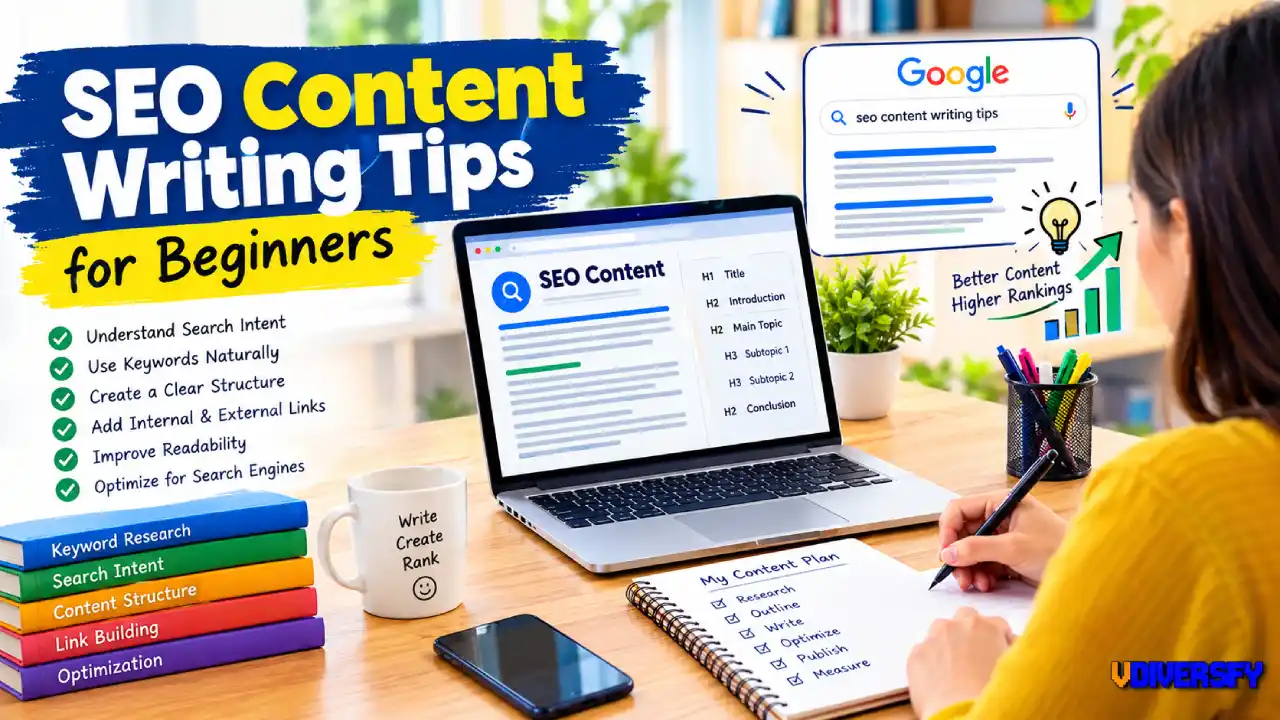
If you are new to blogging or website content, learning seo content writing tips for beginners can help you understand how to create articles that are useful to readers while also making it easier for search engines to understand your pages.
The biggest mistake beginners make is thinking SEO writing means repeating a keyword again and again. Modern SEO is much broader: you need to understand what people are searching for, why they are searching, what information they expect, and how to present a genuinely useful answer in a clear format.
Search has also changed significantly. Google now places strong emphasis on helpful, reliable, people-first content, and its guidance specifically warns against producing content primarily to attract search-engine traffic. Google also says there is no preferred word count, so writing 3,000 or 5,000+ words simply because someone claims that longer articles rank better is not a sound strategy.
This guide will take you from the basics to a practical writing process. You will learn how to choose a topic, understand search intent, plan an article, use keywords naturally, structure headings, write useful introductions, improve readability, add examples, build internal links, demonstrate experience, and prepare content for modern search experiences such as AI Overviews and other generative search features.
Contents
- 1 What Is SEO Content Writing?
- 2 Why SEO Content Writing Matters
- 3 The First Rule: Write for People First
- 4 Understand Search Intent Before You Write
- 5 How to Identify Search Intent Manually
- 6 Build an SEO Content Brief Before Writing
- 7 Create a Clear Content Structure
- 8 Use Keywords as Topics, Not Targets to Repeat
- 9 Keyword Integration Should Feel Natural
- 10 Write a Strong Introduction
- 11 Answer the Main Question Early
- 12 Content Quality Is More Than Word Count
- 13 Add Experience Instead of Rewriting What Everyone Else Says
- 14 Do Not Copy the Top-Ranking Articles
- 15 Think in Topics and Questions, Not Just Keywords
- 16 What Modern Google Guidance Means for Beginners
- 17 A Simple Beginner Workflow
- 18 How to Create an SEO-Friendly Article Outline
- 19 Write Headings That Tell Readers What They Will Learn
- 20 Create Short, Useful Paragraphs
- 21 Use the Inverted Pyramid for Important Answers
- 22 Learn the Difference Between Keyword Relevance and Keyword Stuffing
- 23 Use Primary and Supporting Terms Naturally
- 24 Make Search Intent the Backbone of the Article
- 25 Use Real Examples to Explain Abstract Concepts
- 26 Write Better SEO Titles
- 27 Write Meta Descriptions for Humans
- 28 Use Internal Links Strategically
- 29 Add External Links Where They Strengthen the Article
- 30 Use Images to Explain Difficult Concepts
- 31 Write Useful Image Alt Text
- 32 Make Your Content Easy to Scan
- 33 Write for Readers and Search Engines at the Same Time
- 34 Understand E-E-A-T
- 35 Be Careful With Health, Finance, and Other High-Stakes Topics
- 36 Use Statistics Carefully
- 37 Create Content That Can Answer Specific Questions
- 38 Prepare Content for AI Overviews and Generative Search
- 39 What GEO and LLM SEO Really Mean
- 40 Make Claims Specific
- 41 Avoid Unnecessary Filler
- 42 Use AI Carefully When Creating Content
- 43 Build Originality Into Every Article
- 44 Create a Strong Content Editing Process
- 45 Create a “Reader Satisfaction” Test
- 46 Use Content Refreshes Instead of Constantly Publishing New Pages
- 47 Avoid Creating Multiple Pages for Nearly the Same Search
- 48 Use a Content Cluster When the Topic Is Broad
- 49 Check Your Article Against the Search Results
- 50 A Practical SEO Content Writing Checklist
- 51 The Biggest SEO Content Writing Mistakes Beginners Should Avoid
- 52 A Simple Formula for Better SEO Content
- 53 Key Takeaways So For
- 54 How to Optimize an Article Before Publishing
- 55 Optimize the URL Carefully
- 56 Optimize Images Without Making Them a Problem
- 57 Improve Page Experience
- 58 Add a Clear Next Step
- 59 How to Make Content Better for Featured Snippets
- 60 Use Question-Based Sections Carefully
- 61 Build Self-Contained Answers
- 62 Use AEO as a Content Clarity Exercise
- 63 How to Approach GEO and LLM SEO
- 64 Make Important Facts Easy to Verify
- 65 Build a Source Hierarchy
- 66 Measure Content Performance After Publishing
- 67 Understand Impressions, Clicks, and CTR
- 68 Look at the Queries Your Page Already Ranks For
- 69 Improve Content Based on Evidence
- 70 Know When to Update an Article
- 71 Know When to Merge Content
- 72 Know When to Remove Content
- 73 Build a Content Refresh Schedule
- 74 Create a Topic Map Before Publishing Many Articles
- 75 Build Internal Authority Through Useful Content Relationships
- 76 Create a Content Production System
- 77 A 30-Day SEO Content Writing Plan for Beginners
- 78 A Practical Example: Turning a Weak Article Into Better SEO Content
- 79 How to Decide Whether a Topic Is Worth Writing
- 80 The Complete SEO Content Writing Checklist
- 81 SEO Content Writing Myths Beginners Should Stop Believing
- 82 Frequently Asked Questions About SEO Content Writing
- 83 The Most Important SEO Content Writing Principles to Remember
- 84 Final Conclusion: Write Content People Are Glad They Found
What Is SEO Content Writing?
SEO content writing is the process of creating useful online content that satisfies a reader’s needs while making the topic clear to search engines.
The content could be:
- A blog post
- A how-to guide
- A product page
- A comparison article
- A service page
- A category page
- A tutorial
- A case study
- An FAQ
- A glossary
- An original research article
The important point is that SEO writing is not simply keyword placement.
A good SEO article answers the reader’s question better than many competing pages, presents information in an easy-to-follow way, and gives search engines enough context to understand what the page is about.
Ahrefs describes SEO content in a similar way: content should be created around topics people search for while giving searchers what they want and adding useful expertise or unique insights where possible.
SEO Writing vs. Normal Content Writing
Consider two articles about starting a vegetable garden.
A normal article might explain the writer’s personal experience growing vegetables.
An SEO-focused article could still include that experience, but it might also answer questions such as:
- How do beginners start a vegetable garden?
- What vegetables are easiest to grow?
- How much sunlight is required?
- What soil should beginners use?
- How often should vegetables be watered?
- What mistakes should beginners avoid?
The second approach is more closely aligned with search intent content writing because it considers the questions and problems behind the search.
The best approach, however, is not to remove personality from the article. Instead, combine useful search coverage with genuine experience and original explanations.
Why SEO Content Writing Matters
Millions of websites publish content, but publishing an article does not guarantee that people will discover it.
Search engines need to determine:
- What the page is about.
- Which questions it answers.
- Whether it appears relevant to the search.
- Whether the information appears useful and trustworthy.
- Whether the page provides a satisfactory experience.
Google’s current guidance says its automated ranking systems are designed to prioritize helpful, reliable information created for people rather than content created primarily to manipulate rankings.
This changes how beginners should approach SEO.
Instead of asking:
“How many times should I use my keyword?”
Ask:
“What does someone searching for this topic actually need to know?”
That single change can improve your entire writing process.
A Simple Example
Suppose you want to write about how to choose running shoes.
A weak SEO article might repeat:
Best running shoes are important because choosing the best running shoes requires finding the best running shoes…
This is unnatural and provides little value.
A stronger article could explain:
- Foot type
- Running surface
- Cushioning
- Shoe size
- Running distance
- Injury considerations
- Shoe lifespan
- Differences between road and trail shoes
It might naturally mention related terms such as running shoes, cushioning, heel drop, trail running, road running, and fit.
That is natural keyword usage.
The First Rule: Write for People First
One of the most important lessons beginners should understand is that SEO should not become the reason an article exists.
Google’s people-first content guidance asks creators to consider whether their content is genuinely useful to an existing or intended audience, demonstrates appropriate knowledge or experience, leaves readers feeling that they learned enough to accomplish their goal, and provides a satisfying experience.
This means your first question should be:
Who is this article helping?
Then ask:
What problem are they trying to solve?
Finally:
What would make them satisfied after reading it?
These questions create a much stronger foundation than starting with keyword density.
The “Would I Publish This Anyway?” Test
Here is a useful test for beginners.
Imagine Google did not exist.
Would you still publish the article because your audience needs it?
If the answer is yes, you probably have a strong starting point.
If the only reason for creating the article is that a keyword appears to have search volume, stop and reconsider the topic.
Google specifically warns against creating lots of content on unrelated topics simply because you believe some of it might attract search traffic.
Understand Search Intent Before You Write
Search intent means the reason behind a search query.
Someone searching for:
“What is technical SEO?”
probably wants an explanation.
Someone searching for:
“How to fix technical SEO errors”
probably wants a practical guide.
Someone searching for:
“Best SEO tools for small businesses”
may want a comparison or recommendation.
Someone searching for:
“Ahrefs pricing”
is likely looking for pricing information rather than a general explanation of SEO.
Understanding this difference is one of the most important SEO copywriting basics.
Four Common Types of Search Intent
1. Informational Intent
The searcher wants information.
Examples:
- What is SEO?
- How does Google Search work?
- What is a meta description?
- How do backlinks work?
These searches generally need educational content.
2. Navigational Intent
The searcher wants to reach a specific website, brand, or page.
Examples:
- Google Search Console
- Ahrefs blog
- LinkedIn login
- YouTube
Trying to turn every navigational search into a long informational article usually makes little sense.
3. Commercial Investigation
The searcher is researching before making a decision.
Examples:
- Best SEO tools
- Ahrefs vs Semrush
- Best website hosting for bloggers
- Best email marketing software
Comparison tables, pros and cons, examples, testing information, and clear recommendations can work well here.
4. Transactional Intent
The searcher is ready to take an action.
Examples:
- Buy running shoes
- SEO software pricing
- WordPress hosting plans
- Hire SEO consultant
These searches often require product, service, pricing, or conversion-focused pages rather than general blog posts.
How to Identify Search Intent Manually
You do not always need expensive software to understand intent.
Search your target topic on Google and examine the results.
Look at the top-ranking pages and ask:
What type of content dominates?
Is Google showing:
- Blog posts?
- Product pages?
- Videos?
- Category pages?
- Guides?
- Comparisons?
- Local businesses?
What format dominates?
Are the results mostly:
- Step-by-step guides?
- Lists?
- Reviews?
- Tutorials?
- Definitions?
- Case studies?
What angle dominates?
For example, results may focus on:
- Beginners
- Low-cost solutions
- Small businesses
- Advanced users
- Latest information
- Comparisons
- Specific industries
Ahrefs refers to these three elements as the three Cs of search intent: content type, content format, and content angle.
Do not blindly copy the top results.
Instead, use them to understand what searchers appear to expect, then find a way to make your article more useful, clearer, more complete, or more original.
Build an SEO Content Brief Before Writing
A common beginner mistake is opening Google Docs and immediately starting to write.
That often leads to:
- Repeated ideas
- Missing sections
- Weak introductions
- Poor topic coverage
- Unclear headings
- Random keyword placement
- Excessive editing later
A simple SEO content brief can prevent many of these problems.
Your brief can contain:
Element | What to define |
Main topic | What the page is about |
Target reader | Who the article is written for |
Primary query | Main search topic |
Search intent | Why people search |
Content type | Guide, list, comparison, etc. |
Main questions | Questions the article must answer |
Supporting topics | Closely related subjects |
Examples | Real situations to explain concepts |
Internal links | Relevant pages on your website |
External references | Trusted supporting sources |
CTA | Useful next step for the reader |
A brief does not need to be complicated.
Even a one-page outline can dramatically improve your writing process.
Create a Clear Content Structure
Good content structure for SEO helps both readers and search engines understand the page.
A typical beginner-friendly article structure could look like this:
H1: Main article topic
Introduction
H2: What Is the Topic?
H2: Why Does It Matter?
H2: How to Get Started
H3: Step One
H3: Step Two
H3: Step Three
H2: Common Mistakes
H2: Practical Examples
H2: Checklist
H2: Frequently Asked Questions
Conclusion
The exact structure should depend on the topic.
Do not force every article into the same template.
A product comparison needs a different structure from a technical tutorial. A recipe needs a different structure from a long-form SEO guide.
The goal is logical organization, not a fixed formula.
Use Keywords as Topics, Not Targets to Repeat
Keywords still matter because they help you understand what people are searching for.
But modern SEO is not about inserting the same phrase repeatedly.
Think about keywords in groups.
For example, if your main topic is email marketing, related concepts could include:
- Email campaigns
- Email subscribers
- Email list
- Open rate
- Click-through rate
- Newsletter
- Email automation
- Subject lines
- Conversion rate
- Segmentation
These terms help explain the subject naturally.
This is where semantic SEO writing becomes useful.
Instead of trying to mention one keyword 20 times, cover the subject properly.
What About LSI Keywords?
You may see the phrase LSI keywords writing in older SEO tutorials.
Be careful with the concept.
Beginners sometimes interpret “LSI keywords” as a list of words that must be inserted into an article to make Google rank it.
That is not a reliable approach.
Instead, focus on closely related concepts and terminology that naturally belong to the topic.
For example, an article about home workouts may naturally discuss:
- Warm-up
- Strength training
- Cardio
- Repetitions
- Sets
- Recovery
- Exercise form
- Equipment
You do not need to force these words into every section.
Use them when they help the reader understand the subject.
Keyword Integration Should Feel Natural
Keyword integration writing means incorporating important search terms where they make sense without damaging readability.
Imagine you are writing:
“A good SEO title should clearly tell readers what the page is about.”
If your target concept is SEO titles, that sentence already communicates the subject.
You do not need to rewrite it as:
“SEO title SEO content SEO writing SEO title optimization helps SEO titles…”
That would make the page unpleasant to read.
Good Keyword Placement
Important terms can naturally appear in:
- The page title
- The introduction
- Relevant headings
- Body text
- Image alt text when descriptive
- Internal-link anchor text when appropriate
- Meta description where useful
- URLs where appropriate
But do not treat these locations as boxes that must all contain the exact same keyword.
Google’s guidance emphasizes helpful content rather than keyword repetition, and its documentation specifically cautions against writing primarily for search engines.
Write a Strong Introduction
Your introduction has one main job:
Convince the right reader to continue.
A useful introduction usually does four things:
- Identifies the problem.
- Shows why it matters.
- Establishes what the reader will learn.
- Moves quickly into the solution.
Avoid starting with generic statements such as:
“In today’s digital world, SEO is very important.”
That sentence does not tell the reader much.
Instead, be specific.
For example:
Many beginners believe SEO writing means repeating a target keyword throughout an article. In reality, effective SEO writing starts much earlier—with understanding the reader, matching search intent, planning the topic, and explaining the answer clearly. Once you understand this process, you can create content that is useful to people and easier for search engines to interpret.
This immediately addresses a common misconception.
Answer the Main Question Early
Do not make readers scroll through 800 words before they receive the basic answer.
If someone searches:
“What is internal linking?”
answer it near the beginning.
Then expand.
This is particularly useful for modern search experiences because concise, directly stated answers are easier for systems and readers to understand.
A good pattern is:
Direct answer → explanation → example → deeper detail
For example:
Internal linking is the practice of linking one page on your website to another page on the same website. It helps readers discover related information and helps search engines understand relationships between pages.
Then explain how to use internal links effectively.
This approach supports writing for readers and search engines without turning the article into robotic copy.
Content Quality Is More Than Word Count
One of the most damaging myths for beginners is:
“Longer articles automatically rank higher.”
They do not.
Google explicitly states that it does not have a preferred word count.
A 900-word article that completely solves a problem can be more useful than a 4,000-word article that repeats the same points.
Think about content quality SEO in terms of usefulness.
Ask:
- Is the information accurate?
- Is it complete enough for the query?
- Does it answer the important questions?
- Does it provide useful examples?
- Does it add original information?
- Is it easy to understand?
- Does it demonstrate appropriate experience?
- Does it avoid unnecessary repetition?
Google’s current guidance specifically encourages creators to consider original information, substantial coverage, accuracy, effort, and whether the content provides a satisfying experience.
Add Experience Instead of Rewriting What Everyone Else Says
One of the easiest ways to make beginner content stronger is to add something you actually know.
Suppose ten websites explain:
“Compress images to improve website performance.”
That statement is useful but generic.
A stronger article might explain:
“Before uploading a 3,000 × 2,000-pixel product image, resize it to the dimensions your website actually displays. Then compress the file and compare the visual quality before publishing.”
Now the reader has a practical process.
Experience can appear through:
- Screenshots
- Original examples
- Tests
- Before-and-after comparisons
- Personal observations
- Original research
- Case studies
- Calculations
- Demonstrations
- Specific workflows
Google’s guidance encourages clear evidence of experience and says creators should make it clear who created content and, where appropriate, provide accurate bylines and author information.
Do Not Copy the Top-Ranking Articles
Researching competing pages is useful.
Copying them is not.
When analyzing competing content, look for gaps.
For example, suppose five ranking pages explain:
- What SEO writing is
- Keyword research
- Search intent
- Meta descriptions
But none explain how to edit an article after the first draft.
That could become your opportunity.
You could add:
- A self-editing checklist
- Examples of weak versus strong paragraphs
- A readability review process
- Internal-link checks
- Fact-checking steps
- A final SEO review
This is how you move from simply covering a topic to adding value to the topic.
Think in Topics and Questions, Not Just Keywords
A beginner may start with:
“What keywords should I put in this article?”
A better question is:
“What questions should this article answer?”
For example, an article about starting a blog may need to answer:
- What is a blog?
- How do you choose a niche?
- What platform should you use?
- How do you choose a domain?
- How do you publish your first article?
- How do you find topics?
- How does SEO fit into blogging?
- How do you promote the content?
- How long does it take to get traffic?
- What mistakes should beginners avoid?
Now you have the foundation of a genuinely useful resource.
The keywords become a by-product of covering the topic properly rather than the entire purpose of the article.
What Modern Google Guidance Means for Beginners
Google’s current guidance can be reduced to a simple principle:
Create content because it helps people, then use SEO to make that content discoverable and understandable.
Google says SEO itself is not the problem. SEO can be useful when it is applied to people-first content rather than search-engine-first content.
That distinction is important.
You can:
- Research keywords.
- Study search results.
- Improve titles.
- Create descriptive headings.
- Add internal links.
- Optimize images.
- Improve page structure.
- Use structured data where appropriate.
- Make content easier to crawl and understand.
None of that means you are writing only for algorithms.
The problem begins when ranking becomes more important than helping the reader.
A Simple Beginner Workflow
Before moving into the more advanced writing techniques covered next, remember this basic workflow:
Research → Understand intent → Plan → Write → Improve → Optimize → Review → Publish → Measure
Each stage has a different purpose.
Research
Find out what your audience needs.
Understand Intent
Determine what searchers actually expect.
Plan
Create an outline and decide what the article must cover.
Write
Explain the subject naturally.
Improve
Add examples, experience, evidence, and missing information.
Optimize
Improve titles, headings, links, images, and other relevant on-page elements.
Review
Check accuracy, clarity, usefulness, grammar, and search intent.
Publish
Make the page available and ensure it can be discovered.
Measure
Use performance data to identify what can be improved over time.
That process is much more reliable than publishing dozens of thin articles and hoping one ranks.
How to Create an SEO-Friendly Article Outline
Once you understand the topic and search intent, the next step is creating an outline.
A good outline gives your article direction before you start writing. It also helps prevent a common problem among beginners: covering the same point several times while accidentally missing an important question.
Start with the main question your article needs to answer. Then list the supporting questions a reader is likely to have.
For example, if you are writing about how to start a blog, your outline might include:
- What is a blog?
- How do you choose a blogging topic?
- How do you choose a domain?
- Which platform should you use?
- How do you create your first article?
- How does SEO help a blog?
- How do you get your first visitors?
- What mistakes should beginners avoid?
This creates a natural progression.
Use a Logical Information Flow
A strong article usually moves from simple concepts to more detailed ones.
A useful pattern is:
Problem → Explanation → Process → Example → Mistakes → Advanced tips → Checklist
For example, an article about technical SEO could begin by explaining what technical SEO means, then explain why it matters, followed by specific problems and their solutions.
Do not begin with the most complicated technical details unless the audience specifically expects advanced information.
Your structure should match your reader’s knowledge level.
Write Headings That Tell Readers What They Will Learn
Headings are not merely places to insert keywords.
They act as signposts.
A reader should be able to scan your H2 and H3 headings and understand the article’s main points without reading every paragraph.
Compare these examples:
Weak:
Things You Need to Know
Better:
How to Choose the Right Keyword for a Blog Post
The second heading tells the reader exactly what the section will explain.
Keep Your Heading Hierarchy Consistent
Use:
- One H1 for the article title.
- H2 headings for major sections.
- H3 headings for subsections under an H2.
- H4 headings only when additional structure is genuinely necessary.
Do not use heading tags simply to make text larger or bold.
Headings should represent the structure of the information.
For example:
H1: SEO Content Writing Tips for Complete Beginners
H2: How SEO Content Writing Works
H3: Understand Search Intent
H3: Research the Topic
H3: Create the Outline
H2: How to Optimize the Article
H3: Improve the Title
H3: Add Internal Links
This creates a clean hierarchy.
Create Short, Useful Paragraphs
Online readers rarely read every word from beginning to end.
They scan.
That means large walls of text can make even excellent information feel difficult.
A better approach is to mix:
- Short paragraphs
- Medium-length explanations
- Bullet points
- Tables
- Examples
- Bold emphasis
- Descriptive headings
For example, instead of writing one 250-word paragraph about keyword research, break the idea into smaller sections.
This makes your article easier to consume on both desktop and mobile devices.
However, do not turn every sentence into a separate paragraph.
Your goal is natural readability, not artificial formatting.
Use the Inverted Pyramid for Important Answers
A useful writing technique for SEO articles is to provide the most important information first and then explain it in greater detail.
For example:
Internal links connect one page of your website to another page on the same website. They help visitors discover related content and help search engines understand how pages within your site are connected.
Then explain:
- Where internal links should be added.
- How to choose anchor text.
- Which pages should receive links.
- How to identify orphan pages.
- How internal links support site navigation.
This approach is especially useful when readers want a quick answer.
It also creates content that can be easier for search systems to understand because the answer is clearly stated rather than hidden deep inside the article.
Learn the Difference Between Keyword Relevance and Keyword Stuffing
A keyword is relevant when it naturally describes what you are discussing.
Keyword stuffing happens when a writer repeatedly inserts keywords in ways that make the content unnatural.
For example:
SEO content writing requires SEO content writing skills because SEO content writing helps with SEO content writing and SEO content writing strategies.
That is obviously poor writing.
A natural version could be:
Effective SEO writing combines search intent, useful information, clear structure, and natural language. The goal is to help readers understand the topic while giving search engines enough context to interpret the page.
The second version communicates the subject without repeatedly forcing the same phrase.
Google’s spam policies specifically identify keyword stuffing as a form of spam, including excessive repetition that makes content sound unnatural. (developers.google.com)
Use Primary and Supporting Terms Naturally
Your article will normally have one main topic.
Around that topic are supporting concepts.
For example, imagine the primary topic is:
Local SEO for small businesses
Related concepts could include:
- Google Business Profile
- Local search
- Reviews
- Local citations
- NAP information
- Local landing pages
- Maps
- Local keywords
- Customer reviews
You do not need to create a sentence containing every term.
Instead, introduce each concept where it helps the reader.
This is a practical form of natural keyword usage.
Think About Topic Coverage
Imagine you are explaining a subject to a friend.
You would naturally use different words as the conversation develops.
If you were explaining photography, you would probably mention:
- Camera
- Lens
- Exposure
- Aperture
- Shutter speed
- ISO
- Focus
You would not repeat “photography” in every sentence.
SEO content should work the same way.
Make Search Intent the Backbone of the Article
A page can be perfectly optimized technically and still fail if it does not satisfy the reason behind the search.
Consider the query:
“best laptops for college students”
A definition of laptops would not satisfy that search.
The reader probably expects:
- Recommended models
- Prices or price ranges
- Battery life
- Weight
- Performance
- Pros and cons
- Suitability for different subjects
- Buying advice
The content should therefore reflect the decision the reader is trying to make.
This is the practical side of search intent content writing.
Search Intent Can Change Over Time
Search intent is not permanently fixed.
A query can become more specific as people’s needs change.
For example, someone searching for:
“best project management software”
may want a broad list.
But a related query:
“best project management software for remote teams”
has a more specific need.
When updating content, check whether the search results and user expectations have changed.
Use Real Examples to Explain Abstract Concepts
Examples make SEO content easier to understand.
Suppose you are explaining search intent.
Instead of writing only:
Search intent refers to the reason behind a search.
Add:
Someone searching “how to bake sourdough bread” probably wants instructions. Someone searching “buy sourdough starter” is closer to making a purchase. Although both searches involve sourdough, their needs are different.
This gives the reader something concrete to remember.
Use Before-and-After Examples
Before-and-after examples are especially useful for SEO education.
Weak title:
SEO Tips
Stronger title:
15 SEO Tips for Beginners to Improve a New Website
The second title gives the reader more information about the page.
Another example:
Weak heading:
Keyword Research
Better heading:
How to Find Keywords Your Audience Actually Searches For
The second heading is more specific and reader-focused.
Write Better SEO Titles
The title is one of the first things users see in search results.
A good title should:
- Clearly describe the page.
- Match the searcher’s intent.
- Be specific.
- Set an accurate expectation.
- Encourage the right reader to click.
Avoid exaggerated titles that promise something the article does not deliver.
For example:
10 SEO Tips That Will Guarantee #1 Rankings Overnight
This creates an unrealistic expectation.
A more trustworthy title would be:
10 Practical SEO Tips for Improving Your Website’s Search Visibility
The second title makes a useful promise without claiming something you cannot guarantee.
Google recommends creating descriptive, concise, relevant titles and avoiding keyword stuffing in title elements. (developers.google.com)
Write Meta Descriptions for Humans
A meta description is a short summary that can appear below the title in search results.
Google may use the page’s meta description to create a search snippet, although Google can also generate the snippet from the page content when it believes another section better matches the query. (developers.google.com)
A useful description should explain:
- What the page covers.
- Who it helps.
- What the reader can expect.
For example:
Learn how beginners can create useful SEO content with practical guidance on search intent, keyword usage, article structure, internal links, optimization, and content quality.
Do not write:
SEO SEO SEO tips, SEO writing, SEO content, SEO article, best SEO writing.
That provides little value and looks unnatural.
Use Internal Links Strategically
Internal links connect pages on your own website.
They can help visitors discover related information and can help search engines understand the relationship between pages.
Suppose your website has these articles:
- How to Do Keyword Research
- On-Page SEO Checklist
- Internal Linking Strategy
- How to Write SEO Content
- Google Search Console Guide
An article about SEO writing could naturally link to the keyword research guide when discussing topic research.
It could link to the on-page SEO checklist when discussing optimization.
The links should make sense in context.
Avoid Random Internal Linking
Do not add ten internal links to every paragraph just because you have pages available.
Ask:
Would this link genuinely help the reader at this point?
If the answer is no, leave it out.
Use Descriptive Anchor Text
Instead of:
Click here
try:
learn how to conduct keyword research
The anchor text gives readers more context.
It also creates a clearer relationship between the linked pages.
Add External Links Where They Strengthen the Article
External links are useful when they help readers verify information or explore an authoritative source.
For SEO-related content, good references may include:
- Google Search Central
- Google Search Console documentation
- Google Analytics documentation
- Government websites
- Academic research
- Original studies
- Established industry publications
- First-party product documentation
For example, when explaining Google’s people-first content principles, link to Google’s official documentation rather than relying on an anonymous SEO blog.
Google itself recommends linking to high-quality sources when appropriate and creating content that demonstrates expertise and trustworthiness. (developers.google.com)
Do Not Add Links Just to Look Authoritative
Five useful external references are better than twenty unrelated links.
Every link should have a reason.
Ask:
Does this source help the reader verify, understand, or explore this claim?
If yes, include it.
If not, remove it.
Use Images to Explain Difficult Concepts
Images are not required in every paragraph.
But they can be extremely useful when showing something is easier than explaining it with text.
Useful images include:
- Screenshots
- Diagrams
- Charts
- Before-and-after examples
- Process illustrations
- Product photographs
- Original research charts
- Annotated examples
For a Google Search Console tutorial, for example, a screenshot showing where a report is located can be more useful than several paragraphs describing the interface.
Use Original Images When Possible
If you are explaining your own process, original screenshots can add much more value than generic stock photography.
For example, a website designer writing about Core Web Vitals could show an actual PageSpeed Insights result and explain what the numbers mean.
That provides evidence of practical experience.
Write Useful Image Alt Text
Alt text helps describe an image when it cannot be seen and can also provide context for accessibility tools.
Good alt text describes the actual image.
For example:
Google Search Console Performance report showing clicks, impressions, CTR, and average position
Poor alt text would be:
SEO SEO SEO Google Search Console best SEO tips
Do not turn alt text into a place for keyword stuffing.
The description should match the image.
Google’s image SEO documentation recommends descriptive alt text and explains that alt text provides information about the image when it cannot be viewed. (developers.google.com)
Make Your Content Easy to Scan
A reader should be able to quickly find the section they need.
Useful formatting techniques include:
Bold important ideas when emphasis helps.
Use bullet points for lists.
Use numbered steps for processes.
Use tables for comparisons.
Use examples after difficult concepts.
Use short subheadings to break up long sections.
For example:
SEO Element | Beginner Goal |
Title | Clearly describe the page |
Introduction | Address the reader’s problem |
Headings | Organize the topic |
Keywords | Use naturally |
Internal links | Connect related pages |
Images | Explain where useful |
Sources | Support important claims |
CTA | Give the reader a useful next step |
Tables should simplify information rather than simply make the page look more “SEO optimized.”
Write for Readers and Search Engines at the Same Time
Writing for readers and search engines does not mean writing two separate versions of the article.
You write one useful article.
The reader needs:
- Clear explanations
- Useful examples
- Easy navigation
- Accurate information
- Answers to questions
Search engines need to understand:
- The subject
- Page structure
- Relationships between concepts
- Relevant entities and terminology
- Links between pages
- Page purpose
Good writing can satisfy both.
For example, a clear H2 such as:
How to Create an SEO Content Brief
helps the reader immediately understand the section and also gives search engines a clear structural signal about its subject.
Understand E-E-A-T
Google’s quality guidance discusses Experience, Expertise, Authoritativeness, and Trustworthiness, commonly abbreviated as E-E-A-T.
It is important to understand what E-E-A-T does and does not mean.
Google says E-E-A-T is part of how its Search Quality Rater Guidelines help human evaluators assess content quality. It is not a simple ranking factor where you can “add E-E-A-T” to a page and receive a score. (developers.google.com)
Experience
Have you actually used, tested, visited, created, or experienced what you are discussing?
For example, a person reviewing website builders could explain what happened while creating an actual website.
Expertise
Does the author have appropriate knowledge about the subject?
A technical article should ideally be written or reviewed by someone who understands the technical subject.
Authoritativeness
Does the website or author have a credible reputation in the topic?
Relevant experience, references, original research, and recognition can help establish this.
Trustworthiness
Can readers trust the information?
This includes:
- Accuracy
- Transparent authorship
- Reliable sources
- Clear business information
- Secure transactions
- Honest claims
- Appropriate disclosure
For many websites, trust is the most important part.
Be Careful With Health, Finance, and Other High-Stakes Topics
Some topics can significantly affect a person’s health, money, safety, or legal situation.
These require a higher standard of care.
For example, an article about:
- Medical treatment
- Investing
- Personal finance
- Legal rights
- Tax decisions
- Safety procedures
should not rely on casual opinions.
Use reliable primary or professional sources, keep information current, explain limitations, and consider qualified review where appropriate.
For these topics, publishing a confident but incorrect answer can cause real harm.
Use Statistics Carefully
Statistics can make content more useful, but only when they are relevant and trustworthy.
For example:
According to Google’s documentation, Google does not have a preferred word count for pages. This means a 5,000-word article is not automatically better than a 1,000-word article simply because it is longer. (developers.google.com)
This is useful because it directly addresses a common SEO myth.
When using statistics:
- Identify the source.
- Check the publication date.
- Confirm what was actually measured.
- Do not remove important context.
- Avoid using outdated statistics simply because they look impressive.
A statistic should help explain something, not decorate the paragraph.
Create Content That Can Answer Specific Questions
Modern search increasingly provides direct answers within the search experience.
This means your content should contain clear answers to important questions rather than hiding every answer inside vague introductions.
For example:
What Is an SEO Content Brief?
An SEO content brief is a planning document that defines what an article should cover, who it is intended for, what search intent it should satisfy, which important questions should be answered, and what supporting information or resources may be useful.
That answer is immediately understandable.
Then the article can explain the concept in greater depth.
This format can support Answer Engine Optimization (AEO) because the content contains direct, self-contained answers.
Prepare Content for AI Overviews and Generative Search
Search is no longer limited to ten traditional blue links.
Google has introduced AI Overviews in Search, and other search products are also using generative systems to summarize information and help users explore topics.
That does not mean you should write strange content specifically for AI systems.
The fundamentals remain useful:
- Answer questions clearly.
- Use accurate information.
- Demonstrate first-hand experience where appropriate.
- Cite trustworthy sources.
- Organize information logically.
- Make important claims understandable.
- Cover the topic completely enough for the intended query.
Google says there is no special markup or secret optimization required to appear in AI Overviews or AI Mode. Its guidance instead points creators toward foundational SEO practices and helpful, reliable, people-first content. (developers.google.com)
Make Individual Sections Understandable on Their Own
This is an increasingly useful writing habit.
Suppose an AI system retrieves one section from your article.
That section should still make sense.
Instead of:
This is important because of the reasons mentioned above.
Write:
Internal links are important because they help users discover related pages and help search engines understand relationships between pages on the same website.
The second sentence can stand alone.
This is useful for readers too.
What GEO and LLM SEO Really Mean
You may hear terms such as:
- GEO
- LLM SEO
- AI SEO
- Generative Engine Optimization
- Answer Engine Optimization
These describe efforts to make information easier for AI-powered systems and answer engines to understand, retrieve, and cite.
But do not treat them as a completely separate replacement for SEO.
Strong fundamentals still matter.
A useful approach is:
Clear topic + strong evidence + direct answers + original information + logical structure + trustworthy sources
That creates content that can serve traditional search users as well as users interacting with AI-powered search experiences.
Make Claims Specific
Compare these two sentences:
SEO is extremely important for every business.
and:
Organic search can help businesses reach people who are actively looking for information, products, or services related to their needs.
The second statement is more precise.
It avoids making an absolute claim.
Strong SEO writing usually avoids phrases such as:
- Guaranteed
- Always
- Never
- #1
- Instant rankings
- Guaranteed traffic
- Secret Google trick
Unless you have very strong evidence for the claim, these phrases can reduce trust.
Avoid Unnecessary Filler
Beginners sometimes believe an article needs to be long, so they add sentences that do not contribute anything.
For example:
SEO is important. It is very important for websites. Websites need SEO because SEO helps websites. Therefore, SEO is something websites should consider.
This could be reduced to:
SEO helps search engines understand and discover useful website content.
The shorter version communicates more.
However, cutting words should not mean cutting useful explanations.
If an example helps the reader understand a difficult concept, keep it.
The goal is not short content.
The goal is useful content without unnecessary padding.
Use AI Carefully When Creating Content
AI tools can assist with brainstorming, outlining, summarizing research, or improving a rough draft.
But automatically generating large amounts of pages and publishing them without meaningful review is risky.
Google’s spam policies specifically address scaled content abuse, including situations where many pages are generated primarily to manipulate search rankings rather than provide value. The issue is the abuse of scaled production, not simply the existence of AI-assisted writing. (developers.google.com)
If you use AI during your workflow, add human value.
For example:
AI can help you:
- Brainstorm questions.
- Create an initial outline.
- Find gaps to investigate.
- Suggest alternative explanations.
- Organize notes.
You should still:
- Verify facts.
- Add real experience.
- Check sources.
- Rewrite unnatural passages.
- Add original examples.
- Review search intent.
- Remove unsupported claims.
- Ensure the final article is genuinely useful.
The final result should not feel like a collection of generic statements.
Build Originality Into Every Article
Originality does not necessarily mean inventing a completely new topic.
You can make a common topic original by adding something competitors do not have.
For example:
Original Testing
Test three website builders and report the results.
Original Data
Survey 100 small business owners.
Original Screenshots
Show your actual workflow.
Original Examples
Use real scenarios from your own work.
Original Framework
Create your own step-by-step process.
Original Case Study
Show what happened before and after a change.
These additions can make an article much more valuable than a generic rewrite of existing information.
Create a Strong Content Editing Process
Do not publish immediately after finishing your first draft.
Editing is where good content often becomes excellent content.
A useful editing process can happen in several passes.
Pass 1: Accuracy
Check:
- Facts
- Statistics
- Dates
- Product details
- Links
- Technical claims
Pass 2: Search Intent
Ask:
Does this article actually satisfy the reason someone searched for this topic?
Pass 3: Clarity
Look for:
- Long sentences
- Vague explanations
- Repeated ideas
- Unnecessary jargon
- Unsupported claims
Pass 4: Structure
Check:
- H1
- H2s
- H3s
- Paragraph flow
- Lists
- Tables
- Examples
Pass 5: SEO
Check:
- Title
- URL
- Relevant terminology
- Internal links
- External references
- Image descriptions
- Meta description
Pass 6: Human Review
Finally, read the article as if you were the target reader.
Ask:
If I knew nothing about this subject, would I understand it?
That final question catches many problems.
Create a “Reader Satisfaction” Test
Before publishing, imagine that your article is the only result the reader will read.
Could they accomplish what they wanted?
For example, if your article promises:
How to Set Up Google Search Console
the reader should not finish the article still wondering:
- Where do I start?
- How do I verify the website?
- What verification methods exist?
- Where do I submit the sitemap?
- How do I check indexing?
- What should I do after setup?
The article should take the reader from question to action.
That is one of the simplest ways to think about content quality.
Use Content Refreshes Instead of Constantly Publishing New Pages
SEO is not always about creating something new.
Sometimes an existing article has more potential.
Look for pages that:
- Have declining traffic.
- Contain outdated information.
- Have old screenshots.
- Reference discontinued products.
- Miss newer questions.
- Have weak internal links.
- No longer match search intent.
Updating them may be more valuable than publishing another similar article.
For example, an article published in 2022 about Google Search Console may contain outdated interface instructions.
Instead of writing another article about the same subject, update the original page with:
- Current screenshots
- Current terminology
- Updated processes
- New examples
- Better internal links
- New official references
This also helps prevent a website from accumulating multiple pages competing for nearly identical topics.
Avoid Creating Multiple Pages for Nearly the Same Search
Beginners sometimes create:
- SEO Writing Tips
- SEO Content Writing Tips
- SEO Writing Techniques
- SEO Content Writing Techniques
- SEO Article Writing Tips
- SEO Blog Writing Tips
If all six pages answer essentially the same question, the website may end up with unnecessary duplication and a confusing content structure.
Instead, consider whether one strong resource could cover the topic comprehensively.
Then create separate pages only when the search intent is genuinely different.
For example:
SEO Content Writing Tips
could cover writing principles.
SEO Copywriting for Product Pages
could target a distinct commercial purpose.
The difference should be based on user needs, not merely different keyword variations.
Use a Content Cluster When the Topic Is Broad
Large topics can be divided into connected resources.
For example, an SEO website could have a central guide:
Complete SEO Guide for Beginners
Then supporting articles:
- Keyword Research Guide
- On-Page SEO Guide
- Technical SEO Guide
- Internal Linking Guide
- SEO Content Writing Guide
- Link Building Guide
- Google Search Console Guide
The central page can link to the supporting guides, while supporting pages can link back where appropriate.
This creates a useful information architecture.
The purpose is not to create hundreds of pages simply for SEO.
The purpose is to make important information easier for users to find.
Check Your Article Against the Search Results
After drafting, return to Google and examine the current results again.
Ask:
Does my article satisfy the same intent?
Then ask:
Where does my article provide something more useful?
Maybe you have:
- Better examples
- Clearer instructions
- Original screenshots
- More current information
- A useful checklist
- Better explanations for beginners
- First-hand testing
- A helpful comparison
If your article does not offer a clear reason for existing, improve it before publishing.
A Practical SEO Content Writing Checklist
Use this checklist before publishing.
Research
- I understand the target audience.
- I understand the main search intent.
- I reviewed the current search results.
- I identified important questions.
- I checked authoritative sources.
- I identified opportunities to add original value.
Writing
- The introduction addresses the reader’s problem.
- The main answer appears early.
- The article follows a logical structure.
- Paragraphs are easy to read.
- Examples explain difficult concepts.
- The language sounds natural.
- Unnecessary filler has been removed.
SEO
- The title accurately describes the page.
- Headings are descriptive.
- Important terms appear naturally.
- Internal links are relevant.
- External sources support important claims.
- Images are useful rather than decorative.
- Image alt text describes relevant images.
- The URL is clear.
- The meta description accurately summarizes the page.
Quality
- Facts have been checked.
- Statistics have reliable sources.
- Information is current.
- Claims are not exaggerated.
- The article adds something useful.
- The author or source is clear where appropriate.
- The article does not rely on keyword stuffing.
- The content was created primarily to help the intended reader.
The Biggest SEO Content Writing Mistakes Beginners Should Avoid
Before moving into the final stage of the process, remember these common mistakes.
1. Writing for Keywords Instead of People
Keywords are useful research signals, not a writing formula.
2. Ignoring Search Intent
A page can target the correct phrase and still fail to satisfy the searcher.
3. Copying Competitors
Competitor research should help you understand expectations, not reproduce their content.
4. Chasing Word Count
More words do not automatically mean more value.
5. Adding Unrelated Topics
Do not turn one article into a collection of loosely connected subjects simply to capture more searches.
6. Using AI Without Human Review
Generic, inaccurate, repetitive content rarely creates a strong user experience.
7. Ignoring Experience
If you have genuinely tested something, show what happened.
8. Overusing Exact-Match Keywords
Natural language is more important than repetitive keyword placement.
9. Forgetting Existing Content
Your best SEO opportunity may already be sitting on your website.
10. Publishing Without Editing
The first draft is rarely the strongest version.
A Simple Formula for Better SEO Content
If you are completely new to SEO writing, remember this formula:
Understand → Plan → Explain → Prove → Optimize → Improve
Understand
Understand the reader and their search intent.
Plan
Create a useful content brief and outline.
Explain
Answer the question clearly and naturally.
Prove
Support important claims with evidence, examples, experience, and trustworthy sources.
Optimize
Improve the title, structure, links, images, and other relevant page elements.
Improve
Review performance and update the article when needed.
This is a much better long-term strategy than trying to find a secret keyword density or ranking trick.
Key Takeaways So For
The most important lessons from this stage are:
- Search intent comes first.
- Create an outline before writing.
- Use headings as navigation tools.
- Answer important questions early.
- Use keywords naturally rather than repeatedly.
- Cover related concepts where they help the reader.
- Add original examples and experience.
- Use internal links to connect useful pages.
- Use external sources to support important claims.
- Add images when they improve understanding.
- Write descriptive image alt text.
- Make content easy to scan.
- Understand E-E-A-T without treating it as a simple ranking score.
- Be especially careful with high-stakes topics.
- Make individual sections clear and self-contained.
- Do not chase word count.
- Do not create content solely because a keyword has search volume.
- Use AI as an assistant when appropriate, not as a replacement for research, judgment, and experience.
- Edit every article before publishing.
- Refresh useful existing content when information or search intent changes.
The best SEO content is rarely the article with the most keywords.
How to Optimize an Article Before Publishing
Writing the article is only one part of the process.
Before publishing, perform a final review to make sure the page is useful, technically sound, easy to navigate, and aligned with the searcher’s needs.
A simple pre-publishing process can save you from fixing avoidable problems later.
Check the following:
- Is the main topic obvious?
- Does the title accurately describe the article?
- Does the introduction quickly address the reader’s problem?
- Are the headings logically organized?
- Are important questions answered?
- Are examples included where useful?
- Are claims supported?
- Are internal links relevant?
- Are external references trustworthy?
- Are images useful and properly described?
- Is the page easy to read on mobile?
- Does the article have a clear next step?
Do not think of this as trying to “trick” Google.
Think of it as quality control.
Optimize the URL Carefully
Your URL should be simple and descriptive.
For example:
Better:
example.com/seo-content-writing-tips
Less useful:
example.com/page?id=4837&cat=12
A clean URL can help users understand what a page is about.
You generally do not need to include every keyword variation in the URL.
Keep it short enough to be practical and make sure it reflects the page’s subject.
Google recommends simple, descriptive URL structures that help users and search engines understand the content. (developers.google.com)
Optimize Images Without Making Them a Problem
Images can improve an article, but unnecessarily large image files can hurt the page experience.
Before uploading an image:
- Resize it to an appropriate display size.
- Compress it.
- Use an appropriate modern format where supported.
- Give the file a meaningful name when practical.
- Add useful alt text when the image needs description.
- Avoid adding decorative images simply to increase page length.
For example, if an image will be displayed at 800 pixels wide, there may be little reason to upload a huge 6,000-pixel original unless there is a specific need.
Google’s documentation recommends helping search engines understand images through relevant page context, descriptive alt text, filenames, captions where useful, and other appropriate signals. (developers.google.com)
Improve Page Experience
A great article can still frustrate readers if the page itself is difficult to use.
Look at:
- Mobile responsiveness
- Font size
- Line spacing
- Navigation
- Intrusive pop-ups
- Advertising
- Page loading
- Layout stability
- Accessibility
- Broken links
Google’s Core Web Vitals focus on real-world loading, interactivity, and visual stability measurements, including Largest Contentful Paint, Interaction to Next Paint, and Cumulative Layout Shift. (web.dev)
You do not need to obsess over every technical number while writing an article.
But you should make sure the page does not create obvious problems for visitors.
Add a Clear Next Step
A good article should help readers decide what to do next.
The next step depends on the intent of the page.
For an educational article, you could recommend:
Continue with our beginner’s keyword research guide.
For a software comparison, the next step might be:
Compare the available plans.
For a service page, it might be:
Request a consultation.
For a tutorial, it could be:
Follow the next guide to complete the setup.
A call to action should be relevant.
Do not interrupt every section with a sales pitch.
The best CTA is often the one that naturally follows the reader’s current problem.
How to Make Content Better for Featured Snippets
Featured snippets can appear above traditional organic results for some searches.
There is no guaranteed formula for earning one, but clear answers can make your content easier to understand and extract.
Common formats include:
- Paragraph answers
- Numbered steps
- Bullet lists
- Tables
- Definitions
Suppose the query is:
What is internal linking?
A clear answer could be:
Internal linking is the practice of linking one page on a website to another page on the same website. It helps users discover related information and helps search engines understand how pages are connected.
Then expand on the subject.
For process-based queries, use numbered steps.
For comparison questions, use tables.
For lists, use bullets.
The goal is not to write specifically for a snippet at the expense of readers.
The goal is to make the answer clear, direct, and useful.
Google’s documentation explains that featured snippets are selected automatically based on Google’s systems and that there is no special tag that guarantees a page will appear as a featured snippet. (developers.google.com)
Use Question-Based Sections Carefully
Questions can make useful headings when they match what readers actually want to know.
For example:
How Long Should an SEO Article Be?
This is more useful than:
Article Length
However, do not turn every heading into a question simply because you think search engines prefer questions.
Use whichever heading communicates the information most clearly.
For example:
How to Write an SEO-Friendly Introduction
is useful because the reader wants to learn a process.
But:
What Are the Benefits of Using a Clear Introduction?
may be unnecessarily wordy if the section is simply explaining why introductions matter.
Build Self-Contained Answers
One useful practice for modern search is making important sections understandable without requiring readers to interpret several previous paragraphs.
For example, instead of writing:
As discussed earlier, this is another important factor.
Write:
Search intent is important because it determines whether your article matches what the searcher expects to find.
The second sentence provides its own context.
This is useful for:
- Traditional search readers
- Voice search
- Answer engines
- AI-powered search
- Featured snippets
- People scanning an article
This approach also improves the overall writing quality.
Use AEO as a Content Clarity Exercise
Answer Engine Optimization, or AEO, is often discussed as a way to optimize content for systems that provide direct answers.
Instead of treating AEO as a collection of tricks, use it as a writing discipline.
Ask:
Can the answer be understood without unnecessary context?
For every major question in your article, try this structure:
Question → Direct answer → Explanation → Example → Additional detail
For example:
What Is Keyword Intent?
Keyword intent is the reason a person performs a particular search. Understanding that reason helps you create a page that matches what the searcher actually wants.
Then explain informational, commercial, transactional, and navigational intent.
This format is naturally useful regardless of whether an AI system ever references the page.
How to Approach GEO and LLM SEO
Generative Engine Optimization and LLM SEO are evolving areas.
The terminology varies, and there is no single universally accepted checklist that guarantees inclusion in AI-generated answers.
The practical goal is easier to understand:
Make your information easy to identify, understand, verify, and cite.
You can improve that by:
- Giving direct answers.
- Using descriptive headings.
- Supporting claims with reliable sources.
- Publishing original information.
- Including specific examples.
- Demonstrating experience.
- Avoiding vague statements.
- Keeping important information current.
- Clearly identifying authorship where appropriate.
- Organizing related information logically.
Google’s guidance for AI features states that the same foundational SEO practices continue to apply to AI Overviews and AI Mode, and Google does not require special AI-specific optimization or special schema just to appear in these features. (developers.google.com)
That is an important point.
Do not rebuild your entire SEO strategy around an imaginary “AI ranking trick.”
Build better content.
Make Important Facts Easy to Verify
Suppose you write:
Google recommends a specific word count for blog posts.
That is a claim that should be checked.
Google’s own documentation actually says it does not have a preferred word count. (developers.google.com)
This demonstrates an important research habit:
Do not repeat popular SEO claims simply because many websites repeat them.
Go to the original source whenever possible.
For example:
- Google documentation for Google Search behavior.
- Official product documentation for software features.
- Government sources for regulations.
- Original research papers for scientific findings.
- Company financial filings for financial data.
- Official statistics agencies for demographic data.
Secondary sources are useful for interpretation, but primary sources are often the best starting point for important factual claims.
Build a Source Hierarchy
Not every source has equal value.
For important information, a useful hierarchy is:
Primary source
↓
Professional or institutional source
↓
Established industry publication
↓
Expert commentary
↓
General blog
This does not mean every blog is unreliable.
A specialist may provide an excellent explanation based on first-hand experience.
The point is to evaluate the source according to the claim you are making.
For example, if you want to explain a Google Search feature, Google’s own documentation should usually be your first reference.
If you want to explain how SEO professionals approach a difficult problem, respected industry research and experienced practitioners can provide useful additional context.
Measure Content Performance After Publishing
Publishing should not be the end of the process.
It should begin the measurement stage.
Useful tools include:
- Google Search Console
- Google Analytics
- Server logs for advanced analysis
- Rank tracking tools
- Website analytics platforms
Google Search Console can provide information about how your website performs in Google Search, including queries, impressions, clicks, click-through rate, and average position. (developers.google.com)
This information can reveal opportunities you may not have noticed while writing.
Understand Impressions, Clicks, and CTR
Imagine your article appears in search results 10,000 times but receives only 100 clicks.
That gives you an impression count of 10,000 and a click-through rate of 1%.
The number alone does not tell you whether the article is successful.
You need to consider:
- Search position
- Query type
- Search intent
- Brand recognition
- SERP features
- Competition
- Audience
- Conversion goals
A page ranking near the bottom of page one naturally has different expectations from a page ranking at the top.
Use data as a diagnostic tool rather than judging an article from one metric.
Look at the Queries Your Page Already Ranks For
One of the most useful SEO content techniques is discovering what people actually search for after your page starts receiving impressions.
Suppose your article is about:
SEO Content Writing
But Search Console shows impressions for:
- SEO content writing for beginners
- How to write SEO blog posts
- SEO article structure
- SEO writing examples
- How to write content for Google
- SEO content checklist
Now you have a better understanding of the topic’s real search landscape.
You can use this information to:
- Improve existing sections.
- Add useful examples.
- Clarify headings.
- Create supporting articles.
- Strengthen internal links.
- Identify content gaps.
Do not automatically add every query to the article.
First determine whether it belongs there.
Improve Content Based on Evidence
Suppose your article receives impressions but very few clicks.
Possible reasons include:
- Weak title
- Poor search-intent match
- Strong competition
- Unclear value proposition
- Search features taking attention
- The query may not be a strong match for your page
Do not immediately rewrite everything.
Diagnose the problem first.
Suppose your article ranks well but visitors leave quickly because the answer appears halfway down the page.
Moving the core answer closer to the beginning may improve the experience.
Suppose users arrive through queries your article barely addresses.
Adding a genuinely useful section may be appropriate.
SEO improvement should be based on evidence rather than random changes.
Know When to Update an Article
An article should be updated when the information or user need has changed.
Good reasons to update include:
- New Google guidance
- Changed software interfaces
- Updated statistics
- New regulations
- Discontinued products
- Changed prices
- New industry practices
- Missing questions
- New examples
- Outdated screenshots
- Changed search intent
Do not change the publication date simply to make an old article appear new.
The content itself should be meaningfully updated.
Google’s guidance encourages keeping information accurate and current when freshness matters for the topic. (developers.google.com)
Know When to Merge Content
Sometimes two articles cover almost exactly the same topic.
For example:
How to Write SEO Content
and
SEO Content Writing Guide
may attract similar searches and answer nearly identical questions.
Instead of maintaining two weak pages, you may be better off combining their strongest information into one comprehensive resource.
Then redirect or otherwise consolidate the old page appropriately according to your site’s technical setup.
This can simplify your website structure and reduce unnecessary duplication.
Know When to Remove Content
Not every old page needs to survive forever.
Consider reviewing pages that:
- Provide no useful information.
- Are permanently outdated.
- Have no meaningful audience.
- Are thin versions of stronger pages.
- Exist only because of old SEO strategies.
- Contain inaccurate information that cannot reasonably be updated.
But do not delete pages solely because they receive little traffic.
Some pages may have:
- Backlinks
- Historical value
- Conversion value
- Important internal links
- Long-tail traffic
- Brand value
Evaluate the page before making a decision.
Build a Content Refresh Schedule
A simple schedule can help prevent your website from becoming outdated.
For example:
Review Frequency | Suitable Content |
Monthly | Fast-changing software, news, pricing |
Quarterly | Competitive SEO guides |
Every 6 months | General tutorials |
Annually | Evergreen guides |
As needed | Legal, financial, health, or product information |
These are not strict rules.
The correct frequency depends on how quickly the topic changes.
A guide about a stable concept such as basic HTML may remain useful for years.
A guide about a rapidly changing software interface may need attention much sooner.
Create a Topic Map Before Publishing Many Articles
If you are building a new website, do not randomly publish whatever keyword you find.
Create a topic map.
For example, an SEO website might organize content into:
SEO Fundamentals
- What Is SEO?
- How Search Engines Work
- SEO vs PPC
- SEO Terminology
Keyword Research
- Keyword Research Guide
- Search Intent
- Long-Tail Keywords
- Keyword Mapping
On-Page SEO
- Title Tags
- Meta Descriptions
- Heading Structure
- Internal Linking
- Image SEO
Technical SEO
- Crawling
- Indexing
- XML Sitemaps
- Robots.txt
- Core Web Vitals
Content SEO
- SEO Content Writing
- Content Briefs
- Content Refreshing
- Content Optimization
- Topic Clusters
This makes it easier to develop a coherent website rather than a collection of unrelated articles.
Build Internal Authority Through Useful Content Relationships
A website becomes easier to navigate when related pages support one another.
Suppose your main guide is:
Complete Keyword Research Guide
It could link to:
- Search Intent Guide
- Long-Tail Keyword Guide
- Keyword Mapping Guide
- Free Keyword Research Tools
- Competitor Keyword Research
Those pages can also link back to the main guide when appropriate.
This creates a useful network.
The objective is not simply to pass “SEO value” between pages.
It is to help visitors move naturally from one question to the next.
Create a Content Production System
Once you understand the process, you can turn it into a repeatable workflow.
A practical workflow might be:
Step 1: Find a Topic
Identify a genuine audience problem.
Step 2: Research Intent
Study what people expect from the search.
Step 3: Research the Topic
Use primary sources, expert resources, competitors, forums, customer questions, and other useful research.
Step 4: Create the Brief
Define the reader, goal, questions, structure, and sources.
Step 5: Draft
Write naturally without obsessing over keyword placement.
Step 6: Add Original Value
Add examples, testing, experience, data, screenshots, or useful frameworks.
Step 7: Optimize
Improve titles, headings, links, images, URLs, and other relevant elements.
Step 8: Edit
Check accuracy, clarity, intent, and usefulness.
Step 9: Publish
Make sure the page is accessible and technically healthy.
Step 10: Measure
Review Search Console and analytics data.
Step 11: Improve
Update the content based on evidence.
This system is scalable.
A 30-Day SEO Content Writing Plan for Beginners
If you are starting from zero, you do not need to master everything at once.
Use a simple 30-day learning plan.
Week 1: Learn the Fundamentals
Focus on:
- Search intent
- Keywords
- Search engine basics
- SEO content
- Headings
- Internal links
- Search snippets
Read Google’s official Search documentation and practice analyzing search results.
Week 2: Practice Writing
Choose three topics.
For each one:
- Identify the audience.
- Search the topic.
- Analyze intent.
- Create an outline.
- Write the article.
- Edit it.
- Add examples.
Do not worry about ranking yet.
Focus on writing useful content.
Week 3: Improve Optimization
Review your three articles.
Improve:
- Titles
- Headings
- Internal links
- Images
- Meta descriptions
- URLs
- Examples
- Source citations
Compare the original and revised versions.
Week 4: Publish and Measure
Publish your strongest article first.
Then monitor:
- Impressions
- Clicks
- Queries
- Average position
- Engagement
- Conversions where relevant
Use what you learn to improve your next article.
A Practical Example: Turning a Weak Article Into Better SEO Content
Imagine a beginner writes an article called:
SEO Tips
The article contains 700 words and repeatedly uses the word “SEO.”
It has no examples, no clear search intent, no sources, and no specific audience.
Instead of adding another 2,000 words, start by asking:
Who is this for?
Suppose the answer is:
Beginners who have recently created their first website.
Now the topic becomes more specific.
The article could be renamed:
15 Practical SEO Tips for Beginners With a New Website
Then create sections such as:
- What to Do Before Publishing Content
- How to Choose Topics
- How to Match Search Intent
- How to Write Better Titles
- How to Structure Articles
- How to Add Internal Links
- How to Improve Images
- How to Use Google Search Console
- Common Beginner SEO Mistakes
- Beginner SEO Checklist
Now the article has a clear audience, purpose, and structure.
The improvement did not come from repeating “SEO” more often.
It came from making the content more useful.
How to Decide Whether a Topic Is Worth Writing
Before investing several hours into an article, ask five questions:
1. Does My Audience Need This?
If nobody in your target audience needs it, reconsider.
2. Can I Provide Something Useful?
You do not need to reinvent the subject, but you should add genuine value.
3. What Is the Search Intent?
Know what users expect.
4. Can I Demonstrate Experience or Expertise?
If yes, use it.
5. Does It Fit My Website?
A strong article on an unrelated subject may still be a poor strategic choice for your website.
This simple test can save considerable time.
The Complete SEO Content Writing Checklist
Use this checklist as your repeatable publishing system.
Before Writing
- Define the target reader.
- Define the problem.
- Identify the main search intent.
- Review the current search results.
- Identify important questions.
- Research authoritative sources.
- Create an SEO content brief.
- Build an article outline.
While Writing
- Start with a clear introduction.
- Answer the main question early.
- Use descriptive H2 and H3 headings.
- Keep paragraphs readable.
- Explain difficult ideas simply.
- Add real examples.
- Add first-hand experience where appropriate.
- Use relevant terms naturally.
- Avoid keyword stuffing.
- Avoid unnecessary filler.
- Support important claims.
Before Publishing
- Review the title.
- Review the URL.
- Write or review the meta description.
- Check heading hierarchy.
- Add useful internal links.
- Add relevant external references.
- Optimize images.
- Review alt text.
- Check mobile readability.
- Test important links.
- Check for factual errors.
- Make sure the article satisfies search intent.
After Publishing
- Submit or monitor the page appropriately through Search Console.
- Monitor impressions.
- Monitor clicks.
- Review search queries.
- Watch for changes in search intent.
- Improve weak sections.
- Update outdated information.
- Add new useful examples.
- Strengthen relevant internal links.
- Review performance periodically.
SEO Content Writing Myths Beginners Should Stop Believing
Myth 1: More Keywords Mean Better Rankings
Reality: Excessive keyword repetition can make content unnatural and may violate Google’s spam policies when used excessively. (developers.google.com)
Myth 2: Every Article Needs 2,000+ Words
Reality: Google says it does not have a preferred word count. (developers.google.com)
Myth 3: AI Content Automatically Gets Penalized
Reality: Google’s guidance focuses on the quality and purpose of content. Using automation to manipulate rankings or mass-produce low-value pages can violate spam policies. (developers.google.com)
Myth 4: E-E-A-T Is a Score You Can Add
Reality: E-E-A-T is part of Google’s quality evaluation framework rather than a simple score that can be “added” to a page. (developers.google.com)
Myth 5: You Need a Special AI SEO Trick
Reality: Google says its existing SEO fundamentals remain relevant to AI features such as AI Overviews and AI Mode. (developers.google.com)
Myth 6: Publishing More Is Always Better
Reality: Publishing dozens of low-value pages can be worse than building a smaller library of genuinely useful resources.
Frequently Asked Questions About SEO Content Writing
What is SEO content writing?
SEO content writing is the process of creating useful content that satisfies a user’s search intent while using clear structure, relevant terminology, and appropriate SEO practices so search engines can understand and discover the page.
The emphasis should be on usefulness first, not keyword repetition.
How many keywords should I use in an article?
There is no universal keyword-density percentage that you need to follow.
Use the important terminology naturally where it helps explain the topic.
If a sentence sounds unnatural after inserting a keyword, rewrite the sentence rather than forcing the keyword into it.
How long should an SEO article be?
There is no universal ideal length.
Write enough to satisfy the user’s need.
A simple question may require only a few hundred words, while a comprehensive tutorial may require several thousand.
Google explicitly says it does not have a preferred word count. (developers.google.com)
Should beginners use exact-match keywords?
You can use an important search phrase where it naturally fits, but you do not need to repeat the exact wording throughout the article.
Search engines can understand concepts and related language.
Focus on covering the topic clearly.
Are LSI keywords important for SEO?
Do not treat “LSI keywords” as a required keyword list.
Instead, use relevant terminology and related concepts naturally while explaining the subject thoroughly.
Should I write for Google or readers?
Write for readers first.
Then use SEO practices to make the content easier for search engines to discover, interpret, and present.
Does updating old content help SEO?
Updating content can be useful when the information is outdated, incomplete, inaccurate, or no longer matches search intent.
However, simply changing the date without making meaningful improvements is not a reliable strategy.
Should every article have external links?
No.
Use external links when they genuinely help readers verify information or explore an authoritative source.
Should every paragraph contain a keyword?
Absolutely not.
That approach usually makes writing repetitive and unnatural.
Can AI help with SEO content writing?
Yes, AI can assist with brainstorming, outlining, organizing information, and editing.
But the final content should be fact-checked, useful, original where appropriate, and reviewed by a person who understands the topic and audience.
What is the most important SEO writing tip for beginners?
Understand search intent before writing.
If you know what the reader wants and can provide a clear, trustworthy, useful answer, many other SEO decisions become easier.
The Most Important SEO Content Writing Principles to Remember
If you remember only a handful of ideas from this guide, remember these:
- Understand the reader before the keyword.
A keyword tells you what someone searched.
Search intent helps you understand why.
- Solve the problem completely enough.
Do not deliberately leave important information out just to make readers click another page.
Use internal links for genuinely related deeper information.
- Add something of your own.
Your experience, testing, examples, research, screenshots, framework, or perspective can make an ordinary topic significantly more useful.
- Write naturally.
Good SEO writing should sound like a knowledgeable person explaining something clearly.
- Make the article easy to scan.
Clear headings, paragraphs, lists, tables, and examples help readers find what they need.
- Support important claims.
Use reliable sources, particularly for information that can change or significantly affect people’s decisions.
- Keep content current when necessary.
An outdated article can become less useful even if it once performed well.
- Do not chase SEO myths.
There is no magic keyword density, guaranteed word count, or secret AI optimization formula.
- Measure and improve.
SEO is an ongoing process.
- Put usefulness ahead of rankings.
Ironically, this is one of the most important principles for creating content that can perform well in search.
Final Conclusion: Write Content People Are Glad They Found
SEO content writing becomes much easier when you stop thinking about it as a process of inserting keywords into paragraphs.
The real job is to understand a person’s problem and create the best useful resource you reasonably can for that problem.
Start with the audience.
Understand the search intent.
Research the topic.
Create a clear SEO content brief.
Build a logical outline.
Write naturally.
Use relevant terms without forcing them.
Explain difficult concepts with examples.
Add original experience and evidence wherever possible.
Use internal links to connect useful resources and external references to support important claims.
Then edit the article until it is genuinely helpful.
Modern search also makes this approach even more important. Whether someone discovers your content through a traditional organic result, a featured snippet, an AI-generated search answer, a voice interface, or another search experience, the underlying need is the same: they want a reliable answer to a question or a useful solution to a problem.
Google’s current guidance consistently points creators toward helpful, reliable, people-first content rather than content created primarily to manipulate rankings. It also makes clear that there is no preferred article length and that creators should focus on originality, usefulness, appropriate expertise and experience, accuracy, and satisfying the user’s needs. (developers.google.com)
That is the mindset beginners should build from the beginning.
Do not ask:
“How can I put this keyword into the article more times?”
Ask:
“How can I make this the most useful answer for the person who searched for it?”
That question will lead you toward better topics, better outlines, better writing, better optimization, and—most importantly—a website that deserves to be found.
Your Next Step
Choose one topic your audience genuinely cares about.
Before writing a single paragraph, identify the search intent, review the current search results, list the questions the reader needs answered, create a simple content brief, and decide what original value you can add.
Then write the article for the person—not for a keyword counter.
Once it is published, do not consider the work finished. Watch how people find the page, learn from the queries and behavior you observe, improve the weak sections, update outdated information, and continue building useful content around related problems.
That is how SEO content writing develops from a one-time publishing task into a long-term content strategy.

“Hey, I am Sachin Ramdurg, the founder of VDiversify.com.
I am QA/QC Manager, Certified Lead Auditor and Quality Champion. I am an Engineer and Passionate Blogger with a mindset of Entrepreneurship. I have been experienced in Blogging for more than 15+ years and following as a youtuber along with blogging, online business ideas, affiliate marketing, and make money online ideas since 2012.