
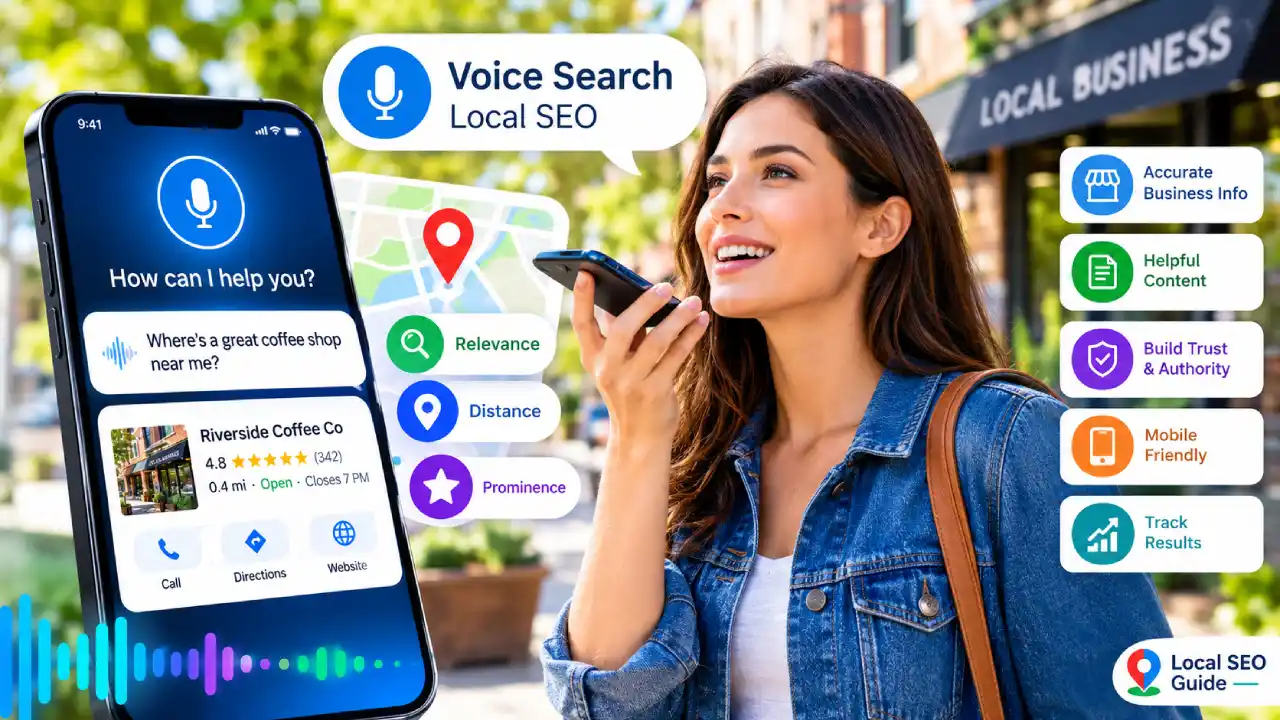
When someone says, “Hey Google, where’s the best Italian restaurant near me?” or “Siri, find a plumber open right now,” the search journey is very different from typing a few words into Google.
For local companies, voice search optimization tips for local business are increasingly important because customers are using natural questions, location signals, and mobile devices to find businesses at the exact moment they need them.
This guide explains how voice search works, why local businesses should care, and how to build a strong foundation that supports traditional Google Search, Maps, voice assistants, and newer AI-powered search experiences.
Contents
- 1 What Is Voice Search Optimization?
- 2 Why Voice Search Matters for Local Businesses
- 3 How Voice Search Is Different From Typed Search
- 4 Conversational Search and Local Intent
- 5 Natural Language Queries Are Becoming More Important
- 6 Voice Search and Google Business Profile
- 7 Keep Your Business Information Consistent
- 8 Choose the Right Google Business Profile Category
- 9 Write a Business Description for Humans First
- 10 Make Your Location Easy to Understand
- 11 “Near Me” Searches Need More Than the Words “Near Me”
- 12 Optimize for Questions Customers Actually Ask
- 13 Create an FAQ Section That Actually Helps
- 14 Keep Important Answers Clear and Direct
- 15 Aim for Featured Snippet-Friendly Answers
- 16 Voice Search Statistics: What Businesses Should Actually Learn
- 17 Mobile Optimization Is a Voice Search Foundation
- 18 Build Local Service Pages Around Real Search Intent
- 19 Don’t Create Content Just Because It Contains a Keyword
- 20 Build Trust Around Your Local Business
- 21 Reviews Can Support Local Visibility
- 22 Use Real Customer Language in Your Content
- 23 Prepare for Different Voice Assistants
- 24 Start Building a Voice-Ready Local SEO Foundation
- 25 A Simple Example: Restaurant Voice Search Strategy
- 26 What Google’s Recent Direction Means for Voice SEO
- 27 Think Beyond “Voice Rankings”
- 28 The Core Strategy in One Sentence
- 29 How to Optimize Your Website for Conversational Voice Searches
- 30 Build Content Around “Who, What, Where, When, Why, and How”
- 31 Google Assistant Search Optimization
- 32 Keep Opening Hours Extremely Accurate
- 33 Siri Search Optimization
- 34 Optimize for “Near Me” and Local Intent Without Keyword Stuffing
- 35 Create Useful Local Landing Pages
- 36 Use Local Language Naturally
- 37 Create an FAQ Section That Answers Buying Questions
- 38 Don’t Make Every FAQ Answer Two Sentences
- 39 Target Featured Snippet Opportunities Naturally
- 40 How Much Does a Furnace Tune-Up Cost?
- 41 Featured Snippet Voice Search Strategy
- 42 Use Lists When Customers Need Steps
- 43 Add Structured Data Where It Actually Applies
- 44 Don’t Expect Schema Markup to Guarantee Rankings
- 45 Add Important Local Information in Visible Text
- 46 Improve Your Internal Linking
- 47 Connect FAQ Content to Service Pages
- 48 Optimize Your Click-to-Call Experience
- 49 Make Directions Easy to Find
- 50 Reviews and Voice Search Work Together
- 51 Use Customer Reviews to Discover Content Ideas
- 52 Mobile Voice Search Trends You Should Watch
- 53 Make Your Website Easy to Use While Moving
- 54 Improve Core Web Vitals
- 55 Use Images Without Slowing the Page Down
- 56 Build Topical Depth Around Local Services
- 57 Demonstrate Real-World Experience
- 58 Create Content That Answers the Next Question
- 59 Think in Topic Clusters, Not Individual Keywords
- 60 Avoid These Common Voice SEO Mistakes
- 61 A Practical Voice Search Optimization Workflow
- 62 Voice Search Optimization Checklist
- 63 What This Means for Local SEO in the AI Search Era
- 64 The Next Step: From Voice Search to AI-Powered Local Discovery
- 65 Advanced Voice Search Local SEO: Preparing for the Next Generation of Search
- 66 Build a Strong Voice Search Local SEO Strategy
- 67 Strengthen Your Local Entity Signals
- 68 Make Your Website the Main Source of Business Information
- 69 What AEO Means for a Local Business
- 70 What GEO Means for a Local Business
- 71 Write Answers That AI Systems Can Understand
- 72 Add First-Hand Experience to Your Content
- 73 Use Original Local Data When You Have It
- 74 Make Important Information Easy to Extract
- 75 Don’t Hide Important Information in Images
- 76 Use Internal Links to Guide Customers
- 77 Make Product Information Machine-Friendly
- 78 Example: Local Retail Voice Search
- 79 Create Strong Conversion Paths
- 80 Track Local Business Actions
- 81 First 30 Days: Fix the Foundation
- 82 Mistake 1: Creating a separate page for every question
- 83 Mistake 2: Keyword-stuffing conversational phrases
- 84 Mistake 3: Creating fake local pages
- 85 Mistake 4: Ignoring business information
- 86 Mistake 5: Publishing generic AI-written content at scale
- 87 Mistake 6: Chasing an “AI SEO hack”
- 88 Mistake 7: Ignoring conversions
- 89 Does voice search require a separate SEO strategy?
- 90 Should I use the phrase “near me” repeatedly?
- 91 Does FAQ schema guarantee voice-search visibility?
- 92 Should every local business create hundreds of FAQ pages?
- 93 Is Google Business Profile important for voice search?
- 94 Does schema markup improve voice rankings?
- 95 Can AI-generated content rank?
- 96 How can I track voice-search traffic?
- 97 Should I optimize for Google Assistant or Siri separately?
- 98 What is the most important voice SEO factor?
- 99 Authoritative References
What Is Voice Search Optimization?
Voice search optimization is the process of making a business’s website, business listings, content, and online information easy for search engines and digital assistants to understand when people speak their searches instead of typing them.
A traditional typed search might look like:
“best dentist Chicago”
A spoken search could be:
“What is the best dentist near me that is open today?”
The second query contains more context.
It communicates intent, location, timing, and sometimes urgency.
This is one reason voice search matters for local businesses. A person asking a voice assistant for a nearby service is often much closer to taking action than someone casually researching a topic.
Google says local results are primarily influenced by relevance, distance, and prominence. Complete and accurate Business Profile information helps Google understand what a business does and match it with relevant local searches. (Google Help)
So, voice optimization is not about finding a secret “voice search ranking factor.”
Instead, it is about making your business information clear, accurate, useful, locally relevant, and easy for machines and people to understand.
A simple example
Imagine a customer says:
“Where can I get an oil change near me today?”
A local auto repair shop has a better chance of being useful if its online information clearly states:
- What services it provides
- Its exact location
- Service area
- Opening hours
- Phone number
- Website
- Appointment information
- Customer reviews
- Relevant service pages
Compare that with a business website that only says:
“Welcome to ABC Auto.”
The second website gives search systems much less useful information.
Why Voice Search Matters for Local Businesses
Voice search is especially relevant to businesses that depend on local customers and immediate decisions.
Think about the situations in which people naturally use voice:
- Driving
- Cooking
- Walking
- Shopping
- Looking for an emergency service
- Searching from a phone
- Looking for nearby restaurants
- Finding opening hours
- Checking directions
- Comparing local services
These are strongly connected to local search intent.
An older BrightLocal consumer study found that 58% of consumers had used voice search to find information about a local business, while 25% had not yet used local voice search but said they would consider doing so. Smartphones were the most common device in that study. (BrightLocal)
The exact percentage should not be treated as a current 2026 market-size figure because consumer behavior changes over time. However, the study demonstrates an important point: voice and local search have been closely connected for years, particularly on smartphones.
Voice search often happens at the bottom of the funnel
Consider these two searches:
Research intent:
“How does teeth whitening work?”
Local action intent:
“Where can I get teeth whitening near me?”
The first person is learning.
The second person may be ready to contact a business.
That makes local voice optimization valuable even if the total number of voice searches is smaller than traditional typed searches.
How Voice Search Is Different From Typed Search
People do not always speak the way they type.
When typing, someone might search:
“24 hour plumber Dallas”
When speaking, that same person might say:
“Who is the closest plumber near me that is open right now?”
This difference is central to voice SEO.
Spoken searches tend to be more conversational and often contain complete questions.
They may include words such as:
- Who
- What
- Where
- When
- How
- Can
- Is
- Near me
- Open now
- Available today
- Closest
- Best
This does not mean you should create hundreds of pages stuffed with question-based keywords.
Instead, your website should naturally answer the questions customers actually ask.
Conversational Search and Local Intent
One of the most important changes in search is the move from short keyword phrases toward meaning and intent.
Google’s systems increasingly need to understand what a person means rather than simply match individual words.
For example:
“coffee shop near me with outdoor seating”
has several pieces of meaning:
Business type: coffee shop
Location intent: near me
Preference: outdoor seating
A strong local business profile and website should provide enough accurate information for search systems to understand those details.
This is where conversational keyword optimization becomes useful.
What is conversational keyword optimization?
It means creating content around the way real customers naturally ask questions.
Instead of forcing:
“best emergency plumber Austin”
into every paragraph, you could answer:
“Need an emergency plumber in Austin after normal business hours? Our team provides emergency plumbing services throughout central Austin and nearby areas.”
The second version sounds natural.
It also provides useful information.
Most importantly, it helps a visitor understand whether the business is relevant.
Natural Language Queries Are Becoming More Important
People increasingly expect search systems to understand complete questions.
For example:
“Can you recommend a family dentist near me that accepts new patients?”
This is more complex than:
“family dentist near me”
A good SEO strategy therefore needs to account for natural language queries SEO rather than relying only on traditional exact-match keywords.
The goal is not to predict every sentence a customer might speak.
That would be impossible.
Instead, identify the common problems, questions, services, locations, and decision factors associated with your business.
Then answer those naturally.
Build content around customer questions
For a local roofing company, questions could include:
- How much does a roof inspection cost?
- How long does a roof replacement take?
- Can you repair storm damage?
- Do you provide emergency roof repairs?
- How often should I replace my roof?
- Do you serve my neighborhood?
- Can you come out today?
Each question represents a potential search intent.
A useful answer can serve traditional searchers and voice users at the same time.
Voice Search and Google Business Profile
One of the strongest foundations for local visibility is a complete and accurate Google Business Profile.
Google specifically recommends keeping business information complete and accurate, including:
- Business address
- Business hours
- Special hours
- Business category
- Attributes
- Photos and videos
- Contact information
- Other relevant business details
Google also says local ranking is mainly based on relevance, distance, and prominence. (Google Help)
This is important because voice assistants need reliable information to answer basic local questions.
Example
Suppose someone asks:
“Is there a Mexican restaurant near me that’s open until 10 PM?”
If your restaurant’s profile incorrectly says it closes at 8 PM, the information may prevent a potential customer from choosing you.
An outdated profile can therefore create more than an SEO problem.
It can create a lost customer problem.
Keep Your Business Information Consistent
Your business information should be consistent across important online sources.
Pay close attention to:
Business name
Use your real-world business name rather than adding extra keywords.
Address
Keep your address accurate wherever the business is legitimately listed.
Phone number
Use a reliable business number that customers can reach.
Hours
Update normal hours and holiday or special hours.
Website
Make sure the website linked from your business listing works correctly and represents the same business.
Services
Clearly explain the services you actually provide.
Consistency makes it easier for customers to trust your information and gives search systems clearer signals about your business.
Choose the Right Google Business Profile Category
Your primary category is an important part of communicating what your business actually is.
For example, a business should not select a category simply because it appears to have a high search volume.
Instead, select the category that best represents the business.
Consider a local company that provides:
Residential electrical services
Its profile should accurately represent the nature of the business rather than trying to manipulate visibility with unrelated categories.
Google’s guidance emphasizes providing complete and detailed information so that it can better understand the business and match it with relevant searches. (Google Help)
Add relevant secondary information
Where appropriate, provide additional services and attributes.
For example, an electrician may offer:
- Electrical repairs
- Panel upgrades
- EV charger installation
- Lighting installation
- Electrical inspections
- Emergency electrical service
This gives customers and search systems a clearer picture of what the company does.
Write a Business Description for Humans First
Your business description should explain:
- What you do
- Who you serve
- Where you operate
- What makes your business useful
Avoid turning the description into a keyword list.
Poor example:
“Best plumber plumber plumber plumbing plumber Austin plumbing services Austin.”
That is not helpful.
A better approach:
“We provide residential plumbing repairs, water heater services, drain cleaning, and emergency plumbing throughout Austin and surrounding communities.”
It is clear.
It sounds natural.
It explains the business.
And it gives customers useful information.
Make Your Location Easy to Understand
Location is especially important for local voice searches.
Someone may ask:
“What’s the closest urgent care near downtown Denver?”
Google needs to understand both:
- What the business does
- Where the business is
Your website should therefore clearly communicate location information.
Include relevant information such as:
- City
- State
- Neighborhood
- Service area
- Physical address when appropriate
- Nearby communities served
- Directions
- Contact information
However, don’t create dozens of nearly identical city pages simply to capture location keywords.
That can create thin, repetitive content that offers little value.
Example
Instead of creating:
- Plumber Austin
- Plumber Round Rock
- Plumber Cedar Park
- Plumber Pflugerville
- Plumber Georgetown
with almost identical text, create genuinely useful local pages only where you can provide meaningful information about the area and service.
“Near Me” Searches Need More Than the Words “Near Me”
A common mistake is assuming that adding “near me” repeatedly to a website will improve visibility.
It will not magically make a business local.
“Near me” is generally a signal of local intent.
The search engine uses location information to determine which businesses may be relevant.
Google explains that distance is one of the primary factors in local results, and if a searcher doesn’t explicitly provide a location, Google may use information it has about the user’s location. (Google Help)
That means businesses should focus on establishing genuine local relevance rather than repeatedly inserting the phrase “near me.”
Optimize for Questions Customers Actually Ask
Question-based content can be particularly useful for voice searches.
Start with the questions your customers ask before buying.
For example, a local HVAC company could answer:
“How often should I service my AC?”
A concise answer could explain the recommended maintenance schedule and why seasonal maintenance matters.
Then expand with useful supporting information.
Another question might be:
“How much does AC repair cost?”
Instead of making an unsupported promise, explain the factors that influence cost:
- Type of problem
- Replacement parts
- System age
- Labor
- Emergency service
- System accessibility
This provides useful information while avoiding misleading price claims.
Create an FAQ Section That Actually Helps
An FAQ page can support both traditional search and conversational searches when it is written for real customers.
Good questions are usually based on:
- Customer emails
- Phone calls
- Sales conversations
- Reviews
- Support tickets
- Search Console queries
- Questions employees hear repeatedly
This makes FAQ content for voice search much more useful than randomly generating questions around keywords.
Example: Local dentist
Instead of generic questions such as:
“What is a dentist?”
Use questions customers might genuinely ask:
“Do you accept new patients?”
“Do you offer emergency dental appointments?”
“How much does a dental cleaning cost?”
“Do you accept my insurance?”
“How early do you open?”
“Where can I park?”
Those answers can directly help someone deciding whether to visit.
Keep Important Answers Clear and Direct
When answering a question, provide the direct answer early.
For example:
How long does a dental cleaning take?
A routine dental cleaning typically takes about 30 to 60 minutes, although the appointment can take longer depending on your oral health and the type of cleaning required.
Then provide additional explanation.
This structure is useful for humans because readers get the answer quickly.
It can also make the page easier for search systems to understand.
Research from Ahrefs has highlighted the relationship between featured snippets and voice search and recommends concise, objective answers, clear hierarchy, simple sentences, and language that matches the audience. (Ahrefs)
Aim for Featured Snippet-Friendly Answers
A voice assistant may need to provide an answer without showing the entire webpage.
That makes clear answer formatting important.
For informational questions, consider placing a concise answer directly below the relevant heading.
For example:
How often should you replace your HVAC filter?
Most homes should check their HVAC filter every month and replace it when it becomes dirty. The exact replacement schedule depends on the filter type, household conditions, pets, and system usage.
Then provide a deeper explanation below.
This creates a useful answer-first structure.
It does not guarantee a featured snippet.
It does not guarantee a voice result.
But it makes the information easier to consume.
Voice Search Statistics: What Businesses Should Actually Learn
There is no single statistic that proves voice search is going to replace traditional Google Search.
That is the wrong way to think about it.
Instead, look at the broader behavior.
People use voice interfaces because speaking can be convenient, especially on smartphones and connected devices.
The BrightLocal local voice-search study found smartphones were the most commonly used device among consumers who had used voice search for local business information, with 56% reporting smartphone use in that study. (BrightLocal)
The practical lesson is more important than the percentage:
Local voice optimization should begin with mobile and local SEO fundamentals.
Don’t build a completely separate “voice website.”
Build a website that works extremely well for people using phones, search engines, maps, and conversational interfaces.
Mobile Optimization Is a Voice Search Foundation
Many local voice searches happen when someone is already using a mobile device.
That means your website needs to work well on a small screen.
Google’s page-experience guidance encourages site owners to consider mobile usability, Core Web Vitals, secure delivery, intrusive interstitials, and whether the main content is easy to distinguish and use. (Google for Developers)
Check the basics:
- Pages load quickly
- Text is readable
- Buttons are easy to tap
- Phone numbers are clickable
- Forms work on mobile
- Navigation is simple
- Important information appears without excessive scrolling
- The site uses HTTPS
- Pop-ups don’t block the main content
Make calling easy
For a local service business, the phone number can be one of the most important conversion elements.
If someone asks:
“Find an emergency locksmith near me.”
and lands on your page, they should not have to search through five menus to find your phone number.
Make important actions obvious.
Build Local Service Pages Around Real Search Intent
A local business website should clearly explain the services it provides.
Suppose you operate a roofing company.
Instead of having one generic page called:
“Our Services”
you may benefit from useful pages covering legitimate core services such as:
- Roof inspection
- Roof repair
- Roof replacement
- Storm damage repair
- Emergency roof repair
Each page should answer the questions a customer has about that service.
For example:
Roof repair page
- What problems do you repair?
- When should someone call?
- Do you offer inspections?
- What areas do you serve?
- What affects repair costs?
- How quickly can you respond?
- How can customers request an appointment?
This supports traditional SEO while also creating useful material for conversational searches.
Don’t Create Content Just Because It Contains a Keyword
Google’s current guidance strongly emphasizes people-first content rather than content created primarily to manipulate search rankings. Google recommends creating useful information for an intended audience and demonstrating appropriate first-hand expertise and depth of knowledge. (Google for Developers)
This matters for voice SEO.
If you create 100 pages containing slightly different versions of:
“best plumber near me”
you are not necessarily making your website more useful.
A better strategy is to create fewer, stronger pages that genuinely answer customer needs.
A useful test
Before publishing a page, ask:
“Would this page still be useful if Google did not exist?”
If the answer is yes, you’re probably moving in the right direction.
Build Trust Around Your Local Business
Voice search can produce very short answers.
That means the information behind those answers needs to be trustworthy.
Local businesses should strengthen trust through:
- Real business information
- Genuine reviews
- Clear contact details
- Accurate service information
- Real photographs
- Author or business expertise where relevant
- Helpful service pages
- Clear policies
- Accurate pricing information where appropriate
Google’s local guidance specifically recommends managing and responding to reviews and keeping business information complete and accurate. (Google Help)
Reviews also contribute to the broader reputation and prominence of a business.
Reviews Can Support Local Visibility
Reviews are not simply a reputation-management task.
They can also provide useful language about the services customers actually care about.
Imagine a customer review says:
“The technician arrived the same day and fixed our broken water heater.”
That review contains useful real-world context:
- Water heater
- Repair
- Same-day service
- Customer experience
Businesses should never manufacture reviews or tell customers exactly what keywords to include.
Instead, encourage genuine feedback about the customer’s actual experience.
Respond professionally and honestly.
Use Real Customer Language in Your Content
One of the easiest ways to improve conversational content is to listen to customers.
Your sales and support teams may hear questions that never appear in keyword tools.
For example:
A customer may ask:
“Can someone come out today if my AC stops working?”
That sentence can reveal several content opportunities:
- Emergency AC repair
- Same-day service
- Service availability
- Response times
- Service areas
Your content can answer those questions naturally.
This is often more valuable than trying to predict every possible keyword variation.
Prepare for Different Voice Assistants
Voice search is not controlled by one single platform.
Depending on the device and ecosystem, people may interact with:
- Apple
- Amazon
- Other smart-device platforms
For Google-related searches, maintaining accurate Google Business Profile information is fundamental.
For Apple users, Apple Business Connect provides businesses with a way to manage how their information appears across Apple Maps, Siri, Mail, and other Apple experiences. Apple’s own documentation describes Business Connect as a free tool for customizing business information and brand appearance across these services. (Apple Business)
That means local businesses should not think only about Google.
They should think about the wider local search ecosystem.
Start Building a Voice-Ready Local SEO Foundation
Before worrying about advanced tactics, make sure these fundamentals are in place.
Local business foundation checklist
- Claim your Google Business Profile
- Verify your business information
- Choose accurate categories
- Keep business hours updated
- Add accurate contact information
- Describe your services clearly
- Maintain accurate location information
- Respond to genuine reviews
- Add useful photographs
- Build helpful local service pages
- Optimize the website for mobile
- Improve page experience
- Answer real customer questions
- Keep information consistent across important platforms
- Maintain an Apple Business Connect listing where relevant
Google confirms that complete business information helps it understand a business and match it with relevant local searches, while local visibility depends primarily on relevance, distance, and prominence. (Google Help)
A Simple Example: Restaurant Voice Search Strategy
Consider a fictional restaurant in Chicago called Lakeview Pasta House.
A customer might ask:
“What’s a good Italian restaurant near me that’s open for dinner?”
The restaurant should make its core information easy to establish:
Business category: Italian restaurant
Location: Accurate Chicago address
Hours: Current dinner hours
Website: Fast mobile website
Menu: Easy to access
Services: Dine-in, takeout, delivery if offered
Attributes: Relevant amenities
Reviews: Genuine customer feedback
Content: Useful pages answering questions about reservations, parking, menu options, and dietary needs
The restaurant does not need a page titled:
“Best Italian Restaurant Near Me Near Me Chicago Voice Search.”
That would be unnatural and potentially harmful to the user experience.
Instead, it needs clear, trustworthy information that matches real customer intent.
What Google’s Recent Direction Means for Voice SEO
The biggest lesson from Google’s current guidance is that businesses should not chase individual search features as if they were separate ranking systems.
Google’s documentation continues to emphasize helpful, reliable, people-first content, good page experience, and information that genuinely serves an intended audience. (Google for Developers)
That is important for voice search because conversational systems need understandable information.
If your website clearly explains:
- What your business does
- Where you operate
- Who you serve
- What services you provide
- What customers should expect
- How to contact you
you are creating a stronger foundation for multiple forms of search.
That includes traditional organic results, local results, Maps, conversational searches, and newer AI-assisted search experiences.
Think Beyond “Voice Rankings”
There is no simple dashboard where you can see:
“Your voice ranking = #3.”
Voice results can depend on:
- Device
- Location
- Query wording
- Search history
- Search intent
- Available business information
- Search ecosystem
- The type of question being asked
Therefore, your goal should not be:
“How do I rank #1 for voice?”
A better question is:
“How do I become the most useful and trustworthy local answer for the questions my customers ask?”
That mindset leads to better SEO decisions.
The Core Strategy in One Sentence
Voice optimization for local businesses is mostly about making your business information accurate, locally relevant, conversational, trustworthy, mobile-friendly, and easy for search systems to understand.
That foundation will become even more important as search experiences continue moving beyond ten blue links toward answers, maps, conversational interfaces, and AI-powered discovery.
How to Optimize Your Website for Conversational Voice Searches
The next step after fixing your local business information is making your website content easy to understand when customers ask complete questions. Voice searches are often longer than typed searches because people speak naturally rather than entering a few keywords. A local business website should therefore answer common customer questions directly while still providing enough detail to satisfy someone who wants to learn more.
For example, someone looking for a local HVAC company might type “HVAC repair Dallas”, but ask a voice assistant, “Who can repair my air conditioner near me today?” Both searches have similar intent, but the second reveals more information about urgency, location, and timing. Your content should be capable of addressing both versions naturally rather than creating separate pages for every variation.
Map conversational questions to your existing pages
Start by identifying the questions associated with each important service.
For a local plumber, the question map could look like this:
Customer question | Best content location |
How much does drain cleaning cost? | Drain-cleaning service page |
Do you offer emergency plumbing? | Emergency plumbing page |
How quickly can you arrive? | Service/FAQ section |
Do you serve my neighborhood? | Location/service-area page |
How do I stop a leaking pipe? | Educational article |
Can you replace a water heater? | Water-heater service page |
This approach prevents a common SEO mistake: creating dozens of thin pages that target slightly different keyword phrases.
Instead, one genuinely useful page can answer several related conversational searches.
Build Content Around “Who, What, Where, When, Why, and How”
A simple way to discover voice-search opportunities is to organize customer questions around six common question types:
- Who provides the service?
- What does the service include?
- Where is the business located?
- When is the business open or available?
- Why should customers choose the service?
- How does the service work?
For example, a local auto repair shop could answer:
Who: Who repairs hybrid vehicles near me?
What: What does a brake inspection include?
Where: Where is your auto repair shop located?
When: When are you open?
Why: Why should I replace worn brake pads?
How: How long does a brake replacement take?
This gives your content a natural structure without forcing keywords into awkward sentences.
Google Assistant Search Optimization
Google Assistant has historically played an important role in conversational search on Android devices, Google Home products, and other supported environments. Google’s current product direction is increasingly centered around Gemini-powered experiences, so businesses should avoid treating “Google Assistant SEO” as a completely separate ranking system.
The underlying optimization principles still matter.
A business needs information that is:
- Accurate
- Structured
- Locally relevant
- Current
- Easy to understand
- Supported by trustworthy sources
For example, if someone asks:
“What’s the closest hardware store that’s open right now?”
your business cannot control which answer Google provides simply by putting the phrase “hardware store open now” on your homepage.
The system has to understand your business category, location, hours, relevance, and other signals.
That’s why Google Assistant search optimization should be viewed as an extension of strong local SEO rather than a separate trick.
Keep Opening Hours Extremely Accurate
Opening hours can directly influence local search decisions.
A customer who asks:
“Which pizza place is open near me?”
doesn’t want a business that closed two hours ago.
Update:
- Regular hours
- Weekend hours
- Holiday hours
- Seasonal hours
- Temporary closures
- Special hours
Google provides a specific mechanism for businesses to manage special hours and other Business Profile information. Keeping this information current is one of the simplest ways to prevent customers from receiving outdated information. (support.google.com)
Example
Suppose a restaurant normally closes at 10 PM but stays open until midnight on Fridays.
If the profile still says 10 PM every day, someone searching at 10:30 PM may never consider the restaurant.
The problem isn’t a lack of keywords.
It’s incorrect business data.
Siri Search Optimization
Apple users can also search for businesses using Siri and Apple Maps.
Apple’s Business Connect allows businesses to control key information shown across Apple’s services. Apple says businesses can manage details such as location information, hours, website, phone number, photos, and other information that can appear in Apple Maps and related Apple experiences. (businessconnect.apple.com)
Therefore, Siri search optimization should begin with accurate Apple business information.
Check your Apple presence
For a local business, review:
- Business name
- Address
- Phone number
- Website
- Hours
- Category
- Photos
- Location
- Business description
- Special hours
The objective isn’t to “stuff Siri keywords.”
It is to make your business correctly represented within Apple’s local ecosystem.
Optimize for “Near Me” and Local Intent Without Keyword Stuffing
“Near me” is one of the most misunderstood parts of local SEO.
You don’t need to repeat:
“dentist near me”
twenty times on a page.
The searcher already supplies their location context.
Instead, make your physical location and service area clear.
For example:
“Our dental office is located in downtown Phoenix and provides preventive, restorative, and emergency dental care for patients throughout central Phoenix and nearby communities.”
This naturally communicates:
- Business type
- Services
- Location
- Service area
It is far more useful than repeating the same keyword phrase.
Create Useful Local Landing Pages
Businesses serving multiple legitimate locations may need individual local pages.
But each page should provide unique value.
Suppose a home-cleaning company serves:
- Dallas
- Plano
- Frisco
- Irving
A weak approach would be to duplicate one page four times and replace the city name.
A stronger page could include:
Dallas cleaning services
- Services available in Dallas
- Neighborhoods served
- Typical cleaning needs
- Scheduling information
- Local contact information
- Relevant customer questions
- Photos of actual work where appropriate
- Service-specific information
The same principle applies to other cities.
Location pages should exist because customers need them, not simply because a keyword tool shows search volume.
Use Local Language Naturally
People often describe locations in different ways.
Someone may search:
“dentist near downtown Austin”
Another may say:
“dentist close to me”
Another may search:
“dentist in Austin TX”
Your content should naturally mention the location customers recognize.
Useful geographic references may include:
- City
- State
- Neighborhood
- District
- Nearby communities
- Major landmarks, where genuinely relevant
But don’t turn your page into a list of city names.
Natural language is more useful.
Create an FAQ Section That Answers Buying Questions
A strong FAQ section can support both informational and transactional searches.
Consider a local roofing company.
Instead of generic questions like:
“What is roofing?”
use questions such as:
- How much does roof repair usually cost?
- How quickly can you inspect storm damage?
- Do you repair leaking roofs?
- Do you work with insurance claims?
- How long does a roof replacement take?
- Do you provide emergency service?
- What areas do you serve?
These questions are much closer to the decisions customers actually make.
Give the answer first
A useful FAQ structure is:
Question
Direct answer
Additional explanation
Next step
For example:
Do you provide emergency roof repairs?
Yes. We provide emergency roof repair services for active leaks and storm-related damage in our service area. Contact us as soon as possible so we can assess the problem and determine whether temporary protection or a permanent repair is needed.
The first sentence provides the answer.
The following sentence adds context.
Don’t Make Every FAQ Answer Two Sentences
Concise answers can be helpful, but not every question deserves a tiny response.
Some questions need explanation.
For example:
How much does a roof replacement cost?
A responsible answer should explain that pricing varies based on:
- Roof size
- Material
- Roof pitch
- Existing damage
- Removal requirements
- Labor
- Local conditions
- Structural repairs
A page should never sacrifice useful information merely because you are trying to make an answer short enough for a voice response.
Write for the customer first.
Target Featured Snippet Opportunities Naturally
Featured snippets can provide a useful visibility opportunity for question-based searches.
Google describes featured snippets as highlighted search results that appear above traditional organic results in some cases. Google also states that there is no special markup required to become eligible for a featured snippet. (developers.google.com)
This is important.
You cannot simply add a piece of code and tell Google:
“Make this my featured snippet.”
Instead, focus on making your answer:
- Direct
- Accurate
- Well organized
- Easy to understand
- Relevant to the question
Use descriptive headings
For example:
How Much Does a Furnace Tune-Up Cost?
Then answer the question directly underneath.
Follow with supporting details.
This structure is useful for readers and search systems.
Featured Snippet Voice Search Strategy
A featured snippet can sometimes be used as a source for spoken answers, although businesses should not assume that every featured snippet will become a voice response.
A useful structure is:
Question heading
→ One clear answer
→ Supporting explanation
→ Bullets or steps
→ Relevant internal link
For example:
How often should I have my HVAC system serviced?
Most homeowners should have their HVAC system professionally inspected at least once a year, although the ideal schedule can vary by system type, age, usage, and manufacturer recommendations.
Then explain what an inspection covers.
This creates a better resource than simply writing a 40-word answer and stopping there.
Use Lists When Customers Need Steps
Voice searches aren’t always questions with one-sentence answers.
People also ask:
“How do I reset my garage door opener?”
or:
“What should I do if my water heater is leaking?”
A numbered structure works well:
- Turn off the appropriate supply if it is safe to do so.
- Check the visible connection.
- Avoid attempting repairs that could create a safety hazard.
- Contact a qualified professional when necessary.
Clear steps can make content easier to understand across search interfaces.
Add Structured Data Where It Actually Applies
Structured data helps search engines understand certain types of information on a webpage.
Google supports several structured-data formats and recommends using the documentation for supported features rather than adding markup simply because it exists. (developers.google.com)
For eligible local businesses, LocalBusiness structured data can help communicate information about a business to search engines.
Potential properties can include information such as:
- Business name
- Address
- Telephone
- URL
- Opening hours
- Geographic information
- Department information
- Relevant business details
Use only information that accurately represents the business and follows Google’s structured-data guidelines.
Don’t Expect Schema Markup to Guarantee Rankings
Structured data is not a magic ranking button.
Adding LocalBusiness schema does not mean:
“Google will now rank this company first.”
Its main value is helping search engines understand machine-readable information about the page.
Google also makes clear that structured data eligibility does not guarantee that a rich result will appear. (developers.google.com)
Therefore, treat schema as part of your technical SEO foundation, not as a shortcut.
Add Important Local Information in Visible Text
One common mistake is putting important information only inside structured data.
If your business address, hours, services, or contact information matters to customers, it should generally be visible on the page as well.
For example:
ABC Plumbing
123 Main Street
Austin, TX 78701
Phone: [business phone]
Monday–Friday: 8 AM–6 PM
The structured data can reinforce this information.
It shouldn’t replace it.
Improve Your Internal Linking
Internal links help users and search engines discover related content.
A local HVAC website could structure links like this:
Homepage
→ HVAC Services
→ AC Repair
→ Furnace Repair
→ HVAC Maintenance
→ Emergency HVAC
→ Service Areas
Each service page can link to relevant educational articles.
For example:
“Not sure whether your system needs repair or replacement? Learn how to identify the most common warning signs.”
This helps create a connected information structure.
Connect FAQ Content to Service Pages
Don’t isolate all questions on one giant FAQ page.
For example:
AC Repair page
→ “How much does AC repair cost?”
Emergency HVAC page
→ “Do you offer after-hours service?”
HVAC Maintenance page
→ “How often should an AC system be serviced?”
This creates a more useful relationship between informational questions and commercial pages.
It can also help customers move naturally from question → information → service → contact.
Optimize Your Click-to-Call Experience
Voice search frequently happens on phones.
If someone discovers your business through search, the next step may be a phone call.
Make calling easy.
Consider using:
- Clickable phone numbers
- Prominent contact buttons
- Simple appointment forms
- Clear business hours
- Directions
- Service-area information
For an emergency business, this is particularly important.
Imagine searching:
“24 hour locksmith near me.”
If the page requires the visitor to open a desktop-style menu just to find a phone number, the business is creating unnecessary friction.
Make Directions Easy to Find
Location-based searches frequently lead to navigation.
Businesses with physical locations should make it easy for customers to:
- Find the address
- Open directions
- Identify parking
- Understand entrance locations
- Find nearby landmarks when useful
For example, a medical clinic might explain:
“Our office is located on the second floor of the building next to the public parking garage.”
That information may be more useful to a customer than another paragraph repeating the city’s name.
Reviews and Voice Search Work Together
Reviews can provide additional context about what customers experience at a business.
A restaurant might receive reviews mentioning:
- Outdoor seating
- Family-friendly atmosphere
- Vegan options
- Fast lunch service
- Reservations
- Parking
A customer could then search for something related to those attributes.
Businesses should never manipulate reviews by asking customers to include specific SEO keywords.
Instead:
Deliver a good experience.
Ask for honest feedback.
Respond appropriately.
Learn from recurring customer comments.
Google’s guidance encourages businesses to engage with reviews and says businesses can use reviews to help customers understand more about the business. (support.google.com)
Use Customer Reviews to Discover Content Ideas
Reviews can become a valuable research source.
Imagine a hotel repeatedly receives questions about:
“Is parking available?”
or reviews mention:
“The hotel is a five-minute walk from the convention center.”
Those details can inspire useful website content.
Similarly, a restaurant may discover customers repeatedly asking:
“Do you have gluten-free options?”
That could become an FAQ.
The key is to turn real customer concerns into useful content.
Mobile Voice Search Trends You Should Watch
The important mobile voice search trends are not just about how many people speak to their phones.
The bigger shift is toward context-rich, immediate searches.
People increasingly expect search systems to understand:
- Location
- Time
- Intent
- Preferences
- Previous context
- Natural language
For local businesses, this creates an opportunity to answer high-intent questions.
Consider:
“Find a coffee shop near me.”
versus:
“Find a coffee shop near me that’s open now and has outdoor seating.”
The second query contains considerably more context.
Businesses should therefore make useful attributes and services easy to understand.
Make Your Website Easy to Use While Moving
Voice searches often occur in situations where users want information quickly.
Mobile visitors may be:
- Walking
- Driving
- Waiting
- Shopping
- Comparing businesses
- Trying to solve a problem
This makes mobile usability critical.
Google’s page experience guidance recommends focusing on aspects such as Core Web Vitals, mobile usability, HTTPS, and avoiding intrusive interstitials that interfere with the main content. (developers.google.com)
A technically excellent website is useful.
But a technically excellent website that is difficult to use is still a poor customer experience.
Improve Core Web Vitals
Core Web Vitals measure aspects of real-world page experience.
The current Core Web Vitals focus on:
- Largest Contentful Paint (LCP) — loading performance
- Interaction to Next Paint (INP) — responsiveness
- Cumulative Layout Shift (CLS) — visual stability
Google provides official documentation and guidance for measuring and improving these metrics. (web.dev)
For local businesses, don’t obsess over achieving perfect numbers at the expense of useful content.
Instead:
- Identify serious performance problems.
- Fix slow resources.
- Optimize images.
- Reduce unnecessary scripts.
- Improve server performance where needed.
- Test important mobile pages.
Use Images Without Slowing the Page Down
Images are important for local businesses.
A restaurant needs food photographs.
A contractor may need project photographs.
A salon may showcase completed work.
A hotel needs room and property images.
But large unoptimized images can slow down mobile pages.
Use appropriately sized images and modern formats where suitable.
Also provide useful alt text that describes the image naturally.
For example:
“Kitchen remodel with white cabinets and quartz countertops in Austin home.”
is more useful than:
“best kitchen remodeling Austin kitchen remodeler near me.”
Alt text should describe images, not become an SEO keyword field.
Build Topical Depth Around Local Services
A strong local website should demonstrate knowledge about the services it offers.
For a pest-control company, related content might include:
- Signs of termite activity
- When to call pest control
- Preventing ants
- Seasonal pest problems
- What happens during an inspection
- Preparing for treatment
- Pet-safety questions
- How long treatment typically takes
This supports broader search visibility.
It also gives conversational systems more useful material to understand the business and its expertise.
Demonstrate Real-World Experience
Google’s people-first guidance encourages content that demonstrates appropriate experience and expertise. (developers.google.com)
Local businesses have a major advantage here because they often possess genuine first-hand knowledge.
A contractor can explain:
“During summer inspections in our service area, we commonly find…”
A dentist can explain:
“Patients often ask us…”
A mechanic can explain:
“One of the most common warning signs we see is…”
These details make content more useful because they come from actual business experience.
Create Content That Answers the Next Question
A strong conversational page should not stop after answering one question.
Suppose someone asks:
“How long does a water heater replacement take?”
Answer it.
Then anticipate the next questions:
- What affects the installation time?
- Can I use the water while waiting?
- What does replacement cost?
- Which water heater should I choose?
- Do I need permits?
- What signs mean replacement is necessary?
This creates a more complete resource.
It also reflects how people naturally have conversations.
Think in Topic Clusters, Not Individual Keywords
Instead of targeting one keyword per page, think about topics and customer journeys.
For a local dentist:
Main service: Emergency dentistry
Related questions:
- What counts as a dental emergency?
- Can I see an emergency dentist today?
- What should I do about a broken tooth?
- How much does emergency dental treatment cost?
- Do you accept emergency appointments?
- Where is the office?
- Do you accept insurance?
These questions can be distributed naturally across service pages, FAQs, guides, and supporting content.
Avoid These Common Voice SEO Mistakes
Voice optimization becomes much easier when you know what not to do.
1. Keyword stuffing
Repeating “best dentist near me” does not make a website more useful.
2. Creating hundreds of thin location pages
City swapping is not the same as creating valuable local content.
3. Writing robotic FAQ questions
Customers don’t speak like keyword databases.
4. Ignoring traditional SEO
Voice search doesn’t eliminate the importance of crawlability, content quality, links, technical SEO, and local signals.
5. Ignoring mobile users
A voice search frequently begins on a mobile device.
6. Publishing inaccurate business information
Wrong hours or phone numbers can directly cost customers.
7. Using fake reviews
Reviews should represent genuine customer experiences.
8. Adding schema everywhere
Only use structured data that accurately represents eligible content and follows Google’s guidelines.
9. Creating content only for search engines
Google’s guidance consistently emphasizes content created to help people rather than content primarily designed to manipulate rankings. (developers.google.com)
A Practical Voice Search Optimization Workflow
You don’t need to rebuild your entire website overnight.
Use this workflow.
Step 1: Audit your local information
Check:
- Google Business Profile
- Apple Business Connect
- Website
- Major business directories
- Opening hours
- Address
- Phone
- Categories
- Services
Step 2: Collect customer questions
Ask your:
- Sales team
- Reception team
- Customer-service team
- Technicians
- Store employees
“What questions do customers ask before buying?”
Create a list.
Step 3: Map questions to pages
Decide whether each question belongs on:
- Homepage
- Service page
- Location page
- FAQ
- Blog article
- Contact page
Step 4: Improve answers
Put direct answers near the relevant headings.
Step 5: Improve mobile UX
Test the site on actual smartphones.
Step 6: Add appropriate structured data
Use Google’s documentation as your implementation guide.
Step 7: Measure results
Track:
- Organic traffic
- Local visibility
- Calls
- Directions
- Website conversions
- Appointment requests
- Search Console queries
- Business Profile interactions
This process is much more sustainable than chasing individual voice-search phrases.
Voice Search Optimization Checklist
Before moving into advanced AEO and AI-search optimization, check whether your local business has these basics covered:
- Google Business Profile is claimed and verified
- Business name is accurate
- Address is accurate
- Phone number is correct
- Opening hours are current
- Special hours are updated
- Primary category is accurate
- Services are clearly described
- Apple Business Connect is managed where relevant
- Website works well on mobile
- Important contact information is easy to find
- Phone numbers are clickable
- Location and service areas are clear
- Important customer questions are answered
- FAQ content reflects real customer questions
- Service pages provide useful information
- Local pages contain genuine local value
- Reviews are genuine and actively managed
- Relevant structured data is implemented correctly
- Pages load efficiently
- Internal links connect related content
- Content demonstrates real business experience
What This Means for Local SEO in the AI Search Era
Voice search should not be treated as an isolated SEO tactic.
Search is increasingly becoming more conversational.
People can ask increasingly complex questions, and search systems can combine information from multiple sources to produce answers.
That means local businesses need to make their information consistent and understandable across their website and important business profiles.
The same content foundation can support:
- Traditional organic search
- Local search
- Maps
- Voice interfaces
- Featured snippets
- AI-assisted search
- Conversational search experiences
The winning approach is therefore not:
“Write content for a voice assistant.”
It is:
“Create reliable information that answers the customer’s question clearly.”
That distinction becomes especially important as Google continues evolving its search experience.
The Next Step: From Voice Search to AI-Powered Local Discovery
Voice is only one part of the larger change happening in search.
A customer might no longer simply ask:
“Best plumber near me?”
They may ask an AI-powered search system:
“I have a leaking water heater in Dallas. Find three reputable plumbers that serve my area, have strong customer reviews, offer emergency service, and are open today.”
That is a much more complex information request.
To compete in these environments, local businesses need more than keywords.
They need:
Accurate business information.
Clear service descriptions.
Strong local relevance.
Helpful content.
Genuine reviews.
Structured information.
First-hand expertise.
A technically sound website.
These foundations will become increasingly important as search moves toward answers rather than simple lists of links.
Advanced Voice Search Local SEO: Preparing for the Next Generation of Search
Voice search is no longer something local businesses should treat as a separate SEO channel. It sits inside a much larger change in how people discover information: searches are becoming more conversational, local results are becoming more context-aware, and AI-powered search experiences can combine information from several sources before presenting an answer.
Google’s current guidance is especially important here. Google says the same foundational SEO practices used for traditional Search also apply to AI Overviews and AI Mode. It also says there are no additional technical requirements specifically required to appear as a supporting link in these AI features beyond being indexed and eligible for Search. (Google for Developers)
That means businesses should not build a completely separate SEO strategy for voice, AEO, GEO, or AI search. Instead, build a strong information system around the business: accurate local data, useful content, clear services, real expertise, trustworthy references, strong technical SEO, and a website that answers customers’ questions.
Build a Strong Voice Search Local SEO Strategy
A successful voice search local SEO strategy starts with understanding that local search has three major considerations: relevance, distance, and prominence.
Google states that local results are primarily based on these factors. Relevance considers how well a Business Profile matches what someone searches for. Distance considers how far the business is from the searcher or location specified. Prominence reflects how well-known the business is and can be influenced by signals such as reviews and information from across the web. (Google Help)
This has a major practical implication.
You cannot simply optimize a page for the phrase:
“best plumber near me”
and expect to appear for every nearby customer.
The customer’s location matters. The business’s actual location matters. The service being requested matters. The reputation and prominence of the business matter.
Focus on relevance before trying to manipulate rankings
Make it unmistakably clear:
- What your business does
- Which services you provide
- Which locations you genuinely serve
- Where customers can find you
- When you are available
- How customers can contact you
- What makes your service useful
Google also explains that Business Profile information can come from multiple sources, including the business itself, publicly available web content, third-party data, users, and other interactions with local places. (Google Help)
This is why consistency across your online presence matters.
Strengthen Your Local Entity Signals
Search engines need to understand that different pieces of information refer to the same real-world business.
Imagine a business called:
Austin Family Dental
Its website says one address.
A directory lists another address.
Its Google Business Profile has a third phone number.
An old social profile lists outdated hours.
A customer may become confused.
Search systems may also have a less consistent picture of the business.
Create a consistent business identity across important platforms.
Check these details regularly
Business name
Use the legitimate business name.
Address
Use the real location where applicable.
Phone
Use a reliable business number.
Website
Ensure profiles point to the correct website.
Hours
Keep them current.
Services
Make sure the services represented online match what you actually offer.
Categories
Use accurate business categories rather than trying to manipulate rankings.
This is especially useful for voice systems because a spoken question often requires the system to connect several pieces of information before producing an answer.
Make Your Website the Main Source of Business Information
Google says it can use content crawled from a business’s official website as one source of information for Business Profiles and local search. (Google Help)
Your website should therefore act as a source of truth for your business.
For example, if you offer emergency plumbing, don’t simply place “Emergency Plumbing” in a navigation menu.
Create a useful page explaining:
- What counts as an emergency
- Which emergencies you handle
- Whether you provide after-hours service
- Which locations you cover
- What customers should do while waiting
- What customers should avoid doing
- How to contact you
- What happens during an emergency visit
This gives customers useful information and gives search systems much more context.
Optimize for AEO, GEO, and LLM-Based Search
Voice search is only one part of the changing search landscape.
Today, local businesses also need to understand:
- AEO — Answer Engine Optimization
- GEO — Generative Engine Optimization
- AI Overviews
- AI Mode
- Conversational search
- LLM-powered discovery
These terms can sound complicated, but the underlying idea is simple:
Make your information easy to discover, understand, verify, and use as an answer.
Google’s latest guidance is particularly useful here. Google published a dedicated guide for generative AI features in Search in 2026 and specifically emphasized valuable, unique, non-commodity content. It also states that traditional SEO remains foundational for generative AI search. (Google for Developers)
What AEO Means for a Local Business
AEO focuses on making content useful when someone wants a direct answer.
Suppose you run a local garage.
A traditional SEO article might target:
“brake repair service”
An AEO-friendly page could answer:
How do I know if my brakes need repair?
Then explain the signs:
- Squealing
- Grinding
- Vibration
- Longer stopping distance
- Brake warning lights
- Pulling while braking
The page can then connect the information to your actual service.
This is much more useful than writing the same keyword repeatedly.
What GEO Means for a Local Business
GEO is often described as optimizing content for generative AI systems.
But be careful with claims that there is a secret “GEO ranking formula.”
Google itself has warned that third-party services may make claims about AEO or GEO that are not backed by Google’s internal ranking data. Google recommends comparing such advice against its official documentation. (Google for Developers)
The practical approach is therefore straightforward:
Create information that is genuinely useful and easy to understand.
Google’s generative AI guidance says unique, valuable, people-first content can be more useful for generative AI visibility than commodity content that simply repeats what is already available. (Google for Developers)
Write Answers That AI Systems Can Understand
Imagine an AI-powered search user asks:
“What should I look for when choosing a family dentist in Phoenix?”
A strong dental website might explain:
- Dentist qualifications
- Services offered
- Emergency availability
- Accepted insurance
- Pediatric services
- Office location
- Appointment options
- Patient experience
- Accessibility
The content isn’t written as:
“Best family dentist Phoenix dentist Phoenix family dentist.”
It provides facts and context.
That’s much more useful.
Add First-Hand Experience to Your Content
This is one of the strongest ways a local business can make content less generic.
Suppose you are a roofing company.
Instead of publishing:
“A roof protects your house from weather.”
Explain something based on actual work:
“During roof inspections, we often find that small flashing problems around chimneys and roof penetrations allow water to enter long before homeowners notice a ceiling stain.”
That is more specific.
It gives the reader something useful.
And it demonstrates practical knowledge.
Google’s guidance on generative AI specifically recommends creating valuable content with unique points of view and first-hand experience rather than simply recycling information already available online. (Google for Developers)
Use Original Local Data When You Have It
A local business may have information that large national websites don’t possess.
Examples include:
- Common local service problems
- Seasonal patterns
- Customer questions
- Local project examples
- Before-and-after results
- Service response data
- Frequently requested services
- Local regulations where appropriately sourced
- Original surveys
- Customer experience insights
For example, an HVAC company could publish:
“The five most common AC problems we see in homes during the first month of summer.”
That is much more useful than rewriting a generic article titled:
“What is an air conditioner?”
Optimize for AI Overviews Without Chasing Them
Google’s current documentation says AI Overviews and AI Mode use Google’s existing Search systems to retrieve relevant information. Google also states that pages must be indexed and eligible to appear in Search to be eligible as supporting links in these AI features. (Google for Developers)
So the basic workflow is:
Crawlable website
→ Indexed pages
→ Useful content
→ Strong relevance
→ Good Search visibility
→ Potential inclusion in AI experiences
There is no guaranteed shortcut.
Make Important Information Easy to Extract
Use clear headings.
For example:
Does your plumber offer emergency service?
Then provide a direct answer.
What areas do you serve?
Then provide the service area.
How quickly can you respond?
Explain your actual process.
How much does emergency plumbing cost?
Explain the factors that affect pricing.
This structure helps readers scan the page.
It also gives search systems clearly defined pieces of information.
Don’t Hide Important Information in Images
A voice or AI system may have difficulty understanding information that exists only inside a graphic.
Don’t put essential information exclusively inside:
- Images
- Infographics
- Videos
- PDFs
- Decorative graphics
If it matters to customers, include the information in accessible page text as well.
For example, if your restaurant offers:
“Gluten-free menu options”
don’t communicate that only through a photograph of your menu.
Write it on the page.
Build a Local Content Hub
A strong local website can be organized around a central service and supporting questions.
For example:
Main page:
Emergency HVAC Repair
Supporting content:
What counts as an HVAC emergency?
How much does emergency AC repair cost?
What should I do if my AC stops working at night?
How can I tell whether my AC needs repair or replacement?
How often should an HVAC system be serviced?
These pages can link to each other where relevant.
The result is a connected topic structure rather than a collection of unrelated blog posts.
Use Internal Links to Guide Customers
Internal links can create a natural path:
Question
→ Answer
→ Service
→ Contact
For example:
“Not sure whether your water heater should be repaired or replaced?”
Link to an educational guide.
Then link that guide to:
Water Heater Repair
and:
Water Heater Replacement
This helps the customer make a decision without forcing them to search again.
Voice Commerce SEO for Local Businesses
Voice is also relevant to transactions.
A person may ask:
“Where can I buy running shoes near me?”
or:
“Find a flower shop that’s open today.”
or:
“Where can I order a birthday cake for tomorrow?”
This is where voice commerce SEO becomes useful.
The key is to make products, services, availability, location, and purchasing information clear.
Make Product Information Machine-Friendly
If you operate a local retail business, make sure your website clearly communicates:
- Product name
- Product type
- Price where appropriate
- Availability where supported
- Brand
- Product details
- Store location
- Pickup options
- Delivery options
- Return information
Google supports structured data for product-related search experiences and provides documentation for eligible product features. (Google for Developers)
For eligible retailers, Google Business Profile can also support in-store product information in certain countries and regions. (Google Help)
Example: Local Retail Voice Search
Imagine a customer says:
“Where can I buy a men’s black running jacket near me today?”
A local sporting-goods store is more useful to that customer if its online information communicates:
Product: Men’s running jackets
Location: Physical store address
Hours: Current opening hours
Availability: Accurate product availability where supported
Pickup: Store pickup information
Contact: Phone number
Website: Product information
The customer is not looking for a long article.
They want an answer and a way to act.
Connect Voice Search to Conversions
Traffic alone isn’t the goal.
For a local business, a voice-driven search may lead to:
- Phone call
- Directions
- Website visit
- Appointment
- Reservation
- Online order
- Store visit
- Quote request
Track those actions.
For example:
Search → Website → Phone call
is often more valuable than:
Search → Website → Exit
Create Strong Conversion Paths
Every important local landing page should make the next action obvious.
Depending on the business, that could be:
Call now
Book an appointment
Get directions
Request a quote
Order online
Check availability
Schedule service
Don’t place all of these buttons everywhere.
Choose the action that makes the most sense for the user’s intent.
Measure Voice Search and Local SEO Performance
Voice search is difficult to measure directly because Google does not provide a universal report labeled:
“Voice searches that generated this visit.”
Therefore, measure the broader signals.
Google Search Console
Use Search Console to study:
- Queries
- Impressions
- Clicks
- CTR
- Average position
- Pages receiving search traffic
Look for conversational queries.
For example:
“how much does…”
“where can I…”
“near me…”
“is there…”
“can I…”
These can reveal the questions your audience is asking.
Track Local Business Actions
Also monitor:
- Calls
- Direction requests
- Website clicks
- Appointment submissions
- Contact-form submissions
- Online orders
- Store visits where measurement is available
- Branded searches
- Service-specific organic traffic
A voice-search strategy should ultimately improve business outcomes, not just impressions.
Use Google’s New Generative AI Reporting
There is an important current development for SEO professionals.
Google announced new Search Generative AI performance reports in Search Console in June 2026. Google said these reports provide dedicated visibility into impressions from generative AI features such as AI Overviews and AI Mode, alongside the overall Search performance data. Google later announced the rollout to all websites worldwide as of August 31, 2026. (Google for Developers)
This makes AI-search measurement much more practical than it used to be.
For a local business, review this data alongside traditional Search Console performance.
Look for:
- Which pages receive generative-AI visibility
- Which topics generate impressions
- Whether informational pages are being surfaced
- Which service pages gain visibility
- Whether AI visibility correlates with conversions
Don’t treat impressions as the final goal.
A page generating fewer impressions but producing several qualified leads may be more valuable than a page generating thousands of low-intent impressions.
Use a 30/60/90-Day Voice SEO Plan
A structured implementation plan makes this strategy much easier to execute.
First 30 Days: Fix the Foundation
Focus on accuracy.
Week 1
Audit:
- Google Business Profile
- Website
- Business directories
- Apple Business Connect
- Business name
- Address
- Phone
- Hours
- Categories
Week 2
Improve:
- Homepage
- Contact page
- Service pages
- Location information
- Mobile usability
- Click-to-call functionality
Week 3
Research:
- Customer questions
- Search Console queries
- Sales questions
- Support questions
- Review themes
- Competitor content gaps
Week 4
Publish or improve:
- FAQs
- Core service pages
- Important location pages
- Question-based content
The objective is simple:
Make your business information accurate and useful.
Days 31–60: Build Conversational Content
During the second month, move deeper into content.
Create content around:
- Common questions
- Service comparisons
- Pricing factors
- “How to” questions
- Emergency situations
- Local problems
- Buying questions
- Customer concerns
For every article, ask:
What would the customer ask next?
Answer that question too.
This produces deeper content without unnecessary padding.
Days 61–90: Strengthen Authority and Measurement
During the third month, focus on:
- Internal linking
- Digital PR
- Relevant local citations
- Legitimate backlinks
- Reviews
- Original content
- Case studies
- First-hand experience
- Structured data validation
- Search Console analysis
- Generative AI visibility
Avoid buying large quantities of low-quality backlinks.
Instead, seek legitimate mentions from sources relevant to your business.
Examples could include:
- Local news organizations
- Industry associations
- Chambers of commerce
- Community organizations
- Local publications
- Professional organizations
- Relevant suppliers
- Local event websites
The objective is reputation and relevance, not simply accumulating links.
Common Voice SEO Mistakes to Avoid
Mistake 1: Creating a separate page for every question
You don’t need 200 pages because customers ask 200 questions.
Combine closely related questions where appropriate.
Mistake 2: Keyword-stuffing conversational phrases
Writing:
“Best dentist near me best dentist near me dentist near me…”
doesn’t create a natural answer.
Use language people actually want to read.
Mistake 3: Creating fake local pages
Don’t create location pages for places you don’t genuinely serve simply because the city has search volume.
Mistake 4: Ignoring business information
A brilliant blog cannot compensate for an incorrect phone number or outdated opening hours.
Mistake 5: Publishing generic AI-written content at scale
Google says generative AI can be useful for research and organization, but producing many pages with little added value can violate its spam policies on scaled content abuse. (Google for Developers)
If AI tools are used during content production, the final material should add real value, accuracy, originality, and appropriate human expertise.
Mistake 6: Chasing an “AI SEO hack”
There is no guaranteed method to force your content into AI Overviews, AI Mode, or voice answers.
Google explicitly says traditional SEO best practices remain foundational for its generative AI experiences. (Google for Developers)
Mistake 7: Ignoring conversions
A local business doesn’t exist to collect rankings.
It exists to attract customers.
Always connect search visibility to:
Calls → Leads → Appointments → Sales
The Complete Voice Search Optimization Checklist
Use this checklist when auditing a US local business.
Google Business Profile
- Profile claimed and verified
- Business name accurate
- Correct primary category
- Relevant secondary information
- Accurate address
- Correct phone number
- Current opening hours
- Special hours updated
- Services listed
- Photos updated
- Reviews monitored
- Reviews answered appropriately
Website
- Mobile-friendly
- HTTPS enabled
- Fast enough for users
- Clear navigation
- Clickable phone number
- Clear address
- Clear opening hours
- Service pages
- Location information
- Useful FAQs
- Strong internal linking
- Clear calls to action
Conversational SEO
- Customer questions researched
- Natural-language content
- Question-based headings
- Direct answers
- Supporting explanations
- Local intent addressed
- “Near me” intent handled naturally
- Emergency and after-hours questions addressed where relevant
Technical SEO
- Search engines can crawl important pages
- Important pages are indexable
- XML sitemap maintained
- Canonical URLs handled correctly
- Structured data implemented where appropriate
- Core Web Vitals monitored
- Broken links fixed
- Mobile experience tested
AI and AEO
- Helpful content
- Original information
- First-hand experience
- Clear answers
- Strong topical coverage
- Author/business expertise where relevant
- No mass-produced low-value pages
- Content satisfies the actual search intent
- Search Console generative-AI visibility monitored
How Different Local Businesses Can Apply This Strategy
The strategy changes slightly depending on the business model.
Business | High-value conversational intent |
Restaurant | “Best restaurant near me open now” |
Dentist | “Emergency dentist near me” |
Plumber | “Who can fix a leaking pipe today?” |
HVAC company | “AC repair near me” |
Lawyer | “What type of lawyer handles…?” |
Hotel | “Hotels near downtown with parking” |
Retail store | “Where can I buy near me?” |
Auto repair | “Who can replace my brakes today?” |
Real estate | “Homes for sale near [location]” |
Salon | “Hair salon near me open Saturday” |
Cleaning company | “House cleaning service near me” |
Roofing company | “Who repairs storm damage near me?” |
The common thread is high-intent local information.
A Realistic Example of the Full Strategy
Imagine a fictional US business:
Dallas Home Comfort
It provides HVAC installation, repair, and maintenance.
A weak SEO strategy might target:
“Dallas HVAC”
and repeat the phrase throughout the site.
A stronger strategy would create a complete information ecosystem.
Business information
- Accurate Google Business Profile
- Correct category
- Address
- Hours
- Phone
- Services
- Reviews
- Photos
Service pages
- AC repair
- Furnace repair
- HVAC maintenance
- AC installation
- Emergency HVAC service
Question-based content
- How often should I service my AC?
- What are the signs my AC needs repair?
- How much does AC repair cost?
- Should I repair or replace my AC?
- What should I do if my AC stops working at night?
Local information
- Dallas service area
- Nearby communities genuinely served
- Local contact details
- Appointment information
Trust signals
- Customer reviews
- Real project photographs
- Technician information
- Experience
- Certifications where applicable
- Case studies
Now imagine a customer asking:
“My AC stopped working. Who can repair it near me today?”
The company has created information covering:
service + location + urgency + availability + expertise + contact
That is much closer to the information architecture needed for modern local search.
What Local Businesses Should Know About AI Overviews, AEO and GEO
The biggest misconception is that businesses need completely new optimization rules for every new search interface.
They don’t.
Google’s current guidance says AI features such as AI Overviews and AI Mode are built on Google’s existing Search systems, and traditional SEO remains important. Google also emphasizes valuable, unique, non-commodity content. (Google for Developers)
So the long-term strategy is surprisingly simple:
Be useful.
Be accurate.
Be clear.
Be locally relevant.
Demonstrate real expertise.
Keep your business information current.
Make your content easy to understand.
Give customers a reason to trust you.
Frequently Asked Questions About Voice Search for Local Businesses
Does voice search require a separate SEO strategy?
No. Voice search should generally be treated as an extension of good SEO, local SEO, mobile usability, and conversational content. Google’s current AI-search guidance similarly says foundational SEO remains relevant to newer generative search experiences. (Google for Developers)
Should I use the phrase “near me” repeatedly?
No. Focus on genuine local relevance, accurate business information, and useful location signals. Google says local results are primarily influenced by relevance, distance, and prominence. (Google Help)
Does FAQ schema guarantee voice-search visibility?
No. Structured data can help search engines understand eligible content, but it does not guarantee rankings, featured snippets, or voice answers.
Should every local business create hundreds of FAQ pages?
No. Create useful content around genuine customer questions. Combine closely related questions when appropriate.
Is Google Business Profile important for voice search?
It is an important part of local visibility because Google uses Business Profile information in local Search and Maps and combines it with information from other sources. (Google Help)
Does schema markup improve voice rankings?
There is no guarantee that adding schema will improve rankings. Use relevant structured data accurately and according to Google’s documentation.
Can AI-generated content rank?
AI assistance itself is not the core issue. Google says AI can be useful for research and structure, but using automation to generate many pages without adding value can violate its spam policies. (Google for Developers)
How can I track voice-search traffic?
There is no universal Google report showing every voice search. Use Search Console, local business metrics, calls, directions, appointments, conversions, and conversational query patterns to measure the broader strategy.
Should I optimize for Google Assistant or Siri separately?
Maintain accurate information in the ecosystems your customers use. For Google, prioritize Google Business Profile and your website. For Apple users, maintain your presence through Apple’s business tools. Avoid treating either platform as a keyword-stuffing exercise.
What is the most important voice SEO factor?
There isn’t one universal voice-search ranking factor. For local businesses, start with accurate business information, relevance, location, prominence, useful content, and strong customer experience.
Final Action Plan for Local Businesses
If you want to start today, don’t try to optimize 100 pages at once.
Follow this order:
First
Fix your business information.
Check Google Business Profile, your website, Apple presence, hours, address, phone, categories, and services.
Second
Understand customer questions.
Talk to customers and staff. Study Search Console queries and reviews.
Third
Improve your core service pages.
Explain what you offer, who it is for, where you serve, what customers should expect, and how they can contact you.
Fourth
Add useful conversational content.
Answer real questions instead of creating pages simply to target keyword variations.
Fifth
Improve mobile experience.
Make your website fast, readable, accessible, and easy to call or navigate from.
Sixth
Build trust.
Collect genuine reviews, publish original experiences, show real work, and demonstrate relevant expertise.
Seventh
Strengthen your wider search presence.
Earn legitimate local mentions, relevant links, industry references, and citations.
Eighth
Measure business outcomes.
Track calls, leads, appointments, directions, orders, organic traffic, local visibility, and generative-AI visibility where available.
Conclusion
Voice search optimization for local businesses is not about finding a magic keyword or adding the words “near me” to every page. It is about making a business understandable to both people and the systems that help people discover it.
A customer may speak a long question into a phone today, ask a conversational AI system tomorrow, use Google Maps the next day, and type a traditional search the following week. The interface can change, but the customer’s underlying need remains the same: find a trustworthy answer and take action.
The strongest local businesses will therefore focus on the information underneath every search experience. Keep your business profile accurate. Make your location and services clear. Answer real customer questions. Build useful service and location pages. Improve mobile usability. Earn genuine reviews. Use structured data appropriately. Publish original information based on real experience. And make it easy for customers to call, visit, book, buy, or request a quote.
Google’s current guidance reinforces this direction: traditional SEO fundamentals remain important for AI-powered Search, while unique, valuable, people-first content is increasingly important in generative search experiences. (Google for Developers)
The future of local SEO is therefore not voice versus text, or SEO versus AI.
It is one strong, trustworthy source of business information that can serve every way customers search.
Key takeaway
The best voice-search strategy is to become the clearest, most useful, and most trustworthy local answer to the questions your customers are already asking.
Authoritative References
For ongoing implementation, these are the most useful official resources to bookmark:
- Google: Tips to improve your local ranking
- Google: How Business Profile information is sourced
- Google Search Central: AI Features and Your Website
- Google Search Central: Optimizing for Generative AI Features
- Google Search Central: Creating Helpful, Reliable, People-First Content
- Google Search Central: Structured Data
- Google Search Central: Featured Snippets
- Google Search Central: Generative AI Content Guidance
- Google Search Central: Generative AI Performance Reports in Search Console

“Hey, I am Sachin Ramdurg, the founder of VDiversify.com.
I am QA/QC Manager, Certified Lead Auditor and Quality Champion. I am an Engineer and Passionate Blogger with a mindset of Entrepreneurship. I have been experienced in Blogging for more than 15+ years and following as a youtuber along with blogging, online business ideas, affiliate marketing, and make money online ideas since 2012.