
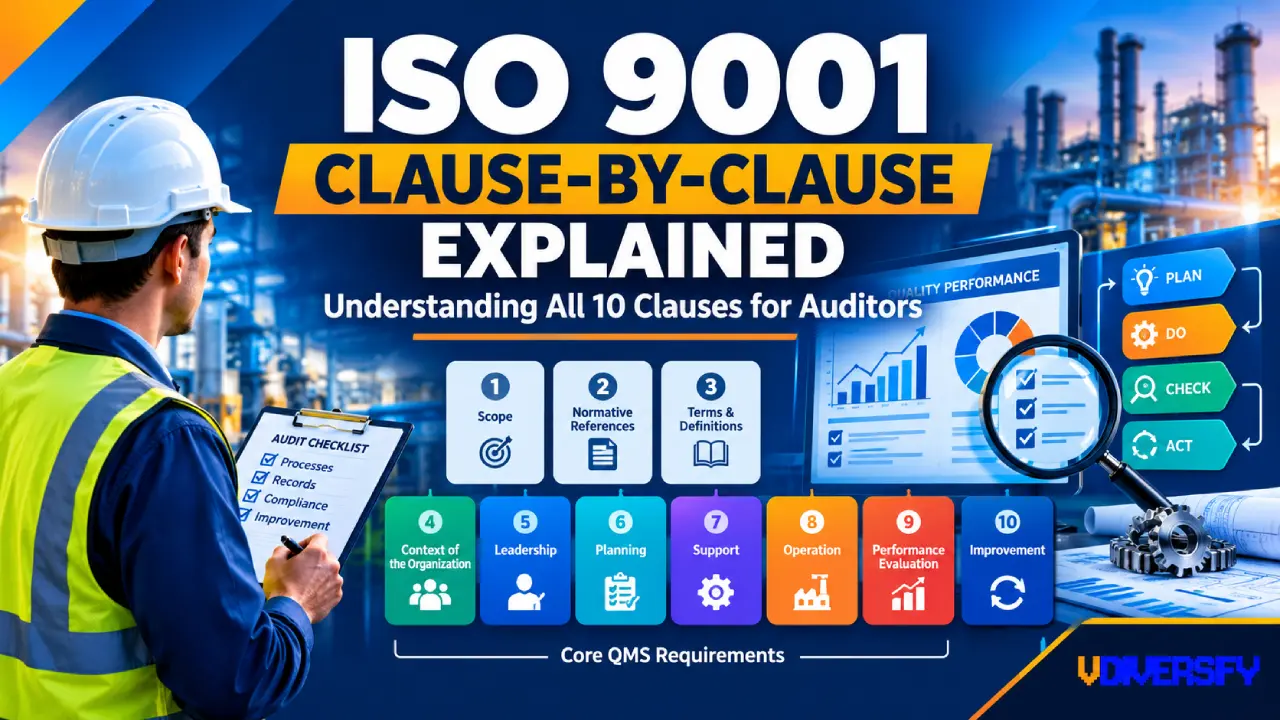
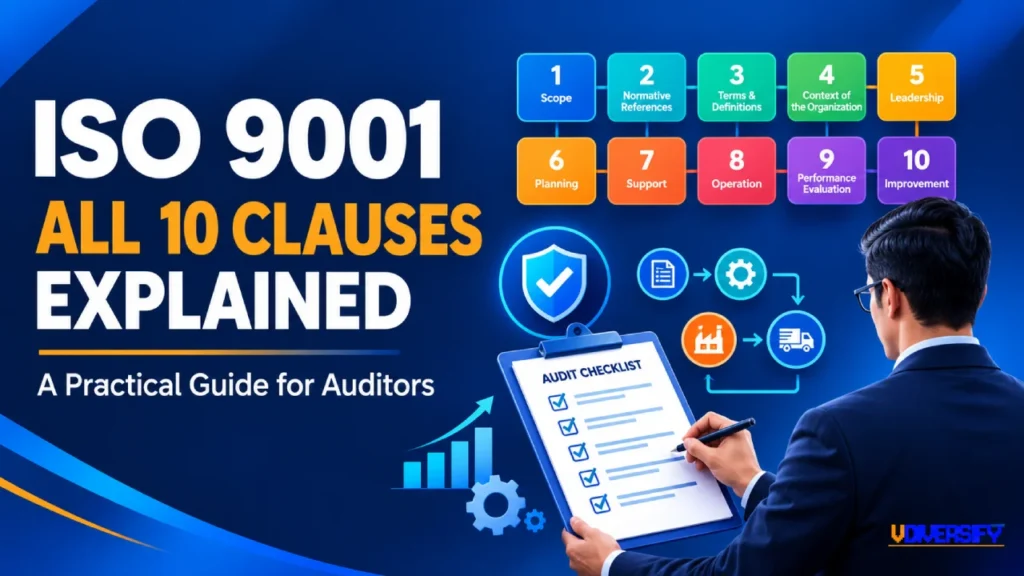
Understanding ISO 9001 clause by clause explained auditors is essential for anyone who needs to assess a quality management system (QMS), prepare for a certification audit, or improve the way an organization manages quality.
ISO 9001 provides a structured approach to meeting customer requirements, controlling business processes, managing risks, and improving performance. However, knowing the clause titles alone is not enough. Auditors must understand what each requirement means in practice, what evidence to collect, and how to decide whether a process is effective.
For example, a manufacturing company may have approved procedures, inspection records, and a quality policy but still experience repeated product defects. An effective audit goes beyond checking whether documents exist. It examines whether employees follow the defined processes, whether controls work as intended, and whether management takes action when performance falls short.
This guide explains all 10 clauses, with practical examples, audit questions, evidence to review, and common problems that quality professionals encounter in real workplaces.
Contents
- 1. What Is ISO 9001, and Why Do Its Clauses Matter?
- 2. ISO 9001 Clauses Overview: Understanding the 10-Clause Structure
- 3. Clause 4: Context of the Organization
- 4. Clause 5: Leadership
- 5. Clause 6: Planning
- 6. Clause 7: Support
- 7. Clause 8: Operation
- 8. Practical Audit Trail: How to Audit Clause 8 Effectively
- 9. Clause 9: Performance Evaluation
- 10. Clause 10: Improvement
- 11. Practical ISO 9001 Auditor’s Checklist: All 10 Clauses
- 12. Audit preparation checklist
- 13. Common ISO 9001 Audit Mistakes to Avoid
- 14. Actionable Takeaways for ISO 9001 Auditors
- 15. Conclusion: Turning ISO 9001 Clauses Into Effective Auditing Practice
- 16. FAQs
What Is ISO 9001, and Why Do Its Clauses Matter?
ISO 9001 is an international standard that specifies requirements for a quality management system. It helps organizations consistently provide products and services that meet customer requirements and applicable legal and regulatory requirements while improving customer satisfaction.
The standard can be applied to manufacturers, construction companies, engineering firms, healthcare-related service providers, software companies, logistics businesses, and other organizations, regardless of size.
According to the International Organization for Standardization (ISO), the 2026 edition was published on September 16, 2026. It builds on the established QMS framework, with clearer wording, a stronger focus on leadership and quality culture, greater clarity around risks and opportunities, and a new Annex A to explain the requirements.
For auditors, this update matters because an audit must use the applicable edition and audit criteria. Organizations certified to the previous edition should consult their certification body about the required transition arrangements.
ISO 9001 certification is not mandatory for every business. However, customers, suppliers, and other stakeholders may require it as evidence that an organization has a controlled approach to quality management.
ISO 9001 Clauses Overview: Understanding the 10-Clause Structure
The ISO 9001 clauses overview starts with an important distinction: the first three clauses establish the standard’s scope and supporting information, while Clauses 4 through 10 contain the main QMS requirements.
The structure helps organizations build a management system that connects business objectives with daily work, operational controls, performance measurement, and improvement.
Clause | Main subject | What auditors should focus on |
1 | Scope | Purpose and intended application of the standard |
2 | Normative references | Referenced standards, where applicable |
3 | Terms and definitions | Understanding key quality management terms |
4 | Context of the organization | Business conditions, interested parties, and QMS scope |
5 | Leadership | Management responsibility, policy, and accountability |
6 | Planning | Risks, opportunities, objectives, and planned changes |
7 | Support | Resources, competence, awareness, communication, and information |
8 | Operation | Product and service delivery controls |
9 | Performance evaluation | Monitoring, measurement, audits, and management review |
10 | Improvement | Nonconformities, corrective action, and continual improvement |
Note: This is a high-level learning overview. Auditors should consult the official ISO 9001:2026 text for the exact requirements, clause wording, and applicable subclauses.
What Is the High-Level Structure in ISO 9001?
The high level structure ISO approach was designed to make it easier to align management system standards around common elements, such as organizational context, leadership, planning, support, operations, evaluation, and improvement.
The 2026 edition retains the familiar 10-clause framework while refining the wording and guidance. This shared structure also helps organizations integrate quality management with other systems, such as environmental or occupational health and safety management, where appropriate.
For auditors, the practical lesson is simple: audit the management system as a connected set of processes, not as ten isolated sections in a manual.
Consider a company that frequently delivers products late. The problem might appear to belong to Clause 8, which addresses operations. However, the root cause could involve poor risk planning under Clause 6, inadequate employee competence under Clause 7, weak performance monitoring under Clause 9, or ineffective corrective action under Clause 10.
A good auditor follows the evidence across these connections.
Clause 4: Context of the Organization
Clause 4 establishes the foundation of the quality management system. Before an organization can control its processes effectively, it must understand its business environment, relevant interested parties, and the boundaries of its QMS.
The requirements under clause 4 context organization help ensure that the system reflects the organization’s actual operations rather than being a collection of generic procedures.
4.1 Understanding the Organization and Its Context
The organization needs to identify internal and external issues that can affect its ability to achieve the intended results of its QMS.
Internal issues may include:
- Employee skills and experience.
- Equipment condition and production capacity.
- Organizational structure and responsibilities.
- Process performance and existing quality problems.
- Company culture and available resources.
External issues may include:
- Customer expectations and market changes.
- Applicable laws and regulations.
- Supplier reliability and supply chain disruptions.
- Technological developments.
- Economic conditions and competition.
The organization should also consider whether climate change is a relevant issue for its QMS, as addressed by the applicable climate-related requirements.
Practical example: A US-based manufacturer of precision metal parts depends on a single supplier for a critical alloy. If that supplier experiences repeated delivery delays, the manufacturer may struggle to meet customer commitments. The organization should recognize the supply risk and consider suitable controls.
An auditor should ask how management identifies and reviews relevant issues. Evidence might include business reviews, risk assessments, meeting records, customer feedback, supplier performance data, and documented planning activities.
A SWOT analysis can be useful, but ISO 9001 does not require a particular analysis tool. The focus is on whether the organization understands the issues that matter and uses that understanding when managing its QMS.
4.2 Understanding the Needs and Expectations of Interested Parties
Interested parties are people or organizations that can affect, be affected by, or perceive themselves to be affected by the QMS. Relevant parties may include customers, employees, regulators, owners, suppliers, and business partners.
The organization must determine which parties are relevant and which of their requirements are relevant to the QMS.
For example, a medical device component supplier may need to consider customer specifications, applicable regulatory requirements, delivery commitments, and material traceability requirements.
An auditor should verify that these requirements are identified and communicated to the people responsible for meeting them.
Common audit concern: A company maintains a list of interested parties but cannot explain how their requirements influence its processes. This may indicate that the information is not being used effectively.
4.3 Determining the Scope of the Quality Management System
The QMS scope defines the organizational activities, products, services, and boundaries covered by the system.
For example, a company may manufacture components at two facilities but provide installation services only from its main location. Its scope must accurately describe the activities covered by the QMS and be consistent with the applicable requirements.
Auditors should check whether the scope reflects actual operations, customer commitments, and relevant requirements. They should also investigate whether any claimed exclusions or non-applicable requirements are justified under the standard.
A scope statement must not be used to hide activities that affect product or service conformity.
4.4 The Quality Management System and Its Processes
The organization must establish, implement, maintain, and improve its QMS, including the processes needed and their interactions.
An auditor should understand how inputs, activities, outputs, responsibilities, resources, and controls connect across the business.
For instance, a typical manufacturing process may involve contract review, purchasing, incoming inspection, production, final inspection, packaging, and delivery. A failure in purchasing can affect production, while a weak final inspection can allow defective products to reach customers.
Useful audit evidence includes:
- Process maps and flowcharts.
- Defined process responsibilities.
- Performance indicators and targets.
- Inspection and verification records.
- Records showing how process problems are addressed.
The goal is not to demand a separate procedure for every activity. The goal is to determine whether the processes are defined and controlled well enough to achieve the required results.
Clause 5: Leadership
Clause 5 makes it clear that quality management is not solely the responsibility of the quality department. Top management must demonstrate leadership, take accountability for the QMS, and support a culture in which quality requirements are understood and followed.
The subject of clause 5 leadership ISO is particularly important during audits because management decisions affect resources, priorities, responsibilities, and the way employees respond to quality problems.
5.1 Leadership and Commitment
Top management must demonstrate that the QMS supports the organization’s business direction and that its requirements are integrated into relevant business processes.
Auditors should look for practical evidence of leadership, including:
- Management decisions based on quality performance.
- Resources allocated to important quality activities.
- Follow-up on customer complaints and recurring defects.
- Communication of quality priorities.
- Support for process owners and improvement actions.
Example: A production line repeatedly fails to meet dimensional requirements. The quality manager requests a machine upgrade, but management postpones the decision without assessing the risk. An auditor may investigate whether management has evaluated the issue, provided appropriate resources, and taken responsibility for ensuring effective controls.
The auditor should not judge leadership only by whether executives attend quality meetings. The stronger question is whether their actions support the effectiveness of the QMS.
5.2 Establishing and Communicating the Quality Policy
The quality policy sets the overall direction for quality management. It should be appropriate to the organization’s purpose and context, support its strategic direction, provide a framework for quality objectives, and include the required commitments.
Employees should understand how the policy relates to their work.
For example, a company policy may emphasize meeting customer requirements, controlling manufacturing processes, developing employee competence, and continually improving performance. A machine operator should be able to explain how following work instructions and reporting defects supports these commitments.
Auditors can review the policy, interview employees, and check whether the policy is communicated and available as required.
A policy displayed on a wall is not sufficient evidence of effective implementation if employees cannot connect it to their daily responsibilities.
5.3 Roles, Responsibilities, and Authorities
Responsibilities and authorities must be assigned, communicated, and understood.
A manufacturing organization, for example, should establish who approves product release, who handles nonconforming outputs, who monitors supplier performance, and who reports QMS performance to management.
Auditors may examine job descriptions, responsibility matrices, organizational charts, process ownership records, and employee interviews.
Common nonconformity: Employees disagree about who has the authority to stop production when a critical defect is found. This uncertainty can lead to inconsistent decisions and allow nonconforming products to move further through the process.
The key audit question is whether responsibilities are clear and whether people have the authority needed to carry them out.
Clause 6: Planning
Clause 6 explains how an organization plans to achieve its quality objectives, address risks and opportunities, and manage changes that may affect its quality management system.
Effective clause 6 planning quality means identifying potential problems before they affect customers, deciding what actions are needed, and checking whether those actions work. Planning should connect directly to the organization’s context, customer requirements, and operational activities.
6.1 Actions to Address Risks and Opportunities
Organizations must determine the risks and opportunities that need to be addressed to ensure the QMS achieves its intended results, enhance desirable effects, prevent or reduce undesired effects, and achieve improvement.
The approach should match the nature and complexity of the business. ISO 9001 does not require every organization to use a formal risk register or a particular scoring method.
Example: A supplier of machined components identifies that an aging CNC machine could cause dimensional defects and unplanned downtime. The company may introduce preventive maintenance, increase inspections for critical dimensions, or plan equipment replacement.
Auditors should verify:
- Whether relevant risks and opportunities have been identified.
- Whether planned actions are appropriate to their potential effects.
- Whether actions have been integrated into business processes.
- Whether their effectiveness is evaluated.
Useful evidence includes maintenance records, risk assessments, action plans, supplier evaluations, process monitoring data, and management meeting minutes.
A risk register alone does not prove effective risk management. The auditor must check whether the organization has taken suitable action and evaluated the results.
6.2 Quality Objectives and Planning to Achieve Them
Organizations must establish quality objectives at relevant functions, levels, and processes. Objectives should meet the applicable requirements, be consistent with the quality policy, be measurable where practicable, and be monitored, communicated, and updated as appropriate.
Examples of useful quality objectives include:
- Reduce internal rejection rates from 4% to 2% within six months.
- Achieve at least 98% on-time delivery.
- Reduce customer complaints by 20% over the next year.
- Complete 95% of planned employee competency training on schedule.
These figures are illustrative targets, not ISO-mandated performance levels.
The organization must also plan how objectives will be achieved, including the necessary actions, resources, responsibilities, timing, and evaluation of results.
Auditor’s example: A company has a target to reduce customer complaints by 20%, but it has no assigned owner, action plan, or performance review. The auditor should investigate whether the organization has adequately planned how to achieve the objective.
6.3 Planning of Changes
Changes to the QMS should be planned and controlled so that the system remains effective.
Changes might involve new production equipment, revised customer specifications, a new supplier, organizational restructuring, software upgrades, or changes to inspection methods.
For example, when a manufacturer installs an automated inspection system, it should consider validation, employee training, measurement reliability, process responsibilities, and the effect on existing controls.
Auditors should examine whether the organization considered the purpose of the change, its possible consequences, resource availability, and the allocation of responsibilities.
Common audit mistake: The auditor checks only whether a change approval form exists. A stronger audit follows the change into actual operations and verifies whether the intended controls were implemented.
References for this section
- Official ISO 9001:2026 standard — the authoritative source for current requirements.
- ISO 9001 Auditing Practices Group — guidance on process-based auditing, risk-based thinking, audit evidence, and related topics.
Clause 7: Support
Clause 7 covers the resources and supporting activities an organization needs to operate its quality management system effectively. Even when a company has clear processes and capable managers, quality problems can occur if employees lack the required skills, equipment is unsuitable, measuring devices are unreliable, or important information is not properly controlled.
The support requirements connect people, infrastructure, the working environment, monitoring resources, organizational knowledge, communication, and documented information. For auditors, the key task is to determine whether the organization provides and maintains the support needed to achieve consistent product and service conformity.
7.1 Resources
Organizations must determine and provide the resources needed to establish, implement, maintain, and continually improve the QMS.
Resources include people, infrastructure, the environment needed for process operation, monitoring and measuring resources, and organizational knowledge.
7.1.1 General Resources
Auditors should examine whether the organization has assessed its resource needs and whether those resources are available when required.
For example, a company may have enough employees to operate its production lines but lack trained personnel to perform final inspections during the night shift. This gap could affect product release and customer satisfaction.
Useful evidence includes resource plans, staffing records, maintenance schedules, equipment lists, and discussions with process owners.
7.1.2 People
The organization must determine and provide the people necessary for effective implementation of its QMS and for the operation and control of its processes.
An auditor should consider whether staffing levels, responsibilities, and employee availability support the work being performed.
For instance, if one qualified inspector must approve products from three production lines simultaneously, the auditor should investigate whether inspection requirements can realistically be met without delays or missed checks.
7.1.3 Infrastructure
Infrastructure may include buildings, utilities, equipment, information systems, transportation resources, and supporting services.
A manufacturing company should maintain its machines, production areas, software, and utilities so that they remain suitable for their intended use.
Example: A temperature-controlled storage area is used for materials that must remain within a defined temperature range. If its cooling system fails and no suitable monitoring or response process exists, material conformity may be at risk.
Auditors can review equipment maintenance records, breakdown reports, infrastructure inspections, and service schedules.
7.1.4 Environment for the Operation of Processes
The organization must determine, provide, and maintain the environment needed to operate its processes and achieve product and service conformity.
Depending on the work, this may involve temperature, humidity, lighting, cleanliness, noise, ergonomics, or human factors.
For example, a laboratory performing dimensional inspections may need stable environmental conditions to obtain reliable measurements. A poorly lit inspection area may increase the risk of visual inspection errors.
The auditor should establish which conditions matter and whether the organization controls them effectively.
7.1.5 Monitoring and Measuring Resources
Organizations must determine and provide suitable resources for monitoring and measuring activities when these activities are needed to verify product or service conformity.
Where measurement traceability is required, or is considered essential to provide confidence in measurement results, the organization must ensure that the relevant measuring equipment is calibrated or verified at specified intervals or before use, as appropriate, against suitable measurement standards.
If no suitable standard exists, the basis used for calibration or verification must be retained as documented information.
Consider a US machine shop producing shafts with a specified diameter of 25.00 mm ± 0.02 mm. If the micrometer used for acceptance inspection is out of calibration, the company may accept parts that do not meet the customer’s specification.
Auditors should review:
- Equipment identification and calibration status.
- Calibration or verification records.
- Suitability of measurement ranges and accuracy.
- Actions taken when equipment is found unsuitable.
- The assessment of previous measurement results where necessary.
Calibration stickers alone are not enough. The auditor should verify that the measuring equipment is appropriate for the measurement and that the organization responds effectively to calibration failures.
7.1.6 Organizational Knowledge
Organizations must determine the knowledge necessary for operating their processes and achieving product and service conformity. This knowledge must be maintained and made available to the extent necessary.
Sources may include employee experience, process instructions, technical drawings, customer specifications, lessons learned, supplier information, and previous corrective actions.
Example: An experienced machinist knows how a particular material behaves during cutting. If the employee leaves without transferring that knowledge, production defects may increase.
Auditors can ask how the organization captures critical knowledge, trains replacements, updates work instructions, and shares lessons learned.
7.2 Competence
Employees performing work that affects quality must be competent based on appropriate education, training, or experience.
The organization must determine the necessary competence, take appropriate actions to acquire it where needed, evaluate the effectiveness of those actions, and retain suitable documented information as evidence of competence.
A training attendance sheet does not automatically prove competence.
For example, an employee may attend a course on using a coordinate measuring machine but still be unable to interpret measurement results correctly. The organization may need a practical assessment, supervised work, or another suitable method to verify competence.
Auditors should review:
- Job-specific competency requirements.
- Training and qualification records.
- Practical assessments or authorization records.
- Evidence of effectiveness after training.
- Actions taken when competence gaps are identified.
Common nonconformity: An employee performs a special inspection activity without the required qualification, and the organization cannot demonstrate competence.
The auditor should establish the applicable requirement and collect evidence before determining whether a nonconformity exists.
7.3 Awareness
People doing work under the organization’s control must be aware of the quality policy, relevant quality objectives, their contribution to QMS effectiveness, and the implications of not conforming to QMS requirements.
Auditors can use employee interviews to determine whether awareness exists in practice.
For example, an operator should understand why a particular inspection must be completed before a part moves to the next production stage. The employee does not need to recite the entire quality policy word for word, but should understand the relevant quality responsibilities.
A useful audit question is: “What would you do if you discovered a defect in the product you are processing?”
The response can help the auditor understand whether the employee knows how to identify, report, and control nonconforming output.
7.4 Communication
The organization must determine the internal and external communications relevant to its QMS, including what to communicate, when to communicate, with whom, how, and who is responsible.
Relevant communication may include:
- Customer changes to product specifications.
- New or revised work instructions.
- Supplier quality concerns.
- Changes in inspection requirements.
- Customer complaints and corrective actions.
- Quality performance and improvement priorities.
Practical example: A customer changes a packaging requirement, but the updated specification reaches the sales department and not the warehouse. The shipment may be rejected even though the product itself meets its technical requirements.
An auditor should trace the information from its source to the employees and processes that need it. Evidence may include email records, meeting minutes, change notices, customer portals, and revision acknowledgments.
7.5 Documented Information
Documented information includes documents that explain how work should be performed and records that demonstrate what actually happened.
ISO 9001 does not require every organization to maintain a large quality manual or create a separate procedure for every process. The organization determines the documented information needed to support effective process operation and demonstrate conformity, subject to the standard’s specific requirements.
Auditors should examine document creation, approval, revision, access, distribution, storage, preservation, retention, and disposal where applicable.
For example, if a production operator uses an obsolete drawing, the organization may manufacture a product to an outdated specification.
A practical document-control audit includes checking whether:
- Employees can access the correct revisions.
- Changes are reviewed and approved as appropriate.
- Records remain legible and retrievable.
- Confidential information is protected where necessary.
- Required records are retained for suitable periods.
Key distinction: A procedure describes an intended method of working; a record provides evidence of an activity or result. Both can be important, but they serve different purposes.
Clause 8: Operation
Clause 8 is one of the most important parts of ISO 9001 for auditors because it covers the processes used to deliver products and services. It addresses customer requirements, design and development, purchasing, production, service provision, product release, and control of nonconforming outputs.
The operation ISO requirements help ensure that products and services meet defined requirements before they reach customers. The exact controls depend on the organization’s activities, the risks involved, and the requirements that apply to its products and services.
An auditor should not limit the audit to reviewing procedures. The auditor should follow a product, service, or transaction through the relevant processes and compare the organization’s documented arrangements with actual working practices. This process-based approach is also emphasized in the ISO 9001 Auditing Practices Group guidance.
8.1 Operational Planning and Control
Organizations must plan, implement, and control the processes needed to meet product and service requirements and implement the actions identified during planning.
Operational planning may include defining specifications, acceptance criteria, process controls, resources, inspection requirements, and the documented information needed to demonstrate conformity.
Example: A US-based manufacturer receives an order for 5,000 precision-machined components. Before production starts, the company must understand the approved drawing, material grade, tolerances, delivery date, inspection requirements, and any special packaging instructions.
The organization should then establish the necessary controls to produce and verify the components.
Auditors should examine:
- Approved specifications and production instructions.
- Process parameters and acceptance criteria.
- Inspection and testing plans.
- Production and service records.
- Evidence that planned changes were controlled.
- Records showing that outsourced activities are appropriately controlled.
A useful audit technique is to select a completed order and trace it from the original customer requirement to delivery. This can reveal gaps that a document-only audit might miss.
8.2 Requirements for Products and Services
This section focuses on understanding customer requirements, communicating with customers, reviewing orders, and controlling changes to agreed requirements.
8.2.1 Customer Communication
Organizations must establish effective arrangements for communicating with customers about relevant matters.
These may include product information, inquiries, quotations, orders, order changes, feedback, complaints, and the handling or control of customer property where relevant.
For example, a customer may request a change in packaging after an order has entered production. The organization needs a reliable way to communicate the change to production, quality, purchasing, and shipping personnel where necessary.
Auditors can review customer emails, order records, complaint logs, and change notifications.
8.2.2 Determining Product and Service Requirements
Before committing to supply products or services, the organization must determine the applicable requirements.
These may include:
- Customer specifications and drawings.
- Delivery and packaging requirements.
- Applicable statutory and regulatory requirements.
- Requirements necessary for the intended use, when known.
- Additional requirements determined by the organization.
Practical example: A construction supplier receives an order for structural steel components. The requirements may include material grade, dimensions, traceability, inspection documentation, delivery dates, and applicable project specifications.
If the company considers only the price and delivery date, it may miss requirements that affect conformity or acceptance.
The auditor should determine whether relevant requirements are identified and understood before the organization commits to supply.
8.2.3 Review of Product and Service Requirements
The organization must review requirements before committing to supply, as applicable, and resolve differences between contract or order requirements and previously stated requirements.
It must also ensure that it can meet the requirements it accepts.
Evidence may include contract reviews, quotation approvals, feasibility assessments, technical reviews, and records of resolved differences.
Common nonconformity: A company accepts a customer order requiring a tolerance that its current equipment cannot consistently achieve. No feasibility review is performed, and the problem is discovered only after production begins.
An auditor should establish whether the organization has an effective review process and whether the accepted requirements can be met.
8.2.4 Changes to Requirements
When product or service requirements change, the organization must ensure relevant documented information is updated and that relevant personnel are made aware of the changed requirements.
For example, a revised drawing may change a hole diameter from 10 mm to 12 mm. If production continues using the old drawing, the resulting parts may be rejected.
Auditors should follow the change from customer approval through internal communication, document revision, production implementation, and final verification.
8.3 Design and Development of Products and Services
Clause 8.3 applies when the organization is responsible for designing and developing products or services. It may not apply to an organization that performs only production to fully specified customer designs, provided the non-applicability is justified and the remaining applicable requirements are met.
Design and development controls help ensure that customer needs are translated into suitable designs and that the resulting products or services meet their intended requirements.
8.3.1 General Design and Development Controls
The organization must establish a design and development process appropriate to the products and services it provides.
For example, a company developing an industrial pump needs a controlled process for determining design inputs, reviewing design outputs, verifying calculations, validating performance where required, and approving changes.
Auditors should establish whether design activities are planned and controlled rather than performed informally without sufficient review.
8.3.2 Design and Development Planning
Planning should consider the stages and controls involved, responsibilities, resources, internal and external interfaces, review and verification activities, validation requirements, and documented information.
For a new electronic control panel, planning might identify electrical design reviews, software testing, safety-related checks, prototype testing, and customer acceptance activities.
The auditor should check whether the planned controls are appropriate to the complexity and risks of the design.
8.3.3 Design and Development Inputs
Inputs must be determined, and the organization must consider applicable functional and performance requirements, information from previous designs where relevant, legal and regulatory requirements, applicable standards, and potential consequences of failure.
Inputs should be adequate for the intended design purpose, complete, and clear enough to support design activities.
Example: A customer requests a lifting device but provides only its required lifting capacity. The designer may also need to determine operating conditions, applicable safety requirements, environmental conditions, and relevant interface requirements before completing the design.
Auditors should look for evidence that necessary inputs were identified and that conflicting or incomplete requirements were addressed.
8.3.4 Design and Development Controls
The organization must apply suitable controls to evaluate whether design results can meet requirements, verify that design outputs meet input requirements, and validate that the resulting products or services can meet their intended use where applicable.
These activities serve different purposes:
- Design review: Evaluates whether the design is suitable and identifies problems.
- Verification: Checks whether design outputs meet specified design inputs.
- Validation: Confirms whether the resulting product or service meets requirements for its intended use.
For example, a manufacturer may verify a pressure vessel design through calculations and drawing reviews, then validate the finished design through appropriate testing.
Auditors should examine actual review, verification, validation, and approval records rather than relying only on a statement that these activities take place.
8.3.5 Design and Development Outputs
Design outputs must meet input requirements, be adequate for subsequent processes, include or reference monitoring and measuring requirements and acceptance criteria as appropriate, and specify the product or service characteristics essential for its intended purpose and safe, proper provision.
Examples include approved drawings, bills of materials, technical specifications, assembly instructions, software requirements, and inspection criteria.
The auditor should trace selected design outputs into purchasing, production, inspection, and delivery to confirm that the information is usable and controlled.
8.3.6 Design and Development Changes
Design changes must be identified, reviewed, and controlled to the extent necessary to prevent adverse effects on conformity.
For example, changing the material used in a component may affect strength, durability, manufacturing methods, and inspection requirements.
The organization should assess the consequences of the change and retain appropriate records of the review, authorization, and necessary actions.
A common problem is making an engineering change without updating related work instructions or supplier specifications.
8.4 Control of Externally Provided Processes, Products, and Services
Many organizations depend on external suppliers for raw materials, components, software, calibration, logistics, maintenance, and other services. Clause 8.4 requires suitable controls when externally provided outputs can affect conformity.
The organization must determine the controls to apply based on the effect of external provision on its ability to meet requirements.
8.4.1 General Requirements
The organization must ensure that externally provided processes, products, and services conform to requirements.
For example, a manufacturer may outsource heat treatment to a specialist supplier. The manufacturer remains responsible for ensuring that the supplied components meet applicable requirements.
Auditors should examine supplier approval, supplier performance, risk assessments, purchasing controls, incoming verification, and responses to supplier-related problems.
8.4.2 Type and Extent of Control
The organization must determine the controls applied to external providers and the controls applied to their outputs.
A supplier providing standard office supplies may require relatively simple controls. A supplier providing safety-critical components may require more detailed qualification, technical review, traceability, inspection, or testing.
The controls should reflect the potential effect of the purchased output on quality.
Example: A company repeatedly receives steel bars with incorrect material certificates. If purchasing continues to approve the supplier without reviewing performance or taking appropriate action, the organization’s supplier control process may be ineffective.
8.4.3 Information for External Providers
The organization must ensure that purchasing requirements are adequate before communicating them to suppliers.
Where applicable, purchasing information may include product specifications, drawings, approval requirements, competence requirements, inspection arrangements, and requirements for verification or validation.
A clear purchase order can prevent confusion about material grades, dimensions, certification requirements, and delivery conditions.
Auditors should compare purchase orders with customer specifications and approved technical requirements to determine whether relevant information is communicated accurately.
8.5 Production and Service Provision
This section addresses the conditions required to carry out production and service activities under controlled conditions.
8.5.1 Control of Production and Service Provision
Controlled conditions may include the availability of documented information, suitable equipment, monitoring and measuring resources, competent personnel, process monitoring, and release or delivery arrangements.
For example, a machine shop may use approved setup sheets, qualified operators, preventive maintenance, in-process inspection, and defined reaction plans when measurements fall outside acceptance limits.
Auditors should observe the process, interview operators, and compare actual practices with the defined controls.
Important questions include:
- Are current specifications available at the point of use?
- Are operators competent for their assigned tasks?
- Are required process parameters monitored?
- Are acceptance criteria clear?
- What happens when a process goes outside its limits?
8.5.2 Identification and Traceability
Organizations must use suitable means to identify outputs when necessary to ensure conformity.
Where traceability is a requirement, the organization must control unique identification and retain the documented information necessary to enable traceability.
For example, a company manufacturing components for aerospace applications may need to connect each batch to material certificates, production records, inspection results, and the relevant customer order, according to applicable requirements.
Auditors can select a finished product and trace it backward to the raw material, production history, and inspection results. They can also trace a material batch forward to determine which products or customers may be affected if a defect is discovered.
8.5.3 Property Belonging to Customers or External Providers
Customer or external-provider property must be identified, verified, protected, and safeguarded while it is under the organization’s control or being used.
This property may include physical materials, tooling, equipment, intellectual property, confidential information, or personal data.
Example: A customer supplies a specialized fixture for production. If the fixture is damaged, the organization should report the issue to the customer and retain appropriate information about the event and subsequent action.
Auditors should examine how such property is identified, stored, protected, and reported when it is lost, damaged, or otherwise unsuitable for use.
8.5.4 Preservation
The organization must preserve outputs during production and service provision to the extent necessary to ensure conformity.
Preservation may include identification, handling, contamination control, packaging, storage, transportation, and protection.
For example, electronic components may require moisture-protective packaging, while finished metal parts may need corrosion protection.
Auditors should inspect storage conditions, packaging methods, handling instructions, stock rotation practices where relevant, and records of damage or deterioration.
8.5.5 Post-Delivery Activities
The organization must meet applicable requirements for post-delivery activities, considering customer requirements, legal and regulatory requirements, potential undesired consequences, the nature and intended use of the product or service, and customer feedback.
Post-delivery activities may include warranties, maintenance, technical support, product servicing, or handling field complaints.
For instance, an industrial equipment supplier may need a process for investigating recurring failures reported after installation.
The auditor should verify that applicable commitments are understood and that post-delivery problems are managed effectively.
8.5.6 Control of Changes
Changes to production or service provision must be reviewed and controlled to the extent necessary to ensure continuing conformity.
Examples include changing a machine setting, switching production lines, replacing a critical tool, modifying a service procedure, or changing a software configuration.
Auditors should verify that changes are authorized where required, relevant risks are considered, and the resulting process remains capable of meeting requirements.
8.6 Release of Products and Services
Before products or services are released to the customer, the organization must implement planned arrangements at appropriate stages to verify that requirements have been met.
Evidence of conformity with acceptance criteria must be retained, along with traceability to the person authorizing release where applicable.
For example, a manufacturer may require completed dimensional inspections, material verification, and final documentation review before a batch can be shipped.
An auditor should select released products and verify that required inspections were completed, acceptance criteria were met, and release authorization was provided.
Common nonconformity: A shipment was released before the required final inspection was completed, with no authorized exception or other applicable control.
The auditor should establish the facts and evaluate them against the relevant requirements before recording a finding.
8.7 Control of Nonconforming Outputs
Organizations must identify and control outputs that do not conform to requirements to prevent their unintended use or delivery.
Appropriate action may include correction, segregation, containment, suspension of delivery, informing the customer, or obtaining authorization for concession where permitted.
The organization must verify conformity when nonconforming outputs are corrected and retain the required documented information.
Example: During final inspection, an operator identifies 40 components with dimensions outside the specified tolerance. The organization should prevent their unintended release, determine an appropriate disposition, and record the relevant information.
Auditors should check whether:
- Nonconforming products are identified and controlled.
- Disposition decisions are authorized as required.
- Rework or correction is followed by appropriate verification.
- Customer concessions are handled appropriately.
- Records identify the nonconformity and actions taken.
A red rejection tag is useful, but it is not enough if rejected products remain accessible for shipment without effective controls.
Practical Audit Trail: How to Audit Clause 8 Effectively
A process-based audit connects evidence from different stages instead of treating each requirement as an isolated checklist item. The ISO 9001 Auditing Practices Group provides additional guidance on process-based auditing and the collection of objective evidence.
Consider an audit of a manufacturer that has received several customer complaints about incorrect dimensions.
- Start with the customer requirement
Review the approved drawing, order review, specified tolerances, and any customer changes.
- Observe the production process
Check the machine setup, operator instructions, process parameters, and actual working practices.
- Verify measurement and inspection
Review measuring equipment status, inspection results, acceptance criteria, and relevant records.
- Trace product release
Confirm that required inspections were completed and that nonconforming products were controlled.
- Follow the complaint
Determine whether the organization investigated the issue, contained affected products, and initiated suitable corrective action.
This audit trail may reveal that the problem is not simply an operator error. It could be caused by an outdated drawing, ineffective machine maintenance, unsuitable measurement equipment, weak inspection controls, or a failure to act on previous complaints.
The auditor should record the evidence, identify the applicable requirement, and determine whether the process conforms. A finding must be based on evidence rather than assumptions about what might have happened.
Authoritative References for Clauses 7 and 8
- ISO 9001:2026 — Official standard: The primary source for requirements and the current edition.
- ISO 9001 Auditing Practices Group: Free guidance for QMS auditors on process auditing, evidence collection, competence, resources, and other audit topics.
- ISO 9001:2026 — Information from ISO: Background on the revised standard and its purpose.
The essential lesson from Clauses 7 and 8 is that resources and operational controls must work together. Competent people, reliable equipment, clear requirements, controlled suppliers, and effective inspection help an organization prevent defects rather than simply detect them after they occur.
Clause 9: Performance Evaluation
Clause 9 explains how an organization determines whether its quality management system is working as intended. Having documented procedures, trained employees, and approved production processes is important, but these elements alone do not prove that the organization is achieving its quality objectives.
The organization must monitor, measure, analyze, and evaluate relevant performance. It must also conduct internal audits and management reviews to identify gaps, assess results, and decide where action is needed.
For auditors, clause 9 performance evaluation is especially useful because it connects daily operational results with management decisions. It helps answer three important questions: Is the organization achieving its intended results? Are its processes effective? Does management act when performance falls short?
9.1 Monitoring, Measurement, Analysis, and Evaluation
Organizations must determine what needs to be monitored and measured, the methods to use, when monitoring and measurement should occur, and when results should be analyzed and evaluated.
The measures selected should be relevant to the organization’s processes, products, services, and quality objectives.
Examples of useful quality performance indicators include:
- Customer complaint rate: Measures the frequency of reported customer problems.
- Defect rate: Shows the proportion of products or process outputs that fail defined requirements.
- First-pass yield: Measures the percentage of outputs that pass a process without rework.
- On-time delivery: Measures whether products or services are delivered as agreed.
- Supplier rejection rate: Helps assess the quality of externally provided materials.
- Corrective action closure: Tracks the completion of corrective actions, although closure alone does not establish effectiveness.
These are examples, not mandatory ISO 9001 metrics. Organizations should select indicators that provide useful information about their own processes and objectives.
Practical example: A US manufacturer sets an objective to reduce its internal rejection rate from 4% to 2%. Monthly production reports show that the rate has fallen to 3.8%, despite additional inspections. Management should investigate the causes rather than assume that the inspection process is sufficient.
An auditor can review the performance data, compare results with targets, interview process owners, and check whether the organization has analyzed the reasons for poor performance.
The auditor should also consider whether the data is reliable. If one department calculates defects per unit while another calculates defects per production batch, comparisons may be misleading.
9.1.2 Customer Satisfaction
The organization must monitor customers’ perceptions of how well their needs and expectations have been fulfilled. It must determine suitable methods for obtaining, monitoring, and reviewing this information.
Customer satisfaction information can come from several sources:
- Customer surveys and feedback.
- Complaints and warranty claims.
- Repeat orders and customer retention.
- Delivery performance.
- Product returns and service issues.
- Customer scorecards and formal reviews.
For example, a supplier may have a very low complaint rate but still lose customers because deliveries are consistently late. If management monitors only product defects, it may miss an important sign of customer dissatisfaction.
Auditors should check whether the organization has selected appropriate ways to monitor customer perceptions and whether it uses the results to improve performance.
Important distinction: A lack of complaints does not automatically prove high customer satisfaction. Customers may report problems through other channels or stop purchasing without submitting formal complaints.
9.1.3 Analysis and Evaluation
Organizations must analyze and evaluate appropriate data and information arising from monitoring and measurement.
This analysis helps determine whether products and services conform, customer satisfaction is improving, the QMS is effective, planned actions are working, suppliers are performing adequately, and improvements are needed.
Consider a company whose supplier rejection rate has increased over three consecutive months. A useful evaluation would examine supplier performance, material types, inspection results, production disruptions, and the actions already taken.
An auditor should ask not only whether the organization collects data, but also what decisions it makes from that data.
Useful evidence includes trend reports, performance dashboards, analysis records, meeting minutes, improvement plans, and documented actions taken in response to results.
9.2 Internal Audit
Internal audits help an organization determine whether its quality management system conforms to its own requirements and the applicable ISO 9001 requirements, and whether the system is effectively implemented and maintained.
Internal audits should be planned at appropriate intervals. The audit program should consider the importance of the processes concerned, changes affecting the organization, and the results of previous audits.
Planning an Internal Audit Program
An effective audit program identifies the processes or areas to be audited, relevant criteria and scope, responsibilities, methods, and reporting arrangements.
For example, a company experiencing repeated supplier-related defects may decide to audit purchasing and supplier control more frequently than a stable administrative process.
This does not mean that every process must be audited on the same schedule. The frequency and depth should be appropriate to the organization and its circumstances.
Auditors should verify whether the program reflects important risks, significant changes, previous findings, and process performance.
Auditor Competence and Impartiality
Internal auditors should be competent to perform the assigned audit activities. They should also conduct audits in an objective and impartial manner.
Where practical, auditors should not audit their own work. Organizations should establish arrangements that reduce conflicts of interest and support reliable findings.
For example, the person responsible for approving supplier invoices may not be the best choice to independently evaluate the effectiveness of that same approval process.
Auditor competence may be demonstrated through training, relevant experience, knowledge of audit methods, supervised audits, and evaluation of performance.
Conducting the Audit and Recording Findings
An internal audit should use objective evidence collected through interviews, observation, and examination of records.
A typical audit may include:
- Reviewing the applicable requirements and previous findings.
- Confirming the audit scope and criteria.
- Interviewing relevant employees.
- Observing the process being performed.
- Sampling records and comparing them with actual practice.
- Documenting evidence and reporting findings.
- Following up on required corrections and corrective actions.
Example: The audit plan states that incoming inspection must be completed before material is released to production. The auditor samples ten receipts and finds that three were released before inspection, with no applicable authorization or alternative control.
The auditor should record the relevant evidence, identify the requirement that was not met, and report the finding through the organization’s established process.
A well-written finding distinguishes between the requirement, the evidence, and the resulting statement of nonconformity. It should not rely on vague wording such as “quality control is poor.”
Following Up on Internal Audit Findings
The audit process should not end when the report is issued. The organization must take appropriate correction and corrective action, and verify the actions taken where required.
For example, if an audit identifies that obsolete work instructions are being used, the immediate correction may involve replacing the documents. Corrective action may also need to address why obsolete instructions remained available.
An auditor should check whether actions were completed and whether their effectiveness was evaluated.
9.3 Management Review
Top management must review the QMS at planned intervals to ensure its continuing suitability, adequacy, effectiveness, and alignment with the organization’s strategic direction.
Management review is an important link between operational performance and leadership decisions.
Management Review Inputs
The review must consider the inputs specified by the standard. These include the status of actions from previous reviews, changes in relevant internal and external issues, information about QMS performance and effectiveness, resource adequacy, the effectiveness of actions addressing risks and opportunities, and opportunities for improvement.
Performance information may include customer satisfaction, quality objectives, process results, product conformity, nonconformities, corrective actions, monitoring results, internal audit results, and supplier performance.
For example, a manufacturer may review rising warranty costs alongside supplier defects, internal rejection rates, and customer complaints. Looking at these results together can help management decide whether additional resources or process changes are necessary.
Auditors should examine whether the required inputs were considered, rather than merely checking whether a meeting took place.
Management Review Outputs
Management review outputs must include decisions and actions related to opportunities for improvement, the need for changes to the QMS, and resource needs, as applicable.
A useful management review record identifies decisions, assigned responsibilities, expected completion dates, and how progress will be monitored.
Common nonconformity: Management holds a meeting every quarter, but the records contain only general discussions and no evidence that required inputs were reviewed or that relevant decisions and actions were recorded.
The auditor should evaluate the actual review process against the applicable requirements. A formal meeting template is helpful, but its existence does not establish effective management review.
Clause 10: Improvement
Clause 10 focuses on how an organization responds when something goes wrong and how it improves the quality management system over time. A QMS should not simply detect defects or record complaints. It should help the organization correct problems, understand their causes, prevent recurrence, and improve the processes that affect customers.
The improvement ISO requirements are closely connected to Clauses 6, 8, and 9. Planning identifies risks, operational controls manage work, and performance evaluation identifies problems and trends. Clause 10 helps turn those findings into effective action.
10.1 General Improvement
Organizations must determine and select opportunities for improvement and implement necessary actions to meet customer requirements and enhance customer satisfaction.
Improvement opportunities may come from customer feedback, internal audits, process performance, supplier evaluations, employee suggestions, management reviews, and analysis of recurring problems.
For example, a packaging company may notice that operators repeatedly make the same labeling mistakes. Rather than relying only on additional final inspections, the company could simplify the labeling process, improve the interface used to generate labels, or introduce an effective verification step.
An auditor should determine whether the organization identifies relevant opportunities and takes suitable action. The objective is not to require a separate improvement project for every minor issue, but to establish whether improvement activities are appropriate to the organization’s needs and performance.
10.2 Nonconformity and Corrective Action
A nonconformity occurs when a requirement is not fulfilled. It may relate to a customer specification, an internal procedure, an applicable legal requirement, or an ISO 9001 requirement.
When a nonconformity occurs, the organization must react to it, control or correct it as appropriate, deal with its consequences, and evaluate the need for action to eliminate its cause so that it does not recur or occur elsewhere.
This requirement is central to effective quality management because correcting a defect is not always the same as correcting its cause.
Correction Versus Corrective Action
Term | Meaning | Practical example |
Correction | Fixes the detected problem | Rework a component with an incorrect dimension |
Containment | Prevents the problem from spreading | Hold the remaining batch for inspection |
Root cause analysis | Investigates why the problem occurred | Determine why the machine produced incorrect dimensions |
Corrective action | Addresses the cause to prevent recurrence | Repair a worn fixture and introduce an effective wear-check control |
Effectiveness verification | Checks whether the action worked | Review subsequent production results to confirm the defect has not recurred |
The methods shown are practical examples, not a mandatory sequence or prescribed set of tools for every nonconformity.
Step 1: React to the Nonconformity
The organization should control the immediate problem and deal with its consequences.
For example, if a shipment contains the wrong component, the company may stop further shipments, identify affected inventory, inform the customer where required, and determine whether previously delivered products are affected.
Auditors should check whether the response was appropriate to the nature and impact of the problem.
Step 2: Investigate the Cause
The organization must evaluate the need to eliminate the cause of the nonconformity. This includes reviewing the problem, determining its cause, and considering whether similar problems exist or could occur elsewhere.
Useful investigation methods may include:
- Five Whys analysis: Repeatedly asks why the problem occurred.
- Fishbone diagram: Organizes possible causes into categories.
- Pareto analysis: Helps identify the categories responsible for a large share of observed problems.
- Process observation: Examines how the work is actually performed.
- Data analysis: Looks for patterns across machines, shifts, products, and suppliers.
No single method is required for every case. The investigation should be appropriate to the problem.
Example: A company receives repeated complaints about damaged products. The first assumption is that warehouse employees handle products carelessly. Further investigation reveals that the packaging is not strong enough to protect the products during transportation.
Training warehouse employees alone may not address the cause. Revising the packaging specification and verifying its suitability may be more effective.
Step 3: Implement Corrective Action
After identifying the cause, the organization should implement suitable action and consider whether changes to processes, instructions, training, equipment, or controls are needed.
For example, if defects result from an ineffective machine setup method, corrective action might include revising the setup instructions, introducing a first-piece verification step, and confirming that operators can apply the revised method.
Auditors should verify that the action addresses the identified cause and is proportionate to the consequences of the nonconformity.
Step 4: Review Effectiveness
The organization must review the effectiveness of corrective action taken.
A closed action is not automatically an effective action. The organization needs appropriate evidence that the action has achieved its intended result.
For example, if a company introduces a new setup verification method to reduce dimensional defects, it may review subsequent inspection results, defect trends, and customer complaints over an appropriate period.
If the same problem continues, the organization may need to revisit its investigation and actions.
Common nonconformity: The corrective action record states that employees were retrained, but there is no evidence that the cause was understood or that the problem stopped recurring.
An auditor should assess the actual investigation, action, and effectiveness evidence rather than judge the process only by the completeness of the form.
10.3 Continual Improvement
Organizations must continually improve the suitability, adequacy, and effectiveness of their QMS.
Continual improvement does not mean that every process must show measurable improvement every month. It means the organization uses relevant information and opportunities to keep its QMS effective and suitable as circumstances change.
Examples include:
- Reducing unnecessary rework.
- Improving supplier reliability.
- Simplifying document control.
- Improving process capability.
- Reducing recurring customer complaints.
- Improving employee competence.
- Strengthening controls after significant process changes.
An auditor should examine whether improvement is supported by evidence, whether important opportunities are considered, and whether management uses performance information to make suitable decisions.
A company that consistently meets its targets may still identify opportunities to reduce waste, improve reliability, or make its processes more efficient.
Practical Example: Connecting Clauses 9 and 10
A US-based manufacturer discovers that customer complaints about damaged shipments have increased over three months.
- Clause 9: Management reviews complaint trends and delivery performance.
- Clause 10: The organization investigates the cause, implements corrective action, and evaluates effectiveness.
- Clause 7: Packaging knowledge, employee competence, and available resources may need review.
- Clause 8: Packaging and preservation controls may need to change.
- Clause 6: The organization may need to update its assessment of risks and opportunities.
This example shows why an effective QMS should be audited as a connected system. The complaint is the starting point, but the audit should follow the evidence through the processes involved.
Practical ISO 9001 Auditor’s Checklist: All 10 Clauses
The following checklist can help auditors prepare for internal audits, supplier assessments, or certification audit activities. It is a practical aid rather than a substitute for the official standard.
Audit preparation checklist
- Clause 1–3: Confirm scope, terminology, and applicable audit criteria.
- Clause 4: Check organizational context, interested parties, QMS scope, and process interactions.
- Clause 5: Verify leadership commitment, quality policy, and clear responsibilities.
- Clause 6: Review risks, opportunities, quality objectives, and planned changes.
- Clause 7: Check resources, competence, awareness, communication, and documented information.
- Clause 8: Trace customer requirements, suppliers, production or service controls, release, and nonconforming outputs.
- Clause 9: Review performance data, customer satisfaction, internal audits, and management review.
- Clause 10: Verify correction, cause analysis, corrective action, effectiveness, and improvement.
Use this as a preparation aid. Marking an item does not establish conformity; each conclusion requires suitable audit evidence.
How to Record an ISO 9001 Audit Finding
A clear audit finding should connect three elements:
- Requirement: Identify the applicable requirement in the audit criteria.
- Objective evidence: State what was observed, reviewed, or confirmed.
- Nonconformity statement: Explain how the evidence demonstrates that the requirement was not fulfilled.
For example:
- Requirement: The organization’s approved process requires inspection before material release.
- Evidence: Three sampled material receipts were released to production before the required inspection was completed.
- Finding: The organization did not consistently implement its defined incoming inspection controls before releasing material to production.
The wording should be adapted to the actual evidence and applicable requirements. Auditors should avoid overstating the scope of a problem based on a small sample or assuming a root cause before the organization has investigated it.
The ISO 9001 Auditing Practices Group provides additional guidance on evidence collection and writing audit reports.
Common ISO 9001 Audit Mistakes to Avoid
Even experienced auditors can miss important issues when they focus too heavily on paperwork or treat the clauses as separate compliance exercises.
1. Checking Documents Without Observing the Process
A procedure may describe the correct method, but employees may follow a different method in practice.
Better approach: Observe the work, interview employees, and compare actual practices with the applicable requirements.
2. Using a Checklist Without Following the Evidence
A checklist helps maintain coverage, but it should not prevent the auditor from investigating unexpected findings.
Better approach: Follow relevant evidence across departments and processes. A customer complaint may lead to purchasing, production, inspection, training, and corrective action records.
3. Treating Every Problem as an Employee Error
Blaming an operator can overlook poor instructions, unsuitable equipment, unrealistic workloads, unclear responsibilities, or ineffective process controls.
Better approach: Examine the process and available evidence before reaching a conclusion about the cause.
4. Confusing Correction With Corrective Action
Reworking a defective part fixes the immediate problem, but it may not prevent the same defect from occurring again.
Better approach: Check whether the organization evaluated the cause, implemented suitable action, and reviewed effectiveness where required.
5. Demanding Documents That ISO 9001 Does Not Require
Auditors should not automatically demand a quality manual, a particular risk matrix, or a separate procedure for every activity unless there is a relevant requirement or another applicable obligation.
Better approach: Evaluate whether the organization meets the actual requirements and has enough documented information to operate its processes and demonstrate conformity.
6. Ignoring the Effectiveness of Management Decisions
Management meetings, action plans, and quality targets do not automatically prove that the QMS is effective.
Better approach: Follow decisions through to implementation and review relevant results.
7. Using the Wrong Edition of the Standard
The applicable audit criteria must reflect the edition and requirements relevant to the audit.
As of October 2026, ISO 9001:2026 is the published edition. Organizations certified to ISO 9001:2015 should consult their certification body and the applicable transition guidance to plan their transition. ISO’s published transition information identifies September 30, 2029, as the deadline for existing ISO 9001:2015-certified organizations to complete the transition.
Better approach: Confirm the applicable edition, certification status, audit scope, and transition arrangements before planning the audit.
Actionable Takeaways for ISO 9001 Auditors
Use these points when preparing for an audit, evaluating a QMS, or helping an organization improve its quality processes.
- Understand the business first. Learn how the organization operates, what its customers require, and which processes have the greatest effect on quality.
- Confirm the audit criteria. Verify the applicable edition of ISO 9001, the audit scope, and relevant customer or regulatory requirements.
- Follow process interactions. Trace how information, materials, responsibilities, and decisions move between departments.
- Collect objective evidence. Use records, interviews, observations, and measurements to support audit conclusions.
- Check actual implementation. Compare documented arrangements with the way work is performed.
- Evaluate risks and opportunities. Determine whether the organization has identified relevant issues and taken appropriate action.
- Review competence and resources. Confirm that employees, equipment, information, and working conditions support process conformity.
- Follow customer complaints. Trace complaints through investigation, containment, corrective action, and effectiveness review.
- Assess management involvement. Check whether management reviews performance, provides resources, and acts on important problems.
- Write clear findings. Identify the requirement, record the evidence, and explain the specific gap without making unsupported assumptions.
- Verify corrective action. Check whether actions address the cause and whether their effectiveness has been evaluated.
- Look for improvement opportunities. Identify ways to strengthen process control and prevent recurring problems without confusing recommendations with formal nonconformities.
For organizations preparing for certification, a useful next step is to perform a gap assessment against the applicable edition of ISO 9001. This helps identify where existing practices meet the requirements, where additional controls may be needed, and which improvements should receive priority.
Conclusion: Turning ISO 9001 Clauses Into Effective Auditing Practice
Understanding all ten ISO 9001 clauses is the starting point for effective quality management system auditing. The real value comes from understanding how the requirements work together and how they affect everyday business operations.
Clauses 1 through 3 establish the standard’s scope and supporting information. Clause 4 establishes the organizational context, Clause 5 addresses leadership, Clause 6 covers planning, Clause 7 provides support, and Clause 8 controls operational activities. Clause 9 evaluates performance, while Clause 10 focuses on improvement and corrective action.
For auditors, the most important lesson is to follow the evidence, not just the paperwork. An effective audit examines whether processes are implemented, whether controls achieve their intended results, whether customer requirements are met, and whether the organization responds effectively when problems occur.
Quality professionals should also keep their knowledge current. With ISO 9001:2026 now published, organizations and auditors should review the official requirements and understand the transition arrangements that apply to their certification or audit activities.
Ultimately, a good audit should do more than identify gaps. It should provide a reliable picture of QMS effectiveness and help the organization understand where its processes need attention. When auditing is based on sound evidence, clear requirements, and an understanding of process interactions, it becomes a valuable tool for better quality, stronger customer confidence, and lasting business improvement.
References and Further Reading
- ISO 9001:2026 — Quality management systems: Requirements: Official ISO standard
- ISO 9001:2026 — What’s new and why it matters: ISO overview of the 2026 edition
- ISO 9001 Auditing Practices Group: Official auditing guidance
- Guidance on Internal Audits: ISO/IAF Auditing Practices Group PDF
- Guidance on Evidence Collection: ISO/IAF Auditing Practices Group PDF
- Guidance on Audit Reports: ISO/IAF Auditing Practices Group PDF
FAQs
1. What are the 10 clauses of ISO 9001?
The standard contains ten main clauses: Scope, Normative References, Terms and Definitions, Context of the Organization, Leadership, Planning, Support, Operation, Performance Evaluation, and Improvement. Clauses 4 through 10 contain the main QMS requirements, while Clauses 1 through 3 provide the scope and supporting information.
2. Which ISO 9001 clauses are most important for auditors?
All applicable requirements matter, but Clauses 4 through 10 form the core of a QMS audit. Clause 4 establishes the organizational context, Clause 5 addresses leadership, Clause 6 covers planning, Clause 7 provides support, Clause 8 controls operations, Clause 9 evaluates performance, and Clause 10 addresses improvement.
Auditors should consider how these clauses interact rather than ranking one clause as universally more important than another.
3. What is the difference between ISO 9001:2015 and ISO 9001:2026?
ISO 9001:2026 is the latest published edition and builds on the established QMS framework. ISO describes updates intended to improve clarity and usability, strengthen the focus on leadership, quality culture, and accountability, clarify risk and opportunity management, and provide a new Annex A explaining key terms and the intent of requirements.
Organizations should use the official 2026 text to understand the precise changes.
4. Does ISO 9001 require a quality manual?
Do not assume that a quality manual is mandatory. Organizations must maintain and retain the documented information required by the applicable standard and determine what additional documentation is necessary for effective process operation.
A quality manual can be useful, particularly in a complex organization, but auditors should evaluate the actual requirements rather than demand a particular document format without justification.
5. What is objective evidence in an ISO 9001 audit?
Objective evidence is information that supports an auditor’s evaluation against defined audit criteria. It can include records, observations, measurements, approved documents, system data, and relevant employee statements that are corroborated as appropriate.
For example, an inspection record can demonstrate a measurement result, while direct observation can help establish whether the required inspection process is followed.
6. How do auditors identify an ISO 9001 nonconformity?
Auditors compare the applicable requirement with objective evidence. When the evidence demonstrates that a requirement has not been fulfilled, the auditor records a clear finding that identifies the requirement and explains the observed gap. Findings should be factual, traceable, and proportionate to the evidence collected.
7. How often should an organization conduct internal audits?
ISO 9001 requires an internal audit program at planned intervals, but it does not establish one universal audit frequency for every process. The program should consider process importance, changes affecting the organization, and previous audit results. A process with recurring failures or significant changes may need more frequent attention than a stable, low-risk process.
8. Can a small business implement ISO 9001 without a large quality department?
Yes. ISO 9001 can be applied to organizations of different sizes and sectors. A small business may use simple process maps, clear work instructions, appropriate records, defined responsibilities, and practical performance measures. The system should match the organization’s activities and risks rather than create unnecessary paperwork.
9. What is the difference between an internal audit and a certification audit?
An internal audit is conducted for the organization’s own evaluation of its QMS. A certification audit is performed by an independent certification body to assess conformity against the certification criteria and determine whether certification requirements are met. Both rely on objective evidence, but their purposes, responsibilities, and outcomes differ.
10. Where can auditors find reliable ISO 9001 guidance?
Start with the official ISO 9001 standard for requirements. The ISO 9001 Auditing Practices Group offers free auditing guidance and practical papers. These resources should be used appropriately: guidance documents can help auditors understand audit methods, but they do not replace the requirements in the applicable edition of the standard.

“Hey, I am Sachin Ramdurg, the founder of VDiversify.com.
I am QA/QC Manager, Certified Lead Auditor and Quality Champion. I am an Engineer and Passionate Blogger with a mindset of Entrepreneurship. I have been experienced in Blogging for more than 15+ years and following as a youtuber along with blogging, online business ideas, affiliate marketing, and make money online ideas since 2012.