
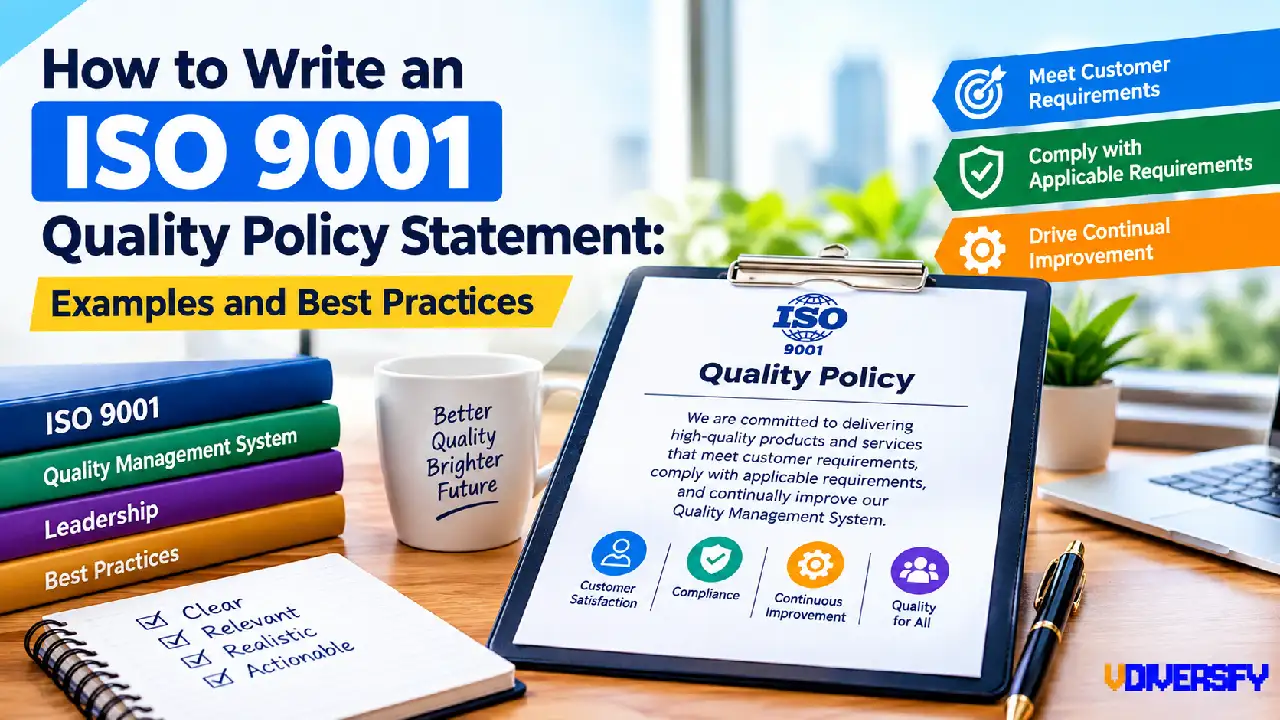
Writing a clear quality policy is an important step toward building a reliable Quality Management System (QMS), improving customer satisfaction, and maintaining consistent business performance.
Understanding ISO 9001 quality policy statement examples best practices helps organizations create a policy that meets applicable ISO 9001 requirements while reflecting their actual business goals, customer needs, and commitment to quality.
However, many companies make the mistake of copying a generic statement, displaying it on a wall, and assuming their work is complete. An effective quality policy should guide decisions, support measurable quality objectives, and help employees understand what quality means in their daily work.
This guide explains the requirements, writing process, industry-specific examples, implementation methods, and audit considerations that organizations need to develop a meaningful policy.
Contents
- 1. What Is an ISO 9001 Quality Policy Statement?
- 2. Understanding Clause 5.2 Quality Policy
- 3. Important Update: ISO 9001:2026 and the Quality Policy
- 4. The Role of Top Management in Quality Policy Development
- 5. Quality Policy vs. Quality Objectives vs. Quality Procedures
- 6. 1. Quality policy
- 7. 2. Quality objectives
- 8. 3. Quality procedures and work instructions
- 9. Characteristics of an Effective Quality Policy
- 10. How to Write an ISO 9001 Quality Policy Statement Step by Step
- 11. Quality Policy Examples for Different Industries
- 12. Sample Quality Policy — Precision Manufacturing
- 13. Sample Quality Policy — Engineering Services
- 14. Sample Quality Policy — Construction Services
- 15. Sample Quality Policy — Software Development
- 16. Sample Quality Policy — Healthcare Services
- 17. Sample Quality Policy — Small Business
- 18. Quality Management Policy Template You Can Customize
- 19. Quality Policy
- 20. Good vs. Bad Quality Policy Statements
- 21. Common Mistakes to Avoid When Writing a Quality Policy
- 22. How to Implement and Communicate the Quality Policy
- 23. How to Link the Quality Policy With Quality Objectives
- 24. How to Control and Review the Quality Policy
- 25. How Auditors Evaluate an ISO 9001 Quality Policy
- 26. Practical Case Study: Improving a Manufacturing Quality Policy
- 27. Best Practices for Maintaining an Effective Quality Policy
- 28. Actionable Checklist: Is Your Quality Policy Ready?
- 29. Quality policy review
- 30. Conclusion: Make Your Quality Policy Work for Your Organization
- 31. FAQs
What Is an ISO 9001 Quality Policy Statement?
An ISO 9001 quality policy statement is a formal declaration of an organization’s commitment to quality, customer satisfaction, compliance with applicable requirements, and continual improvement. It establishes the overall direction for the organization’s Quality Management System and explains the principles that guide its approach to delivering products or services.
In simple terms, a quality policy explains what an organization stands for when it comes to quality. It tells employees, customers, suppliers, auditors, and other relevant interested parties what the business intends to achieve and how it approaches quality management.
For example, a manufacturing company might commit to producing reliable components, meeting customer specifications, complying with applicable regulations, and improving production processes. A software company might focus on delivering dependable software, protecting product quality through testing, meeting agreed customer requirements, and improving its development process.
Both organizations have different operations, but their policies serve the same purpose: establishing a clear direction for quality management.
Why Is a Quality Policy Important?
A well-written quality policy helps an organization turn its general commitment to quality into a consistent approach across departments and processes.
Its main benefits include:
- Clear direction: Employees understand the organization’s quality commitments.
- Customer confidence: Customers can see that quality is managed systematically.
- Consistent processes: Departments work toward shared quality priorities.
- Better decision-making: Managers can use the policy to guide quality-related decisions.
- Measurable improvement: Quality objectives can be developed in line with the policy.
- Audit readiness: The organization can demonstrate that it has established and maintains the required policy.
- Employee awareness: Workers understand how their responsibilities contribute to product and service quality.
Consider a company that manufactures precision-machined components for industrial equipment. If its policy emphasizes product conformity and on-time delivery, the purchasing team may pay closer attention to supplier reliability, production teams may monitor dimensional accuracy, and the inspection team may verify compliance with customer drawings.
The policy does not replace work instructions or inspection plans. Instead, it provides the common direction that connects these activities.
Is a Quality Policy Mandatory Under ISO 9001?
Yes. ISO 9001 requires an organization to establish, implement, and maintain a quality policy that meets the applicable requirements of the standard.
Under ISO 9001:2015, these requirements are primarily addressed in Clause 5.2, Quality Policy. The clause covers establishing the policy, communicating it, making it available to relevant interested parties as appropriate, and ensuring it meets specific content and alignment requirements.
Organizations should also verify which edition of ISO 9001 applies to their certification and transition arrangements. The applicable edition matters because requirements and transition deadlines can change when a revised standard is introduced.
Simply having a document titled “Quality Policy” is not enough. The policy must meet the applicable requirements and be put into practice through the organization’s Quality Management System.
Understanding Clause 5.2 Quality Policy
Clause 5.2 is a key requirement within the leadership section of ISO 9001. It places responsibility on top management to establish and maintain a quality policy that supports the organization’s purpose, strategic direction, and quality management commitments.
The clause has three main areas:
- Establishing the quality policy: The policy must meet specified requirements and include the required commitments.
- Communicating the quality policy: It must be available, understood, and applied within the organization.
- Making the policy available: It must be available to relevant interested parties, as appropriate.
These requirements are closely connected. A policy that is well written but unknown to employees will have limited practical value. Similarly, a policy that is widely communicated but does not meet the standard’s content requirements will not be sufficient.
Clause 5.2.1: Establishing the Quality Policy
ISO 9001:2015 Clause 5.2.1 requires top management to establish, implement, and maintain a quality policy that:
- Is appropriate to the purpose and context of the organization and supports its strategic direction.
- Provides a framework for setting quality objectives.
- Includes a commitment to satisfy applicable requirements.
- Includes a commitment to continual improvement of the Quality Management System.
The policy must also be maintained as documented information.
These requirements are not intended to force every organization to use identical wording. A small engineering business and a large medical-device manufacturer may write very different policies, provided their policies meet the applicable requirements.
For example, an engineering company might state:
“We are committed to delivering accurate engineering solutions that meet agreed customer requirements, comply with applicable obligations, and support continual improvement in our quality management processes.”
This wording addresses important quality commitments, but the company should also verify that the policy reflects its purpose, context, strategic direction, and provides a framework for establishing quality objectives.
Clause 5.2.2: Communicating the Quality Policy
Clause 5.2.2 focuses on making the policy effective throughout the organization. The quality policy must be:
- Available and maintained as documented information.
- Communicated, understood, and applied within the organization.
- Available to relevant interested parties, as appropriate.
This means the organization needs more than a signed document stored in a folder.
Employees should be able to explain the quality commitments that are relevant to their roles. Managers should use the policy when setting objectives and making decisions. Relevant external parties should be able to access it when appropriate to the organization’s circumstances.
For instance, a production operator does not need to memorize every sentence of the policy. However, the operator should understand how following the approved work instructions, checking product dimensions, reporting defects, and preventing nonconforming output supports the organization’s quality commitments.
What Should a Quality Policy Include?
The following table summarizes the main expectations under ISO 9001:2015 Clause 5.2.
Requirement | What it means in practice |
Appropriate to the organization | The policy reflects the company’s activities, context, and direction. |
Framework for quality objectives | It provides a basis for setting and reviewing measurable quality goals. |
Commitment to applicable requirements | The organization commits to meeting relevant customer, statutory, regulatory, and other applicable requirements. |
Commitment to continual improvement | The organization commits to improving the suitability, adequacy, and effectiveness of its QMS. |
Documented information | The policy is maintained as controlled documented information. |
Internal communication | Employees receive and understand the policy and apply it in their work. |
External availability | The policy is made available to relevant interested parties, as appropriate. |
Important: ISO 9001 does not prescribe one universal quality policy template, a fixed number of sentences, or a specific page layout. The organization determines the wording and format, provided the policy satisfies the applicable requirements.
Important Update: ISO 9001:2026 and the Quality Policy
As of October 2026, ISO has published ISO 9001:2026, the sixth edition of its Quality Management Systems requirements standard, replacing the 2015 edition in the ISO catalogue. Organizations should therefore check the current edition when developing or revising their policies.
Organizations certified to the previous edition should consult their certification body for the applicable transition arrangements, deadlines, and assessment expectations. The detailed Clause 5.2 explanation above refers specifically to ISO 9001:2015 and should not be treated as a verified clause-by-clause interpretation of the 2026 edition.
When preparing a new policy, use the official requirements of the edition applicable to your organization. The policy should reflect the current standard, the organization’s actual business activities, and its customer and regulatory commitments.
For US businesses, this is particularly important when customer contracts, supplier approval requirements, or certification arrangements specify a particular edition of ISO 9001.
The Role of Top Management in Quality Policy Development
Quality policy development is a leadership responsibility. Quality managers and management representatives may coordinate the drafting process, but top management must take responsibility for establishing and implementing the policy.
This matters because quality performance is affected by business decisions involving budgets, staffing, equipment, training, suppliers, production schedules, and customer commitments.
If senior management treats quality as the responsibility of the inspection department alone, the policy is unlikely to influence the whole organization.
What Responsibilities Does Top Management Have?
Top management should ensure that the policy reflects the organization’s direction and can be supported by the resources and decisions needed to put it into practice.
Key responsibilities include:
- Defining quality commitments: Establish the principles that guide the organization’s approach to quality.
- Aligning quality with business strategy: Ensure the policy supports customer expectations, business priorities, and relevant risks.
- Providing resources: Make appropriate resources available for training, inspection, process control, and improvement.
- Setting quality objectives: Establish measurable goals that support the policy.
- Communicating expectations: Help employees understand how the policy relates to their work.
- Reviewing performance: Use audit results, customer feedback, complaints, and performance data to identify improvement needs.
- Supporting continual improvement: Encourage corrective action and improvements instead of treating recurring defects as normal.
For example, imagine a US manufacturer whose quality policy promises reliable products and consistent delivery. If management repeatedly approves unrealistic production schedules without providing adequate inspection resources, its business decisions conflict with the policy.
A stronger approach would be to balance delivery commitments with production capacity, employee competence, process controls, and product acceptance requirements.
The quality policy must reflect how management actually operates the business, not just what it wants customers to hear.
Should the Quality Manager Write the Policy?
The quality manager can lead the drafting process, gather information from departments, review compliance requirements, and prepare a proposed statement.
However, the policy should not be developed in isolation.
A practical development team may include:
Role | Contribution |
President, CEO, or general manager | Defines strategic direction and approves the policy. |
Quality manager | Coordinates drafting and checks alignment with QMS requirements. |
Production manager | Identifies realistic commitments relating to process control and product conformity. |
Engineering manager | Addresses design, technical requirements, and process capability where relevant. |
Purchasing manager | Identifies supplier quality and incoming material concerns. |
Customer service or sales manager | Provides insight into customer expectations and complaint trends. |
Human resources or training lead | Supports employee awareness and competence. |
In a small company, one person may hold several of these responsibilities. A large organization may need input from several sites and business units.
The objective is the same: create a policy that senior management supports and that employees can apply in their work.
Quality Policy vs. Quality Objectives vs. Quality Procedures
These three elements are connected, but they serve different purposes. Confusing them can lead to a policy that is too detailed, difficult to maintain, or unsuitable for its intended role.
1. Quality policy
The overall commitment and direction
Explains the organization’s approach to quality, including applicable requirements and continual improvement.
Example: “We are committed to delivering products that meet customer requirements and continually improving our processes.”
2. Quality objectives
The measurable results the organization wants to achieve
Translate the policy into specific targets that can be monitored and reviewed.
Example: “Reduce customer-reported defects from 2.5% to below 1.5% by the end of the next financial year.”
3. Quality procedures and work instructions
The methods used to control and perform activities
Describe how particular processes are carried out, controlled, checked, or improved.
Example: An inspection work instruction specifies the sampling method, measurement equipment, acceptance criteria, and recording requirements for a machined component.
How Do These Elements Work Together?
Consider a company that manufactures industrial valves.
Its quality policy commits to meeting customer specifications, complying with applicable requirements, and improving production quality.
To support that commitment, the company establishes quality objectives such as reducing leakage failures, improving on-time delivery, and lowering scrap rates. It then uses production controls, inspection procedures, equipment maintenance, employee training, and corrective action to achieve those objectives.
The relationship can be summarized as follows:
Element | Question it answers | Example |
Quality policy | What are we committed to? | Delivering conforming, reliable products. |
Quality objective | What measurable result do we want? | Reduce leakage failures by 20% within 12 months. |
Procedure or work instruction | How will the work be controlled? | Test every valve according to the approved inspection plan. |
Performance review | Are we achieving the intended result? | Analyze test results and compare failures against the target. |
This structure makes the policy useful rather than merely decorative.
An organization should also avoid turning its policy into a long list of operational targets. Specific targets belong in quality objectives, where they can be measured, assigned, and revised as business needs change.
Characteristics of an Effective Quality Policy
A policy can satisfy the basic purpose of a formal document while still being difficult for employees to understand. The strongest policies are clear, relevant, realistic, and connected to the organization’s actual work.
The following characteristics provide a useful starting point.
1. Clear and Easy to Understand
Use ordinary business language instead of complicated technical expressions.
For example:
Less effective: “The organization shall pursue the optimization of operational conformity through systematic quality assurance methodologies.”
Better: “We work to deliver products that meet customer requirements by controlling our processes and improving our methods.”
The second statement is easier for an employee to understand and explain.
2. Relevant to the Organization
The policy should reflect the products or services the company provides, its customers, and the nature of its operations.
A software development business may emphasize reliable software releases, testing, and customer requirements. A metal fabrication company may emphasize dimensional accuracy, material traceability where required, and conformity to approved drawings.
A generic statement copied from another company may contain appropriate words but fail to reflect the actual business.
3. Aligned With Business Strategy
Policy alignment ISO 9001 means connecting quality commitments to the organization’s purpose, context, and direction under the applicable requirements.
For example, a company competing through high-precision manufacturing should place strong emphasis on process control, technical competence, and product conformity. A service company competing through dependable customer support may focus on accurate service delivery, responsiveness, and consistent handling of customer requirements.
The policy should support the direction the company is genuinely pursuing.
4. Focused on Customer Requirements
Customer satisfaction is a central part of quality management. The policy should reflect the organization’s commitment to understanding and meeting applicable customer requirements.
This does not mean promising that every customer will always be satisfied. It means establishing processes that help the organization deliver what was agreed, address problems, and improve performance.
For example, a supplier of industrial fasteners may use customer drawings, material specifications, order requirements, inspection records, and complaint data to support its quality commitments.
5. Supported by Measurable Objectives
The policy should provide a framework for setting quality objectives, rather than attempting to include every target directly in the statement.
A company that commits to improving product reliability could establish objectives for defect rates, warranty claims, first-pass yield, or complaint resolution time.
These indicators should be selected according to the organization’s products, services, processes, and business priorities. There is no single set of metrics that is appropriate for every company.
6. Realistic and Supported by Resources
Avoid commitments that the organization cannot reasonably support.
For example, promising “zero defects in every product under all circumstances” may sound impressive, but it can create an unrealistic expectation. A better commitment is to control processes, meet applicable acceptance requirements, prevent nonconformities where possible, and improve performance.
The wording should reflect a serious commitment without guaranteeing outcomes that cannot be assured.
7. Reviewed and Kept Current
A quality policy should continue to reflect the organization as it changes.
A company may expand into new markets, introduce a new product line, change suppliers, adopt new manufacturing technology, or take on additional regulatory obligations. These changes may justify reviewing the policy.
Review should also consider relevant audit findings, customer feedback, quality performance, and changes to the applicable standard.
A useful policy is not simply written and approved; it is maintained as part of an active management system.
This establishes the foundation for developing a policy that meets applicable requirements and supports the organization’s business direction. The next step is to turn those principles into a practical statement: identify the organization’s real commitments, choose suitable wording, and build a policy that employees can understand and management can support.
How to Write an ISO 9001 Quality Policy Statement Step by Step
Writing a quality policy does not need to be complicated. The most effective approach is to understand the organization’s business, identify its quality commitments, confirm the applicable requirements, and express those commitments in clear language.
A good policy is usually concise enough for employees to understand and remember, yet detailed enough to reflect the organization’s purpose and obligations. There is no mandatory word count or universal format in ISO 9001:2015. What matters is whether the policy meets the applicable requirements and provides meaningful direction for the Quality Management System.
The following steps provide a practical method for developing a quality policy for a US-based organization.
Step 1: Understand the Organization’s Purpose and Context
Before writing anything, identify what the organization does, whom it serves, and what affects its ability to deliver quality products or services.
Consider these questions:
- What products or services does the organization provide?
- Who are its main customers?
- What quality characteristics matter most to those customers?
- Which customer, statutory, regulatory, and other applicable requirements must be met?
- What operational risks could affect product or service quality?
- What are the organization’s long-term business priorities?
- What improvements would make the greatest difference to performance?
For example, a US company manufacturing aerospace components may need to focus on technical conformity, traceability where required, process control, and customer specifications. A commercial cleaning service may focus on consistent service delivery, customer requirements, employee competence, and effective handling of complaints.
Both organizations need a quality policy, but their statements should reflect their different activities.
Practical tip: Review the organization’s business strategy, customer feedback, process performance, risk assessments, and management review findings before drafting the policy. This helps prevent a generic statement that could apply to almost any business.
Step 2: Identify the Required Quality Commitments
Under ISO 9001:2015 Clause 5.2.1, the quality policy must include a commitment to satisfy applicable requirements and a commitment to continual improvement of the Quality Management System.
It must also provide a framework for establishing quality objectives and be appropriate to the organization’s purpose and context while supporting its strategic direction.
These are core elements, not optional additions.
A useful way to begin is to create a table of commitments and the actions that support them.
Quality commitment | What it means | Example of supporting activity |
Meet applicable requirements | Deliver products or services that conform to relevant requirements. | Verify products against approved specifications. |
Improve the QMS | Identify weaknesses and improve the system’s effectiveness. | Analyze recurring defects and implement corrective actions. |
Support quality objectives | Provide direction for measurable quality targets. | Monitor scrap rates, complaint trends, or service errors. |
Reflect business direction | Connect quality priorities with organizational goals. | Invest in process capability, training, or service consistency where needed. |
Support customer satisfaction | Understand and meet agreed customer requirements. | Review customer feedback and resolve complaints effectively. |
Additional commitments may address employee competence, supplier performance, product reliability, process consistency, or responsible resource use, provided they are relevant to the business.
Do not include every possible quality-related phrase merely to make the statement appear comprehensive. Select commitments that the organization can genuinely support.
Step 3: Choose Three to Five Main Policy Themes
Once the required elements are clear, select a small number of themes that represent the organization’s quality priorities.
Common themes include:
- Customer satisfaction and customer requirements.
- Product or service conformity.
- Compliance with applicable requirements.
- Employee competence and awareness.
- Supplier and process performance.
- Risk prevention and effective controls.
- Continual improvement.
For example, a precision engineering company might choose customer requirements, technical conformity, process control, and continual improvement as its main themes.
A software services business might choose customer needs, reliable delivery, testing, information integrity where relevant, and improvement.
These themes should guide the wording, but they do not need to appear as separate headings in the final policy. A short paragraph or a few clear bullet points may be sufficient.
Step 4: Write a Clear Opening Statement
The opening should identify the organization’s commitment to delivering quality products or services.
Avoid vague statements such as:
“We believe quality is important and aim to provide the best service possible.”
This sentence sounds positive but does not explain what the organization will do.
A stronger opening would be:
“We are committed to providing products that meet agreed customer requirements and applicable specifications through controlled processes and consistent attention to quality.”
This statement is more useful because it identifies the intended result and the organization’s approach.
For a service organization, the wording could be:
“We are committed to delivering dependable services that meet agreed customer requirements through competent employees, consistent processes, and regular performance review.”
The exact wording should reflect the organization’s activities and the applicable requirements.
Step 5: Include a Commitment to Applicable Requirements
The policy should express the organization’s commitment to satisfying applicable requirements. Depending on the business, these may include customer requirements, statutory obligations, regulatory requirements, contractual commitments, and relevant internal specifications.
For example, a US manufacturer may need to consider customer drawings, purchase order requirements, applicable product regulations, and agreed inspection criteria.
A suitable policy sentence could be:
“We are committed to meeting applicable customer, statutory, regulatory, and other requirements relevant to our products and services.”
The phrase “other requirements” should be understood in the context of obligations that apply to the organization. Do not list laws or standards that have no relevance to the business simply to make the statement look more formal.
Step 6: Include a Commitment to Continual Improvement
Continual improvement is another essential element of the ISO 9001:2015 quality policy requirements.
This commitment should be meaningful. It should support the organization’s ongoing efforts to improve its processes, product conformity, customer satisfaction, and QMS effectiveness.
For example:
“We continually evaluate our performance, address identified problems, and improve our quality management processes to strengthen product conformity and customer satisfaction.”
The organization can support this commitment by using:
- Internal audit findings.
- Customer complaints and feedback.
- Corrective action records.
- Process performance indicators.
- Scrap and rework data.
- Supplier performance reviews.
- Management review decisions.
Continual improvement does not mean that every indicator must improve every month. It means the organization systematically evaluates performance, identifies opportunities, and takes suitable action.
Step 7: Make Sure the Policy Supports Quality Objectives
A quality policy should provide a framework for establishing quality objectives. The objectives translate the policy’s general commitments into measurable results.
Suppose a company commits to reliable products and continual improvement. Its quality objectives might include reducing internal rejection rates, improving on-time delivery, or reducing repeat customer complaints.
The policy should not contain an excessive list of changing targets. Keep the statement focused on commitments and manage the detailed targets separately.
For example:
Policy commitment | Possible quality objective | Measurement |
Improve product conformity | Reduce internal defects | Defects per 1,000 units |
Improve delivery performance | Increase on-time delivery | Percentage of orders delivered on time |
Improve customer satisfaction | Reduce repeat complaints | Number of repeat complaints per quarter |
Improve process effectiveness | Reduce rework | Rework hours as a percentage of production hours |
These are examples, not universal targets required by ISO 9001. Each organization should select meaningful indicators and realistic targets based on its circumstances.
Step 8: Use Simple, Direct Language
Employees should be able to understand the policy without needing a standards expert to explain every sentence.
Compare the following statements.
Weak wording | Better wording |
We endeavor to optimize quality-related operational outcomes. | We monitor our processes and improve them when needed. |
We seek excellence in all business activities. | We work to meet customer requirements and applicable specifications. |
Quality is everyone’s responsibility. | Every employee must follow applicable procedures and report quality problems. |
We will always achieve perfect quality. | We work to prevent defects and improve product conformity. |
The stronger statements are more specific and realistic.
Writing rule: Use language that reflects actions the organization can demonstrate through its actual processes, records, and decisions.
Step 9: Review the Draft With Relevant Managers and Employees
Before approval, share the draft with people who understand the organization’s operations and customer requirements.
Ask them:
- Does the policy reflect what we actually do?
- Are the commitments clear and realistic?
- Does the wording support our business direction?
- Can we establish meaningful quality objectives from it?
- Can employees understand how their work supports it?
- Can the organization provide evidence that it follows these commitments?
For a smaller organization, this review may involve the owner, quality manager, and production supervisor. For a larger company, input may be needed from multiple departments or sites.
If employees cannot explain the policy’s main commitments in plain language, simplify the wording before approval.
Step 10: Obtain Approval and Control the Document
Under ISO 9001:2015, the policy must be maintained as documented information. The organization should therefore manage it using its document control arrangements.
A controlled policy commonly includes:
- Organization name or logo.
- Document title.
- Policy statement.
- Document number, if used.
- Revision or version number.
- Approval authority.
- Approval date or effective date.
- Review or revision history, where applicable.
ISO 9001:2015 does not prescribe a specific layout or require every one of these fields. These are practical document control methods rather than a universal list of mandatory policy fields.
The policy should be approved by authorized top management. If it is revised, the organization should control the new version and prevent obsolete copies from being mistaken for the current policy.
Quality Policy Examples for Different Industries
The best quality policy examples are written for the organization’s actual products, services, customers, and business priorities. A policy for a manufacturing plant should not read exactly like a policy for a consulting firm, software developer, or construction contractor.
The examples below are original sample statements intended for adaptation. They illustrate how organizations can express their quality commitments in plain language. They are not official ISO templates, and organizations should verify them against the requirements of the applicable edition of ISO 9001.
1. Quality Policy Example for a Manufacturing Company
Manufacturing organizations often need to maintain consistent product specifications, control production processes, manage suppliers, and prevent nonconforming products from reaching customers.
Sample Quality Policy — Precision Manufacturing
Fictional example for a US manufacturer of precision-machined components
At Precision Manufacturing Solutions, we are committed to producing reliable, high-quality components that meet agreed customer requirements and applicable specifications.
We will achieve this commitment by:
- Meeting applicable customer, statutory, regulatory, and other requirements.
- Maintaining effective controls over our manufacturing and inspection processes.
- Developing employee competence and promoting awareness of quality responsibilities.
- Monitoring product conformity, customer feedback, and operational performance.
- Working with suppliers to support consistent material and component quality.
- Continually improving the effectiveness of our Quality Management System and the processes that support it.
We will use this policy to establish and review measurable quality objectives, communicate our commitments throughout the organization, and make the policy available to relevant interested parties as appropriate.
Approved by: Managing Director
Effective date: [Insert date]
Why this example works: It identifies the organization’s main activity, makes the required quality commitments explicit, and links the policy to measurable objectives. Its commitments can also be supported by practical evidence, such as inspection records, supplier evaluations, training records, and performance reports.
These quality policy examples manufacturing teams can adapt should reflect their actual processes. A company producing electronic assemblies may need to emphasize component traceability and testing, while a metal fabrication business may focus on weld quality, dimensional inspection, and compliance with customer drawings where applicable.
2. Quality Policy Example for an Engineering Company
Engineering businesses may provide design, consulting, testing, project engineering, or technical support services. Their quality policies should reflect the nature of their deliverables and the requirements agreed with customers.
Sample Quality Policy — Engineering Services
At ABC Engineering Services, we are committed to delivering accurate, dependable engineering solutions that meet agreed customer requirements and applicable technical and regulatory requirements.
We will support this commitment by:
- Maintaining effective controls over engineering calculations, drawings, reviews, and deliverables as applicable.
- Ensuring personnel have the competence needed for their assigned responsibilities.
- Verifying deliverables against agreed specifications and acceptance criteria.
- Learning from customer feedback, project reviews, errors, and corrective actions.
- Continually improving our processes and the effectiveness of our Quality Management System.
We will establish measurable quality objectives, communicate this policy to our employees, and review its continuing suitability as our business develops.
This policy is appropriate for an engineering service provider because it focuses on technical accuracy, controlled deliverables, and employee competence rather than manufacturing-specific activities.
3. Quality Policy Example for a Construction Company
Construction companies must coordinate contractors, materials, site activities, project specifications, inspections, and customer expectations. The policy should reflect the company’s scope of work and the requirements that apply to its projects.
Sample Quality Policy — Construction Services
At ABC Construction Group, we are committed to delivering construction projects that meet agreed client requirements, approved project specifications, and applicable legal and regulatory obligations.
We will work toward this commitment by:
- Planning and controlling construction activities according to approved project requirements.
- Verifying materials and completed work against applicable acceptance criteria.
- Ensuring personnel and subcontractors understand relevant quality requirements.
- Identifying nonconforming work and taking appropriate corrective action.
- Reviewing project performance and client feedback to identify opportunities for improvement.
We will establish quality objectives appropriate to our projects and continually improve the effectiveness of our Quality Management System.
Practical example: If a construction contractor regularly discovers incorrect material specifications during site inspections, it might establish an objective to reduce material-related nonconformities. The company could then improve purchasing reviews, material verification, and communication between project engineers and site supervisors.
The policy sets the direction. The project quality plan and inspection procedures explain how individual projects will meet their requirements.
4. Quality Policy Example for a Software Development Company
Software organizations need to manage requirements, development activities, testing, releases, defects, and customer feedback. Depending on their services, they may also need to address availability, maintainability, or other agreed software characteristics.
Sample Quality Policy — Software Development
At ABC Software Solutions, we are committed to developing and supporting reliable software that meets agreed customer requirements and applicable obligations.
We will support this commitment by:
- Reviewing requirements and acceptance criteria before development.
- Applying appropriate development, review, and testing controls.
- Managing software changes and releases through defined processes.
- Monitoring defects, customer feedback, and service performance.
- Developing employee competence and continually improving our processes.
We will use this policy as a framework for setting quality objectives and maintaining an effective Quality Management System.
Software companies can use guidance such as ISO/IEC/IEEE 90003:2018 to understand how ISO 9001:2015 can be applied to software-related activities. This guidance supports application of the standard; it does not replace the ISO 9001 requirements.
Source: webstore.ansi.org, webstore.iec.ch/en
5. Quality Policy Example for a Healthcare Service Provider
Healthcare organizations must tailor their quality management arrangements to their actual services, applicable regulations, and patient or client requirements. A quality policy should not be treated as a substitute for clinical governance, patient safety controls, or legally required healthcare procedures.
Sample Quality Policy — Healthcare Services
At ABC Healthcare Services, we are committed to providing consistent, dependable services that meet applicable requirements and the needs of the people we serve.
We will support this commitment by:
- Maintaining appropriate controls over service delivery and supporting processes.
- Ensuring personnel are competent for their assigned responsibilities.
- Monitoring service performance, feedback, and identified quality concerns.
- Addressing nonconformities and opportunities for improvement.
- Reviewing our Quality Management System to support continual improvement.
We will communicate this policy to relevant personnel and make it available to interested parties as appropriate.
Healthcare organizations should obtain appropriate regulatory and professional advice before using a policy as part of a regulated quality system.
6. Quality Policy Example for a Small Business
A small business does not need an elaborate statement. It needs a policy that reflects its actual services, customer commitments, and ability to manage quality consistently.
Sample Quality Policy — Small Business
At ABC Business Services, we are committed to providing dependable services that meet agreed customer requirements and applicable obligations.
We will maintain consistent work processes, develop our employees’ skills, respond to customer feedback, and continually improve the effectiveness of our Quality Management System.
We will set quality objectives that support our business priorities, communicate this policy to our employees, and review it as our business and customer needs change.
This is a useful starting point for a small consultancy, repair business, technical service provider, or similar organization. Before adoption, replace the generic wording with commitments that reflect the business’s actual activities.
7. Quality Policy Example for a Distribution or Warehousing Company
Distribution companies may focus on order accuracy, product handling, storage conditions where relevant, inventory control, and delivery performance.
A suitable statement could be:
“At ABC Distribution Services, we are committed to fulfilling customer orders accurately and consistently while meeting applicable requirements. We will control receiving, storage, picking, packing, and dispatch processes as appropriate to our operations. We will monitor errors, customer feedback, and delivery performance, develop employee competence, and continually improve our Quality Management System.”
The organization could support this policy by measuring picking errors, shipment discrepancies, delivery performance, and customer complaints.
Quality Management Policy Template You Can Customize
A quality management policy template can save time during drafting, but it should be treated as a starting point rather than a ready-made compliance document.
Use the following template to develop a statement that fits your organization. Replace the bracketed text, remove commitments that do not apply, and confirm that the final version meets the requirements of the applicable ISO 9001 edition.
[Organization Name]
Quality Policy
At [Organization Name], we are committed to providing that meet agreed customer requirements and applicable requirements relevant to our business.
Our quality commitments are to:
- Understand and satisfy applicable customer, statutory, regulatory, and other requirements.
- Maintain effective processes that support consistent product or service conformity.
- Establish and review measurable quality objectives aligned with our business direction.
- Develop employee competence and awareness of individual quality responsibilities.
- Monitor performance, address nonconformities, and use feedback to identify improvements.
- Continually improve the effectiveness of our Quality Management System.
Top management is responsible for supporting this policy and ensuring that it remains appropriate to the organization’s purpose, context, and strategic direction.
This policy will be maintained as documented information, communicated and applied within the organization, and made available to relevant interested parties as appropriate.
Approved by: [Name or authorized position]
Document number: [If applicable]
Revision: [Version]
Effective date: [Date]
How to Customize the Template
Before approving the template, answer these questions:
Customization question | What to change |
What does your company produce or deliver? | Replace the generic description with your actual products or services. |
What matters most to your customers? | Include relevant commitments, such as reliability, accuracy, consistency, or timely delivery. |
Which requirements apply to your business? | Ensure the wording reflects applicable obligations and contractual requirements. |
What is your strategic direction? | Align the policy with the organization’s actual priorities. |
How will the policy guide quality objectives? | Identify suitable performance measures and targets in separate objective records. |
How will employees use the policy? | Plan communication and awareness activities suited to the workforce. |
Do not copy the template without review. A statement that includes many quality-related words can still be ineffective if it does not reflect the organization’s context or actual operating methods.
Good vs. Bad Quality Policy Statements
Reviewing weak examples is one of the easiest ways to understand what makes a policy useful.
Weak statement | Problem | Improved statement |
We provide the best quality in the industry. | Vague and difficult to demonstrate. | We monitor product conformity and customer feedback to identify and address quality problems. |
We guarantee zero defects forever. | Makes an unrealistic absolute promise. | We work to prevent nonconformities and continually improve process performance. |
Quality is the responsibility of the quality department. | Excludes the role of other employees and management. | Everyone is responsible for following applicable quality controls and reporting quality concerns within their role. |
We follow ISO standards. | Does not identify meaningful quality commitments. | We meet applicable requirements and continually improve the effectiveness of our Quality Management System. |
Customer satisfaction is our priority. | Positive but incomplete when used alone. | We review customer requirements, monitor feedback, address complaints, and use results to improve our services. |
The improved versions are more useful because they describe commitments that can be supported through processes, records, and management decisions.
Common Mistakes to Avoid When Writing a Quality Policy
Even experienced organizations can develop policies that are difficult to apply or maintain. The following mistakes should be checked during drafting and review.
Copying Another Company’s Policy
A competitor’s policy may be written for different products, customer expectations, and regulatory obligations. Copying it can result in commitments that do not fit your business.
Better approach: Use examples for inspiration, then write the policy around your own operations, customers, and objectives.
Making the Policy Too Long
A long policy may be difficult for employees to understand and remember. It can also become a list of detailed operating rules rather than a statement of direction.
Better approach: Keep the policy focused on the main quality commitments. Put detailed instructions in procedures and work instructions.
Omitting Required Commitments
Under ISO 9001:2015, a policy that does not include commitments to satisfy applicable requirements and continually improve the QMS would be incomplete.
Better approach: Check the final statement against every applicable requirement of the edition being used. Do not assume a generic promise of “quality excellence” covers everything.
Making Promises the Organization Cannot Support
Statements promising perfect products, no complaints, or immediate delivery in every circumstance can create unrealistic expectations.
Better approach: Use credible commitments that management can support with suitable resources, processes, and controls.
Failing to Connect the Policy to Objectives
A policy may sound impressive but have little effect if no one uses it to guide measurable quality goals.
Better approach: Identify objectives that reflect the policy’s commitments, assign responsibility, establish suitable measures, and review performance.
Treating the Policy as a Certification Document Only
Displaying the policy in reception does not demonstrate that employees understand or apply it.
Better approach: Include policy awareness in onboarding, team discussions, management communication, and relevant training. Employees should understand the commitments that relate to their jobs.
Ignoring Changes in the Business
A policy written when a company had one product line may no longer reflect its activities after expansion into new markets or services.
Better approach: Review the policy when significant business changes occur and during relevant management review activities.
The next step is to make the policy part of daily operations. Even a well-written statement will have limited value unless employees understand it, management supports it, and the organization can demonstrate that its quality commitments guide decisions and improvement activities.
How to Implement and Communicate the Quality Policy
Writing the policy is only the beginning. To make it effective, an organization must ensure employees understand its commitments, managers use it to guide decisions, and the Quality Management System supports the promises made in the statement.
Under ISO 9001:2015 Clause 5.2.2, the policy must be communicated, understood, and applied within the organization. It must also be available to relevant interested parties, as appropriate.
This means communicating quality policy requirements is an ongoing activity, not a one-time announcement during certification preparation.
1. Communicate the Policy to All Relevant Employees
Employees should understand the quality commitments that relate to their responsibilities. The level of explanation needed will depend on their roles, the complexity of their work, and the risks associated with their activities.
Useful communication methods include:
- Employee induction and onboarding.
- Team meetings and shift briefings.
- Training sessions and toolbox talks.
- Digital employee portals and controlled document systems.
- Workplace noticeboards and suitable visual displays.
- Department meetings and management briefings.
- Periodic awareness refreshers.
For example, a manufacturing operator should understand the importance of following approved work instructions, checking product conformity, and reporting defects. A purchasing employee should understand how supplier selection and purchasing controls can affect product quality.
The goal is not to make every employee memorize the policy word for word. It is to help them understand how their work supports the organization’s quality commitments.
2. Display the Policy Where It Is Useful
Displaying the policy can help make it visible, but visibility alone does not establish understanding.
Suitable locations may include:
- Reception areas.
- Production departments.
- Quality inspection areas.
- Employee common areas.
- Internal digital portals.
- Training rooms.
For a business with multiple sites, use a controlled method to ensure that employees can access the current approved version.
A company may also publish the policy on its website when doing so is appropriate for customers, suppliers, or other interested parties.
3. Make the Policy Available to Relevant Interested Parties
ISO 9001:2015 does not require every organization to publish its policy publicly. It requires the policy to be available to relevant interested parties, as appropriate.
Depending on the organization’s circumstances, relevant parties may include:
- Customers.
- Suppliers and subcontractors.
- Certification auditors.
- Regulatory or contractual stakeholders.
- Business partners.
A manufacturer may provide its policy during supplier qualification or customer audits. A service company may include a link to the policy in its supplier documentation or on its website.
The method should suit the needs of the interested parties and the organization’s circumstances.
4. Connect the Policy to Daily Work
The policy becomes meaningful when employees can connect its commitments to real activities.
Consider a company that promises to deliver products that meet customer specifications. Its daily activities might include:
- Reviewing customer requirements before accepting orders.
- Verifying raw materials against purchasing requirements.
- Using approved production instructions.
- Calibrating or verifying measurement equipment as required.
- Inspecting products against defined acceptance criteria.
- Identifying and controlling nonconforming output.
- Investigating recurring defects.
- Reviewing performance data and implementing improvements.
Each activity supports the policy, but the policy itself does not replace the detailed controls required for individual processes.
How to Link the Quality Policy With Quality Objectives
One of the most important functions of a quality policy is to provide a framework for establishing quality objectives.
The policy describes the organization’s general commitments. Quality objectives translate those commitments into measurable results that can be monitored, communicated, and updated.
For example, a company may commit to improving product conformity. It could then establish an objective to reduce internal rejection rates over a defined period.
Example: Policy Commitments and Measurable Objectives
Quality policy commitment | Example objective | Measurement method |
Improve product conformity | Reduce internal rejection rates | Rejected units divided by units produced |
Improve delivery performance | Increase on-time delivery | Orders delivered on time as a percentage of total orders |
Improve customer satisfaction | Reduce repeat complaints | Repeat complaints recorded per reporting period |
Improve process effectiveness | Reduce rework | Rework hours as a percentage of total production hours |
Improve supplier performance | Reduce incoming material defects | Nonconforming incoming lots as a percentage of lots received |
These are illustrative measures, not targets prescribed by ISO 9001. Organizations should establish suitable objectives based on their context, customer needs, quality risks, and operational priorities.
Example of a SMART Quality Objective
Suppose a US manufacturer currently records an internal rejection rate of 3% of units produced.
A possible objective is:
“Reduce the internal rejection rate from 3% to 2% or less by the end of the next financial year, while maintaining applicable product acceptance requirements.”
To manage this objective effectively, the organization should define:
- Baseline: Current rejection rate of 3%.
- Target: 2% or less.
- Deadline: End of the next financial year.
- Responsibility: Production and quality management.
- Resources: Appropriate process controls, training, and defect analysis.
- Monitoring: Monthly production quality reports.
- Action: Investigate recurring causes and implement suitable corrective measures.
The target should be realistic and supported by data. A target without a responsible owner, a monitoring method, or a plan for action is unlikely to drive consistent improvement.
How to Control and Review the Quality Policy
A quality policy is maintained as documented information under ISO 9001:2015. The organization should therefore ensure that the approved version is identifiable, available where needed, and protected against inappropriate use of obsolete information.
Document Control Best Practices
A practical document control system should address the following:
- Approval: Ensure the policy is approved by authorized top management.
- Identification: Include a document title and other identification details appropriate to the organization’s system.
- Version control: Identify the current revision where revisions are used.
- Availability: Make the approved version accessible to relevant personnel.
- Protection: Prevent accidental loss, inappropriate alteration, or use of obsolete copies.
- Revision history: Record changes where appropriate to the organization’s document control method.
ISO 9001 does not prescribe a particular software package or require a dedicated document control platform. A controlled digital system, a suitable document management application, or another effective method may be used, depending on the organization’s needs.
How Often Should the Quality Policy Be Reviewed?
ISO 9001:2015 does not prescribe a universal annual review interval specifically for the quality policy. The organization should review it as necessary to ensure that it remains appropriate and effective.
Practical review triggers include:
- Significant changes in products or services.
- Entry into new markets.
- Changes in applicable customer or regulatory requirements.
- Major organizational restructuring.
- Changes to the applicable ISO 9001 edition.
- Recurring customer complaints or quality failures.
- Audit findings that reveal problems with policy implementation.
- Management decisions that change strategic priorities.
Many organizations include policy suitability in their management review process. The appropriate review frequency should reflect the organization’s circumstances and document control arrangements.
How Auditors Evaluate an ISO 9001 Quality Policy
During an ISO 9001 audit, auditors do not simply check whether a policy document exists. They may examine its content, approval, availability, communication, and relationship with the organization’s actual Quality Management System.
The exact audit approach depends on the applicable standard, audit scope, and the evidence available.
What Evidence Might an Auditor Request?
Audit area | Examples of evidence |
Policy content | Current approved quality policy |
Leadership responsibility | Evidence of management involvement and approval |
Documented information | Document identification, revision, and access controls |
Employee awareness | Interviews with employees about relevant quality commitments |
Policy communication | Induction records, training records, briefings, or internal communication |
Quality objectives | Objectives that reflect the policy’s commitments |
Implementation | Processes, records, and decisions that support policy commitments |
External availability | Evidence that the policy is available to relevant interested parties as appropriate |
A policy can be well written and still reveal an implementation weakness if employees do not understand it or if the organization consistently acts against its stated commitments.
Example of an Employee Awareness Interview
An auditor visits a production area and asks an operator:
“What does your company’s quality policy mean for your work?”
A useful response might be:
“Our company is committed to meeting customer specifications and improving quality. I follow the approved work instructions, check the required dimensions, record inspection results, and report any product that does not meet the acceptance criteria.”
The employee does not need to recite the policy exactly. The response demonstrates an understanding of how the policy connects to the person’s responsibilities.
Now consider an operator who says:
“I have never heard of the quality policy. Only the quality department handles quality.”
This could indicate that the organization has not effectively communicated the policy or established sufficient employee awareness. The auditor would consider the available evidence and applicable requirements before reaching a conclusion.
Common Quality Policy Audit Problems
Potential issues include:
- The policy does not include the required commitments.
- The policy does not reflect the organization’s activities or direction.
- Employees cannot explain relevant quality commitments.
- The policy is not maintained as documented information.
- Obsolete versions remain in circulation.
- Quality objectives are not meaningfully connected to the policy.
- Management decisions repeatedly conflict with stated commitments.
These situations do not automatically have the same classification in every audit. The auditor must evaluate the evidence against the applicable requirements and determine whether a nonconformity exists.
Practical Case Study: Improving a Manufacturing Quality Policy
Consider a fictional US manufacturer of metal components supplying equipment makers. The company has an approved quality policy, but customer complaints about dimensional defects are increasing, and production employees are unsure how their work relates to the policy.
The company reviews its policy and finds that it contains broad statements about quality excellence but provides little direction about product conformity or improvement.
The Improvement Process
- Review the policy. Management confirms the commitment to meet customer requirements and continually improve the QMS.
- Investigate performance. The quality team reviews inspection data, customer complaints, machine settings, and recurring defect patterns.
- Set a measurable objective. Management establishes a realistic target for reducing dimensional defects within a defined period.
- Improve process controls. Production and quality teams review work instructions, measurement methods, employee training, and equipment conditions.
- Communicate expectations. Supervisors explain how the policy relates to production, inspection, and defect reporting.
- Review results. Management compares performance against the baseline and target, investigates gaps, and decides whether further action is needed.
The important lesson is that changing the policy wording alone will not solve a quality problem. The policy provides direction, while process controls, employee competence, corrective action, and performance review turn that direction into practical improvement.
This example is illustrative rather than a report of an actual company or a claim of measured results.
Best Practices for Maintaining an Effective Quality Policy
A strong policy should remain useful as the organization grows, introduces new products, or changes its operating methods.
The following practices help organizations maintain that usefulness.
Keep the Policy Concise but Meaningful
A policy of one or two well-developed paragraphs may be sufficient for many organizations. Others may prefer a short introduction followed by a few bullet points.
There is no prescribed word count. Focus on the required commitments, business relevance, and clarity rather than the number of words.
Assign Responsibility for Implementation
Top management remains accountable for establishing and implementing the policy. Department managers should help translate its commitments into appropriate activities and objectives.
For example, the production manager may oversee process conformity, while the quality manager monitors nonconformities and audit results. Responsibilities should be clear within the organization’s management system.
Use Evidence to Support Quality Commitments
If the policy promises continual improvement, the organization should be able to demonstrate that it reviews performance and acts on identified opportunities.
Relevant evidence may include:
- Internal audit reports.
- Customer satisfaction data.
- Corrective action records.
- Quality objective reviews.
- Employee training records.
- Management review outputs.
- Process performance reports.
These records should arise from the organization’s actual activities, not be created merely to satisfy an auditor.
Review the Policy When Business Priorities Change
A growing company may enter a new market, introduce a different product, or acquire another business. Its policy should remain appropriate to the organization’s current purpose, context, and direction.
Policy review should be part of a sensible management process, rather than a routine exercise in changing words every year.
Make Quality a Shared Responsibility
Quality does not belong exclusively to inspectors or the quality department. Employees throughout the organization influence quality through purchasing, design, production, delivery, customer service, and management decisions.
A useful quality policy reinforces this shared responsibility while making clear that individuals must follow the requirements relevant to their roles.
Actionable Checklist: Is Your Quality Policy Ready?
Use this checklist when reviewing a new or existing policy.
Quality policy review
Content and alignment
- Reflects the organization’s purpose, context, and strategic direction
- Includes the commitments required by the applicable ISO 9001 edition
- Provides a framework for establishing quality objectives
- Uses clear and realistic wording relevant to the business
Approval and document control
- Approved by authorized top management
- Maintained as required documented information
- Current version is identifiable and available
- Changes are controlled through the organization’s document management arrangements
Communication and implementation
- Communicated to relevant employees
- Employees understand the commitments relevant to their work
- Applied through suitable processes and management decisions
- Available to relevant interested parties as appropriate
Performance and review
- Quality objectives reflect the policy’s commitments
- Performance is monitored using suitable measures
- Feedback and nonconformities inform improvement
- Policy suitability is reviewed when circumstances require it
This is a practical self-review aid, not an official ISO checklist or a substitute for assessing the applicable standard.
Conclusion: Make Your Quality Policy Work for Your Organization
An effective quality policy does more than demonstrate that a company has prepared a document for certification. It provides direction for the way the organization manages quality, meets customer requirements, and improves its processes.
The most reliable approach is to understand the applicable ISO 9001 requirements, identify the organization’s real commitments, write the statement in clear language, obtain top management approval, and communicate it effectively. Those commitments should then guide quality objectives, process controls, employee responsibilities, and management decisions.
For US organizations, it is also important to check the applicable edition of ISO 9001. ISO 9001:2026 was published on September 16, 2026, so organizations developing or revising their policies should consult the current official standard and confirm relevant transition arrangements with their certification body.
Remember that a quality policy is only as useful as the actions that support it. A concise, relevant statement backed by effective processes is more valuable than an impressive statement that employees never use.
Start by reviewing your existing policy against the applicable requirements. Identify any gaps, revise the wording where necessary, and connect its commitments to measurable objectives. With regular communication, sound document control, and meaningful management review, your quality policy can become a practical part of your organization’s daily work.
References and Further Reading
The following sources provide authoritative information for readers who want to verify requirements and develop their understanding of quality management and content publishing.
- International Organization for Standardization (ISO): ISO 9001:2026 — Quality management systems: Requirements. The official source for the current edition, publication information, and access to the standard.
- ISO: ISO 9001:2015 — Previous edition and transition context. Useful for understanding the earlier edition’s status alongside the current edition.
Final recommendation:
Use the official ISO standard as the source of requirements, certification-body guidance for transition questions, and your organization’s own customer and process data to ensure the quality policy reflects how your business actually operates.
FAQs
1. What is a quality policy in ISO 9001?
A quality policy is a formal statement of an organization’s overall intentions and direction regarding quality. Under ISO 9001:2015 Clause 5.2, it must be appropriate to the organization’s purpose and context, support its strategic direction, provide a framework for quality objectives, and include commitments to satisfy applicable requirements and continually improve the QMS.
2. What are the mandatory elements of a quality policy?
For ISO 9001:2015, the policy must meet the requirements in Clause 5.2.1, including appropriate alignment with the organization’s purpose, context, and strategic direction; a framework for quality objectives; and commitments to satisfy applicable requirements and continually improve the QMS. It must be maintained as documented information.
The organization must also meet Clause 5.2.2 requirements concerning communication, understanding, application, and appropriate availability to relevant interested parties.
Organizations using ISO 9001:2026 should verify the exact requirements in that edition rather than assume every clause remains unchanged.
3. How long should an ISO 9001 quality policy be?
ISO 9001 does not prescribe a fixed length. A concise statement that clearly communicates the required commitments may be more effective than a lengthy document filled with technical language.
The appropriate length depends on the organization’s activities and the complexity of the commitments it needs to communicate.
4. Who should approve the quality policy?
Top management is responsible for establishing and implementing the policy. An authorized senior leader, such as the president, CEO, managing director, or general manager, may approve it according to the organization’s governance and document control arrangements.
A quality manager can prepare and coordinate the document, but the policy should reflect management’s actual commitments.
5. Does every employee need to memorize the quality policy?
No. Employees should understand the policy, know the commitments relevant to their work, and apply them in their responsibilities.
For example, a warehouse employee should understand how accurate picking, correct handling, and reporting damaged goods support the organization’s quality commitments. Exact memorization is not the objective.
6. Must the quality policy be displayed on a noticeboard?
No. ISO 9001:2015 requires the policy to be communicated, understood, and applied within the organization, and to be available to relevant interested parties as appropriate. A noticeboard is one possible method, but it is not the only acceptable method.
Organizations can use controlled electronic documents, employee portals, training sessions, or other effective communication methods.
7. Can a company use the same quality policy for all its locations?
Yes, where a common policy appropriately reflects the organization’s activities and meets the applicable requirements across the locations covered by the QMS.
However, a multinational company or a business operating different types of facilities may need additional local communication or supporting arrangements to address differences in applicable requirements and operations.
8. Is a quality policy the same as a quality manual?
No. A quality policy states the organization’s overall quality commitments and direction. A quality manual, where an organization chooses to maintain one, provides a broader description of its QMS.
ISO 9001:2015 does not generally require organizations to maintain a quality manual. They must, however, maintain the documented information required by the applicable standard and by their own QMS.
9. How often should a quality policy be updated?
There is no universal annual revision requirement specifically for the quality policy in ISO 9001:2015. It should be reviewed when needed to ensure that it remains appropriate.
Significant changes in business direction, products, services, customer requirements, or applicable standards may trigger a review.
10. What is the difference between a quality policy and a quality commitment statement?
A quality commitment statement is a general description of an organization’s promise or intention regarding quality. A formal quality policy used within an ISO 9001 QMS must meet the applicable requirements of the standard.
A general statement such as “We are committed to excellence” is not, by itself, sufficient evidence that a formal quality policy meets those requirements.
11. Can a quality policy include environmental or safety commitments?
Yes, an organization may include relevant commitments that support its broader business objectives. However, additional statements do not replace the quality commitments required by ISO 9001.
If the organization also maintains environmental or occupational health and safety management systems, it may use an integrated policy, provided the relevant requirements of each applicable standard are addressed.
12. Does a good quality policy guarantee ISO 9001 certification?
No. A quality policy is only one part of the QMS. Certification depends on conformity with the applicable requirements across the audit scope, including leadership, planning, operational controls, performance evaluation, and improvement.
A well-written policy cannot compensate for ineffective processes or other nonconformities.

“Hey, I am Sachin Ramdurg, the founder of VDiversify.com.
I am QA/QC Manager, Certified Lead Auditor and Quality Champion. I am an Engineer and Passionate Blogger with a mindset of Entrepreneurship. I have been experienced in Blogging for more than 15+ years and following as a youtuber along with blogging, online business ideas, affiliate marketing, and make money online ideas since 2012.