
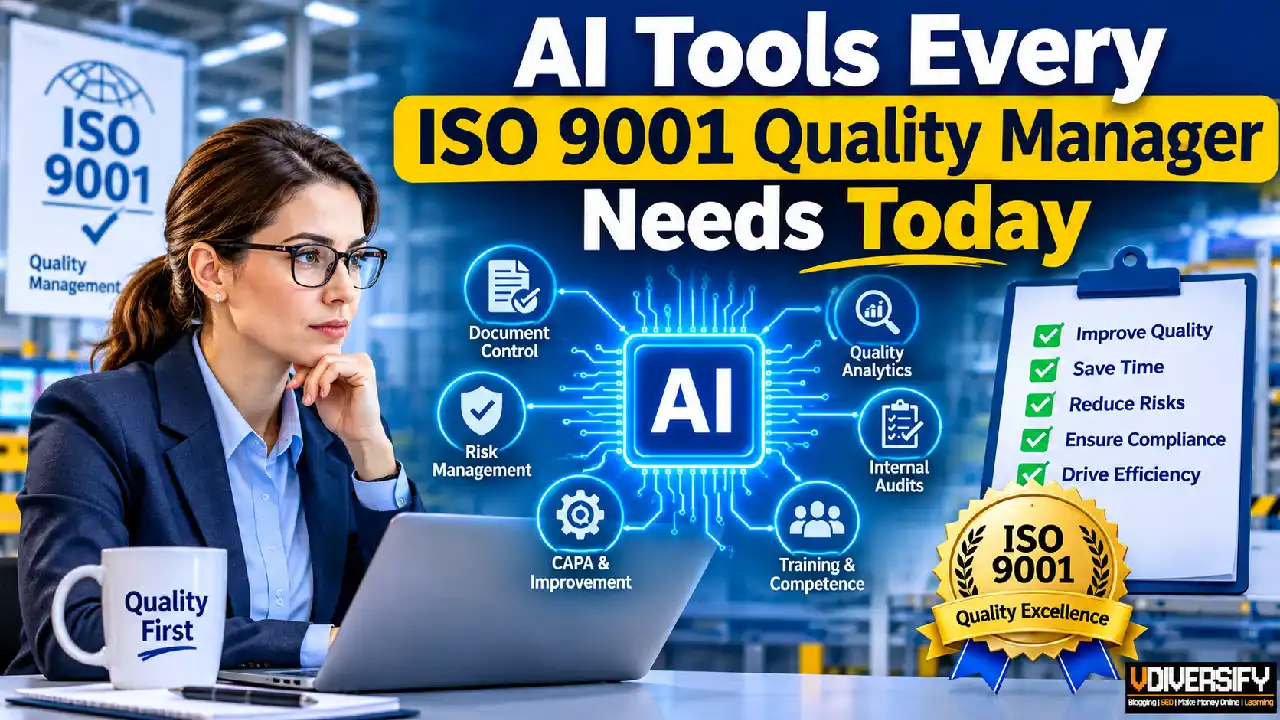
Quality management is changing rapidly. Organizations in the United States are under increasing pressure to deliver consistent products and services, reduce operational costs, meet customer expectations, maintain regulatory compliance, and improve their business processes.
At the same time, quality managers must handle a growing amount of documentation, inspection records, customer complaints, supplier evaluations, audit findings, corrective actions, and performance data. Managing all these activities manually can consume a significant amount of time and make it difficult to identify problems before they affect customers.
This is where AI tools ISO 9001 quality manager today can make a practical difference.
Artificial intelligence (AI) is becoming a useful part of modern quality management. It can help quality professionals review large amounts of information, identify unusual patterns, prepare reports, organize documentation, analyze nonconformities, and support better decision-making.
Instead of spending hours searching through spreadsheets and records, a quality manager can use suitable AI applications to find relevant information and focus more attention on improving processes.
However, AI is not a replacement for a quality manager, a certified auditor, or an effective quality management system (QMS). It is a supporting technology that can improve the speed and consistency of certain activities when used correctly.
In 2026, this subject is particularly important because organizations are also adapting to the latest edition of ISO 9001. The International Organization for Standardization published ISO 9001:2026 on September 16, 2026, replacing ISO 9001:2015. Hence it’s important for businesses to know what new addition of ISO 9001:2026 offers.
The revised standard reinforces leadership, quality culture, and the management of risks and opportunities. These areas make it important for organizations to understand how digital technology and AI can support their quality objectives.
This guide explains the different AI tools available to quality managers, how they support ISO 9001 processes, and how organizations can use them to improve their QMS. It also examines practical applications such as document control, internal auditing, corrective actions, risk assessment, inspection, and quality performance monitoring.
Contents
- 1. What Is Artificial Intelligence in ISO 9001 Quality Management?
- 2. How AI Supports ISO 9001:2026 Requirements
- 3. Essential AI Tools Every ISO 9001 Quality Manager Needs in 2026
- 4. Practical AI Applications, Quality Management Tools and Software Platforms
- 5. AI Tools for Risk Assessment and Risk-Based Thinking
- 6. AI Tools for Quality Inspection, Testing and Defect Detection
- 7. AI Tools for Nonconformity and Customer Complaint Management
- 8. AI Tools for Supplier Quality Management
- 9. AI Tools for Employee Training and Competence Management
- 10. AI Tools for Quality KPIs, Performance Monitoring and Management Reviews
- 11. Best AI and QMS Software Platforms for Quality Managers in 2026
- 12. AI Implementation, ISO 9001 Compliance, Risks and the Future of Quality Management
- 13. How to Implement AI Tools in an ISO 9001 Quality Management System
- 14. How to Choose the Right AI Quality Management Software
- 15. AI Governance, Data Protection and Cybersecurity in Quality Management
- 16. Limitations and Challenges of Using AI in ISO 9001
- 17. How AI Can Improve ISO 9001 Audit Readiness and Quality Certification
- 18. Cost of Implementing AI Tools for Quality Management in the US
- 19. Practical Checklist: Implementing AI in an ISO 9001 Quality Management System
- 20. Future of AI in ISO 9001 Quality Management
- 21. Conclusion: AI Will Support the Future of ISO 9001 Quality Management
- 22. References and Further Reading
- 23. FAQs
What Is Artificial Intelligence in ISO 9001 Quality Management?
Artificial intelligence refers to computer systems that can perform tasks that normally require human intelligence. These tasks include understanding language, analyzing information, recognizing images, identifying patterns, making predictions, and generating responses based on available data.
In quality management, AI can help organizations process information faster and identify potential quality problems that may not be immediately visible through manual reviews.
For example, consider a manufacturing company that produces 15,000 components every month. The quality department receives inspection reports, production records, customer complaints, machine performance data, and supplier quality reports.
A traditional approach requires employees to review different records, prepare spreadsheets, compare historical results, and identify recurring problems.
An AI-enabled quality management system can help analyze these records together, identify repeated defect patterns, and highlight areas that require further investigation.
AI does not make a nonconforming product acceptable. It helps the organization identify information that may require attention and supports decisions made by authorized personnel.
How AI works in a quality management system
AI applications used in quality management generally rely on one or more of the following technologies:
AI technology | How it works | Quality management application |
Machine learning | Learns patterns from historical data | Identifying recurring defects |
Generative AI | Creates text, summaries and other content | Preparing procedures and audit reports |
Natural language processing (NLP) | Understands and processes written language | Reviewing complaints and audit findings |
Computer vision | Analyzes images and videos | Detecting visible product defects |
Predictive analytics | Estimates possible future outcomes using historical data | Predicting equipment or quality problems |
Intelligent automation | Automates repetitive tasks using defined rules and AI | Document classification and workflow support |
These technologies do not all perform the same function.
For instance, a generative AI assistant may help prepare a draft corrective action report, while a machine learning application may analyze historical production data to identify factors associated with defects.
A quality manager should understand these differences before selecting a solution.
What is the difference between traditional QMS software and AI-powered QMS software?
Traditional QMS software primarily helps organizations record, manage, approve, and track quality activities. It can provide workflows for document control, nonconformity management, training, audits, supplier evaluations, and corrective actions.
AI-powered QMS software goes a step further. Depending on its capabilities, it may analyze records, summarize information, identify unusual trends, recommend possible actions, and help employees complete certain quality-related tasks.
Consider the following comparison:
Activity | Traditional QMS | AI-enabled QMS |
Document control | Stores and controls documents | Can assist with document search, review and classification |
Internal audits | Stores audit plans and findings | Can help prepare questions and summarize evidence |
CAPA | Tracks corrective actions | Can analyze similar historical cases |
Customer complaints | Records complaints | Can classify complaints and identify recurring themes |
Quality reporting | Displays recorded KPIs | Can identify trends and explain unusual changes |
Risk assessment | Records risks and actions | Can help analyze risk information and identify potential concerns |
The actual features depend on the software provider, subscription, configuration, and data available. A product described as an AI QMS platform may offer only a few AI-assisted features rather than complete automation.
Important: AI functionality does not automatically demonstrate ISO 9001 conformity. The organization must still establish effective processes, maintain appropriate documented information, evaluate results, and retain responsibility for its QMS.
How AI Supports ISO 9001:2026 Requirements
ISO 9001 provides a framework for establishing, implementing, maintaining, and continually improving a quality management system.
The 2026 edition continues the familiar management system structure while placing greater emphasis on leadership, quality culture, and the consideration of risks and opportunities. It also improves clarity and alignment with other management system standards.
AI can support different activities within this framework, but organizations should not assume that the standard requires them to purchase or use artificial intelligence.
ISO 9001 does not prescribe AI software. Organizations can comply with its requirements using manual processes, conventional software, AI-enabled applications, or a combination of these approaches.
The important consideration is whether the selected approach helps the organization achieve its intended quality results.
Where can AI be used across ISO 9001?
ISO 9001 area | Potential AI application | Example |
Clause 4 – Context of the organization | Information analysis | Summarizing market and stakeholder information |
Clause 5 – Leadership | Quality performance insights | Preparing management review summaries |
Clause 6 – Planning | Risk and opportunity analysis | Identifying possible operational risks |
Clause 7 – Support | Documentation and competence support | Drafting training material |
Clause 8 – Operation | Inspection and process monitoring | Identifying recurring production defects |
Clause 9 – Performance evaluation | Data analysis and reporting | Monitoring customer satisfaction trends |
Clause 10 – Improvement | Root cause analysis support | Reviewing recurring nonconformities |
These are examples of potential applications, not a statement that every listed AI feature is a specific requirement of the corresponding clause.
Example: Using AI to support risk-based thinking
Imagine a US-based automotive component manufacturer that receives an increasing number of customer complaints about dimensional defects.
The quality manager has access to:
- Previous inspection reports.
- Machine maintenance records.
- Production batch information.
- Supplier material certificates.
- Customer complaint records.
- Nonconformity reports.
An AI analytics application can help compare these records and identify whether dimensional defects occur more frequently on a particular production line, machine, shift, or material batch.
The quality manager can then investigate the findings and determine whether additional controls, maintenance, supplier action, or process changes are necessary.
This is a practical example of how AI ISO 9001 tools can support risk-based decision-making and continual improvement.
However, the quality manager must verify the information before taking action. An AI-generated relationship between two variables does not automatically prove that one caused the other.
How AI can support the ISO 9001:2026 transition
Organizations moving from ISO 9001:2015 to ISO 9001:2026 may also use AI to organize their transition activities.
For example, AI can assist with:
- Comparing existing QMS documents against an authorized copy of the new standard.
- Preparing an initial list of areas requiring review.
- Summarizing changes identified by the organization’s compliance team.
- Organizing responsibilities and transition activities.
- Preparing employee awareness and training material.
- Tracking the completion of approved improvement actions.
The comparison must be checked against the actual published standard. An AI assistant should not be treated as an authoritative source of ISO requirements, and organizations should not upload copyrighted standard documents to external AI services unless their license and the service’s terms permit it.
For organizations certified to the previous edition, ISO indicates a three-year transition period for moving to ISO 9001:2026. Certification bodies should be consulted for the applicable transition arrangements and audit schedule.
Buy: Quality management systems — Requirements
Essential AI Tools Every ISO 9001 Quality Manager Needs in 2026
There is no single AI application that can manage every quality-related activity within an organization. Quality managers often need a combination of AI assistants, QMS software, document management applications, analytics tools, and inspection technologies.
The following are some of the most useful categories of AI tools to consider in 2026.
Generative AI Tools for Quality Documentation and Technical Support
Generative AI tools are among the easiest technologies for quality managers to start using. They can understand written instructions, prepare draft documents, summarize information, and help employees organize technical content.
Popular options include:
- ChatGPT – Useful for preparing draft procedures, work instructions, quality reports, and audit questions. Official website
- Microsoft Copilot – Can assist with document preparation, spreadsheet analysis, email summaries, and workplace productivity. Official website
- Google Gemini – Useful for researching information, summarizing documents, and preparing written content. Official website
How can quality managers use generative AI?
Consider a company preparing for an upcoming ISO 9001 surveillance audit. The quality manager needs to update several documents, including:
- Quality objectives.
- Internal audit checklists.
- Quality procedures.
- Work instructions.
- Risk assessment records.
- Management review presentation.
- Corrective action reports.
Instead of creating every first draft manually, the quality manager can use an AI assistant to organize the information and prepare draft content.
For example, the manager can provide the following instruction:
Prompt example:
“Prepare a draft internal audit checklist for the purchasing process of a manufacturing company based on ISO 9001:2026. Include supplier evaluation, purchasing information, verification of purchased products, supplier performance monitoring, and records to be reviewed. Present the checklist in a table with audit questions and expected evidence.”
The AI assistant can generate a structured checklist that the auditor can review and customize.
However, the quality manager must verify the questions against the applicable requirements and the organization’s actual processes.
Practical applications include:
- Drafting quality procedures and work instructions.
- Preparing inspection formats.
- Summarizing customer complaints.
- Creating employee training presentations.
- Preparing management review reports.
- Drafting nonconformity reports.
- Developing quality awareness material.
Important limitation: Generative AI can produce incorrect information, including incorrect clause references and technical recommendations. Never approve an AI-generated procedure or use an AI-generated audit conclusion without competent human review.
AI-Powered QMS Software for Centralized Quality Management
A quality management system involves several interconnected processes. Managing them through separate spreadsheets, emails, shared folders, and paper records can create confusion.
AI-powered QMS software helps organizations centralize quality activities and, where supported, use AI to analyze quality information.
Some platforms worth evaluating include:
Software | Main application | Website |
MasterControl | Document control, audits and quality processes | |
Octave Reliance (formerly ETQ Reliance) | Enterprise quality management and AI-driven insights | |
Qualio | Cloud-based QMS and controlled documentation | |
Intelex | Quality, environmental and safety management | |
Arena QMS | Product and quality lifecycle management |
These products have different target markets, functions, and configurations. Their AI capabilities should be evaluated individually.
For example, Octave Reliance announced its Reliance AI capabilities in January 2026, including a Form Field Advisor and Complaint & Feedback Advisor. These features illustrate how AI can be incorporated into existing quality workflows rather than operating as a separate chatbot.
Example:
A company with three manufacturing facilities receives quality information from all three locations.
Without centralized software, each facility may maintain separate nonconformity registers, audit records, and corrective action trackers.
A centralized QMS can bring these records together. AI capabilities can then help identify recurring problems across different facilities, allowing the quality team to investigate common issues and coordinate improvement activities.
When evaluating quality management AI software, look for:
- Document control and revision history.
- Nonconformity and CAPA management.
- Internal audit management.
- Supplier quality management.
- Employee training records.
- Approval workflows.
- Reporting and analytics.
- Access control and audit trails.
- AI functionality with appropriate human review.
Do not purchase software simply because the provider advertises AI. First, determine whether it addresses the organization’s actual quality management needs.
AI Tools for Document Control and QMS Documentation
Document control is one of the most time-consuming activities in many ISO 9001-certified organizations.
Quality departments must ensure that employees use the correct versions of procedures, forms, work instructions, inspection formats, and other controlled documents.
A single outdated work instruction can create serious operational problems.
For example, imagine that a manufacturing company updates its inspection procedure but an employee continues using an older version. The employee may apply an outdated acceptance criterion, resulting in incorrect inspection decisions.
AI-enabled document management applications can help reduce such risks by supporting document classification, content searching, document comparisons, and review workflows.
How AI helps with document control
- Document classification: AI can help identify whether a document is a procedure, work instruction, inspection report, or quality record.
- Document searching: Employees can search for information using natural language instead of remembering exact file names.
- Content comparison: AI can help summarize differences between two document versions.
- Review assistance: It can identify missing sections, unclear instructions, or inconsistent terminology.
- Document summaries: Long procedures can be summarized to help employees understand important instructions.
Practical example:
A quality manager wants to review a 25-page inspection procedure before approving its revision.
An AI assistant can summarize the existing procedure, identify repeated instructions, and highlight areas that may need clarification.
The manager can then review the actual document, confirm technical accuracy, and submit the revised version through the organization’s formal approval process.
Remember that AI-generated document content must not bypass authorization, revision control, approval, distribution, or withdrawal of obsolete documents.
Useful software to investigate includes MasterControl Documents and Microsoft SharePoint. The suitability of either platform depends on the required document control features and configuration.
AI Tools for Internal Audits and Audit Preparation
Internal audits are essential for evaluating whether the QMS is effectively implemented and maintained.
However, preparing audit schedules, reviewing previous findings, developing checklists, collecting evidence, and preparing audit reports can require considerable effort.
AI tools can support auditors throughout this process.
Key applications of AI in internal auditing:
- Preparing draft audit checklists.
- Identifying relevant process documentation.
- Summarizing previous audit findings.
- Organizing audit evidence.
- Identifying repeated nonconformities.
- Preparing draft audit reports.
- Highlighting areas requiring additional investigation.
For example, a quality manager planning an internal audit of the maintenance department can use an AI assistant to prepare questions about equipment maintenance schedules, breakdown records, maintenance responsibilities, and equipment availability.
The auditor can then customize the checklist according to the organization’s maintenance process and audit criteria.
Example of an AI-supported audit
Suppose the previous three internal audits identified repeated gaps in preventive maintenance records.
An AI-enabled audit application may help compare these findings and highlight that the same department has repeatedly failed to maintain complete records.
The internal auditor can use this information to give appropriate attention to the issue during the next audit.
However, AI cannot independently establish whether an ISO 9001 requirement has been fulfilled. The auditor must collect objective evidence, evaluate the evidence against the audit criteria, and determine whether a nonconformity exists.
AI can assist the auditor, but it cannot replace auditor competence, independence, and professional judgment.
AI Tools for Corrective Actions, CAPA and Root Cause Analysis
Corrective action is another area where AI can provide considerable assistance.
When a nonconformity occurs, organizations must understand what happened, determine its cause, take appropriate action, and evaluate whether the action has been effective.
Unfortunately, many organizations struggle with identifying the actual root cause.
Employees sometimes write explanations such as:
- Operator mistake.
- Lack of awareness.
- Human error.
- Improper handling.
- Employee negligence.
These statements may describe what happened, but they do not necessarily explain why the problem occurred.
AI tools can help quality professionals organize investigation information, compare similar incidents, and explore possible contributing factors.
How AI supports CAPA activities
CAPA activity | AI-supported application |
Problem identification | Summarizing nonconformity information |
Root cause investigation | Suggesting possible causes for investigation |
5 Why analysis | Helping develop structured investigation questions |
Fishbone analysis | Organizing possible causes into categories |
Corrective action planning | Suggesting possible actions for evaluation |
Effectiveness verification | Comparing historical and subsequent results |
Real-world example:
A manufacturing company identifies repeated surface defects in painted metal components.
The initial investigation records the cause as “improper painting by the operator.”
The quality manager uses an AI assistant to organize the available evidence:
- Paint viscosity records.
- Spray gun maintenance history.
- Environmental temperature records.
- Operator training records.
- Paint supplier information.
- Previous inspection results.
The AI assistant suggests several possible areas to investigate, including incorrect viscosity, spray pressure variation, equipment condition, and environmental conditions.
The investigation team checks the actual records and discovers that the spray equipment has not been calibrated according to the planned maintenance schedule.
The organization can now evaluate the equipment-related cause and determine appropriate corrective actions.
This example demonstrates how AI QMS tools can support problem-solving without allowing the AI system to make unsupported conclusions.
Some useful applications include ChatGPT for investigation support and dedicated QMS platforms for managing corrective action workflows.
The quality manager should ensure that corrective actions address the verified cause and that effectiveness is checked using suitable evidence.
Practical AI Applications, Quality Management Tools and Software Platforms
AI can support much more than document preparation, internal audits, and corrective action management. Quality managers also need to monitor operational risks, inspect products, evaluate suppliers, investigate customer complaints, and measure process performance.
These activities generate large amounts of information. When the information is spread across different departments, identifying recurring problems and taking timely action can become difficult.
This is where AI-powered quality management applications can provide additional value. By analyzing inspection results, production records, supplier information, customer feedback, and performance indicators, these tools can help quality professionals identify areas requiring attention.
The following sections explain how quality managers can apply AI to everyday quality activities, with practical examples and software recommendations.
AI Tools for Risk Assessment and Risk-Based Thinking
Risk-based thinking is an important part of ISO 9001 quality management. Organizations must understand the risks and opportunities that could affect their ability to achieve intended results and deliver products or services that meet requirements.
However, risk assessment can become a difficult activity when organizations depend entirely on manual spreadsheets and periodic reviews.
For example, a manufacturing company may need to evaluate risks related to:
- Equipment breakdown.
- Supplier delivery delays.
- Raw material quality.
- Employee competence.
- Production process variation.
- Customer complaints.
- Changes in customer requirements.
- Environmental and operating conditions.
AI can help analyze historical information and identify patterns that may indicate potential problems.
How AI helps with risk assessment
AI applications can support risk assessment in several ways.
- Identifying recurring risk patterns
An AI analytics tool can review previous nonconformity reports, customer complaints, supplier performance records, and production data to identify repeated problems.
- Supporting risk prioritization
AI can help organize risk information according to factors such as frequency, impact, historical occurrence, and operational significance.
The quality manager must still determine the appropriate risk evaluation criteria and approve the final priorities.
- Monitoring changes
Some AI-enabled systems can continuously analyze operational data and highlight unusual changes.
For example, if a supplier’s rejection rate increases over several months, the system may identify the trend before it results in a major production disruption.
- Supporting risk review meetings
AI can summarize risk registers, highlight overdue mitigation activities, and prepare information for management review.
Practical example: Supplier-related risk assessment
Consider a US-based automotive parts manufacturer that purchases precision components from five suppliers.
During the previous six months, the quality department recorded:
- Increasing incoming inspection rejections from one supplier.
- Two delayed deliveries.
- Three customer complaints involving components from the same supply chain.
- Incomplete supplier corrective action responses.
An AI-powered analytics application can compare these records and identify the supplier as an area requiring additional attention.
The quality manager can then review the supplier’s performance, arrange a supplier meeting, increase verification activities where appropriate, and evaluate whether a formal corrective action is necessary.
This is a practical application of AI compliance management and risk-based quality monitoring.
Recommended AI tools for risk assessment
Tool | Potential application | Official website |
Microsoft Power BI | Risk dashboards and trend analysis | |
IBM watsonx | AI-assisted data analysis and enterprise AI | |
ChatGPT | Risk brainstorming and assessment documentation | |
Microsoft Copilot | Risk summaries and spreadsheet assistance |
Important: AI-generated risk scores should not automatically replace an organization’s approved risk assessment methodology. Risk evaluation must consider the actual process, customer requirements, business context, and available evidence.
AI Tools for Quality Inspection, Testing and Defect Detection
Inspection and testing are essential activities in manufacturing and other industries.
Traditional inspection often relies on employees visually checking products, measuring dimensions, testing performance, and recording results. Although these methods remain important, manual inspection can become challenging when production volumes increase or defects are difficult to identify consistently.
AI-powered computer vision and machine learning applications can support automated inspection by analyzing images, measurements, and other process information.
This is one of the most practical applications of automated ISO 9001 processes in manufacturing.
How AI-powered inspection works
An AI-based visual inspection system typically uses cameras, lighting equipment, image processing software, and trained machine learning models.
The process generally follows these steps:
- A camera captures an image of the product.
- The software processes the image.
- The AI model checks for predefined defect patterns.
- The system identifies areas that may not meet acceptance criteria.
- The result is displayed for operator review or sent to a configured inspection workflow.
- Authorized personnel decide whether the product should be accepted, rejected, or investigated further.
Real-world example: Detecting defects in manufactured components
Imagine a company producing 20,000 metal components every day.
Each component requires inspection for:
- Surface scratches.
- Cracks.
- Incorrect dimensions.
- Missing features.
- Surface contamination.
- Improper finishing.
Manual inspection of every component can require significant labor and may result in inconsistent detection, particularly when defects are small or difficult to see.
A computer vision system can analyze images at defined inspection points and flag components that appear to have defects.
For example, if the AI model identifies a possible crack, the component can be diverted for further inspection.
The quality inspector verifies the result using the approved inspection method before making the final disposition decision.
Benefits of AI-based inspection
- Faster inspection of high-volume products.
- More consistent detection of predefined visual defects.
- Reduced dependence on repetitive manual visual checks.
- Improved traceability when integrated with production records.
- Faster identification of recurring defect patterns.
- Better support for process improvement.
AI inspection software and technologies
Product or technology | Main application | Website |
Landing AI | Visual inspection and industrial computer vision | |
Cognex VisionPro | Machine vision and industrial inspection | |
Keyence vision systems | Automated visual inspection | |
Robovision | Industrial AI vision applications |
Not every industrial vision product offers the same machine learning or generative AI features. Evaluate the specific product, configuration, and integration requirements.
What should quality managers consider?
Before implementing AI inspection, verify:
- Whether the system can identify the relevant defect types.
- Whether inspection accuracy has been validated.
- Whether false acceptance and false rejection rates are acceptable.
- Whether lighting and camera conditions are controlled.
- Whether measurement equipment is suitable and properly maintained.
- Whether inspection results are traceable.
- Whether human verification is available for uncertain results.
AI inspection must be validated against the organization’s approved acceptance criteria. A computer vision system should not independently change product specifications or acceptance limits.
AI Tools for Nonconformity and Customer Complaint Management
Customer complaints are valuable sources of information for improving product and service quality.
However, organizations may receive complaints through different channels, including emails, telephone calls, online forms, customer portals, service reports, and distributor feedback.
When this information is not organized properly, recurring issues can remain unnoticed.
AI can help classify complaints, identify common themes, summarize customer feedback, and direct information to the appropriate department.
How AI improves complaint management
- Automatic complaint classification
AI can analyze complaint descriptions and classify them into categories such as:
- Product defects.
- Delivery delays.
- Packaging problems.
- Incorrect specifications.
- Service failures.
- Documentation errors.
- Identifying repeated complaints
AI can compare current complaints with historical records to identify similar problems.
- Complaint trend analysis
AI-powered analytics can highlight increases in complaints involving a particular product, production line, location, or supplier.
- Supporting investigation
AI can summarize the complaint history and organize relevant information for the investigation team.
- Drafting customer responses
Generative AI can help prepare professional draft responses, which must be reviewed and approved by authorized employees.
Practical example: Customer complaints in a manufacturing company
A US-based company manufactures industrial pumps.
Over three months, the company receives 45 customer complaints.
After reviewing the complaints, the quality department discovers that:
- 18 complaints involve leakage.
- 12 involve abnormal noise.
- 8 involve delayed delivery.
- 7 involve packaging damage.
An AI-powered complaint analysis tool can classify the complaints and identify leakage as the largest complaint category.
The quality manager can then investigate whether the leakage complaints are related to a particular product model, supplier, manufacturing process, or installation condition.
This helps the organization move beyond simply closing individual complaints and focus on reducing recurring problems.
Recommended tools
- Qualio – QMS workflows and quality event management.
- MasterControl – Quality event and corrective action management.
- Zendesk AI – AI-assisted customer service and ticket management.
- Microsoft Copilot – Complaint summaries and feedback analysis.
A customer service AI application is not automatically a complete ISO 9001 complaint management solution. It should be integrated with appropriate quality processes when used for QMS purposes.
AI Tools for Supplier Quality Management
Supplier quality management is an important responsibility for organizations that depend on external providers for materials, components, services, or outsourced processes.
A supplier’s performance can directly affect product quality, production schedules, customer satisfaction, and business continuity.
Quality managers therefore need reliable information about supplier performance and the controls applied to externally provided products and services.
AI tools can help organize supplier information and identify potential performance concerns.
How AI supports supplier quality management
AI applications can assist with:
- Reviewing supplier performance history.
- Identifying repeated incoming inspection failures.
- Analyzing supplier delivery performance.
- Summarizing supplier audit reports.
- Comparing supplier corrective action responses.
- Monitoring supplier-related quality trends.
- Identifying potential supply chain risks.
Practical example: Monitoring supplier performance
Consider a company that purchases raw materials from 12 approved suppliers.
The quality department evaluates each supplier based on:
- Incoming material acceptance rate.
- On-time delivery.
- Number of supplier nonconformities.
- Corrective action response time.
- Documentation accuracy.
- Audit performance.
An AI-enabled supplier analytics application can review historical performance data and highlight suppliers with declining performance.
For example, Supplier A may have maintained a 98% incoming acceptance rate during the previous quarter but dropped to 91% in the current quarter.
The system can flag this change for investigation.
The supplier quality engineer can review the rejected batches, determine the reasons for rejection, and decide whether additional supplier controls are necessary.
Recommended supplier quality and analytics tools
Tool | Potential use | Website |
SAP Ariba | Supplier management and procurement processes | |
Coupa | Supplier and supply chain management | |
MasterControl | Supplier quality and quality workflows | |
Power BI | Supplier quality performance dashboards |
Quality manager’s recommendation: Do not evaluate suppliers using an AI-generated score alone. Supplier approval and monitoring should consider the organization’s defined evaluation criteria, product risks, supplier capabilities, and actual performance evidence.
AI Tools for Employee Training and Competence Management
Employee competence has a direct influence on product quality, process performance, and customer satisfaction.
Even when an organization has well-written procedures, employees may make mistakes if they do not understand their responsibilities or have not received suitable training.
Quality managers must therefore ensure that employees performing work affecting quality have the necessary competence.
AI can support training needs identification, learning material preparation, employee assessments, and training effectiveness monitoring.
How AI helps with employee training
- Preparing training materials
Generative AI can help prepare presentations, training manuals, quizzes, and practical examples based on approved company procedures.
For example, a quality manager can use AI to prepare a short training session explaining how operators should identify and report nonconforming products.
- Creating role-specific training
Different employees require different levels of quality-related knowledge.
AI can help prepare separate learning materials for:
- Production operators.
- Quality inspectors.
- Maintenance engineers.
- Internal auditors.
- Supervisors.
- Department managers.
- Identifying training gaps
AI can help analyze training records, employee assessment results, and recurring process errors to identify areas where additional training may be necessary.
- Supporting employee assessments
AI can generate knowledge tests and scenario-based questions to evaluate employee understanding.
However, the organization must verify the accuracy of training content and retain appropriate competence evidence.
Practical example: Training production operators
A company experiences repeated nonconformities because operators are not following the correct inspection procedure.
The quality manager reviews the problem and identifies that the existing training material is too technical and difficult for new employees to understand.
The manager uses an AI assistant to prepare a simplified training presentation containing:
- Inspection steps.
- Photographs of acceptable and unacceptable products.
- Common inspection mistakes.
- Examples of nonconforming products.
- Escalation instructions.
The training material is reviewed by the responsible engineer before it is delivered.
After training, employees complete a knowledge assessment and demonstrate the inspection process under supervision.
The quality department can then evaluate whether the training has improved inspection performance.
Recommended AI and training platforms
- Docebo – AI-enabled learning management and employee training. Official website
- TalentLMS – Employee training and online learning. Official website
- Microsoft Copilot – Assistance with training presentations and learning content. Official website
- ChatGPT – Training material, quizzes, and explanations. Official website
The important point is that AI-generated training content does not, by itself, demonstrate employee competence. Organizations must evaluate whether employees can perform their assigned activities effectively.
AI Tools for Quality KPIs, Performance Monitoring and Management Reviews
Quality managers regularly monitor key performance indicators (KPIs) to understand whether the QMS is achieving its intended results.
However, collecting information is only one part of performance monitoring. The organization must also analyze the information, identify trends, and determine whether improvement activities are necessary.
AI-powered analytics can make this process more efficient.
Important quality KPIs that AI can help monitor
Quality KPI | What it measures |
First Pass Yield (FPY) | Percentage of products passing inspection without rework |
Defect Rate | Number of defective products relative to total production |
Customer Complaint Rate | Frequency of customer complaints |
Supplier Rejection Rate | Percentage of supplied materials rejected |
On-Time Delivery | Percentage of orders delivered on schedule |
Cost of Poor Quality (COPQ) | Financial impact of quality failures |
CAPA Closure Time | Time taken to complete corrective actions |
Audit Finding Closure | Status of internal and external audit findings |
Rework Rate | Percentage of products requiring rework |
How AI improves quality performance monitoring
AI can help quality managers:
- Analyze large datasets from multiple departments.
- Identify unusual changes in quality indicators.
- Compare performance across production lines.
- Highlight recurring quality problems.
- Prepare management review summaries.
- Identify relationships between different KPIs.
- Support forecasting and improvement planning.
Practical example: Monitoring First Pass Yield
Suppose a manufacturing company has a monthly production target of 50,000 units.
During the first month, 47,500 units pass inspection without rework.
The First Pass Yield is:
FPY = (47,500 ÷ 50,000) ✖ 100
FPY = 95%
During the next month, the First Pass Yield decreases to 89%.
An AI-enabled analytics platform can help compare production information and highlight possible contributing factors, such as:
- Increased machine downtime.
- Changes in raw material batches.
- Employee shift patterns.
- Process parameter variations.
- Increased defect frequency.
The quality manager can investigate the relevant information and decide whether corrective action or process improvement is required.
Recommended tools for quality analytics
Microsoft Power BI
Useful for creating interactive dashboards, tracking quality KPIs, and analyzing information from different sources.
Tableau
Supports data visualization, performance reporting, and business analytics.
IBM watsonx
Provides enterprise AI capabilities and tools for working with business information and analytics.
These platforms can support management review preparation, but the management review itself must still involve the required leadership evaluation and decisions.
Best AI and QMS Software Platforms for Quality Managers in 2026
Choosing the right software is one of the most important decisions when introducing AI into a quality management system.
Some organizations need an enterprise QMS with advanced workflows, while others simply need assistance with document preparation, inspection analysis, and reporting.
A small manufacturing business may not require the same software as a large automotive manufacturer with multiple facilities and thousands of controlled documents.
The following comparison highlights products worth considering.
AI and quality management software comparison
Software | Primary strength | Suitable application |
ChatGPT | Generative AI assistance | Drafting, analysis and quality knowledge support |
Microsoft Copilot | Workplace productivity | Documentation, spreadsheets and reporting |
MasterControl | Enterprise QMS | Document control, audits and CAPA |
Octave Reliance | Enterprise quality management | Quality workflows and AI-assisted processes |
Qualio | Cloud QMS | Controlled documents and quality events |
Intelex | EHSQ and quality management | Multi-process management |
Arena QMS | Product and quality lifecycle | Product development and quality processes |
Power BI | Data analytics | Quality dashboards and KPI reporting |
Landing AI | Industrial computer vision | Automated visual inspection |
ChatGPT for Everyday Quality Management Activities
ChatGPT — Useful starting point
ChatGPT can support quality professionals in preparing and organizing quality-related information.
Common applications include:
- Drafting internal audit checklists.
- Preparing 5 Why analysis questions.
- Creating fishbone diagrams.
- Drafting quality procedures.
- Preparing employee training material.
- Summarizing nonconformity reports.
- Explaining quality management concepts.
- Preparing management review presentations.
Example prompt:
“Act as a quality management assistant. Prepare a 5 Why analysis for repeated dimensional defects in a manufacturing process. Include the problem statement, investigation questions, possible contributing factors, evidence required, and proposed corrective action considerations. Clearly distinguish possible causes from verified root causes.”
This type of instruction can help the quality manager organize an investigation.
However, the AI response should be treated as a draft for professional review, not as an approved root cause analysis.
Microsoft Copilot for Quality Documentation and Reporting
Microsoft Copilot
Microsoft Copilot can be useful for organizations already working with Microsoft applications.
Depending on the subscription and available integrations, it can assist with:
- Preparing quality reports in Word.
- Analyzing inspection information in Excel.
- Preparing management review presentations in PowerPoint.
- Summarizing quality-related email discussions in Outlook.
- Organizing information in Microsoft 365 applications.
Example:
A quality manager receives an Excel file containing six months of inspection results.
Copilot may help summarize the information, identify changes in recorded values, and prepare charts or explanations.
The manager should verify the underlying calculations and confirm that the data has been interpreted correctly before presenting the results.
MasterControl for Enterprise Quality Management
MasterControl
MasterControl is an established quality management software provider offering solutions for controlled documentation, training, audits, corrective actions, and other quality processes.
It is worth evaluating for organizations that need a centralized QMS rather than a collection of separate applications.
Potential benefits include:
- Centralized quality documentation.
- Controlled approval workflows.
- Audit and CAPA management.
- Employee training records.
- Quality event tracking.
- Improved visibility of quality activities.
Its suitability depends on the specific product configuration, implementation requirements, and AI functionality available to the customer.
Octave Reliance for Quality Process Management
Octave Reliance
Octave Reliance, formerly known as ETQ Reliance, is an enterprise quality management platform.
It is relevant to organizations that want to manage quality processes through structured workflows and centralized information.
Its AI-related capabilities are particularly interesting for complaint management and quality process assistance.
Organizations should request a demonstration to understand the available AI features, supported workflows, implementation options, and licensing arrangements.
Qualio for Cloud-Based Quality Management
Qualio
Qualio is a cloud-based QMS platform used by organizations that need structured document and quality process management.
Its potential applications include:
- Document control.
- Training management.
- Quality events.
- Corrective actions.
- Audit preparation.
- Quality process visibility.
It is particularly worth investigating for organizations looking for a cloud-based approach rather than maintaining multiple disconnected quality records.
Landing AI for Automated Visual Inspection
Landing AI
Landing AI focuses on computer vision and industrial AI applications.
It is worth considering for manufacturers that want to explore automated visual inspection and defect detection.
For example, a company producing electrical connectors may use a suitable vision system to identify missing components, surface damage, or incorrect assembly.
The system must be trained and validated using representative images and approved inspection criteria before it is relied upon for production decisions.
The selection of an appropriate platform should depend on the organization’s size, industry, existing QMS maturity, operational complexity, and budget. A quality manager should also evaluate whether the software can integrate with existing ERP, manufacturing, inspection, and document management systems.
AI Implementation, ISO 9001 Compliance, Risks and the Future of Quality Management
Selecting the right AI tools is only the beginning. The real value comes when an organization integrates these technologies into its existing quality management system and uses them to improve business processes.
An organization may purchase advanced AI software, introduce automated inspection systems, and use generative AI for documentation. However, if employees do not understand how to use these tools, the information is inaccurate, or management does not review the results, the investment may not deliver the expected benefits.
Quality managers must therefore approach AI implementation carefully. They should understand the organization’s requirements, identify suitable applications, establish controls, train employees, and evaluate whether the technology improves quality performance.
The following sections explain how organizations can implement AI effectively while maintaining control over their ISO 9001 quality management systems.
How to Implement AI Tools in an ISO 9001 Quality Management System
Implementing AI does not mean replacing the existing QMS with a completely new system.
A better approach is to identify areas where AI can improve existing quality processes and introduce the technology gradually.
For example, an organization experiencing difficulties with document searches may initially introduce an AI-assisted document search application rather than immediately investing in a large enterprise AI platform.
Similarly, a manufacturing company struggling with repeated visual inspection errors may evaluate computer vision technology for a specific product or production line.
Step 1: Identify existing quality management problems
Before selecting AI software, the quality manager should understand the organization’s current challenges.
Start by reviewing existing quality processes and identifying activities that consume excessive time, generate repeated errors, or require better analysis.
Common challenges include:
- Excessive time spent preparing quality reports.
- Difficulty identifying recurring nonconformities.
- Inconsistent document management.
- Delayed corrective action investigations.
- Repeated customer complaints.
- Limited visibility of supplier performance.
- High inspection workload.
- Difficulty monitoring quality KPIs.
- Incomplete management review information.
Practical example:
A company spends approximately 30 hours every month preparing quality performance reports from separate Excel files.
The quality manager may consider integrating the data into a business intelligence platform and using suitable AI features to assist with analysis.
The objective is not simply to introduce AI. It is to reduce unnecessary manual work while improving the accuracy and usefulness of quality information.
Step 2: Evaluate which processes are suitable for AI
Not every quality management activity needs artificial intelligence.
Some processes are better managed through traditional software, while others can benefit from machine learning, computer vision, or generative AI.
Quality process | AI suitability | Suggested application |
Document searching | High | AI-assisted document retrieval |
Audit preparation | High | Checklist and evidence summarization |
CAPA investigation | High | Investigation support and historical analysis |
Visual inspection | High | Computer vision |
Quality KPI monitoring | High | Trend identification and analytics |
Employee training | Medium to high | Training content and learning assistance |
Document approval | Limited automation | AI-assisted review with authorized approval |
Final product acceptance | Depends on validation | Approved inspection and measurement systems |
Management decisions | Human-led | AI-assisted information and analysis |
The suitability of each application depends on the availability of reliable data, process complexity, and the consequences of incorrect results.
Step 3: Select the right AI and QMS software
Once suitable processes have been identified, compare the available software solutions.
A quality manager should evaluate:
Technical capabilities
- Does the software provide the required AI functionality?
- Can it analyze the organization’s existing quality data?
- Can it integrate with current systems?
- Does it support different departments and locations?
Quality management capabilities
- Does it support document control?
- Can it manage nonconformities and CAPA?
- Does it support internal audits?
- Can it maintain approval records?
- Does it provide useful quality performance reports?
Security and compliance
- Does it provide appropriate access controls?
- How is company information stored?
- Does the provider use customer information to train its models?
- Can administrators manage data retention?
- Are relevant audit logs available?
Step 4: Conduct a pilot implementation
Do not immediately introduce AI throughout the entire organization.
Start with one clearly defined process.
For example, a manufacturing company can pilot AI-assisted analysis of customer complaints for three months.
During the pilot, evaluate:
- Time required to classify complaints.
- Accuracy of complaint classification.
- Number of incorrectly categorized complaints.
- Employee feedback.
- Time saved during investigation preparation.
- Quality of the information generated.
Compare the results against the previous process.
If the pilot demonstrates useful results and appropriate controls are in place, the organization can consider expanding its use.
Step 5: Establish AI usage procedures and responsibilities
Employees should understand what AI tools they are permitted to use, what information they can enter, and which decisions require approval.
An AI usage procedure can cover:
- Approved AI software and applications.
- Permitted and prohibited data.
- User responsibilities.
- Verification of AI-generated information.
- Approval of AI-assisted documents.
- Reporting incorrect AI outputs.
- Data protection and confidentiality.
- Monitoring and periodic review.
This helps prevent employees from using unapproved applications or relying on unverified information.
Step 6: Train employees and monitor performance
Employees need training before using AI as part of their quality-related activities.
Training should cover:
- Basic AI awareness.
- Appropriate use of approved AI applications.
- Writing effective instructions and prompts.
- Identifying incorrect AI-generated information.
- Protecting confidential company information.
- Verifying technical and quality-related outputs.
- Escalating errors or unexpected results.
The quality manager should periodically review whether the tools are delivering the intended benefits.
Step 7: Measure results and improve continuously
AI implementation should be treated like any other improvement activity.
The organization should establish measurable objectives before implementation.
For example:
Performance indicator | Before implementation | Target after implementation |
Monthly report preparation time | 30 hours | 18 hours |
Complaint classification time | 10 minutes per complaint | 5 minutes |
Document search time | 8 minutes | 3 minutes |
CAPA investigation preparation | 6 hours | 4 hours |
Illustrative targets only, not verified industry benchmarks or guaranteed software performance.
The organization must measure actual results rather than assume that AI automatically improves performance.
How to Choose the Right AI Quality Management Software
There are many AI applications available in 2026. However, the most expensive platform is not necessarily the best choice for every organization.
A small manufacturing company may need basic AI assistance for documentation and reporting, while a large organization may require an integrated enterprise QMS with advanced analytics, supplier management, and automated inspection capabilities.
Before purchasing any software, consider the following factors.
Understand your organization’s requirements
Begin by reviewing your existing QMS.
Identify which processes are working effectively and which require improvement.
For example:
- If document searching is difficult, consider AI-assisted document management.
- If internal audit preparation takes too long, consider AI-supported audit applications.
- If recurring defects are difficult to identify, consider predictive analytics.
- If visual inspection is time-consuming, consider computer vision.
- If supplier performance is difficult to monitor, consider supplier analytics.
The software should solve a genuine business problem.
Check integration capabilities
AI software becomes more useful when it can work with the organization’s existing systems.
Consider whether it can integrate with:
- ERP systems.
- Manufacturing execution systems (MES).
- Enterprise document management systems.
- Inspection and testing applications.
- Customer relationship management (CRM) systems.
- Supplier management platforms.
- Business intelligence tools.
Poor integration can create additional manual work and duplicate records.
Evaluate data security and confidentiality
Quality management information may contain confidential customer details, supplier information, production specifications, product designs, and commercially sensitive business records.
Before selecting an AI application, understand how the provider handles this information.
Check:
- Data encryption.
- User authentication.
- Role-based permissions.
- Data retention policies.
- Data residency options.
- Third-party access.
- Backup arrangements.
- Incident reporting.
- Customer data usage for model training.
For US organizations, relevant considerations may include contractual confidentiality obligations, applicable privacy laws, industry-specific requirements, and customer security agreements.
Evaluate actual AI functionality
Some providers use the term AI to describe basic automation, while others provide machine learning, natural language processing, generative AI, or computer vision.
These technologies have different capabilities.
Ask software providers to demonstrate actual workflows rather than relying only on marketing descriptions.
For example, ask the provider to demonstrate how its system analyzes a real-world nonconformity, identifies similar historical records, and supports corrective action management.
Consider total implementation cost
The cost of AI software may include more than the subscription price.
Consider:
- Software licensing.
- Implementation and configuration.
- Data migration.
- Employee training.
- System integration.
- Technical support.
- Ongoing maintenance.
- Additional AI usage charges.
- Cybersecurity requirements.
A solution that appears inexpensive initially may become costly if it requires extensive customization.
Compare vendors before making a decision
The following comparison can help during the initial selection process.
Evaluation factor | Basic AI assistant | AI-enabled QMS | Industrial AI inspection |
Document preparation | Strong | Platform-dependent | Limited |
Document control | Not a full QMS | Strong | Limited |
CAPA management | Assistance only | Workflow-based | Limited |
Internal audit support | Strong for drafting | Platform-dependent | Limited |
Visual defect detection | Limited | Integration-dependent | Strong |
Quality KPI analysis | Data-dependent | Platform-dependent | Inspection-focused |
Implementation complexity | Usually lower | Medium to high | Medium to high |
My recommendation: Start with the organization’s most important quality problem, not the software provider’s most impressive AI demonstration.
AI Governance, Data Protection and Cybersecurity in Quality Management
AI introduces new risks that quality managers must understand.
Although AI can improve productivity, it can also generate inaccurate information, expose confidential data, introduce bias, and create excessive dependence on automated recommendations.
Organizations should therefore establish appropriate governance before using AI for important business or quality-related activities.
Follow an AI risk management framework
The National Institute of Standards and Technology (NIST) provides an AI Risk Management Framework designed to help organizations identify and manage risks associated with AI systems.
The framework includes four core functions:
NIST function | Meaning | Quality management example |
Govern | Establish responsibilities and policies | Define approved AI tools |
Map | Understand the AI system and its context | Identify where AI is used in the QMS |
Measure | Assess and evaluate risks | Test accuracy and reliability |
Manage | Address identified risks | Apply controls and monitor performance |
Source: NIST AI Risk Management Framework.
NIST also published a Generative AI Profile to help organizations understand risks associated with generative AI applications.
Source: NIST Generative AI Risk Management Profile.
These resources are useful references for organizations developing an AI governance approach.
Protect confidential quality information
Employees should never assume that information entered into an AI application is automatically private.
Before uploading company information, confirm the service’s data handling terms and the organization’s authorization requirements.
For example, employees should not upload the following information into an unapproved public AI service:
- Confidential customer specifications.
- Supplier contracts.
- Proprietary manufacturing drawings.
- Employee personal information.
- Unreleased product designs.
- Sensitive nonconformity investigations.
- Restricted audit reports.
Organizations should use approved enterprise services and configure suitable access controls where necessary.
Prevent incorrect AI-generated information
AI systems can generate convincing but incorrect answers.
This is particularly concerning when preparing ISO 9001 procedures, audit reports, corrective actions, or technical inspection instructions.
For example, an AI assistant may provide an incorrect clause reference or suggest a corrective action that does not address the actual root cause.
To reduce this risk:
- Verify references against the applicable standard.
- Check technical information against approved specifications.
- Validate calculations independently.
- Review AI-generated audit findings against objective evidence.
- Require authorization before approving controlled documents.
- Maintain records of important decisions.
Establish human oversight
Human oversight is essential when AI is used for decisions that may affect product conformity, customer satisfaction, or QMS effectiveness.
A useful approach is to define three levels of AI involvement:
Level | AI involvement | Human responsibility |
Low risk | Drafting and summarizing | Review content |
Medium risk | Analyzing trends and suggesting actions | Verify findings and approve actions |
High risk | Supporting inspection or safety-related decisions | Validate the system and retain authorized decision-making |
The exact level of control should depend on the consequences of an incorrect result.
Limitations and Challenges of Using AI in ISO 9001
AI is useful, but it is not perfect.
Organizations should understand its limitations before integrating it into quality management processes.
Inaccurate or misleading results
Generative AI can produce information that sounds correct but is factually wrong.
This can create problems when preparing technical documentation, inspection instructions, or compliance reports.
Solution: Establish verification and approval procedures for AI-generated content.
Dependence on data quality
AI systems depend heavily on the information available to them.
If historical inspection records are incomplete, inconsistent, or inaccurate, the resulting analysis may also be unreliable.
For example, an AI system analyzing supplier performance cannot provide a dependable comparison if different departments record supplier rejections using different methods.
Solution: Improve data quality and standardize information before introducing advanced analytics.
Employee resistance
Some employees may worry that AI will replace their jobs or reduce the importance of their experience.
Others may simply find new technologies difficult to use.
Solution: Explain that AI is intended to support employees, reduce repetitive tasks, and help them focus on activities that require technical knowledge and judgment.
Integration difficulties
Organizations often use multiple systems that do not communicate effectively.
Integrating an AI application with an ERP, QMS, and production system may require additional configuration and technical resources.
Solution: Evaluate integration requirements before purchasing software and conduct pilot testing.
Implementation and maintenance costs
AI systems may require ongoing licensing, employee training, data preparation, technical support, and system maintenance.
Solution: Calculate the total cost of ownership and compare it against measurable operational benefits.
Lack of transparency
Some AI models make recommendations without providing enough information about how they reached their conclusions.
This can make it difficult for quality managers to verify results.
Solution: Prefer applications that provide traceable information, explainable results where appropriate, and access to supporting evidence.
How AI Can Improve ISO 9001 Audit Readiness and Quality Certification
Organizations preparing for ISO 9001 certification or surveillance audits often need to review large amounts of documented information.
AI can help organize this preparation work and improve access to relevant records.
For example, an AI-supported QMS can help employees locate:
- Approved quality policies.
- Current procedures.
- Internal audit reports.
- Management review records.
- Training and competence records.
- Supplier evaluation records.
- Corrective action reports.
- Inspection and testing records.
- Customer complaint information.
How AI supports certification preparation
- Documentation review
AI can help identify missing sections, inconsistent terminology, and potential gaps in controlled documentation.
- Audit checklist preparation
AI can prepare draft audit questions based on the organization’s processes and applicable requirements.
- Historical audit analysis
AI can summarize previous findings and identify departments with recurring problems.
- Evidence organization
AI-enabled search applications can help locate relevant records and organize evidence for auditor review.
- Corrective action monitoring
AI analytics can highlight overdue actions and recurring nonconformities.
Practical example: Preparing for a certification audit
A US-based manufacturing company is preparing for an ISO 9001 certification audit.
The quality manager needs to coordinate documentation and records across production, purchasing, maintenance, inspection, and human resources.
The company uses an AI-assisted QMS to search for controlled documents, summarize previous audit findings, and prepare a departmental audit readiness report.
The report highlights several areas requiring attention:
- Two overdue corrective actions.
- An incomplete training record.
- An outdated maintenance instruction.
- Missing supplier performance review information.
The quality manager assigns responsibilities and verifies that each issue is addressed through the organization’s established processes.
This approach can improve audit preparation and reduce the time employees spend searching for records.
However, AI cannot guarantee ISO 9001 certification.
Certification depends on the organization’s conformity with the applicable requirements and the results of an independent certification audit conducted by an appropriately accredited certification body.
An AI-generated compliance checklist is a preparation tool, not certification evidence by itself.
Cost of Implementing AI Tools for Quality Management in the US
The cost of implementing AI in quality management varies considerably.
A company using a general-purpose AI assistant may have a relatively small initial investment, while an organization implementing an enterprise QMS, predictive analytics, and automated inspection equipment may require a much larger budget.
There is no single standard price for AI quality management software.
Pricing depends on the number of users, software modules, data volume, integrations, implementation requirements, and support arrangements.
Typical AI implementation cost categories
Cost category | What it includes |
AI subscription | Access to AI applications |
QMS licensing | Quality management software modules |
Implementation | Configuration and deployment |
Integration | Connecting AI with existing systems |
Training | Employee awareness and technical training |
Data preparation | Cleaning and organizing historical records |
Maintenance | Ongoing technical support |
Security | Access controls and cybersecurity measures |
How to calculate the potential return on investment
Organizations should compare the investment with measurable savings and quality improvements.
A simple ROI calculation is:
ROI = [(Annual Benefits – Annual Costs) ÷ Annual Costs] ✖ 100
Example:
Suppose a company invests $12,000 annually in AI-assisted quality reporting and document analysis.
The company estimates that the solution saves 15 employee hours per month.
Assume the fully loaded labor cost is $45 per hour.
Annual estimated labor savings:
15 ✖ 45 ✖ 12 = $8,100
If the organization also identifies $6,000 in additional annual savings from reduced administrative rework, the total estimated benefit becomes $14,100.
Therefore:
ROI = [(14,100 – 12,000) ÷ 12,000] ✖ 100
ROI = 17.5%
Illustrative calculation. Actual savings must be established using measured results, and implementation, training, integration and other indirect costs should be included where applicable.
A quality manager should also consider benefits that may be difficult to express financially, such as improved traceability, faster access to information, better risk visibility, and more consistent quality reporting.
Practical Checklist: Implementing AI in an ISO 9001 Quality Management System
The following checklist can help quality managers plan AI adoption systematically.
AI implementation readiness checklist
- Identify quality management activities that need improvement.
- Review existing QMS processes and available data.
- Identify suitable AI applications and software providers.
- Evaluate software functionality and integration capabilities.
- Assess data security, confidentiality and privacy requirements.
- Define approved AI usage and responsibilities.
- Conduct a pilot implementation in one selected process.
- Validate AI-generated information and recommendations.
- Train employees on approved AI applications.
- Establish human review and approval controls.
- Monitor AI performance using measurable KPIs.
- Review AI-related risks periodically.
- Evaluate implementation costs and business benefits.
- Improve the system based on performance results.
- Select each item as your organization completes it.
Future of AI in ISO 9001 Quality Management
AI is expected to play an increasingly important role in quality management as organizations improve their digital infrastructure and collect more reliable operational data.
The future of quality management will not simply involve automating existing paperwork. It will involve using data to understand process performance, identify potential problems earlier, and support better decisions.
Several developments are particularly important.
Predictive quality management
Traditional quality management often relies on inspection results and historical nonconformity records.
Predictive quality applications can analyze historical and real-time information to identify patterns associated with possible future defects.
For example, an AI model may identify that certain combinations of machine temperature, operating speed, and material conditions are associated with higher defect rates.
The production team can investigate these conditions and take appropriate action before more defective products are produced.
Greater use of automated inspection
Computer vision systems will continue to support manufacturing organizations that need to inspect large product volumes.
As camera technology and AI models improve, organizations may be able to identify increasingly complex visual defects.
However, these systems will still require validation, calibration where applicable, controlled operating conditions, and ongoing performance monitoring.
AI-assisted internal audits
Future audit applications may offer more advanced evidence searches, automated summaries, and identification of recurring findings across departments.
Auditors may spend less time organizing records and more time evaluating whether processes are effective.
Nevertheless, the auditor must remain responsible for audit conclusions.
Connected quality management systems
Organizations are increasingly connecting QMS platforms with production systems, ERP applications, supplier databases, and customer service platforms.
This can create a more complete view of quality performance.
For example, a customer complaint may be linked with the original production batch, incoming material inspection, supplier records, and final inspection results.
Such connections can help quality teams investigate problems more efficiently.
AI-assisted management reviews
AI may increasingly support management review preparation by organizing information related to:
- Customer satisfaction.
- Quality objectives.
- Process performance.
- Nonconformities.
- Corrective actions.
- Audit results.
- Supplier performance.
- Risks and opportunities.
- Improvement activities.
Management can use these summaries to focus discussion on important issues.
However, leadership must still evaluate the information, make decisions, and provide direction for continual improvement.
Increased focus on AI governance
As organizations depend more heavily on AI, they will need stronger controls over data, system access, model performance, and accountability.
AI governance will become an important consideration for quality, IT, cybersecurity, and senior management teams.
The organizations most likely to benefit will be those that combine reliable data, suitable technology, competent employees, and effective management oversight.
Conclusion: AI Will Support the Future of ISO 9001 Quality Management
Artificial intelligence is creating new opportunities for organizations to improve their quality management systems, reduce repetitive administrative work, and make better use of operational information.
For ISO 9001 quality managers, AI is particularly useful in areas such as document control, internal audits, corrective action management, risk assessment, inspection, supplier quality, employee training, and performance monitoring.
However, adopting AI should not become a goal in itself. Organizations should introduce technology to solve real quality problems and improve the effectiveness of their processes.
A company does not need to implement every available AI application. It should begin by identifying its most important challenges, selecting suitable tools, testing their capabilities, training employees, and monitoring actual results.
It is equally important to establish appropriate controls over data protection, information accuracy, system access, and human decision-making. AI-generated recommendations must be verified, and important quality decisions must remain under the responsibility of authorized and competent personnel.
As ISO 9001:2026 becomes the basis for organizations’ quality management systems, combining established quality management principles with suitable digital technologies can help businesses become more responsive, consistent, and efficient.
The future of quality management is not about replacing quality professionals with AI. It is about giving quality professionals better tools to identify problems, prevent failures, improve processes, and deliver greater value to customers.
For quality managers, engineers, auditors, and organizations in the United States, 2026 is an excellent time to understand these technologies and begin exploring how they can support a more effective quality management system.
References and Further Reading
The following authoritative resources and official software websites can help readers explore AI, quality management, and the technologies discussed in this article.
ISO standards and quality management
AI governance and responsible AI
- NIST – Artificial Intelligence Risk Management Framework
- NIST – Generative Artificial Intelligence Profile
Google and SEO best practices
- Google Search Central – Creating Helpful, Reliable, People-First Content
- Google Search Central – Guidance About Generative AI Content
AI and quality management software
- ChatGPT
- Microsoft Copilot
- MasterControl
- Octave Reliance
- Qualio
- Intelex
- Arena Solutions
- Microsoft Power BI
- Landing AI
FAQs
The following questions address some of the most common concerns quality professionals have when considering AI applications in their organizations.
1. What are the best AI tools for ISO 9001 quality managers in 2026?
Some useful AI tools include ChatGPT, Microsoft Copilot, Power BI, MasterControl, Octave Reliance, Qualio, Intelex, and Landing AI.
Each application serves a different purpose. ChatGPT and Copilot can assist with documentation and information analysis, QMS platforms help manage quality processes, Power BI supports performance reporting, and computer vision applications can support automated inspection.
The best choice depends on the organization’s size, industry, budget, existing QMS, and quality improvement objectives.
2. Can AI automate ISO 9001 compliance?
AI can automate or assist with certain activities associated with ISO 9001 compliance, including document searching, report preparation, audit scheduling, data analysis, and corrective action tracking.
However, AI cannot independently guarantee compliance with ISO 9001.
Organizations remain responsible for establishing effective processes, maintaining appropriate documented information, ensuring product and service conformity, and evaluating QMS performance.
3. Can ChatGPT prepare ISO 9001 documents?
Yes. ChatGPT can assist with preparing draft quality policies, procedures, work instructions, audit checklists, training materials, risk assessment formats, and corrective action reports.
However, the generated content must be reviewed by competent personnel before approval and implementation.
The organization must also ensure that the documents reflect its actual processes and applicable requirements rather than relying on generic templates.
4. Can AI replace an ISO 9001 internal auditor?
No. AI can support internal auditors by preparing checklists, summarizing evidence, identifying repeated findings, and organizing audit reports.
However, internal auditors must have appropriate competence and evaluate objective evidence independently.
AI cannot replace the auditor’s responsibility to determine whether a nonconformity exists and report accurate audit conclusions.
5. How does AI help with ISO 9001 corrective actions?
AI can help organize nonconformity information, compare previous incidents, prepare 5 Why questions, develop fishbone diagrams, and identify possible contributing factors.
For example, when a company experiences repeated product defects, AI can help compare inspection records, production data, and maintenance history.
The investigation team must verify the actual root cause and approve appropriate corrective actions.
6. Is AI-powered QMS software necessary for ISO 9001 certification?
No. ISO 9001 does not require organizations to use AI-powered QMS software.
Organizations can establish and maintain an effective QMS using manual processes, conventional software, or AI-enabled applications.
The important requirement is that the organization’s quality management processes meet the applicable standard requirements and operate effectively.
7. How much does AI quality management software cost in the United States?
There is no universal price for AI quality management software.
Costs depend on the software provider, number of users, selected modules, implementation requirements, integrations, and support arrangements.
Some organizations may only need a general-purpose AI subscription, while larger manufacturers may require an enterprise QMS and specialized inspection technology.
Businesses should request quotations from providers and calculate the total cost of ownership before making a purchasing decision.
8. Is AI safe to use for confidential ISO 9001 documents?
AI can be used for confidential quality information when the organization selects an appropriate service, establishes security controls, and complies with its contractual and legal obligations.
However, employees should not upload confidential documents into unapproved public AI applications.
Organizations should evaluate encryption, access permissions, data retention, data usage, and security arrangements before implementation.
9. What is the difference between AI and automation in quality management?
Traditional automation generally follows predefined rules and instructions to perform repetitive activities.
AI can additionally analyze information, recognize patterns, interpret language, and generate predictions or recommendations.
For example, a traditional system may send an automatic reminder when a corrective action becomes overdue. An AI-enabled application may also analyze historical corrective actions and identify recurring reasons for delays.
Both technologies can work together to improve quality management.
10. Will AI replace quality managers in the future?
AI is more likely to change the responsibilities of quality managers than completely replace them.
Many repetitive activities, including documentation preparation, information searching, data classification, and report generation, can be supported by AI.
However, quality management requires leadership, technical knowledge, process understanding, risk evaluation, problem-solving, communication, and accountability.
These responsibilities require competent human involvement.
The most effective quality managers will learn how to use AI as a supporting tool while strengthening their technical and management skills.

“Hey, I am Sachin Ramdurg, the founder of VDiversify.com.
I am QA/QC Manager, Certified Lead Auditor and Quality Champion. I am an Engineer and Passionate Blogger with a mindset of Entrepreneurship. I have been experienced in Blogging for more than 15+ years and following as a youtuber along with blogging, online business ideas, affiliate marketing, and make money online ideas since 2012.