
Preparing quality management system (QMS) documentation is one of the most time-consuming responsibilities for quality managers, QA/QC engineers, ISO consultants, and other quality professionals.
Whether an organization is implementing ISO 9001 for the first time or maintaining an existing quality management system, creating clear procedures, work instructions, forms, and records requires a good understanding of business processes and quality requirements.
This is where ChatGPT write ISO 9001 procedures work instructions becomes a useful approach for organizations looking to simplify documentation, improve consistency, and reduce the time spent preparing quality documents.
Many organizations still prepare their quality procedures manually using Word documents, spreadsheets, and existing templates. Although this approach works, it can become difficult when several departments need different procedures, multiple revisions are required, or the organization operates across different locations.
For example, a manufacturing company may need procedures for purchasing, incoming inspection, production control, equipment calibration, nonconforming outputs, corrective actions, and internal audits. Each procedure must reflect what actually happens within the organization. Preparing all these documents from scratch can take considerable time, especially when the quality team has limited resources.
ChatGPT can make this process easier. It can help quality professionals develop document structures, prepare procedure drafts, create work instructions, generate inspection checklists, improve existing documents, and identify information that may be missing.
However, using AI does not mean copying its responses directly into the QMS. Every document must be checked against actual company processes, applicable ISO 9001 requirements, customer requirements, and relevant legal or regulatory obligations before approval.
In this guide, we will explain how to use ChatGPT for quality management documentation, how to prepare effective prompts, how to create procedures and work instructions, and how to review AI-generated documents before introducing them into an organization.
The objective is simple: help quality professionals use AI as a practical documentation assistant while maintaining control over the accuracy, suitability, and effectiveness of their QMS.
Contents
- 1. What Are ISO 9001 Procedures and Work Instructions?
- 2. Can ChatGPT Write ISO 9001 Procedures and Work Instructions?
- 3. How ChatGPT Supports ISO 9001:2026 Documentation
- 4. Benefits of Using ChatGPT for QMS Documentation
- 5. What Information Should You Prepare Before Using ChatGPT?
- 6. How to Write Effective ChatGPT Prompts for ISO 9001 Documents
- 7. AI-assisted procedure development workflow
- 8. How to Use ChatGPT to Write ISO 9001 Procedures Step by Step
- 9. Sample QMS Procedure Document Header
- 10. How to Use ChatGPT to Create Work Instructions
- 11. Practical ChatGPT Prompts for Different ISO 9001 Procedures
- 12. How to Use ChatGPT to Improve Existing QMS Documents
- 13. How to Generate Forms, Checklists, and Quality Records Using ChatGPT
- 14. Real-World Example: Creating an ISO 9001 Procedure Using ChatGPT
- 15. Incoming Material Inspection Process
- 16. How to Verify AI-Generated Procedures Against ISO 9001
- 17. Common Mistakes When Using ChatGPT for Quality Documentation
- 18. Data Security and Confidentiality When Using ChatGPT
- 19. Best Practices for Using ChatGPT in Your QMS
- 20. Can ChatGPT Replace an ISO 9001 Consultant or Quality Manager?
- 21. Human expertise + AI assistance = Better QMS documentation
- 22. Conclusion:
- 23. Actionable Takeaways: Checklist for Using ChatGPT in ISO 9001 Documentation
- 24. References and Further Reading
- 25. FAQs
What Are ISO 9001 Procedures and Work Instructions?
Before using ChatGPT to prepare quality documents, it is important to understand the difference between procedures and work instructions. Although both documents support the quality management system, they serve different purposes.
A procedure explains how a particular process is managed, including responsibilities, activities, controls, and required records. A work instruction explains how to perform a specific task, usually by providing detailed steps that employees must follow.
In simple terms, a procedure explains what needs to happen, who is responsible, and how the process is controlled. A work instruction explains exactly how an individual activity should be performed.
What Is an ISO 9001 Procedure?
An ISO 9001 procedure is a documented description of how an organization manages and controls a particular activity or process.
It helps employees understand their responsibilities, follow consistent methods, and complete activities according to established requirements.
For example, a purchasing procedure may explain:
- How purchasing requirements are identified.
- How suppliers are evaluated and selected.
- Who is authorized to approve suppliers.
- How purchase orders are prepared.
- How purchased products are verified.
- How supplier performance is monitored.
- What purchasing records must be maintained.
A good procedure should reflect the organization’s actual purchasing process rather than simply describe an ideal process taken from a generic template.
Consider a company that purchases raw materials from 15 approved suppliers. Its purchasing procedure should explain how suppliers are selected, how incoming materials are checked, and what happens when a supplier delivers defective materials.
This makes the procedure useful for daily operations, employee training, and internal audits.
What Is an ISO 9001 Work Instruction?
A work instruction provides detailed guidance on how to perform a particular job or activity.
Unlike a procedure, which generally covers an entire process, a work instruction focuses on the practical steps involved in completing a specific task.
For example, an incoming material inspection procedure may explain the overall inspection process. However, the related work instruction may explain how an inspector checks the dimensions of a particular component using a digital vernier caliper.
A typical work instruction may include:
- Purpose of the activity.
- Required tools and equipment.
- Safety precautions, where applicable.
- Material or product identification requirements.
- Step-by-step working instructions.
- Inspection or acceptance criteria.
- Actions to take when results are unacceptable.
- Records to be completed.
Example: Dimensional Inspection Work Instruction
Step | Activity | Acceptance criteria |
1 | Identify the component | Part number matches the drawing |
2 | Check the measuring instrument | Instrument is suitable and within calibration status |
3 | Clean the measuring surfaces | No visible dirt or obstruction |
4 | Measure the component | Follow the specified measurement method |
5 | Record the result | Record actual measurement values |
6 | Compare with specifications | Results meet drawing tolerances |
7 | Identify rejected components | Follow the nonconforming output process |
This type of instruction gives inspectors a consistent method to follow.
Difference Between Procedures and Work Instructions
The following table explains the main differences.
Comparison | Procedure | Work instruction |
Main purpose | Explain process control | Explain task execution |
Coverage | Entire process or activity | Specific task |
Main users | Managers, supervisors, employees | Operators and technicians |
Level of detail | General to moderate | Highly detailed |
Responsibilities | Defines process responsibilities | Defines task responsibilities |
Examples | Purchasing procedure | Supplier material inspection instruction |
Records | Identifies required records | Explains how to complete task records |
Both documents should work together.
For example, a production control procedure may define how production activities are planned, monitored, and controlled. Individual work instructions can then explain how employees operate machines, assemble components, inspect products, and record production results.
Important ISO 9001 consideration: Organizations should not assume that every activity requires a separate written procedure or work instruction. The amount and type of documented information should be appropriate to the organization’s processes, complexity, risks, competence, and operational needs. The purpose is to control processes effectively, not to create unnecessary paperwork.
Can ChatGPT Write ISO 9001 Procedures and Work Instructions?
Yes. ChatGPT can help prepare ISO 9001 procedures and work instructions by using information provided by the quality professional, such as process descriptions, responsibilities, inspection requirements, acceptance criteria, and existing company templates.
It can organize unstructured information into professional documents, suggest missing sections, improve sentence clarity, and generate consistent formats for different departments.
For example, suppose a quality manager wants to prepare a corrective action procedure. Instead of starting with a blank Word document, the manager can provide ChatGPT with information about how the organization identifies nonconformities, investigates root causes, assigns corrective actions, verifies effectiveness, and closes action requests.
ChatGPT can use this information to prepare a structured first draft.
This makes ChatGPT ISO 9001 applications particularly useful for organizations that want to improve documentation without spending excessive time on repetitive writing activities.
What Can ChatGPT Do When Preparing Quality Documents?
ChatGPT can support several documentation activities.
Documentation activity | How ChatGPT can help |
Procedure preparation | Create structured procedure drafts |
Work instruction preparation | Develop detailed task instructions |
Quality manual development | Organize QMS information into manual sections |
Forms and templates | Prepare inspection and audit forms |
Checklists | Generate internal audit and verification checklists |
Document revision | Improve existing documents |
Gap identification | Highlight missing information for human review |
Employee training | Simplify technical instructions |
Process mapping | Suggest process steps and relationships |
Record formats | Create structured record templates |
For example, a quality engineer can ask ChatGPT to prepare a supplier evaluation form containing supplier details, delivery performance, product quality, responsiveness, and corrective action history.
The result can be used as a starting point for a company-specific form after reviewing the evaluation criteria and approval requirements.
What ChatGPT Cannot Do Independently
Although ChatGPT can prepare useful drafts, it does not automatically know how a particular organization operates.
It cannot independently confirm whether:
- A supplier approval process reflects actual company practice.
- An inspection frequency is technically appropriate.
- A measuring instrument is suitable for a particular application.
- A production acceptance criterion is correct.
- A legal or regulatory requirement applies to the organization.
- A procedure has been properly implemented.
- An employee is competent to perform a task.
- A corrective action has actually eliminated the cause of a problem.
It may also generate incorrect ISO clause references, invent requirements, or suggest controls that are unsuitable for the organization’s operations.
Therefore, AI-generated procedures must undergo human verification before they become controlled QMS documents.
The best approach is to treat ChatGPT as a documentation assistant, not as an independent quality authority.
Can AI Replace Manual Procedure Writing?
AI can reduce the amount of manual drafting required, but it cannot replace the knowledge of employees who understand the organization’s processes.
For instance, ChatGPT may prepare a detailed machine operation instruction based on the information supplied by an engineer. However, the engineer must verify machine settings, operating limits, safety requirements, inspection points, and actual operating conditions.
Similarly, a quality manager must check whether the procedure covers the correct responsibilities, records, process controls, and applicable requirements.
The most effective method combines:
- AI-assisted drafting for speed and document structure.
- Process-owner input for operational accuracy.
- Quality review for QMS consistency.
- Management approval where required by the organization’s document control arrangements.
- Employee feedback to confirm that documents are practical.
This combination allows organizations to use AI write quality procedures more effectively without losing control over their quality management system.
How ChatGPT Supports ISO 9001:2026 Documentation
ISO 9001 provides a framework for establishing, implementing, maintaining, and continually improving a quality management system.
As of November 2026, ISO 9001:2026 is the current published edition. ISO officially announced its publication on September 16, 2026, replacing the previous 2015 edition. The updated standard retains the familiar quality management framework while providing greater emphasis on areas such as leadership, quality culture, ethical behaviour, and consideration of risks and opportunities.
Source: Quality management systems — Requirements
Organizations should therefore ensure that their documentation activities are aligned with the edition applicable to their QMS and certification transition arrangements.
Understanding Documented Information
One important concept in ISO 9001 is documented information.
Documented information includes information that an organization needs to maintain or retain to support its quality management system and demonstrate that activities have been performed as planned.
Examples include:
- Quality policies and objectives.
- Process descriptions.
- Procedures and work instructions.
- Inspection reports.
- Supplier evaluation records.
- Calibration records.
- Training and competence records.
- Internal audit reports.
- Corrective action records.
- Management review records.
Not all documented information needs to be prepared in the same format. Depending on the process, organizations may use Word documents, Excel spreadsheets, electronic forms, software systems, checklists, or other suitable methods.
The important point is that documented information must be appropriately controlled and available where needed.
How ChatGPT Helps with Different QMS Areas
ChatGPT can support documentation activities across several areas of a quality management system.
QMS area | Example document | Potential ChatGPT application |
Context of the organization | Context analysis | Organize internal and external issues |
Leadership | Quality policy | Prepare a draft based on business direction |
Planning | Risk assessment | Structure risks, opportunities, and actions |
Support | Training procedure | Develop competence and training documentation |
Operation | Production procedure | Organize production controls |
Supplier management | Purchasing procedure | Prepare supplier evaluation workflows |
Performance evaluation | Internal audit procedure | Structure audit activities and reporting |
Improvement | Corrective action procedure | Develop investigation and action workflows |
For example, an organization may ask ChatGPT to develop a training procedure that explains how employee training needs are identified, how training is arranged, how competence is evaluated, and how training records are maintained.
The quality manager can then compare the draft with the organization’s actual practices and relevant ISO 9001 requirements.
Does ISO 9001 Require Every Organization to Have Written Procedures?
No. Organizations should not interpret ISO 9001 as requiring a separate written procedure for every clause or activity.
The organization must determine what documented information is necessary to support effective process operation and provide evidence of conformity.
For example, a small consulting company may control its work through a combination of documented processes, project records, checklists, and electronic systems. A large manufacturing organization may need more detailed work instructions because of equipment complexity, product risks, customer requirements, and the number of employees involved.
The level of documentation should match the actual operational needs.
This is where LLM SOP ISO 9001 applications can help. ChatGPT can assist in preparing different document formats while allowing the organization to decide which documents are genuinely necessary.
A useful rule: Do not create a procedure simply because an AI tool suggests one. Create documentation because it helps control a process, communicate requirements, maintain consistency, or provide necessary evidence.
Using ChatGPT During the ISO 9001:2015 to ISO 9001:2026 Transition
Organizations that previously maintained an ISO 9001:2015-based QMS should review their existing documentation as part of the transition to the 2026 edition.
ChatGPT can assist by:
- Organizing existing procedures for review.
- Comparing documented practices against a requirements checklist.
- Highlighting sections that may need attention.
- Preparing draft revisions.
- Identifying outdated terminology.
- Creating document review checklists.
- Helping communicate changes to employees.
However, it is important not to rely on ChatGPT as the official source of ISO 9001 requirements.
Use a licensed copy of ISO 9001:2026, applicable guidance, and information from your certification body when performing a formal transition assessment. The official ISO publication page confirms the current edition and its publication status.
Benefits of Using ChatGPT for QMS Documentation
Preparing quality management documentation involves more than writing paragraphs and adding headings. Quality professionals must understand process requirements, identify responsibilities, define controls, and ensure that employees can follow the documented instructions.
ChatGPT can support these activities by making the preparation and revision of documents easier. When used with accurate process information and proper human review, it can improve the way organizations prepare and maintain their QMS documentation.
Let’s look at the major benefits.
Saves Time When Preparing Procedures
One of the biggest benefits of using ChatGPT is that it can reduce the time spent preparing the initial draft of a procedure.
Traditionally, a quality engineer may spend several hours collecting information, arranging sections, writing responsibilities, and formatting a procedure. With ChatGPT, the engineer can provide the necessary process information and request a structured first draft.
For example, consider a company that wants to develop a document for incoming material inspection.
The quality engineer can provide the following information:
- Materials are received from approved suppliers.
- The store department checks the delivery documents.
- Quality inspectors verify the material against purchase specifications.
- Accepted materials are identified and released.
- Rejected materials are segregated.
- Inspection results are recorded.
ChatGPT can organize these details into a procedure with suitable headings, responsibilities, process steps, and records.
The quality engineer then reviews and improves the draft rather than writing everything from the beginning.
The actual time saved will depend on the complexity of the process, the quality of the information supplied, and the amount of verification required.
Improves Document Consistency
Organizations often experience differences in document structure because procedures are prepared by different employees and departments.
For example, the purchasing department may prepare a procedure with detailed responsibilities, while the production department may use a completely different format.
This can make the QMS difficult to understand and maintain.
ChatGPT can help establish a common document structure for all departments.
A standard procedure format may include:
- Purpose
- Scope
- References
- Definitions and abbreviations
- Responsibilities
- Procedure
- Records
- Revision history
The same format can be applied to purchasing, production, inspection, calibration, training, and corrective action procedures.
This improves consistency and makes it easier for employees and auditors to locate information.
Makes Technical Documents Easier to Understand
Some quality procedures are written using complicated sentences, technical expressions, and long paragraphs.
Although technical accuracy is important, documents should also be understandable to the people who use them.
ChatGPT can help simplify language without changing the intended meaning.
For example:
Original statement:
“The concerned department shall ensure that all relevant inspection activities are performed in accordance with the applicable specifications and that appropriate records are maintained to demonstrate conformity.”
Improved statement:
“The responsible department must perform inspections according to the approved specifications and maintain the required inspection records.”
The improved version is easier to read while retaining the main instruction.
This is particularly helpful when preparing ChatGPT work instructions for operators, technicians, inspectors, and employees who need direct and practical instructions.
5.4 Helps Identify Missing Information
A well-written procedure should cover the important stages of a process.
However, quality professionals may sometimes overlook certain details while preparing documents.
For example, a supplier evaluation procedure may explain how suppliers are selected but fail to describe what happens when an approved supplier repeatedly delivers defective materials.
ChatGPT can review the draft and identify possible areas that require clarification.
It may suggest reviewing:
- Supplier re-evaluation criteria.
- Responsibility for supplier approval.
- Handling of poor supplier performance.
- Required evaluation records.
- Supplier corrective action requirements.
These suggestions should be treated as review points, not confirmed ISO 9001 nonconformities.
The process owner and quality manager must decide which controls are necessary.
Supports Faster Document Revision
Quality documents should reflect current business practices.
When an organization changes its inspection method, introduces new equipment, modifies supplier approval criteria, or changes employee responsibilities, the relevant documents may need revision.
ChatGPT can help rewrite affected sections and improve document consistency.
For example, if a company changes its incoming inspection process from 100% inspection to risk-based sampling, ChatGPT can help prepare a revised procedure using the new approved inspection method.
However, the quality team must first confirm that the new inspection approach is technically suitable and authorized.
Helps Standardize Quality Documentation Across Departments
A company operating across several departments or locations may struggle to maintain consistent documentation.
ChatGPT can help create standard templates for:
- Production procedures.
- Quality inspection instructions.
- Equipment maintenance instructions.
- Supplier evaluation forms.
- Training records.
- Internal audit checklists.
- Nonconformity reports.
This can support automated quality documentation activities when combined with approved templates, document management systems, and appropriate review arrangements.
However, automated document generation should never bypass approval, revision control, or authorization requirements.
Supports Employee Training and Awareness
A procedure is only useful when employees understand how to apply it.
ChatGPT can convert complicated procedures into simpler training materials, quick reference guides, and frequently asked questions.
For example, a quality manager can provide an approved nonconforming output procedure and ask ChatGPT to prepare a one-page employee awareness guide explaining:
- How to identify a nonconforming product.
- How to segregate rejected materials.
- Whom to inform.
- How to identify the affected product.
- Which records must be completed.
This helps employees understand their responsibilities without having to read lengthy procedures every time.
What Information Should You Prepare Before Using ChatGPT?
One common mistake when using AI for quality documentation is asking it to create a complete procedure without providing sufficient information about the organization’s process.
For example, a prompt such as “Write an ISO 9001 purchasing procedure” may produce a professional-looking document. However, the output may contain generic responsibilities, unsuitable approval methods, and activities that the organization does not actually perform.
The quality of an AI-generated document depends heavily on the quality of the information provided.
Before asking ChatGPT to prepare a procedure or work instruction, collect the following information.
Understand the Actual Process
Start by understanding how the activity is performed within your organization.
Speak with the relevant department employees, supervisors, and process owners.
Collect information about:
- What starts the process.
- What activities are performed.
- Who performs each activity.
- What inputs are required.
- What outputs are generated.
- What equipment or software is used.
- What controls are applied.
- What happens when something goes wrong.
For example, before preparing a production procedure, understand how production orders are received, how materials are issued, how machines are prepared, how operations are monitored, and how completed products are inspected.
Do not ask ChatGPT to invent these details.
Identify Responsibilities and Authorities
Every procedure should clearly explain who is responsible for performing, reviewing, verifying, and approving activities.
Depending on the organization, responsibilities may include:
Position | Example responsibility |
Quality Manager | Controls QMS documentation |
Production Manager | Ensures production activities follow approved requirements |
Quality Engineer | Prepares and reviews inspection documentation |
Production Supervisor | Ensures operators follow work instructions |
Quality Inspector | Performs inspections and records results |
Storekeeper | Maintains material identification and storage records |
Operator | Performs assigned activities according to approved instructions |
These are illustrative responsibilities. The actual roles should match the organization’s structure and authority arrangements.
Identify Inputs, Outputs, and Process Controls
ChatGPT needs to understand what enters a process, what activities take place, and what results are expected.
For example, a purchasing process may have the following information:
Element | Example |
Input | Purchase requisition |
Activity | Supplier selection and purchase order preparation |
Control | Approved supplier list and authorization |
Output | Approved purchase order |
Record | Purchase order and supplier evaluation record |
This information helps ChatGPT prepare a procedure that follows the actual process rather than producing generic content.
Provide Applicable Requirements and Acceptance Criteria
Technical requirements should always come from reliable sources.
For example, if you are preparing a dimensional inspection work instruction, provide:
- Applicable product drawing.
- Part number.
- Required dimensions.
- Tolerances.
- Inspection method.
- Measuring equipment.
- Sampling requirements.
- Acceptance and rejection criteria.
ChatGPT can organize this information into a structured work instruction.
However, it should not independently decide technical tolerances, inspection frequencies, or product acceptance limits.
These must be established and approved by competent personnel using applicable specifications, engineering requirements, customer requirements, and other relevant information.
Identify Required Forms and Records
Before generating a procedure, identify which records are created during the process.
For example, a calibration procedure may refer to:
- Equipment identification records.
- Calibration schedules.
- Calibration certificates.
- Equipment status labels.
- Out-of-calibration reports.
- Calibration history records.
Providing these details helps ChatGPT connect the procedure with the actual records maintained by the organization.
Use an Information Checklist Before Writing
The following checklist can help quality professionals collect the necessary information.
QMS documentation preparation checklist
- Process name and purpose
- Process scope and boundaries
- Applicable ISO 9001 and customer requirements
- Process owner and employee responsibilities
- Inputs and expected outputs
- Step-by-step process activities
- Equipment, tools, and software used
- Inspection and acceptance criteria
- Risks and process controls
- Forms and records maintained
- Actions for errors and nonconforming outputs
- Existing company document template
The more accurate information you provide, the more useful the resulting document is likely to be.
How to Write Effective ChatGPT Prompts for ISO 9001 Documents
Writing a good prompt is one of the most important steps in using AI for quality documentation.
A prompt is the instruction you provide to ChatGPT to explain what you want it to prepare. A detailed prompt gives the AI enough context to understand the process, document type, intended users, and expected output.
A simple prompt may produce a generic procedure. A well-structured prompt can produce a much more useful first draft.
Understand the Structure of an Effective Prompt
When preparing a prompt for ISO 9001 documentation, include the following elements:
Prompt element | What to include |
Role | Ask ChatGPT to approach the task from a quality documentation perspective |
Objective | Explain which document needs to be prepared |
Process details | Describe the actual activities |
Responsibilities | Identify relevant departments and positions |
Requirements | Provide applicable standard, customer, and company requirements |
Document structure | Specify the required headings |
Level of detail | Explain how detailed the document should be |
Output format | Request tables, numbered steps, or checklists |
Limitations | Instruct ChatGPT not to invent technical or company-specific information |
For example, instead of asking ChatGPT to write a purchasing procedure, explain how purchasing is performed in your organization.
Example of a Basic Prompt Versus a Detailed Prompt
Basic prompt:
“Write an ISO 9001 purchasing procedure.”
This prompt does not explain the organization, purchasing activities, responsibilities, supplier approval process, or required records.
The resulting document may look professional but may not match the company’s actual purchasing process.
Improved prompt:
Example prompt – Purchasing procedure
Copy-ready
Act as an experienced quality management system documentation specialist.
Prepare a draft purchasing procedure for a US-based manufacturing company operating a quality management system aligned with ISO 9001:2026.
The purchasing process includes:
- Departments raise purchase requisitions.
- Department managers review and approve requisitions.
- The purchasing department obtains quotations from suppliers.
- Suppliers are selected based on approved evaluation criteria.
- Purchase orders are prepared and authorized.
- Purchased materials are received and inspected by the quality department.
- Nonconforming materials are identified and controlled.
- Supplier performance is monitored.
Prepare the procedure using these headings:
- Purpose
- Scope
- References
- Definitions
- Responsibilities
- Procedure
- Records
- Revision history
Use clear professional English. Include responsibilities, process steps, and relevant controls.
Do not invent approval limits, inspection frequencies, supplier performance scores, or technical acceptance criteria. Mark any missing information as “To be confirmed by the organization.”
Present the procedure in a structured format suitable for review by the quality manager and purchasing manager.
Copy Prompt
This prompt gives ChatGPT a much clearer understanding of what the organization expects.
Ask ChatGPT to Identify Missing Information Before Drafting
Another useful approach is to ask ChatGPT to review the information first instead of immediately generating a complete document.
For example:
Example prompt – Process information review
I am preparing a procedure for incoming material inspection.
Before writing the procedure, review the process information I provide and identify any missing details that could affect process control.
Check whether I have explained:
- Material identification.
- Inspection responsibilities.
- Applicable specifications.
- Inspection methods.
- Acceptance criteria.
- Inspection records.
- Rejected material handling.
- Material release and traceability.
Ask me relevant questions about missing information. Do not assume or invent answers.
Only prepare the procedure after the necessary information has been confirmed.
Copy prompt
This approach is particularly useful because it encourages the quality professional to think about the complete process before preparing the document.
Use ChatGPT to Improve the First Draft
After receiving the first draft, do not assume that the document is ready for approval.
Review it and provide additional instructions.
For example, you can ask:
- “Rewrite this procedure using simpler language.”
- “Convert the responsibilities into a table.”
- “Explain the process in numbered steps.”
- “Identify missing records and responsibilities.”
- “Highlight statements that require technical confirmation.”
- “Remove repeated information without changing the intended meaning.”
- “Check whether the procedure follows the actual process information supplied.”
This is how ISO 9001 AI writing can become a useful part of the documentation process.
Build Documents Through Multiple Prompts
One of the most effective approaches is to develop a document gradually instead of requesting everything in a single prompt.
A practical sequence is:
AI-assisted procedure development workflow
- Provide process information
Explain how the process works in the organization. - Identify missing information
Ask ChatGPT to identify unanswered questions. - Prepare the first draft
Generate the procedure using the approved document structure. - Improve the document
Refine responsibilities, process steps, tables, and wording. - Review against requirements
Check applicable ISO 9001, customer, regulatory, and company requirements. - Obtain approval
Have the responsible personnel review and authorize the final document.
This approach is more reliable than asking an AI procedure generator to create a complete QMS document without any background information.
It also helps quality professionals maintain control over the information used to develop their procedures.
The key to getting useful results from ChatGPT is to provide accurate process information, explain what the document must achieve, and develop the document through a series of well-planned prompts.
A well-prepared prompt can give you a strong starting point, but the real value comes from reviewing the draft, confirming the process details, and ensuring that every instruction reflects how the organization actually operates.
With the necessary process information collected and the initial prompts prepared, the next step is to use ChatGPT to develop complete, structured quality procedures and practical work instructions, starting with the actual documentation process.
How to Use ChatGPT to Write ISO 9001 Procedures Step by Step
Once you have collected the necessary process information and prepared an effective prompt, you can start creating your quality management system procedures using ChatGPT.
The best approach is to develop each procedure in stages. Instead of asking ChatGPT to generate an entire document without sufficient information, provide the process details, confirm missing information, prepare the draft, and improve each section.
This approach makes LLM quality procedures more practical because the final document is based on actual organizational activities rather than generic AI-generated content.
Let’s understand the complete process using a practical example.
Step 1: Select the Procedure You Want to Create
First, identify which process requires documentation.
Start with processes that have a direct impact on product quality, service delivery, customer satisfaction, or compliance.
Some common ISO 9001 procedures include:
No. | Procedure | Main purpose |
1 | Document Control Procedure | Control QMS documents and revisions |
2 | Record Control Procedure | Maintain and protect quality records |
3 | Purchasing Procedure | Control externally provided products and services |
4 | Supplier Evaluation Procedure | Evaluate and monitor suppliers |
5 | Production Control Procedure | Control production activities |
6 | Incoming Inspection Procedure | Verify purchased materials |
7 | Calibration Procedure | Control monitoring and measuring resources |
8 | Training Procedure | Manage employee competence |
9 | Internal Audit Procedure | Plan and conduct internal audits |
10 | Corrective Action Procedure | Address nonconformities and their causes |
11 | Customer Complaint Procedure | Receive and address customer complaints |
12 | Management Review Procedure | Support management review activities |
For example, if your organization frequently receives defective materials from suppliers, you may start by developing a supplier evaluation or incoming inspection procedure.
Step 2: Provide ChatGPT With Process Information
After selecting the procedure, explain how the process works.
Consider a manufacturing organization that wants to prepare an incoming material inspection procedure.
The quality manager provides the following information:
- Materials are received from approved suppliers.
- The storekeeper checks delivery documents.
- Materials are identified with a unique identification number.
- Quality inspectors verify materials against approved specifications.
- Inspection results are recorded.
- Accepted materials are released for storage or production.
- Rejected materials are identified and segregated.
- The purchasing department communicates supplier-related issues.
This information gives ChatGPT a foundation for preparing the procedure.
The more specific your process information is, the less likely the document will contain unsuitable generic instructions.
Step 3: Ask ChatGPT to Prepare the Procedure Structure
Before generating the complete procedure, request a suitable document structure.
For example, use this prompt:
Prompt: Create a procedure structure
Based on the incoming material inspection process information provided, prepare a suitable ISO 9001 quality procedure structure.
Include the following sections:
- Purpose
- Scope
- References
- Definitions
- Responsibilities
- Procedure
- Inspection and acceptance controls
- Control of nonconforming materials
- Records
- Revision history
Briefly explain what information should be included under each section. Do not invent technical inspection criteria.
Copy prompt
Review the proposed structure before moving forward.
This helps ensure that important process activities are not overlooked.
Step 4: Generate the Complete Procedure
Once the structure is approved, ask ChatGPT to prepare the procedure using the confirmed process information.
A good procedure should explain:
- What activity is performed.
- Who performs the activity.
- When the activity takes place.
- How the activity is controlled.
- What happens when requirements are not met.
- Which records must be maintained.
For example, an incoming material inspection procedure may include the following process.
Sample procedure: Incoming Material Inspection
Process stage | Activity | Responsibility | Required evidence |
Material receipt | Receive and identify incoming materials | Storekeeper | Delivery documents |
Document verification | Check purchase order and delivery details | Storekeeper | Receiving record |
Inspection request | Notify the quality department | Storekeeper | Inspection request |
Material inspection | Inspect materials against approved requirements | Quality Inspector | Inspection report |
Material acceptance | Identify and release accepted materials | Authorized personnel | Acceptance status |
Material rejection | Identify and segregate rejected materials | Quality Inspector / Storekeeper | Nonconformity record |
Supplier communication | Communicate supplier-related issues | Purchasing Department | Supplier communication record |
This table provides a simple view of the process.
ChatGPT can then convert the table into detailed procedural paragraphs.
Step 5: Include Responsibilities and Authorities
Responsibilities should be clear enough that employees understand their roles.
Avoid general statements such as “The concerned department shall take necessary action.”
Instead, identify the responsible position and the expected action.
For example:
Position | Responsibility |
Storekeeper | Verify delivery documents and identify received materials |
Quality Inspector | Perform incoming inspections and record results |
Quality Manager | Review inspection controls and monitor quality issues |
Purchasing Manager | Coordinate supplier-related corrective actions |
Department Manager | Ensure the process is followed within the department |
The organization must confirm that these responsibilities match its actual authority structure.
Step 6: Add Process Controls and Records
A procedure should not only describe activities. It should also explain how the organization ensures that the process achieves its intended results.
For an incoming inspection process, controls may include:
- Verification against approved specifications.
- Identification of inspection status.
- Use of suitable measuring equipment.
- Recording of inspection results.
- Segregation of rejected materials.
- Authorization before material release.
ChatGPT can also help prepare a records table.
Record | Responsible department | Example information |
Material Receiving Report | Stores | Supplier, delivery date, material details |
Incoming Inspection Report | Quality | Inspection results and acceptance status |
Nonconformity Report | Quality | Defect description and disposition |
Supplier Corrective Action Record | Purchasing / Quality | Supplier response and action status |
Retention periods, access rights, and storage arrangements must be confirmed by the organization based on applicable requirements.
Step 7: Review and Improve the Procedure
After receiving the first draft, ask ChatGPT to review it for clarity and completeness.
For example:
“Review this incoming material inspection procedure. Identify unclear responsibilities, missing process controls, missing records, and activities that require technical confirmation. Do not claim that the document is ISO 9001 compliant without verifying the applicable requirements.”
You can also ask it to:
- Remove repeated statements.
- Improve sentence structure.
- Convert long paragraphs into tables.
- Make responsibilities more specific.
- Identify inconsistent terminology.
- Highlight assumptions requiring confirmation.
Finally, the quality manager and process owner should review the complete procedure before it enters the organization’s document approval process.
Step 8: Format and Control the Final Document
Once the procedure has been reviewed and approved, transfer it into the organization’s controlled document template.
A typical document identification section may look like this:
Sample QMS Procedure Document Header
ILLUSTRATIVE TEMPLATE – NOT AN APPROVED COMPANY DOCUMENT
Document information | Details |
Document title | Incoming Material Inspection Procedure |
Document number | QP-08 |
Department | Quality Assurance |
Revision | 00 |
Effective date | To be assigned |
Prepared by | Quality Engineer |
Reviewed by | Quality Manager |
Approved by | Authorized Manager |
Document control requirements
- Unique document identification.
- Revision and approval status.
- Availability at points of use.
- Protection against unintended changes.
- Control of obsolete versions.
- Appropriate access and distribution.
The document should be entered into the organization’s document control system, and employees should receive access to the approved version.
Remember: A procedure generated by ChatGPT is only a draft until it has been reviewed, authorized, and released according to the organization’s document control arrangements.
How to Use ChatGPT to Create Work Instructions
Procedures explain how processes are managed. Work instructions provide the practical details employees need to perform individual activities correctly.
For this reason, work instructions should be more specific than procedures.
A useful work instruction should tell the employee what to do, how to do it, what equipment to use, what result is acceptable, and what action to take when something goes wrong.
ChatGPT can help create work instructions for manufacturing, inspection, assembly, testing, maintenance, packaging, warehousing, and service activities.
Identify the Specific Task
Start by selecting one task that needs a detailed instruction.
For example:
- Operating a CNC machine.
- Performing dimensional inspection.
- Checking incoming raw materials.
- Assembling a mechanical component.
- Testing an electrical product.
- Packing finished goods.
- Recording production inspection results.
- Performing equipment cleaning.
Avoid combining several unrelated activities into one instruction.
A separate instruction for each important task often makes the document easier to follow.
Provide Detailed Task Information
Suppose a manufacturing company wants to prepare a work instruction for dimensional inspection using a digital vernier caliper.
The quality engineer provides ChatGPT with the following details:
Information | Example |
Task | Dimensional inspection |
Product | Machined metal component |
Equipment | Digital vernier caliper |
Drawing | Approved engineering drawing |
Measurement | External dimension |
Tolerance | As specified in the approved drawing |
Responsibility | Quality Inspector |
Record | Dimensional Inspection Report |
Rejection action | Identify and segregate nonconforming components |
This information helps ChatGPT prepare an instruction that is relevant to the actual inspection activity.
Generate a Step-by-Step Work Instruction
Use the following example prompt.
Prompt: Create a dimensional inspection work instruction
Prepare a detailed work instruction for performing dimensional inspection of a machined metal component using a digital vernier caliper.
The work instruction must include:
- Purpose and scope.
- Required equipment.
- Preparation before inspection.
- Equipment condition verification.
- Step-by-step measurement instructions.
- Recording of actual measurement results.
- Comparison against approved drawing tolerances.
- Identification of nonconforming components.
- Inspection record requirements.
Write the instructions in simple language suitable for a quality inspector.
Do not invent dimensions, tolerances, instrument accuracy requirements, or inspection frequencies. Use placeholders where technical information is missing.
Copy prompt
Example of an AI-Assisted Work Instruction
The following is an illustrative example of how ChatGPT can organize the information.
Work Instruction: Dimensional Inspection Using a Digital Vernier Caliper
Step | Work activity | Instructions |
1 | Prepare the component | Identify the component and verify its part number |
2 | Check equipment | Confirm that the measuring instrument is suitable and its calibration status is acceptable |
3 | Clean surfaces | Ensure that the component and measuring surfaces are clean |
4 | Check instrument condition | Inspect the instrument for visible damage and check its zero reading |
5 | Position component | Place the component correctly for the required measurement |
6 | Perform measurement | Measure according to the approved drawing and measurement method |
7 | Record results | Enter actual readings in the inspection report |
8 | Verify conformity | Compare results against the specified drawing tolerances |
9 | Identify status | Mark or segregate nonconforming components according to the approved process |
The final instruction should also contain any necessary safety precautions, instrument-specific operating requirements, and approved measurement methods.
For example, if the component has a tolerance of ±0.05 mm, that value must come from the approved engineering drawing or another authorized specification. ChatGPT should not select it independently.
Include Visual References Where Necessary
Some activities are difficult to explain using text alone.
For example, an operator may find it easier to understand a machine setup instruction when it includes:
- A photograph showing the correct machine setup.
- An image identifying important operating controls.
- A diagram showing component orientation.
- A photograph of an acceptable finished product.
- A visual example of common defects.
Visual instructions are especially useful for assembly, inspection, equipment operation, and packaging activities.
Where safety is involved, images and instructions should be checked by competent personnel to ensure that they accurately represent safe working practices.
Make Work Instructions Easy for Employees to Follow
Avoid writing work instructions as long technical paragraphs.
Instead, use:
- Numbered steps.
- Clear action statements.
- Relevant photographs.
- Simple diagrams.
- Important warnings.
- Acceptance criteria.
- Examples of acceptable and unacceptable results.
For example, instead of writing:
“The operator shall ensure the correct positioning of the component before initiating the assembly process.”
Use:
“Position the component according to the approved assembly drawing before starting assembly.”
The second statement is easier to understand and follow.
Practical ChatGPT Prompts for Different ISO 9001 Procedures
One of the most useful applications of ChatGPT is its ability to help prepare different types of QMS procedures using a consistent documentation approach.
Instead of writing every procedure manually, quality professionals can develop a library of prompts for different departments and processes.
However, each prompt must contain the relevant process information. A purchasing procedure, calibration procedure, and corrective action procedure have different objectives, responsibilities, and controls. Therefore, using the same generic prompt for every document is not recommended.
Below are practical examples of prompts that quality managers and engineers can adapt to their organizations.
Document Control Procedure
Document control is an important part of maintaining a reliable QMS. Organizations need to ensure that employees use the correct versions of approved documents and that obsolete documents are not unintentionally used.
A document control procedure may cover:
- Document preparation and identification.
- Review and approval.
- Document numbering and revision.
- Distribution and access.
- Changes and revision history.
- Control of external documents.
- Prevention of unintended use of obsolete documents.
Example ChatGPT prompt:
Prompt: Document Control Procedure
Prepare a draft document control procedure for an organization implementing ISO 9001:2026.
Include document preparation, review, approval, identification, revision control, distribution, access, external documents, and control of obsolete versions.
Define responsibilities for document owners, department managers, and the quality manager.
Include a document master list format and revision history table.
Use clear professional language and distinguish between information that must be maintained and records that must be retained.
Do not invent company-specific approval authorities or retention periods. Mark these as items requiring confirmation.
Copy prompt
Supplier Evaluation and Purchasing Procedure
Supplier management is important because purchased materials and externally provided services can directly affect product and service quality.
A supplier evaluation procedure should explain how the organization selects, approves, monitors, and re-evaluates external providers.
It may include:
- Supplier identification.
- Initial supplier evaluation.
- Supplier approval.
- Approved supplier list maintenance.
- Purchase order controls.
- Incoming material verification.
- Supplier performance monitoring.
- Supplier corrective action.
Example ChatGPT prompt:
Prompt: Supplier Evaluation Procedure
Create a draft supplier evaluation and monitoring procedure for a US-based manufacturing company.
The organization evaluates suppliers based on product quality, delivery performance, technical capability, responsiveness, and compliance with purchasing requirements.
Include supplier selection, initial evaluation, approval, monitoring, periodic re-evaluation, poor supplier performance, and supplier corrective action.
Prepare a supplier evaluation table and an approved supplier list format.
Do not assign arbitrary evaluation scores or approval thresholds. Use placeholders where the organization must establish its own criteria.
Copy prompt
Calibration Procedure
Organizations using monitoring and measuring equipment must ensure that the equipment is suitable for its intended purpose and that its status is appropriately controlled.
ChatGPT can help prepare a calibration procedure covering equipment identification, calibration arrangements, status identification, records, and action when equipment is found unsuitable.
Example ChatGPT prompt:
“Prepare a draft calibration and control of monitoring and measuring equipment procedure. Include equipment identification, calibration requirements, calibration status, calibration intervals, external calibration services, calibration records, and actions when equipment is found out of tolerance. Include a sample calibration register. Do not invent calibration intervals or technical acceptance limits. Explain that these must be established based on intended use, risk, equipment history, and applicable requirements.”
Internal Audit Procedure
Internal audits help organizations evaluate whether their QMS conforms to applicable requirements and is effectively implemented and maintained.
A typical internal audit procedure may cover:
- Annual or planned audit programs.
- Audit scope and criteria.
- Auditor competence and impartiality.
- Audit preparation.
- Audit execution.
- Collection of objective evidence.
- Audit findings.
- Reporting and follow-up.
- Verification of corrective action.
Example ChatGPT prompt:
“Prepare a draft internal audit procedure for an organization operating under ISO 9001:2026. Include audit program planning, risk-based audit scheduling, auditor selection, audit preparation, opening and closing meetings, evidence collection, findings classification according to the organization’s approved method, audit reporting, corrective action follow-up, and record maintenance. Include a sample internal audit checklist structure. Do not invent mandatory audit frequencies or claim that every department must be audited at a fixed interval.”
Corrective Action Procedure
Corrective action is an important part of continual improvement.
A corrective action procedure should explain how an organization identifies nonconformities, determines their causes, implements corrective actions, and evaluates whether those actions have been effective.
Example ChatGPT prompt:
“Prepare a draft corrective action procedure for a manufacturing company. Include nonconformity identification, immediate correction, containment where necessary, cause analysis, corrective action planning, action responsibility, implementation, effectiveness verification, and closure. Include examples of the 5 Why analysis method and a corrective action report format. Clearly distinguish correction from corrective action. Do not automatically assume that every nonconformity requires the same investigation method.”
Training and Competence Procedure
Employees performing activities that affect quality should have the necessary competence.
ChatGPT can help prepare a training procedure that explains how competence requirements are identified, how training is arranged, and how the organization evaluates training effectiveness.
Example ChatGPT prompt:
“Prepare a draft employee training and competence procedure for a US-based manufacturing organization. Include identification of competence requirements, training needs, induction training, job-specific training, on-the-job training, competence evaluation, refresher training where necessary, and maintenance of training records. Include a training matrix and training effectiveness evaluation form. Do not assume that attendance alone demonstrates competence.”
Production and Service Provision Procedure
Organizations must plan and control production and service activities so that outputs meet specified requirements.
A production control procedure may include:
- Production planning.
- Work order review.
- Material availability.
- Machine and equipment readiness.
- Process monitoring.
- In-process inspection.
- Product identification and traceability where required.
- Final inspection and release.
- Handling of nonconforming outputs.
Example ChatGPT prompt:
“Prepare a draft production control procedure for a manufacturing organization. Include production order review, availability of approved drawings and specifications, material verification, machine readiness, operator competence, process monitoring, in-process inspection, product identification, final inspection, and product release. Include the responsibilities of production, quality, and maintenance departments. Do not invent machine parameters, inspection frequencies, or product acceptance criteria.”
Customer Complaint Handling Procedure
Customer complaints provide useful information about product and service performance.
A complaint handling procedure should explain how complaints are received, recorded, evaluated, investigated, and addressed.
Example ChatGPT prompt:
“Prepare a draft customer complaint handling procedure for a US-based organization. Include complaint receipt, registration, acknowledgement, initial evaluation, investigation, root cause analysis where appropriate, corrective action, customer communication, closure, and trend monitoring. Include a customer complaint register with complaint number, customer details, product or service, complaint description, investigation status, action owner, and closure date. Do not invent customer response deadlines or contractual commitments.”
Which Procedures Should You Create First?
If your organization is developing a new QMS, avoid attempting to create every document at the same time.
Prioritize documentation according to process importance, risks, customer requirements, and operational needs.
For example:
Priority | Procedure | Reason |
High | Document control | Supports control of QMS documented information |
High | Production control | Direct impact on product conformity |
High | Inspection and testing | Supports verification of requirements |
High | Nonconformity and corrective action | Supports control and improvement |
Medium | Supplier evaluation | Supports external provider control |
Medium | Calibration | Relevant where measuring resources require control |
Medium | Training and competence | Supports competent process execution |
Medium | Internal audit | Supports QMS performance evaluation |
As applicable | Customer complaint handling | Depends on business activities and complaint arrangements |
This is an example of a prioritization approach, not a mandatory ISO 9001 document list.
How to Use ChatGPT to Improve Existing QMS Documents
Organizations that already have an established quality management system do not always need to create new procedures.
In many cases, the existing documents simply need to be reviewed, simplified, corrected, or updated to reflect current operations.
This is another area where generative AI quality documents can provide value.
Instead of rewriting a complete procedure manually, quality professionals can provide the existing document to ChatGPT and request specific improvements.
Rewrite Complicated Procedures in Simple Language
Some procedures are difficult to understand because they contain long sentences and repeated information.
ChatGPT can rewrite these documents using clear language while maintaining the original technical meaning.
Example:
Original statement:
“The designated personnel shall be responsible for ensuring that the required verification activities are undertaken in accordance with the applicable requirements prior to authorizing the release of the completed product.”
Improved statement:
“Authorized personnel must complete the required verification activities before releasing the finished product.”
The revised version is easier to understand.
However, the reviewer must confirm that the simplified statement does not remove an important responsibility or control.
Identify Missing Responsibilities
A procedure may explain what activities take place without identifying who is responsible.
For example:
“Supplier evaluation shall be performed periodically.”
This statement does not identify the responsible department or who reviews the results.
You can ask ChatGPT:
“Review the following supplier evaluation procedure and identify all activities where the responsible position or department is not clearly defined. Prepare a table showing the original statement, missing responsibility, and suggested clarification. Do not assign responsibilities without confirmation.”
This helps identify areas requiring attention.
Improve Process Flow and Sequence
Sometimes procedures contain all the necessary information but present it in the wrong sequence.
For example, a production procedure may describe final inspection before explaining how production orders are released.
ChatGPT can help rearrange the activities into a logical sequence.
You can use the following prompt:
“Review this production control procedure and organize the activities in the order they occur in the actual process. Identify missing handover points between departments and highlight any activities that require confirmation from the process owner. Do not change approved technical requirements.”
Identify Repeated and Unnecessary Information
Older QMS documents may contain repeated statements across several sections.
For example, the same responsibility for document approval may appear under both the responsibilities and procedure sections.
ChatGPT can identify repeated content and suggest ways to simplify the document.
This helps make procedures shorter and easier to maintain.
However, do not remove information simply to reduce document length. If a requirement is important for process control, it should remain clearly documented.
Compare Two Versions of a Procedure
When a procedure is revised, it is important to understand what has changed.
ChatGPT can compare two versions and prepare a change summary.
For example:
Section | Previous version | Revised version | Review required |
Responsibilities | Quality Manager | Quality Manager and Process Owner | Confirm authority |
Inspection | General inspection requirement | Reference to approved inspection plan | Verify document reference |
Records | Inspection report | Inspection report and receiving record | Confirm records |
Rejection | Rejected material identified | Rejected material identified and segregated | Confirm actual practice |
Example prompt:
“Compare the two attached versions of this purchasing procedure. Identify additions, deletions, changed responsibilities, changed process controls, and changed records. Present the results in a comparison table. Do not assume that the newer version is correct. Highlight changes requiring approval by the process owner.”
This is particularly useful when reviewing documents during an ISO 9001 transition or an internal QMS improvement project.
Review Existing Documents Against Applicable Requirements
ChatGPT can also help prepare a preliminary review of existing procedures against an organization’s requirements checklist.
For example, you can provide:
- The approved procedure.
- Relevant extracts from the applicable ISO standard.
- Customer-specific requirements, where relevant.
- Your organization’s internal documentation rules.
Then ask ChatGPT to prepare a comparison table.
Requirement or review point | Evidence in procedure | Potential gap | Action |
Responsibilities defined | Yes | None identified | Retain |
Process activities described | Yes | Inspection handover unclear | Review |
Acceptance criteria identified | Partial | Specification reference missing | Confirm |
Records identified | Yes | Retention period not specified | Confirm |
Nonconforming outputs controlled | Partial | Disposition authority unclear | Review |
The table is a preliminary review aid. It is not a formal compliance determination or a substitute for an audit conducted by a competent auditor.
Use ChatGPT to Prepare a Better AI ISO 9001 Manual
A quality manual is an overview of an organization’s quality management system, its scope, and the way its processes are arranged and managed.
Although ISO 9001:2015 did not require every organization to maintain a quality manual as a specific mandatory document, some organizations continue to use one because it provides a useful overview of their QMS.
ChatGPT can help prepare a manual by organizing:
- Organizational context.
- QMS scope.
- Quality policy.
- Process interactions.
- Roles and responsibilities.
- Documented information references.
- Links to supporting procedures.
If your organization already has a manual, you can ask ChatGPT to review whether the content reflects current operations and the applicable edition of ISO 9001.
The final manual must be checked against the actual QMS. Avoid including statements that describe processes the organization does not perform.
How to Generate Forms, Checklists, and Quality Records Using ChatGPT
Procedures and work instructions often require supporting forms, checklists, and records to ensure that employees can perform activities consistently and provide evidence of what has been completed.
Preparing these supporting documents can also take considerable time, particularly when different departments use different formats.
ChatGPT can help create structured templates that quality professionals can transfer into Microsoft Word, Microsoft Excel, or their existing QMS software.
This is one of the practical applications of automated quality documentation, especially for organizations that want to standardize their forms and records.
Create an Incoming Inspection Report
An incoming inspection report provides evidence that purchased materials have been inspected against applicable requirements.
You can ask ChatGPT to prepare a form containing:
Field | Information required |
Inspection report number | Unique report identification |
Supplier name | Name of supplier |
Purchase order number | Relevant purchase order |
Material description | Name of received material |
Part number | Material or component identification |
Quantity received | Total quantity received |
Quantity inspected | Quantity actually inspected |
Inspection criteria | Applicable specifications |
Inspection results | Actual inspection observations |
Acceptance status | Accepted, rejected, or other approved status |
Inspector | Name or identification of inspector |
Inspection date | Date of inspection |
Example prompt:
“Create a professional incoming material inspection report template for a manufacturing company. Include supplier information, purchase order details, material identification, quantity received, inspection quantity, applicable specifications, inspection results, acceptance status, inspector details, and remarks. Provide a structured table suitable for Microsoft Excel. Do not invent inspection criteria.”
Create an Internal Audit Checklist
Internal audit checklists help auditors organize their audit activities and record objective evidence.
ChatGPT can prepare checklists based on the processes being audited and the applicable requirements.
For example, a purchasing department audit checklist may contain:
No. | Audit question | Evidence to verify |
1 | Are purchasing requirements reviewed before orders are placed? | Purchase requisitions |
2 | Are external providers evaluated according to established criteria? | Supplier evaluation records |
3 | Are approved suppliers identified? | Approved supplier list |
4 | Are purchasing requirements communicated clearly? | Purchase orders |
5 | Are received products verified as required? | Incoming inspection reports |
6 | Are supplier performance issues addressed? | Supplier corrective action records |
A useful prompt is:
“Prepare an internal audit checklist for the purchasing process of a manufacturing organization. Include audit questions, relevant evidence to examine, interview points, and space for audit findings. Align the checklist with the applicable ISO 9001:2026 requirements. Do not assume that every organization uses the same supplier evaluation method.”
The auditor must verify the questions against the actual standard and the organization’s approved audit criteria.
Create a Corrective Action Report
A corrective action report helps organizations document nonconformities, investigate their causes, implement actions, and verify effectiveness.
ChatGPT can create a template with the following fields:
Field | Description |
CAR number | Unique corrective action identification |
Source | Internal audit, customer complaint, inspection, etc. |
Nonconformity description | Details of the problem |
Immediate correction | Action taken to address the identified issue |
Containment | Action to control potential effects, where needed |
Root cause analysis | Investigation of the cause |
Corrective action | Action to address the cause |
Responsible person | Assigned action owner |
Target completion date | Planned completion |
Implementation evidence | Evidence of completed actions |
Effectiveness verification | Evaluation of whether the action worked |
Closure approval | Authorized closure |
This form can be useful for quality departments that want to standardize their corrective action process.
Create a Training Matrix
A training matrix helps organizations identify employee competence requirements and monitor training activities.
For example:
Employee | Job position | Required training | Training status | Competence evaluation |
Employee A | Machine Operator | Machine operation | Completed | Satisfactory |
Employee B | Quality Inspector | Inspection methods | Completed | Pending |
Employee C | Storekeeper | Material identification | Planned | Pending |
Employee D | Production Supervisor | Process control | Completed | Satisfactory |
ChatGPT can help prepare a training matrix, training needs analysis, and competence evaluation form.
However, actual competence must be established using appropriate evidence, such as demonstrated skills, practical assessment, qualifications, or relevant experience. A completed attendance sheet alone does not necessarily demonstrate competence.
Create a Calibration Register
A calibration register helps organizations maintain information about monitoring and measuring equipment.
A suitable format may include:
Equipment ID | Equipment description | Location | Calibration status | Next due date |
ME-001 | Digital Vernier Caliper | Inspection Room | To be updated | To be updated |
ME-002 | Outside Micrometer | Production | To be updated | To be updated |
ME-003 | Digital Multimeter | Electrical Lab | To be updated | To be updated |
ME-004 | Weighing Scale | Stores | To be updated | To be updated |
ChatGPT can create the template and suggest useful fields, but equipment identification, calibration status, dates, and technical requirements must come from verified company records.
Can ChatGPT Create Excel and Word Templates?
Yes. ChatGPT can help prepare content and structured layouts for documents and spreadsheets. Depending on the available ChatGPT features, it can also assist with creating downloadable files.
For example, you can ask it to prepare:
- A Word procedure template.
- An Excel supplier evaluation sheet.
- A calibration tracker.
- An internal audit checklist.
- A training matrix.
- A corrective action register.
- A document master list.
For spreadsheet templates, provide the required columns, formulas, validation rules, and reporting needs.
For example:
“Create an Excel supplier performance tracker with columns for supplier name, total deliveries, on-time deliveries, accepted deliveries, rejected deliveries, quality issues, and evaluation period. Include formulas for delivery performance and accepted delivery percentage. Clearly identify any assumptions and allow the organization to set its own performance targets.”
The formulas should be tested using sample data before the spreadsheet is used for business decisions.
Practical tip: If your organization already uses an approved QMS software platform, consider using ChatGPT to prepare the content and then transferring it into the controlled system rather than creating separate uncontrolled files.
Real-World Example: Creating an ISO 9001 Procedure Using ChatGPT
To understand how all these activities work together, consider a practical example of a US-based manufacturing company that produces precision-machined metal components.
The company receives raw materials from several suppliers. The quality department performs incoming inspections before materials are released for production.
However, the existing inspection procedure is outdated. It does not clearly explain material identification, inspection responsibilities, rejection handling, or inspection records.
The quality manager decides to use ChatGPT to prepare an improved incoming material inspection procedure.
Let’s follow the process.
Step 1: Identify the Documentation Problem
The quality manager reviews the existing process and identifies several issues:
- Incoming materials are not always identified consistently.
- The inspection request process is unclear.
- Responsibilities between stores and quality are not well defined.
- Rejected materials are sometimes stored near accepted materials.
- Inspection records contain incomplete information.
- Employees are using different methods to communicate inspection results.
The objective is to prepare a procedure that addresses these issues.
Step 2: Collect Actual Process Information
The quality manager speaks with the storekeeper, purchasing manager, and quality inspectors.
The following process information is collected:
Process activity | Actual company practice |
Material receipt | Materials are received against purchase orders |
Document verification | Storekeeper checks delivery documents |
Material identification | Unique receiving identification is assigned |
Inspection request | Stores informs the quality department |
Inspection | Quality inspector checks materials against approved requirements |
Acceptance | Accepted materials receive an approved identification status |
Rejection | Rejected materials are identified and segregated |
Supplier communication | Purchasing communicates supplier-related issues |
Records | Receiving and inspection records are maintained |
This information becomes the basis for the AI-assisted document.
Step 3: Ask ChatGPT to Prepare the First Draft
The quality manager enters the process information into ChatGPT and requests a structured procedure.
The prompt includes:
- Company process information.
- Responsibilities.
- Applicable specifications.
- Required document sections.
- Expected process controls.
- Required records.
- Instructions not to invent technical requirements.
ChatGPT generates an initial procedure draft.
Step 4: Review the AI-Generated Procedure
The quality manager reviews the draft and notices that some information needs improvement.
For example:
AI-generated content | Problem identified | Required improvement |
Materials shall be inspected as required | Inspection method is unclear | Refer to approved inspection criteria |
Rejected materials shall be controlled | Segregation method is missing | Explain identification and segregation arrangements |
The quality department shall approve materials | Authority is unclear | Confirm authorized release responsibility |
Inspection records shall be maintained | Records are not identified | List applicable inspection and receiving records |
The quality manager provides additional instructions to ChatGPT and requests a revised draft.
This is an important step. The first response should not be treated as the final procedure.
Step 5: Prepare the Final Process Flow
After incorporating confirmed information, the process can be presented as follows:
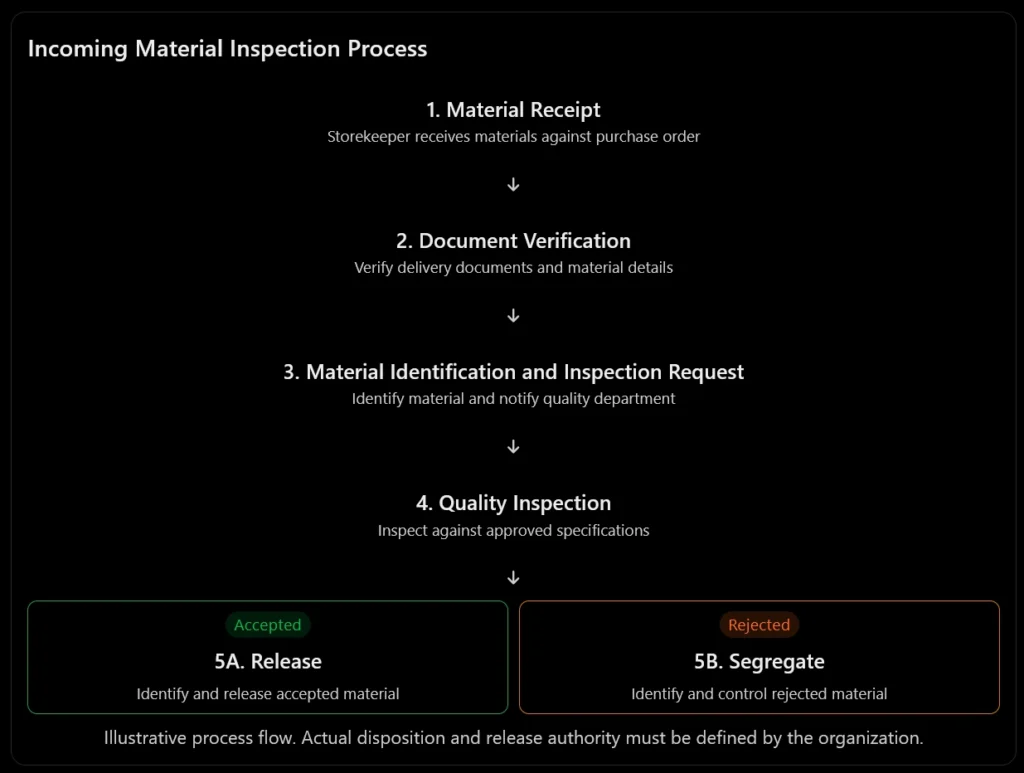
Incoming Material Inspection Process
- Material Receipt
Storekeeper receives materials against purchase order
- Document Verification
Verify delivery documents and material details
- Material Identification and Inspection Request
Identify material and notify quality department
- Quality Inspection
Inspect against approved specifications
Accepted
5A. Release
Identify and release accepted material
Rejected
5B. Segregate
Identify and control rejected material
Illustrative process flow. Actual disposition and release authority must be defined by the organization.
This process flow helps employees understand the sequence of activities and the relationship between the stores, quality, and purchasing departments.
Step 6: Develop Supporting Records
The quality manager then asks ChatGPT to prepare supporting formats.
The required documents may include:
- Material Receiving Report.
- Incoming Inspection Report.
- Material Identification Label.
- Nonconformity Report.
- Supplier Corrective Action Request, where applicable.
These records support the procedure and provide evidence that the inspection process has been performed.
Step 7: Verify the Procedure Against Actual Requirements
Before approving the procedure, the quality manager performs a final review.
The review covers:
- Whether all process activities are accurately described.
- Whether responsibilities match the company’s organizational structure.
- Whether inspection requirements match approved specifications.
- Whether acceptance and rejection arrangements are clear.
- Whether required records are identified.
- Whether applicable ISO 9001 requirements have been addressed.
- Whether the procedure can be followed by employees.
The process owner and other relevant personnel also review the document.
Step 8: Approve, Release, and Implement the Procedure
After the necessary reviews are completed, the procedure is submitted for approval according to the organization’s document control process.
The approved version is then:
- Assigned a document number.
- Given a revision number.
- Issued with an effective date.
- Added to the document master list.
- Made available to relevant employees.
- Communicated to affected departments.
- Used during employee awareness or training activities.
The quality manager should also check whether the procedure is being followed in actual operations.
For example, during an internal audit, the auditor may examine incoming inspection reports and verify whether rejected materials are properly identified and segregated.
This is how an AI-assisted draft becomes a controlled and implemented QMS document.
What Does This Example Teach Us?
This example demonstrates that AI-assisted documentation is not simply about generating a procedure with a single prompt.
It involves a complete process:
- Understand the actual activity.
- Collect reliable process information.
- Prepare a structured prompt.
- Generate the initial draft.
- Review and improve the content.
- Confirm technical and ISO requirements.
- Prepare supporting records.
- Obtain approval.
- Implement and monitor the document.
The quality professional remains responsible for the accuracy and effectiveness of the final documentation.
This is the difference between simply generating documents with AI and using AI as part of a controlled quality management process.
How to Verify AI-Generated Procedures Against ISO 9001
One of the most important steps when using ChatGPT for quality documentation is verifying whether the generated procedures and work instructions are accurate, suitable, and aligned with applicable requirements.
A document may look professional, contain well-organized tables, and use correct quality management terminology. However, this does not automatically mean that it meets ISO 9001 requirements or reflects the organization’s actual processes.
AI-generated documentation must always be reviewed before approval and implementation.
ChatGPT can help identify possible gaps, organize requirements, and prepare comparison tables. However, the final compliance decision must be made by competent personnel using the applicable standard and verified organizational information.
Check the Applicable ISO 9001 Requirements
Start by identifying which ISO 9001 requirements apply to the process covered by the procedure.
For example:
Procedure | Relevant ISO 9001 areas to examine |
Document Control | Clause 7.5 – Documented information |
Training and Competence | Clause 7.2 – Competence |
Supplier Evaluation | Clause 8.4 – Control of externally provided processes, products and services |
Production Control | Clause 8.5 – Production and service provision |
Calibration | Clause 7.1.5 – Monitoring and measuring resources |
Internal Audit | Clause 9.2 – Internal audit |
Corrective Action | Clause 10.2 – Nonconformity and corrective action |
Customer Satisfaction | Clause 9.1.2 – Customer satisfaction |
These references are based on the familiar clause framework. For formal verification, check the exact wording, structure, and applicable requirements in the licensed ISO 9001:2026 edition.
Do not assume that every procedure needs to address only one clause. A single procedure may support several requirements.
For example, a supplier evaluation procedure may support external provider control, risk-based decision-making, purchasing controls, and performance evaluation.
Use a Requirement-to-Document Mapping Table
A useful way to verify an AI-generated procedure is to compare the applicable requirements with the information contained in the document.
For example, consider a purchasing procedure.
Review area | What to verify | Review status |
Supplier selection | Are supplier selection criteria defined? | To be verified |
Supplier approval | Is approval authority identified? | To be verified |
Purchasing information | Are purchasing requirements communicated? | To be verified |
Verification | Are purchased products checked as required? | To be verified |
Supplier monitoring | Is supplier performance evaluated? | To be verified |
Records | Are necessary records identified and controlled? | To be verified |
This table helps the quality manager identify areas that require additional information or clarification.
Ask ChatGPT to Perform a Preliminary Gap Review
You can use ChatGPT to assist with an initial document review.
Example prompt:
Prompt: ISO 9001 Procedure Gap Review
Act as a quality management system documentation reviewer.
Review the attached procedure against the applicable requirements from ISO 9001:2026 that I provide.
Evaluate the following:
- Whether relevant requirements are addressed.
- Whether process responsibilities are defined.
- Whether process inputs and outputs are identified.
- Whether operational controls are explained.
- Whether required documented information is identified.
- Whether nonconforming outputs are addressed where applicable.
- Whether any statements require technical or organizational confirmation.
Prepare a gap analysis table with the following columns:
- Requirement or review point.
- Evidence in the procedure.
- Potential gap.
- Recommended improvement.
- Verification required.
Do not invent ISO requirements, clause references, or company practices. If the provided information is insufficient, clearly state that further verification is required.
Copy prompt
The quality manager should independently verify the results against the official standard.
Verify Technical Accuracy
Technical accuracy is particularly important when preparing work instructions for manufacturing, inspection, testing, maintenance, and other operational activities.
For example, consider a work instruction for pressure testing a manufactured component.
The instruction may require:
- Test pressure.
- Test duration.
- Equipment identification.
- Test method.
- Acceptance criteria.
- Safety precautions.
- Required test records.
ChatGPT can organize these details into a structured instruction, but the actual pressure, duration, and acceptance limits must come from approved engineering specifications, applicable standards, customer requirements, or other authorized technical sources.
Never use AI-generated technical values without verification.
Verify That Employees Can Actually Follow the Document
A procedure can meet a documentation review requirement but still be difficult to use in practice.
Therefore, perform a practical review with the employees who will use the document.
For a work instruction, ask the operator to follow the instructions and observe whether:
- The steps are presented in the correct sequence.
- The tools and equipment are correctly identified.
- The instructions are easy to understand.
- Acceptance criteria are available.
- Important warnings are included.
- The required records can be completed.
- The employee knows what to do when a problem occurs.
This practical verification is important because the purpose of quality documentation is to support consistent process operation, not simply to produce documents for an audit.
Common Mistakes When Using ChatGPT for Quality Documentation
Although ChatGPT can make documentation easier, improper use can introduce errors into the QMS.
Some mistakes may remain unnoticed until an internal audit, customer complaint, or certification audit.
Understanding these mistakes helps quality professionals use AI more responsibly.
Copying AI-Generated Procedures Without Reviewing Them
This is one of the most common mistakes.
A quality professional asks ChatGPT to prepare a procedure, receives a professional-looking document, and immediately adds it to the QMS.
The problem is that AI-generated content may include activities, responsibilities, approval limits, or controls that do not exist in the organization.
How to avoid it:
- Review every process step.
- Confirm all responsibilities.
- Check technical requirements.
- Verify applicable ISO clauses.
- Obtain approval from relevant process owners.
Asking Generic Questions Without Providing Process Information
A prompt such as “Write an ISO 9001 calibration procedure” does not explain the organization’s equipment, calibration arrangements, responsibilities, or technical requirements.
The resulting procedure may contain generic statements that are not suitable for the organization.
How to avoid it: Provide actual process information, equipment details, applicable requirements, and company practices before requesting the draft.
Allowing ChatGPT to Invent Technical Requirements
ChatGPT may suggest inspection frequencies, calibration intervals, acceptance limits, supplier scores, or approval thresholds even when those details have not been provided.
Such information should never be accepted simply because it appears reasonable.
How to avoid it: Instruct ChatGPT to use placeholders for missing information and require confirmation from competent personnel.
Creating Too Many Unnecessary Procedures
Some organizations believe that having more procedures means having a stronger QMS.
This is not necessarily true.
Creating separate documents for every minor activity can increase administrative work and make document maintenance difficult.
How to avoid it: Determine which documented information is necessary based on process complexity, risks, competence, operational needs, and applicable requirements.
Ignoring Document Revision and Approval
Another mistake is allowing AI-generated documents to circulate without proper identification and approval.
Employees may accidentally use draft versions or outdated documents.
How to avoid it: Ensure that all documents pass through the established review, approval, release, and revision control process.
Relying on Incorrect ISO Clause References
AI tools can sometimes provide outdated or incorrect clause references.
This is particularly important when organizations are transitioning from ISO 9001:2015 to ISO 9001:2026.
How to avoid it: Use the current licensed standard as the authoritative reference and verify every clause citation before publishing or approving the document.
Ignoring Employee Feedback
A procedure prepared entirely by a quality department may not reflect the difficulties faced by employees performing the actual work.
How to avoid it: Involve operators, technicians, supervisors, and process owners in reviewing relevant procedures and work instructions.
Treating AI-Generated Documents as Proof of Implementation
Having a complete set of procedures does not prove that an organization has effectively implemented its QMS.
For example, a company may have an excellent training procedure, but if employees are not trained or competent, the documented process alone does not demonstrate effective implementation.
How to avoid it: Check actual process performance, employee awareness, records, and objective evidence.
Data Security and Confidentiality When Using ChatGPT
Quality management documentation often contains confidential business information.
Examples include customer drawings, supplier pricing, production specifications, inspection results, employee details, manufacturing methods, customer complaints, and internal audit findings.
Before using ChatGPT for quality documentation, organizations should establish clear rules about what information employees are permitted to share.
This is particularly important for US-based companies that handle customer-sensitive information, proprietary technical data, or regulated information.
Avoid Sharing Confidential Company Information Without Authorization
Do not upload sensitive business information simply because it would help ChatGPT prepare a better procedure.
Before sharing information, check:
- Company AI usage policies.
- Customer confidentiality agreements.
- Data protection requirements.
- Contractual restrictions.
- Information security policies.
- Applicable industry or regulatory obligations.
For example, a quality engineer preparing a supplier evaluation procedure may not need to upload actual supplier contracts or confidential pricing information.
Instead, the engineer can provide a generalized description of the supplier evaluation process.
Understand ChatGPT Data Controls
ChatGPT provides data controls that allow users to manage how their conversations are used.
On eligible personal Free, Plus, and Pro workspaces, users can turn off Improve the model for everyone in Settings under Data Controls. This prevents new conversations from being used for model improvement under the applicable setting, although other data retention and legal policies still apply.
For ChatGPT Business, Enterprise, Edu, and API services, business inputs and outputs are not used to train OpenAI models by default, subject to applicable agreements and settings.
Organizations should evaluate the available plans and contractual protections before deciding how employees may use AI for business documentation.
Use Generalized Process Information
One practical approach is to replace sensitive company information with generic descriptions.
For example:
Instead of sharing | Use a safer description |
Actual customer name | Customer A |
Confidential supplier name | Approved Supplier 01 |
Proprietary part number | Component XYZ |
Actual contract price | Agreed purchase price |
Employee personal details | Relevant job position |
Confidential production parameters | Approved process parameters |
The goal is to provide enough information for ChatGPT to understand the process without unnecessarily exposing confidential details.
Establish an Internal AI Usage Policy
Organizations should consider developing a simple AI usage policy covering:
- Approved AI tools.
- Permitted and prohibited information.
- Employee responsibilities.
- Confidentiality requirements.
- Human review and approval.
- Verification of AI-generated information.
- Storage and retention of generated documents.
- Reporting of AI-related errors or incidents.
This becomes particularly important when several departments use generative AI for different business activities.
The NIST Generative AI Risk Management Profile provides useful guidance on risks such as inaccurate or fabricated AI outputs, which should be considered when developing internal AI controls.
Best Practices for Using ChatGPT in Your QMS
To get the best results from AI-assisted quality documentation, organizations should establish a consistent approach for preparing, reviewing, approving, and maintaining documents.
The objective should not be to generate as many documents as possible. It should be to improve the quality, clarity, and usefulness of the existing documentation system.
The following practices can help quality professionals achieve this.
Always Use Actual Process Information
Before preparing a procedure, understand how the process works.
Speak with process owners and employees who perform the activities. Collect relevant information, including responsibilities, inputs, outputs, controls, risks, and records.
Use ChatGPT to organize this information rather than asking it to invent an entire process.
Develop Standard Prompts for Different Documents
Create a library of approved prompts for commonly used QMS documents.
For example:
- Document control procedure prompt.
- Purchasing procedure prompt.
- Supplier evaluation prompt.
- Production control prompt.
- Calibration procedure prompt.
- Internal audit checklist prompt.
- Corrective action procedure prompt.
- Work instruction prompt.
This makes AI-assisted documentation more consistent across departments.
It also helps organizations establish a repeatable method for ISO 9001 AI writing.
Maintain Human Review and Approval
Every AI-generated procedure should be reviewed by the relevant process owner and authorized personnel.
A typical review arrangement may look like this:
Activity | Responsible person |
Prepare process information | Process Owner |
Generate initial draft | Quality Engineer using ChatGPT |
Verify technical details | Relevant Technical Expert |
Review QMS requirements | Quality Manager |
Review operational suitability | Department Manager |
Approve document | Authorized Approver |
Release controlled version | Document Controller |
The actual approval responsibilities should follow the organization’s established authority arrangements.
Keep a Clear Separation Between Drafts and Approved Documents
AI-generated documents should not automatically enter the controlled document system.
Use clear document statuses such as:
- Draft.
- Under review.
- Approved.
- Released.
- Obsolete.
Only the authorized and released version should be made available as the current controlled document.
This helps prevent employees from accidentally using unapproved AI-generated content.
Test Work Instructions Before Implementation
A work instruction should be tested by the employees who will perform the task.
For example, before releasing a machine setup instruction, ask an experienced operator to follow it.
Observe whether the instruction correctly explains:
- Required preparation.
- Equipment identification.
- Setup sequence.
- Operating requirements.
- Inspection points.
- Safety precautions.
- Abnormal condition handling.
Make necessary corrections before approval and implementation.
Review Documents Periodically
Quality documentation should be reviewed when relevant changes occur.
Examples include:
- Changes in production methods.
- New equipment or technology.
- Changes in customer requirements.
- Changes in applicable regulations.
- Changes in organizational responsibilities.
- Repeated process failures.
- Internal audit findings.
- Changes in applicable ISO 9001 requirements.
ChatGPT can assist with preparing revision drafts, but the organization must control the actual review and approval process.
Use ChatGPT Alongside Existing QMS Software
Organizations that already use electronic document management systems or QMS software can integrate AI-assisted drafting into their existing workflows.
For example, ChatGPT can help prepare the content, while the QMS platform manages:
- Document identification.
- Revision history.
- Review workflows.
- Electronic approvals.
- Controlled distribution.
- Employee access.
- Audit trails.
This approach allows organizations to benefit from AI without creating a separate uncontrolled documentation system.
Measure Whether AI Is Actually Improving Documentation
Organizations should not assume that using AI automatically improves productivity.
Instead, monitor practical indicators such as:
Performance indicator | What it helps measure |
Procedure preparation time | Time needed to prepare initial drafts |
Document review time | Time spent reviewing and correcting documents |
First-review acceptance | How often drafts require major revisions |
Documentation errors | Errors identified during document review |
Employee understanding | Whether employees can follow the instructions |
Revision completion | Timely updating of affected documents |
Document-related audit findings | Problems associated with QMS documentation |
These indicators can help the organization determine whether its AI-assisted documentation process is producing real benefits.
Can ChatGPT Replace an ISO 9001 Consultant or Quality Manager?
No. ChatGPT can support quality professionals, but it cannot fully replace an experienced quality manager, certified auditor, or ISO 9001 consultant.
Quality management involves much more than preparing documents.
It requires understanding business processes, evaluating operational risks, interpreting applicable requirements, interacting with employees, investigating nonconformities, and assessing whether the QMS is effective.
ChatGPT can assist with many of the supporting activities, but it cannot independently take responsibility for the organization’s quality management system.
What ChatGPT Can Help With
ChatGPT can support quality professionals in:
- Preparing procedure drafts.
- Creating work instructions.
- Developing audit checklists.
- Preparing training materials.
- Organizing process information.
- Improving document language.
- Preparing corrective action report templates.
- Reviewing document consistency.
- Generating sample forms.
- Explaining quality management concepts.
These activities can reduce repetitive writing work and allow quality professionals to spend more time on process improvement and operational controls.
What Still Requires Human Expertise?
Some activities require direct knowledge, professional judgment, and accountability.
Activity | Why human involvement is necessary |
ISO 9001 interpretation | Requires verification against the official standard |
Process risk assessment | Requires knowledge of actual operations |
Technical acceptance decisions | Requires engineering or technical competence |
Supplier approval | Requires evaluation of actual supplier capability |
Internal auditing | Requires competent and impartial auditors |
Root cause investigation | Requires evidence from the actual process |
Management review | Requires management participation and decisions |
Document approval | Requires authorized organizational personnel |
QMS effectiveness evaluation | Requires actual performance evidence |
For example, ChatGPT can suggest possible causes of repeated product defects, but it cannot independently confirm which cause actually produced the problem.
The quality engineer must investigate the process, collect evidence, interview relevant employees, and verify the cause.
The Best Approach: Combine AI With Quality Expertise
The most practical approach is to combine AI capabilities with human experience.
Human expertise + AI assistance = Better QMS documentation
Human expertise
- Process knowledge
- Technical decisions
- ISO interpretation
- Risk evaluation
- Approval and accountability
AI assistance
- Document drafting
- Language improvement
- Templates and forms
- Checklist preparation
- Document comparisons
Reviewed, approved, and controlled QMS documentation
Final decisions remain with competent and authorized personnel.
This combination is the foundation of a practical ChatGPT QMS approach.
Conclusion:
Preparing ISO 9001 procedures and work instructions does not have to be a complicated or time-consuming activity. With the right approach, ChatGPT can help quality professionals prepare structured procedures, develop detailed work instructions, create supporting forms, improve existing documents, and organize QMS information more efficiently.
However, the real benefit does not come from asking AI to generate documents without understanding the process. It comes from combining accurate organizational information, well-written prompts, technical knowledge, and proper human review.
For example, a quality manager can use ChatGPT to prepare a purchasing procedure, a quality engineer can develop an inspection work instruction, and an internal auditor can generate a preliminary audit checklist. Each document can then be reviewed by the relevant process owner and approved according to the organization’s document control arrangements.
As organizations move towards more digital and AI-supported business operations, generative AI can become a useful tool for improving quality documentation. Nevertheless, AI should support the quality management system, not replace the people responsible for managing it.
Organizations should also review their documentation against the current ISO 9001:2026 edition, identify necessary changes, and ensure that employees understand and follow approved processes.
The best way to start is to select one existing procedure that needs improvement, collect the actual process information, and use ChatGPT to prepare a better first draft.
Remember: A good QMS is not measured by how many procedures an organization has. It is measured by how effectively its processes are controlled, implemented, monitored, and improved.
Actionable Takeaways: Checklist for Using ChatGPT in ISO 9001 Documentation
Use this checklist when introducing AI-assisted documentation into your quality management system.
ISO 9001 AI documentation checklist
- Identify which procedures and work instructions need to be developed or improved.
- Collect actual process information from relevant departments.
- Identify responsibilities, inputs, outputs, risks, and process controls.
- Prepare detailed prompts for each document.
- Ask ChatGPT to identify missing information before drafting.
- Generate procedures and work instructions using approved templates.
- Create supporting forms, checklists, and quality records.
- Verify technical information and applicable ISO 9001:2026 requirements.
- Review documents with process owners and competent personnel.
- Protect confidential company and customer information.
- Obtain authorized approval before releasing documents.
- Update the document master list and control revisions.
- Train employees on new or revised instructions.
- Monitor implementation and review document effectiveness.
References and Further Reading
The following resources are useful for quality professionals who want to learn more about ISO 9001, AI documentation, data security, and effective content creation.
- ISO 9001:2026 – Official Standard: International Organization for Standardization (ISO). Official publication details and standard status.
- ISO 9001:2026 – What’s Changing: ISO Quality Management Guidance. Information about the revised requirements and transition.
- ISO 9001:2026 Publication Announcement: ISO Official Announcement. Publication information dated September 16, 2026.
- NIST Generative AI Risk Management Profile: National Institute of Standards and Technology. Guidance on managing generative AI risks.
- ChatGPT Data Controls: OpenAI Help Center. Information about data controls and privacy options.
- How Your Data Is Used to Improve Model Performance: OpenAI Help Center. Information about ChatGPT data usage.
- Google’s Guidance on Generative AI Content: Google Search Central. Guidance on accuracy, quality, and AI-generated website content.
- Creating Helpful, Reliable, People-First Content: Google Search Central. Guidance for creating valuable content for readers.
- ISO 9001:2026 Transition Guidance: UKAS Technical Bulletin. Information about transition arrangements.
FAQs
Can ChatGPT Create Complete ISO 9001 Procedures?
Yes. ChatGPT can prepare structured procedure drafts containing purpose, scope, responsibilities, process steps, controls, and records. However, the quality of the output depends on the process information supplied. The organization must verify the document against actual activities, applicable ISO 9001 requirements, and customer requirements before approval.
Can ChatGPT Write Work Instructions for Manufacturing Companies?
Yes. ChatGPT can help prepare detailed work instructions for machine operation, assembly, inspection, testing, packaging, and other manufacturing activities. You should provide the actual equipment details, process sequence, approved specifications, acceptance criteria, and safety requirements. Technical information must be verified by competent personnel before the instruction is released.
Can ChatGPT Create an ISO 9001 Quality Manual?
Yes. ChatGPT can help organize a quality manual covering the organization’s QMS scope, context, quality policy, processes, responsibilities, and supporting documentation. However, ISO 9001:2015 and ISO 9001:2026 do not make a quality manual a universally mandatory document. Organizations can maintain one when it provides value to their QMS.
Is ChatGPT Reliable for ISO 9001 Documentation?
ChatGPT is useful for drafting, organizing, and improving documentation, but its outputs are not automatically reliable. It can generate incorrect requirements, outdated clause references, or unsuitable technical instructions. Always verify information against the official standard, approved company processes, and reliable technical sources.
Can ChatGPT Generate ISO 9001 Forms and Checklists?
Yes. It can help prepare internal audit checklists, inspection reports, supplier evaluation forms, training matrices, calibration registers, corrective action reports, and document master lists. The organization should confirm that the templates contain all necessary information and are suitable for its processes.
Is ChatGPT Useful for ISO 9001:2026 Implementation?
Yes. ChatGPT can assist with reviewing existing documentation, preparing preliminary gap analysis tables, updating procedure drafts, and creating employee awareness materials. Organizations should use the official ISO 9001:2026 standard as the authoritative source and confirm transition arrangements with their certification body.
Can I Use ChatGPT to Prepare Documents for an ISO 9001 Certification Audit?
Yes. You can use ChatGPT to prepare and improve procedures, work instructions, forms, audit checklists, and document review summaries. However, certification auditors evaluate actual conformity and implementation, not simply the appearance or quantity of documents. Your employees must follow the approved processes and maintain appropriate evidence.
Can ChatGPT Create SOPs for Small Businesses?
Yes. Small businesses can use ChatGPT to prepare simple procedures and work instructions suited to their operations. They do not need to create an unnecessarily large documentation system. The documents should be proportionate to the complexity of their activities and the controls needed to achieve consistent results.
Which ChatGPT Model Should I Use for Quality Documentation?
Choose a model capable of handling detailed instructions, longer documents, and multi-step review tasks. The exact model available will depend on your ChatGPT plan and current product options. Regardless of the model, verify technical details and applicable ISO requirements independently.
Can ChatGPT Automatically Update All My ISO 9001 Documents?
ChatGPT can help revise and compare documents when you provide the existing content and updated requirements. However, it should not independently change and release controlled QMS documents without authorized review. Organizations should use their document management process to approve revisions and maintain version history.
Can ChatGPT Be Used to Prepare ISO 9001 Documentation in Excel and Word?
Yes. ChatGPT can help prepare content and templates for Microsoft Word and Excel, including procedure layouts, inspection forms, audit checklists, and tracking registers. You can also use available file-generation features to create editable documents. Always test formulas, formatting, and document controls before introducing the files into the QMS.
Does Using AI for ISO 9001 Documentation Affect Certification?
Using AI to prepare documentation does not, by itself, make an organization nonconforming with ISO 9001. What matters is whether the organization’s QMS meets applicable requirements and is effectively implemented. The organization remains responsible for document accuracy, process control, confidentiality, and approval.

“Hey, I am Sachin Ramdurg, the founder of VDiversify.com.
I am QA/QC Manager, Certified Lead Auditor and Quality Champion. I am an Engineer and Passionate Blogger with a mindset of Entrepreneurship. I have been experienced in Blogging for more than 15+ years and following as a youtuber along with blogging, online business ideas, affiliate marketing, and make money online ideas since 2012.