
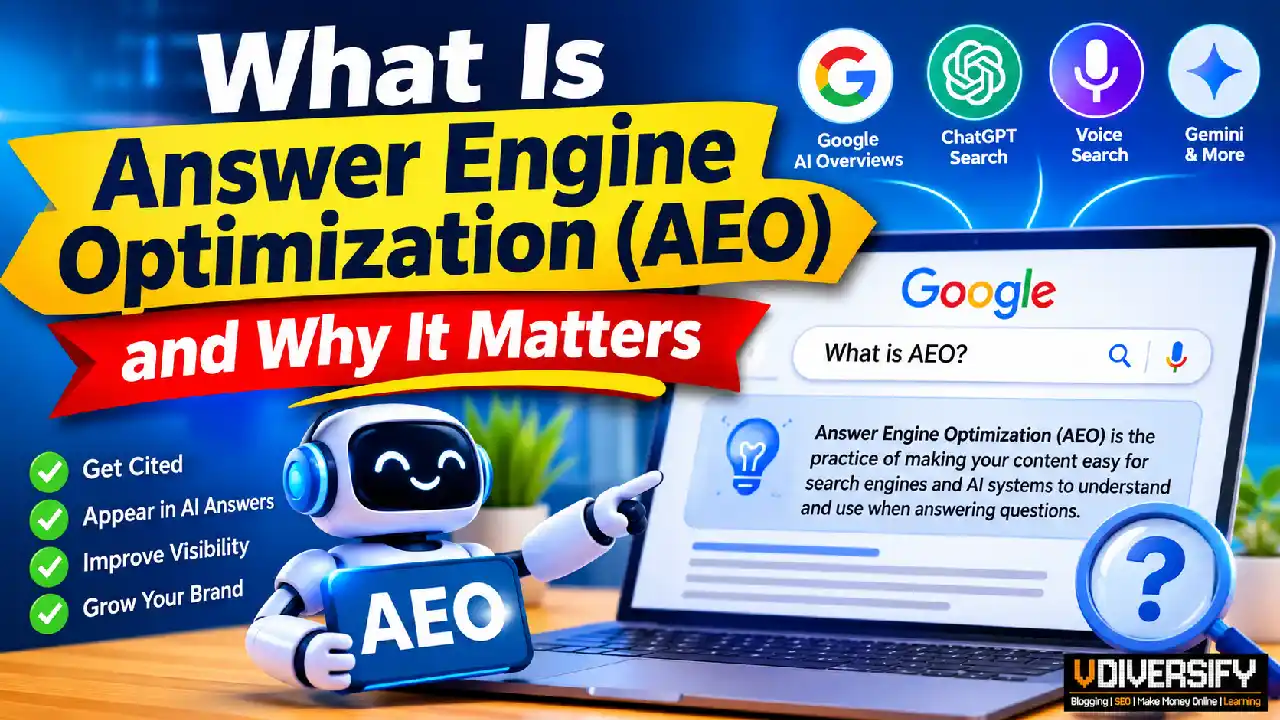
Search is changing faster than many website owners realize. People are no longer using Google only to type a few keywords, open ten blue links, and visit several websites before finding an answer.
They are asking longer questions, using conversational language, speaking to voice assistants, and increasingly relying on AI-generated answers from tools such as Google AI Overviews, ChatGPT, Gemini, and Perplexity.
This shift makes what is answer engine optimization AEO an important question for anyone who creates content for the web.
The basic idea is simple: AEO helps your content become easier for search engines and AI-powered answer systems to understand, extract, cite, and present when someone asks a question.
For bloggers, publishers, website owners, designers, marketers, and content creators, this does not mean abandoning traditional SEO. Instead, AEO builds on strong SEO fundamentals and changes how you structure information so that both people and modern search systems can understand it.
In this guide, we will cover the answer engine optimization definition, how AEO works, how it differs from traditional SEO, why AI-generated answers are changing search behavior, important ranking factors, practical content techniques, and how AEO connects with GEO, LLM SEO, AI Overviews, voice search, featured snippets, and zero-click searches.
Contents
- 1. What Is Answer Engine Optimization?
- 2. How AEO Is Changing the Search Experience
- 3. AEO vs SEO: What Is the Difference?
- 4. Why AEO Matters in 2026
- 5. What Is Zero-Click Search?
- 6. Featured Snippet Optimization and Direct Answers
- 7. Voice Assistant Answers and Conversational Search
- 8. The Core Principle Behind AEO
- 9. What Comes Next
- 10. How Do Answer Engines Work?
- 11. What Are the Main Answer Engine Ranking Factors?
- 12. The First AEO Ranking Signal: Relevance to the Question
- 13. The Second Signal: Clear Content Structure
- 14. The Third Signal: Original Information
- 15. The Fourth Signal: Trust and Source Quality
- 16. The Fifth Signal: Strong Topical Coverage
- 17. How to Structure an Article for AEO
- 18. AEO, GEO, and LLM SEO: Are They the Same?
- 19. How AI Overviews Change Content Strategy
- 20. Why Content “Chunking” Should Not Be Misunderstood
- 21. Build Content Around Search Journeys
- 22. Internal Linking Becomes Even More Useful
- 23. Entity Clarity Matters
- 24. Use Structured Data Where It Actually Makes Sense
- 25. What AEO Looks Like in a Real Blog Post
- 26. How to Make Paragraphs More “Answer Ready”
- 27. Create Definitions That Stand on Their Own
- 28. Support Claims With Evidence
- 29. A Practical AEO Content Framework
- 30. The Relationship Between AEO and Brand Authority
- 31. AEO Is More Than Getting a Link
- 32. The Biggest AEO Mistake: Writing for AI Instead of People
- 33. What This Means for Bloggers and Website Owners
- 34. AEO Strategy Basics for a New Website
- 35. The Key Lesson Before Moving to the Final Part
- 36. How to Build an AEO Strategy Step by Step
- 37. Step 3: Put the Direct Answer Near the Top
- 38. Step 4: Expand the Answer With Supporting Details
- 39. Step 5: Add Evidence and Original Value
- 40. Step 6: Strengthen Your Website’s Authority
- 41. Step 7: Make Your Content Technically Accessible
- 42. How to Optimize Existing Articles for AEO
- 43. How to Optimize for Google AI Overviews
- 44. How AEO Relates to SGE
- 45. AEO and LLM SEO: What Website Owners Should Know
- 46. How to Optimize for AI Answer Boxes
- 47. How to Approach Voice Search
- 48. How to Measure AEO Performance
- 49. Why Traffic Should Not Be Your Only AEO Goal
- 50. AEO Tools You Can Use
- 51. Common AEO Mistakes to Avoid
- 52. A Practical AEO Audit Checklist
- 53. AEO Content Template for Bloggers
- 54. AEO for Different Types of Websites
- 55. What the 2026 Search Landscape Means for Content Creators
- 56. The Future of AEO
- 57. The Most Important AEO Principle
- 58. Actionable AEO Takeaways
- 59. Conclusion: AEO Is the Next Layer of Search Optimization
What Is Answer Engine Optimization?
Answer Engine Optimization is the practice of creating and organizing website content so that answer engines can understand the information and use it when responding to users.
An answer engine is a search or AI system designed to provide a direct response rather than simply returning a list of webpages.
Traditional search often works like this:
User searches → search results appear → user chooses a webpage → user finds the answer.
Modern answer-focused search can work more like this:
User asks a question → system understands the intent → relevant information is retrieved → system creates or displays an answer → supporting sources may be shown.
Google’s AI features are a major example of this change. Google explains that AI Overviews and AI Mode are designed to help people understand complicated questions more quickly while also providing links that allow users to explore information further. Google also says that normal SEO best practices continue to apply to these AI features.
This distinction is important because AEO is not simply a trick for getting an AI system to mention your website.
It is fundamentally about making useful information easy to identify and understand.
For example, imagine someone searches:
“How often should I water a new indoor plant?”
A traditional article might begin with a long introduction about indoor gardening.
An answer-focused page might begin with a clear response:
“Most new indoor plants should be watered when the top 1–2 inches of soil become dry, although the exact schedule depends on the plant, pot size, soil, temperature, and light.”
The second format gives the reader the answer quickly and then provides supporting details.
That structure can be useful for both humans and search systems.
How AEO Is Changing the Search Experience
Search engines are becoming better at understanding questions, context, entities, relationships, and user intent.
This is one reason question-based search optimization has become increasingly important.
A user may previously have searched:
“best running shoes beginners”
Today, that same person might ask:
“What are the best running shoes for a beginner who runs three times a week on pavement?”
The second query contains more context.
The search system has to understand:
- The person is a beginner.
- The activity is running.
- The frequency is three times per week.
- The surface is pavement.
- The user is looking for a recommendation rather than a definition.
This creates a larger opportunity for detailed, well-structured content.
Google has also reported that AI Overviews can lead people to ask longer and more complex questions.
That matters for publishers because content now needs to support not only the original search but also the follow-up questions that naturally occur during a search journey.
From Keywords to Questions and Conversations
Traditional SEO often starts with keyword research.
AEO starts with the same foundation but goes further.
Instead of asking only:
“What keyword has search volume?”
an AEO-focused content creator also asks:
- What question is the user actually trying to answer?
- What would they ask next?
- What information would help them make a decision?
- What definitions need to be explained?
- What comparisons might they want?
- What examples would remove confusion?
- What evidence would make the answer trustworthy?
For example, an article targeting “website speed” could answer the main question but also cover:
- What is website speed?
- Why does website speed matter?
- How do you test website speed?
- What is a good page-load time?
- How do you improve Core Web Vitals?
- Does website speed affect SEO?
- How does mobile speed differ from desktop speed?
This creates a broader information resource rather than a page written around one phrase.
AEO vs SEO: What Is the Difference?
AEO vs SEO is not really a battle between two separate marketing systems.
SEO remains the foundation. AEO expands that foundation for answer-driven search experiences.
Traditional SEO focuses heavily on helping search engines discover, understand, index, and rank webpages.
AEO puts additional attention on how clearly information can answer a specific question.
Traditional SEO | AEO |
Targets search visibility | Targets answer visibility |
Focuses strongly on search queries | Focuses strongly on questions and intent |
Optimizes pages for search engines and users | Structures answers for users and answer systems |
Works with organic search results | Also considers AI answers and direct responses |
Values authority and relevance | Also emphasizes clear, extractable answers |
Measures rankings and traffic | Can also measure mentions, citations, and AI visibility |
The two approaches overlap heavily.
Google explicitly states that the best practices used for normal SEO remain relevant to AI Overviews and AI Mode. It also says websites do not need special AI files or a new type of schema markup to appear in those experiences.
That means website owners should be cautious about anyone selling a secret “AI ranking formula.”
There is no guaranteed markup that makes a webpage appear in every AI answer.
Instead, the fundamentals still matter: useful content, clear information, crawlability, internal linking, good page experience, text that can be understood, and accurate structured data where appropriate.
Why AEO Matters in 2026
The biggest reason AEO matters is that the search results page is no longer always the final destination.
Users can receive answers directly inside the search experience.
Google’s AI features are one example, but the wider ecosystem also includes conversational AI assistants and generative search systems.
Pew Research Center reported that in its March 2025 U.S. web-browsing study, 58% of respondents encountered an AI-generated summary in at least one Google search during the month.
More recent Pew research found that 60% of U.S. adults surveyed in February 2026 said they had read AI summaries at the top of search results.
These numbers show why answer-focused visibility deserves attention.
The goal is no longer simply:
“Can my page rank?”
A broader question is:
“Can my information become part of the answer users see?”
That can happen in several ways.
Your content might appear as:
- A traditional organic result.
- A featured snippet.
- A cited source inside an AI-generated answer.
- A link in an AI Overview.
- A source used to support a conversational response.
- A direct answer to a question.
- A resource referenced during a longer search journey.
This is where zero-click search becomes important.
What Is Zero-Click Search?
A zero-click search occurs when someone gets the information they need directly from the search results without clicking through to a website.
For example, someone searches:
“How many ounces are in a pound?”
They may see the answer immediately.
There is little reason to visit another webpage.
The same principle applies to definitions, dates, calculations, simple facts, weather information, and many other searches.
For publishers, this creates an important challenge.
If your content provides the answer but the user never visits your website, traditional organic traffic may not fully capture the value of your visibility.
However, zero-click behavior is not identical across all types of searches.
Research from Pew found that when U.S. users encountered an AI-generated summary in Google Search during its March 2025 browsing-data study, they clicked a traditional search result 8% of the time, compared with 15% when no AI summary appeared. The study also found that users who encountered AI summaries rarely clicked the cited sources.
This does not mean every website will lose traffic from AI search.
It means publishers need to think beyond rankings alone.
Featured Snippet Optimization and Direct Answers
One of the earliest forms of answer-focused search was the featured snippet.
A featured snippet can display a short answer from a webpage above or alongside traditional organic results.
This is why featured snippet optimization remains useful even as AI-powered search grows.
Consider a question such as:
“What is a meta description?”
A page that answers with a direct definition near the beginning gives search systems a clean passage to understand.
For example:
A meta description is a short summary of a webpage that can appear below the page title in search results. It helps users understand what the page is about before they click.
The page can then explain how to write one, common mistakes, examples, and best practices.
This approach is valuable because it satisfies two different needs:
The first sentence answers the question.
The rest of the page provides depth.
That is one of the most practical foundations of AEO.
Voice Assistant Answers and Conversational Search
AEO also connects with voice search.
People using voice assistants often ask questions in complete sentences rather than typing short keyword combinations.
For example:
Typed search:
“coffee shops open late”
Voice-style search:
“What’s a good coffee shop that’s open late near me?”
The second query is conversational.
Content designed around natural questions can therefore become more useful for voice assistant answers and other conversational search systems.
However, voice optimization should not be treated as a completely separate SEO discipline.
The same principles still apply:
- Give a clear answer.
- Use natural language.
- Explain concepts simply.
- Organize supporting information logically.
- Make the page easy to crawl.
- Provide trustworthy and useful information.
The Core Principle Behind AEO
The most important AEO lesson is simple:
Do not write for an answer engine instead of people. Write useful content that answer engines can understand.
This distinction matters.
Google’s current guidance says its systems prioritize helpful, reliable, people-first content and warns against creating content primarily to manipulate search rankings. Google also encourages original information, substantial coverage, clear sourcing, first-hand expertise where relevant, and content that leaves users satisfied.
So, if an article is packed with awkward question headings simply because someone believes that will trigger AI answers, it is not necessarily well optimized.
A better approach is to understand the reader first.
Then organize the information so the reader can quickly find the answer and easily understand the supporting details.
That is the foundation on which a strong AEO strategy should be built.
What Comes Next
Understanding the concept is only the beginning.
The next step is learning how answer engines select information, what makes a passage easy to understand, how authority and relevance influence visibility, how structured data fits into the process, and which content formats are most useful for question-based searches.
The practical AEO strategy basics also include topic research, question mapping, content structure, internal linking, entity clarity, original research, examples, citations, and ongoing measurement.
How Do Answer Engines Work?
To understand AEO, it helps to understand what happens between a user’s question and the answer they receive.
Traditional search engines mainly help users discover webpages. Modern AI-powered search systems can go several steps further. They may interpret the question, identify related concepts, retrieve information from different sources, compare that information, and generate a response.
A simplified process looks like this:
Question → intent understanding → information retrieval → source evaluation → answer generation → citations or links
Not every answer engine follows exactly the same process.
Google AI Overviews, Google AI Mode, ChatGPT, Perplexity, Gemini, and other systems have different technologies, indexes, retrieval methods, models, and ranking systems. Research from Ahrefs has found relatively limited overlap between the domains cited across major AI search platforms, which is a useful reminder that AI search should not be treated as one single ranking system.
This has an important practical consequence.
A webpage that performs well in traditional Google Search may not automatically be the source selected by every AI platform.
Retrieval Is a Major Part of AI Search
Many modern AI search experiences combine a language model with web retrieval.
This means the system can search for current information instead of depending entirely on what the model learned during training.
A simplified example is:
A user asks, “What are the latest changes to U.S. small-business tax rules?”
The system may retrieve current pages from government agencies, accounting firms, legal resources, and other authoritative sources. It can then use those sources to construct an answer.
This is one reason freshness, accuracy, authority, and clear information matter.
It also explains why publishing a page once and forgetting about it is not always enough for subjects that change frequently.
For example, a guide about:
- tax regulations,
- software pricing,
- search algorithms,
- product specifications,
- government programs,
- technology features,
may need regular review.
If important facts change, an outdated page becomes less useful to both readers and search systems.
What Are the Main Answer Engine Ranking Factors?
There is no universally published list of “AEO ranking factors” that applies to every answer engine.
That distinction is important.
Google does not publish a secret AEO score, and ChatGPT, Gemini, Perplexity, and other systems do not use one identical formula.
However, several signals and content characteristics repeatedly matter when the goal is to make information easier for search and AI systems to understand and trust.
These include:
- Topical relevance
- Content quality
- Accuracy
- Source credibility
- Clear page structure
- Direct answers
- Original information
- First-hand experience
- Strong internal linking
- Accessible text
- Crawlability
- Useful supporting evidence
- Brand and website authority
- Relevant mentions across the web
- Up-to-date information
Google’s guidance for AI features emphasizes many familiar SEO fundamentals, including crawlability, internal links, textual content, structured data, and helpful content. Google also says there is no special schema markup required specifically for AI Overviews or AI Mode.
That means AEO should not be approached as a collection of shortcuts.
It is better understood as making high-quality information easier to discover, interpret, verify, and use.
The First AEO Ranking Signal: Relevance to the Question
The answer must actually address what the user asked.
This sounds obvious, but it is one of the most common weaknesses in online content.
Imagine someone asks:
“How long does SEO take to work?”
A weak article might spend 700 words explaining the history of SEO before finally mentioning that results vary.
A stronger page would answer early:
SEO results can take several months, but the timeline varies based on competition, website authority, technical health, content quality, search demand, and the changes being made.
The page can then explain why.
This structure works because the main question is immediately addressed.
That is the heart of direct answer optimization.
The Second Signal: Clear Content Structure
Answer systems need to identify what different parts of a page mean.
A page with a clear hierarchy makes this easier.
For example:
H2: How Long Does SEO Take?
H3: New Websites
H3: Established Websites
H3: Highly Competitive Keywords
Each section has a clear purpose.
Compare this with a page consisting of large blocks of text with no headings, no lists, no examples, and no clear separation between topics.
Even if both pages contain the same information, the structured page is easier for a human to scan and easier for automated systems to interpret.
This does not mean every article needs dozens of headings.
It means the headings should reflect the actual information architecture of the page.
The Third Signal: Original Information
AI systems have access to enormous amounts of similar content.
If your page repeats the same generic advice found on hundreds of other websites, there may be little reason for an answer system to treat it as a particularly useful source.
Original information gives your content something distinct.
That might include:
- Your own research.
- Survey results.
- Original statistics.
- First-hand testing.
- Screenshots.
- Product comparisons.
- Expert interviews.
- Case studies.
- Unique examples.
- Original calculations.
- Data collected from your own website.
For example, instead of writing:
“Page speed is important for websites.”
A stronger article might say:
“After compressing the largest images on our 42-page website, the median mobile page weight fell by 31%, while the pages with the largest improvements also showed better Core Web Vitals measurements.”
That is more specific.
It gives the reader information they cannot get from a generic paragraph.
The Fourth Signal: Trust and Source Quality
AEO is not simply about making content easy to extract.
The information also needs to be trustworthy.
This becomes especially important for topics involving:
- Health.
- Finance.
- Law.
- Safety.
- Government.
- Education.
- Scientific claims.
- Consumer decisions.
A clear answer that is factually wrong is still a poor answer.
For important claims, use reliable sources and link to them where appropriate.
For example, if an article discusses Google’s search guidance, link to Google Search Central.
If it discusses U.S. government statistics, link to the relevant government agency.
If it discusses research, link to the original study where possible rather than relying only on a blog summarizing it.
This gives readers a path to verify important information.
The Fifth Signal: Strong Topical Coverage
AEO does not mean writing a tiny paragraph for every possible question.
Instead, think about topic coverage.
Suppose your main topic is “email marketing.”
One article might answer:
What is email marketing?
Another might explain:
How does email marketing work?
A more comprehensive resource could cover:
- What email marketing is.
- How email lists work.
- Types of email campaigns.
- Email segmentation.
- Personalization.
- Open rates.
- Click-through rates.
- Deliverability.
- Compliance.
- Automation.
- Examples.
- Common mistakes.
- Measurement.
The objective is not to make the article unnecessarily long.
The objective is to provide enough useful context to satisfy the user’s actual needs.
How to Structure an Article for AEO
A practical AEO-friendly article can follow a simple structure.
Start With a Direct Answer
Do not make readers work through five paragraphs before they find the basic definition.
Give them the answer early.
Then expand.
For example:
What is AEO?
AEO is the practice of creating content that is easy for search engines and AI-powered answer systems to understand, retrieve, and use when responding to users’ questions.
Then explain:
- How it works.
- Why it matters.
- How it differs from SEO.
- How to implement it.
- What mistakes to avoid.
This creates a natural information hierarchy.
Use Question-Based Headings
Question headings are particularly useful when they reflect real user intent.
Examples include:
- What is AEO?
- Why does AEO matter?
- How does AEO differ from SEO?
- How do you optimize content for AI search?
- How do AI Overviews choose sources?
- What is zero-click search?
- How do you measure AEO?
This supports question-based search optimization without forcing awkward keywords into every heading.
The question should come first.
The keyword should fit naturally.
Give the Short Answer Before the Detailed Explanation
A useful pattern is:
Direct answer → explanation → example → evidence → practical advice
For example:
Does AEO replace SEO?
No. AEO builds on traditional SEO and extends optimization toward AI-generated answers and conversational search experiences.
Then explain the differences.
Then provide an example.
Then discuss what a website owner should do.
This format serves readers at different levels.
A beginner can stop after the first paragraph.
An experienced reader can continue for the deeper details.
AEO, GEO, and LLM SEO: Are They the Same?
You will often see several terms used when discussing AI-powered search:
- AEO
- GEO
- LLM SEO
- LLMO
- AI SEO
- AI search optimization
They overlap, but they are not always used in exactly the same way.
AEO, or Answer Engine Optimization, traditionally focuses on getting content surfaced as direct answers.
GEO, or Generative Engine Optimization, is commonly used for optimizing visibility in generative AI systems.
LLM SEO or LLMO generally refers to improving the chances that large language model-based systems understand, retrieve, mention, or cite your content or brand.
In practice, the activities can overlap heavily.
Semrush, for example, describes AI search optimization as making content more visible in systems such as ChatGPT, Google AI Overviews, and Perplexity and notes that the terms GEO and LLM optimization are also used for this area.
Ahrefs similarly describes AEO as building on SEO fundamentals while focusing on visibility in AI-generated answers.
For a website owner, the exact label matters less than the underlying goal:
Create useful information that search and AI systems can find, understand, trust, and accurately represent.
How AI Overviews Change Content Strategy
Google AI Overviews have made this topic more important because users can receive an AI-generated response before seeing or clicking traditional results.
Google says AI Overviews are designed to help users understand information quickly and explore links for further information. It also explains that websites appearing in AI features still rely on Google’s existing search systems and SEO fundamentals.
This means content creators should not create a completely separate “AI version” of their website.
Instead, improve the underlying content.
For example, a website selling website-hosting services could create a page titled:
What Is Web Hosting?
The page could start with a concise definition.
Then explain:
- How hosting works.
- Types of hosting.
- Shared vs VPS hosting.
- Cloud hosting.
- Factors affecting hosting performance.
- How much hosting costs.
- How to choose a host.
- Common hosting mistakes.
That page can potentially serve several search intents.
A user looking for a definition gets the answer.
A beginner researching hosting gets an explanation.
A buyer gets decision-making information.
An AI system has clearly separated sections from which it can understand individual concepts.
Why Content “Chunking” Should Not Be Misunderstood
There is a common idea in AEO that every article should be broken into tiny blocks because AI systems supposedly prefer “chunks.”
The useful part of this idea is that clear sections are easier to read and understand.
But there is a problem when writers turn it into a formula.
A page should not become a collection of two-sentence fragments simply because someone says AI likes short content.
Google’s current guidance does not say that publishers must rewrite content into a special AI format. Instead, its AI-search documentation points back to established SEO and content best practices.
The better rule is:
Use the amount of text required to answer the question properly.
Some questions need two sentences.
Others need 2,000 words.
The user’s information need should determine the length.
Build Content Around Search Journeys
A strong AEO strategy does not stop at the first question.
Think about the entire search journey.
For example:
Question 1: What is AEO?
Then the user may ask:
Question 2: How is AEO different from SEO?
Then:
Question 3: How do I optimize my blog for AEO?
Then:
Question 4: How do I know if my content appears in AI answers?
Then:
Question 5: What tools can I use to track AI visibility?
A strong article can anticipate these related questions without becoming repetitive.
This creates a natural progression from definition → explanation → implementation → measurement.
It also gives users a reason to stay on the website.
Internal Linking Becomes Even More Useful
Internal links help users and search engines discover related information.
They can also establish relationships between topics.
Suppose your website has:
- A guide about AEO.
- A guide about technical SEO.
- A guide about featured snippets.
- A guide about keyword research.
- A guide about Google AI Overviews.
- A guide about content optimization.
These pages can support one another through logical internal links.
For example, when explaining featured snippets, you could link to your detailed guide about featured snippets.
When explaining keyword research, you could link to a detailed keyword research guide.
This creates a connected knowledge structure.
Instead of isolated articles, your website becomes a topic-based resource.
Entity Clarity Matters
Search systems increasingly need to understand not just words, but the entities and relationships behind those words.
Consider this sentence:
“Apple released a new model.”
What does “Apple” mean?
A fruit?
Apple Inc.?
The surrounding context resolves the ambiguity.
If an article repeatedly discusses Apple products, iPhones, macOS, Tim Cook, and Cupertino, the meaning becomes much clearer.
This is why websites should use clear names and descriptions.
For example:
Instead of:
“The company launched a new service.”
Use:
“Microsoft launched the new service.”
Specific language reduces ambiguity.
The same principle applies to products, organizations, people, places, software, industries, and technical concepts.
Use Structured Data Where It Actually Makes Sense
Structured data can help search engines understand page content.
But it should not be treated as a magic AEO switch.
Google’s documentation says structured data can help its systems understand page content and that structured data should accurately describe the visible content on the page. Google also states that there is no special schema markup required specifically for AI Overviews or AI Mode.
So, if your page qualifies for relevant structured data, implement it correctly.
But do not add unrelated schema simply because someone claims it will force an AI system to cite your page.
For example, if you publish a genuine recipe, appropriate Recipe structured data can make sense.
If you publish a standard informational article, Article structured data may be relevant.
The implementation should reflect the actual page.
What AEO Looks Like in a Real Blog Post
Consider two articles targeting the same topic:
Article A:
“SEO is very important for businesses today. There are many benefits of SEO. In this article, we will discuss SEO and why it is important…”
The article continues for 1,500 words before providing a clear explanation.
Article B:
“SEO is the process of improving a website so that it can be discovered and understood by search engines and users. The goal is to increase relevant organic visibility and attract people who are searching for information, products, or services.”
Then it continues with:
- How SEO works.
- On-page SEO.
- Technical SEO.
- Off-page SEO.
- Keyword research.
- Search intent.
- Examples.
- Common mistakes.
- Measurement.
Article B gives the reader an answer immediately.
It also creates clear sections that can be independently understood.
That is a much better foundation for answer-focused search.
How to Make Paragraphs More “Answer Ready”
There is no guaranteed paragraph length for AEO.
Still, clear paragraphs tend to work better for readers.
A useful pattern is:
One main idea per paragraph.
For example, instead of writing a 300-word paragraph explaining all aspects of internal linking, separate it into logical ideas.
One paragraph can explain what internal linking is.
Another can explain why it matters.
Another can explain how to create internal links.
Another can provide an example.
This improves readability without turning the article into shallow content.
Create Definitions That Stand on Their Own
Definitions are particularly useful for AEO.
When introducing an important concept, write a definition that makes sense even when separated from the surrounding article.
For example:
A featured snippet is a search-result feature that displays a short answer from a webpage in a prominent position for certain queries.
That sentence is understandable by itself.
It does not depend on the previous paragraph.
This is a useful writing habit for technical topics because individual passages can be understood without requiring excessive surrounding context.
Support Claims With Evidence
An answer becomes stronger when important claims have evidence behind them.
Suppose you write:
“AI search is changing how people discover information.”
That is a broad claim.
You can strengthen it by referencing current research.
For example, Pew Research Center’s research into U.S. web browsing has measured how often people encounter AI-generated summaries in Google Search and how their clicking behavior differs when those summaries appear.
Similarly, industry research from Ahrefs and Semrush is useful for understanding emerging AI-search visibility patterns, although their datasets and methodologies are proprietary and should not be treated as universal measurements of every website or search engine.
This distinction is important.
Statistics are useful, but context matters.
Do not turn one company’s study into a universal rule.
A Practical AEO Content Framework
For bloggers and website creators, the following framework is a useful starting point.
1. Identify the Main Question
Start with the user’s primary intent.
Ask:
What does the reader actually want to know?
2. List Related Questions
Create a question map.
Include:
- Definitions.
- How-to questions.
- Comparisons.
- Benefits.
- Costs.
- Alternatives.
- Problems.
- Examples.
- Common mistakes.
3. Answer the Main Question Early
Give a clear response near the beginning.
Do not hide the answer behind a long introduction.
4. Expand With Supporting Information
After the direct answer, add context, examples, evidence, and practical instructions.
5. Add Original Value
Include something readers cannot easily get from generic articles.
6. Link to Relevant Sources
Use authoritative external sources when they genuinely support the claim.
7. Add Useful Internal Links
Connect the article to related resources on your own website.
8. Review Accuracy
Check dates, statistics, product details, regulations, and other information that may change.
9. Improve Readability
Use:
- Clear headings.
- Short lists.
- Tables when useful.
- Examples.
- Definitions.
- Descriptive links.
- Simple language.
10. Measure What Happens
Track traditional SEO performance and, where possible, AI visibility and referral traffic.
This last step is becoming increasingly important.
Ahrefs, for example, now provides tools for tracking AI visibility, AI referral traffic, and AI crawler activity, while Semrush offers AI visibility and prompt-based monitoring across several major AI platforms. These are commercial tools, so their measurements should be understood as tool-specific indicators rather than universal rankings.
The Relationship Between AEO and Brand Authority
One of the biggest differences between traditional keyword targeting and AI visibility is the role of the broader web.
A search engine can rank an individual webpage for a particular query.
An AI system may consider information about a brand or organization from multiple sources.
For example, imagine a software company has:
- Its own website.
- Independent reviews.
- Industry publications mentioning it.
- YouTube videos.
- Customer discussions.
- Product documentation.
- Expert interviews.
- News coverage.
Together, these sources create a broader picture of the company.
That is why AEO should not be reduced to “put questions in your H2 tags.”
Content matters.
But the wider reputation and information footprint of a brand can matter too.
Ahrefs’ current AEO material emphasizes the importance of brand mentions and citations across the web, while also stressing that traditional SEO remains part of the foundation.
AEO Is More Than Getting a Link
AI visibility can take several forms.
Your website or brand might be:
Cited and linked:
The AI answer includes your page as a source.
Mentioned without a link:
The system names your brand but does not provide a direct clickable source.
Used as supporting information:
Information from your content contributes to the answer without your brand receiving obvious visibility.
These outcomes have different business value.
A citation can produce direct traffic.
A brand mention can create awareness.
A useful piece of information can strengthen your broader digital presence even when it does not immediately generate a click.
Ahrefs distinguishes between these types of AI visibility in its current AEO research and tools.
This is another reason why traffic alone is not enough to measure modern search visibility.
The Biggest AEO Mistake: Writing for AI Instead of People
Perhaps the most important warning is this:
Do not make your website sound like it was written for a machine.
Readers can recognize unnatural content.
Consider:
“What is AEO? AEO is important. Why is AEO important? AEO is important because AEO helps websites answer questions.”
The page may contain the right words.
But it provides little value.
A better version would naturally explain the concept:
“AEO focuses on making useful information easy for answer engines to understand and use. Instead of forcing the same phrase into every heading, the content should answer the questions readers genuinely have and provide enough context to help them understand the subject.”
The second version is clearer and more useful.
That is the standard to aim for.
What This Means for Bloggers and Website Owners
If you run a blog, you do not need to rebuild your entire website around AEO.
Start with the pages that already matter.
Look at your:
- Highest-traffic articles.
- Pages ranking on page one.
- Pages receiving featured snippets.
- Articles answering common questions.
- Commercial pages.
- Product comparisons.
- Evergreen guides.
- Pages with strong backlinks.
- Pages that already generate conversions.
Then ask:
Does this page answer the user’s main question quickly?
Does it provide information that is better than the competing pages?
Are important claims supported?
Is the page easy to navigate?
Are related questions answered?
Is the information current?
Does the page demonstrate real expertise or original value?
Those questions are far more useful than simply asking whether you inserted a keyword enough times.
AEO Strategy Basics for a New Website
A new website can start with a simple process.
Choose a narrow subject.
Build a small group of closely related pages.
For example, a website about home coffee could begin with:
- What is pour-over coffee?
- How to make pour-over coffee.
- Best grind size for pour-over coffee.
- Best water temperature for pour-over coffee.
- Pour-over vs French press.
- Common pour-over mistakes.
Connect those pages internally.
Use consistent terminology.
Add original photographs or testing where possible.
Cite reliable sources for technical claims.
Update information when it changes.
Over time, this creates topical depth.
It is much stronger than publishing dozens of unrelated articles simply because their keywords have search volume.
The Key Lesson Before Moving to the Final Part
AEO is not a replacement for SEO.
It is an evolution of how website owners think about visibility.
Traditional SEO asks:
“How can this page perform well in search?”
AEO adds:
“How can this information become the answer when someone asks a question?”
GEO and LLM SEO add a similar layer for generative AI systems.
Together, these approaches point toward a broader search environment in which being discovered, understood, mentioned, cited, and trusted can all matter.
The practical foundation remains surprisingly familiar: useful information, strong technical SEO, clear structure, original value, trustworthy sources, good internal linking, and content created for real people.
The difference is that the final destination may no longer be a traditional search-result page.
It may be an AI-generated answer.
And that makes the next step especially important: how to put all of these ideas into a repeatable AEO workflow, how to audit an existing website, which tools can help, what mistakes can damage visibility, and how to measure whether your AEO efforts are actually working.
That is where the strategy becomes actionable.
How to Build an AEO Strategy Step by Step
The easiest way to start with AEO is not to create a completely new content strategy.
Start with the content you already have.
Review your existing pages, identify the questions they answer, find gaps, improve the clarity of the answers, strengthen the supporting evidence, and make sure search engines and users can access the information.
A practical AEO process can be divided into seven stages:
- Research real questions
- Map search intent
- Create or improve the answer
- Build supporting depth
- Strengthen trust and authority
- Improve technical accessibility
- Measure visibility and results
This approach works for a personal blog, SaaS website, ecommerce store, publisher, agency, local business, or large enterprise site.
Step 1: Research the Questions People Actually Ask
Start with questions rather than keywords alone.
Traditional keyword research might identify:
“content marketing strategy”
An AEO-focused research process goes further:
- What is a content marketing strategy?
- How do you create one?
- What should a content strategy include?
- How much does content marketing cost?
- How long does content marketing take?
- What are common content marketing mistakes?
- What tools can help?
- What does a content strategy look like?
These questions can come from several sources.
Use:
- Google Search suggestions.
- Related searches.
- People Also Ask results.
- Search Console queries.
- Customer support questions.
- Sales calls.
- Reddit discussions.
- Industry forums.
- Product reviews.
- Competitor content.
- Your website’s internal search data.
- AI tools for brainstorming, followed by real-world validation.
The important point is that AI can help generate ideas, but real user behavior should guide your priorities.
Ahrefs’ current AEO guidance also recommends prompt and question research as part of an AEO workflow.
Step 2: Map Each Question to an Intent
Not every question deserves the same type of answer.
A user asking:
“What is a CRM?”
has informational intent.
Someone asking:
“Best CRM for a small law firm”
has commercial investigation intent.
Someone searching:
“Salesforce pricing”
is much closer to a product or transaction-related decision.
The content should reflect that intent.
A definition page should explain.
A comparison page should compare.
A product page should help people evaluate or purchase.
A tutorial should show the steps.
This is important for AEO because the best answer is not always the longest answer.
The right answer is the one that satisfies the actual intent.
Step 3: Put the Direct Answer Near the Top
Once you understand the question, answer it early.
For example, suppose the question is:
“What is a canonical URL?”
A strong opening could be:
A canonical URL is the preferred version of a webpage that you tell search engines to treat as the main version when multiple URLs contain similar or duplicate content.
Then explain:
- Why canonical URLs matter.
- When to use them.
- How to implement them.
- Common mistakes.
- Examples.
- How to check them.
This is direct answer optimization in practice.
The reader receives immediate value while the rest of the article provides depth.
Step 4: Expand the Answer With Supporting Details
After answering the main question, think about what the reader needs next.
For example:
Question: What is a sitemap?
Direct answer: A sitemap is a file that provides information about pages, videos, images, or other files on a site and the relationships between them.
Next questions:
- Why do websites need sitemaps?
- Does every website need one?
- How do you create one?
- Where do you submit it?
- Does a sitemap guarantee indexing?
- How often should it be updated?
Now you have the structure for a useful article.
This is much more effective than repeating the phrase “what is a sitemap” throughout the page.
Step 5: Add Evidence and Original Value
If ten websites already provide the same basic answer, your page needs a reason to exist.
That reason could be better explanation, stronger evidence, original research, clearer examples, first-hand experience, or a better format.
For example, a generic article might say:
“Compressing images can improve website performance.”
A stronger article might show:
“On a 100-page ecommerce site, reducing oversized product images from an average of 1.8 MB to approximately 400 KB lowered image weight substantially and improved the loading experience on mobile connections.”
If the result comes from your own test, explain the methodology.
What device did you use?
What tools measured performance?
How many pages were tested?
What changed?
What did not change?
That transparency makes the information more useful.
Step 6: Strengthen Your Website’s Authority
AEO does not happen only on your own website.
AI systems can encounter information about your business in many places.
That makes your wider web presence important.
A company might be mentioned in:
- Industry publications.
- Independent reviews.
- Expert articles.
- Podcasts.
- YouTube videos.
- News websites.
- Research papers.
- Business directories.
- Community discussions.
- Partner websites.
- Professional organizations.
This creates a broader information footprint.
Current AEO research from Ahrefs emphasizes brand mentions and citations as important parts of AI visibility, while its broader guidance still treats traditional SEO as the foundation.
That does not mean buying hundreds of low-quality mentions.
The goal should be legitimate recognition from relevant sources.
For example, if you run cybersecurity software, a mention on a respected cybersecurity publication is likely more useful than dozens of unrelated websites repeating your company name.
Step 7: Make Your Content Technically Accessible
A brilliant article cannot help much if search engines cannot access it properly.
Check the basics:
- Can search engines crawl the page?
- Is the page indexable when it should be?
- Is important information available as text?
- Are internal links working?
- Is the page accessible without unnecessary interaction?
- Are important resources blocked?
- Does the page work well on mobile?
- Are canonical tags correct?
- Is structured data accurate where applicable?
- Does the page load reasonably well?
- Are important images accompanied by useful text where appropriate?
Google’s current AI-search guidance specifically points website owners back to established technical SEO practices such as crawlability, internal linking, textual content, and appropriate structured data.
This is another reason not to overcomplicate AEO.
Good technical SEO remains important.
How to Optimize Existing Articles for AEO
You do not need to rewrite every article from scratch.
A content refresh can often start with a simple audit.
Before Updating
Ask:
Does the page answer the primary question?
If not, identify the missing answer.
Is the answer easy to find?
If readers must scroll through 800 words of introduction, move the important information higher.
Does the article answer related questions?
Look for natural gaps.
Are important claims supported?
Add authoritative sources where appropriate.
Is the content current?
Update outdated statistics, screenshots, prices, dates, product information, or regulations.
Does the page contain original value?
Add examples, research, experience, comparisons, or useful data.
After Updating
Check:
- Search performance.
- Featured snippet visibility.
- Organic clicks.
- Impressions.
- Search queries.
- Engagement.
- Conversions.
- AI referrals where measurable.
- Brand mentions in relevant AI systems.
Do not judge the success of an AEO update solely by whether an AI system cites the page the next morning.
Search and AI systems change.
Different prompts produce different results.
Results can also vary by location, personalization, freshness, platform, and query wording.
How to Optimize for Google AI Overviews
There is an important misconception here.
You do not need a secret “AI Overview optimization technique.”
Google’s documentation says the same fundamental SEO practices apply to its AI search features. Google also says there are no special requirements or special schema markup specifically needed for AI Overviews or AI Mode.
That means the practical approach is:
Create content that is genuinely useful and make it easy for Google to access and understand.
For example, if you want a guide about:
“How to start a podcast”
Do not create a page containing 100 variations of that phrase.
Instead, build a genuinely useful guide covering:
- Choosing a topic.
- Defining the audience.
- Selecting equipment.
- Recording.
- Editing.
- Hosting.
- Publishing.
- Distribution.
- Promotion.
- Measuring performance.
Answer specific questions inside each section.
Add first-hand examples where possible.
Cite important claims.
Keep the information current.
This approach supports both conventional search and AI-assisted search.
How AEO Relates to SGE
You may still see the term Search Generative Experience, or SGE, in older SEO discussions.
SGE was Google’s earlier experimental name for a generative search experience.
Google subsequently introduced AI Overviews and continued expanding AI-powered search features.
For content creators, the important lesson is not to optimize around an old product name.
Instead, focus on the underlying change:
Search is increasingly capable of generating answers from multiple sources.
That is why AEO, GEO, and related AI-search discussions continue to matter even as individual Google product names and interfaces change.
A strategy based on a specific interface can become outdated.
A strategy based on helpful content, clear answers, strong sources, technical accessibility, and genuine authority is much more durable.
AEO and LLM SEO: What Website Owners Should Know
Large language models can understand and generate language at a very high level, but that does not mean they know everything about your business.
Your website can provide current information that helps explain:
- What your company does.
- Which products you sell.
- Who your customers are.
- What features your products have.
- How your service works.
- What makes your approach different.
- What evidence supports your claims.
Make these facts easy to find.
For example, a software company should not make visitors guess what its product does.
Its website should clearly explain:
Product → audience → problem → solution → features → limitations → pricing → evidence
Clear information helps humans.
It also creates a cleaner information source for systems that may retrieve and summarize the page.
Semrush’s 2026 guidance similarly frames AI-search optimization around improving the likelihood that content is referenced in systems such as ChatGPT, Google AI Overviews, and Perplexity.
How to Optimize for AI Answer Boxes
AI answer boxes can summarize information from multiple sources.
That means a page should not rely only on one isolated keyword.
Instead, create clear, self-contained passages.
For example:
What is a CDN?
A content delivery network, or CDN, is a distributed network of servers that stores and delivers website content from locations closer to users. This can reduce the distance data travels and improve the delivery of static files such as images, stylesheets, JavaScript, and videos.
That passage can stand on its own.
Then the article can continue:
How Does a CDN Work?
Explain the process.
Does a CDN Improve SEO?
Explain what it can and cannot do.
How Much Does a CDN Cost?
Provide current information.
This creates an article that contains several useful answer units without becoming repetitive.
How to Approach Voice Search
Voice optimization is often discussed as if it requires a completely separate strategy.
It usually does not.
The same content principles apply.
Write naturally.
Answer common questions.
Use conversational wording.
Explain unfamiliar terms.
Make local information accurate if you operate locally.
For example, a local restaurant website could clearly publish:
- Opening hours.
- Address.
- Parking information.
- Menu.
- Reservation details.
- Dietary information.
- Popular dishes.
- Contact information.
Someone might ask:
“Is this restaurant open on Sunday?”
Clear, accurate business information gives search systems something useful to work with.
The key is information accuracy, not stuffing conversational phrases onto the page.
How to Measure AEO Performance
Measurement is one of the hardest parts of AEO because AI answers are not as easy to measure as traditional rankings.
A traditional SEO report might show:
- Position.
- Impressions.
- Clicks.
- CTR.
- Organic sessions.
- Conversions.
A broader AEO report can include:
- AI mentions.
- AI citations.
- AI referral traffic.
- Brand visibility.
- Frequently cited pages.
- Frequently mentioned competitors.
- Prompt coverage.
- Share of visibility within tracked prompts.
Tools are beginning to provide some of these measurements.
For example, Ahrefs currently offers AI visibility monitoring, AI referral traffic reporting, and AI crawler activity information. Its Brand Radar product tracks AI visibility across a large set of prompts and AI search platforms.
Its free AI Visibility Checker also provides a snapshot of brand visibility across several AI systems, including ChatGPT, Gemini, Perplexity, Copilot, Google AI Overviews, and Google AI Mode.
These are useful measurement tools, but remember that tool-specific visibility scores are not official Google or OpenAI rankings.
Treat them as indicators.
A Simple AEO Measurement Dashboard
A small website could track:
Metric | What It Tells You |
Organic impressions | Whether search visibility is growing |
Organic clicks | Whether users visit from search |
Featured snippets | Whether direct-answer visibility is improving |
AI mentions | Whether your brand appears in tracked AI answers |
AI citations | Whether your pages are cited |
AI referral sessions | Whether AI systems send visitors |
Conversions | Whether that traffic creates business value |
Brand searches | Whether broader awareness is changing |
This gives you a more complete view than rankings alone.
Why Traffic Should Not Be Your Only AEO Goal
Suppose an AI answer mentions your company but does not generate a click.
At first glance, that may look like a failure.
But imagine a potential customer sees your company name in an answer while researching several vendors.
Later, that person searches for your brand directly.
The original AI exposure may have contributed to the eventual conversion even though Google Analytics does not necessarily attribute the journey perfectly.
This is one reason brand visibility and direct traffic should be considered alongside referral traffic.
At the same time, do not assume every mention creates business value.
Measure what you can.
Compare visibility with branded searches, leads, sales, and other meaningful outcomes.
AEO Tools You Can Use
There is no single tool that “does AEO.”
Instead, use a combination of familiar SEO tools and emerging AI-visibility tools.
Google Search Console
Useful for:
- Search queries.
- Impressions.
- Clicks.
- CTR.
- Pages.
- Search performance trends.
It remains one of the most important free sources of first-party search data.
Google Analytics
Useful for:
- Website traffic.
- Referral sources.
- Engagement.
- Conversions.
- Landing pages.
Use it to understand whether AI-related referrals are contributing to actual business outcomes.
Ahrefs
Useful for:
- Keyword research.
- Backlink analysis.
- Content research.
- Competitor analysis.
- AI visibility.
- AI referral traffic.
Ahrefs now has a dedicated AEO course and AI visibility products, reflecting how quickly this area has developed.
Semrush
Useful for:
- Keyword research.
- Competitive analysis.
- Content research.
- Search visibility.
- AI-search visibility and tracking.
Its current AI-search guidance covers optimization for AI systems and uses terms such as GEO and LLM optimization in this broader context.
Screaming Frog and Similar Crawlers
Technical crawlers can help identify:
- Broken links.
- Missing titles.
- Duplicate pages.
- Canonical problems.
- Redirect issues.
- Indexability problems.
These are not “AEO tools” in the narrow sense.
But technical SEO supports AEO.
Common AEO Mistakes to Avoid
AEO is still new enough that misinformation is common.
Here are some mistakes worth avoiding.
Mistake 1: Keyword Stuffing Questions
Do not write:
What is AEO?
What does AEO mean?
Why is AEO important?
What is answer engine optimization?
How does AEO work?
If each question leads to essentially the same paragraph, the page becomes repetitive.
Use questions only where they represent genuine information needs.
Mistake 2: Creating Extremely Short Answers
A direct answer does not mean an incomplete answer.
If someone asks:
“How do I migrate a WordPress website?”
Two sentences are not enough.
The answer needs steps, warnings, backups, testing, redirects, and verification.
Answer quickly, then answer completely.
Mistake 3: Believing Schema Guarantees AI Visibility
Schema can help search engines understand content.
It does not guarantee that an AI system will cite your website.
Google explicitly says there is no special schema requirement for AI Overviews or AI Mode.
Mistake 4: Publishing Large Amounts of Generic AI Content
Producing hundreds of pages with little original value is not a durable AEO strategy.
Google’s people-first guidance remains relevant.
The question should always be:
Would this page be useful if search engines did not exist?
If the answer is no, rethink the content.
Mistake 5: Ignoring Technical SEO
A well-written page still needs to be accessible.
Problems with crawling, indexing, internal linking, rendering, or page availability can undermine visibility.
Mistake 6: Chasing Every New AI Platform
You do not need to rebuild your website every time a new AI search product appears.
Build a strong information foundation first.
Then monitor where your audience actually searches.
Mistake 7: Treating Every AI Answer as Permanent
AI answers can change.
A citation visible today may not appear tomorrow.
A different prompt may produce a different answer.
Different platforms can use different sources.
Therefore, do not treat one screenshot as proof of a permanent ranking position.
A Practical AEO Audit Checklist
Use this checklist when reviewing an existing article.
Content
- Does the page answer the primary question?
- Is the answer near the beginning?
- Are related questions covered?
- Is the information accurate?
- Is the content current?
- Does the page offer original value?
- Are examples included where useful?
- Are important claims supported?
Structure
- Is there one clear H1?
- Are H2 and H3 headings logical?
- Does each section have one clear purpose?
- Are important definitions easy to find?
- Are lists used where they improve readability?
- Are tables used when comparison makes sense?
SEO
- Is the page indexable?
- Can search engines crawl it?
- Are internal links relevant?
- Are titles and descriptions useful?
- Are canonical signals correct?
- Are images optimized?
- Is the page usable on mobile?
AEO
- Does the page contain direct answers?
- Are question-based queries covered naturally?
- Can important passages stand alone?
- Are entities clearly identified?
- Are authoritative sources cited?
- Is the brand clearly explained?
- Are related topics connected?
Measurement
- Are Search Console queries monitored?
- Are organic clicks tracked?
- Are conversions measured?
- Are AI referrals monitored where possible?
- Are important AI platforms checked?
- Are competitors appearing in relevant answers?
- Are changes documented over time?
AEO Content Template for Bloggers
If you are starting from scratch, this simple template can work for many informational topics.
Introduction
Answer the reader’s main problem and explain what the article covers.
Direct Definition
Give a concise definition in one or two paragraphs.
Why It Matters
Explain the practical importance.
How It Works
Break the process into simple steps.
Main Types or Components
Explain the important categories.
Examples
Use real-world situations.
Common Questions
Address related searches.
Common Mistakes
Explain what readers should avoid.
How to Implement It
Give actionable steps.
Tools
Mention relevant tools and explain what each does.
Measurement
Explain how readers can determine whether their efforts are working.
Conclusion
Summarize the key lesson and provide the next action.
This structure is flexible.
Do not force every topic into exactly the same template.
The user’s intent should determine the final structure.
AEO for Different Types of Websites
AEO is not limited to blogs.
Ecommerce Websites
Product pages should clearly explain:
- What the product is.
- Who it is for.
- Key features.
- Specifications.
- Compatibility.
- Pricing.
- Shipping.
- Returns.
- Common questions.
For example:
“Does this laptop support two external monitors?”
That answer should be easy to locate.
SaaS Websites
Explain:
- What the software does.
- Who uses it.
- Features.
- Integrations.
- Pricing.
- Alternatives.
- Setup.
- Limitations.
- Security.
- Support.
Local Businesses
Provide accurate:
- Address.
- Hours.
- Services.
- Phone number.
- Booking information.
- Parking.
- Service areas.
Publishers
Focus on:
- Clear reporting.
- Original research.
- Strong sourcing.
- Author expertise.
- Updated information.
- Transparent editorial practices.
The implementation changes by website type, but the principle remains the same:
Make useful information easy to find, understand, verify, and use.
What the 2026 Search Landscape Means for Content Creators
The growth of AI-generated search summaries is no longer just a theoretical trend.
In a Pew Research Center survey conducted among U.S. adults from February 17–23, 2026, 60% said they had read AI summaries at the top of a search-engine result, while 30% said they had not and 10% were unsure. Among adults ages 18–29, the figure was 72%; among those ages 30–49, it was 68%. (Source: Pew Research Center)
That does not mean traditional search has disappeared.
It means the search experience is becoming more mixed.
Users may move between:
- Traditional search results.
- AI summaries.
- Chatbots.
- Social platforms.
- Video platforms.
- Forums.
- Brand websites.
- Product marketplaces.
For content creators, this creates a broader challenge:
Your information needs to remain useful wherever your audience looks for answers.
The Future of AEO
AEO is likely to keep changing because answer engines themselves are changing.
AI systems are becoming more capable of handling multi-step questions.
Search interfaces are becoming more conversational.
Users can ask follow-up questions instead of starting a new search.
Systems can combine information from multiple sources.
This means the future of search may be less about one isolated query and more about an ongoing information conversation.
For example:
User: What is website hosting?
AI: Explains hosting.
User: Which type is best for an ecommerce store?
AI: Compares options.
User: I have 20,000 monthly visitors. What should I consider?
AI: Gives a more specific answer.
User: Which providers offer those features?
AI: Provides options.
This is a very different journey from the traditional model of entering a keyword, clicking one result, returning to Google, and repeating the process.
For publishers and businesses, that means depth, clarity, authority, and brand recognition can become increasingly important.
The Most Important AEO Principle
If there is one idea to remember from this entire guide, it is this:
Do not optimize only for rankings. Optimize the information itself.
Make it accurate.
Make it clear.
Make it useful.
Make it easy to verify.
Make it easy to navigate.
Answer real questions.
Add something original.
Support important claims.
Keep the information updated.
Make the website technically accessible.
Then build authority beyond your own website through legitimate relationships, references, mentions, research, and useful contributions to your industry.
These practices help with traditional SEO.
They also create a stronger foundation for AEO, GEO, LLM SEO, AI Overviews, conversational search, and future search experiences.
Actionable AEO Takeaways
If you want to start today, do not try to optimize your entire website at once.
Start with your 10 most important pages.
For each page:
- Identify the primary question.
- Answer it near the beginning.
- List the related questions users may have.
- Create useful sections around those questions.
- Use clear H2 and H3 headings.
- Add examples.
- Add original information where possible.
- Support important claims with trustworthy sources.
- Improve internal linking.
- Check crawling and indexing.
- Keep important information available as text.
- Review outdated statistics and claims.
- Make your brand and products clearly identifiable.
- Monitor organic search performance.
- Monitor AI visibility where reliable tools are available.
- Track AI referral traffic and conversions.
- Review competing brands and frequently cited sources.
Most importantly, do not confuse AEO with keyword stuffing.
The goal is not to repeat a phrase until an algorithm notices it.
The goal is to create the clearest, most useful answer to a real information need.
Conclusion: AEO Is the Next Layer of Search Optimization
Answer-focused search is changing the way people discover information.
Instead of always choosing a webpage from a list of results, users can now receive synthesized answers directly through search engines and AI assistants. Current U.S. research shows that AI-generated search summaries are already being read by a majority of adults, while Google’s own documentation makes clear that the fundamentals of SEO and people-first content still apply to its AI search features.
That combination is important.
AEO does not mean SEO is dead.
It means the definition of search visibility is getting broader.
A website can be visible through a traditional organic result, featured snippet, AI Overview, chatbot citation, voice response, brand mention, or referral from an AI-powered search experience.
The strongest strategy is therefore not to abandon traditional SEO and chase every new AI feature.
- It is to build a strong foundation.
- Create genuinely helpful content.
- Answer questions directly.
- Use clear structure.
- Cover the topic properly.
- Add original information.
- Cite trustworthy sources.
- Keep information current.
- Make your website technically accessible.
- Build legitimate authority across the wider web.
And measure both traditional search performance and emerging AI visibility where meaningful data is available.
The websites that adapt well will not simply be the ones that know how to insert keywords into an article.
They will be the ones that understand what their audience is asking, provide a reliable answer, and make that answer easy for both people and modern search systems to understand.
That is the real purpose of Answer Engine Optimization.
Recommended reference resources
Here are some of the best references and resources you can make use of to learn more about AEO:
- Google Search Central — AI features and your website — Google’s guidance on AI Overviews, AI Mode, crawling, indexing, internal links, text content, and structured data. Google for Developers
- Google Search Central — Creating Helpful, Reliable, People-First Content — useful for the people-first content principles discussed throughout the article.
- Pew Research Center — Americans and AI 2026 — current U.S. research on AI search summaries.
- Ahrefs — What Is Answer Engine Optimization? — useful additional AEO research and terminology.
- Ahrefs Academy — AEO Course — practical material covering AI search, prompt research, content optimization, brand mentions, technical AEO, and measurement.
- Semrush — How to Optimize for AI Search Results in 2026 — current industry guidance on AI search, GEO, and LLM optimization.

“Hey, I am Sachin Ramdurg, the founder of VDiversify.com.
I am QA/QC Manager, Certified Lead Auditor and Quality Champion. I am an Engineer and Passionate Blogger with a mindset of Entrepreneurship. I have been experienced in Blogging for more than 15+ years and following as a youtuber along with blogging, online business ideas, affiliate marketing, and make money online ideas since 2012.