
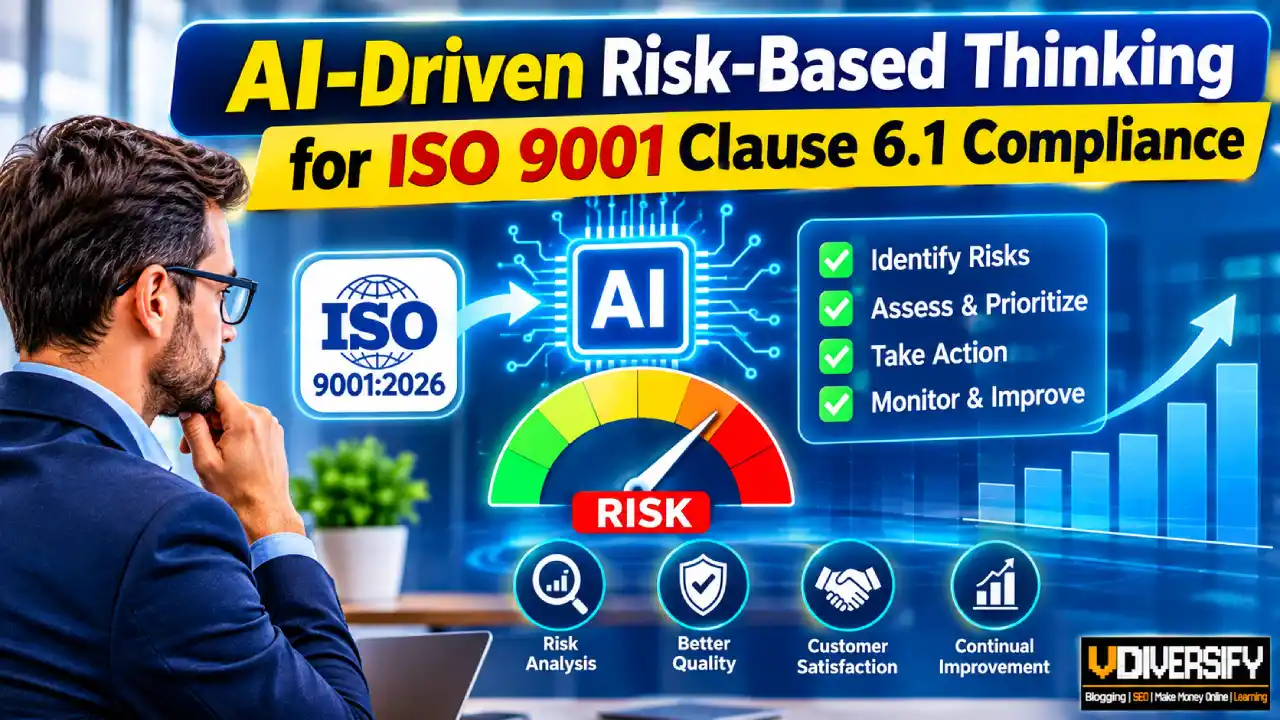
Quality management is changing as organizations adopt artificial intelligence to improve their processes, prevent failures, and make better business decisions.
AI risk-based thinking ISO 9001 clause 6.1 is becoming an important approach for companies that want to identify potential quality problems earlier, evaluate operational risks more accurately, and take corrective action before those problems affect customers.
Traditional risk assessment methods often depend on manual reviews, spreadsheets, historical records, and employee experience.
Although these methods remain useful, AI can help quality professionals analyze larger amounts of information, identify patterns, predict possible failures, and recognize improvement opportunities.
This guide explains how organizations can combine AI with ISO 9001 requirements to build a more effective, practical, and proactive Quality Management System (QMS).
Contents
- 1. Why Traditional Risk Assessment Is No Longer Enough?
- 2. What Is Risk-Based Thinking in ISO 9001?
- 3. Understanding ISO 9001 Clause 6.1 Requirements
- 4. What Is AI-Driven Risk-Based Thinking?
- 5. How AI Helps Identify Quality Risks
- 6. How to Implement AI-Driven Risk Assessment Step by Step
- 7. Practical AI Applications in Different Industries
- 8. Real-World Example: AI-Assisted Quality Risk Assessment
- 9. How to Create an AI-Powered ISO 9001 Risk Register
- 10. Best AI Tools for ISO 9001 Risk Management
- 11. How AI Supports Internal Audits and Management Reviews
- 12. Challenges and Limitations of AI in Risk Management
- 13. How to Maintain Human Control and AI Governance
- 14. Common Mistakes Organizations Should Avoid
- 15. Practical Implementation Checklist
- 16. Conclusion:
- 17. References and Further Reading
- 18.
- 19. FAQs
Why Traditional Risk Assessment Is No Longer Enough?
Every organization faces risks that can affect its ability to deliver products and services that meet customer requirements. These risks may arise from equipment failures, supplier delays, incorrect specifications, employee errors, inadequate training, process variations, changing customer expectations, or unexpected operational disruptions.
For example, a manufacturing company may experience an increase in rejected products because one production machine is gradually losing accuracy. If the quality department identifies the issue only during final inspection, the company may already have produced hundreds of defective components.
This is where AI-supported risk assessment can make a difference.
AI systems can analyze historical inspection results, production measurements, maintenance records, customer complaints, and machine performance data to identify unusual patterns. Instead of waiting for a defect to occur, quality teams can investigate early warning signs and take preventive measures.
Consider a company that receives repeated customer complaints about dimensional defects. An AI-based analysis may identify that most complaints are associated with one production line, a particular shift, or a specific raw material supplier. The quality team can then investigate the actual cause and introduce appropriate controls.
The objective is not to replace experienced quality professionals with technology. It is to give them better information so they can make informed decisions.
For organizations operating in the United States, this approach can be particularly useful in manufacturing, automotive supply chains, aerospace, medical device supply chains, engineering, construction, logistics, and professional services.
The main objective is simple: identify quality risks early, prioritize them correctly, take suitable action, and verify that those actions work.
What Is Risk-Based Thinking in ISO 9001?
Risk-based thinking is an approach that requires organizations to consider what could go wrong, what could improve, and what actions are necessary to achieve the intended results of their Quality Management System.
Rather than waiting for a nonconformity, customer complaint, or process failure, organizations identify potential problems in advance and plan suitable controls.
Under ISO 9001, risk-based thinking is connected to several parts of the QMS, including:
- Understanding the organization and its context.
- Identifying the needs and expectations of interested parties.
- Planning quality management activities.
- Controlling operational processes.
- Evaluating performance.
- Addressing nonconformities.
- Driving continual improvement.
It is important to understand that risk-based thinking is not limited to maintaining a risk register. It should influence everyday business decisions.
For example, when a company selects a new supplier, it should consider whether that supplier can consistently meet its technical specifications, delivery commitments, and quality requirements.
Similarly, when an organization introduces new machinery, it should evaluate whether employees have the required skills, whether the equipment can meet production tolerances, and whether additional inspection or maintenance controls are necessary.
Understanding Risks and Opportunities
A risk is the effect of uncertainty on an expected result. In quality management, risks commonly relate to anything that could negatively affect product conformity, service quality, customer satisfaction, or the effectiveness of the QMS.
Examples include:
- Equipment breakdown during production.
- Delayed delivery of critical raw materials.
- Incorrect product specifications.
- Inadequate employee training.
- Increased customer complaints.
- Failure to meet regulatory requirements.
- Loss of important process knowledge.
An opportunity, on the other hand, is a situation that may help an organization achieve better results.
Examples include:
- Using automation to reduce human errors.
- Introducing predictive maintenance.
- Improving supplier evaluation methods.
- Using digital inspection systems.
- Reducing production cycle time.
- Introducing AI-based complaint analysis.
Risks and opportunities should be considered together, but they require different types of action. An organization should not focus only on preventing failures. It should also look for practical ways to improve quality and business performance.
For instance, introducing an automated inspection system may create an opportunity to reduce inspection time. However, it may also introduce risks related to incorrect sensor calibration, software errors, or inaccurate detection results.
This is why an effective risk assessment considers both sides.
Why Risk-Based Thinking Matters
Risk-based thinking helps organizations move from reactive quality control to proactive quality management.
Its practical benefits include:
- Fewer quality failures: Potential problems can be identified before they affect customers.
- Better decision-making: Managers can prioritize resources according to risk.
- Improved customer satisfaction: Organizations can reduce recurring defects and service failures.
- Reduced operational costs: Early intervention can reduce scrap, rework, downtime, and warranty claims.
- Stronger supplier performance: Supplier-related problems can be identified and addressed earlier.
- Continual improvement: Organizations can use risk analysis to identify better ways of working.
Risk-based thinking also helps management understand which processes require closer monitoring and which controls need improvement.
Understanding ISO 9001 Clause 6.1 Requirements
Clause 6.1 deals with actions to address risks and opportunities. It is one of the important planning requirements of an ISO 9001 Quality Management System.
The requirement connects risk assessment with the organization’s business context, interested parties, quality objectives, operational processes, and continual improvement.
An organization must determine the risks and opportunities that need to be addressed, plan suitable actions, integrate those actions into its QMS processes, and evaluate whether the actions are effective.
It is not enough to identify a risk and enter it into a spreadsheet. The organization must demonstrate that it has considered what action is appropriate and whether that action produces the expected result.
ISO 9001:2015 Clause 6.1 Explained
ISO 9001:2015 divided Clause 6.1 into two main requirements.
Clause 6.1.1 – Determining risks and opportunities
Organizations were required to consider the issues identified under Clause 4.1 and the requirements of interested parties under Clause 4.2.
They had to determine the risks and opportunities that needed attention to:
- Give assurance that the QMS achieves its intended results.
- Enhance desirable effects.
- Prevent or reduce undesired effects.
- Achieve improvement.
Clause 6.1.2 – Planning actions
Organizations were required to plan:
- Actions to address identified risks and opportunities.
- How these actions would be integrated into QMS processes.
- How the effectiveness of these actions would be evaluated.
Actions also needed to be proportionate to the potential impact on product and service conformity.
For example, a minor administrative delay may require a simple process adjustment, while a risk involving incorrect safety-critical product dimensions may require stronger controls, additional verification, and management attention.
The important point is that the level of control should reflect the level of risk.
ISO 9001:2015 did not prescribe one mandatory risk assessment method or require every organization to use a particular scoring matrix. Companies could select an approach that suited their size, complexity, products, services, and operational risks.
Reference: ISO 9001:2015 risk and opportunity requirements.
What Has Changed in ISO 9001:2026?
An important development for quality professionals is the publication of ISO 9001:2026 on 16 September 2026. It replaces ISO 9001:2015 and retains the familiar management-system structure while introducing clarifications and refinements.
One important development concerns how organizations consider risks and opportunities.
The 2026 edition provides a clearer distinction between addressing risks and pursuing opportunities. This encourages organizations to take more deliberate action rather than treating both subjects as one general assessment exercise.
For organizations using AI, this distinction is useful.
For example:
Risk | Opportunity |
Incorrect AI-generated inspection results | Faster inspection through AI-assisted analysis |
Inaccurate supplier risk predictions | Better supplier performance monitoring |
Incomplete production data | Improved process visibility |
Incorrect defect classification | Automated defect identification |
Dependence on unreliable software | Improved decision-making through validated digital systems |
Organizations certified to the 2015 edition should review the new requirements and plan their transition with their certification body. The published transition period extends to 30 September 2029.
Important: Organizations should consult the official ISO 9001:2026 text when updating their procedures, risk assessment methods, and compliance arrangements. The explanations in this article are practical guidance, not a replacement for the licensed standard.
What Auditors Expect to See
During an ISO 9001 audit, auditors generally want to understand whether the organization has identified relevant risks and opportunities and taken suitable action.
They may examine:
- How risks are identified.
- Whether risk assessments consider organizational context.
- Whether interested-party requirements are considered.
- How significant risks are prioritized.
- Whether planned controls are implemented.
- Whether responsibilities are assigned.
- Whether actions are integrated into operational processes.
- How the organization evaluates effectiveness.
Suppose a company identifies a high risk of supplier-related material defects.
The auditor may ask:
- How was this risk identified?
- What evidence supports the risk assessment?
- What controls were introduced?
- Who is responsible for monitoring the supplier?
- How does the organization evaluate whether the controls are effective?
If the company simply shows an AI-generated risk register without evidence of review, action, or monitoring, that is not sufficient to demonstrate effective risk management.
AI-generated documentation does not automatically establish ISO 9001 compliance. The organization must demonstrate that its risk management activities are implemented and effective.
What Is AI-Driven Risk-Based Thinking?
AI-driven risk-based thinking combines traditional quality risk assessment with artificial intelligence, machine learning, predictive analytics, and automated data analysis.
The purpose is to help organizations identify potential risks, understand their causes, evaluate their possible impact, and make better decisions.
Traditional assessments often depend on brainstorming sessions, employee experience, historical nonconformity records, and manual calculations.
These methods remain important. However, they can become difficult to manage when an organization has multiple production lines, hundreds of suppliers, thousands of inspection records, and large amounts of customer feedback.
AI can support these activities by processing information from different sources and identifying patterns that may not be immediately visible to employees.
How Artificial Intelligence Supports Quality Risk Management
AI can support quality professionals in several ways.
- Identifying hidden patterns
AI can analyze large datasets to identify repeated failures, unusual measurements, and relationships between different process variables.
For example, an AI system may identify that defects increase when production temperature rises above a certain level.
- Predicting possible failures
Machine learning models can use historical information to estimate the likelihood of certain failures under similar conditions.
For example, equipment vibration, operating temperature, and maintenance history may help identify machinery that requires inspection.
- Automating data analysis
AI can process customer complaints, inspection reports, audit findings, and supplier performance records more quickly than manual review.
- Supporting risk prioritization
AI can help quality teams compare risks using factors such as frequency, potential impact, process history, and available evidence.
- Recognizing improvement opportunities
AI can analyze production efficiency, customer feedback, and process performance to identify areas where changes may improve quality.
These applications make ISO 9001 risk-based thinking AI approaches particularly useful for organizations that generate large amounts of operational data.
However, AI recommendations should always be reviewed by competent personnel before they are accepted as business decisions.
AI vs. Traditional Risk Assessment
Both traditional and AI-assisted approaches have a place in a Quality Management System.
Assessment area | Traditional approach | AI-assisted approach |
Risk identification | Meetings and manual reviews | Data analysis and pattern detection |
Risk evaluation | Manual scoring | Data-supported scoring recommendations |
Defect analysis | Historical inspection reports | Pattern recognition across datasets |
Supplier monitoring | Periodic supplier reviews | Continuous performance analysis where data is available |
Risk prioritization | Experience-based decisions | Evidence-supported recommendations |
Monitoring | Scheduled manual checks | Automated alerts and dashboards |
Reporting | Manually prepared reports | AI-assisted reporting |
For example, a quality engineer may traditionally review 500 inspection records to identify recurring dimensional problems.
An AI-based system may analyze those records and highlight unusual variations associated with a particular machine, shift, or material batch.
The quality engineer can then verify the finding and investigate the root cause.
AI improves the speed and depth of analysis, while human expertise ensures that the conclusions make sense in the actual workplace.
How AI Helps Identify Quality Risks
Risk identification is one of the most valuable applications of AI in quality management.
Organizations collect information from many sources, including production records, maintenance logs, inspection reports, supplier evaluations, customer feedback, and internal audits.
However, the information is often stored in separate systems. This makes it difficult for quality teams to identify connections between different problems.
AI can help bring these information sources together, provided the data can be accessed safely and its quality is sufficient.
Identifying Process and Operational Risks
AI can analyze production information to identify unusual process behavior.
For example, consider a US-based manufacturer producing precision-machined components.
The company records:
- Machine operating temperatures.
- Production cycle times.
- Dimensional inspection results.
- Tool replacement history.
- Rejection percentages.
- Maintenance activities.
An AI system can analyze this information and identify patterns associated with higher defect rates.
Suppose the system identifies that dimensional rejections increase after a particular cutting tool reaches a certain number of operating hours.
The quality and maintenance teams can investigate the relationship and determine whether tool replacement intervals need to be revised.
This can help the company reduce defects, prevent unnecessary rework, and improve production consistency.
Other possible applications include:
- Identifying unusual production variations.
- Detecting repeated process deviations.
- Predicting equipment maintenance requirements.
- Identifying bottlenecks.
- Monitoring process performance.
- Recognizing changes in inspection results.
This is an example of machine learning risk ISO 9001 applications, where historical data helps identify conditions associated with possible quality failures.
However, predictions should not be treated as proof of causation. The organization must validate the findings through process investigation and appropriate testing.
Identifying Supplier and Supply Chain Risks
Supplier performance has a direct effect on an organization’s ability to deliver conforming products and services.
A supplier may provide materials that meet specifications for several months before quality problems begin to increase.
Traditional supplier evaluations may identify these problems only during periodic reviews.
AI can help analyze supplier-related information such as:
- Incoming inspection rejection rates.
- On-time delivery performance.
- Supplier nonconformity reports.
- Corrective action response times.
- Material certification records.
- Historical delivery disruptions.
- Changes in supplier performance.
For example, an automotive component manufacturer may purchase steel components from five suppliers.
An AI-based analysis may identify that one supplier has a growing trend of dimensional nonconformities and delayed deliveries.
The procurement and quality departments can investigate the supplier’s performance, request corrective action, increase incoming inspection where justified, or identify alternative sources.
This makes AI risk management ISO applications useful for supplier evaluation and supply chain monitoring.
AI can also support the identification of opportunities, such as finding suppliers with consistently better delivery performance or identifying materials that reduce process variation.
Predicting Product and Service Quality Issues
AI is not limited to manufacturing.
Service organizations can also use AI to identify risks affecting customer satisfaction and service delivery.
For example, a US-based IT support company may receive thousands of customer support requests every month.
AI can analyze ticket descriptions, response times, complaint categories, and resolution records to identify recurring service problems.
It may identify that customers experience repeated delays whenever a particular software application is updated.
The organization can then review its release management process, improve testing, and introduce additional verification before future updates.
Similar applications include:
- Identifying recurring customer complaints.
- Predicting service delays.
- Detecting errors in transaction processing.
- Monitoring documentation mistakes.
- Identifying training requirements.
- Recognizing repeated service failures.
AI quality risk assessment therefore applies to both product-based and service-based organizations.
The main requirement is to connect AI findings to actual business risks and take suitable action.
How to Implement AI-Driven Risk Assessment Step by Step
Implementing AI within an existing QMS does not mean that an organization must immediately purchase expensive software or completely change its current risk management procedures.
A practical approach is to begin with existing quality records, identify processes where AI can provide value, and gradually introduce AI-supported analysis.
The following steps provide a practical implementation method for organizations.
Step 1: Collect Relevant Quality Data
AI systems depend on data to identify patterns and generate useful recommendations.
Before implementing AI, organizations should identify the information required for risk assessment.
Common data sources include:
Data source | Information to collect | Purpose |
Inspection reports | Defects, measurements, rejection rates | Identify product quality risks |
Customer complaints | Complaint type, frequency, severity | Identify customer-related risks |
Internal audits | Findings and repeated nonconformities | Identify QMS weaknesses |
Maintenance records | Equipment breakdowns and repairs | Identify equipment-related risks |
Supplier records | Delivery delays and rejection rates | Identify supplier risks |
Training records | Employee skills and competency gaps | Identify human-related risks |
Production records | Process parameters and output | Identify operational risks |
For example, a manufacturing company may have three years of production inspection records.
By organizing these records into a consistent format, the quality department can use AI tools to examine rejection trends, identify frequently occurring defects, and highlight processes that require further investigation.
Data quality is extremely important. Incomplete records, incorrect measurements, inconsistent defect descriptions, and missing information can lead to misleading AI recommendations.
Organizations should also establish appropriate access controls and protect confidential customer, employee, supplier, and production information.
Step 2: Identify Potential Risks Using AI
Once the required information is available, AI can help identify potential risks across different business processes.
Quality professionals can use generative AI to review process descriptions, audit findings, customer complaints, and historical nonconformities.
For example, consider a company that manufactures electrical components.
The quality manager can provide a process description and relevant historical failure information to an AI tool and request possible risks associated with that process.
An AI system may suggest:
- Incorrect component dimensions.
- Inadequate equipment maintenance.
- Inconsistent raw material quality.
- Incorrect assembly procedures.
- Insufficient employee training.
- Inadequate final inspection.
- Delays in identifying defective products.
The quality team should review each suggestion and determine whether it is relevant to the organization’s actual operations.
This is an important distinction: AI can suggest potential risks, but the organization must determine which risks genuinely apply.
A useful prompt could be:
Example AI prompt for risk identification
Practical example
You are assisting a quality management team in identifying operational risks under ISO 9001 Clause 6.1.
Review the following process:
Process: CNC machining of precision metal components.
Identify potential risks related to equipment, operators, raw materials, process parameters, inspection, and product conformity.
For each risk, provide:
- Risk description.
- Possible cause.
- Potential consequence.
- Existing controls to investigate.
- Suggested additional controls.
Do not assume that suggested risks are confirmed facts. Clearly identify assumptions requiring verification.
Copy prompt
This approach can make risk identification more structured and help quality professionals consider issues they may otherwise overlook.
Step 3: Analyze Likelihood and Impact
Identifying risks is only the beginning. Organizations must also understand how serious those risks could be.
Two commonly used factors are:
- Likelihood: How likely is the risk to occur?
- Impact: How serious would the consequences be if it occurred?
Organizations can use a simple 1–5 scoring method to evaluate these factors.
For example:
Score | Likelihood | Impact |
1 | Rare | Insignificant |
2 | Unlikely | Minor |
3 | Possible | Moderate |
4 | Likely | Major |
5 | Almost certain | Critical |
A simple risk priority score can be calculated as:
Risk Score = Likelihood ✖ Impact
For example, if the likelihood of a machine-related failure is rated 4 and its potential impact is rated 5:
4 ✖ 5 = 20
The resulting score is 20 out of 25.
Illustrative scoring method. ISO 9001 does not prescribe this particular formula or scoring scale.
AI can assist by examining historical information and recommending preliminary scores. However, the final assessment should consider process knowledge, customer requirements, safety implications where relevant, and the actual effectiveness of existing controls.
Step 4: Prioritize Risks
Not every identified risk requires the same level of attention.
A minor documentation error and a defect that could affect a safety-critical product should not receive equal priority.
Organizations should prioritize risks according to their potential consequences and the effectiveness of existing controls.
For example:
Risk | Likelihood | Impact | Score | Priority |
Machine breakdown | 4 | 4 | 16 | High |
Supplier material rejection | 3 | 5 | 15 | High |
Minor documentation error | 2 | 2 | 4 | Low |
Employee training gap | 3 | 3 | 9 | Medium |
Incorrect final inspection | 3 | 5 | 15 | High |
AI can help rank these risks and identify trends across departments.
However, a numerical score should never be the only basis for a decision. A low-frequency event with severe consequences may require immediate attention even if its calculated score is relatively low.
The quality manager should also consider applicable regulatory, contractual, and customer-specific requirements.
Step 5: Develop and Implement Controls
After identifying and prioritizing risks, the organization should determine what actions are necessary.
For example, if an organization identifies a high risk of dimensional defects due to machine wear, possible actions may include:
- Introducing preventive maintenance.
- Establishing tool replacement intervals.
- Increasing inspection frequency where justified.
- Monitoring critical machine parameters.
- Training machine operators.
- Introducing automated measurement systems.
AI can assist by suggesting possible controls based on the available information.
However, the selected actions must be practical, approved by responsible personnel, and integrated into the relevant QMS processes.
The organization should clearly define:
Implementation requirement | Example |
Risk | Dimensional defects caused by tool wear |
Action | Introduce tool-life monitoring |
Responsibility | Production Manager |
Resources | Monitoring software and measurement equipment |
Target date | Within 30 days |
Effectiveness measure | Reduction in dimensional rejections |
Verification | Monthly review of inspection records |
This ensures that risk management becomes part of daily operations rather than remaining an administrative exercise.
Step 6: Monitor and Evaluate Effectiveness
The final step is to determine whether the actions have actually reduced the risk or improved the expected result.
For example, a manufacturing company introduces a predictive maintenance system to reduce unexpected machine failures.
Before implementation, the company experienced an average of eight unplanned machine breakdowns per quarter.
After introducing the new monitoring process, the number decreases to three breakdowns per quarter.
Illustrative example, not a published industry statistic.
The quality and maintenance teams should examine whether the reduction is linked to the new controls and whether other factors influenced the results.
Useful monitoring indicators include:
- Number of product rejections.
- Customer complaint frequency.
- Supplier rejection percentage.
- Equipment downtime.
- Repeat nonconformities.
- Corrective action effectiveness.
- Process performance trends.
AI can help monitor these indicators, identify unusual changes, and generate alerts when performance moves outside established limits.
However, the organization must periodically verify the accuracy of its AI models, review unexpected recommendations, and update its risk assessments when processes or operating conditions change.
Effective risk management is a continuous activity, not a one-time assessment.
Practical AI Applications in Different Industries
AI-driven risk assessment is not limited to large manufacturing companies. Organizations in different industries can use AI to identify potential quality problems, improve process performance, and make better decisions.
The type of information used and the risks being assessed will depend on the organization’s activities. A manufacturing company may focus on machine performance and product defects, while a service company may focus on customer complaints, service delays, and documentation errors.
The following examples demonstrate how organizations can apply AI-supported risk management in their daily operations.
Manufacturing and Production
Manufacturing companies can use AI to monitor production performance, identify unusual process variations, and predict potential equipment failures.
For example, an automotive component manufacturer may experience repeated rejection of machined components because of inconsistent dimensions.
The company can use AI to analyze:
- Machine operating conditions.
- Inspection and measurement results.
- Tool replacement history.
- Production rejection records.
- Operator shift information.
- Preventive maintenance activities.
AI may identify that dimensional defects occur more frequently when a particular machine operates beyond a certain temperature range.
The quality team can investigate the finding, verify the actual cause, and introduce suitable process controls.
Other applications include:
- Predictive maintenance.
- Automated visual inspection.
- Process variation monitoring.
- Production defect prediction.
- Supplier quality analysis.
- Scrap and rework reduction.
For manufacturers, AI quality risk management can help improve process stability and reduce the possibility of defective products reaching customers.
Engineering and Construction
Engineering and construction organizations face several quality-related risks throughout project execution.
These may include incorrect drawings, material specification errors, inadequate inspection, contractor performance issues, equipment failures, and delays in completing required quality activities.
AI can help analyze project documentation, inspection reports, nonconformity records, and contractor performance information.
For example, a US-based construction company may use AI to review inspection records from multiple project sites.
The system may identify that concrete-related nonconformities are repeatedly associated with inadequate curing practices.
The quality team can investigate the issue and recommend stronger inspection requirements, employee training, and improved site monitoring.
Other possible applications include:
- Reviewing technical documentation.
- Identifying recurring construction defects.
- Monitoring subcontractor performance.
- Analyzing inspection and test reports.
- Identifying project quality risks.
- Monitoring material compliance.
AI can also support document review, but engineering calculations, design approvals, and safety-related decisions must remain under appropriate professional control.
Service-Based Organizations
Service companies can also benefit from automated risk thinking ISO approaches.
For example, a financial services company may experience repeated errors in customer documentation because employees follow inconsistent procedures.
AI can analyze service records, customer complaints, and transaction errors to identify recurring patterns.
The company may discover that most documentation errors occur during a particular stage of customer onboarding.
It can then revise its work instructions, introduce additional verification, and provide targeted employee training.
Other examples include:
- Healthcare administration: identifying documentation and scheduling errors.
- IT services: identifying recurring system failures.
- Logistics: predicting delivery delays.
- Customer support: identifying recurring complaint categories.
- Consulting: identifying risks related to incomplete project deliverables.
AI can help service organizations identify risks that may not be visible through occasional manual reviews.
Real-World Example: AI-Assisted Quality Risk Assessment
Consider a hypothetical US-based automotive parts manufacturer that produces precision-machined components for industrial and automotive customers.
The organization has approximately 150 employees and operates multiple CNC machines.
During the previous six months, the company experienced an increase in customer complaints related to dimensional defects.
The quality manager initially reviewed customer complaints and internal inspection records. However, the available information was spread across different spreadsheets and production reports.
The company decided to use AI-assisted analysis to investigate the issue.
Step 1: Data collection
The quality team collected:
- Six months of inspection records.
- Customer complaint reports.
- Machine maintenance records.
- Production rejection reports.
- Tool replacement information.
Step 2: AI-assisted analysis
The team used an AI analytics system to identify relationships between production conditions and dimensional defects.
The system highlighted a possible relationship between increased rejection rates and extended tool operating hours.
Step 3: Risk evaluation
The quality manager reviewed the findings and assessed the risk.
Assessment factor | Evaluation |
Identified risk | Dimensional defects caused by tool wear |
Possible cause | Extended tool usage |
Likelihood | 4 – Likely |
Impact | 5 – Critical |
Initial risk score | 20 |
Risk priority | High |
Step 4: Implementation of controls
The company introduced the following actions:
- Revised tool replacement intervals.
- Introduced tool-life monitoring.
- Increased inspection at selected production stages.
- Updated machine operating instructions.
- Trained production operators.
Step 5: Effectiveness evaluation
The quality department monitored rejection rates, customer complaints, and inspection results after implementing the controls.
The results were reviewed during the next quality performance meeting.
The important lesson is that AI helped identify a possible relationship, but the quality team verified the finding and decided which controls were appropriate.
This is how ISO 9001 risk AI applications should work in practice.
Note: This is an illustrative case study created to demonstrate implementation. It is not a reported customer case or independently verified performance result.
How to Create an AI-Powered ISO 9001 Risk Register
A risk register is a useful tool for documenting identified risks, their possible consequences, evaluation results, planned actions, responsibilities, and monitoring activities.
Although ISO 9001 does not prescribe one mandatory risk register format, maintaining a suitable record can help organizations demonstrate how they manage important risks.
AI can support the preparation, review, and updating of the register.
A good AI risk register quality process should include actual operational information rather than relying entirely on AI-generated suggestions.
Sample AI-Assisted Risk Register
Consider the following example for a manufacturing organization.
Process | Identified risk | Likelihood | Impact | Score |
Production | Machine breakdown | 4 | 4 | 16 |
Purchasing | Supplier material rejection | 3 | 5 | 15 |
Inspection | Incorrect measurement | 3 | 5 | 15 |
Human resources | Inadequate employee training | 3 | 3 | 9 |
Dispatch | Incorrect product labeling | 2 | 4 | 8 |
Customer service | Delayed complaint resolution | 3 | 3 | 9 |
All scores are illustrative and use a 1–5 likelihood and impact scale.
The organization can extend this register by adding the following fields:
Additional field | Information to record |
Risk owner | Person responsible for the risk |
Existing controls | Controls already implemented |
Planned actions | Additional actions required |
Target date | Expected completion date |
Resources | Resources needed |
Residual risk | Risk remaining after controls |
Effectiveness | Evidence that actions are working |
Review date | Next assessment date |
A practical example of an action plan is shown below.
Identified risk | Planned action | Responsible person | Effectiveness indicator |
Machine breakdown | Introduce predictive maintenance | Maintenance Manager | Unplanned downtime |
Supplier rejection | Strengthen supplier monitoring | Purchase Manager | Incoming rejection rate |
Measurement errors | Introduce calibration verification | Quality Manager | Measurement-related nonconformities |
Training gaps | Conduct competency assessment | HR Manager | Training effectiveness results |
Incorrect labeling | Introduce barcode verification | Dispatch Manager | Labeling errors |
The organization should define acceptable performance targets based on its own requirements and operating conditions.
Risk Scoring and Prioritization
AI can support risk scoring by analyzing historical information and recommending possible likelihood and impact ratings.
However, organizations should not allow AI to assign final scores without human review.
For example, an AI system may recommend a likelihood score of 2 because a particular defect has occurred only twice in the previous year.
However, if that defect could result in a serious regulatory or customer-related consequence, the quality manager may decide that the risk needs a higher priority.
Organizations should also consider:
- Existing control effectiveness.
- Frequency of occurrence.
- Severity of consequences.
- Ability to detect the problem.
- Customer-specific requirements.
- Regulatory requirements.
- Changes in operating conditions.
Some organizations may use Failure Mode and Effects Analysis (FMEA) to evaluate failure modes, their effects, causes, and controls.
AI can assist with preparing an initial FMEA, analyzing historical failure information, and identifying possible failure modes. Nevertheless, the responsible engineering and quality teams must verify the technical accuracy of the analysis.
A risk register should be a working management tool, not simply a document prepared for an external audit.
Best AI Tools for ISO 9001 Risk Management
Several AI and analytics tools can support risk identification, process monitoring, documentation review, and quality performance analysis.
Organizations should select tools according to their actual needs, data availability, budget, information security requirements, and technical capabilities.
The following are useful options to consider.
ChatGPT and Generative AI
ChatGPT
AI assistant for quality documentation and analysis
ChatGPT can assist quality professionals with:
- Identifying possible process risks.
- Preparing draft risk registers.
- Reviewing process descriptions.
- Analyzing nonconformity reports.
- Preparing internal audit questions.
- Developing corrective action plans.
- Suggesting quality improvement opportunities.
- Creating management review summaries.
For example, a quality manager can provide a sanitized process description and ask ChatGPT to identify possible risks associated with purchasing, production, inspection, and delivery.
The resulting suggestions can be reviewed and converted into a practical risk assessment.
ChatGPT can also support AI opportunity analysis ISO activities by identifying possible process improvements, automation opportunities, and areas where quality performance could be enhanced.
However, ChatGPT should not be treated as an authoritative source of ISO requirements or as a replacement for professional judgment.
Power BI and Predictive Analytics
Microsoft Power BI
Quality dashboards and performance monitoring
Power BI helps organizations analyze quality data and create interactive dashboards.
It can be used to monitor:
- Rejection percentages.
- Customer complaints.
- Supplier performance.
- Corrective action status.
- Equipment downtime.
- Audit findings.
- Process performance trends.
For example, a quality manager can develop a dashboard showing rejection rates across different production lines.
If one production line shows a sudden increase in defects, the dashboard can help the team identify where further investigation is necessary.
Power BI is primarily a business intelligence platform. Advanced predictive analysis may require additional statistical, machine learning, or AI capabilities.
Machine Learning and Quality Analytics
Machine learning platforms
Advanced prediction and pattern recognition
Machine learning can help organizations identify patterns in historical quality data and estimate the likelihood of certain failures.
For example, a manufacturer can use historical equipment data to develop a model that identifies operating conditions associated with higher breakdown risk.
Applications may include:
- Predictive maintenance.
- Defect classification.
- Anomaly detection.
- Process performance prediction.
- Supplier performance analysis.
- Quality trend identification.
Organizations with suitable technical resources can use machine learning libraries such as Scikit-learn to develop and test analytical models.
However, these models need proper validation, suitable data, ongoing monitoring, and controls to prevent unreliable predictions from influencing important quality decisions.
Comparing AI Tools for Quality Professionals
Tool | Main application | Suitable users |
ChatGPT | Risk identification and documentation support | Quality managers and auditors |
Microsoft Power BI | Quality dashboards and reporting | Quality and operations teams |
Scikit-learn | Machine learning and prediction | Data analysts and engineers |
Python | Quality data analysis and automation | Engineers and technical teams |
Computer vision systems | Automated visual inspection | Manufacturing companies |
The best solution is not necessarily the most advanced or expensive one.
A small organization may achieve useful results by combining its existing quality records, ChatGPT, and a basic reporting dashboard.
A large manufacturer may require an integrated system involving machine learning, production monitoring, and automated inspection.
How AI Supports Internal Audits and Management Reviews
Internal audits and management reviews are important activities for evaluating whether a Quality Management System is functioning effectively.
AI can support these activities by analyzing audit findings, identifying repeated nonconformities, reviewing performance trends, and highlighting areas that may require management attention.
AI in ISO 9001 Internal Audits
Internal auditors often review several types of information, including:
- Previous internal audit reports.
- Customer complaints.
- Corrective action records.
- Process performance indicators.
- Supplier evaluation results.
- Risk registers.
- Training and competency records.
When these records are available in a suitable digital format, AI can help identify recurring issues and suggest areas for further audit investigation.
For example, suppose an organization has completed 12 internal audits over the previous year.
The audit reports contain repeated findings related to incomplete inspection records, overdue calibration activities, and inadequate employee training.
An AI-assisted analysis may identify that these issues are concentrated in one department.
The internal auditor can use this information to plan a more focused audit and investigate whether the department has weaknesses in its process controls.
AI can also help prepare audit questions based on the organization’s processes and identified risks.
However, auditors must independently evaluate evidence, interview relevant employees, observe activities, and determine whether requirements are being fulfilled.
AI can assist the audit process, but it cannot replace auditor competence, independence, or professional judgment.
AI in Management Review Meetings
Management reviews provide an opportunity for top management to evaluate QMS performance and determine whether improvements or changes are necessary.
AI can help summarize relevant information and identify trends that may require management attention.
For example, AI can analyze:
- Customer satisfaction trends.
- Supplier performance.
- Process performance.
- Nonconformity trends.
- Corrective action effectiveness.
- Audit results.
- Risk and opportunity status.
- Resource requirements.
Suppose an organization notices that customer complaints have increased over three consecutive months.
AI may identify that most complaints relate to delayed deliveries and repeated product defects.
Management can use this information to investigate the reasons, allocate resources, improve supplier controls, or revise production planning.
The final management review decisions must be made by authorized management personnel and supported by reliable information.
This makes automated risk thinking ISO applications useful for improving the quality of information available during management reviews.
Challenges and Limitations of AI in Risk Management
Although AI offers several benefits, organizations should understand its limitations before introducing it into their QMS.
AI is not always accurate, and its recommendations may be affected by incomplete information, poor-quality data, incorrect assumptions, or limitations in the analytical model.
Some important challenges include the following.
1. Inaccurate or Incomplete Data
AI systems require reliable information.
If an organization has incomplete inspection reports, inconsistent defect classifications, or incorrect supplier records, AI may generate misleading conclusions.
For example, if employees do not consistently record machine breakdowns, a predictive maintenance model may underestimate equipment failure risks.
Recommended action: Establish data collection procedures, standardize records, and periodically verify the accuracy of information.
2. Incorrect AI Recommendations
Generative AI can produce answers that appear professional and convincing but contain incorrect information.
For example, an AI tool may suggest that a particular risk is low because it has not occurred frequently in historical records.
However, the risk may still have serious consequences.
Recommended action: Require competent personnel to review important AI-generated recommendations before accepting them.
3. Data Security and Confidentiality
Quality records may contain sensitive customer information, supplier details, technical drawings, employee records, and commercially confidential information.
Uploading such information to an unapproved AI platform can create security and confidentiality risks.
Recommended action:
- Use organization-approved AI platforms.
- Review data handling and retention arrangements.
- Apply role-based access controls.
- Remove unnecessary personal or confidential information.
- Establish clear rules for uploading company data.
- Review third-party security and privacy arrangements.
4. Lack of Employee Knowledge
Employees may not understand how AI works or how to interpret its recommendations.
If employees blindly accept AI-generated risk scores, they may overlook important process conditions.
Recommended action: Provide training on AI usage, data interpretation, risk assessment, and human verification.
5. Overdependence on Automation
Some organizations may assume that introducing AI automatically improves quality performance.
This is not necessarily true.
An AI model can identify patterns, but it cannot always understand the full operational context or recognize every business consequence.
Recommended action: Keep human oversight, independent verification, and established quality controls in place.
6. Cost and Integration Challenges
Implementing AI may require investment in software, data infrastructure, employee training, system integration, and technical support.
Small organizations may not have the resources to implement advanced predictive analytics immediately.
Recommended action: Start with one high-priority process, demonstrate measurable value, and expand gradually.
How to Maintain Human Control and AI Governance
AI should support an organization’s Quality Management System rather than operate as an uncontrolled decision-making system.
Organizations should establish clear responsibilities for selecting, implementing, monitoring, and reviewing AI applications.
This is particularly important when AI recommendations can influence product acceptance, supplier approval, inspection decisions, or customer-related activities.
Establish Clear AI Responsibilities
A practical responsibility structure may look like this:
Role | Responsibility |
Top Management | Approve AI strategy and provide resources |
Quality Manager | Ensure integration with the QMS |
Process Owner | Verify process-related AI recommendations |
IT Department | Manage system security and access |
Data Analyst | Monitor data quality and model performance |
Internal Auditor | Evaluate implementation and effectiveness |
Employees | Follow approved procedures and report issues |
Validate AI Systems Before Using Their Outputs
Before relying on an AI system for important quality decisions, organizations should evaluate whether it performs as intended.
For example, if a computer vision system is used to identify surface defects, the company should compare its results with verified inspection findings.
The evaluation may consider:
- Detection accuracy.
- False acceptance rates.
- False rejection rates.
- Repeatability.
- Performance under different operating conditions.
- Impact of changes in lighting or camera position.
- Model performance after software updates.
The organization should define acceptance criteria before approving the system for operational use.
It should also maintain records of testing, approval, changes, and ongoing performance monitoring where appropriate.
Use Recognized AI Risk Management Guidance
Organizations introducing AI into quality operations can also consider established guidance for managing AI-related risks.
Two useful references are:
ISO/IEC 42001:2023 – Artificial Intelligence Management Systems
This standard provides requirements and guidance for establishing, implementing, maintaining, and continually improving an AI management system.
Official reference: ISO/IEC 42001.
NIST AI Risk Management Framework
The US National Institute of Standards and Technology developed the AI Risk Management Framework to help organizations manage risks associated with AI systems.
Its main functions are:
- Govern
- Map
- Measure
- Manage
Organizations can use these functions to establish responsibilities, understand AI-related risks, evaluate system performance, and introduce suitable controls.
Official reference: NIST AI Risk Management Framework.
These frameworks do not replace ISO 9001 requirements. Instead, they can complement the organization’s existing risk management and governance arrangements.
Common Mistakes Organizations Should Avoid
Organizations may face difficulties when introducing AI into their risk management processes, particularly when they focus more on technology than actual quality performance.
The following mistakes should be avoided.
- Treating AI-generated risk registers as approved assessments
AI-generated risk registers are starting points. The responsible process owners must review and approve relevant findings.
- Ignoring actual process conditions
Historical data may not capture new machinery, new suppliers, new products, or changing customer requirements.
Risk assessments should reflect current operating conditions.
- Focusing only on high numerical scores
A low-frequency risk can still have serious consequences. Organizations should consider the nature and potential impact of each risk.
- Failing to assign responsibilities
Every significant action should have an accountable owner and a suitable completion date.
- Not evaluating effectiveness
Completing an action does not automatically mean that the risk has been reduced.
Organizations must review evidence to determine whether the action achieved the intended result.
- Using AI without data protection controls
Confidential business information should not be entered into unapproved AI systems.
- Forgetting opportunities
Risk management should also identify ways to improve processes, reduce waste, improve customer satisfaction, and increase efficiency.
- Treating AI implementation as an ISO 9001 requirement
ISO 9001 does not require organizations to use artificial intelligence to meet Clause 6.1. AI is an optional supporting technology, not a mandatory compliance tool.
Practical Implementation Checklist
Organizations can use the following checklist when introducing AI-assisted risk management into their Quality Management System.
AI and ISO 9001 implementation checklist
- Review the applicable ISO 9001 edition and Clause 6.1 requirements.
- Identify important business processes and their associated risks.
- Review organizational context and interested-party requirements.
- Collect relevant inspection, audit, supplier, and customer records.
- Check the accuracy and completeness of available data.
- Select an AI tool suitable for the intended application.
- Establish data security and confidentiality controls.
- Use AI to identify potential risks and opportunities.
- Verify AI-generated findings with process owners.
- Evaluate likelihood, impact, and existing controls.
- Prioritize risks according to their potential consequences.
- Develop suitable actions and assign responsibilities.
- Integrate approved actions into operational processes.
- Define measurable effectiveness indicators.
- Monitor process performance and review AI recommendations.
- Validate AI models and review their performance periodically.
- Include significant risk and opportunity information in management reviews.
- Maintain appropriate documented information and audit evidence.
This checklist can be adapted to the size, complexity, and operational requirements of the organization.
It can also be used during internal audits to evaluate whether AI-assisted risk management activities are properly implemented and maintained.
Conclusion:
AI-driven risk-based thinking provides organizations with an additional way to improve their Quality Management Systems and strengthen their approach to identifying and addressing potential problems. By analyzing inspection reports, customer complaints, supplier performance, maintenance records, and production information, AI can help quality professionals identify patterns that may otherwise remain unnoticed.
It can also support risk prioritization, predictive maintenance, automated reporting, and the identification of improvement opportunities. However, technology alone cannot guarantee effective risk management or ISO 9001 compliance.
Organizations must ensure that AI-generated recommendations are reviewed by competent personnel, suitable controls are implemented, and their effectiveness is regularly evaluated.
Whether an organization is a small service provider or a large manufacturing company, combining professional quality knowledge with AI-supported analysis can help create a more proactive, reliable, and effective approach to quality management.
The real value of AI is not simply identifying more risks. It is helping organizations make better decisions before those risks become quality problems.
References and Further Reading
The following resources provide additional information for quality professionals who want to understand ISO 9001 requirements, AI governance, and risk management.
- International Organization for Standardization (ISO) – ISO 9001:2026 Quality Management Systems – Requirements.
- ISO – ISO 9001:2026: What Businesses Need to Know.
- ISO – ISO/IEC 42001:2023 – Artificial Intelligence Management Systems.
- NIST – Artificial Intelligence Risk Management Framework.
- NIST – Generative AI Risk Management Profile.
- ASQ – Quality Risk Management Resources.
- Microsoft – Power BI for Business Intelligence and Analytics.
- Scikit-learn – Machine Learning in Python.
- OpenAI – ChatGPT – AI Assistant.
FAQs
1. Does ISO 9001 Clause 6.1 require organizations to use AI for risk assessment?
No. ISO 9001 does not require organizations to use artificial intelligence, machine learning, or automated risk assessment software.
Organizations can use traditional risk assessment methods, spreadsheets, FMEA, brainstorming, or other suitable techniques.
AI is an optional tool that can improve risk identification, data analysis, risk monitoring, and decision-making.
The organization remains responsible for meeting the applicable requirements and demonstrating that its actions are effective.
2. How can AI help organizations comply with Clause 6.1?
AI can help organizations identify potential risks, analyze historical quality data, recognize recurring failures, and identify improvement opportunities.
For example, AI can analyze customer complaints and inspection reports to identify processes associated with repeated product defects.
Quality professionals can use these findings to evaluate risks, introduce controls, and monitor performance.
However, using AI does not automatically establish compliance. The organization must implement and evaluate appropriate actions.
3. Can ChatGPT be used to prepare an ISO 9001 risk register?
Yes. ChatGPT can assist with preparing draft risk registers, identifying possible process risks, suggesting controls, and organizing risk assessment information.
For example, a quality manager can provide a process description and request possible risks related to purchasing, production, inspection, and delivery.
The resulting information should be reviewed and verified by the relevant process owners before being approved.
ChatGPT should be treated as an assistance tool rather than an authoritative source of compliance decisions.
4. What is the difference between traditional risk assessment and AI-based risk assessment?
Traditional risk assessment commonly relies on employee experience, brainstorming, historical records, and manual scoring.
AI-based risk assessment uses data analysis, pattern recognition, machine learning, and automated monitoring to support the identification and evaluation of potential risks.
Traditional methods are useful for understanding operational conditions, while AI can help analyze larger datasets and identify patterns more quickly.
The most effective approach often combines both methods, allowing technology to support decisions while experienced professionals retain responsibility.
5. Which AI tools are useful for ISO 9001 risk management?
Several tools can support different quality management activities.
- ChatGPT: Risk identification, documentation, and analysis support.
- Microsoft Power BI: Quality dashboards and performance monitoring.
- Scikit-learn: Machine learning and predictive analytics.
- Python: Data processing and quality analysis.
- Computer vision systems: Automated visual inspection.
Organizations should select tools according to their requirements, available data, budget, security arrangements, and technical capabilities.
6. Can AI predict product quality failures?
AI can help estimate the likelihood of certain quality failures by analyzing historical inspection results, production conditions, and process performance.
For example, a machine learning model may identify operating conditions associated with increased product rejection rates.
However, predictions are not guarantees. Organizations must validate the model, investigate its findings, and maintain suitable inspection and process controls.
7. Is an AI-generated risk assessment acceptable during an ISO 9001 audit?
AI-generated information can support an organization’s risk assessment activities, provided it is properly reviewed, verified, and integrated into the QMS.
An auditor may examine the evidence supporting identified risks, the actions taken, assigned responsibilities, and effectiveness evaluations.
An unverified AI-generated report is not sufficient evidence that the organization has effectively addressed its risks and opportunities.
8. What is the difference between AI risk management and ISO 9001 risk management?
ISO 9001 risk management focuses on risks and opportunities that may affect the organization’s Quality Management System and its ability to deliver conforming products and services.
AI risk management focuses on risks associated with the design, development, deployment, and use of artificial intelligence systems.
For example, ISO 9001 risk management may address the possibility of defective products reaching customers, while AI risk management may address incorrect AI predictions or unreliable automated inspection results.
Organizations using AI in quality operations should consider both areas.
9. Is ISO 9001:2026 the current standard for risk-based thinking?
Yes. As of November 2026, ISO 9001:2026 is the current published edition, replacing ISO 9001:2015.
The revised edition retains the familiar management-system structure and provides greater clarity around requirements, including the consideration of risks and opportunities.
Organizations certified to the previous edition should plan their transition by consulting their certification body. The transition deadline is 30 September 2029.
10. Can small businesses use AI for ISO 9001 risk assessment?
Yes. Small businesses do not need expensive AI platforms to begin using AI-assisted risk assessment.
They can start with existing inspection records, customer complaints, supplier evaluations, and process information.
A general-purpose AI assistant can help identify possible risks and prepare draft risk registers, while simple dashboards can support performance monitoring.
The important requirement is to ensure that the selected approach is suitable for the organization’s actual operations and that identified actions are implemented and reviewed.

“Hey, I am Sachin Ramdurg, the founder of VDiversify.com.
I am QA/QC Manager, Certified Lead Auditor and Quality Champion. I am an Engineer and Passionate Blogger with a mindset of Entrepreneurship. I have been experienced in Blogging for more than 15+ years and following as a youtuber along with blogging, online business ideas, affiliate marketing, and make money online ideas since 2012.