
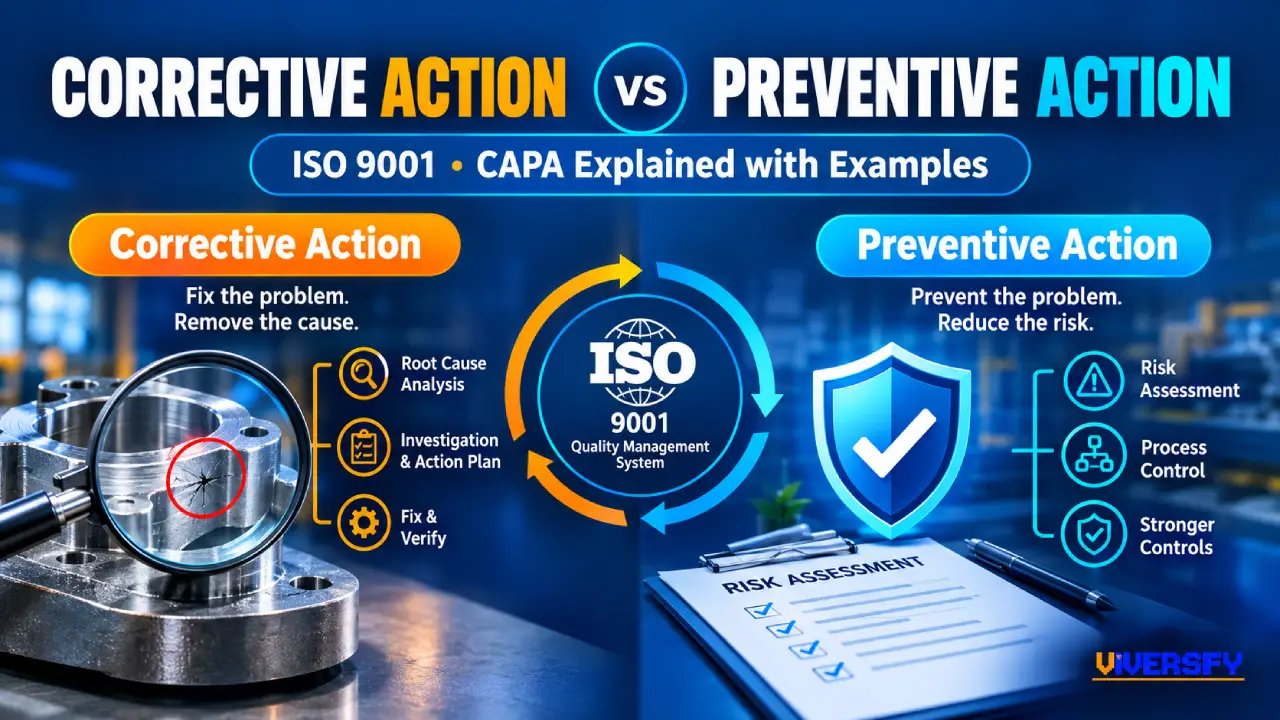
In any organization, product defects, customer complaints, audit findings, and process failures can affect quality, cost, and customer satisfaction.
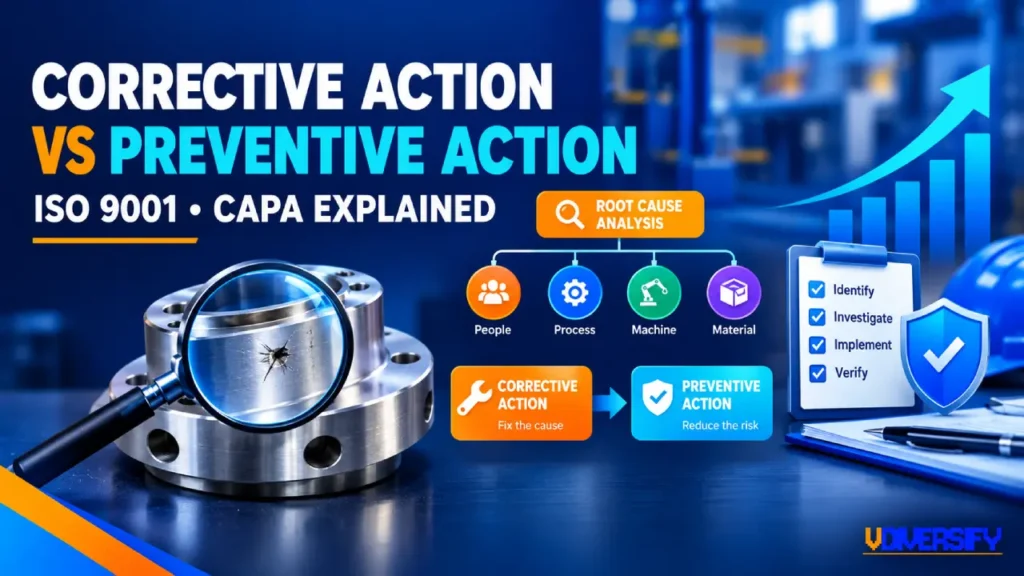
Understanding corrective action preventive action ISO 9001 CAPA examples helps quality professionals identify why problems occur, eliminate their causes, and reduce the risk of similar problems in the future.
Although corrective action and preventive action are closely related, they serve different purposes in a quality management system (QMS). Knowing when to apply each approach is essential for maintaining compliance, improving processes, and building customer confidence.
This guide explains the differences, ISO 9001 requirements, practical workplace examples, and the methods organizations can use to manage quality problems effectively.
Contents
- 1. What Is CAPA in ISO 9001?
- 2. What Is Corrective Action in ISO 9001?
- 3. What Is Preventive Action in a Quality Management System?
- 4. Correction vs Corrective Action vs Preventive Action
- 5. Corrective Action vs Preventive Action: Key Differences
- 6. Understanding ISO 9001 Clause 10.2: Nonconformity and Corrective Action
- 7. Why Preventive Action Is Still Important Under ISO 9001
- 8. How to Implement the CAPA Process in ISO 9001
- 9. Root Cause Analysis Methods Used in CAPA
- 10. Corrective Action Examples From Realistic Workplace Situations
- 11. 8D Corrective Action: A Structured Problem-Solving Method
- 12. How to Build an Effective CAPA System
- 13. Common CAPA Mistakes and How to Avoid Them
- 14. CAPA Form Template: A Practical Example for ISO 9001
- 15. CAPA Record — Sample
- 16. How to Write an Effective Corrective Action Procedure
- 17. How Auditors Evaluate CAPA During an ISO 9001 Audit
- 18. CAPA and Continual Improvement in ISO 9001
- 19. Practical CAPA Implementation Checklist
- 20. Conclusion: Make CAPA a Tool for Lasting Quality Improvement
- 21. FAQs
What Is CAPA in ISO 9001?
CAPA stands for Corrective Action and Preventive Action. It is a structured approach to identifying problems, investigating their causes, implementing suitable actions, and checking whether those actions work.
Organizations use CAPA to deal with issues such as defective products, repeated process failures, supplier problems, customer complaints, and internal audit findings. A well-managed CAPA system helps an organization move beyond fixing individual problems and focus on preventing them from happening again.
For example, imagine a US-based manufacturer discovers that 150 metal components have incorrect hole diameters. The immediate response may be to segregate the affected components and inspect the remaining inventory.
These steps address the current problem.
A proper corrective action investigation would then examine why the machining process produced incorrect dimensions and implement measures to eliminate the underlying cause.
If the investigation reveals that a worn cutting tool was not replaced according to the maintenance schedule, the organization might revise its tool-life controls, update maintenance instructions, and train operators. It would then verify whether subsequent production meets specifications consistently.
This is the practical purpose of CAPA: solve the current problem, remove its cause, and reduce the likelihood of recurrence.
Why CAPA Matters in a Quality Management System
CAPA is important because unresolved quality problems rarely remain isolated. A defect in one production batch can affect multiple customers, while an ineffective process can create recurring nonconformities, additional inspection costs, delivery delays, and warranty claims.
A strong CAPA process supports several business objectives:
- Improved product quality: Reduce recurring defects and process failures.
- Customer satisfaction: Address complaints and demonstrate that problems receive proper attention.
- Audit readiness: Maintain documented evidence of investigations and actions.
- Cost control: Reduce scrap, rework, returns, and unnecessary inspections.
- Risk reduction: Identify weaknesses before they lead to larger problems.
- Continual improvement: Use lessons from failures to improve the QMS.
CAPA is not simply a form that must be completed after an audit. It is a practical problem-solving process that connects quality data, root cause analysis, corrective measures, and effectiveness verification.
Organizations may use a dedicated CAPA procedure, an electronic quality management system, a spreadsheet-based register, or an integrated enterprise quality platform. The tool matters less than the quality of the investigation and the effectiveness of the actions taken.
What Is Corrective Action in ISO 9001?
Corrective action is action taken to eliminate the cause of a detected nonconformity or other undesirable situation to prevent it from happening again.
The key point is that corrective action addresses the cause of a problem, not merely its visible effect.
Under ISO 9001:2015, Clause 10.2 requires organizations to respond to nonconformities, evaluate the need for action to eliminate their causes, implement necessary action, and review whether that action was effective.
The organization must also update relevant risks and opportunities, where necessary, and make changes to the QMS if required.
How Corrective Action Works in Practice
Consider a company that manufactures industrial pumps for customers across the United States. During the final inspection, the quality inspector finds that several pumps fail a pressure test.
The company could repair or replace the affected pumps. However, doing so does not necessarily prevent the same failure from occurring in the next production batch.
A proper corrective action process would involve:
- Identify the nonconformity: Record the failed pressure test and affected products.
- Contain the problem: Segregate the failed units and determine whether other products are affected.
- Investigate the cause: Review assembly records, test equipment, component specifications, and operator practices.
- Determine the root cause: Establish the actual reason the pumps failed, using objective evidence.
- Implement corrective action: Correct the underlying process weakness.
- Verify effectiveness: Review subsequent test results to confirm that the failure does not recur.
- Update relevant documentation: Revise procedures, risk assessments, or work instructions where necessary.
Suppose the investigation finds that a sealing component was installed incorrectly because the assembly fixture allowed it to be positioned in two different ways. The company modifies the fixture so that the seal can only be installed in the correct orientation.
This is a stronger corrective action than simply reminding operators to be careful because it addresses the identified process weakness.
The goal of corrective action is to prevent recurrence by eliminating the verified cause of the problem.
What Is Preventive Action in a Quality Management System?
Preventive action means taking steps to address a potential cause of a problem before the problem occurs. The objective is to reduce the chance of future nonconformities by identifying weaknesses, assessing risks, and improving processes before they produce failures.
For example, a company manufactures electrical control panels. During a risk assessment, the quality team discovers that condensation could enter the panels during storage in humid conditions. No customer complaint has occurred, and no defective panels have been identified.
However, the risk is real.
The company could improve storage conditions, introduce humidity monitoring, revise packaging requirements, and establish suitable inspection controls. These actions help reduce the likelihood of a future quality problem.
Preventive thinking is especially useful when organizations introduce new products, change suppliers, install new equipment, modify production methods, or enter unfamiliar markets.
Practical Examples of Preventive Action
Preventive action can be applied in almost every department.
- Manufacturing: Add a mistake-proofing feature to prevent components from being assembled incorrectly.
- Supplier quality: Assess an alternative supplier before relying on a single source for a critical component.
- Document control: Configure an electronic system to prevent employees from accessing obsolete work instructions.
- Equipment maintenance: Replace a component based on its condition or service life before it fails and affects product quality.
- Customer service: Review recurring delivery delays and improve workload planning before they cause widespread customer complaints.
- Inspection and testing: Introduce automated alerts when measurement results approach specification limits.
These are examples of preventive action in practice, although the specific measures an organization needs depend on its processes, risks, and requirements.
A preventive measure should be proportionate to the risk. A possible failure with serious consequences may require formal analysis and documented controls, while a low-risk issue may be handled through routine process planning.
Preventive Action Under ISO 9001:2015
One important point often confuses quality professionals: ISO 9001:2015 does not contain a separate clause titled “Preventive Action.”
Earlier editions of ISO 9001 included a distinct preventive-action requirement. The 2015 edition moved this thinking into the broader approach of risk-based thinking, which considers risks and opportunities throughout the quality management system.
This means organizations should not wait for a failure before considering what could go wrong. They should identify relevant risks, determine appropriate controls, and evaluate whether those controls achieve their intended results.
For example, if a new production line is being installed, the quality team might assess risks associated with machine settings, operator competence, measurement systems, and material handling before production begins.
If the assessment identifies a risk that incorrect settings could cause defective parts, the organization could introduce validated setup instructions, access controls for critical parameters, and first-piece inspection.
This approach supports prevention without requiring every potential problem to be managed through a formal corrective action record.
Correction vs Corrective Action vs Preventive Action
These three terms are closely related, but they should not be used interchangeably. Understanding the difference is essential for effective nonconformity management ISO practices and for explaining quality records during an audit.
A correction deals with the problem that exists now. Corrective action addresses why an actual nonconformity happened. Preventive action addresses the causes of a potential problem before that problem occurs.
Consider a machining company that discovers a batch of shafts with diameters above the specified limit.
- Correction: Rework the shafts where permitted, or reject and replace them.
- Corrective action: Investigate why the machine repeatedly produced oversized shafts and eliminate the verified cause.
- Preventive action: Apply lessons from the investigation to similar machines or processes where the same failure could occur.
How the three approaches differ
Correction — Fix what is wrong
Example: Rework a shaft that exceeds the permitted diameter.
Focus: The existing nonconforming output.
Corrective action — Remove the cause
Example: Correct a verified machine-control problem responsible for repeated oversized shafts.
Focus: Preventing recurrence.
Preventive action — Address a potential failure
Example: Review similar machines and introduce suitable controls before the same defect occurs elsewhere.
Focus: Reducing future risk.
The three activities may form part of the same improvement effort. For instance, an organization can correct defective parts, implement corrective action on the affected machine, and extend suitable controls to other machines that share the same risk.
However, completing a correction alone does not demonstrate that the cause has been eliminated.
Corrective Action vs Preventive Action: Key Differences
The following comparison explains how the two approaches differ in purpose, timing, investigation, and application.
Comparison point | Corrective action | Preventive action |
Primary purpose | Eliminate the cause of an existing nonconformity | Address the causes of a potential nonconformity |
Timing | After a problem has been detected | Before the potential problem occurs |
Starting point | Actual defect, complaint, or audit finding | Identified risk, weakness, or possible failure |
Investigation | Determine why the observed problem occurred | Assess how and why a possible problem could occur |
Typical tools | 5 Whys, fishbone diagram, 8D analysis | Risk assessment, FMEA, process review, mistake-proofing |
Example | Correct the verified cause of repeated assembly failures | Introduce controls to prevent a similar failure on a new assembly line |
Effectiveness check | Confirm the original problem does not recur | Confirm the risk controls are implemented and effective |
ISO 9001:2015 context | Explicitly addressed by Clause 10.2 | Integrated into risk-based thinking across the QMS |
The effectiveness of either approach depends on evidence, not merely on the action being completed. Updating a procedure, buying new equipment, or conducting training does not automatically prove that a quality problem has been solved.
For example, if a company trains operators after repeated labeling errors, it should also establish whether training addresses the actual cause. If the real issue is an unclear label-selection screen, improving the interface may be more effective than providing additional training alone.
The American Society for Quality (ASQ) provides further guidance on corrective and preventive action, including root cause analysis, containment, action planning, and verification.
Understanding ISO 9001 Clause 10.2: Nonconformity and Corrective Action
ISO 9001:2015 Clause 10.2 is one of the most important requirements for managing quality failures and preventing their recurrence. It requires organizations to react to nonconformities, control and correct them as appropriate, deal with their consequences, and evaluate whether action is needed to eliminate their causes.
The clause also requires organizations to review the effectiveness of corrective action, update risks and opportunities where necessary, and make changes to the quality management system if required.
They must retain documented information as evidence of the nature of the nonconformities, subsequent actions taken, and the results of corrective action.
What Does Clause 10.2 Require?
In practical terms, organizations should establish a reliable process that covers the following activities.
- React to the nonconformity: Take appropriate action to control and correct the problem.
- Manage the consequences: Consider affected products, customers, deliveries, and other relevant impacts.
- Investigate the cause: Determine whether action is needed to eliminate the cause and prevent recurrence.
- Check for similar problems: Determine whether the same nonconformity exists elsewhere or could occur in other processes.
- Implement the required action: Assign responsibilities, resources, and completion dates.
- Review effectiveness: Confirm that the action achieved its intended result.
- Update the QMS where necessary: Revise relevant risks, procedures, controls, or other system elements.
- Maintain documented information: Retain appropriate records of the problem, actions, and results.
These activities provide the foundation of a practical corrective action procedure.
ISO 9001 does not require every minor issue to trigger a lengthy investigation.
The organization should evaluate the nature and effects of the nonconformity and determine the level of action needed. A repeated defect with a significant customer impact may need a formal investigation, while a straightforward isolated issue may be handled through a simpler process, provided the applicable requirements are met.
Example of Clause 10.2 in a US Manufacturing Company
Suppose an automotive component supplier in Michigan receives a customer complaint about incorrectly machined mounting holes.
The quality team initially isolates the affected batch and checks inventory awaiting shipment. It then reviews inspection results, machine settings, operator records, and similar production runs to establish the scope of the issue.
The investigation reveals that a recent machine setup change was not independently verified, allowing incorrect coordinates to be used during production.
The company introduces a setup-verification control and updates the relevant work instructions. It also evaluates other machines using the same setup process and reviews subsequent inspection data to determine whether the action is effective.
The company retains records of the complaint, containment activities, investigation, approved actions, and effectiveness review.
This example illustrates how Clause 10.2 connects immediate problem handling with longer-term process improvement.
Important: ISO 9001:2015 requires the organization to determine the appropriate action based on the nonconformity. The particular tools, forms, and approval steps used to meet that requirement can vary according to the organization’s needs.
For the official source, see the ISO 9001 quality management systems overview.
Why Preventive Action Is Still Important Under ISO 9001
Although ISO 9001:2015 does not have a separate preventive-action clause, organizations still need to think ahead and address relevant risks.
This is where preventive action QMS practices become valuable. Instead of waiting for a failure, a quality team considers what could go wrong, how serious the consequences might be, and what controls would reduce the risk.
For example, a company introducing a new packaging process may identify a risk that vibration during transportation could damage its products. Before the first shipment, it can evaluate packaging materials, conduct suitable tests, and improve the packaging design.
These steps reflect preventive thinking because they address a possible failure before a nonconformity occurs.
ISO explains that risk-based thinking is part of its broader process-based approach to managing quality and achieving intended results. See the ISO explanation of the 2015 revision.
Where Preventive Thinking Fits Into the QMS
Organizations can build preventive practices into everyday operations through:
- Clause 6.1: Addressing risks and opportunities.
- Clause 8.1: Planning and controlling operations.
- Clause 8.4: Controlling externally provided processes, products, and services.
- Clause 9.1: Monitoring, measurement, analysis, and evaluation.
- Clause 9.3: Management review.
- Clause 10.3: Continual improvement.
These clauses support a proactive quality management approach, although each has its own specific requirements. Preventive thinking should not be treated as a substitute for meeting those requirements.
For a quality manager, the practical lesson is straightforward: use the results of audits, customer feedback, process data, supplier performance, and risk assessments to identify opportunities to improve before failures occur.
Key Takeaways So For
- Correction fixes the immediate problem.
- Corrective action eliminates the cause of an existing nonconformity.
- Preventive action addresses potential failures before they occur.
- ISO 9001:2015 Clause 10.2 establishes the requirements for nonconformity and corrective action.
- Preventive thinking is integrated into risk-based thinking rather than addressed through a separate preventive-action clause.
- Effective action must be supported by evidence and appropriate effectiveness checks.
- CAPA should improve the way work is performed, not simply increase the number of forms completed.
How to Implement the CAPA Process in ISO 9001
A well-designed CAPA process helps an organization manage nonconformities in a consistent and effective way. It provides a clear path from identifying a problem to investigating its cause, implementing improvements, and confirming that the problem has been resolved.
The CAPA process ISO 9001 organizations use should be appropriate to their operations, the seriousness of the issue, and the risks involved.
A small office may need a simple corrective action register, while a large manufacturing facility may require a formal investigation, cross-functional review, customer notification, and documented approval.
The objective is the same in both cases: address the problem, determine whether action is necessary to eliminate its cause, and verify the result.
Step 1: Identify and Record the Nonconformity
The first step is to identify the problem and record enough information for someone else to understand what happened.
A nonconformity occurs when a requirement is not fulfilled. The requirement might come from a customer specification, an approved drawing, an internal procedure, a regulatory obligation, or the organization’s own quality management system.
Common sources include:
- Internal and external audits.
- Customer complaints and returns.
- Incoming material inspections.
- In-process and final inspections.
- Equipment breakdowns affecting product quality.
- Supplier performance issues.
- Missed delivery or service requirements.
- Process monitoring and performance data.
Example: A manufacturer discovers that 18 out of 300 machined components have a hole diameter outside the approved tolerance.
The initial record should identify the product, batch number, applicable specification, actual measurement results, date of discovery, and inspection method. Photographs, measurement reports, and related production records may also be useful.
Avoid vague descriptions such as “operator error” or “quality problem.” These statements do not explain what requirement was violated or what evidence supports the finding.
Step 2: Contain the Problem and Correct the Immediate Issue
Before investigating the root cause, the organization may need to prevent the problem from spreading.
Containment actions protect customers and limit the impact while the investigation continues. Depending on the situation, these actions may include:
- Segregating nonconforming products.
- Suspending shipment of affected batches.
- Inspecting work in progress and finished goods.
- Notifying relevant departments or customers.
- Arranging authorized repair, rework, replacement, or other disposition.
- Checking whether products already delivered are affected.
For example, if a company discovers incorrect labels on a shipment of medical equipment, it should determine whether the affected products can be identified and whether any have already reached customers. Correcting labels in stock does not address the risk posed by products already shipped.
Under ISO 9001, the organization must respond appropriately to the nonconformity and deal with its consequences. The exact response depends on the nature and impact of the problem.
Remember: Containment is not the same as corrective action. Containment controls the immediate situation; corrective action addresses the cause.
Step 3: Assess the Severity and Need for Corrective Action
Not every issue requires the same depth of investigation. The organization should evaluate the nonconformity and determine whether action is needed to eliminate its cause.
Consider the following factors:
- Customer impact: Could the issue affect product function, safety, or satisfaction?
- Frequency: Has the same problem occurred before?
- Extent: Are other batches, machines, suppliers, or departments affected?
- Cost: Could the issue cause significant scrap, rework, returns, or delays?
- Compliance: Does the issue affect contractual or applicable regulatory requirements?
- Risk: Could the problem create a serious consequence if it happens again?
A repeated defect affecting several customers generally deserves more attention than a minor, isolated issue with no continuing impact. However, an apparently isolated failure may still need formal action when its potential consequences are significant.
A risk-based assessment helps organizations prioritize resources without overlooking important problems.
Step 4: Investigate the Root Cause
The next step is to determine why the problem occurred.
Root cause analysis CAPA should be based on objective evidence rather than assumptions. Investigators may review process records, inspect equipment, interview personnel, examine materials, compare successful and unsuccessful production runs, and test possible explanations.
Suppose an assembly line repeatedly produces loose fasteners. An initial conclusion might be that operators are not tightening the fasteners properly. Further investigation could reveal that the torque tool is incorrectly calibrated or that its settings are being reset between shifts.
The investigation should establish which cause or combination of causes explains the failure.
Useful methods include:
- The 5 Whys technique for tracing cause-and-effect relationships.
- A fishbone diagram for organizing possible causes.
- Failure Mode and Effects Analysis (FMEA) for assessing potential failure modes.
- Process mapping for identifying weaknesses in a workflow.
- Statistical analysis for investigating patterns in process data.
These tools are discussed in greater detail below.
Step 5: Develop and Approve the Corrective Action Plan
Once the cause has been established, the organization should decide what changes are necessary to address it.
The action should be linked directly to the verified cause. Depending on the issue, this may involve redesigning equipment, changing a process, improving a control, revising a procedure, modifying supplier requirements, or improving measurement methods.
A useful corrective action plan identifies:
- The root cause being addressed.
- The action to be taken.
- The person responsible.
- The resources required.
- The target completion date.
- The evidence needed to confirm completion.
- The method for checking effectiveness.
For example, if an assembly fixture allows a component to be installed incorrectly, the company might redesign the fixture so that incorrect installation is physically prevented. It should then verify the revised fixture under actual operating conditions.
Training can support the solution when a competence gap is established, but training should not be used automatically as the answer to every problem.
Step 6: Implement the Action and Retain Evidence
The responsible personnel should complete the approved actions and retain evidence of what was done.
Examples of evidence include:
- Revised and approved work instructions.
- Equipment modification records.
- Calibration or validation results.
- Training and competency assessments.
- Updated supplier requirements.
- Inspection and test reports.
- Updated risk assessments.
- Photographs or system records showing implemented changes.
The CAPA owner should check that actions are completed as planned and that any required document approvals or process validations have taken place.
A closed action record should demonstrate more than a completed task. It should also show whether the organization has established a suitable basis for determining effectiveness.
Step 7: Verify Effectiveness
Effectiveness verification determines whether the action achieved its intended result.
Suppose the company changes its machine setup procedure to prevent dimensional defects. It might review subsequent production batches, compare defect rates, and check whether the new verification control is consistently followed.
The verification criteria should be established before the effectiveness review whenever practical.
Possible measures include:
- No recurrence of the identified defect over a defined production period.
- Consistent compliance with the applicable specification.
- Reduced scrap or rework.
- Successful completion of a follow-up audit.
- Evidence that the revised control is used consistently.
- Improved supplier performance over an appropriate period.
The observation period should suit the process. A few successful units may not be enough to establish effectiveness for a high-volume operation or an intermittent failure.
If the problem recurs, the organization should reconsider the investigation, check whether the original cause was correct, and determine whether the action was fully implemented or sufficiently strong.
Step 8: Update the QMS and Share Lessons Learned
The final step is to determine whether the findings have implications beyond the original problem.
A corrective action may reveal that similar weaknesses exist in other machines, departments, products, or supplier relationships. ISO 9001 Clause 10.2 specifically requires the organization to consider whether similar nonconformities exist or could potentially occur.
For example, if one facility discovers that an obsolete inspection method caused incorrect acceptance decisions, other facilities using the same method should be assessed.
Where appropriate, update procedures, risk assessments, control plans, training materials, and audit plans. Communicate lessons learned to the relevant teams so that improvements are not limited to the original location.
The result should be a stronger quality management system, not just a closed CAPA record.
Root Cause Analysis Methods Used in CAPA
Root cause analysis is one of the most important parts of a corrective action system. If the investigation identifies the wrong cause, even a well-organized action plan may fail to prevent recurrence.
A common mistake is to stop investigating as soon as a possible explanation appears. For example, saying “the operator made a mistake” may describe what happened, but it does not explain why the process allowed the mistake to occur or why existing controls did not detect it.
The following methods help quality teams investigate problems systematically.
1. The 5 Whys Method
The 5 Whys method involves asking why a problem occurred and continuing to investigate the answers until the underlying cause or causes are supported by evidence. Five is a guide, not a fixed number. Some problems require fewer questions, while complex failures may require several additional lines of investigation.
Consider a packaging company that discovers damaged products during delivery.
Example: Damaged products during transportation
Problem: Products arrive at the customer with damaged corners.
Why 1? The products moved inside the shipping cartons during transportation.
Why 2? The protective inserts did not hold the products firmly in place.
Why 3? The insert design was not suitable for the product’s dimensions.
Why 4? The packaging approval process did not include an adequate transport simulation.
Possible underlying cause: The packaging approval process lacked a suitable requirement for verifying protection during transportation.
The organization should confirm this explanation by reviewing packaging specifications, approval records, and appropriate test results. The chain of questions alone does not prove the cause.
Potential corrective actions:
- Revise packaging approval requirements.
- Validate the redesigned inserts using suitable transport tests.
- Update packaging specifications for similar products.
- Review other products that use the same insert design.
The 5 Whys method is especially useful for straightforward problems. For complex issues, it should be combined with additional evidence and analysis rather than used as the only investigation tool.
2. Fishbone Diagram (Ishikawa Diagram)
A fishbone diagram helps investigators organize possible causes into categories. It is particularly useful when a problem may involve several factors rather than one clear cause.
In manufacturing, common categories include:
- People: Competence, communication, fatigue, or unclear responsibilities.
- Machines: Equipment condition, settings, wear, or calibration.
- Methods: Work instructions, process sequence, and inspection procedures.
- Materials: Supplier variation, incorrect components, or damaged stock.
- Measurement: Instrument accuracy, measurement methods, or sampling plans.
- Environment: Temperature, humidity, cleanliness, or lighting.
These categories are sometimes adapted to suit the process being investigated.
Illustrative fishbone analysis
Problem: Repeated dimensional defects in machined components.
People: Insufficient setup competence; unclear handover
Machines: Tool wear; unstable machine settings
Methods and measurement: Weak setup verification; unsuitable inspection frequency
Observed problem: Components exceed the specified dimensional tolerance.
Illustrative categories and possible causes only. The investigation must establish which factors actually contributed to the defect.
The team should list possible causes, collect evidence, and test the most plausible explanations. A fishbone diagram organizes the investigation; it does not independently establish the root cause.
For example, the team might find that machine settings are stable and the measuring equipment is suitable, but that the cutting tool is replaced too late. This evidence would support action on tool-life control rather than unrelated changes to operator training.
3. Failure Mode and Effects Analysis (FMEA)
Failure Mode and Effects Analysis is a structured method for identifying potential failures, evaluating their effects, and prioritizing actions to reduce risk.
FMEA is especially useful for preventive thinking because it can be applied before a new product, process, or piece of equipment enters service. It can also help investigate existing problems by identifying other failure modes that may share the same weaknesses.
For example, a manufacturer developing a new assembly line might identify incorrect fastener torque as a possible failure mode. The team would evaluate the possible effects, causes, and existing controls, then decide whether additional controls are needed.
Potential actions might include:
- Using torque tools with suitable control features.
- Introducing verification for critical assembly settings.
- Designing fixtures that prevent incorrect positioning.
- Establishing appropriate maintenance and calibration controls.
- Reviewing inspection methods and acceptance criteria.
FMEA scoring systems vary. Some use severity, occurrence, and detection ratings, while others use different risk evaluation approaches. A numerical score should support informed decisions rather than replace professional judgment.
FMEA is not explicitly mandated by ISO 9001 for every organization. It is one of several possible tools for managing risks and investigating potential failures.
4. Pareto Analysis
Pareto analysis helps identify which categories contribute most to a problem. It commonly uses a bar chart to rank defect types, complaints, or failure causes by frequency or impact.
Imagine a company records 200 product defects during a month:
Defect category | Number of defects |
Incorrect dimensions | 90 |
Surface damage | 50 |
Labeling errors | 30 |
Missing components | 20 |
Other defects | 10 |
Total | 200 |
In this illustrative example, dimensional defects account for 45% of recorded defects. Addressing them may offer a useful improvement opportunity, provided the team also considers severity and customer risk.
Pareto analysis helps prioritize investigation. It does not establish why the most frequent defect occurs, so root cause analysis is still necessary.
Corrective Action Examples From Realistic Workplace Situations
The following examples show how CAPA can be applied in different industries. They are illustrative scenarios, not claims about specific companies.
Example 1: Manufacturing — Repeated Dimensional Defects
Problem: A US-based machining company finds that components repeatedly exceed the permitted diameter during final inspection.
Immediate correction and containment:
- Segregate the affected batch.
- Inspect related work in progress and finished inventory.
- Determine whether any nonconforming products have already been shipped.
- Rework or reject products according to approved requirements.
Root cause investigation: The team reviews machine records, tool-change history, inspection data, and operator setup records. Evidence shows that cutting tools are being used beyond their suitable service life because the tool-replacement schedule is based on an outdated production estimate.
Corrective action:
- Establish a suitable tool-life control based on verified process data.
- Introduce a clear replacement and verification method.
- Update work instructions and maintenance records.
- Review other machines using the same tool-management approach.
Effectiveness verification: Review subsequent production results and confirm that the dimensional defects do not recur under the revised controls.
Lesson learned: Reworking defective components corrects the immediate issue. Improving tool-life control addresses the cause supported by the investigation.
Example 2: Customer Complaints — Incorrect Product Labels
Problem: A customer reports receiving products with labels that show the wrong part number.
Immediate action: The company checks affected inventory, prevents further shipment of suspect products, and assesses whether delivered products require customer notification or other action.
Investigation: The team discovers that the label-printing system allows employees to select product codes from a long list without an independent verification step. Records indicate that similar selection errors have occurred previously.
Corrective action:
- Improve the label-selection process.
- Introduce an appropriate barcode or part-number verification control.
- Revise the labeling procedure.
- Validate the revised process and train affected employees where needed.
Effectiveness verification: Review labeling errors over a defined number of production runs and check that the new verification control is consistently applied.
Preventive extension: Assess other packaging and labeling processes that use similar software or manual selection steps.
Lesson learned: Repeated labeling errors may indicate a weakness in process design, not simply an individual employee’s mistake.
Example 3: Supplier Quality — Defective Incoming Materials
Problem: An industrial equipment manufacturer receives several shipments of metal components that fail the specified hardness requirement.
Immediate action: The quality team places the affected materials on hold, checks the extent of the problem, and determines whether previously accepted materials from the supplier may also be affected.
Investigation: Material test reports, supplier production records, and inspection results are reviewed. The evidence indicates that a heat-treatment process was not consistently controlled within the required operating range.
Corrective action:
- Require the supplier to investigate and address the process weakness.
- Agree on appropriate process controls and objective evidence of implementation.
- Verify incoming material against the applicable acceptance criteria.
- Review the supplier’s performance after the changes.
Preventive extension: Evaluate whether other suppliers or components depend on a similar process and whether additional risk controls are justified.
Effectiveness verification: Review material acceptance results and supplier records over an appropriate period.
Lesson learned: Supplier corrective action should be based on evidence and followed by verification. Simply asking a supplier to “be more careful” is not a reliable solution.
8D Corrective Action: A Structured Problem-Solving Method
The 8D corrective action method is a team-based approach commonly used in manufacturing, automotive supply chains, and other industries where recurring quality problems need a structured investigation.
The name refers to eight disciplines used to organize the investigation and resolution of a problem. Some organizations also include an initial planning step known as D0.
8D is useful when a problem has a significant customer impact, repeats despite previous actions, involves several departments, or requires a formal supplier response. It is not necessary for every minor nonconformity.
The Eight Disciplines of 8D
Discipline | What the team does | Practical example |
D1 — Establish the team | Select people with the right knowledge and authority | Include quality, production, engineering, and maintenance |
D2 — Describe the problem | Define the issue using measurable facts | Record the defect type, quantity, location, and affected batches |
D3 — Contain the problem | Protect customers while investigating | Hold affected inventory and inspect related stock |
D4 — Identify root causes | Establish the actual cause and escape point | Find why the machine produced defects and why inspection missed them |
D5 — Select permanent corrective actions | Choose actions that address verified causes | Improve the machine control and introduce a suitable verification step |
D6 — Implement and validate | Put actions in place and confirm they work as intended | Run production trials and review measurement results |
D7 — Prevent recurrence | Update relevant systems and apply lessons elsewhere | Revise procedures and assess similar production lines |
D8 — Recognize the team and close | Document results and formally complete the investigation | Approve the final report and share lessons learned |
The exact documentation and approval requirements depend on the organization’s procedure or customer-specific requirements.
Example: 8D for Repeated Assembly Failures
Suppose an equipment manufacturer receives repeated complaints about loose fasteners on delivered products.
The team initially secures affected inventory and checks whether customers need to be notified. It then investigates assembly records, torque-tool settings, maintenance history, and inspection methods.
The evidence shows that the tool can lose its programmed setting during changeover, and the existing process does not verify the setting before production restarts.
The team introduces a controlled setup procedure, a setting-verification step, and appropriate checks on similar equipment. It then reviews production results and verifies that the new controls are effective.
The final report documents the problem, evidence, actions, and results.
The important point is that 8D is a method for organizing problem-solving, not a substitute for sound root cause analysis. A completed 8D report is not evidence of effectiveness unless the results support that conclusion.
How to Build an Effective CAPA System
An organization needs more than a good investigation method. It also needs clear responsibilities, consistent records, appropriate deadlines, and a way to learn from completed actions.
A practical CAPA system should define the following:
- Ownership: Who raises, investigates, approves, and closes actions?
- Priority: Which issues require immediate escalation?
- Investigation requirements: When are root cause analysis and cross-functional teams needed?
- Action planning: How are responsibilities and due dates assigned?
- Evidence: What records demonstrate that actions were implemented?
- Effectiveness: How and when will the organization evaluate results?
- Escalation: What happens when actions are overdue or ineffective?
- System improvement: How are lessons communicated and similar risks assessed?
A quality manager should also monitor the CAPA register to identify recurring causes, overdue actions, ineffective solutions, and departments that may need additional support.
CAPA should be integrated with the organization’s existing nonconformity management process rather than operating as an isolated administrative system.
Useful CAPA Performance Indicators
Organizations can use performance indicators to understand whether their system is improving. Useful measures include:
KPI | What it helps measure |
Overdue CAPAs | Whether actions are completed within planned timeframes |
Recurrence rate | Whether previously identified problems return |
Average closure time | How long investigations and actions take |
Effectiveness failure rate | How often completed actions fail verification |
Repeat audit findings | Whether previously identified system weaknesses remain |
Scrap and rework trends | Whether process quality is improving |
These measures should be interpreted together. A low average closure time, for example, is not necessarily a sign of success if investigations are rushed and the same problems continue to occur.
There is no single CAPA KPI target that suits every organization. Targets should reflect process risks, customer requirements, operational complexity, and historical performance.
Common CAPA Mistakes and How to Avoid Them
Even organizations with established quality systems can struggle to make corrective actions effective.
- Treating correction as corrective action. Replacing a defective product does not automatically eliminate the cause of the defect. Record the immediate correction separately from the actions intended to prevent recurrence.
- Blaming employees without investigating the process. Human error may contribute to a failure, but investigators should also examine instructions, equipment design, workload, training, and controls.
- Implementing actions without checking effectiveness. Closing a task because a procedure was revised is not enough. Verify that the change achieved the intended result.
- Applying the same solution to every problem. Training, additional inspections, and revised procedures can be useful, but they should address the actual cause.
- Ignoring similar processes. An issue affecting one production line may also exist on another line using the same equipment, materials, or work instructions.
- Setting unrealistic deadlines. Investigations and process changes need sufficient time and resources. Overdue actions should be escalated rather than closed prematurely.
- Collecting too much paperwork without useful analysis. Records should support decisions, demonstrate implementation, and establish effectiveness. Documentation should serve the process rather than become the entire process.
The strongest CAPA systems combine disciplined investigation with practical actions and objective verification.
An effective CAPA process starts by identifying and containing the nonconformity, then investigates its cause, implements appropriate actions, and verifies effectiveness. Tools such as 5 Whys, fishbone diagrams, FMEA, Pareto analysis, and 8D help teams choose a suitable method for the problem.
CAPA Form Template: A Practical Example for ISO 9001
A CAPA form template helps organizations record nonconformities, document investigations, assign actions, and demonstrate that the actions taken have been reviewed for effectiveness.
ISO 9001:2015 does not prescribe one mandatory CAPA form or require every organization to use a specific software system. The organization can choose a paper form, spreadsheet, electronic workflow, or integrated quality management software, provided its approach meets applicable requirements.
A useful form should capture enough information to demonstrate what happened, how the organization responded, what caused the problem, what action was taken, and what the results showed.
Recommended CAPA Form Fields
The following template can be adapted for manufacturing, engineering, service companies, supplier quality, and internal audits.
Section | Information to record |
CAPA identification | CAPA number, date raised, department, and responsible owner |
Problem description | Clear description of the nonconformity and requirement not fulfilled |
Source | Customer complaint, internal audit, supplier issue, inspection, or other source |
Evidence | Measurements, photographs, reports, records, and relevant specifications |
Immediate correction | Steps taken to correct the existing problem |
Containment | Actions taken to control affected products or processes |
Impact assessment | Affected batches, customers, processes, and potential consequences |
Root cause analysis | Investigation method, findings, and supporting evidence |
Similar-risk assessment | Whether the issue exists or could occur elsewhere |
Corrective action plan | Specific actions, owners, resources, and target dates |
Implementation evidence | Approved documents, test results, records, or other evidence |
Effectiveness review | Verification method, results, reviewer, and review date |
Closure | Approval, closure date, and any follow-up requirements |
A CAPA form should make the distinction between correction and corrective action clear. Combining them into one vague field can make it difficult to determine whether the organization has addressed the underlying cause.
Sample Completed CAPA Record
Consider a fictional US-based manufacturer that discovers repeated dimensional defects in machined components.
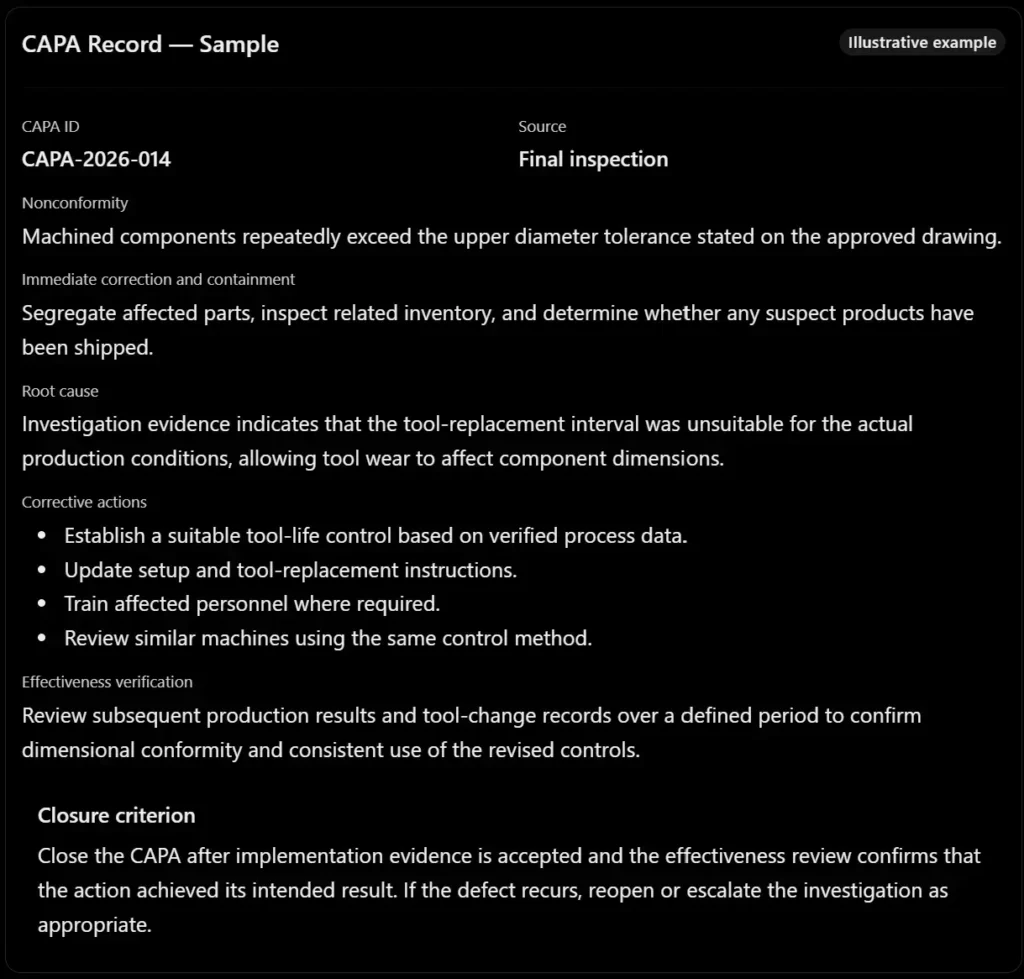
CAPA Record — Sample
(Illustrative example)
CAPA ID: CAPA-2026-014
Source: Final inspection
Nonconformity: Machined components repeatedly exceed the upper diameter tolerance stated on the approved drawing.
Immediate correction and containment: Segregate affected parts, inspect related inventory, and determine whether any suspect products have been shipped.
Root cause: Investigation evidence indicates that the tool-replacement interval was unsuitable for the actual production conditions, allowing tool wear to affect component dimensions.
Corrective actions:
- Establish a suitable tool-life control based on verified process data.
- Update setup and tool-replacement instructions.
- Train affected personnel where required.
- Review similar machines using the same control method.
Effectiveness verification:
Review subsequent production results and tool-change records over a defined period to confirm dimensional conformity and consistent use of the revised controls.
Closure criterion:
Close the CAPA after implementation evidence is accepted and the effectiveness review confirms that the action achieved its intended result. If the defect recurs, reopen or escalate the investigation as appropriate.
This example shows the information a CAPA record should contain. The actual root cause, action plan, and effectiveness criteria must be based on the evidence from the organization’s own investigation.
How to Write an Effective Corrective Action Procedure
A corrective action procedure explains how an organization identifies, investigates, resolves, and reviews nonconformities. It helps employees follow a consistent process and ensures that significant issues receive suitable attention.
The procedure should be practical, clear, and appropriate to the organization’s size and complexity.
Recommended Procedure Structure
- Purpose and scope
Explain why the procedure exists and which departments, processes, products, services, and suppliers it covers.
- Responsibilities
Define who can raise a CAPA, who investigates the problem, who approves the action plan, who verifies effectiveness, and who authorizes closure.
- Identification and reporting
Describe how nonconformities are reported and what information must be recorded.
- Containment and correction
Explain how affected products, services, and processes are controlled while the investigation is underway.
- Investigation and root cause analysis
Describe how investigators select appropriate methods, gather evidence, determine causes, and evaluate similar risks.
- Action planning and implementation
Require actions to have clear owners, suitable deadlines, appropriate resources, and objective evidence of completion.
- Effectiveness verification
Define how the organization evaluates whether an action has achieved its intended outcome and what happens when the action is ineffective.
- Documentation and closure
Explain how records are retained, reviewed, approved, and closed in accordance with applicable document-control and retention requirements.
- Monitoring and improvement
Describe how the organization reviews CAPA trends, overdue actions, repeated failures, and opportunities to improve the QMS.
Example of CAPA Responsibilities
Role | Main responsibility |
Employee or inspector | Identify and report the issue |
Department supervisor | Contain the problem and support the investigation |
CAPA owner | Coordinate the investigation and complete assigned actions |
Quality manager | Oversee the process and ensure suitable review |
Technical specialist | Provide evidence and technical expertise |
Effectiveness reviewer | Evaluate results against defined criteria |
Management | Provide resources and address significant or recurring issues |
One person may perform multiple roles in a small organization. For important issues, however, an independent effectiveness review can improve confidence in the outcome.
The procedure should also explain how overdue actions, ineffective solutions, and serious customer-impacting issues are escalated.
How Auditors Evaluate CAPA During an ISO 9001 Audit
During an ISO 9001 audit, auditors may examine how an organization handles nonconformities, investigates causes, implements corrective action, and verifies effectiveness. They are interested in whether the process works in practice, not just whether a procedure exists.
Clause 10.2 is particularly relevant when reviewing corrective action records. Auditors may sample previous audit findings, customer complaints, inspection failures, and supplier issues to determine whether the organization’s response is suitable.
CAPA Audit Questions and Expected Evidence
Audit question | Examples of evidence |
How are nonconformities identified and recorded? | Nonconformity reports, complaint records, inspection results |
How does the organization control affected products? | Quarantine records, disposition approvals, traceability records |
How was the root cause determined? | Investigation reports, 5 Whys, fishbone diagrams, process data |
How does the organization assess similar risks? | Records showing evaluation of other products, machines, or processes |
Were corrective actions implemented? | Revised procedures, equipment changes, training records, test results |
How is effectiveness verified? | Follow-up inspections, performance data, repeat-defect analysis |
Are risks and QMS documents updated where necessary? | Updated risk assessments, work instructions, control plans |
Are records retained? | Completed CAPA records and supporting evidence |
Common CAPA Audit Findings
An organization may receive a nonconformity when its process fails to meet an applicable ISO 9001 requirement. Common weaknesses include:
- Correcting the defect without evaluating its cause.
- Recording an unsupported root cause such as “operator error.”
- Failing to assess whether the same issue exists elsewhere.
- Closing corrective actions without reviewing their effectiveness.
- Failing to retain required documented information.
- Repeating the same corrective action without investigating why previous actions failed.
The precise audit outcome depends on the evidence, the applicable requirements, and the extent of the failure.
For example, an organization may show that it revised a work instruction after a recurring defect. If the same defect continues to occur and no effectiveness review was performed, the auditor may question whether the corrective action process is adequate.
Audit tip: Be prepared to explain the complete chain from the original nonconformity to the root cause, action taken, and evidence of effectiveness.
CAPA and Continual Improvement in ISO 9001
CAPA is closely linked to continual improvement ISO 9001 because the information gained from individual problems can reveal opportunities to improve the wider quality management system.
Continual improvement does not mean opening a corrective action for every minor variation. It means using evidence, performance trends, customer feedback, and risk assessments to identify where changes can improve the suitability, adequacy, and effectiveness of the QMS.
For example, a manufacturer may discover through its CAPA records that several different products have experienced defects linked to inconsistent machine setup. Although the products differ, the findings may point to a common weakness in setup verification.
Instead of treating each defect as an unrelated event, the organization can review its setup standards across multiple production lines. It may introduce common verification requirements, update relevant risk assessments, and include the revised controls in future internal audits.
That is how a local problem can lead to a broader improvement.
Using CAPA Data to Make Better Decisions
Quality managers should periodically analyze CAPA data to identify trends and recurring weaknesses.
Useful questions include:
- Which nonconformities occur most frequently?
- Which issues have the greatest impact on customers?
- Which root causes appear across multiple departments?
- How often do previously closed actions prove ineffective?
- Are certain suppliers or processes contributing disproportionately to defects?
- Are corrective actions reducing scrap, rework, complaints, or repeat findings?
- Do management reviews identify the resources needed to address recurring issues?
CAPA information can also support management review, internal audit planning, supplier evaluation, and risk-based improvement projects.
The American Society for Quality provides additional resources on root cause analysis and corrective and preventive action training. These resources can help quality professionals strengthen their investigation and problem-solving skills.
Practical CAPA Implementation Checklist
Use this checklist to assess whether your organization’s process covers the main activities expected under ISO 9001:2015 Clause 10.2.
CAPA readiness review
- Record the nonconformity and the requirement that was not met.
- Control and correct the immediate problem where appropriate.
- Assess the consequences and determine the extent of affected products or processes.
- Evaluate the need for corrective action based on the problem and its effects.
- Investigate and document the cause using objective evidence.
- Determine whether similar nonconformities exist or could occur elsewhere.
- Define corrective actions, responsibilities, resources, and due dates.
- Implement the approved actions and retain supporting evidence.
- Review effectiveness and take further action if the solution is unsuccessful.
- Update relevant risks, procedures, and QMS processes where necessary.
- Retain documented information about the nonconformity, actions, and results.
- Analyze CAPA trends and use lessons learned to improve the QMS.
This is a practical self-assessment tool, not an official ISO checklist or a substitute for evaluating applicable requirements.
Conclusion: Make CAPA a Tool for Lasting Quality Improvement
Corrective action and preventive thinking are essential parts of an effective quality management system. Corrective action addresses the cause of an existing nonconformity, while preventive thinking helps organizations identify and manage potential problems before they occur.
Under ISO 9001:2015, Clause 10.2 provides the requirements for nonconformity and corrective action, while risk-based thinking supports proactive improvement across the QMS.
The most effective CAPA systems go beyond completing forms and closing records. They use objective evidence to investigate problems, select actions that address verified causes, check whether those actions work, and apply lessons to similar processes where necessary.
For quality managers, engineers, internal auditors, and business leaders, the practical goal is clear: fix the problem, address its cause, verify the result, and use what you learn to improve the system. When CAPA becomes part of everyday problem-solving, it can help reduce recurring defects, improve process consistency, strengthen customer confidence, and support continual improvement.
References and Further Reading
The following resources provide additional information on quality management, root cause analysis, and corrective action.
- International Organization for Standardization (ISO) — ISO 9001 Quality Management Systems. An overview of the standard and its role in quality management.
- American Society for Quality (ASQ) — Corrective and Preventive Action Training. Practical training on problem definition, containment, investigation, and corrective action.
- American Society for Quality (ASQ) — Root Cause Analysis. Resources on evidence-based problem-solving and verification of corrective action effectiveness.
- ISO 9001:2015 Clause 10.2 — Consult an authorized copy of the standard for the complete normative requirements relating to nonconformity and corrective action.
- ASQ Quality Resources — Risk-Based Corrective-Preventive Action Strategy. Background on risk assessment, root cause analysis, and effective corrective action.
Note: ISO 9001 certification requirements and other applicable legal or contractual obligations should be checked against the current official documents relevant to your organization and industry.
FAQs
1. Is CAPA mandatory under ISO 9001:2015?
ISO 9001:2015 requires organizations to respond to nonconformities and determine, implement, and review corrective action as necessary under Clause 10.2. It also requires documented information about nonconformities, actions taken, and corrective action results.
The standard does not require every organization to use a document specifically titled “CAPA form.”
2. What is the difference between correction and corrective action?
A correction addresses an existing nonconformity, such as reworking a defective component. Corrective action addresses the cause of the nonconformity to prevent recurrence. An organization may need both, but completing the correction does not automatically satisfy the need to evaluate and address the cause.
3. Does ISO 9001:2015 require preventive action?
There is no separate preventive-action clause in ISO 9001:2015. Instead, risk-based thinking is integrated throughout the standard, including Clause 6.1 on actions to address risks and opportunities. Organizations should identify and address relevant risks before they lead to nonconformities, using methods appropriate to their processes and circumstances.
4. Which tools are best for root cause analysis?
The right tool depends on the complexity of the problem. The 5 Whys method can help investigate straightforward issues, while fishbone diagrams organize potential causes.
FMEA helps evaluate potential failures and their risks, Pareto analysis helps prioritize recurring issues, and 8D provides a structured approach for complex problems. These tools should support evidence-based investigation rather than replace it.
5. How long should a CAPA remain open?
There is no single closure period that applies to every CAPA. The timeframe should reflect the investigation’s complexity, risk, required changes, and the time needed to verify effectiveness.
A corrective action should not be closed simply because a deadline has passed or an action has been completed; the organization needs an appropriate basis for concluding that the required activities and effectiveness review are satisfactory.
6. Can training be a corrective action?
Yes, when the investigation identifies a competence or knowledge gap that contributed to the problem. However, training may be insufficient if the underlying cause involves poor equipment design, unclear procedures, unsuitable process controls, or a flawed system. The selected action should address the cause supported by the investigation.
7. What software can organizations use to manage CAPA?
Organizations can manage CAPA through spreadsheets, document-management systems, or dedicated quality management software.
A suitable electronic system may provide workflow approvals, action assignments, due-date reminders, evidence storage, audit trails, and reporting. The organization should select a solution that fits its needs and supports appropriate control of records; software alone does not guarantee an effective CAPA process.

“Hey, I am Sachin Ramdurg, the founder of VDiversify.com.
I am QA/QC Manager, Certified Lead Auditor and Quality Champion. I am an Engineer and Passionate Blogger with a mindset of Entrepreneurship. I have been experienced in Blogging for more than 15+ years and following as a youtuber along with blogging, online business ideas, affiliate marketing, and make money online ideas since 2012.