
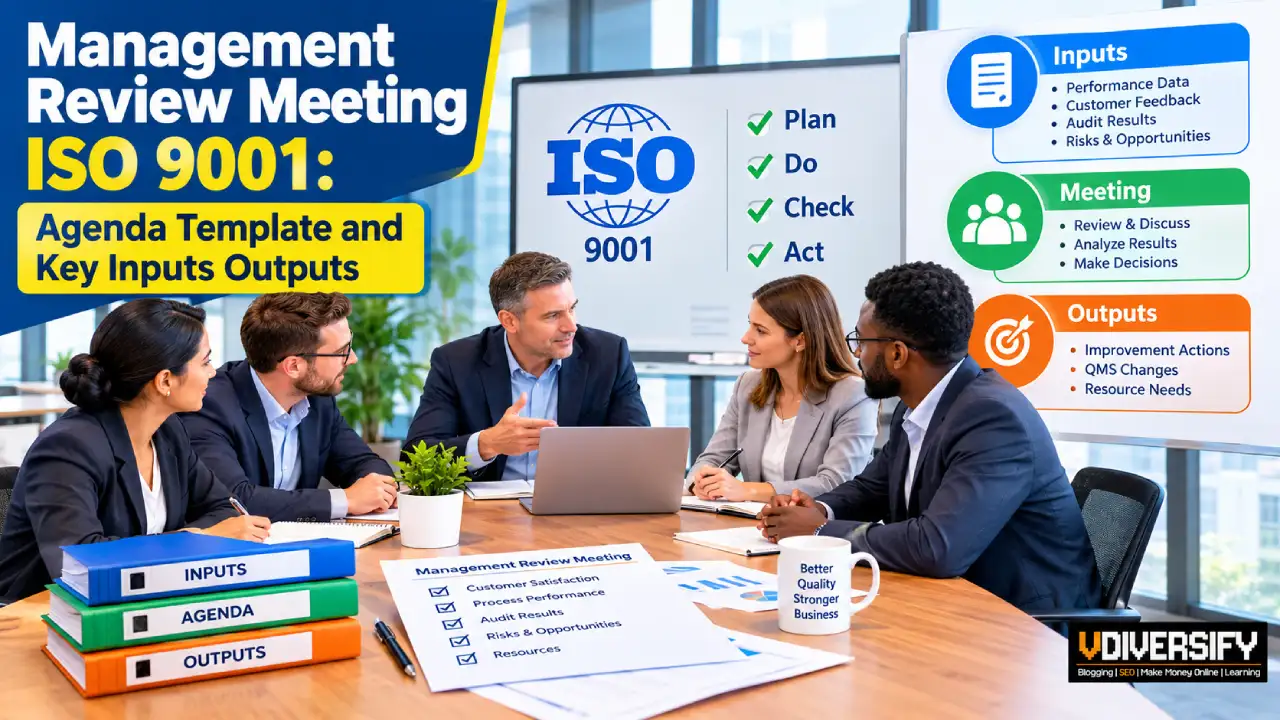
A well-planned management review meeting ISO 9001 agenda template inputs outputs helps an organization check whether its Quality Management System (QMS) is working, whether customer requirements are being met, and what improvements top management needs to approve.
Under Clause 9.3 of ISO 9001, management must review the QMS at planned intervals, evaluate its performance, and make decisions about improvements, changes, and resources.
This guide explains how to prepare the agenda, collect the required information, record management decisions, and turn review findings into practical actions that improve quality and business performance.
Contents
- 1. What Is an ISO 9001 Management Review Meeting?
- 2. Understanding Clause 9.3 Management Review
- 3. Why Is a Management Review Important?
- 4. Who Should Attend the Meeting?
- 5. How Often Should a Management Review Be Conducted?
- 6. How to Prepare Before the Review
- 7. Management Review Agenda Template
- 8. ISO 9001 QMS Review Meeting
- 9. Management Review Inputs: What Must Be Reviewed?
- 10. Input 1: Status of Actions from Previous Management Reviews
- 11. Input 2: Changes in Internal and External Issues
- 12. Input 3: Customer Satisfaction and Feedback
- 13. Input 4: Progress Toward Quality Objectives
- 14. Input 5: Process Performance and Product or Service Conformity
- 15. Input 6: Nonconformities and Corrective Actions
- 16. Input 7: Monitoring and Measurement Results
- 17. Input 8: Internal and External Audit Results
- 18. Input 9: Performance of External Providers
- 19. Input 10: Adequacy of Resources
- 20. Input 11: Effectiveness of Actions Addressing Risks and Opportunities
- 21. Input 12: Opportunities for Improvement
- 22. How to Conduct a Useful Quality System Performance Review
- 23. How to Record Evidence and Use Statistics Correctly
- 24. Management Review Outputs: What Must Come Out of the Meeting?
- 25. Sample Management Review Outputs Table
- 26. Management Review Minutes: How to Document the Meeting
- 27. Management Review Meeting Minutes
- 28. Management Review Action Tracker
- 29. Common Management Review Mistakes to Avoid
- 30. How Auditors Evaluate the Management Review Process
- 31. Practical Checklist for an Effective ISO 9001 Management Review
- 32. Management review checklist
- 33. Recommended Resources and Reference Links
- 34. Conclusion: Make Every Management Review Count
What Is an ISO 9001 Management Review Meeting?
An ISO 9001 management review is a planned evaluation of the organization’s quality management system by its top management. The purpose is to determine whether the system remains suitable, adequate, and effective, and whether it supports the organization’s strategic direction.
In simple terms, the meeting helps senior leaders answer five important questions:
- Are we consistently meeting customer requirements?
- Are our quality objectives being achieved?
- Are our processes performing as expected?
- Do we have the people, equipment, time, and budget needed to maintain quality?
- What changes or improvements should we make next?
For example, a US-based manufacturing company may discover that customer complaints have increased over the last quarter, even though its production targets are being met. During the review, management can examine defect trends, investigate recurring problems, approve employee training, and decide whether inspection methods or equipment need to change.
This makes the review more than a compliance exercise. It connects quality performance with business decisions.
Understanding Clause 9.3 Management Review
Clause 9.3 of ISO 9001:2015 sets out the requirements for management review. It has three main sections: general requirements, review inputs, and review outputs. Together, these sections explain why the review is necessary, what information management must consider, and which decisions the review must produce.
Source: IS/ISO 9001:2015, Make Management Review Meaningful
Clause 9.3.1 — General
Management reviews the QMS at planned intervals to confirm its continued suitability, adequacy, effectiveness, and alignment with the organization’s strategic direction.
Clause 9.3.2 — Inputs
Management considers previous actions, changes in relevant issues, QMS performance, customer feedback, audits, risks, resources, and improvement opportunities.
Clause 9.3.3 — Outputs
The review produces decisions and actions related to improvement opportunities, necessary QMS changes, and resource needs. Documented information must be retained as evidence of the results.
Important: ISO 9001 requires a review at planned intervals, but it does not prescribe one universal meeting frequency, a fixed agenda format, or a mandatory single-session meeting. Organizations should set a schedule that suits their operations and ensures the full requirements are addressed.
As of October 2026, ISO’s official website lists the sixth edition of ISO 9001, dated September 2026, as being under publication and intended to replace the 2015 edition. Organizations should verify the applicable edition, publication status, and transition instructions with ISO and their certification body before revising controlled QMS documents.
Source: Quality management systems — Requirements (ISO 9001:2026)
Why Is a Management Review Important?
A properly conducted review helps management identify problems before they affect customers, delivery schedules, or operating costs. It also gives senior leaders a clear picture of whether the QMS is supporting business goals.
The main benefits include:
- Better decision-making: Leaders use actual performance data rather than assumptions.
- Improved customer satisfaction: Recurring complaints and service issues receive management attention.
- Stronger process control: Poor-performing processes can be identified and improved.
- Effective resource planning: Management can approve additional staff, training, equipment, or technology.
- Better risk management: Emerging risks are discussed before they become serious problems.
- Continual improvement: Findings are converted into assigned actions with deadlines.
Consider a US-based industrial equipment supplier experiencing a rise in late deliveries. Production managers may blame supplier delays, while purchasing managers may point to inaccurate demand forecasts.
A management review brings these issues together, allowing leaders to examine supplier performance, inventory data, planning processes, and customer commitments before approving a corrective plan.
This is where top management quality leadership becomes important. Quality is not solely the responsibility of the quality department. Senior leaders must provide direction, make decisions, and ensure that the organization has the resources required to meet its objectives.
Who Should Attend the Meeting?
ISO 9001 places responsibility for the review on top management. The people attending should have enough authority and knowledge to evaluate performance, discuss problems, and approve actions.
The exact attendance list depends on the organization’s size, structure, and activities.
Role | Main responsibility during the review |
President, CEO, or General Manager | Reviews overall performance and approves major decisions |
Quality Manager | Presents QMS performance, audit results, complaints, and corrective actions |
Operations or Production Manager | Reports process performance, defects, and delivery issues |
Sales or Customer Service Manager | Presents customer feedback, complaints, and satisfaction trends |
Purchasing or Supply Chain Manager | Reports supplier performance and supply risks |
HR or Training Manager | Reviews competence, staffing, and training needs |
Finance or Department Heads | Explains resource needs and supports investment decisions |
For a small company, the owner, operations manager, and quality manager may be sufficient participants, provided the review covers the required subjects and the appropriate decisions are made.
For a larger organization, representatives from several departments may be needed.
Practical tip: Invite people who can explain the data and take responsibility for the resulting actions. A meeting with many attendees but no decision-making authority often produces little improvement.
How Often Should a Management Review Be Conducted?
ISO 9001:2015 requires management to conduct reviews at planned intervals. It does not specify that every organization must meet monthly, quarterly, or annually.
The appropriate frequency depends on business risk, customer requirements, operational changes, and the stability of the QMS.
Suggested frequency | When it may be appropriate |
Monthly | High-risk operations, rapid growth, or serious recurring quality problems |
Quarterly | Organizations that need regular oversight of performance and corrective actions |
Every six months | Relatively stable operations with sufficient interim monitoring |
Annually | Stable systems where annual reviews still allow all required matters to be evaluated effectively |
These are practical scheduling examples, not frequencies mandated by ISO 9001.
A company may also review particular subjects during regular leadership meetings throughout the year and consolidate the results into a documented review process. The key is to ensure that all required matters are considered and that management decisions and actions are recorded.
For example, a company might review customer complaints and delivery performance every month, supplier performance quarterly, and the overall effectiveness of its QMS during a broader annual review.
This approach can reduce unnecessary meeting time while keeping quality issues visible to senior management.
How to Prepare Before the Review
A useful management review begins before everyone enters the meeting room. The quality manager or designated coordinator should prepare the agenda, collect relevant information, check previous actions, and send the necessary reports to participants.
Use the following preparation steps.
Step 1: Review previous meeting minutes
Check the previous management review minutes and action tracker.
Identify:
- Completed actions.
- Actions still in progress.
- Overdue actions.
- Actions that failed to achieve the expected result.
- Decisions that require further approval.
For example, if management previously approved operator training to reduce assembly defects, the next review should examine whether training was completed and whether the defect rate actually improved.
Step 2: Collect performance data
Gather reports that show how the QMS has performed during the review period.
Useful reports include:
- Customer complaints and satisfaction results.
- Internal and external audit findings.
- Quality objectives and KPI results.
- Nonconformities and corrective actions.
- Product or service conformity data.
- Supplier performance reports.
- Inspection, testing, and monitoring results.
- Resource and training requirements.
Whenever possible, present trends rather than isolated numbers. Comparing several months or quarters makes it easier to identify recurring issues.
Step 3: Check risks, changes, and opportunities
Identify changes that may affect the QMS, including new customer requirements, changes in production technology, new suppliers, staffing changes, or relevant legal and regulatory requirements.
For instance, a service company introducing new scheduling software should consider whether employees need training, whether customer records remain accurate, and whether the change affects service delivery.
Step 4: Send the agenda in advance
Share the agenda and supporting reports with attendees before the meeting. This gives participants time to review the evidence and prepare questions.
A practical approach is to circulate the materials several business days before the review, although ISO 9001 does not prescribe a specific notice period.
Step 5: Define the decisions needed
Do not limit preparation to collecting documents. Identify where management approval or direction may be required.
Examples include:
- Approving additional inspection equipment.
- Allocating funds for employee training.
- Changing a quality objective.
- Revising a process that repeatedly fails to meet requirements.
- Assigning resources to resolve a supplier problem.
The purpose is to make the meeting a decision-making process, not simply a presentation of reports.
Management Review Agenda Template
The following sample agenda can be adapted for a US-based manufacturing company, engineering firm, construction business, or service provider. The suggested time allocations are examples and should be adjusted to suit the organization’s size and complexity.
ISO 9001 QMS Review Meeting
Editable meeting-planning template
Organization:
Meeting date (Select date):
Meeting chair:
Review frequency:
Planned duration:
Suggested agenda and timing
Select the topics to include in your meeting plan.
- Opening, purpose, and previous actions (10 min)
- Changes affecting the QMS (10 min)
- Customer feedback and satisfaction (10 min)
- Quality objectives and process performance (15 min)
- Audits, nonconformities, and corrective actions (15 min)
- Supplier performance, risks, and opportunities (10 min)
- Resource adequacy and improvement opportunities (10 min)
- Decisions, action owners, and deadlines (10 min)
Copy meeting agenda
The template is a starting point rather than a fixed ISO requirement. Make sure the final agenda covers all applicable review inputs, including previous actions, changes, QMS performance, resources, risks, and opportunities.
Management Review Inputs: What Must Be Reviewed?
The management review inputs are the information and evidence that top management must consider when evaluating the Quality Management System. Under Clause 9.3.2 of ISO 9001:2015, the review must address seven groups of inputs.
These cover previous actions, changes affecting the QMS, performance and effectiveness, resource adequacy, risk-related actions, and opportunities for improvement.
The goal is not simply to place reports on a meeting table. Management should understand what the results mean, where performance is falling short, and what decisions are needed.
The following table provides a practical overview of the required inputs and the evidence an organization can prepare.
Required input | Examples of evidence | Questions management should ask |
Status of previous actions | Action tracker, meeting minutes, closure evidence | Were actions completed and effective? |
Changes in internal and external issues | Business changes, customer requirements, regulatory updates | What has changed that could affect the QMS? |
QMS performance and effectiveness | KPIs, customer feedback, audit reports, process results | Are processes achieving their intended results? |
Adequacy of resources | Staffing, training, equipment, budget, infrastructure | Do we have sufficient resources to meet requirements? |
Effectiveness of actions addressing risks and opportunities | Risk register, action plans, effectiveness checks | Are our actions reducing risks or improving outcomes? |
Opportunities for improvement | Improvement proposals, trend analysis, employee suggestions | Where can we improve quality, delivery, or efficiency? |
The performance and effectiveness input includes several specific subjects, such as customer satisfaction, progress toward quality objectives, process performance, product and service conformity, nonconformities and corrective actions, monitoring results, audit results, and external provider performance.
These should not be overlooked when preparing the review.
Input 1: Status of Actions from Previous Management Reviews
The first step is to check what happened after the last review. Management should establish whether previously agreed actions were completed, whether they produced the intended results, and whether any issues remain unresolved.
A simple action tracker is usually sufficient.
Previous action | Owner | Due date | Status | Evidence of effectiveness |
Reduce packaging damage | Packaging Manager | June 30 | Completed | Damage rate reduced from 4% to 1.5% |
Improve supplier delivery | Purchasing Manager | July 15 | In progress | Two suppliers still miss delivery dates |
Train inspection staff | Quality Manager | July 20 | Completed | Competency assessment passed |
The figures above are illustrative examples, not published industry statistics.
How to discuss overdue actions
An overdue action should not be marked complete simply because an employee has submitted a report or attended training. The organization needs evidence that the action was carried out and, where applicable, that it achieved the intended result.
For example, if a company introduced a new inspection checklist to reduce assembly errors, the quality manager should compare defect results before and after implementation. If defects remain high, management may need to approve further investigation, equipment changes, or revised work instructions.
Key takeaway: Management review minutes should record unresolved actions, revised deadlines, and any additional resources or decisions required.
Input 2: Changes in Internal and External Issues
An organization operates in a changing business environment. New customer expectations, supplier problems, technology changes, staffing challenges, and legal requirements can affect the QMS.
Management should review changes that may influence the organization’s ability to deliver conforming products or services.
Internal changes
Examples include:
- Introducing new equipment or production processes.
- Hiring a large number of new employees.
- Opening a new office, warehouse, or production facility.
- Changing responsibilities or reporting structures.
- Implementing new software for order processing.
- Experiencing a major increase in production volume.
External changes
Examples include:
- New or revised customer specifications.
- Changes in applicable regulatory requirements.
- Supplier shortages or transport disruptions.
- Changes in market demand.
- New technologies that affect service delivery.
- Changes in customer expectations or contractual obligations.
Consider a US-based engineering company that starts using a new computer-aided design system. Although the software may improve productivity, it can also introduce risks related to employee competence, drawing revisions, document control, and customer approvals.
During the review, management should decide whether additional training, validation, process controls, or updated procedures are necessary.
The purpose is to make sure the QMS continues to support the organization’s current operations and business direction rather than relying on arrangements that may no longer be suitable.
Input 3: Customer Satisfaction and Feedback
Customer satisfaction is one of the most important parts of a QMS review. Management needs to understand whether customers believe the organization is meeting their requirements and whether the quality of products or services is improving.
ISO 9001 does not require one particular customer satisfaction measurement method. An organization can select methods suited to its customers, products, services, and business model.
What information should be presented?
Useful evidence includes:
- Customer satisfaction survey results.
- Complaints and complaint categories.
- Customer returns and warranty claims.
- Repeat business and customer retention trends.
- Customer scorecards and supplier ratings.
- Delivery performance and missed commitments.
- Positive feedback and customer suggestions.
- Results of customer audits, where applicable.
A company should avoid relying on survey scores alone. Customers may not complete surveys even when they have serious concerns, so complaints, service records, customer meetings, and other feedback channels can provide a more complete picture.
Example: Customer satisfaction is falling
Imagine a US-based industrial parts supplier that receives a customer satisfaction score of 92% in one quarter and 84% in the next.
The score alone does not explain the problem. Further analysis reveals that most negative feedback relates to late deliveries and incorrect order quantities.
Management can then decide to investigate production planning, review picking and packing controls, and improve communication about delayed orders.
The following table illustrates how customer feedback can be translated into management decisions.
Customer feedback | Possible cause to investigate | Potential management decision |
Deliveries arrive late | Scheduling or supplier delays | Improve planning and supplier monitoring |
Products arrive damaged | Packaging or handling problems | Review packaging methods and handling training |
Incorrect quantities received | Picking or order verification errors | Introduce an additional dispatch check |
Slow responses to complaints | Unclear responsibilities or limited staffing | Set response targets and assign complaint ownership |
Repeated service failures | Weak process controls or incomplete training | Review root causes and strengthen controls |
These are potential actions, not automatic conclusions. Management should review evidence before deciding on a solution.
Quality manager’s tip: Present both the number of complaints and the rate of complaints relative to sales, orders, or units delivered. A company delivering twice as many orders may receive more complaints in total even when its quality performance has improved.
For further guidance on customer feedback measurement, consult the ISO 10004 guidance on monitoring and measuring customer satisfaction, where applicable to the published edition.
Source: Guidelines for monitoring and measuring
Input 4: Progress Toward Quality Objectives
Quality objectives are measurable targets established to support the quality policy and improve performance. During the review, management must evaluate the extent to which these objectives have been achieved.
A useful objective has a clear measure, a target, an owner, and a defined review period.
For example, a company might set an objective to reduce customer returns from 3% to below 1.5% by the end of the financial year.
Sample quality objectives dashboard
Quality objective | Target | Actual result | Status | Management response |
Reduce customer returns | Below 1.5% | 2.2% | Not achieved | Investigate recurring return reasons |
Improve on-time delivery | At least 97% | 95% | Not achieved | Review planning and supplier delays |
Complete required training | 100% | 98% | Not achieved | Close remaining training gaps |
Close corrective actions by due date | At least 95% | 96% | Achieved | Maintain current controls |
All values are illustrative. Organizations should establish targets appropriate to their own operations and customer requirements.
What should management do when targets are missed?
A missed objective should lead to a discussion about the reasons for the result and whether additional action is necessary.
Management should consider:
- Whether the target remains appropriate.
- Whether the organization has reliable data.
- Whether the process owner has enough resources.
- Whether the current action plan is working.
- Whether a revised action, deadline, or target is justified.
For instance, if delivery performance remains below target because a key supplier repeatedly misses agreed dates, the organization may need to review supplier selection, safety stock, alternative sourcing, or customer communication.
Objectives should not be changed merely to make poor performance appear acceptable. Any change should have a clear reason and remain consistent with customer requirements and the organization’s quality policy.
Input 5: Process Performance and Product or Service Conformity
This input helps management determine whether the organization’s processes consistently deliver the expected results.
Process performance measures how well activities operate. Conformity measures whether the resulting product or service meets specified requirements.
The indicators will vary by industry.
Industry | Example performance indicators |
Manufacturing | Scrap rate, rework rate, first-pass yield, defect rate |
Construction | Inspection pass rate, rework hours, completion against specifications |
Engineering | Design errors, revision control issues, verification completion |
IT services | Incident resolution time, failed deployments, service availability |
Consulting | Deliverable acceptance, report errors, missed milestones |
Warehousing | Picking accuracy, shipment errors, order cycle time |
Example: Manufacturing process performance
Suppose a manufacturer produces 10,000 units during a month and identifies 250 defective units.
The defective-unit rate is:
Defect rate = (250 ÷ 10,000) ✕ 100 = 2.5%
If the organization’s target is 1.5%, management should examine the gap and determine whether it requires additional investigation or action.
However, the review should go beyond the percentage. It should also consider:
- Which defects occur most often?
- Which process or machine produces the defects?
- Have the defects increased over several periods?
- Are inspection methods reliable?
- Have previous corrective actions worked?
- Could the same problem affect other products or locations?
Use trends rather than isolated results
A single month’s result may not tell the whole story. Comparing several reporting periods can show whether a process is improving, deteriorating, or remaining stable.
For example, defect rates of 3.4%, 3.1%, 2.8%, and 2.5% indicate an improving trend, although the process may still be missing its target.
Management should recognize progress while continuing to address the remaining gap.
Input 6: Nonconformities and Corrective Actions
A nonconformity occurs when a requirement is not fulfilled. It may involve a defective product, an incorrect document, an incomplete service, a failed inspection, or a process that does not follow an established requirement.
Management review should consider the number and type of nonconformities, recurring issues, the status of corrective actions, and whether those actions have been effective.
What evidence should the quality manager bring?
- Internal nonconformity reports.
- Customer complaints linked to quality failures.
- Root-cause analysis results.
- Corrective action status and overdue actions.
- Repeat findings and recurrence rates.
- Verification or effectiveness-check results.
- Costs or operational effects of quality failures, where available.
Example: A recurring assembly defect
A manufacturer records 15 assembly defects in one month. Operators correct the defective units, but similar failures continue the following month.
The initial correction addresses the affected units. It does not necessarily eliminate the cause of the problem.
Management may need to support a more thorough investigation into fixture alignment, tool calibration, work instructions, operator competence, or process design.
The review should record the decision, responsible person, due date, and evidence needed to confirm that the action worked.
Important distinction: Correcting a specific defect and taking corrective action to address its cause are not the same thing. The appropriate response depends on the nature and significance of the nonconformity.
For more detail on this topic, see ASQ’s quality resources for guidance on root-cause analysis and corrective action.
Input 7: Monitoring and Measurement Results
Monitoring and measurement provide evidence about whether processes, products, and services meet their intended requirements. Management should review relevant results and trends to understand where the QMS is working and where controls need improvement.
Examples include:
- Equipment calibration and verification results.
- Inspection and testing results.
- Production yield and scrap data.
- Service delivery performance.
- Measurement system problems.
- Environmental or operating conditions where relevant to product conformity.
- Accuracy and completeness of service records.
Example: Equipment calibration
A manufacturing company discovers that a measuring instrument used to accept finished parts has an overdue calibration status.
Management should consider whether the instrument remains suitable for use and whether previously accepted products could have been affected. The organization may need to assess the validity of earlier measurement results, evaluate affected products, and take appropriate corrective action.
The review should also consider whether the calibration process itself needs improvement.
Not every individual measurement result needs to be presented to senior management. The quality manager should summarize the important trends, exceptions, risks, and decisions that require leadership attention.
Input 8: Internal and External Audit Results
Audit results give management an independent view of whether the QMS conforms to applicable requirements and is being implemented effectively.
Internal audits examine the organization’s processes against defined audit criteria. External audits may include certification audits, customer audits, and other relevant assessments.
What should the audit report include?
A useful summary contains:
- Number of audits planned and completed.
- Major findings and recurring issues.
- Nonconformities by process or department.
- Status of corrective actions.
- Repeat findings from previous audits.
- Areas of good performance.
- Any significant gaps in the audit program.
- Relevant findings from certification or customer audits.
Example: Repeated document-control findings
Suppose internal audits identify three separate instances in which employees used outdated work instructions.
Management should consider whether the problem is isolated or reflects a broader weakness in document control. The cause could involve poor access to current documents, unclear responsibilities, or inadequate training.
Possible decisions include improving document access, revising the approval workflow, or adding checks to confirm that obsolete versions have been removed from points of use.
The aim is to understand the significance of audit findings and ensure that the organization addresses systemic problems rather than repeatedly correcting individual instances.
For further reading, see ASQ’s guidance and resources on quality auditing.
Input 9: Performance of External Providers
External providers include suppliers, subcontractors, outsourced service providers, and other organizations whose products or services can affect the QMS.
Poor supplier performance can lead to production delays, defective materials, customer complaints, and higher operating costs. Management should therefore consider whether external providers are meeting the organization’s requirements.
Useful supplier performance indicators
Indicator | What it measures |
On-time delivery | Percentage of orders delivered as agreed |
Incoming defect rate | Proportion of received items that fail requirements |
Supplier corrective action response | Timeliness and adequacy of responses to reported issues |
Documentation compliance | Completeness of certificates, inspection reports, or required records |
Repeat nonconformities | Frequency of recurring supplier quality problems |
Responsiveness | Ability to resolve issues and communicate changes |
Example: A supplier repeatedly misses delivery dates
A US-based manufacturer depends on one supplier for a critical component. The supplier delivers late in four of the last six months, forcing the manufacturer to reschedule production.
The quality manager should present the delivery trend, its effect on production, and any corrective actions already taken.
Management might approve a supplier improvement plan, assess alternative sources, revise inventory controls, or review the supplier’s status under the organization’s purchasing controls.
The decision should reflect the risk and importance of the supplied product or service. Not every supplier requires the same level of monitoring.
Input 10: Adequacy of Resources
A QMS cannot perform effectively without suitable resources. Management must consider whether the organization has the people, infrastructure, equipment, technology, knowledge, and working environment required to meet quality requirements.
This is an important part of the review because repeated quality problems may result from insufficient resources rather than a lack of written procedures.
Resources to evaluate
- Staffing levels and employee competence.
- Training and qualification requirements.
- Production and inspection equipment.
- Calibration and maintenance support.
- Software, IT systems, and document-control tools.
- Workspaces and storage conditions.
- Time and budget for corrective actions.
- External expertise where necessary.
Example: An overloaded inspection department
A company increases production by 30%, but its inspection team remains the same size. Inspection queues grow, deliveries are delayed, and employees begin working overtime.
Management should evaluate whether the inspection process has sufficient capacity and whether process changes, additional staffing, improved scheduling, or automated inspection would be appropriate.
The decision should be based on evidence, including workload, defect risk, delivery performance, and the cost of potential solutions.
Resource decisions are particularly important when management expects employees to achieve more demanding quality objectives without changing staffing, equipment, or working methods.
Input 11: Effectiveness of Actions Addressing Risks and Opportunities
ISO 9001 requires organizations to address relevant risks and opportunities as part of planning their QMS. During management review, leaders should evaluate whether the actions taken have been effective.
The objective is not to read the entire risk register aloud. It is to examine important risks, changes in exposure, and evidence that planned actions are producing the intended results.
Example risk review
Risk or opportunity | Action taken | Evidence to review | Possible decision |
Dependence on one critical supplier | Approved an alternative supplier | Delivery and incoming quality results | Continue qualification or expand sourcing |
Frequent operator errors | Introduced practical training | Competency results and defect trends | Provide follow-up training if needed |
Inaccurate order entry | Added a verification step | Order error rate | Improve or automate the check |
High inspection workload | Reviewed process capacity | Inspection backlog and escape rate | Approve additional capacity if justified |
Management should assess whether the action has reduced the risk to an acceptable level or whether further action is necessary.
For example, qualifying a second supplier may reduce the risk of a supply interruption, but the benefit is not fully demonstrated until the alternative supplier has been assessed and can provide conforming materials when needed.
This discussion links the management review with the organization’s risk-based planning and continual improvement activities.
Input 12: Opportunities for Improvement
Opportunities for improvement are ideas or identified changes that could make the QMS more effective, improve customer satisfaction, reduce errors, or improve the use of resources.
They may come from audit findings, customer feedback, employee suggestions, process data, supplier reviews, or changes in technology.
Examples include:
- Automating repetitive data entry.
- Improving inspection methods.
- Reducing unnecessary approval steps.
- Simplifying document access.
- Improving employee training.
- Reducing packaging damage.
- Improving communication between departments.
- Introducing clearer service acceptance criteria.
Example: Reducing repetitive inspection work
A company discovers that employees manually enter the same inspection results into two different systems. The repeated entry consumes time and creates opportunities for transcription errors.
Management may approve an integrated reporting system, subject to suitable controls and validation.
The organization should define how it will evaluate the change, such as comparing data-entry errors, reporting time, and record completeness before and after implementation.
An improvement should not be approved simply because it sounds attractive. Management should consider its expected benefit, cost, risk, resource requirements, and effect on product or service conformity.
How to Conduct a Useful Quality System Performance Review
Once the required information has been collected, the quality manager should present it in a way that allows senior management to understand the overall performance of the QMS.
A good quality system performance review connects the data to business outcomes. Instead of reporting only that 12 complaints were received, explain the main causes, whether complaints are increasing, their effect on customers, and what action is needed.
Use a simple structure for each important topic:
- Target: What result did the organization expect?
- Actual result: What happened during the review period?
- Trend: Is performance improving, declining, or stable?
- Reason: What explains the result, based on available evidence?
- Decision needed: What should management approve or change?
- Follow-up: Who will act, by when, and how will success be checked?
For example, a service company may have a target of completing 95% of customer requests within two business days but achieve only 88%. Management should review the reasons, such as staffing shortages or an inefficient approval process, before deciding on additional resources or process changes.
This format keeps the meeting focused on results and decisions rather than lengthy presentations.
How to Record Evidence and Use Statistics Correctly
Performance information is most useful when it is accurate, comparable, and supported by reliable records.
When presenting figures, the quality manager should identify the reporting period, the calculation method, the target, and the data source. This allows management to interpret the results correctly and compare them with earlier periods.
For example, a company reporting a reduction in defects from 200 to 150 should also consider production volume. If production fell by half, the number of defects alone may give a misleading impression of improvement.
Similarly, customer satisfaction scores should be interpreted alongside response rates, complaint data, and other available evidence.
Use charts when they make trends easier to understand, but do not overload the meeting with unnecessary graphs. A small dashboard showing the most important quality objectives, customer feedback, audit findings, corrective actions, and supplier performance is often more useful than dozens of unrelated indicators.
The goal is informed management decisions, not a large collection of statistics. This completes the review inputs and performance evaluation section.
Management Review Outputs: What Must Come Out of the Meeting?
The management review outputs are the decisions and actions that result from evaluating the QMS. Under Clause 9.3.3 of ISO 9001:2015, the results must include decisions and actions related to improvement opportunities, changes needed to the QMS, and resource needs.
The organization must retain documented information as evidence of the results of its management reviews.
A meeting is not effective simply because all the required reports were presented. Its value depends on whether management uses the information to make decisions and whether those decisions are followed through.
For example, if customer complaints have increased because of incorrect shipments, the review should not end with a general statement that shipping accuracy needs improvement. It should identify the agreed response, the responsible person, the deadline, and how management will determine whether the action worked.
The three required output areas are explained below.
A. Decisions and actions related to improvement opportunities
Management should decide which opportunities deserve attention and what action is appropriate.
Examples include:
- Reducing recurring defects.
- Improving customer complaint handling.
- Automating repetitive administrative work.
- Improving supplier performance.
- Reducing rework and waste.
- Improving the accuracy of service delivery.
- Simplifying processes without weakening controls.
Example: A manufacturer finds that operators repeatedly enter inspection results manually into two systems. Management approves an improvement project to integrate the records, reduce duplicate work, and improve data accuracy.
The meeting minutes should record the decision, the assigned project owner, the target date, and the measure that will demonstrate success.
B. Decisions about changes needed to the QMS
Management may determine that the QMS needs changes because of audit findings, new customer requirements, business growth, process problems, or changes in the organization’s operating environment.
Possible changes include:
- Revising process responsibilities.
- Updating quality objectives.
- Changing inspection or verification methods.
- Revising document-control arrangements.
- Introducing new software or equipment.
- Updating procedures or work instructions.
- Changing how risks are monitored.
Example: A service organization expands from one office to three locations. Management determines that the existing process for reviewing customer deliverables is not consistent across all locations.
The decision may be to introduce a common review process, define approval responsibilities, and establish a consistent method for retaining records.
The organization should plan and control the change so that the QMS continues to function effectively during implementation.
C. Decisions about resource needs
Management should decide whether additional resources are required to maintain or improve the QMS.
Resource decisions may involve:
- Hiring additional employees.
- Providing technical training.
- Purchasing inspection equipment.
- Replacing unsuitable machinery.
- Improving IT systems.
- Engaging external technical support.
- Allocating budget for corrective action projects.
Example: A quality team cannot complete planned inspections because production has increased significantly. Management reviews the workload, delivery risks, and inspection requirements before deciding whether to recruit an additional inspector or improve the inspection process.
A resource decision should be based on evidence and business needs, not simply on the assumption that more resources will solve every problem.
D. Other useful management decisions
In addition to the three required output areas, management may record decisions concerning quality objectives, business priorities, process ownership, risk treatment, and the timing of follow-up reviews.
These additional outputs can make the review more useful, provided they support the QMS and do not replace the required output areas.
Sample Management Review Outputs Table
The following example shows how management can convert review findings into specific decisions and actions.
Review finding | Management decision or action | Responsible person | Target date | Evidence of completion |
Customer complaints increased | Investigate the main complaint causes and implement suitable corrective action | Quality Manager | November 15 | Investigation and effectiveness results |
Delivery target not achieved | Review production planning and supplier delays | Operations Manager | November 20 | Updated delivery performance report |
Employees lack training on a revised process | Complete training and verify competence | HR Manager | November 10 | Training and competency records |
Repeated document-control findings | Improve access to current approved documents | Document Control Owner | November 25 | Updated controls and verification results |
Inspection workload exceeds capacity | Evaluate staffing and equipment requirements | General Manager | December 1 | Approved resource plan or documented decision |
The dates, roles, and examples are illustrative. Replace them with actual organizational responsibilities and agreed deadlines.
A strong action statement identifies a clear outcome. “Improve delivery performance” is too vague on its own. “Review the causes of late deliveries, implement the agreed controls, and report the on-time delivery rate at the next review” is more useful because it establishes what needs to happen and how progress will be checked.
Management Review Minutes: How to Document the Meeting
Management review minutes provide evidence of what was reviewed, what management concluded, and which actions were agreed upon. They also help the organization follow decisions through to completion.
ISO 9001 requires documented information as evidence of management review results, but it does not prescribe one mandatory minutes template or require a particular software system. A controlled Word document, spreadsheet, or electronic QMS record can be suitable if it captures the necessary information and is properly maintained.
What should management review minutes contain?
A practical record should include:
- Organization name and meeting title.
- Date and location or meeting format.
- Attendees and relevant absentees.
- Meeting chair and person preparing the minutes.
- Review period and agenda topics.
- Relevant performance results and significant findings.
- Decisions made by management.
- Agreed actions and responsible persons.
- Due dates and required resources.
- Follow-up arrangements and closure evidence.
The record should be detailed enough to demonstrate that the review took place and that its results were considered. It does not need to reproduce every word spoken during the meeting.
Sample management review minutes template
Management Review Meeting Minutes
ISO 9001 — Clause 9.3
Organization:
Meeting date (Select date):
Review period:
Attendees:
Key findings and performance results:
Management decisions and actions:
Action owner:
Due date (Select date):
Resources required and follow-up:
Copy meeting minutes
Complete the fields with actual meeting information. Retain supporting reports and evidence under your organization’s document-control arrangements.
Management Review Action Tracker
Minutes record the review results, while an action tracker makes it easier to monitor implementation. These can be maintained together or in separate records.
A useful tracker should distinguish between an action that has been assigned, one that is in progress, one that is complete, and one whose effectiveness has been verified.
Action ID | Agreed action | Owner | Due date | Status | Effectiveness evidence |
MR-01 | Investigate recurring customer complaints | Quality Manager | Nov. 15 | In progress | Complaint trend and investigation |
MR-02 | Complete training for revised process | HR Manager | Nov. 10 | Open | Competency assessment |
MR-03 | Review critical supplier performance | Purchasing Manager | Nov. 20 | Open | Supplier performance report |
MR-04 | Improve document-control access | Process Owner | Nov. 25 | Open | Verification audit |
Illustrative example only.
How to close an action correctly
A practical action-closure process includes the following steps:
- The action owner completes the agreed task.
- Evidence of completion is recorded.
- The responsible person verifies the result where appropriate.
- The organization checks effectiveness when the action is intended to prevent recurrence or improve performance.
- Any remaining problem is reassigned or escalated.
- The result is reported to management at the appropriate follow-up point.
For example, purchasing may complete a supplier improvement plan, but management should not automatically assume that supplier performance has improved. The organization should review subsequent delivery and quality data to determine whether the plan achieved its purpose.
Completion is not always the same as effectiveness. This distinction is especially important when actions address recurring nonconformities or significant risks.
Common Management Review Mistakes to Avoid
Even organizations with certified QMSs can conduct reviews that add little value. The following mistakes can weaken the process and make it harder to demonstrate effective management oversight.
Mistake 1: Treating the meeting as a formality
A review should not be held simply to produce a signed attendance sheet. Management needs to evaluate results, consider the required inputs, and make decisions where necessary.
Better approach: Use performance evidence to identify issues that need management attention and record the resulting decisions.
Mistake 2: Reviewing only audit findings
Audit results are important, but they represent only one part of the review. Customer feedback, process performance, quality objectives, resources, risks, and opportunities also need consideration.
Better approach: Use a structured agenda linked to all applicable Clause 9.3 inputs.
Mistake 3: Presenting data without analysis
A report may show that the defect rate is 3%, but management also needs to understand the target, trend, significance, and likely causes.
Better approach: Explain what the results mean and what decision is required.
Mistake 4: Recording vague actions
Statements such as “improve quality” or “monitor suppliers” do not clearly establish what should happen.
Better approach: Specify the expected outcome, action owner, due date, and follow-up evidence.
Mistake 5: Failing to follow up
Repeatedly carrying forward the same actions without investigating the delay can weaken accountability and allow quality problems to continue.
Better approach: Review overdue actions, document reasons for delay, and escalate issues that require additional authority or resources.
Mistake 6: Ignoring resource requirements
Management may demand better performance without considering whether employees, equipment, training, and budget are adequate.
Better approach: Evaluate resource needs alongside performance gaps and proposed improvements.
Mistake 7: Failing to retain evidence
A company may conduct a useful discussion but struggle to demonstrate its results because minutes, reports, and decisions were not retained.
Better approach: Establish a clear process for recording decisions, maintaining supporting evidence, and controlling the records.
How Auditors Evaluate the Management Review Process
During an ISO 9001 audit, auditors may examine whether management reviews are planned, whether required inputs have been considered, whether appropriate outputs have been recorded, and whether there is evidence that agreed actions are followed through.
The auditor may sample records rather than expect every detail of the organization’s QMS to be presented in one meeting.
Typical questions include:
- How do you demonstrate that top management reviews the QMS?
- How are the required inputs included in the review?
- What happens when quality objectives are not achieved?
- How are customer complaints and audit findings discussed?
- How are resource requirements identified and approved?
- Where are management decisions recorded?
- How do you monitor actions from previous reviews?
- How do you determine whether actions have been effective?
Example of a potential audit finding
An organization has meeting minutes showing that customer complaints were discussed. However, the minutes contain no conclusions, decisions, or actions, even though complaints have increased significantly.
The auditor may investigate whether the review adequately addressed QMS performance and whether its results meet the applicable requirements.
The absence of a particular template or a separate document is not automatically a nonconformity. The issue is whether the organization can demonstrate conformity with the actual standard requirements.
Organizations should avoid creating unnecessary paperwork solely for auditors. The better approach is to maintain reliable evidence that reflects the review process and the decisions management actually makes.
Practical Checklist for an Effective ISO 9001 Management Review
Use this checklist to prepare for the next QMS review and verify that the process covers the required areas.
Management review checklist
Before the meeting
- Set the review date and invite the appropriate management participants.
- Review previous minutes and outstanding actions.
- Collect customer feedback and satisfaction information.
- Prepare quality objectives and process performance reports.
- Summarize audit findings and corrective action status.
- Review supplier performance, risks, opportunities, and resource needs.
During the meeting
- Discuss changes affecting the QMS.
- Evaluate whether quality objectives are being achieved.
- Review product or service conformity and process performance.
- Discuss nonconformities, corrective actions, and recurring issues.
- Evaluate the effectiveness of actions addressing risks and opportunities.
- Identify improvement opportunities and necessary resource decisions.
After the meeting
- Record the review results and management decisions.
- Assign action owners and realistic due dates.
- Retain supporting documented information.
- Communicate relevant decisions to responsible employees.
- Track progress and verify action effectiveness as appropriate.
- Carry forward unresolved issues to the appropriate follow-up review.
Copy checklist
This checklist is a practical aid, not a substitute for reviewing the applicable requirements. Adapt it to the organization’s scope, processes, risks, and management arrangements.
Recommended Resources and Reference Links
The following resources can help quality professionals understand the standard, improve their review process, and build a more effective QMS.
International Organization for Standardization (ISO)
The official source for ISO standards, publications, and information about edition status.
American Society for Quality (ASQ)
Quality management resources covering auditing, corrective action, quality tools, and process improvement.
ISO 9001 quality management guidance
Use this as a starting point for locating official standard information and related guidance. Always confirm the applicable edition before updating controlled documents.
ISO 19011 — Guidelines for auditing management systems
Useful for understanding audit principles and management system auditing practices.
Edition note: ISO’s standards catalog should be checked for current publication details. Guidance documents and standard editions may change, so verify the applicable version before using a reference in a formal audit or certification activity.
Conclusion: Make Every Management Review Count
An effective management review meeting is one of the most important ways for an organization to connect its quality objectives with leadership decisions. It allows top management to evaluate customer satisfaction, process performance, audit results, nonconformities, supplier performance, risks, opportunities, and resource needs in a structured way.
The key to a successful ISO 9001 management review is not the length of the meeting or the number of reports presented. It is the quality of the decisions, the clarity of responsibilities, and the evidence that agreed actions are being implemented.
A well-prepared management review agenda, supported by reliable data and clear minutes, helps organizations identify problems, allocate resources, and improve their QMS over time.
For quality managers and business leaders, the practical goal is simple: review the evidence, make informed decisions, assign responsibility, and verify the results. When this becomes a regular management practice, the review supports more than certification.
It helps build a quality system that responds to customer needs and contributes to better business performance.

“Hey, I am Sachin Ramdurg, the founder of VDiversify.com.
I am QA/QC Manager, Certified Lead Auditor and Quality Champion. I am an Engineer and Passionate Blogger with a mindset of Entrepreneurship. I have been experienced in Blogging for more than 15+ years and following as a youtuber along with blogging, online business ideas, affiliate marketing, and make money online ideas since 2012.