
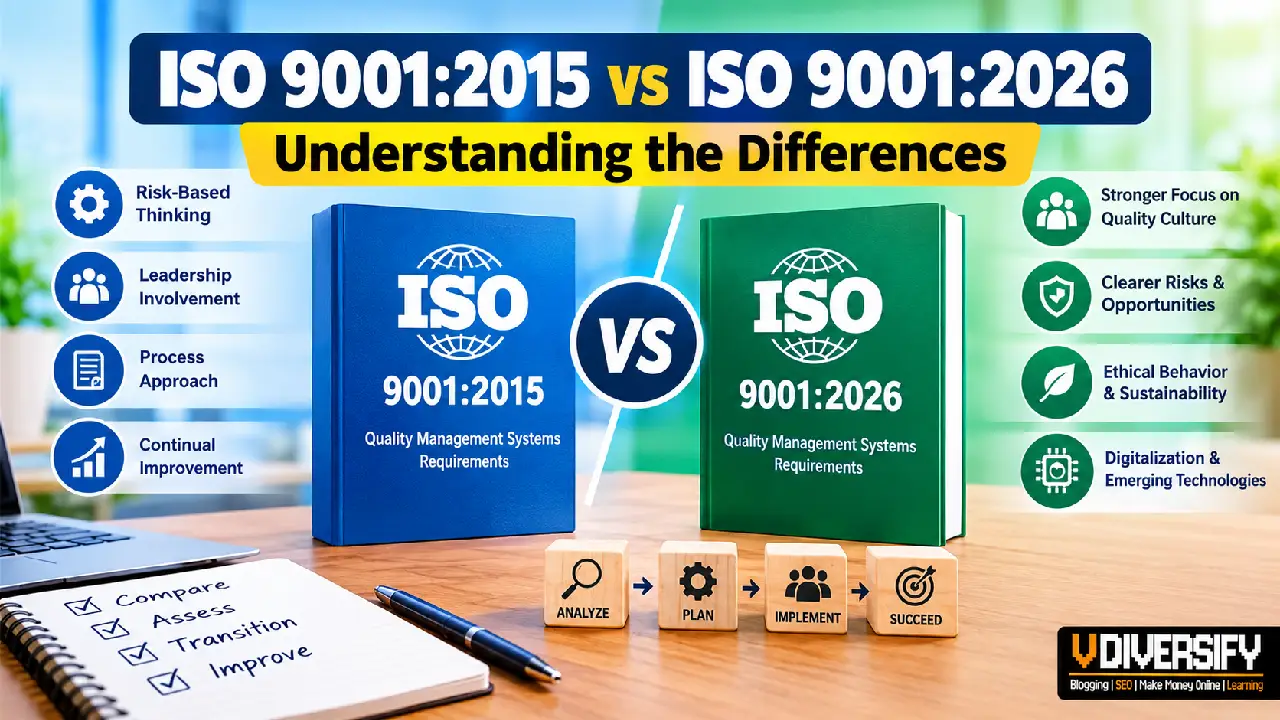
ISO 9001:2015 vs ISO 9001:2026 key differences is an important topic for quality managers, internal auditors, QA/QC engineers, and US businesses that want to maintain certification and improve their quality management systems.
The release of the revised standard raises several practical questions:
- What has changed?
- Which existing requirements remain relevant?
- Will companies need new procedures, employee training, or additional audits?
- Most importantly, how should an organization prepare for the transition without wasting time and money?
This guide explains the differences in plain English, using practical examples, comparison tables, and implementation advice to help organizations understand the new edition and prepare their quality management systems.
Contents
- 1. Why the Revision Matters to US Businesses?
- 2. What Is ISO 9001?
- 3. What Is ISO 9001:2015?
- 4. What Is ISO 9001:2026?
- 5. ISO 9001:2015 vs ISO 9001:2026: High-Level Comparison
- 6. ISO 9001:2015 vs ISO 9001:2026 Differences: The Major Areas of Change
- 7. Detailed Clause-by-Clause Comparison of ISO 9001:2015 and ISO 9001:2026
- 8. How Digitalization, Artificial Intelligence, and Technology Fit Into the Revision
- 9. Climate Change and Environmental Considerations in ISO 9001:2026
- 10. Practical Example: A US Manufacturer Preparing for ISO 9001:2026
- 11. Key Lessons From the Clause Comparison
- 12. How to Transition From ISO 9001:2015 to ISO 9001:2026
- 13. ISO 9001:2026 Transition Timeline and Deadline
- 14. How Much Does the Transition Cost?
- 15. Common Mistakes to Avoid During the Transition
- 16. ISO 9001:2026 Transition Readiness Checklist
- 17. Transition progress
- 18. Conclusion: Prepare Early and Make the Transition Count
- 19. FAQs
Why the Revision Matters to US Businesses?
ISO 9001 is one of the world’s best-known standards for quality management systems (QMS). It provides a structured approach for organizations to control their processes, meet customer requirements, manage risks, and improve the quality of their products and services.
In the United States, ISO 9001 certification is relevant to manufacturers, engineering companies, aerospace and automotive suppliers, construction businesses, medical device supply chains, logistics providers, software companies, and professional service organizations.
Many companies use certification to demonstrate that they have established processes for consistently meeting customer and applicable regulatory requirements.
However, obtaining certification is only the beginning. A quality management system must continue to work as the organization grows, introduces new technology, changes suppliers, hires employees, or enters new markets.
That is why revisions to ISO 9001 matter. A change to the standard may affect the way an organization evaluates risks, assigns responsibilities, trains employees, controls processes, measures performance, and demonstrates compliance during an audit.
The 2026 edition needs to be understood in this context. Companies should not assume that every existing procedure is now incorrect, nor should they assume that their current certification automatically demonstrates conformity with the revised edition.
They need to understand the published requirements and determine which changes apply to their own operations.
This article compares the 2015 and 2026 editions, explains the significance of the revised requirements, and provides a practical approach to transition planning for organizations operating in the United States.
What Is ISO 9001?
ISO 9001 is an international standard that specifies requirements for a quality management system. It was developed by the International Organization for Standardization (ISO) to help organizations establish processes that consistently meet customer requirements and applicable statutory and regulatory requirements.
The standard can be applied to organizations of different sizes and across different industries. It does not require every business to follow an identical set of procedures. Instead, it establishes a common framework that organizations use to manage quality according to their products, services, processes, risks, and business environment.
For example, a US manufacturer may use ISO 9001 to control production specifications, inspect incoming materials, monitor manufacturing performance, and manage defective products.
A consulting firm may apply the same standard to control project requirements, review deliverables, manage customer feedback, and verify the quality of its services.
Although their daily activities are different, both organizations need reliable processes, clear responsibilities, competent employees, and evidence that their quality management systems are effective.
The main objectives of ISO 9001
An effective quality management system helps an organization:
- Meet customer requirements consistently.
- Reduce process errors, rework, and avoidable waste.
- Identify and address risks that could affect quality.
- Establish clear responsibilities and process controls.
- Monitor performance using relevant data.
- Manage suppliers and externally provided products or services.
- Investigate nonconformities and take corrective action.
- Improve customer satisfaction and overall process performance.
ISO 9001 does not guarantee that every product will be defect-free. Instead, it requires an organization to establish and maintain a system that supports consistent results, evaluates performance, and addresses problems when they occur.
For example, if a machine shop repeatedly produces components outside the specified dimensional tolerance, an effective QMS should help identify the problem, contain affected products, investigate the cause, implement appropriate action, and verify whether that action worked.
This process-based approach remains central to understanding the relationship between the 2015 and 2026 editions.
What Is ISO 9001:2015?
ISO 9001:2015 was published in September 2015 and introduced a number of important changes compared with its predecessor, ISO 9001:2008. These included a stronger emphasis on risk-based thinking, organizational context, leadership involvement, and the integration of quality management into business processes.
The 2015 edition uses the High-Level Structure, also known as the common management system structure, which helps align ISO 9001 with other standards such as ISO 14001 for environmental management.
It contains ten main clauses. The first three establish the scope, references, and terminology, while Clauses 4 through 10 contain the principal requirements that organizations implement and auditors assess.
The ten clauses of ISO 9001:2015
Clause | Title | Main purpose |
1 | Scope | Defines the standard’s scope and intended application. |
2 | Normative references | Identifies referenced documents. |
3 | Terms and definitions | Establishes terminology. |
4 | Context of the organization | Understands internal and external issues, interested parties, and QMS scope. |
5 | Leadership | Establishes leadership responsibilities and the quality policy. |
6 | Planning | Addresses risks, opportunities, objectives, and planned changes. |
7 | Support | Covers resources, competence, awareness, communication, and documented information. |
8 | Operation | Controls the processes used to deliver products and services. |
9 | Performance evaluation | Covers monitoring, measurement, analysis, audits, and management review. |
10 | Improvement | Addresses nonconformities, corrective action, and continual improvement. |
Clauses 4 through 10 form the main operational framework for an ISO 9001 quality management system. Organizations should understand how these clauses connect rather than treating them as separate paperwork requirements.
For example, a company identifies a risk under Clause 6, assigns suitable resources under Clause 7, establishes process controls under Clause 8, monitors results under Clause 9, and takes corrective action or makes improvements under Clause 10.
The clauses work together to support a functioning management system.
Why organizations adopted the 2015 edition
The 2015 edition moved away from the idea that quality management depends mainly on written procedures and inspection records. It encouraged organizations to consider the wider business environment, involve leadership, and integrate quality into everyday decision-making.
Three features were particularly important.
- Risk-based thinking
Organizations were expected to consider risks and opportunities that could affect the intended results of their QMS. This encouraged preventive planning instead of relying only on corrective action after a failure occurred.
- Leadership involvement
Top management became more directly accountable for the effectiveness of the QMS. Quality could not be treated as the responsibility of the quality department alone.
- Process-based management
Organizations were encouraged to manage connected processes, understand their interactions, and monitor whether those processes achieved their intended results.
Consider an electronics manufacturer that depends on a single supplier for a critical component. Under a process-based and risk-aware approach, the organization should consider the consequences of supplier failure, establish appropriate controls, and monitor supplier performance.
Waiting until production stops would be a weaker way to manage the same risk.
These principles provide the foundation for understanding what the 2026 edition changes and what organizations should retain from their existing systems.
What Is ISO 9001:2026?
ISO 9001:2026 is the sixth edition of the international quality management system standard. It was officially published on September 16, 2026, replacing the 2015 edition as the current version. The revision builds on the existing framework instead of requiring organizations to start their quality management systems from scratch.
The revision responds to changes in how businesses operate, including increasingly connected supply chains, changing customer expectations, new technologies, and the need for organizations to respond effectively to change.
For organizations already using the 2015 edition, the main task is to understand the revised requirements, identify gaps, and update the QMS where necessary.
Why was ISO 9001 revised?
ISO standards are reviewed periodically to ensure that they remain useful and relevant. Business conditions change, and a management system standard must continue to support organizations operating in different industries, markets, and environments.
The 2026 revision aims to improve the clarity and usability of the requirements while retaining the established principles of quality management. ISO identifies leadership, quality culture, ethical behavior, and clearer treatment of risks and opportunities among the important areas of the update.
The revision is particularly relevant to businesses that want quality management to influence everyday decisions rather than exist mainly to satisfy an external audit.
Consider a US manufacturer that meets its inspection targets but repeatedly experiences late deliveries because of poor supplier planning. A useful quality management system should help management examine the causes, evaluate the risks, assign responsibility, and improve the process. The revised standard reinforces the importance of an effective system that supports organizational performance.
Does ISO 9001:2026 require organizations to start over?
No. Organizations should retain effective processes and make targeted changes where the revised requirements call for them. ISO confirms that the new edition keeps the familiar management system structure, allowing existing users to build on their current systems.
For example, a company that already has an effective internal audit program, supplier evaluation process, document control system, and corrective action process should review those arrangements rather than automatically replace them.
The organization should determine whether its existing practices meet the revised requirements and whether its employees understand their responsibilities.
A practical approach is to:
- Obtain and review the published 2026 standard.
- Compare the new requirements with the existing QMS.
- Identify gaps and assess their importance.
- Assign responsibility for necessary changes.
- Update relevant processes, documented information, and training.
- Verify that the revised arrangements work in practice.
The objective is not to produce more paperwork. It is to maintain a system that works and can demonstrate conformity to the applicable requirements.
ISO 9001:2015 vs ISO 9001:2026: High-Level Comparison
The most useful way to understand the revision is to compare the two editions across their main areas of emphasis.
The following table provides a high-level overview. It distinguishes the overall direction of the revision from the detailed requirements that organizations must verify against the published standard.
Area of comparison | ISO 9001:2015 | ISO 9001:2026 |
Overall framework | Established QMS framework based on the 2015 edition | Retains the established framework with targeted revisions |
Clause structure | Ten main clauses | Retains the familiar Harmonized Structure |
Leadership | Requires leadership commitment and accountability | Gives clearer emphasis to quality culture, ethical behavior, and leadership |
Organizational context | Requires consideration of internal and external issues | Continues the context-based approach within the revised framework |
Risks and opportunities | Requires organizations to address relevant risks and opportunities | Provides clearer separation and explanation of risks and opportunities |
Quality culture | Quality is supported through leadership, awareness, and process controls | Quality culture receives more explicit attention |
Documented information | Requires documented information where specified or necessary | Existing controls should be reviewed against the revised requirements |
Performance evaluation | Covers monitoring, measurement, analysis, audits, and management review | The established evaluation framework remains, with revised requirements to assess |
Continual improvement | Requires improvement and corrective action | Retains the improvement approach within the updated framework |
Integration with other standards | Uses a common management system structure | Aligns with the latest Harmonized Structure |
Certification transition | Previous edition | Certified organizations must transition within the applicable transition period |
Sources: ISO’s official announcement and its guidance for organizations using the revised standard.
This table is a starting point, not a substitute for a formal clause-by-clause gap assessment. Organizations should consult the actual published standard before deciding whether a particular procedure, record, or control needs to change.
What remains the same?
Although the revision introduces changes, the basic purpose of quality management remains familiar.
Organizations still need to understand customer requirements, manage relevant processes, provide suitable resources, ensure employee competence, control operations, evaluate performance, address nonconformities, and improve the QMS.
The familiar ten-clause framework also remains in place. This means that organizations with a well-established system should be able to use much of their existing documentation and process knowledge.
For example, an automotive supplier that already controls inspection equipment, monitors supplier performance, maintains production records, and investigates customer complaints does not need to abandon those controls simply because a new edition has been published.
It should instead verify that those controls remain appropriate and meet the revised requirements.
What deserves closer attention?
Four areas deserve particular attention during the initial review:
- Leadership and quality culture: Determine whether leaders actively support quality and ethical behavior, rather than leaving quality matters entirely to the quality department.
- Risks and opportunities: Review how the organization identifies risks, evaluates opportunities, and decides on suitable actions.
- Understanding requirements: Examine the revised wording and explanatory material so that employees and auditors interpret requirements consistently.
- Management system integration: Consider how the updated structure affects an organization that also uses environmental, occupational health and safety, or other management system standards.
These are sensible starting points for a gap assessment, but they should not be treated as an exhaustive list of every change in the 2026 edition.
ISO 9001:2015 vs ISO 9001:2026 Differences: The Major Areas of Change
The differences between the editions are better understood by looking at how they affect real management decisions. A revised requirement may involve more than changing a sentence in a procedure; it may require an organization to review how leaders act, how risks are evaluated, or how responsibilities are communicated.
1. Greater emphasis on quality culture and ethical behavior
One of the notable changes is the more explicit attention given to quality culture and ethical behavior. The official announcement highlights their importance, and revision summaries identify stronger references to these topics in leadership and related requirements.
Quality culture describes how people across an organization understand, value, and act on quality. It includes the decisions employees make when they discover a defect, encounter an unclear specification, or face pressure to meet a delivery deadline.
A strong quality culture encourages employees to report problems honestly, follow approved processes, and raise concerns without being pushed to hide mistakes.
Example: A production supervisor discovers that a batch of components failed an inspection. Shipping the batch to meet a customer deadline may appear to protect short-term performance, but it creates a risk to the customer and the business. A healthy quality culture supports reporting the failure, controlling the affected product, and involving the appropriate people in the decision.
For US businesses, the practical review should consider whether:
- Senior leaders demonstrate their commitment to quality through decisions and actions.
- Employees understand the importance of meeting customer and product requirements.
- Quality concerns are escalated through suitable channels.
- Production targets do not encourage employees to bypass required controls.
- Managers respond appropriately to reported problems.
A quality policy alone does not establish a strong quality culture. Employees need to see consistent behavior from leadership, and the organization’s day-to-day decisions should support the quality objectives.
2. Clearer treatment of risks and opportunities
Risk-based thinking was already a core feature of the 2015 edition. Organizations were expected to consider relevant risks and opportunities when planning their QMS and determining actions to address them.
The 2026 revision provides clearer treatment of these topics, including a more distinct separation between risks and opportunities. This is intended to help organizations understand the requirements and apply them more consistently.
Source: Quality management systems — Requirements
A risk is something that could prevent an organization from achieving an intended result or create an unwanted outcome. An opportunity is a possibility that could improve performance, customer satisfaction, efficiency, or another intended result.
For example, a supplier’s financial instability may create a risk of production interruption. Qualifying a second supplier may create an opportunity to improve supply continuity and reduce dependence on a single source.
Organizations should examine whether their current risk process:
- Identifies relevant threats to product and service conformity.
- Considers changes in suppliers, technology, staffing, and customer requirements.
- Separately recognizes beneficial opportunities.
- Assigns responsibility for appropriate actions.
- Evaluates whether the actions have been effective.
A company does not necessarily need a complex risk scoring system. A simple, well-maintained method may be appropriate for a small business, while a large manufacturer with multiple sites and critical suppliers may need a more detailed approach.
The important point is that risk and opportunity decisions should be connected to actual business processes rather than recorded only to satisfy an audit.
3. Clearer explanations of requirements
Another important development is the introduction of Annex A with explanatory material to help users understand the intent of the requirements. ISO’s revision information highlights improved clarity and usability as key aims of the new edition.
This matters because two organizations may interpret the same requirement differently, especially when they use different audit methods, procedures, or industry practices.
For example, a small engineering consultancy and a large manufacturing company will not need identical operational controls. Both must understand the applicable requirements and establish arrangements appropriate to their activities.
The explanatory material can help users understand how to apply the requirements, but organizations must distinguish between mandatory requirements and explanatory guidance. Guidance does not automatically create a new mandatory obligation.
4. Continued focus on organizational context
Understanding organizational context remains an important part of a quality management system. Businesses must consider the internal and external issues that affect their ability to achieve intended QMS results.
For a US company, relevant issues could include:
- Changes in customer expectations or contract requirements.
- Supplier availability and supply chain disruption.
- Workforce competence and employee turnover.
- New production technology or software systems.
- Changes in applicable legal or regulatory requirements.
- Competition, market conditions, and business expansion.
For example, a manufacturer that introduces automated inspection equipment should consider whether employees need new training, whether the equipment produces reliable results, and whether existing inspection controls remain suitable.
The important lesson is that the QMS should reflect the organization’s actual operating environment. It should not remain unchanged when the business faces significant new challenges.
Detailed Clause-by-Clause Comparison of ISO 9001:2015 and ISO 9001:2026
Understanding the revised standard requires more than reading a summary of the changes. Organizations need to examine how the requirements affect their existing processes, responsibilities, documented information, and audit evidence.
The following sections explain the main areas that quality professionals should review when comparing the two editions. The focus is on practical implementation for US businesses, including manufacturers, engineering firms, suppliers, and service providers.
An important rule applies throughout this comparison: do not change a procedure simply because the standard has a new edition. First, identify the applicable requirement, compare it with the organization’s current practice, and determine whether a change is necessary.
5. Clause 4: Context of the Organization
Clause 4 establishes the foundation of a quality management system. It requires organizations to understand their circumstances, identify relevant interested parties, determine the QMS scope, and establish the processes needed to achieve intended results.
The 2026 edition retains this foundation while providing revised requirements that organizations need to assess against their current systems. The key practical question is whether the organization understands the issues that can affect its ability to provide conforming products and services.
What should organizations review?
A useful review covers three areas:
- Internal and external issues: Are the important factors affecting quality identified and reviewed when circumstances change?
- Interested parties: Does the organization understand relevant customer, regulatory, supplier, and other applicable requirements?
- QMS scope and processes: Does the documented scope accurately reflect the organization’s activities, and are the necessary process interactions understood?
For example, consider a US company that manufactures precision-machined parts for industrial equipment. It expands into a second facility and introduces a new production line. The organization should evaluate whether the existing QMS scope, process responsibilities, inspection arrangements, and resource planning still reflect its operations.
Simply adding the new facility’s address to a certificate would not, by itself, demonstrate that the quality management system adequately controls the expanded operation.
Practical action: Review the context analysis at planned intervals and when significant business changes occur. Keep the information relevant and usable rather than creating lengthy lists that have little connection to actual decisions.
6. Clause 5: Leadership and Commitment
Leadership remains central to an effective quality management system. Top management is responsible for ensuring that quality management is integrated into business processes, that the quality policy and objectives are appropriate, and that the QMS achieves its intended results.
The 2026 revision places additional emphasis on quality culture and ethical behavior, making leadership practices an important area for organizations to examine.
How should leadership responsibilities be demonstrated?
Senior managers should be able to explain how quality supports business objectives and how they ensure that employees have the resources and authority needed to meet requirements.
Examples of useful evidence include:
- Management review records showing decisions about QMS performance.
- Quality objectives linked to relevant business priorities.
- Actions taken to address recurring customer complaints.
- Decisions to provide additional training or equipment.
- Communication that encourages employees to report quality concerns.
- Evidence that quality risks are considered before major changes are approved.
Imagine a manufacturer that has a monthly production target of 50,000 units. Employees discover that a machine is producing parts outside the approved tolerance. If management pressures the team to continue production without appropriate controls, the organization’s actions may undermine its stated commitment to quality.
A stronger approach is to contain potentially affected products, assess the extent of the problem, and determine whether production can safely resume after corrective measures are taken.
Practical action: Review management responsibilities, decision-making arrangements, and communication practices. Quality should be part of operational and commercial decisions, not just the responsibility of the quality manager.
7. Clause 6: Planning, Risks, Opportunities, and Quality Objectives
Clause 6 addresses planning for the QMS, including actions to address risks and opportunities, establishing quality objectives, and managing planned changes.
The revised edition gives organizations reason to examine how clearly they distinguish risks from opportunities and how effectively they translate planning decisions into action.
Source: Quality management systems — Requirements
Risks and opportunities
A risk may involve a supplier failure, an increase in product defects, a loss of skilled employees, or a change in customer specifications. An opportunity may involve automation, improved supplier performance, better process monitoring, or a more effective service delivery method.
For example, a medical equipment component supplier may identify that one inspection station is responsible for checking a critical dimension on every production batch. If the station fails, production may stop while the company arranges alternative inspection capacity.
The organization could evaluate the risk and consider appropriate controls, such as maintenance planning, suitable backup arrangements, or a qualified alternative inspection method.
The right action depends on the severity of the risk, the nature of the process, and the organization’s requirements. ISO 9001 does not prescribe one universal risk register format.
Quality objectives
Quality objectives should be measurable where practicable, monitored, communicated, and updated as appropriate.
A company might establish objectives such as:
Quality objective | Example target | Monitoring method |
Reduce customer complaints | 15% reduction over 12 months | Complaint trend report |
Improve on-time delivery | At least 96% | Delivery performance dashboard |
Reduce production scrap | Below 2.5% of output | Scrap and yield records |
Improve corrective action | 90% completed by agreed due dates | Corrective action log |
Improve supplier quality | Reduce incoming defects by 20% | Supplier performance reports |
These are illustrative targets, not ISO-prescribed limits. Each organization should select objectives that suit its processes, customer requirements, risks, and business priorities.
Planning changes
Organizations should also consider the possible effects of planned changes. A change in a production method, software system, supplier, facility, or staffing arrangement may affect product conformity and process performance.
Practical action: Review the risk and opportunity process, verify that quality objectives remain relevant, and confirm that significant changes are planned and controlled.
8. Clause 7: Support, Competence, Awareness, and Documented Information
Clause 7 addresses the resources and support needed to operate the QMS. These include people, infrastructure, the process environment, monitoring and measuring resources, organizational knowledge, competence, awareness, communication, and documented information.
The 2026 transition should prompt organizations to verify that these arrangements remain effective and meet the revised requirements. It does not automatically mean that every form, procedure, or record must be rewritten.
Employee competence and awareness
Employees need the competence required for their assigned work. Where a competence gap exists, the organization should take appropriate action and evaluate whether that action was effective.
For example, a company introducing a new coordinate measuring machine may need to train inspectors in the approved measurement method, equipment operation, interpretation of results, and applicable acceptance criteria.
Training attendance alone is not always sufficient evidence of competence. Depending on the task, useful evidence might include practical assessments, supervised work, qualification records, or demonstrated ability to perform the process correctly.
Documented information
Organizations should review controlled procedures, work instructions, forms, inspection records, and other documented information against the revised standard.
The objective is to ensure that information is suitable, available where needed, and protected from unintended changes or loss.
A practical review should ask:
- Is the document still accurate?
- Does it reflect the process actually being followed?
- Are responsibilities clear?
- Is the document available at the point of use?
- Are obsolete versions appropriately controlled?
- Are required records retained for the appropriate period?
For a US manufacturer, this may include inspection plans, equipment maintenance records, production instructions, supplier approvals, and nonconformity reports.
Practical action: Use a document register to identify affected documents and assign owners. Update only what needs to change, and communicate revised instructions to the employees who use them.
9. Clause 8: Operation and Process Controls
Clause 8 covers the processes an organization uses to deliver products and services that meet customer and applicable requirements. It includes operational planning, customer requirements, design and development where applicable, external providers, production, service provision, release of products and services, and control of nonconforming outputs.
For many organizations, this clause is already supported by detailed work instructions, inspection plans, supplier controls, production records, and customer order reviews.
The main priority during the 2026 transition is to verify that these arrangements continue to meet the revised requirements. The overall operational framework remains familiar, and the changes are generally more limited than the major restructuring that accompanied the 2015 edition.
Source: DNV
Customer requirements and operational planning
Organizations need to establish how customer requirements are reviewed and how the processes necessary to meet those requirements are controlled.
For example, a US manufacturer receives an order for 5,000 machined components with specified dimensions, surface finish, material grade, and delivery date.
Before production begins, the company should confirm that it can meet the requirements, that the correct drawings and specifications are available, and that the necessary equipment, materials, and competent personnel are available.
If the customer changes a drawing after production has started, the organization should assess the change and control its implementation. Otherwise, different departments may work to different versions of the specification.
Supplier and outsourced process controls
Supplier performance can directly affect product quality, delivery, and customer satisfaction.
A company that purchases precision bearings, electronic components, packaging materials, or outsourced testing services should determine the controls appropriate to the supplier and the potential effect of its output.
Useful evidence may include:
- Approved supplier records.
- Supplier performance and defect data.
- Purchase specifications and acceptance criteria.
- Incoming inspection results.
- Records of supplier corrective action.
- Verification of externally provided services.
The appropriate level of control depends on the risk and the importance of the supplied product or service. Not every supplier requires the same inspection frequency or evaluation method.
Production, service provision, and traceability
Organizations should also review whether their production and service processes remain controlled.
A manufacturer might use machine settings, first-piece inspection, in-process checks, and final inspection to verify conformity. A service provider might use project reviews, approval checkpoints, and verification of deliverables.
Where identification and traceability are required, the organization should ensure that relevant products, materials, records, and results can be connected appropriately.
Practical action: Review operational procedures against the published 2026 requirements, paying particular attention to changed terminology, references, and any affected process controls. Avoid adding unnecessary inspections or records when existing controls already provide adequate evidence of conformity.
10. Clause 9: Performance Evaluation
Clause 9 addresses how organizations determine whether their quality management systems are effective. It includes monitoring, measurement, analysis, evaluation, internal audits, and management review.
The fundamental performance evaluation framework remains in place in the 2026 edition. Organizations should focus on understanding the revised requirements and using available information to make sound decisions, rather than assuming they need to introduce an entirely new audit or measurement system.
Monitoring and measurement
Organizations should identify what needs to be monitored and measured, how the results will be evaluated, and when the evaluation will take place.
Examples of useful quality performance indicators include:
Performance indicator | What it helps measure |
Customer complaint rate | Customer-reported quality problems |
First-pass yield | Percentage of units passing without rework |
Scrap rate | Material or product lost through defects |
On-time delivery | Ability to meet agreed delivery dates |
Supplier defect rate | Quality of externally supplied products |
Corrective action effectiveness | Whether implemented actions address the problem |
Customer satisfaction | Customer perceptions of the organization’s performance |
These indicators are examples rather than mandatory ISO targets. Organizations should choose measures that provide meaningful information about their processes and customer requirements.
For example, a factory might achieve a high production volume while its scrap rate continues to rise. Looking only at output could hide a growing quality problem. Reviewing both production and defect data gives management a more complete picture.
Internal audits
Internal audits help determine whether the QMS conforms to applicable requirements and is effectively implemented and maintained.
Organizations should retain an audit program that considers process importance, changes affecting the organization, and previous audit results.
A useful audit should examine actual process performance, not just whether a procedure exists.
For example, an auditor reviewing inspection activities might compare the approved inspection plan with the records generated on the production floor. If the procedure requires verification of three critical dimensions but the records show that only two were checked, the auditor should investigate the discrepancy and determine whether a nonconformity exists.
The organization should also ensure that audit findings are communicated to the appropriate managers and that necessary follow-up actions are taken.
Management review
Management review gives top management an opportunity to evaluate the continuing suitability, adequacy, and effectiveness of the QMS.
Organizations should review relevant performance information, customer feedback, audit findings, nonconformities, process results, risks and opportunities, and the need for changes or improvements.
For example, a management review may identify that customer complaints have increased even though final inspection results remain acceptable. Management could investigate whether the problem relates to packaging, delivery damage, unclear customer communication, or another process outside final inspection.
Practical action: Review the internal audit program, performance indicators, and management review arrangements. Ensure that the information presented to management supports decisions and leads to appropriate action.
11. Clause 10: Improvement and Corrective Action
Improvement remains a key part of ISO 9001. Organizations need to address nonconformities, take appropriate corrective action, and continually improve the suitability, adequacy, and effectiveness of their QMS.
One structural change in the 2026 edition is that continual improvement is consolidated under Clause 10.1, while nonconformity and corrective action are addressed under Clause 10.2. The former separate Clause 10.3 in the 2015 edition is no longer present as a separate clause.
Source: Qlause
This is an important detail for auditors and quality professionals updating clause references in procedures, audit checklists, training materials, and QMS documentation.
Nonconformity and corrective action
A nonconformity occurs when a requirement has not been fulfilled. Corrective action addresses the cause of a nonconformity to prevent recurrence or occurrence elsewhere, as appropriate.
For example, a customer reports that several delivered components have incorrect hole spacing.
A sound response may involve:
- Recording the complaint and identifying affected products.
- Assessing whether other batches may be affected.
- Taking appropriate containment or correction measures.
- Investigating the cause of the problem.
- Implementing corrective action where necessary.
- Checking whether the action was effective.
The organization should avoid treating every complaint as an isolated event. If the same problem occurs repeatedly, it may indicate a weakness in process controls, training, equipment maintenance, or change management.
Continual improvement
Improvement does not need to involve a major project or expensive technology. It can result from better work instructions, improved supplier controls, reduced process variation, more effective training, or simpler ways of managing information.
The revised standard’s explanatory material also recognizes that changes in context, risks, opportunities, and technology can influence improvement.
Practical action: Review corrective action procedures, verify the updated clause references, and make sure management supports improvements that benefit the organization as a whole.
How Digitalization, Artificial Intelligence, and Technology Fit Into the Revision
Digital tools are becoming more common in quality management. Organizations use electronic inspection records, automated data collection, statistical process control software, supplier portals, document management systems, and AI-supported analysis.
However, it is important to distinguish between technology that an organization chooses to use and technology that ISO 9001 actually requires.
ISO 9001:2026 does not require every organization to implement artificial intelligence or purchase new quality management software. Organizations should choose technology according to their needs, resources, risks, and operational objectives.
Using digital tools to improve quality
A digital QMS may help an organization:
- Control document versions and approvals.
- Track corrective actions and due dates.
- Monitor nonconformities and customer complaints.
- Analyze inspection and production data.
- Maintain training and competence records.
- Review supplier performance.
- Prepare reports for management review.
For example, a manufacturer could use statistical software to identify a gradual increase in the diameter variation of machined parts. Early identification may allow the company to investigate tool wear before more products fall outside the specified tolerance.
AI tools may also help summarize quality trends or identify patterns in large datasets. However, their outputs should be checked by competent personnel, particularly when decisions affect product conformity, customer requirements, or safety.
What should organizations consider before adopting new technology?
A company should assess whether a digital solution improves the effectiveness of its QMS and whether appropriate controls are in place.
Relevant considerations include:
- Accuracy and reliability of data.
- Access permissions and protection of records.
- Validation or verification appropriate to the intended use.
- Employee competence and training.
- Dependence on software providers.
- Risks associated with incorrect automated recommendations.
Technology should support effective process management, not create an additional layer of complexity without a clear benefit.
Climate Change and Environmental Considerations in ISO 9001:2026
Climate change was addressed through an amendment to ISO management system standards in 2024. The amendment introduced explicit consideration of climate change into the organizational context and interested-party requirements in Clauses 4.1 and 4.2.
These provisions are integrated into the 2026 edition.
This does not mean that every organization must establish an environmental management system under ISO 9001. Instead, it means that an organization must consider whether climate change is a relevant issue that could affect its quality management system.
For example, a US food packaging supplier may face extreme weather that interrupts deliveries of raw materials. A manufacturer operating in an area exposed to flooding may need to consider whether disruption could affect production, storage, or its ability to meet customer commitments.
A service company might face climate-related disruption to its data center, office operations, or supply chain.
Organizations should determine whether these issues are relevant to their context and, where applicable, address them through their existing planning and risk management processes.
Practical action: Review the organization’s context analysis and relevant interested-party requirements. Document the reasoning and take appropriate action where climate-related issues could affect the QMS or its intended results.
Practical Example: A US Manufacturer Preparing for ISO 9001:2026
Consider a medium-sized manufacturer in Ohio that produces precision-machined components for industrial customers. It is already certified to ISO 9001:2015 and has established procedures for production control, inspection, supplier management, internal audits, and corrective action.
The organization does not need to rebuild its QMS. It needs a structured assessment of the revised requirements and a plan for addressing any gaps.
Step 1: Review the published standard
The quality manager obtains the official 2026 edition and identifies changes affecting the company’s current QMS.
Step 2: Conduct a gap assessment
The company compares its current leadership practices, risk planning, documented information, and improvement processes against the revised requirements.
Step 3: Involve management and employees
Managers review how quality culture and ethical behavior are demonstrated. Supervisors and employees receive training relevant to their responsibilities.
Step 4: Update affected processes
The organization revises documents and clause references where necessary while retaining effective inspection, supplier control, and corrective action processes.
Step 5: Verify readiness
Internal auditors check whether the changes have been implemented and whether the QMS continues to meet the applicable requirements. The company coordinates its transition audit arrangements with its certification body.
This example illustrates a sensible transition approach: identify the changes, assess the gaps, implement the necessary actions, and verify their effectiveness.
The actual workload will depend on the organization’s size, existing QMS maturity, operational complexity, and the findings of its gap assessment.
Key Lessons From the Clause Comparison
The 2026 edition retains the familiar management system framework, so organizations should be able to build on their existing QMS. The most important work is to understand the revised requirements, identify actual gaps, and make targeted changes.
For quality managers and auditors, the key points are:
- Review the official text rather than relying only on summaries.
- Pay particular attention to leadership, quality culture, and ethical behavior.
- Reassess how risks and opportunities are identified and addressed.
- Verify that operational controls remain suitable and effective.
- Update affected clause references, particularly those relating to improvement.
- Keep performance evaluation and internal audits focused on real process effectiveness.
- Assess technology and climate-related issues where relevant to the organization’s context.
- Confirm transition arrangements with the certification body.
How to Transition From ISO 9001:2015 to ISO 9001:2026
For organizations already certified to ISO 9001:2015, the transition should be treated as a planned improvement project rather than a last-minute documentation exercise.
The objective is to understand the revised requirements, identify gaps, update affected processes, and demonstrate that the quality management system meets the applicable requirements of the 2026 edition.
The first step is to obtain the official standard and confirm the transition arrangements with the organization’s certification body. Organizations should not assume that the transition deadline, audit method, or certification arrangements are identical for every certification scheme or provider.
Step 1: Obtain the official ISO 9001:2026 standard
Start by obtaining an authorized copy of the published standard from ISO or an authorized national standards body.
Use the official text as the basis for your assessment. Articles, training materials, audit checklists, and online summaries can help explain the changes, but they should not replace the requirements themselves.
Official reference: ISO 9001 — Quality management systems.
The quality manager should identify the clauses that have changed and determine which departments, processes, procedures, and records may be affected.
For example, if the organization uses an internal audit checklist based on the 2015 edition, the checklist should be reviewed against the 2026 edition. Simply changing the document’s title from 2015 to 2026 would not be sufficient.
Step 2: Conduct a gap assessment
A gap assessment compares the organization’s existing quality management system with the requirements of the revised standard.
The assessment should identify what already meets the requirements, what needs improvement, and what requires further investigation.
A practical gap assessment may include:
- Reviewing the existing QMS scope and process map.
- Comparing the requirements of the two editions.
- Reviewing the quality policy and objectives.
- Assessing leadership responsibilities and quality culture.
- Reviewing risk and opportunity planning.
- Checking competence, awareness, and documented information.
- Evaluating operational controls and supplier management.
- Reviewing internal audits, management reviews, and corrective action.
- Identifying any new or revised requirements that need implementation.
Each finding should have an owner, a target completion date, and a suitable method for verifying completion.
Step 3: Prepare a transition action plan
Once the gaps have been identified, create a transition plan that prioritizes actions according to their importance.
For example, a gap affecting product conformity or customer requirements should receive more attention than a minor document formatting issue.
A transition plan can use the following format.
Action | Responsible person | Target timing | Evidence of completion |
Review revised standard | Quality manager | First phase | Documented review |
Complete gap assessment | Quality team and process owners | Early in the project | Approved gap report |
Review leadership practices | Top management | After initial assessment | Meeting records and assigned actions |
Update affected documents | Document owners | Based on gap findings | Approved document revisions |
Conduct employee training | Department managers | Before affected processes change | Training and competence records |
Perform internal audit | Internal audit team | After implementation | Audit report and findings |
Review readiness | Top management | Before certification assessment | Management review or documented decision |
Coordinate transition audit | Quality manager and certification body | According to agreed arrangements | Confirmed audit plan |
The timings in this table are illustrative, not official transition deadlines.
Practical tip: Do not assign every action to the quality manager. Process owners should be responsible for implementing changes in their own departments, while the quality manager coordinates the project and verifies overall readiness.
Step 4: Train employees and communicate the changes
Training should be based on employees’ responsibilities and the effect of the revised requirements on their work.
Senior managers may need a briefing on leadership responsibilities and quality culture. Internal auditors may require training on revised requirements and audit criteria. Production employees may need updated work instructions or training if their processes change.
A short awareness session may be enough for some employees, while specialized training may be necessary for those responsible for auditing or managing affected processes.
For example, if the organization changes its corrective action procedure, employees who raise nonconformities need to understand the revised reporting process. Managers responsible for investigating causes need to understand their responsibilities for selecting and verifying actions.
Retain appropriate evidence of training and competence, but avoid organizing training sessions that do not address an identified need.
Step 5: Update documents and implement necessary changes
The next step is to update the documented information affected by the gap assessment.
This may include:
- QMS manuals or descriptions, where used.
- Procedures and work instructions.
- Internal audit checklists.
- Risk and opportunity records.
- Training materials.
- Corrective action forms.
- Management review inputs and outputs.
- Clause references in compliance matrices.
Not every organization needs a quality manual, and not every process requires a separate procedure. The documentation should reflect the organization’s needs and the applicable requirements.
After documents are revised, ensure that the changes are approved, communicated, and implemented. A procedure that has been updated but is not followed in practice does not demonstrate effective implementation.
Step 6: Conduct an internal audit against the revised standard
An internal audit provides an opportunity to check whether the revised arrangements have been implemented and whether the QMS conforms to the applicable requirements.
The audit should use the published 2026 edition as its criteria, together with relevant customer, regulatory, and organizational requirements.
Auditors should examine actual evidence, including interviews, records, observations, and process results.
For example, if the organization has introduced changes to its risk management process, the auditor should verify that the changes are reflected in actual risk assessments and that relevant actions have been taken. The existence of a revised procedure alone is not sufficient.
Any nonconformities identified during the audit should be addressed through the organization’s established corrective action process.
Step 7: Coordinate the certification transition
Contact the certification body early to confirm its transition process, audit requirements, scheduling arrangements, and applicable fees.
Do not assume that completing an internal gap assessment automatically changes the status of an existing certificate. The certification body must apply the relevant certification arrangements before the organization can be certified to the revised edition.
For official information, begin with the ISO website and consult the organization’s certification body for the requirements that apply to its certificate.
ISO 9001:2026 Transition Timeline and Deadline
One of the most important questions for certified organizations is how long they have to transition.
According to the published transition requirements, the transition period is three years from publication of the revised standard. ISO 9001:2026 was published on September 16, 2026, and the final transition deadline for organizations certified to the 2015 edition is September 30, 2029.
Important transition dates
Date | Milestone |
September 16, 2026 | ISO 9001:2026 published |
March 31, 2027 | Accreditation bodies must be ready to assess against the revised edition |
June 30, 2027 | Deadline for accredited certification bodies to submit transition declarations and supporting information |
September 30, 2027 | Deadline for accreditation bodies to complete transition decisions |
March 31, 2028 | New and initial accredited certifications may only be issued to ISO 9001:2026 |
September 30, 2029 | Deadline for organizations certified to ISO 9001:2015 to complete their transition |
Source: ISO/TC 176 transition announcement and Global Accreditation Cooperation Incorporated.
These dates describe the overall transition framework. Certification bodies may have their own application procedures, audit scheduling requirements, and arrangements for handling the transition.
Do not wait until 2029 to begin preparing. Organizations should contact their certification body early, understand the applicable arrangements, and schedule their transition audit with enough time to resolve any findings before the deadline.
What happens if a company misses the deadline?
An organization that has not completed the required transition by September 30, 2029, risks losing the validity of its ISO 9001:2015 certification under the transition arrangements. This may affect customer approvals, supplier qualification, and contracts that require valid ISO 9001 certification.
For this reason, companies should treat the deadline as a certification planning requirement, not simply as a date for updating internal documents.
How Much Does the Transition Cost?
The cost of moving from ISO 9001:2015 to ISO 9001:2026 depends on the size and complexity of the organization, the maturity of its existing QMS, the number of sites, and the amount of work needed to address identified gaps.
There is no single transition price that applies to every US company.
Main cost factors
Cost factor | What affects the cost |
Standard purchase | Cost of obtaining the authorized standard |
Training | Number of employees and level of training required |
Internal resources | Time spent on gap assessment, document updates, and implementation |
Consulting support | Whether external assistance is required |
Internal audits | Time needed to verify the revised system |
Certification audit | Certification body fees and any additional audit time |
Corrective action | Resources needed to address identified gaps |
A company with a mature QMS and a small number of straightforward processes may need relatively limited changes. A large organization with several facilities, complex outsourced processes, or inconsistent implementation may require considerably more effort.
How to control transition costs
Organizations can keep costs under control by:
- Reusing effective procedures and records.
- Assigning existing process owners to manage relevant changes.
- Training employees according to their responsibilities.
- Combining transition work with planned internal audits where appropriate.
- Discussing audit scheduling with the certification body early.
- Avoiding unnecessary software purchases and document rewrites.
For example, if a company already has an effective electronic document control system, there may be no reason to replace it solely because the standard has changed. The company should instead determine whether the system meets its current needs and applicable requirements.
The best way to control cost is to identify the actual gaps before purchasing training packages, consulting services, or new software.
Common Mistakes to Avoid During the Transition
Even organizations with years of ISO 9001 experience can make mistakes when a revised edition is introduced.
1. Changing document titles without reviewing requirements
Changing the revision date or the standard reference on a procedure does not demonstrate conformity with the new edition.
Better approach: Compare the actual requirements, identify the affected processes, and update documentation only where needed.
2. Treating the transition as the quality department’s responsibility alone
Quality management involves leadership, operations, purchasing, engineering, human resources, customer service, and other relevant functions.
Better approach: Assign responsibilities to the process owners who control the activities being changed.
3. Assuming that training attendance proves competence
Employees may attend a training session without understanding how the revised requirements affect their work.
Better approach: Use appropriate checks, such as interviews, practical demonstrations, assessments, or observation of work.
4. Confusing guidance with mandatory requirements
Explanatory material can help organizations understand requirements, but not every recommendation or example becomes mandatory.
Better approach: Distinguish requirements in the published standard from optional methods used to meet them.
5. Waiting until the last minute to book an audit
Certification bodies will need to manage transition work across many customers. Delayed planning may make it difficult to secure the preferred audit date.
Better approach: Agree on a transition plan with the certification body and allow time to address any nonconformities before the final deadline.
6. Focusing on certification instead of performance
A company may complete every required document update while continuing to experience high defect rates, recurring customer complaints, or poor delivery performance.
Better approach: Use the transition to improve the effectiveness of the QMS and connect quality objectives with real business needs.
ISO 9001:2026 Transition Readiness Checklist
Use this checklist to organize your initial transition work.
Transition progress
- Obtain the official ISO 9001:2026 standard.
- Review the published requirements and identify changes.
- Complete a gap assessment against the existing QMS.
- Assign owners and target dates for required actions.
- Review leadership responsibilities and quality culture.
- Review risks, opportunities, and quality objectives.
- Update affected procedures, records, and audit checklists.
- Train employees whose responsibilities are affected.
- Implement changes and retain appropriate evidence.
- Conduct an internal audit against the revised requirements.
- Address nonconformities and verify corrective action.
- Agree on the transition audit plan with the certification body.
- Complete the transition before September 30, 2029.
This checklist is a practical planning tool, not a substitute for the official standard or certification body’s transition requirements.
Authoritative References and Further Reading
The following resources are useful for organizations preparing for the revised standard. The official ISO publication and transition requirements should take priority over third-party summaries.
- ISO — ISO 9001:2026 official standard
The official publication page confirms the edition, publication status, and general information about the standard.
Read the official ISO publication
- ISO/TC 176 — Revision and transition information
Technical committee information about the revision, its principal changes, and transition milestones.
Read the ISO/TC 176 announcement
- Global Accreditation Cooperation Incorporated
Published transition requirements and milestones for accreditation bodies and accredited certification bodies.
Read the transition requirements announcement
- UKAS — ISO 9001:2026 transition bulletin
Accreditation transition guidance and implementation information relevant to certification bodies.
Read the UKAS technical bulletin
- NQA — ISO 9001:2026 transition guide
Practical transition information for organizations moving from the 2015 edition to the revised standard.
Conclusion: Prepare Early and Make the Transition Count
The comparison between the 2015 and 2026 editions shows that ISO 9001 continues to use an established quality management framework, with targeted revisions intended to improve clarity and usability. The revised edition places clearer emphasis on leadership, quality culture, ethical behavior, and risks and opportunities while retaining the familiar structure that organizations already know.
For US companies, the most effective approach is to begin with the published standard, perform a careful gap assessment, involve the relevant process owners, and update the QMS only where necessary.
Internal audits and management reviews should then verify that the changes work in practice and that the system continues to support customer satisfaction, product and service conformity, and continual improvement.
Organizations certified to the 2015 edition have until September 30, 2029, to complete the transition under the published transition arrangements. Starting early gives businesses more time to train employees, address gaps, coordinate certification audits, and avoid unnecessary last-minute costs.
Ultimately, the purpose of the revision is not simply to obtain an updated certificate. It is to maintain a quality management system that helps the organization understand its risks, respond to change, deliver consistent results, and improve the way it operates.
The best transition is one that meets the revised requirements while making the quality management system more useful to the business and its customers.
FAQs
1. Has ISO 9001:2026 officially replaced ISO 9001:2015?
Yes. ISO 9001:2026 was published on September 16, 2026, and is the current edition. Organizations certified to the 2015 edition should plan their transition in accordance with the applicable transition arrangements.
2. Do organizations need to rebuild their entire quality management system?
No. Organizations should retain effective existing processes and make targeted changes where necessary to meet the revised requirements. A gap assessment helps identify what needs to change and what can remain in place.
3. What is the deadline for transitioning to ISO 9001:2026?
The transition deadline for organizations certified to ISO 9001:2015 is September 30, 2029. Companies should confirm their specific transition arrangements with their certification bodies and schedule audits early enough to meet the deadline.
4. Will companies need new procedures under the revised standard?
Not necessarily. Some organizations may need to revise procedures, work instructions, training materials, or audit checklists. Others may already have processes that meet the revised requirements. The need for changes should be determined through a documented gap assessment.
5. Is ISO 9001:2026 certification mandatory for every US business?
No. ISO 9001 certification is generally voluntary. However, customers, contracts, industry supply chains, or other business arrangements may require a company to hold a valid certificate. Organizations should check their contractual and market requirements before deciding how certification affects them.
6. Can an organization transition during a surveillance audit?
A transition may be conducted alongside a scheduled surveillance or recertification audit, or through a separate transition audit, depending on the applicable arrangements. Organizations should confirm the options, audit duration, and requirements with their certification body.
7. Does ISO 9001:2026 require artificial intelligence or quality management software?
No. Organizations may use digital tools where they provide value, but the standard does not require every business to purchase AI tools or a new QMS platform. The choice should depend on the organization’s needs, resources, risks, and operational objectives.
8. What should internal auditors do first?
Internal auditors should obtain the official 2026 edition, understand the revised requirements, update their audit criteria, and identify the processes that may be affected. They should then verify implementation through interviews, observations, and records rather than relying only on document reviews.
9. What is the most important difference between the two editions?
There is no single change that matters equally to every organization. The revised edition builds on the existing framework while placing clearer emphasis on quality culture, leadership, ethical behavior, and the treatment of risks and opportunities. The practical impact depends on the organization’s existing QMS and the gaps identified during its assessment.

“Hey, I am Sachin Ramdurg, the founder of VDiversify.com.
I am QA/QC Manager, Certified Lead Auditor and Quality Champion. I am an Engineer and Passionate Blogger with a mindset of Entrepreneurship. I have been experienced in Blogging for more than 15+ years and following as a youtuber along with blogging, online business ideas, affiliate marketing, and make money online ideas since 2012.