


How German Automakers BMW Mercedes Volkswagen Use VDA 6.3 [2026]

In my experience as a Quality Manager, Certified Auditor, and QA/QC expert, one of the most common questions suppliers ask is how BMW Mercedes Volkswagen use VDA 6.3 supplier audits in real production and sourcing environments. 

The simple answer is that these German OEMs use VDA 6.3 as a structured process audit method to check whether a supplier’s systems, manufacturing controls, risk management, and product realization processes are strong enough to support serial production without quality failures. 

In 2026, this has become even more important because vehicle systems now include electronics, software integration, traceability controls, and global supply chain risks. 

The latest VDA updates continue to emphasize process maturity, risk prevention, and supplier development across the full product lifecycle.

For suppliers working with BMW, Mercedes-Benz, Volkswagen, Audi, or Porsche, VDA 6.3 is not just an audit checklist. It is a business qualification tool that directly affects sourcing decisions, nomination approvals, launch readiness, and long-term supplier scorecards. 

A poor audit score can delay SOP, increase customer-controlled shipping, or even place a supplier under escalation. On the other hand, a strong VDA 6.3 performance often improves customer confidence and increases the chances of future business allocation.

how-BMW-Mercedes-Volkswagen-use-VDA 6.3-supplier-audits

How German Automakers BMW Mercedes Volkswagen Use VDA 6.3?

German automakers such as BMW, Mercedes-Benz, and Volkswagen use VDA 6.3 supplier audits to evaluate process capability, supplier risk, production readiness, and long-term quality performance. 

The audit covers project planning, development, supplier management, production control, and customer support processes. Suppliers with strong scores are more likely to secure nominations and maintain approved supplier status.

Recommended Reference Materials and Audit Resources:

For professionals wanting to perform stronger audits, these references are extremely useful:

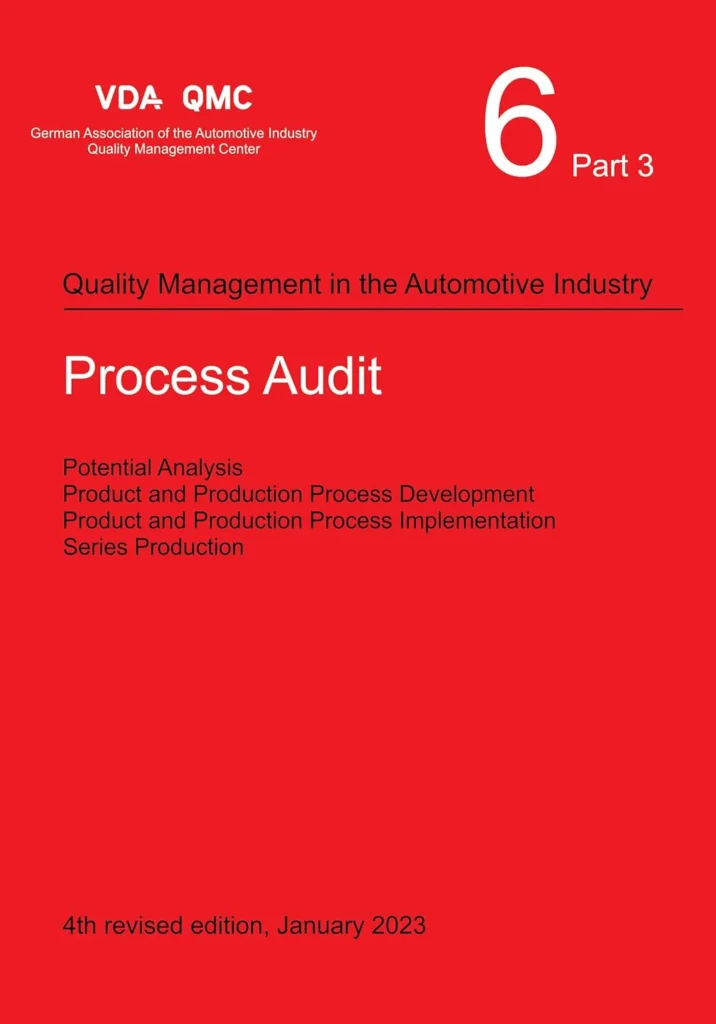
I strongly recommend the official VDA Volume 6 Part 3 : Process Audit, 4th Revised Edition for auditors working in automotive supplier quality.

How BMW Mercedes Volkswagen Use VDA 6.3 Supplier Audits?

From what I have seen during OEM-facing supplier audits, German car makers use VDA 6.3 as a risk-based process audit framework rather than only a compliance requirement. Their focus is always on whether the supplier can repeatedly produce conforming parts at scale with stable quality performance. 

This includes process controls, PFMEA alignment, control plans, traceability, layered audits, mistake-proofing, and escalation handling.

BMW, Mercedes-Benz, and Volkswagen may use slightly different customer-specific requirements, but the audit logic remains strongly aligned with VDA compliance OEM requirements. The process typically begins during sourcing or before nomination, where the supplier’s process maturity is assessed. 

After nomination, audits become more detailed and focus heavily on launch readiness and series production robustness.

For example, if a supplier manufactures brake caliper housings, ECU casings, seat frame assemblies, or wiring harness components, the OEM audit team wants to see clear evidence that every process step is controlled. 

They will review machine capability, SPC trends, gauge calibration, operator competency matrices, and reaction plans for out-of-control conditions. Even a simple missing escalation matrix can be raised as a major finding if it affects customer risk.

Why German OEM Quality Requirements Are More Process-Focused Than Documentation-Focused?

One important point I always explain to suppliers is this: German OEMs do not audit paperwork for the sake of paperwork. Their main interest is whether the actual manufacturing process performs consistently. A perfect set of documents means very little if the shop floor cannot demonstrate repeatability.

For example, a control plan may state that torque verification is checked every hour. During the audit, BMW or Volkswagen auditors will walk to the line and ask the operator to demonstrate the process live. 

They may verify the actual torque tool calibration status, last 10 records, reaction plan for failures, and defect containment method. If the process on the line does not match the document, that becomes a serious process deviation.

This is why German car manufacturer standards strongly emphasize “say what you do, do what you say, prove it with records.” 

In my audits, I often see suppliers lose points not because the process is weak, but because evidence is not aligned across departments. Engineering, production, quality, and maintenance must all tell the same process story.

The Strategic Role of VDA 6.3 in BMW Supplier Quality Standard:

BMW places significant importance on supplier process capability because its vehicles rely on precision manufacturing and premium brand consistency. Whether it is interior trim parts, suspension assemblies, electronics, or powertrain components, process stability directly affects customer perception and warranty costs.

The BMW supplier quality standard usually combines VDA 6.3 expectations with additional customer-specific launch and APQP requirements. In practice, this means suppliers are expected to demonstrate strong readiness before SOP and sustained control after SOP.

A good example is dimensional capability during PPAP approval. Suppose a supplier produces machined shafts for drivetrain systems. BMW auditors may review:

  • Cp / Cpk values
  • MSA studies
  • PFMEA severity rankings
  • control plan linkage
  • SPC reaction plan
  • layered process audit results

If the Cpk requirement is 1.67 for critical characteristics and the supplier shows only 1.12, that can trigger immediate escalation. In my experience, this is where VDA 6.3 moves from an audit standard into a business risk decision tool.

Mercedes-Benz VDA Requirements and Premium Manufacturing Expectations:

When working with premium brands, Mercedes-Benz VDA requirements often focus deeply on prevention and customer risk. Mercedes suppliers are usually expected to show strong process discipline, especially in safety-related parts and visible customer-facing components.

Take an example of painted dashboard trim components. Even a low defect rate like 0.8% surface blemish rejection can be treated seriously because visible quality directly impacts customer satisfaction. 

For premium brands, cosmetic standards are often as important as functional quality.

Mercedes audit teams typically look at:

  • defect prevention
  • poka-yoke controls
  • traceability
  • defect escape history
  • supplier response time
  • 8D closure effectiveness

From an auditor’s point of view, I always guide suppliers to strengthen their closed-loop corrective action systems because Mercedes places strong emphasis on systemic recurrence prevention.

Read more from:

Volkswagen Supplier Audit and Formula Q-Capability Integration:

Volkswagen is widely known for its structured supplier quality approach, and the Volkswagen supplier audit process is often linked with Formula Q-capability principles. This is one of the most recognized supplier performance frameworks in the German automotive sector.

In practical terms, Volkswagen uses VDA 6.3 to evaluate process maturity, while Formula Q supports supplier classification, escalation, and ongoing performance management.

For example, if a stamping supplier has recurring burr defects affecting assembly fitment, Volkswagen may:

  • conduct VDA 6.3 process audit
  • raise supplier escalation
  • request containment
  • demand capability improvement plan
  • schedule follow-up audit

This combination of audit + performance monitoring is what makes German OEM quality systems highly effective.

A supplier with repeated process instability may be moved into controlled development status until measurable improvement is demonstrated.

How German OEMs Actually Use VDA 6.3 in 2026?

In 2026, BMW, Mercedes, and Volkswagen use VDA 6.3 as a supplier risk management and process maturity system across sourcing, launch, and serial production. The standard is applied to verify that supplier processes are capable, documented, traceable, and resilient against quality risks. 

It is widely integrated with APQP, PPAP, Formula Q-capability, and supplier scorecards. OEMs increasingly focus on digital traceability, software-linked components, and proactive risk prevention in supplier audits.

Why Statistics Matter in German OEM Audits?

One thing I always tell suppliers is that German OEM audits are highly data-driven. Opinions do not carry much weight unless backed by measurable evidence.

Typical audit metrics include:

  • PPM performance
  • first pass yield
  • internal rejection %
  • warranty returns
  • OEE
  • Cpk / Ppk
  • delivery OTIF %
  • audit closure lead time

For instance, if a supplier’s customer PPM moved from 85 to 420 within one quarter, this trend alone can trigger a focused VDA 6.3 audit.

Similarly, a first pass yield below 98% in high-volume automotive components may raise serious questions around process stability.

Example: Real Supplier Audit Scenario

Let me give you a practical example from a supplier-side perspective.

Suppose you are supplying aluminum die-cast transmission housings to Volkswagen Group. During the VDA 6.3 audit, the auditor checks:

  • mold maintenance frequency
  • porosity control
  • X-ray inspection effectiveness
  • SPC for wall thickness
  • operator qualification
  • containment process

Now assume porosity defects increased by 32% month-over-month. Even if shipment quality is still acceptable, the process risk trend itself becomes a key audit finding.

This is exactly how German OEMs think: prevent the issue before it reaches the customer.

How Each German OEM Actually Applies VDA 6.3:

I now want to take you deeper into how each German OEM actually applies VDA 6.3 on suppliers in practical manufacturing environments. 

As someone who has worked closely with supplier quality teams, I can tell you that while the framework remains common, BMW, Mercedes-Benz, Volkswagen, Audi, and Porsche each apply it with their own quality culture and customer-specific expectations

This is where many suppliers either build long-term trust or face repeated escalations.

The key thing suppliers must understand is that VDA 6.3 is rarely treated as a standalone audit. In 2026, German OEMs connect it with IATF 16949, APQP, PPAP, supplier scorecards, warranty feedback, traceability controls, and product safety requirements

This means the audit result directly affects sourcing decisions, volume allocation, future RFQs, and sometimes even payment risk ratings.

How BMW Uses VDA 6.3 in Premium Supplier Development?

From my professional experience, BMW’s audit style is strongly focused on process maturity and premium customer expectations

The BMW supplier quality standard is built around the idea that every supplied component must support premium brand consistency, whether it is a structural part, visible trim, power electronics module, or safety-critical system.

For example, if a supplier manufactures seat frame weldments, BMW auditors will not only check weld penetration validation and process parameters, but also long-term consistency. They often review:

  • welding current history
  • fixture repeatability
  • poka-yoke presence
  • destructive test frequency
  • defect traceability
  • layered audit evidence

A process that performs at 99.5% yield may still be questioned if the defect trend is increasing month over month. This is because BMW places strong emphasis on trend-based risk prevention, not just snapshot compliance.

In several OEM audits, I have seen BMW teams ask suppliers to demonstrate whether PFMEA high-severity risks are directly linked to shop-floor controls. 

If severity rankings show weld crack risk as critical, then the control plan, inspection standard, operator training, and reaction plan must all clearly reflect it.

Example: BMW Supplier Audit Finding and Corrective Action

Let me explain this with a realistic example.

Suppose a supplier produces aluminum steering knuckle components for BMW. During audit, the process capability for a critical bore diameter characteristic shows Cpk = 1.18, while the customer requirement is 1.67.

This would usually be raised as a major process capability finding.

A strong corrective action response would include:

  • containment of WIP and FG stock
  • 100% inspection
  • machine alignment verification
  • tool wear study
  • MSA revalidation
  • revised SPC control limits
  • PFMEA update
  • preventive maintenance frequency revision

In my role as an auditor, I always advise suppliers to ensure the corrective action addresses systemic cause, not only symptom correction.

Mercedes-Benz VDA Requirements for High-Reliability Components:

The Mercedes-Benz VDA requirements are usually very strong around reliability, luxury finish, and product safety. Suppliers dealing with visible parts, safety systems, and premium cabin components are often held to extremely tight process controls.

For example, a supplier making chrome-plated interior bezels may be audited on:

  • cosmetic defect standards
  • surface scratch prevention
  • packaging controls
  • transport protection
  • humidity exposure validation
  • traceability batch mapping

Even a minor recurring cosmetic issue can become serious because premium customers notice visual defects immediately.

In one practical example, I worked with a supplier where the internal rejection for chrome surface marks increased from 0.4% to 1.1% over six weeks. Mercedes considered this an early risk signal and requested focused VDA 6.3 process review before the issue could affect field quality.

This is exactly why automotive OEM quality demands go beyond defect counts and move into risk forecasting.

Volkswagen Supplier Audit and Formula Q-Capability in Practice:

Among German OEMs, Volkswagen’s system is often one of the most structured because it combines VDA 6.3 with Formula Q-capability. This means suppliers are evaluated not only for process compliance but also for sustained business capability and escalation readiness.

The Volkswagen supplier audit often places strong focus on:

  • process capability
  • supplier chain visibility
  • D/TLD documentation retention
  • traceability period
  • customer escalation response
  • quality capability rating

One important requirement is that suppliers are expected to achieve an “A” capability rating before SOP. This is a major business gate in many sourcing decisions.

For example, a supplier producing stamped bracket assemblies for door modules may have acceptable outgoing quality but poor process discipline. If internal layered audits are missing and reaction plans are weak, Volkswagen may still rate the supplier as high risk.

This is why I always tell suppliers that document discipline and process discipline must work together.

Formula Q-Capability: What Makes Volkswagen Different?

A very important semantic keyword for this topic is Formula Q-capability, and this is where Volkswagen goes deeper than standard VDA 6.3 scoring.

Formula Q includes additional customer-specific expectations such as:

  • product safety representative (PSCR)
  • supply chain audit responsibility
  • certified VDA auditors
  • special characteristic retention
  • long-term traceability controls
  • escalation milestones

In fact, several Formula Q requirements explicitly go beyond base VDA 6.3 expectations.

For example, records for critical product characteristics may need to be retained for up to 15 years, especially where liability or safety traceability is involved.

This is highly relevant for:

  • airbags
  • braking systems
  • steering assemblies
  • ADAS electronics
  • battery safety components

Audi Supplier Audit VDA Approach:

The Audi supplier audit VDA methodology is closely aligned with Volkswagen Group systems but often includes additional focus on fit, finish, premium tolerance standards, and customer-visible precision.

For example, if the supplier manufactures dashboard decorative trim panels, even slight variation in gloss level or gap alignment can become an audit concern.

Typical focus areas include:

  • tolerance stack-up validation
  • dimensional repeatability
  • cosmetic acceptance limits
  • incoming raw material consistency
  • poka-yoke fixture alignment

In premium cabin parts, even a 0.2 mm dimensional shift may affect flushness and customer feel.

This is why Audi suppliers often need stronger process controls than general automotive commodity parts.

Porsche VDA 6.3 Requirements for High-Performance Components:

The Porsche VDA 6.3 requirements are especially demanding for performance-critical and safety-sensitive components.

For example, if the supplier manufactures brake rotor castings or suspension arms, the audit may go deeply into:

  • metallurgical controls
  • heat treatment validation
  • fatigue testing records
  • traceability
  • capability studies
  • supplier sub-tier audits

Porsche’s performance vehicle expectations mean that even low-frequency process variation can become unacceptable.

For instance, a process running at 99.8% acceptance may still require improvement if the defect mode affects high-speed performance or durability.

This is where German OEM quality requirements become highly risk-based.

Recommended Reference Materials and Audit Resources:

For professionals wanting to perform stronger audits, these references are extremely useful:

I strongly recommend the official VDA Volume 6 Part 3 : Process Audit, 4th Revised Edition for auditors working in automotive supplier quality.

Common Findings Seen Across German OEM Supplier Audits:

Across BMW, Mercedes, Volkswagen, Audi, and Porsche, I repeatedly see similar findings during supplier audits.

Some of the most common findings include:

  • PFMEA not linked to control plan
  • outdated work instructions
  • missing reaction plan
  • low Cpk for special characteristics
  • calibration overdue
  • weak operator training matrix
  • incomplete traceability
  • poor sub-supplier control
  • no evidence of layered process audits
  • ineffective 8D closure

These findings directly impact VDA 6.3 scores under P5, P6, and P7 elements.

German automakers use VDA 6.3 as a live process risk audit system rather than a paperwork exercise. BMW focuses on premium process stability, Mercedes emphasizes prevention and visible quality, while Volkswagen integrates Formula Q-capability and supplier rating controls. 

Audi and Porsche apply tighter tolerance and performance-based requirements for premium and high-performance components. In 2026, suppliers must demonstrate measurable process capability, traceability, and robust corrective action systems to meet German OEM expectations.

Supplier Preparation Roadmap for German OEM Audits in 2026:

I now want to help you with the most practical section of this article — how suppliers can actually prepare and succeed when facing German OEM process audits. From my experience as a Quality Manager and Certified VDA 6.3 Auditor, this is the section that readers and suppliers usually find the most useful because it converts theory into action. 

By 2026, VDA 6.3 has become even more important due to software-integrated products, stricter procurement controls before SOP, and deeper supply chain risk reviews.

The reality is simple: BMW, Mercedes-Benz, Volkswagen, Audi, and Porsche do not just want compliant suppliers. They want predictable, low-risk, data-driven manufacturing partners who can consistently deliver quality at scale. 

This means your audit readiness must be visible not only in documents but also in machine data, operator discipline, traceability, and management response systems.

Whenever I guide suppliers for OEM readiness, I follow a structured roadmap that aligns directly with VDA compliance OEM requirements.

Step 1: Process Risk Mapping

The first thing I recommend is mapping all process risks across the manufacturing flow. Start from raw material receiving and continue through machining, assembly, testing, packaging, and dispatch. Every process step should have:

  • risk
  • control
  • evidence
  • reaction plan
  • ownership

For example, if you manufacture ADAS sensor housings, dimensional shift due to tool wear must be linked to PFMEA, SPC, and preventive maintenance. This alignment is one of the first things German auditors verify.

Step 2: Control Plan Alignment

A major finding I often see is poor linkage between PFMEA and control plans. Every high-risk failure mode must be clearly reflected in the shop-floor inspection and process control documents.

For example:

  • PFMEA risk = burr on machined edge
  • Control = 100% vision inspection
  • Reaction = line stop + containment
  • Record = hourly defect trend

If these are disconnected, the supplier can lose major points under P5 and P6 elements.

Step 3: Evidence Readiness

German OEM audits are evidence-heavy. The team will ask for:

  • Cpk reports
  • MSA studies
  • calibration records
  • training matrix
  • maintenance logs
  • layered audit closure
  • 8D effectiveness

In 2026, digital evidence is becoming a strong expectation. Cloud MES systems, digital SPC dashboards, and real-time traceability are increasingly viewed positively.

Practical Tips to Pass BMW, Mercedes, and Volkswagen Audits:

Let me share some real-world guidance from the supplier side.

Tip 1: Never Prepare Only for the Audit Day

One of the biggest mistakes suppliers make is “audit-day preparation.” German OEM teams quickly identify staged compliance.

Instead, focus on:

  • sustained process discipline
  • real-time KPI reviews
  • live escalation response
  • defect trend meetings

If your process is stable every day, the audit becomes much easier.

Tip 2: Use Statistics Naturally

Statistics are extremely powerful in supplier audits.

For example:

  • PPM below 50
  • FPY above 98.5%
  • OEE above 85%
  • Cpk > 1.67 for critical dimensions

These numbers immediately improve auditor confidence because they demonstrate measurable control.

Tip 3: Train Operators Beyond Basic SOP

Operators should understand:

  • what defect looks like
  • why the control matters
  • when to stop the line
  • who to escalate to

In my audits, operator interviews often decide whether the process is genuinely mature.

Future Trends: How German OEM Audits Are Changing in 2026?

This is an important SEO and AI Overview section because many readers search for future trends.

The 2023 update applied from January 2023 continues to shape 2026 audits, especially around:

  • software-integrated products
  • procurement activities before SOP
  • more practical content updates

For suppliers dealing with:

  • ECUs
  • sensors
  • radar modules
  • EV battery parts
  • BMS systems

German OEMs now increasingly check software change traceability, version control, validation linkage, and supplier cybersecurity maturity.

This is especially relevant for:

  • BMW EV platforms
  • Mercedes software-defined vehicle programs
  • Volkswagen Group digital architecture suppliers

I strongly expect AI-supported traceability analytics and predictive quality dashboards to become part of future supplier audits.

How Suppliers Can Successfully Use VDA 6.3?

Suppliers working with BMW, Mercedes-Benz, and Volkswagen should use VDA 6.3 as a process risk management system rather than only an audit requirement. 

Focus on PFMEA alignment, control plan effectiveness, capability studies, traceability, and strong corrective action systems. German OEMs reward suppliers who demonstrate sustained process stability, data-driven control, and proactive risk prevention.

Read more from:

Final Conclusion:

As a Quality Manager and VDA 6.3 auditor, my honest advice is this: German automakers use VDA 6.3 not merely to score suppliers, but to judge whether a supplier is capable of supporting premium automotive manufacturing without quality risk.

  • BMW focuses on premium consistency.
  • Mercedes emphasizes prevention and visible quality.
  • Volkswagen strengthens the system with Formula Q-capability.
  • Audi and Porsche tighten tolerance and performance expectations.

For suppliers, success comes from process discipline, measurable capability, strong corrective action, and real risk prevention.

If you use VDA 6.3 effectively, it becomes more than an audit standard — it becomes a competitive advantage for long-term OEM business growth.

Frequently Asked Questions (FAQs)

1. What is VDA 6.3 and why do German automakers use it?

VDA 6.3 is a process audit standard used by German automakers like BMW, Mercedes-Benz, and Volkswagen to evaluate supplier process quality and risk control. It helps ensure that manufacturing processes are stable, repeatable, and capable of producing defect-free parts consistently. 

In my experience as a Quality Manager, it is one of the most important tools used in supplier selection and development.

German OEMs use it because it focuses on real process performance, not just documentation. It checks whether suppliers can control risks across production stages. It is widely used during sourcing, launch, and serial production audits.

Key reasons include:

  • Process risk identification
  • Supplier capability evaluation
  • Quality consistency assurance
  • Production readiness validation

2. How BMW uses VDA 6.3 supplier audits in quality control?

BMW uses VDA 6.3 as part of its BMW supplier quality standard to ensure premium-level manufacturing consistency. The focus is strongly on process stability, defect prevention, and long-term supplier performance.

BMW auditors check whether PFMEA, control plans, and shop-floor processes are fully aligned. Even small deviations in capability or process discipline can lead to findings.

Typical focus areas include:

  • Process capability (Cpk/Ppk)
  • Layered process audits
  • Traceability systems
  • Reaction plans for defects

BMW uses these audits to reduce warranty risks and maintain premium brand reputation.

3. What are Mercedes-Benz VDA requirements for suppliers?

The Mercedes-Benz VDA requirements are highly focused on prevention, product safety, and visible quality. Mercedes expects suppliers to maintain strong control over both functional and cosmetic quality characteristics.

From my audit experience, Mercedes places strong attention on recurrence prevention and 8D effectiveness. Even minor defects can be escalated if trends indicate risk.

Main expectations include:

  • Strong defect prevention systems
  • Effective corrective actions (8D)
  • Traceability for safety parts
  • Stable production controls

Mercedes aims for zero-defect thinking in critical components.

4. How does Volkswagen supplier audit system work with Formula Q-capability?

Volkswagen combines VDA 6.3 with Formula Q-capability to manage supplier performance. This system evaluates both process quality and supplier business capability.

The audit results are used for supplier classification, escalation, and sourcing decisions. Suppliers must demonstrate consistent quality performance and strong process control.

Key elements include:

  • VDA 6.3 process audit results
  • Supplier capability rating (A/B/C)
  • Escalation management system
  • Long-term traceability requirements

This system ensures high supplier accountability.

5. What is Audi supplier audit VDA approach?

The Audi supplier audit VDA approach focuses strongly on precision, fit, finish, and premium interior/exterior quality standards. Audi emphasizes tight tolerances and consistent aesthetic quality.

In my experience, Audi audits often include deep checks on dimensional variation and cosmetic standards.

Important focus areas:

  • Dimensional stability
  • Surface finish quality
  • Assembly fit and gap control
  • Supplier process capability

Even small deviations in visual quality can result in audit findings.

6. What are Porsche VDA 6.3 requirements for suppliers?

The Porsche VDA 6.3 requirements are highly strict, especially for performance and safety-critical components. Porsche expects extremely stable and high-capability manufacturing processes.

Suppliers must demonstrate strong engineering control and durability validation.

Key expectations include:

  • High fatigue resistance components
  • Strong material validation
  • Tight process capability (Cpk > 1.67 often expected)
  • Robust traceability systems

Porsche focuses heavily on performance reliability under extreme conditions.

7. What are common findings in VDA 6.3 supplier audits?

Across BMW, Mercedes, and Volkswagen supplier audits, I often see similar findings. These usually relate to weak process linkage or incomplete control systems.

Most common findings include:

  • PFMEA not linked to control plan
  • Weak reaction plans
  • Low process capability (Cpk issues)
  • Missing traceability records
  • Incomplete operator training

These findings often affect P5 to P7 audit elements and reduce supplier scores.

8. How can suppliers prepare for German OEM VDA 6.3 audits?

Suppliers should focus on process discipline, not just documentation. Preparation must include real shop-floor readiness and data-backed quality control systems.

Best preparation steps include:

  • Align PFMEA with control plan
  • Strengthen SPC and capability studies
  • Train operators for real process understanding
  • Ensure traceability is complete
  • Run internal layered audits

Daily process control is more important than audit-day preparation.

9. What is the role of statistics in VDA 6.3 audits?

Statistics play a major role in German OEM audits because they show real process stability. Auditors rely heavily on data rather than verbal explanations.

Important metrics include:

  • PPM levels
  • FPY (First Pass Yield)
  • Cpk and Ppk values
  • OEE performance
  • Scrap and rework trends

Strong statistical performance increases supplier credibility during audits.

10. Why is VDA 6.3 important for BMW, Mercedes, and Volkswagen suppliers?

VDA 6.3 is important because it ensures suppliers can meet strict German OEM quality requirements consistently. It reduces production risks, improves supplier accountability, and strengthens supply chain reliability.

In my experience, it is not just an audit tool but a business qualification system. Suppliers with strong VDA 6.3 performance gain better OEM trust and long-term contracts.

Main benefits include:

  • Reduced production risks
  • Improved supplier ranking
  • Better customer trust
  • Higher chance of future business
This Page uses Affiliate Links. When you Click an Affiliate Link, we get a small compensation at no cost to you. Our Affiliate Disclosure for more info.

Leave a comment