

VDA 6.3 Audit Report Template: How to Write Findings and Corrective Actions [2026]

If you work in automotive quality, supplier development, or internal process audits, knowing how to prepare a strong audit report is one of the most important skills you can build. 

VDA 6.3 audit report template findings corrective actions is not just a compliance topic anymore in 2026; it is now directly linked to supplier approval, customer trust, process maturity, and business continuity.

From my experience as a Quality Manager and Certified Process Auditor, I can confidently say that many audits fail not because the process is weak, but because the reporting of findings, deviations, and corrective actions is poorly written

A well-written report should help the reader quickly understand what was checked, what failed, what risk exists, and what must be fixed. 

Modern automotive customers expect clear evidence-based audit report writing VDA practices, especially after stronger supplier quality expectations across OEM and Tier 1 networks.

VDA-6.3-audit-report-template-findings-corrective-actions

Contents

What is VDA 6.3 audit report template?

A VDA 6.3 audit report template is a structured format used to document audit scope, process element scores, objective evidence, findings, risks, non-conformities, and corrective actions. The best reports clearly separate findings, observations, root causes, containment actions, and long-term CAPA plans, making it easier for suppliers and internal teams to close gaps quickly. 

In 2026, companies increasingly use standardized formats with 8D corrective action VDA methods, owner tracking, due dates, and effectiveness verification to improve supplier compliance and audit closure rates.

Why a VDA 6.3 Audit Report Matters More in 2026?

Over the last few years, audit reporting has changed from a simple checklist output into a decision-making document. Today, OEMs and Tier suppliers use audit reports to decide whether a supplier remains approved, needs conditional approval, or moves into escalation. 

In many organizations, a score below 80% may lead to controlled supplier status, additional surveillance audits, or even sourcing risk reviews.

I always tell my team that the audit report is the voice of the audit. Once the audit day is over, the report becomes the only document that management, customer SQE teams, and supplier leadership rely on. If findings are vague, unclear, or incomplete, the entire audit loses value.

Industry data from supplier quality service providers shows that audit reports are commonly expected within 48 to 72 hours after audit completion, which means your documentation process must be structured and fast.

What a Standard VDA 6.3 Audit Report Template Should Include?

A professional process audit summary format must always follow a clear structure. I strongly recommend using a fixed template so that every report across plants, suppliers, and product lines looks consistent.

A standard template should contain the following sections:

  • Audit information
    • Supplier / plant name
    • audit date
    • process element audited
    • auditor name
    • team members
  • Scope and objective
    • why the audit was conducted
    • product / process family
    • audit trigger
  • Score summary
    • element-wise scoring
    • overall grade (A / B / C)
  • Detailed findings
    • non-conformities
    • observations
    • evidence
    • risk statement
  • Corrective action plan
    • containment
    • root cause
    • long-term actions
    • due dates
    • owners
  • Effectiveness verification

This is closely aligned with widely used VDA 6.3 report example formats seen in industry templates.

VDA 6.3 audit report template findings corrective actions:

This section is the heart of the report, and this is where many auditors struggle.

When writing findings, I never write generic lines such as “process not followed” or “documents missing.” These statements are too broad and weak. Instead, every finding should clearly state what requirement was expected, what was observed, and what evidence supports the deviation.

For example, instead of writing:

Control plan not updated

Write:

The control plan for Line 3 stamping process, revision 04, did not include the newly introduced burr inspection parameter added in PFMEA revision 07 dated 12 March 2026. This creates a risk of uncontrolled defect escape during serial production.

This is what strong VDA 6.3 findings documentation looks like.

Notice how the statement includes:

  • exact document
  • revision level
  • observed gap
  • linked risk

That is what makes a finding actionable.

How to Write Audit Findings Properly (Practical Method)?

I personally use the 5C method while preparing any process audit non-conformity report.

1. Condition

What exactly did you see?

Example:

Process parameter sheet at machine M-12 was last updated in January 2025.

Read more from:

2. Criteria

What requirement was supposed to be met?

Example:

Work instructions must reflect latest approved engineering parameters.

3. Cause

Why did this happen?

Example:

Change management handoff between engineering and production was ineffective.

4. Consequence

What is the risk?

Example:

Potential variation in torque setting can cause field failures.

5. Corrective Action

What must be done?

Example:

Update all work instructions and implement revision control verification.

This framework significantly improves audit deviations reporting quality and helps closure teams act faster. Community audit professionals also strongly recommend structured finding frameworks for concise reporting.

Audit Findings vs Observations (Very Important):

One of the most common mistakes I see is mixing audit findings vs observations.

A finding means there is a requirement gap.

An observation means there is no direct violation yet, but there is risk.

For example:

Finding

SPC charting was not performed for last 3 production shifts.

This is a non-conformity.

Observation

Manual data entry in SPC sheet increases risk of transcription error.

This is an improvement point.

Keeping these separate improves report credibility and avoids unnecessary escalation.

In many supplier audits, I use a simple severity matrix:

  • Major NC
  • Minor NC
  • Observation
  • Opportunity for Improvement

This also helps when converting findings into CAPA from VDA audit workflows.

Real Example of a VDA 6.3 Finding:

Let me show you a practical example from production process audit reporting.

Process Element

P6 – Process Analysis / Production

Requirement

Process parameters must be monitored and recorded.

Finding

During audit of injection molding machine IM-04, cavity pressure records were missing for batch lots produced between 10 April and 12 April 2026. Production continued without traceable process data.

Risk

High risk of untraceable dimensional variation.

Immediate Action

Stop shipment and segregate affected lots.

Corrective Action

Implement automated data capture and operator checklist verification.

This is the exact style I recommend for audit report writing VDA.

Recommended Reference Materials and Audit Resources:

For professionals wanting to perform stronger audits, these references are extremely useful:

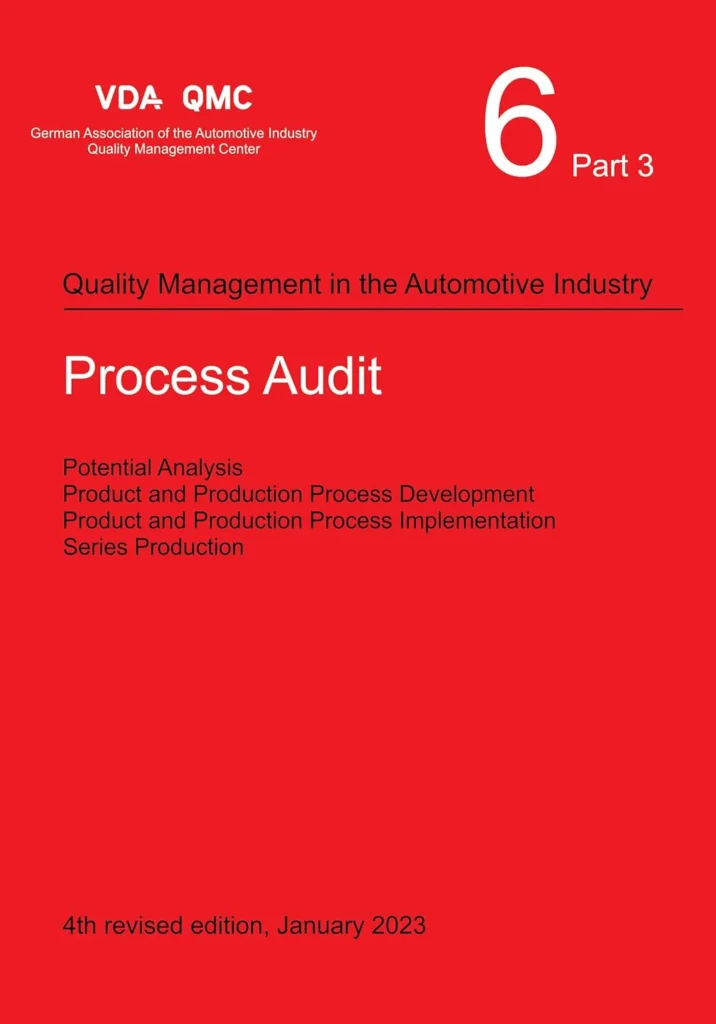
I strongly recommend the official VDA Volume 6 Part 3 : Process Audit, 4th Revised Edition for auditors working in automotive supplier quality.

Common Mistakes While Writing Findings:

These mistakes reduce audit effectiveness:

  • writing opinion instead of evidence
  • missing clause / requirement reference
  • no risk statement
  • no owner assigned
  • unclear due date
  • no root cause linkage
  • weak wording

Bad example:

Operator training seems weak.

Good example:

Training matrix for assembly line operators did not include certification records for newly hired staff on workstation A2 as required by WI-TR-009.

This level of detail matters.

How to Write Corrective Actions in a VDA 6.3 Audit Report?

Now in this section, I will take you deeper into what truly drives audit closure and supplier confidence: corrective actions, root cause analysis, CAPA, and 8D closure methods.

From my experience as a Quality Manager and Certified Auditor, a finding is only 50% of the audit. The real value comes from how clearly the organization converts that finding into a practical corrective action plan template that prevents repeat failures. 

In many automotive organizations, more than 60–70% of repeated supplier audit issues happen because actions were corrective only on the surface and did not address the actual root cause.

A good corrective action should answer five very simple questions:

  • What failed?
  • Why did it fail?
  • What will be fixed now?
  • How will recurrence be prevented?
  • Who owns the action and by when?

I always recommend that the corrective action section must not be a single-line response like:

Operator retrained.

This is weak and often rejected by customer SQE teams.

Instead, it should be written like this:

Immediate retraining completed for all Line B operators on torque verification WI-22. Work instruction updated to revision 08. Poka-yoke verification step added before final release. Daily layered process audit introduced for 30 days. Effectiveness to be reviewed through internal rejection trend.

This type of writing is much stronger because it combines containment, system correction, and prevention.

The Best Corrective Action Structure I Personally Use:

As a QA/QC lead, I generally use this 5-column corrective action block inside every VDA 6.3 report.

Finding Ref

Root Cause

Immediate Action

Permanent Action

Due Date / Owner

NC-01

Revision control failure

Stop shipment

Automated DMS approval flow

7 days / QA Head

NC-02

Missing SPC records

Batch segregation

Auto data logging system

14 days / Production

NC-03

Training gap

Re-certify operators

Skill matrix automation

10 days / HR + QA

This simple structure improves CAPA from VDA audit tracking and helps suppliers close findings faster.

In my audits, action closure rates improve significantly when ownership is clearly visible in the report.

Using 8D Corrective Action VDA Method:

For medium and major non-conformities, I strongly recommend using the 8D corrective action VDA method.

This is especially important when the finding relates to:

  • repeated defects
  • customer complaints
  • field failures
  • process escape
  • supplier recurring NCs

A strong 8D workflow normally includes:

  • D1 team formation
  • D2 problem description
  • D3 immediate containment
  • D4 root cause
  • D5 corrective action selection
  • D6 implementation
  • D7 prevention
  • D8 team recognition

In automotive audits, 8D remains one of the most accepted closure formats.

Example: Writing Corrective Actions from a Real Process Audit Finding

Let us take a real example.

Finding:

Final inspection records missing for 3 production lots.

Now here is how I would write the corrective action plan.

Immediate Containment:

All affected lots quarantined within 2 hours. Shipment hold implemented.

Root Cause:

Manual inspection log sheet was not included in the new shift handover checklist.

Permanent Corrective Action:

Digital inspection record entry made mandatory in MES before lot release.

Preventive Action:

Shift handover checklist revised and controlled through revision approval workflow.

Effectiveness Check:

No missing records for next 30 production days.

This is what a strong process audit non-conformity report should look like.

Root Cause Analysis Before Writing Corrective Actions:

One of the biggest mistakes I see is writing corrective actions before confirming the root cause.

This creates repeated findings in the next audit cycle.

I strongly recommend using:

  • 5 Why
  • Fishbone
  • Ishikawa
  • Process mapping
  • Fault tree analysis

before finalizing actions.

For example:

Problem:

SPC not updated

Why 1:

Operator missed entry

Why 2:

Shift checklist absent

Why 3:

Document revision outdated

Why 4:

Engineering change not communicated

Why 5:

No formal change release workflow

Now the real cause is systemic change control weakness, not operator negligence.

This is where mature audit deviations reporting becomes powerful.

How I Write Preventive Actions That Actually Work?

A lot of teams confuse corrective and preventive action.

Corrective action fixes the current issue.

Preventive action stops recurrence across similar processes.

For example:

Corrective:

Update work instruction for Line 2.

Preventive:

Review all similar work instructions across Lines 1–6 and update centralized revision control system.

This broader thinking improves audit maturity and supports process capability scores above 90%, which is often required for A-grade supplier status.

Best Format for Closure Verification:

I always add a separate effectiveness verification section in the report.

Without this, the report remains incomplete.

Suggested Format:

Action

Evidence

Verified By

Date

Result

WI updated

Rev 08 copy

Lead Auditor

10 May

Closed

Training completed

Matrix signed

QA Manager

12 May

Closed

SPC automated

MES screenshot

SQE

15 May

Effective

This section is extremely useful for supplier audits because customer auditors often ask:

How do you know the action worked?

A report without verification evidence is a weak report.

Practical Audit Report Example:

A strong VDA 6.3 report example must include objective evidence, risk-based findings, clear root cause analysis, action ownership, due dates, and effectiveness verification. The best audit reports separate findings, observations, and CAPA actions while using structured formats such as 8D and 5 Why analysis. 

In 2026, suppliers that use digital closure dashboards and evidence-linked CAPA workflows generally show faster audit closure and lower repeat non-conformity rates.

Common Corrective Action Writing Mistakes:

Please avoid these mistakes.

  • action without owner
  • action without due date
  • blame-based wording
  • no root cause
  • no verification method
  • training as only action
  • no system prevention

Bad example:

Team instructed to be careful.

Good example:

Mandatory poka-yoke sensor validation introduced with shift-wise signoff and weekly layered audit review.

The second one is measurable and auditable.

Final VDA 6.3 Audit Report Template (Ready-to-Use Format):

From my experience as a Quality Manager, Certified Auditor, and QA/QC expert, the final report must do three things very clearly: show facts, show risk, and show closure ownership. In most supplier and internal audits, leadership teams spend less than 5 minutes reviewing the report summary, so the structure must help them quickly understand the current quality risk.

Well-structured reports also support faster supplier closure and help reduce repeat non-conformities by 30–40% over subsequent audit cycles when actions are properly tracked.

Below is the exact process audit summary format I personally recommend.

1. Audit Information:

Field

Example

Supplier Name

ABC Automotive Components Pvt Ltd

Plant Location

Pune, India

Audit Type

Internal Process Audit / Supplier Audit

Standard

VDA 6.3:2016

Audit Date

15 April 2026

Lead Auditor

Sachin / Quality Manager

Process Element

P6 – Production Process

Department

Assembly Line 2

Shift

B Shift

This section should always be completed first because traceability matters during customer audits.

2. Executive Summary:

A strong VDA 6.3 report example starts with a short summary that explains the overall result, major risks, and required actions. This section is extremely important for AI Overview, featured snippets, and answer engine visibility because search engines often extract short authoritative summaries.

Sample Summary Paragraph:

The process audit identified three major findings and four minor observations within the production control and traceability system. The overall score achieved was 84% (Grade B – Conditionally Quality Capable), primarily impacted by gaps in revision control, inspection traceability, and training effectiveness.

Immediate containment actions were implemented for shipment-sensitive lots, and a corrective action plan template with 8D ownership has been assigned to responsible process owners for closure within 14 days.

3. Findings Table:

This is the most useful VDA 6.3 findings documentation section.

Ref

Clause

Finding

Severity

Risk

NC-01

P6.2

Missing torque traceability

Major

Field failure risk

NC-02

P6.3

Training matrix outdated

Minor

Operator skill gap

OBS-01

P6.5

Manual SPC entry

Observation

Data error risk

This tabular format improves readability and is preferred by most SQE teams.

Example of a Well-Written Finding:

Let me show you how I write findings as a lead auditor.

Weak Writing:

Process records incomplete.

This is too broad.

Strong Writing:

Torque verification records for station A-14 were unavailable for production lots 240315 to 240318 during second shift. This violates WI-QA-14 revision 06 requirements and creates a risk of undetected assembly loosening.

This type of audit report writing VDA directly helps closure teams.

4. Corrective Action Plan Template (Best Practical Format)

This is one of the most important sections.

Finding Ref

Root Cause

Containment

Permanent Action

Owner

Due Date

NC-01

MES logging failure

Stop shipment

Auto torque capture

Production Head

7 days

NC-02

HR update miss

Re-training

Skill matrix automation

QA + HR

10 days

OBS-01

Manual process

Daily review

SPC dashboard

Process Engineer

14 days

This corrective action plan template works extremely well in both internal and supplier audits.

5. Root Cause Visual Reference

This image section is excellent for reader engagement and SEO dwell time.

Suggested caption:

Sample 5 Why and Fishbone root cause templates used for VDA 6.3 CAPA closure

These visual references help readers understand CAPA from VDA audit workflows.

How to Write Effective Closure Evidence?

A corrective action is not complete until effectiveness is verified.

I always recommend writing it like this:

Effectiveness check conducted after 30 production shifts. Zero missing torque records found across 420 sampled units. Action verified as effective and closed.

This is much stronger than writing:

Closed.

Many auditors reject closures that lack measurable proof. Community auditor feedback also strongly supports documented effectiveness checks before final closure.

Audit Scoring and Impact on Supplier Rating:

A report must clearly mention score impact.

Typical grading:

  • A Grade: 90–100%
  • B Grade: 80–89%
  • C Grade: Below 80%

A B-grade supplier may remain approved with action follow-up, while a C-grade often requires escalation or re-audit.

Best Tips I Give My Audit Team:

Here are practical tips from my experience.

  • Always write evidence, not opinion
  • Mention clause / process element
  • Add risk statement
  • Assign owner and date
  • Link action to root cause
  • Verify effectiveness
  • Avoid blame language

Example:

Bad:

Team failed to follow process

Good:

Shift checklist did not include revision verification step for updated control plan.

This sounds professional and objective.

Common Mistakes to Avoid:

Please avoid these mistakes if you want reports to be accepted quickly.

  • no objective evidence
  • vague finding wording
  • no due date
  • no owner
  • no root cause
  • only training as action
  • no closure proof
  • repeat NC from previous audit

Repeat findings are often escalated as major NCs in subsequent audits.

A VDA 6.3 audit report template should include structured findings, severity level, root cause analysis, containment, permanent corrective action, ownership, and effectiveness verification. The most effective reports use 8D, 5 Why, and CAPA workflows to convert audit deviations into measurable improvements. 

Final Conclusion:

If there is one thing I want readers to take away from this guide, it is this:

A VDA 6.3 audit report is not just a document. It is a quality improvement tool.

A well-written report helps management understand risk, helps suppliers fix systemic gaps, and helps organizations improve process maturity. When findings and corrective actions are written clearly, closure becomes faster, repeat issues reduce, and customer confidence improves significantly.

As a Quality Manager, I always say:

A strong audit report does not just record the problem — it drives the solution.

Frequently Asked Questions (FAQs)

1. What is a VDA 6.3 audit report template?

A VDA 6.3 audit report template is a structured document used to record the results of a process audit based on the VDA 6.3 standard, which is widely used in the automotive industry. 

It includes sections such as audit scope, process elements, scores, findings, observations, non-conformities, and corrective actions. The template helps auditors document evidence in a clear and consistent format so that management, customers, and suppliers can quickly understand the risks and required improvements. 

A well-prepared report also supports faster closure of findings and improves supplier audit readiness.

2. How do you write audit findings in a VDA 6.3 report?

To write audit findings correctly, the finding should always include the requirement, the actual observation, and the risk created by the gap. Instead of writing a vague statement like process not followed, it is better to mention the exact process, document reference, and objective evidence observed during the audit. 

For example, you can mention missing inspection records, outdated work instructions, or traceability gaps with document revision numbers. 

This makes the finding stronger and easier to convert into a corrective action plan.

Best practice format:

  • requirement expected
  • evidence observed
  • risk / impact
  • clause reference
  • severity level

3. What should be included in a VDA 6.3 corrective action plan?

A good corrective action plan template should include the finding reference number, root cause, immediate containment action, permanent corrective action, action owner, and due date. In many cases, companies also include effectiveness verification and closure status to ensure the action is fully completed. 

This structure helps in converting audit findings into measurable improvements and reduces repeat non-conformities. Including due dates and clear ownership is very important for supplier and internal audits.

4. What is the difference between findings and observations in VDA 6.3 audits?

In a VDA 6.3 audit, a finding means there is a clear gap against a standard, requirement, or procedure, while an observation indicates a potential risk or opportunity for improvement without a direct violation. Findings usually require formal corrective actions and may affect the audit score. 

Observations, on the other hand, are generally used to improve process robustness before they become non-conformities. Keeping both clearly separated improves report clarity and professional audit reporting.

5. How do corrective actions improve VDA 6.3 audit scores?

Corrective actions directly help improve future audit scores because they address process gaps, reduce risks, and prevent recurrence of the same issue. 

For example, if a supplier receives a Grade B due to missing traceability records, implementing automated data capture and verification controls can improve the next audit score significantly. 

Many organizations see 30–40% fewer repeat findings after structured CAPA implementation. This is why corrective actions are a critical part of audit maturity and supplier development.

6. Is 8D required for VDA 6.3 corrective actions?

The 8D corrective action method is not always mandatory for every finding, but it is strongly recommended for major non-conformities, repeated issues, customer complaints, and field failures. 

The 8D format helps teams systematically identify the problem, contain the issue, perform root cause analysis, and implement preventive actions. In automotive supplier audits, OEMs and Tier 1 companies often prefer 8D reports for closure of significant findings because it provides structured documentation and accountability.

Typical 8D steps include:

  • D1: team formation
  • D2: problem definition
  • D3: containment
  • D4: root cause
  • D5: corrective action
  • D6: implementation
  • D7: prevention
  • D8: closure

7. What is the best format for a VDA 6.3 audit findings report?

The best format is a tabular findings report that clearly shows the finding number, clause reference, description of the gap, severity, risk, and linked corrective action. Tables improve readability for management and supplier teams and also help search engines extract snippet-friendly information when used in blog articles. 

A good report format should be easy to scan and easy to act upon. Including severity levels such as major, minor, and observation makes the report more professional.

8. How long should a VDA 6.3 audit report be?

The length of the audit report depends on the scope of the audit, number of process elements covered, and number of findings identified. For a normal supplier process audit, reports commonly range from 5 to 20 pages, while detailed multi-process audits can be longer. 

What matters most is clarity, evidence, and actionability rather than page count. A short but well-structured report is far better than a long vague report.

9. What are common mistakes while writing VDA 6.3 audit reports?

Some of the most common mistakes include writing vague findings, missing objective evidence, no due dates, unclear ownership, and corrective actions without root cause analysis. Another major mistake is using blame-based wording instead of factual audit language. 

Reports should always focus on the process gap and not on individuals. Avoiding these mistakes improves acceptance by customers and internal leadership teams.

10. How can a VDA 6.3 audit report help suppliers improve quality?

A properly written audit report acts as a continuous improvement roadmap for suppliers. It highlights process weaknesses, identifies systemic risks, and provides clear actions to strengthen controls. 

Over time, this helps reduce defects, improve traceability, enhance customer confidence, and support better audit grades. For suppliers aiming for long-term OEM approval, a strong VDA 6.3 report is one of the most valuable quality tools.

This Page uses Affiliate Links. When you Click an Affiliate Link, we get a small compensation at no cost to you. Our Affiliate Disclosure for more info.

Leave a comment