

VDA 6.3 vs ISO 9001: What Is the Difference and Which Do You Need in 2026?

If you are trying to understand “VDA 6.3 vs ISO 9001 difference which one needed”, you are not alone. As a Quality Manager, Certified Auditor, and QA/QC professional, I often see companies, especially automotive suppliers, struggle to decide whether they need a general quality certification, a process audit standard, or both.

In simple words, ISO 9001 builds your company’s quality management system, while VDA 6.3 checks how well your processes actually work on the shop floor and across the supply chain. Both are important, but they solve different business problems. 

More than 1 million ISO 9001 certificates are active across 189 countries, which clearly shows how widely it is used worldwide.

For automotive companies, especially suppliers working with German OEMs and Tier 1 manufacturers, this decision directly affects customer approvals, supplier audits, and long-term business growth.

VDA-6.3-vs-ISO-9001-difference-which-one-needed

VDA 6.3 vs ISO 9001 - The Key Difference:

ISO 9001 is a global quality management standard used across all industries to build a structured QMS, improve customer satisfaction, and drive continual improvement. VDA 6.3 is an automotive-specific process audit standard developed by the German automotive industry to evaluate manufacturing, supplier, and product realization processes.

If you are a general manufacturing or service company, start with ISO 9001. If you are an automotive supplier, especially serving German OEMs, you typically need VDA 6.3 in addition to ISO 9001.

From my experience in automotive quality systems, the question is not always ISO 9001 vs VDA 6.3 as an either-or choice. In most practical cases, it is about quality management vs process audit.

ISO 9001 helps create the framework, documentation, leadership controls, risk-based thinking, and continuous improvement culture.

VDA 6.3 goes much deeper into process performance monitoring, supplier controls, production readiness, and risk prevention across the product lifecycle.

This is why many automotive organizations use ISO 9001 and VDA integration rather than choosing only one.

Recommended Reference Materials and Audit Resources:

For professionals wanting to perform stronger audits, these references are extremely useful:

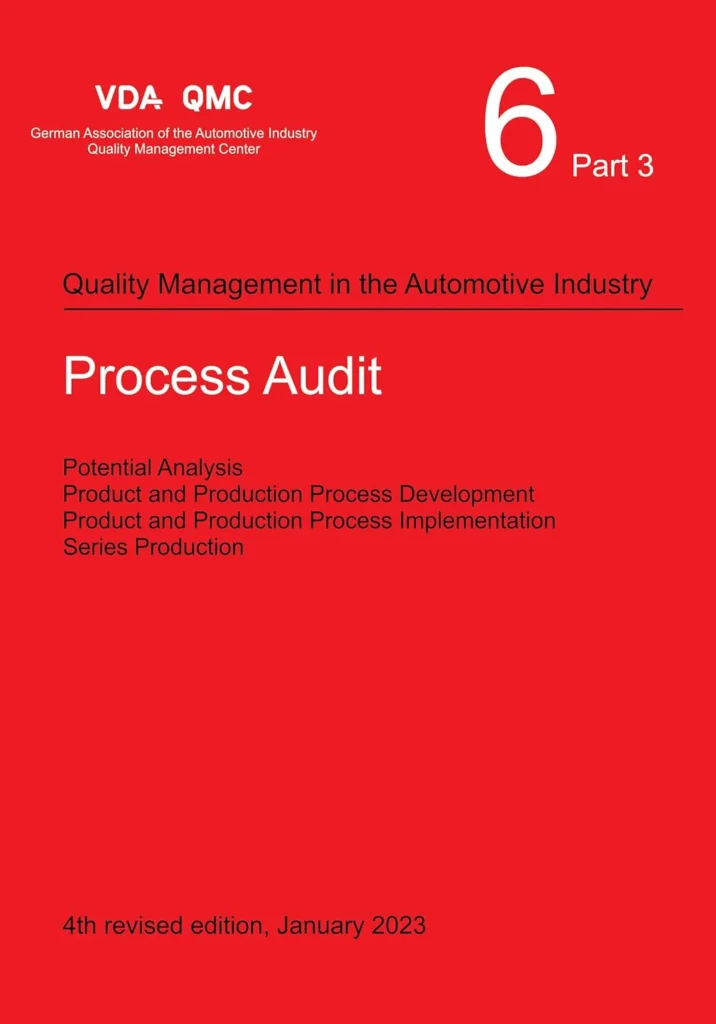
I strongly recommend the official VDA Volume 6 Part 3 : Process Audit, 4th Revised Edition for auditors working in automotive supplier quality.

What Is ISO 9001?

ISO 9001 is the world’s most widely accepted Quality Management System (QMS) standard. It is designed for all industries, including manufacturing, automotive, healthcare, logistics, software, and services.

The main purpose is to ensure that your company consistently delivers products and services that meet customer and regulatory requirements.

As a quality auditor, I usually explain ISO 9001 as the foundation of your quality house. It defines how leadership works, how risks are handled, how documents are controlled, how internal audits are conducted, and how corrective actions are managed. 

It is not limited to production alone; it covers the entire organization.

For example, if you run an automotive components manufacturing company in Bengaluru supplying brackets, fasteners, or plastic trims, ISO 9001 ensures that your purchasing, production, inspection, calibration, customer complaint handling, and CAPA system are all documented and controlled.

Some of the major focus areas include:

  • customer satisfaction
  • process approach
  • risk-based thinking
  • corrective actions
  • continuous improvement
  • internal audits
  • management review

According to ISO, over one million certificates globally are active, making it the most trusted QMS standard worldwide.

What Is VDA 6.3?

VDA 6.3 is a process audit standard specifically designed for the automotive industry. It was developed by the German automotive industry association and is heavily used by OEMs such as BMW, Mercedes-Benz, and Volkswagen supplier ecosystems.

Unlike ISO 9001, VDA 6.3 does not mainly focus on system-level documentation. Instead, it goes deeper into process effectiveness, production controls, supplier management, and operational risks.

This is where many people misunderstand the process audit standard comparison.

ISO asks:

“Do you have a quality system?”

VDA 6.3 asks:

“Is your manufacturing and supplier process capable of consistently delivering defect-free parts?”

That difference is massive.

For example, during a VDA 6.3 audit, I would review:

  • project management controls
  • product and process development
  • supplier quality controls
  • production readiness
  • serial production stability
  • rework and traceability
  • customer complaint closure
  • process risks

VDA 6.3 is highly practical and strongly linked to actual manufacturing performance.

VDA 6.3 vs ISO 9001 difference which one needed:

This is the most important section, and I want to explain it in the simplest way possible.

The biggest difference is that ISO 9001 is a management system standard, while VDA 6.3 is a process audit methodology.

ISO 9001 checks whether your organization has a documented system to manage quality. It is broad and applies to almost any business. VDA 6.3 goes into process-level questions and scoring to identify weak areas in manufacturing and supplier controls.

Let me explain with a practical example.

Imagine you manufacture steering column parts.

Under ISO 9001, the auditor checks whether you have:

  • documented procedures
  • internal audit records
  • training matrix
  • calibration controls
  • non-conformance procedure
  • CAPA records

Under VDA 6.3, the auditor checks:

  • whether PFMEA risks are reflected in controls
  • whether control plan matches actual inspection
  • whether reaction plans exist
  • whether machine capability is stable
  • whether supplier incoming quality is controlled
  • whether process deviations are escalated

This is why many professionals say VDA 6.3 beyond ISO 9001.

Because it truly goes beyond system documentation.

ISO 9001 vs VDA 6.3: Scope Comparison:

One of the biggest differences lies in scope.

ISO 9001 Scope:

ISO 9001 covers the entire organization.

This includes:

  • leadership
  • HR competency
  • procurement
  • operations
  • sales
  • customer support
  • internal audits
  • risk management

It is company-wide.

VDA 6.3 Scope:

VDA 6.3 covers product realization processes.

This includes:

  • APQP
  • design feasibility
  • process development
  • production launch
  • supplier quality
  • serial production
  • field feedback

This is why I always explain it as QMS audit vs process audit.

One is broad.

One is deep.

Read more from:

Real-World Example: Automotive Supplier Case

Let me give you a real-world style example.

A Tier 2 supplier manufacturing injection molded interior trims had ISO 9001 certification for 4 years. Their documentation was strong, internal audits were regular, and customer complaints were closed on time.

Still, they failed a customer supplier audit.

Why?

Because during the process audit, the auditor found:

  • mismatch between control plan and line inspection
  • operator instructions outdated
  • no escalation plan for mold variation
  • no process capability trend review
  • supplier resin lot traceability weak

This is exactly where automotive quality compliance depends on VDA 6.3.

The company had a good QMS.

But their actual process controls were weak.

That is the difference.

Which Industries Need ISO 9001?

ISO 9001 is useful for almost every industry.

Examples include:

  • automotive
  • aerospace
  • pharmaceuticals
  • hospitals
  • education
  • logistics
  • IT services
  • construction

Even non-manufacturing companies use it.

For example, a testing laboratory or SaaS company can still implement ISO 9001.

This is why it remains a universal standard.

Which Industries Need VDA 6.3?

VDA 6.3 is mainly needed in:

  • automotive OEM supply chain
  • Tier 1 suppliers
  • Tier 2 suppliers
  • component manufacturers
  • electronics for vehicles
  • EV battery manufacturing
  • metal stamping suppliers
  • injection molding suppliers

With EV growth in India and globally, this has become even more important in 2026.

Industry reports continue to show rising supplier audit requirements as OEMs tighten defect prevention expectations.

Read more from:

For more knowledge, you deep dive into the content from below references:

Detailed Comparison Table: ISO 9001 vs VDA 6.3

I explained the basic difference between ISO 9001 vs VDA 6.3 from a system and process perspective. In this section, I’ll go much deeper as a Quality Manager and auditor, so readers can clearly understand which one fits their business need, audit requirement, and customer expectation in 2026.

This part is especially important for companies dealing with automotive QMS standards, supplier development, customer audits, and process risk reduction.

Parameter

ISO 9001

VDA 6.3

Type

Quality Management System Standard

Process Audit Standard

Industry Use

All industries

Automotive industry

Primary Focus

System management

Process effectiveness

Certification

Yes, third-party certification

Usually audit assessment / customer requirement

Audit Type

System audit

Process audit

Scope

Entire organization

Product realization & manufacturing process

Risk Focus

Risk-based thinking

Process-specific risk prevention

Supplier Use

General supplier approval

Automotive supplier rating

Scoring

Pass / NC findings

A, B, C grading system

Customer Expectation

Baseline compliance

OEM supplier requirement

Documentation

QMS procedures & records

Process evidence & line controls

Best For

company-wide QMS

shop-floor process control

This difference is one of the most searched process audit standard comparison topics in quality management today.

Quality Management vs Process Audit: The Real Practical Difference

From my auditing experience, this is where most readers need real clarity.

ISO 9001 focuses on how the business is managed. It checks whether the organization has a structured method to plan, execute, monitor, and improve quality activities. 

The focus is on leadership involvement, process mapping, customer satisfaction, competence, internal audits, and CAPA systems. It is more strategic and system-driven.

VDA 6.3 focuses on whether the process itself is capable and stable. It goes to the production floor, supplier interface, launch planning, serial production, traceability, escalation controls, and process outputs. It is much more operational and evidence-based.

To explain it simply:

  • ISO 9001 = management system health
  • VDA 6.3 = process performance health

This is the core of QMS audit vs process audit.

Example: Same Company, Different Audit Lens

Let me explain this with a real-world example.

Suppose I am auditing a company that manufactures EV battery housing brackets for a Tier 1 automotive supplier.

Under ISO 9001, I would verify:

  • documented procedures
  • supplier evaluation method
  • calibration records
  • customer complaint process
  • training records
  • internal audit plan
  • management review minutes

Under VDA 6.3, I would check:

  • line setup verification
  • torque control process
  • operator skill validation
  • poka-yoke controls
  • PFMEA linkage
  • control plan execution
  • defect reaction flow
  • lot traceability

This is why many companies say VDA 6.3 beyond ISO 9001.

Because VDA goes far deeper into actual production effectiveness.

Audit Methodology: How the Two Standards Are Audited?

This section is critical for readers preparing for certification or customer audits.

ISO 9001 Audit Method

ISO 9001 is usually audited through:

  • Stage 1 audit
  • Stage 2 certification audit
  • surveillance audits
  • recertification every 3 years

The auditor checks clause compliance and objective evidence.

Typical clauses reviewed:

  • context of organization
  • leadership
  • planning
  • support
  • operations
  • performance evaluation
  • improvement

This follows a formal certification route.

Industry data continues to show more than 1.2 million active certificates globally, making it a strong business credibility standard.

VDA 6.3 Audit Method:

VDA 6.3 follows a scoring methodology.

Each process element is scored, commonly across:

  • P1 Project Management
  • P2 Product & Process Development
  • P3 Supplier Management
  • P4 Production Planning
  • P5 Production Execution
  • P6 Customer Support
  • P7 Improvement Process

Scores are then classified into:

  • A Grade = strong compliance
  • B Grade = conditional acceptance
  • C Grade = unacceptable

This scoring system is extremely useful for process performance monitoring and supplier development.

Documentation Requirements Comparison:

This is one of the biggest concerns for quality teams.

ISO 9001 Documentation

ISO 9001 requires strong documented information.

Typical documents include:

  • quality manual (if maintained)
  • SOPs
  • work instructions
  • process maps
  • risk registers
  • audit reports
  • CAPA forms
  • management review records

The documentation structure supports system control.

VDA 6.3 Documentation:

VDA 6.3 requires process evidence, not just procedures.

Examples include:

  • PFMEA
  • control plans
  • reaction plans
  • capability studies
  • inspection records
  • layered process audits
  • traceability records
  • supplier PPAP evidence

This is far more evidence-driven.

As an auditor, I always tell teams:

Documents must match what actually happens on the line.

That is where many suppliers fail.

Supplier Quality and Customer Approval:

For supplier quality, this difference becomes business-critical.

A company may be ISO 9001 certified and still lose customer approval if process controls are weak.

German OEM ecosystems and many Tier 1 suppliers increasingly use VDA 6.3 for supplier evaluation and ongoing monitoring.

Examples include requirements for:

  • launch readiness audits
  • process release audits
  • annual supplier assessments
  • escalation audits after complaints

This directly impacts automotive quality compliance.

Recommended Reference Materials and Audit Resources:

For professionals wanting to perform stronger audits, these references are extremely useful:

I strongly recommend the official VDA Volume 6 Part 3 : Process Audit, 4th Revised Edition for auditors working in automotive supplier quality.

Statistics and Industry Trends for 2026:

In 2026, supplier audits are becoming more process-driven.

Based on industry trends and automotive audit discussions, organizations are increasingly moving beyond certification-only compliance and focusing on actual operational performance evidence.

Some common findings I continue to see include:

  • documented systems not followed
  • process capability not monitored
  • weak reaction plans
  • poor traceability
  • PFMEA not linked to control plan

This is why customer-specific audits are increasing.

Which One Is Better for Small vs Large Companies?

Here is a clear differentiation between small companies and large automotive suppliers:

Small Companies:

For small manufacturers, start with ISO 9001.

It builds the discipline for:

  • documentation
  • audits
  • customer confidence
  • structured improvement

Without this, VDA 6.3 implementation becomes difficult.

Large Automotive Suppliers:

For automotive suppliers, especially Tier 1 and Tier 2, both are usually needed.

Best practice:

  • ISO 9001 = base QMS
  • VDA 6.3 = process assurance

This is the best model for ISO 9001 and VDA integration.

Which One Do You Actually Need in 2026?
- Expert Guidance, Roadmap, Costs, and Recommendation

Now we come to the most important part of this article.

As a Quality Manager, Certified Auditor, and QA/QC expert, this is the exact question clients ask me during supplier onboarding, certification planning, and customer audit preparation:

“Which one do we actually need — ISO 9001, VDA 6.3, or both?”

The answer depends entirely on your industry, customer requirements, and business growth plans.

By 2026, more than one million certificates remain active across 189 countries, making International Organization for Standardization ISO 9001 the most widely used quality standard globally.

At the same time, VDA 6.3 continues to be a major expectation across automotive OEM and supplier networks, especially where German automotive customers are involved.

This is where I want to guide readers with a practical decision framework.

If You Are a General Manufacturing or Service Company:

If your business is not directly supplying automotive OEMs or Tier 1 suppliers, ISO 9001 should be your first priority.

This includes companies in:

  • industrial manufacturing
  • precision machining
  • electronics assembly
  • healthcare products
  • testing labs
  • software services
  • logistics
  • construction support services

ISO 9001 gives you a complete quality management framework.

It helps establish:

  • documented processes
  • internal audit system
  • corrective action workflow
  • management review
  • customer complaint controls
  • supplier evaluation
  • process KPIs

This is the foundation of quality management vs process audit.

Without this system base, operational improvements become difficult.

If You Are an Automotive Supplier:

If you supply parts, assemblies, components, tools, or services to the automotive industry, especially German OEM ecosystems, then VDA 6.3 is often essential in addition to ISO 9001.

This is especially true for:

  • Tier 1 suppliers
  • Tier 2 suppliers
  • EV component manufacturers
  • battery pack suppliers
  • molded plastic suppliers
  • metal stamping suppliers
  • electronics suppliers

Customers may specifically request:

  • process audit reports
  • supplier process capability
  • launch readiness audits
  • VDA scoring evidence
  • risk mitigation plans

This is where automotive QMS standards go beyond basic certification.

My Professional Recommendation: In Most Automotive Cases, You Need Both

This is the most practical answer.

I rarely advise automotive suppliers to choose only one.

The best approach is:

  • ISO 9001 = management system foundation
  • VDA 6.3 = process control and customer confidence

This creates strong ISO 9001 and VDA integration.

Think of it this way:

ISO 9001 helps you build the system.

VDA 6.3 proves that the system works on the line.

That difference matters during supplier audits.

Cost and Implementation Timeline in 2026:

This is a question many business owners ask.

ISO 9001 Typical Timeline:

For small to mid-sized companies:

  • 2 to 4 months for documentation
  • 1 month for implementation
  • 1 month for internal audits and corrections
  • certification in 4 to 6 months

Larger companies may take 6 to 9 months.

VDA 6.3 Typical Timeline:

VDA implementation depends on process maturity.

Typical preparation:

  • 1 to 2 months for gap assessment
  • 2 to 3 months for PFMEA / control plan alignment
  • 1 to 2 months for line stabilization
  • supplier process audits
  • internal VDA audit readiness

Typical total: 3 to 6 months

In weak systems, this may take longer.

Read more from:

Common Mistakes Companies Make:

This section is very important for readers.

I repeatedly see these mistakes.

Mistake 1: Treating ISO as a Certificate Only

Many companies focus only on passing the audit.

They prepare documents for certification but do not use them in daily operations.

This creates audit findings later.

As many quality professionals openly discuss, the biggest risk is when the system exists on paper but not in culture.

Mistake 2: Poor Shop Floor Alignment

This is a major VDA 6.3 issue.

Examples:

  • SOP says 100% inspection
  • line operator checks only samples
  • control plan not updated
  • PFMEA risk not reflected in process controls

This leads to poor process performance monitoring.

Mistake 3: Weak Supplier Controls

For automotive companies, weak supplier quality is one of the biggest risks.

Examples include:

  • no supplier audits
  • no incoming lot traceability
  • no escalation matrix
  • no supplier CAPA follow-up

This directly impacts automotive quality compliance.

Expert Tips From My Auditor Experience:

As someone who has worked with manufacturing and supplier audits, here is my honest recommendation.

Start With These 5 Steps:

  • build process map
  • define measurable KPIs
  • link PFMEA to control plan
  • perform internal audits
  • conduct line verification checks

This creates strong alignment between QMS audit vs process audit.

Which One Should You Choose?

Choose ISO 9001 if you need a company-wide quality management system for certification, process control, and customer confidence.

Choose VDA 6.3 if you are in the automotive supply chain and need process-level audit evidence for OEM or Tier supplier approval.

Choose both if you are an automotive manufacturer or supplier.

This answer is the most search-intent aligned result for 2026.

Final Conclusion:

If I had to guide a company in one sentence, I would say this:

ISO 9001 tells customers that you have a quality system. VDA 6.3 proves that your production and supplier processes are actually capable.

That is the real difference.

For general industries, start with ISO 9001.

For automotive suppliers, use both.

This gives the strongest quality and customer trust position in 2026.

Frequently Asked Questions (FAQs)

1. What is the main difference between VDA 6.3 and ISO 9001?

The main difference is that ISO 9001 is a quality management system (QMS) standard, while VDA 6.3 is a process audit standard mainly used in the automotive industry. ISO 9001 focuses on how the entire organization manages quality, customer satisfaction, leadership, risks, and continuous improvement. 

In contrast, VDA 6.3 checks how well specific manufacturing and supplier processes perform in real working conditions. From my auditing experience, I often explain it simply as system audit vs process audit.

Quick difference:

  • ISO 9001 = company-wide quality system
  • VDA 6.3 = process-level operational audit
  • ISO 9001 = all industries
  • VDA 6.3 = automotive-focused

2. Do automotive companies need both ISO 9001 and VDA 6.3?

In most automotive cases, yes, companies need both. ISO 9001 provides the basic structure for quality management, documentation, internal audits, and corrective action systems. 

VDA 6.3 adds a deeper layer by evaluating process capability, supplier controls, production readiness, and defect prevention on the shop floor. Many OEMs and Tier 1 suppliers expect evidence of process audits beyond system certification, which is why both standards are commonly used together.

This combined approach gives stronger automotive quality compliance and supplier approval confidence.

3. Is ISO 9001 enough for automotive suppliers?

For small suppliers or companies entering the market, ISO 9001 may be enough initially. However, if you are supplying to German OEMs, Tier 1 suppliers, or high-risk automotive programs, customers may require VDA 6.3 process audits in addition to ISO certification. 

ISO alone proves you have a management system, but it may not be sufficient to demonstrate real process control maturity. In practice, many customer-specific requirements go beyond ISO 9001.

This is where VDA 6.3 goes beyond ISO 9001.

4. Which is better for quality improvement: ISO 9001 or VDA 6.3?

This depends on the type of improvement you need.

If your company needs better systems, documentation, complaint handling, and internal controls, ISO 9001 is the better starting point. If your issue is shop floor quality, line defects, supplier variation, process capability, or launch failures, VDA 6.3 is more effective.

I usually recommend:

  • ISO 9001 for system improvement
  • VDA 6.3 for process improvement

Using both creates the best long-term improvement strategy.

5. Can a non-automotive company use VDA 6.3?

Yes, it can, although it is primarily designed for automotive process audits. In recent years, many companies in mechanical engineering, industrial manufacturing, and complex production environments have started using VDA 6.3 as a process audit tool. 

It is especially useful where process risks, traceability, and defect prevention are critical. The methodology can still add value outside automotive when adapted properly.

For example:

  • heavy engineering
  • precision machining
  • industrial electronics
  • wind energy component manufacturing

6. Is VDA 6.3 a certification like ISO 9001?

Not in the same way.

ISO 9001 is a formal third-party certification standard where accredited certification bodies issue certificates. VDA 6.3 is usually used as an audit and scoring methodology for internal process audits, supplier audits, and customer process assessments.

Instead of a standard certificate, VDA 6.3 often uses grades such as:

  • A = strong compliance
  • B = acceptable with actions
  • C = unacceptable

This grading system helps customers assess supplier process maturity.

7. Which standard should a startup manufacturing company choose first?

For a startup or growing manufacturing company, I strongly recommend starting with ISO 9001 first. It helps build process discipline, defined responsibilities, quality objectives, document control, and corrective action workflows. 

Once the system becomes stable and customer requirements increase, VDA 6.3 can be added for deeper process assurance.

This staged approach is practical and cost-effective.

Recommended roadmap:

  • Step 1: ISO 9001
  • Step 2: process KPIs
  • Step 3: VDA 6.3 readiness
  • Step 4: supplier process audits

8. How long does it take to implement ISO 9001 and VDA 6.3?

The timeline depends on company size and process maturity.

For ISO 9001, most organizations take around 3 to 6 months for implementation and certification. For VDA 6.3, preparation may take 2 to 6 months, depending on how mature the production and supplier processes already are.

Typical influencing factors include:

  • documentation readiness
  • process controls
  • PFMEA and control plan linkage
  • internal audit capability
  • customer requirements

9. Does VDA 6.3 replace ISO 9001?

No, VDA 6.3 does not replace ISO 9001.

This is one of the most common misunderstandings.

ISO 9001 creates the quality management system foundation, while VDA 6.3 evaluates how well the manufacturing and supplier processes are actually performing. They are complementary standards, not replacements.

I always explain it this way:

ISO builds the framework, VDA tests the process reality.

10. Which standard is more important for customer audits in 2026?

For general industries, ISO 9001 remains the most important standard because it is globally recognized and customer-friendly.

For automotive suppliers, however, VDA 6.3 is becoming increasingly critical for supplier audits, launch approvals, and process risk management in 2026.

Many customers now expect both:

  • ISO 9001 for certification
  • VDA 6.3 for process assurance

This is especially true for EV, electronics, and Tier supplier ecosystems.

This Page uses Affiliate Links. When you Click an Affiliate Link, we get a small compensation at no cost to you. Our Affiliate Disclosure for more info.

Leave a comment